Infectious coryza
Nasal discharge, conjuctivitis, sinusitis with odema of the
face,
Cheesy exudates- catarrhal inflammation of the infra orbital sinus
TEME-Thrombo embolic
meningo encephalitis
 fever and stiff gait
 progresses to paresis and
paralysis.
Opisthotonus and convulsions
pneumonia-rare
Embolic pneumonia
Multifocal haemorrhage and necrosis
Intense vasculitis (V) with extension of the purulent
inflammation (P) into the surrounding parenchyma.
Glassers Disease
Acute septicamia -typical GD
Pleuritis & fibrin deposits
Pericarditis with fibrin deposits
Haemophilus
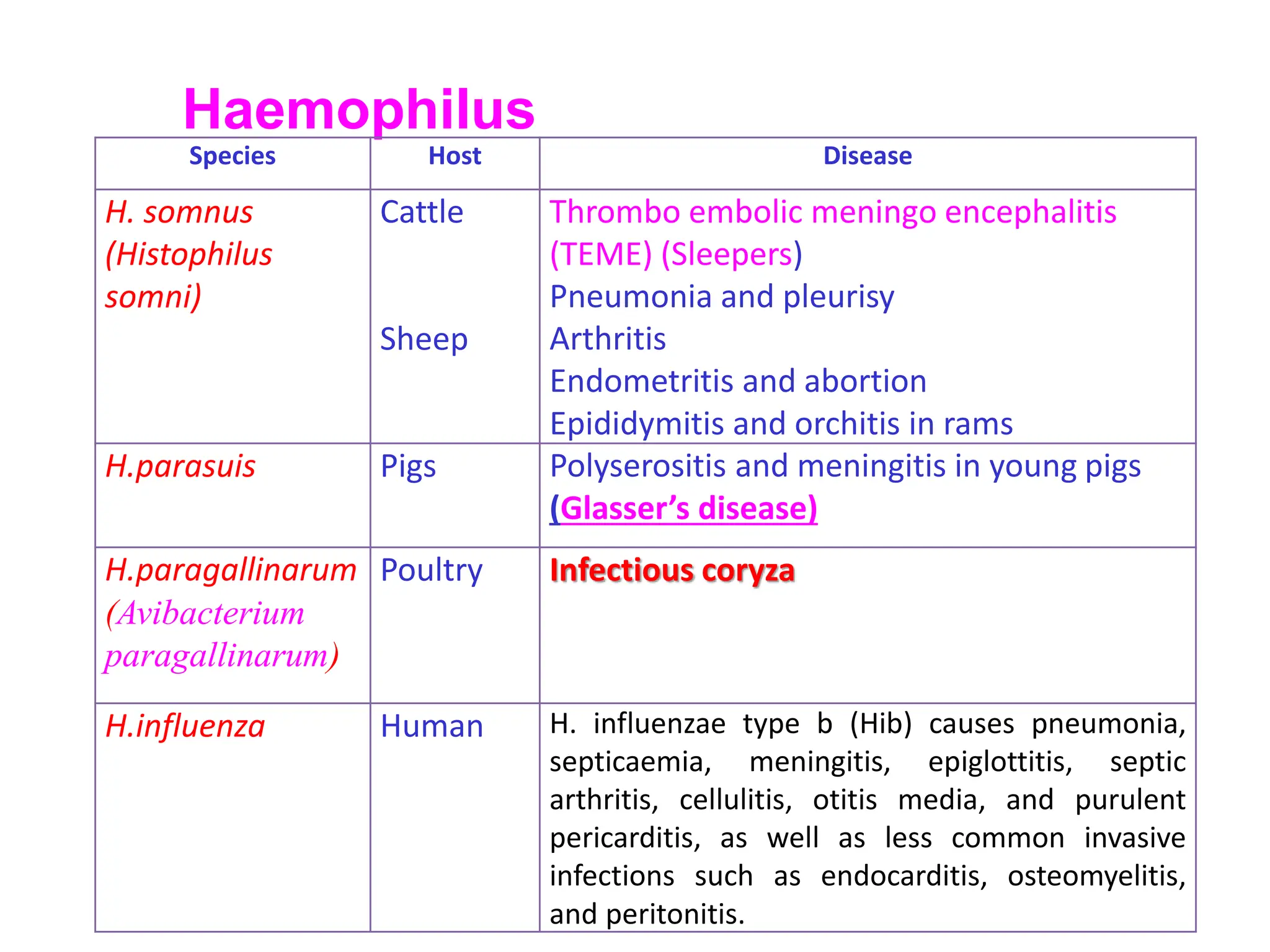
Species Host Disease
H. somnus
(Histophilus
somni)
Cattle
Sheep
Thrombo embolic meningo encephalitis
(TEME) (Sleepers)
Pneumonia and pleurisy
Arthritis
Endometritis and abortion
Epididymitis and orchitis in rams
H.parasuis Pigs Polyserositis and meningitis in young pigs
(Glasser’s disease)
H.paragallinarum
(Avibacterium
paragallinarum)
Poultry Infectious coryza
H.influenza Human H. influenzae type b (Hib) causes pneumonia,
septicaemia, meningitis, epiglottitis, septic
arthritis, cellulitis, otitis media, and purulent
pericarditis, as well as less common invasive
infections such as endocarditis, osteomyelitis,
and peritonitis.
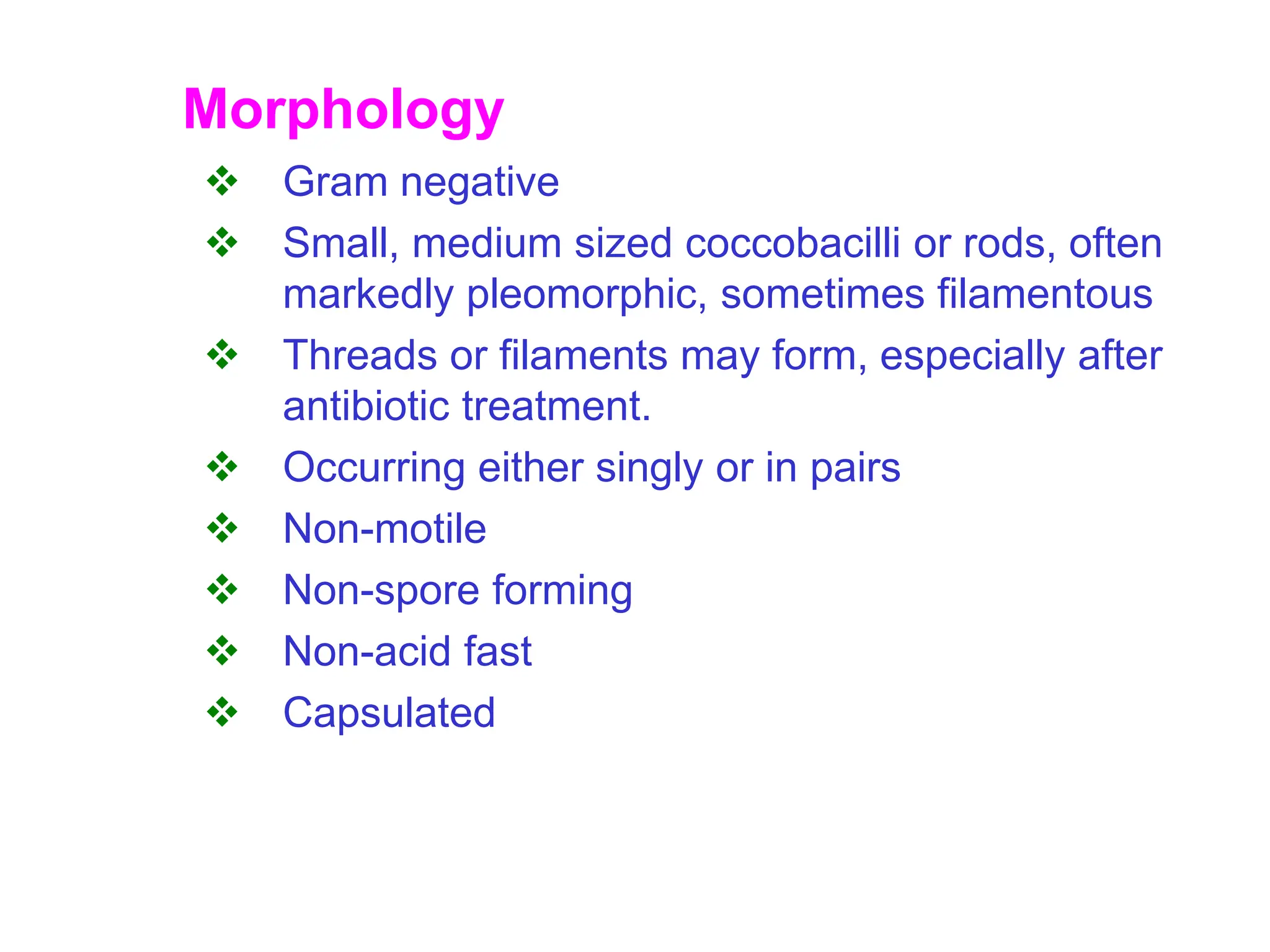
Morphology
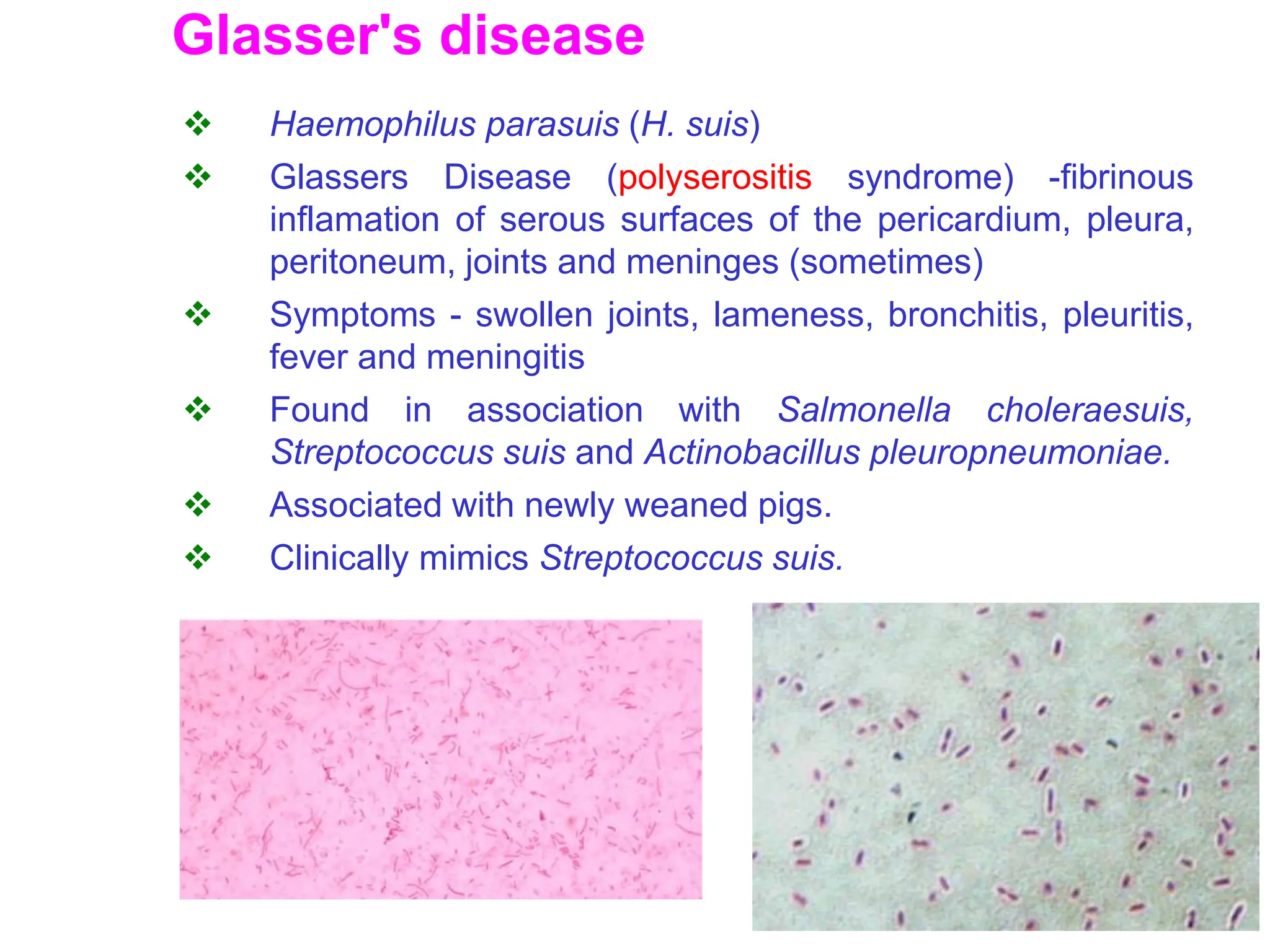
 Gram negative
 Small, medium sized coccobacilli or rods, often
markedly pleomorphic, sometimes filamentous
 Threads or filaments may form, especially after
antibiotic treatment.
 Occurring either singly or in pairs
 Non-motile
 Non-spore forming
 Non-acid fast
 Capsulated
Cultural characteristics
 aerobic and facultatively anaerobic.
 optimum temp.- 37°C.
 nutritionally fastidious
 not grow on nutrient agar and MacConkey agar.
 X factor is a heat stable iron-porphyrin-haematin or other
haemins. Necessary for the synthesis of catalase and
other enzymes involved in aerobic respiration.
 V factor is a heat labile factor, present in RBC’s and in
many other animal and plant cells. Synthesized by fungi
and some bacteria ( eg: Staphylococcus aureus).
 V factor can be supplied as co-enzyme I, NAD
(nicotinamide adenine dinucleotide), or NADP+. Act as a
hydrogen acceptor in the metabolism of the cell.
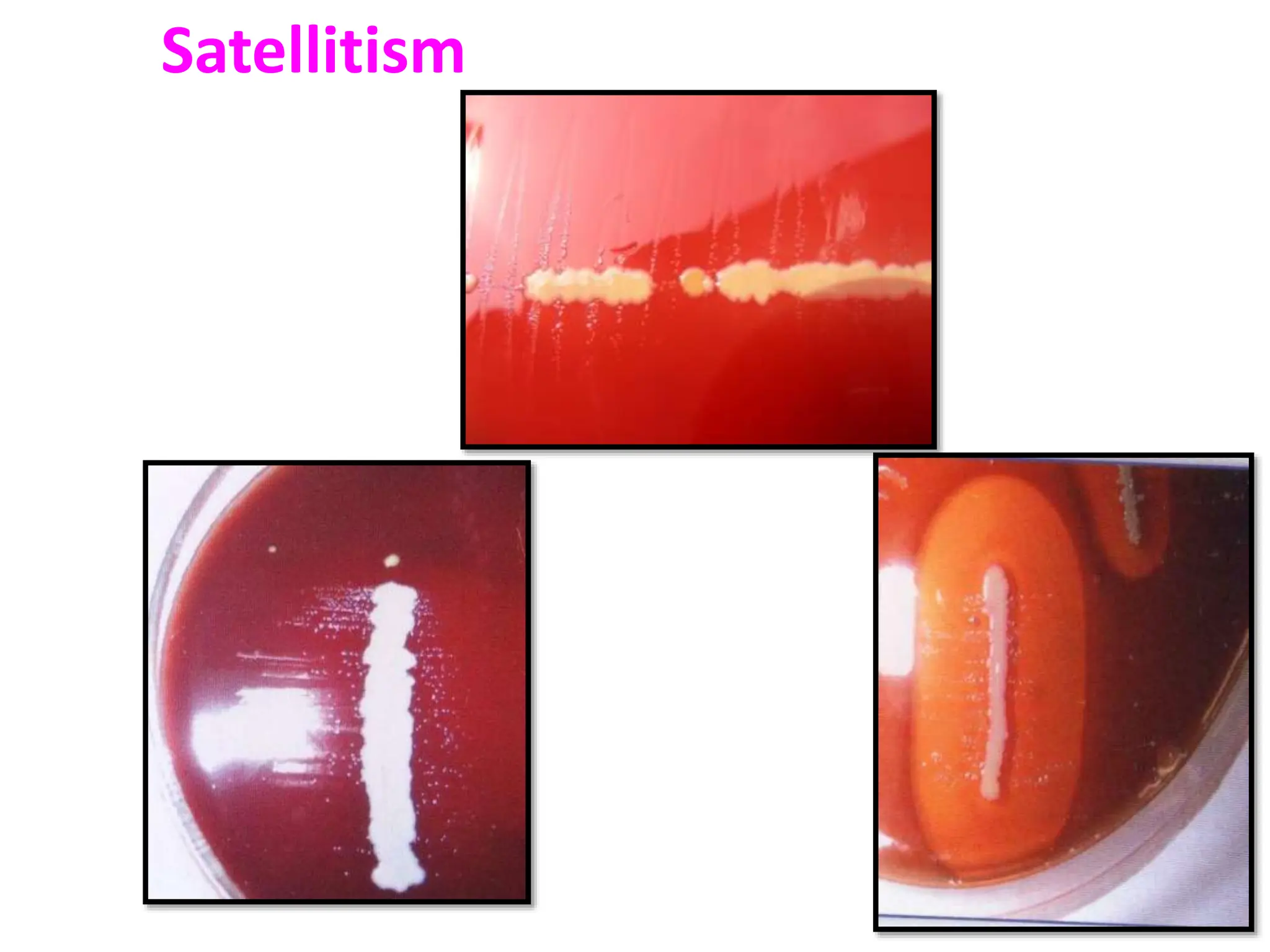
 Staphylococcus aureus is streaked across a plate
of blood agar on which a specimen containing
Haemophilus has been inoculated.
 After 18-24hrs incubation at 37°C under 5-10%
Co2, the colonies of the Haemophilus will be
large, well developed alongside the streak of
Staphylococcus, and smaller farther away.
 Satellitism - demonstrate the dependence of
Haemophilus on V factor, which is available in
high concentration near the staphylococcal growth
and only in smaller quantities away from it.
Satellitism
Satellitism
Species X factor V factor
H. influenzae + +
H. aegyptius + +
H.parasuis - +
H.paragallinarum - +
H.parinfluenzae - +
H.somnus - -
X and V factors must be supplied for all the Haemophilus species
except H.somnus.
Cultural characteristics Contd..
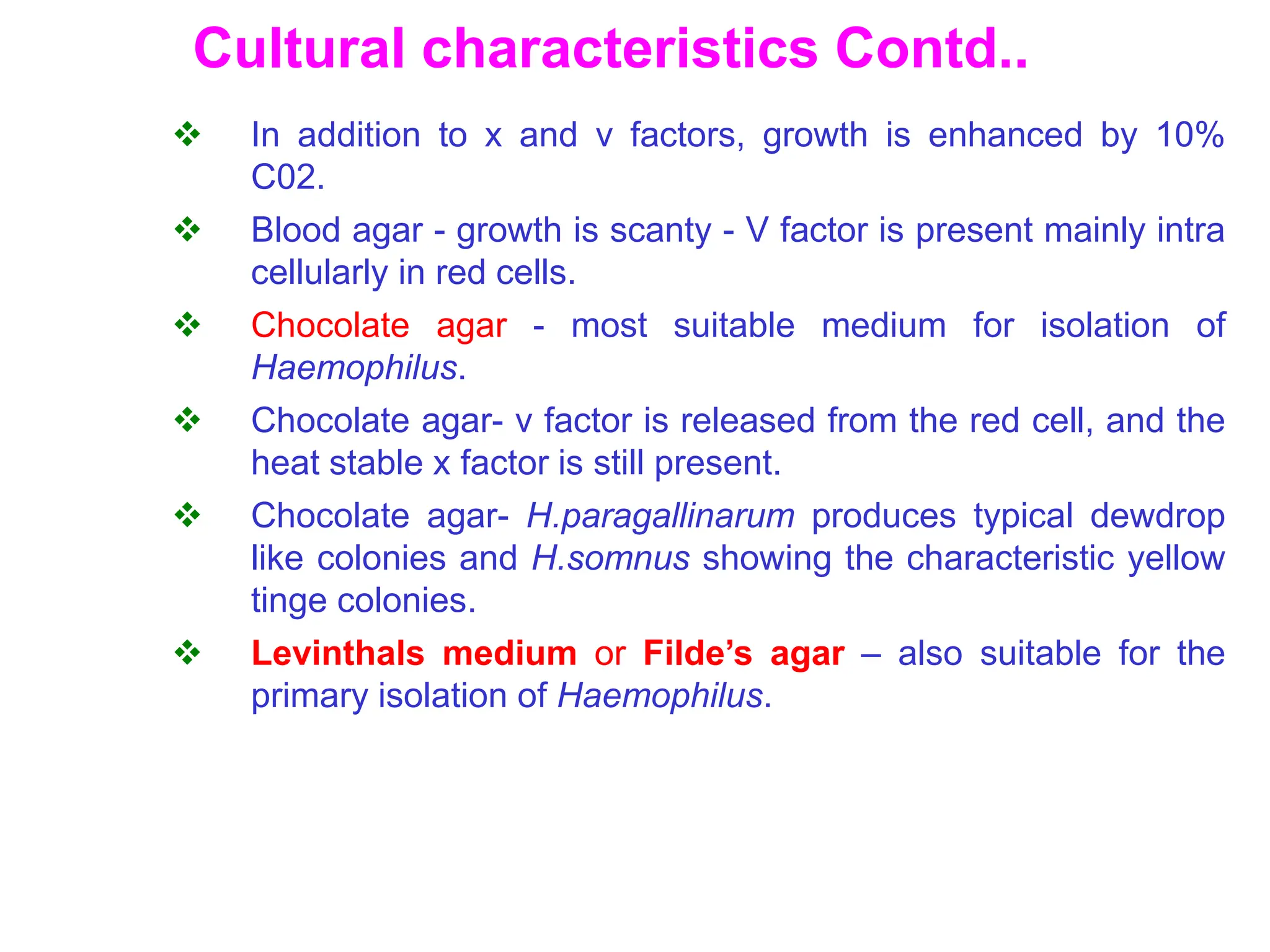
 In addition to x and v factors, growth is enhanced by 10%
C02.
 Blood agar - growth is scanty - V factor is present mainly intra
cellularly in red cells.
 Chocolate agar - most suitable medium for isolation of
Haemophilus.
 Chocolate agar- v factor is released from the red cell, and the
heat stable x factor is still present.
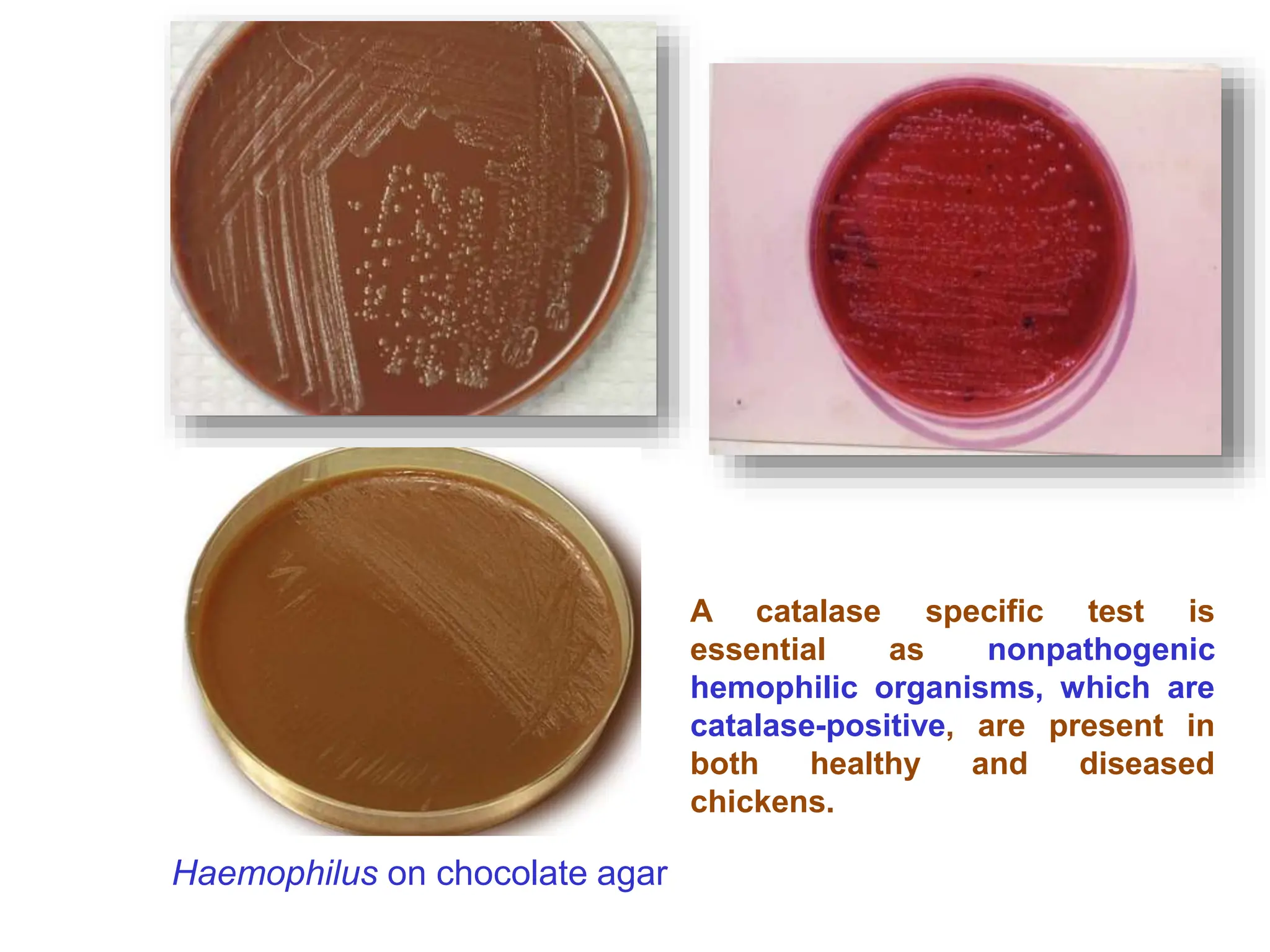
 Chocolate agar- H.paragallinarum produces typical dewdrop
like colonies and H.somnus showing the characteristic yellow
tinge colonies.
 Levinthals medium or Filde’s agar – also suitable for the
primary isolation of Haemophilus.
Cultural characteristics Contd..
Haemophilus on chocolate agar
A catalase specific test is
essential as nonpathogenic
hemophilic organisms, which are
catalase-positive, are present in
both healthy and diseased
chickens.
Resistance
 very fragile.
 Readily destroyed by heating (55°C for
30mts), refrigeration (0°C to 4°C), drying and
disinfectants.
 In cultures, cells die within 2 to 3 days due to
autolysis.
 Lyophilization for long-term preservation.
Habitat
 Commensals or parasites of the mucous membranes of
humans, pigs, fowl, dogs cattle, rats, mice, deer, sheep,
guinea pigs, ferrets.
 Most commonly - upper respiratory and lower genital tracts.
 H.somnus - bacterial flora of the male and female bovine
genital tract.
 H.paragallinarum - upper respiratory tract and sinuses of
sick or recovered birds.
 Transmission - generally via respiratory route
 Absolutely host-specific - obtain iron only from iron-bound
proteins of their natural host
(e.g. H. somnus can utilize iron from bovine transferrin, but
not transferrin from any other host).
 Caused by H. Paragallinarum ( Avibacterium paragallinarum)
 Poultry are the only hosts
 Three recognized serogroups A, B, and C
 Nine currently recognized Kume serovars (HI test) are
termed A-1, A-2, A-3, A-4, B-1, C-1, C-2, C-3, and C-4.
 Requires V factor, but not X factor
 Oxidase negative and catalase negative
 Serious and widespread disease of chickens
 Respiratory transmission & contaminated water
 Clinical signs: inflammation of the turbinates and sinus
epithelium, disruption of the turbinates, and acute air
sacculitis.
 Chicken are primarily infected; turkeys and pigeons are
resistant to infection.
 Infection severe following viral or Mycoplasma infection.
Infectious coryza
 Haemophilus parasuis (H. suis)
 Glassers Disease (polyserositis syndrome) -fibrinous
inflamation of serous surfaces of the pericardium, pleura,
peritoneum, joints and meninges (sometimes)
 Symptoms - swollen joints, lameness, bronchitis, pleuritis,
fever and meningitis
 Found in association with Salmonella choleraesuis,
Streptococcus suis and Actinobacillus pleuropneumoniae.
 Associated with newly weaned pigs.
 Clinically mimics Streptococcus suis.
Glasser's disease
 Susceptible to gentamicin, tetracycline,
sulfonamides, chloramphenicol, neomycin
and erythromycin.
 Vaccines prepared from H.paragallinarum
grown in egg yolk, if inoculated
intramuscularly reduces the incidence of
infectious coryza.
Treatment

Haemophilus.ppt BACTERIOLOGY Haemophilus

  • 1.
    Infectious coryza Nasal discharge,conjuctivitis, sinusitis with odema of the face,
  • 2.
    Cheesy exudates- catarrhalinflammation of the infra orbital sinus
  • 3.
    TEME-Thrombo embolic meningo encephalitis fever and stiff gait  progresses to paresis and paralysis. Opisthotonus and convulsions pneumonia-rare Embolic pneumonia
  • 4.
    Multifocal haemorrhage andnecrosis Intense vasculitis (V) with extension of the purulent inflammation (P) into the surrounding parenchyma.
  • 5.
    Glassers Disease Acute septicamia-typical GD Pleuritis & fibrin deposits Pericarditis with fibrin deposits
  • 6.
    Haemophilus Species Host Disease H.somnus (Histophilus somni) Cattle Sheep Thrombo embolic meningo encephalitis (TEME) (Sleepers) Pneumonia and pleurisy Arthritis Endometritis and abortion Epididymitis and orchitis in rams H.parasuis Pigs Polyserositis and meningitis in young pigs (Glasser’s disease) H.paragallinarum (Avibacterium paragallinarum) Poultry Infectious coryza H.influenza Human H. influenzae type b (Hib) causes pneumonia, septicaemia, meningitis, epiglottitis, septic arthritis, cellulitis, otitis media, and purulent pericarditis, as well as less common invasive infections such as endocarditis, osteomyelitis, and peritonitis.
  • 7.
    Morphology  Gram negative Small, medium sized coccobacilli or rods, often markedly pleomorphic, sometimes filamentous  Threads or filaments may form, especially after antibiotic treatment.  Occurring either singly or in pairs  Non-motile  Non-spore forming  Non-acid fast  Capsulated
  • 8.
    Cultural characteristics  aerobicand facultatively anaerobic.  optimum temp.- 37°C.  nutritionally fastidious  not grow on nutrient agar and MacConkey agar.  X factor is a heat stable iron-porphyrin-haematin or other haemins. Necessary for the synthesis of catalase and other enzymes involved in aerobic respiration.  V factor is a heat labile factor, present in RBC’s and in many other animal and plant cells. Synthesized by fungi and some bacteria ( eg: Staphylococcus aureus).  V factor can be supplied as co-enzyme I, NAD (nicotinamide adenine dinucleotide), or NADP+. Act as a hydrogen acceptor in the metabolism of the cell.
  • 9.
     Staphylococcus aureusis streaked across a plate of blood agar on which a specimen containing Haemophilus has been inoculated.  After 18-24hrs incubation at 37°C under 5-10% Co2, the colonies of the Haemophilus will be large, well developed alongside the streak of Staphylococcus, and smaller farther away.  Satellitism - demonstrate the dependence of Haemophilus on V factor, which is available in high concentration near the staphylococcal growth and only in smaller quantities away from it. Satellitism
  • 10.
  • 11.
    Species X factorV factor H. influenzae + + H. aegyptius + + H.parasuis - + H.paragallinarum - + H.parinfluenzae - + H.somnus - - X and V factors must be supplied for all the Haemophilus species except H.somnus. Cultural characteristics Contd..
  • 12.
     In additionto x and v factors, growth is enhanced by 10% C02.  Blood agar - growth is scanty - V factor is present mainly intra cellularly in red cells.  Chocolate agar - most suitable medium for isolation of Haemophilus.  Chocolate agar- v factor is released from the red cell, and the heat stable x factor is still present.  Chocolate agar- H.paragallinarum produces typical dewdrop like colonies and H.somnus showing the characteristic yellow tinge colonies.  Levinthals medium or Filde’s agar – also suitable for the primary isolation of Haemophilus. Cultural characteristics Contd..
  • 13.
    Haemophilus on chocolateagar A catalase specific test is essential as nonpathogenic hemophilic organisms, which are catalase-positive, are present in both healthy and diseased chickens.
  • 14.
    Resistance  very fragile. Readily destroyed by heating (55°C for 30mts), refrigeration (0°C to 4°C), drying and disinfectants.  In cultures, cells die within 2 to 3 days due to autolysis.  Lyophilization for long-term preservation.
  • 15.
    Habitat  Commensals orparasites of the mucous membranes of humans, pigs, fowl, dogs cattle, rats, mice, deer, sheep, guinea pigs, ferrets.  Most commonly - upper respiratory and lower genital tracts.  H.somnus - bacterial flora of the male and female bovine genital tract.  H.paragallinarum - upper respiratory tract and sinuses of sick or recovered birds.  Transmission - generally via respiratory route  Absolutely host-specific - obtain iron only from iron-bound proteins of their natural host (e.g. H. somnus can utilize iron from bovine transferrin, but not transferrin from any other host).
  • 16.
     Caused byH. Paragallinarum ( Avibacterium paragallinarum)  Poultry are the only hosts  Three recognized serogroups A, B, and C  Nine currently recognized Kume serovars (HI test) are termed A-1, A-2, A-3, A-4, B-1, C-1, C-2, C-3, and C-4.  Requires V factor, but not X factor  Oxidase negative and catalase negative  Serious and widespread disease of chickens  Respiratory transmission & contaminated water  Clinical signs: inflammation of the turbinates and sinus epithelium, disruption of the turbinates, and acute air sacculitis.  Chicken are primarily infected; turkeys and pigeons are resistant to infection.  Infection severe following viral or Mycoplasma infection. Infectious coryza
  • 17.
     Haemophilus parasuis(H. suis)  Glassers Disease (polyserositis syndrome) -fibrinous inflamation of serous surfaces of the pericardium, pleura, peritoneum, joints and meninges (sometimes)  Symptoms - swollen joints, lameness, bronchitis, pleuritis, fever and meningitis  Found in association with Salmonella choleraesuis, Streptococcus suis and Actinobacillus pleuropneumoniae.  Associated with newly weaned pigs.  Clinically mimics Streptococcus suis. Glasser's disease
  • 18.
     Susceptible togentamicin, tetracycline, sulfonamides, chloramphenicol, neomycin and erythromycin.  Vaccines prepared from H.paragallinarum grown in egg yolk, if inoculated intramuscularly reduces the incidence of infectious coryza. Treatment