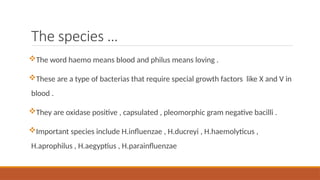
The species …
Theword haemo means blood and philus means loving .
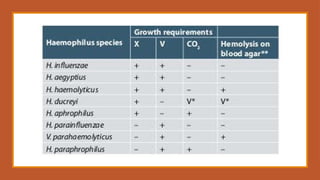
These are a type of bacterias that require special growth factors like X and V in
blood .
They are oxidase positive , capsulated , pleomorphic gram negative bacilli .
Important species include H.influenzae , H.ducreyi , H.haemolyticus ,
H.aprophilus , H.aegyptius , H.parainfluenzae
4.
H.Influenzae
Pfeiffer in 1892observed small bacilli in sputum of patients during influenzae
pandemic .
It was mistaken for agent of human influenzae .
Later renamed by pfeiffer .
The difference between the virus and bacteria finally ended as Smith ,Andrew
and Ladlow isolated the virus in 1933.
5.
Morphology
They are nonmotile , non sporing , non capsulated gram negative bacilli .
In sputum samples it is often found as cocccobacilliary form and in csf as bacilli
.
In acute infections it is found to be capsulated .
In older cultures it is found to be pleomorphic .
6.
Cultural and biochemicalsproperties
it is highly fastidious and requires factor X and V in blood .
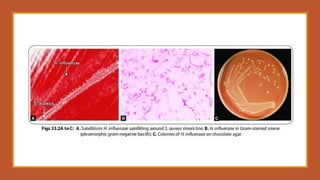
Sattelitism can be observed on blood agar. It grows well on chocolate agar .
Fildes and levinthals agar can be used .
Haemophilus selective agar with bacitracin is also used .
Glucose and xylose are fermented with acid production and not lactose and
sucrose .
7.
Reduces nitrates ,is catalase positive and oxidase positive .
Eight biotypes are identified to produce indole , urease and ornithine .
8.
Resistance
A delicate bacteriumdestroyed at 55 degree for 30 mins .
Refrigeration at 4 degrees .
Cultures they die in 2 days due to autolysis .
Long term preservation should be done using lyophilization .
9.
Growth requirements
Factor X– heat stable hemins or porphyrins required for production of
cytochrome catalase and peroxidase .
Factor V – heat labile nicotinamide adenine dinucleotide . It is produced by
staphylococcus also ,it was named as NAD as it was first thought o be a vitamin .
Gets inactivated by NADase .
10.
Growth variations
Nutreint agarand peptone water is not preferred for growth.
Growth is scanty on blood agar because only factor X is available in blood agar .
Sheep blood used contains NADase which destroys factor V .
On chocolate agar NADase is inactivated and excess factor V is released from
RBC lysis , hence best for growth
11.
Serotyping
Based on polysaccharidethere are 6 serotypes .
Hib is the most virulent type .
Its capsule is made up of polyribosyl ribitol phosphate , and is strongly
immunogenic .
H.influenzae is the first free living organism whose entire genome was
sequenced .
12.
Virulence factors
Capsular polysaccharideis important as it inhibits phagocytosis .
Based on this it is classified by pitmann into 6 capsular types a-f.
Typing was originally by quelling reaction CIE , ELISA .
Medically important types include 95 % of isolate from active infection in
meningitis include type b .
13.
Type b hasa unique structure of pentose structure instead of hexose and
hexamines .
Endotoxin causes immune response .
Omp is are also employed . And based on this 13 subtypes are there
igA1 protease inactivate igA1 on mucosal protease .
Pili and other adhesion proteins help in colonization on mucosal surface ,.
14.
Pathogenicity
it is exclusivelya human pathogen , but high doses intraperitonealy for mouses
etc. can prove fatal .
Diseases may be considered under two groups –invasive and non invasive .
The bacteria spreads through blood protected by capsule and cause meningitis
etc. also local invasions on mucosal surfaces and cause secondary infections .
15.
Clinical manifestations
Hib isthe most common invasive type of H.influenzae .
Meningitis – 90% fatality , the bacteria reaches the meninges via the blood
stream from nasopharynx .
Occurs mainly in younger children whereas older children are found to be
having some immunity .
Can have fever , neck rigidity , headache , altered sensorium .
16.
Epiglottitis by obstructionof airway can prove fatal .
It affects children 2-7 years old age and rarely adults .
Pneumonia in infants : clinically similar to other types of pneumonia except
pleural involvement is common .
Cellulitis of neck and head region , pericarditis , orbital cellulitis ,
endophthalmitis , urinary tract infections are less common .
17.
Laboratory diagnosis
Specimen :CSF , sputum , pus ,aspirates , middle ear or sinuses .
Specimens should never be refrigerated .
Specimens should be transported without delay .
Gram staining : gram negative pleomorphic coccobacilli .
Capsule detection : capsule swelling when csf mixed with type b antiserum and
methylene blue .
19.
antigen detection :type b capsular antigen can be detected using latex
agglutination .
It grows well on chocolate agar .
Fildes and levinthals agar can be used .
Haemophilus selective agar with bacitracin is also used .
Glucose and xylose are fermented with acid production and not lactose and
sucrose .
20.
Reduces nitrates ,is catalase positive and oxidase positive .
Eight biotypes are identified to produce indole , urease and ornithine .
Biotyping : based on indole , ornithine , decarboxylase and urease .
Serotyping : using type specific antisera.
21.
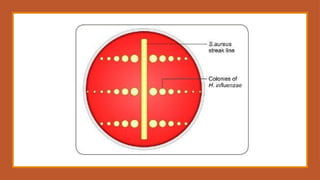
Satelitism
S.aureus is streakedacross blood agar plate perpendicular to H.influenzae .
When factor V is released from S.aureus , the H.influenzae grows large
colonies in fading manner away from S.aureus .
This is routinely employed for isolation of H.influenzae .
23.
Prophylaxis
Hib : PRPcapsular antigen is used for vaccination
But these are poorly immunogenic to children hence adjuvants are used such
as diphtheria toxin , tetanus toxoid and N.meningitidis omp .
It can also reduce pharyngeal colonization .
It has helped to reduce Hib in developed countries .
Oral rifampicin is of choice in chemoprophylaxis .
24.
Haemophilus ducreyi
Etiologic agentof chancroid or soft chancre .
Causes sexually transmitted infections .
A painfull ulceration that bleeds easily and causes no inflammation of
surrounding tissue .
Enlarged bubos appear.
Also hypersensitivity may develop.
25.
Epidemiology
Common cause ofgenital ulcers .
Heterosexual transmission.
It increases the transmission chances of HIV .
26.
Lab diagnosis
Exudate orswab from edge of ulcer is taken.
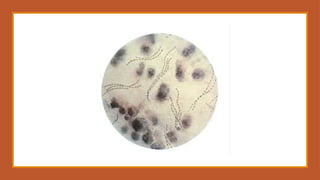
In gram staining they appear as gram negative coccobacilli in groups or parallel
chains .
Often a school of fish or rail road track appearance .
It only requires factor X and hence difficult to isolate .
BA or CA with 1% isovitalex is used also chorioallentoic membrane of chick
embryo can be employed .
27.
10% co2 isrequired for optimum growth .
Colonies are small grey transluscent .
It is biochemically inert hence disk test can be used .
Slide agglutination and multiplex PCR can be used .
29.
Haemophilus aegyptus
Also calledKoch – weeks bacillus as it closely resembles H.influenzae biotype 3 .
More inclination towards conjunctiva than pharyngeal carrier state .
It causes Egyptian ophthalmia (purulent contagius conjunctivitis )
Brazilian purpuric fever (fulminant fever , purpura , hypotension and shock )
Requires factor X and V and fails to ferment xylose , shows heamaglutination
with guinea pig RBC .
30.
Haemophilus parainfluenzae
Commensal inmouth and throat .
Causes opportunistic endocarditis , conjunctivitis , bronchopulmonary
infections in patients with cystic fibrosis .
Ferments sucrose , but not xylose .
Requires factor V and not X
References
Ananthanarayan, R. (2006).Ananthanarayan and Paniker’s Textbook of Microbiology. Orient
Blackswan.
Sastry, A. S., & K, S. B. (2018). Essentials of medical microbiology. JP Medical Ltd.




![CTEV [ clubfoot] DR ARUN LAL ,DR MOHAMED ASHRAF travancore medical college k...](https://cdn.slidesharecdn.com/ss_thumbnails/ctevclubfootdrarunlaldrmohamedashraftravancoremedicalcollegekollamkeralaindia-260208063247-18fc466c-thumbnail.jpg?width=640&height=640&fit=bounds)


![PERI-PROSTHETIC FRACTURE NAIL-PLATE CONSTRUCT [NPC].pptx](https://cdn.slidesharecdn.com/ss_thumbnails/drarunkumardrmohamedashrafperiprostheticfrasturenail-plateconstructnpc-260209164459-7e9d15a1-thumbnail.jpg?width=640&height=640&fit=bounds)


