ED MANAGEMENT OF
PV BLEEDING
CME JUNE 2017
➤ Common ED presentation
- 20-40% of pregnancies have 1st trimester bleeding
➤ Wide range of differential diagnoses
➤ Can be life-threatening
➤ Distressing
INTRODUCTION
Assessment of patient
Important causes
Management/Disposition
ASSESSMENT
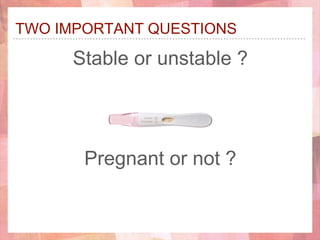
TWO IMPORTANT QUESTIONS
Stable or unstable ?
Pregnant or not ?
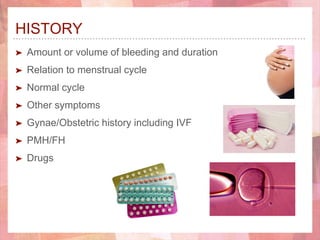
HISTORY
➤ Amount or volume of bleeding and duration
➤ Relation to menstrual cycle
➤ Normal cycle
➤ Other symptoms
➤ Gynae/Obstetric history including IVF
➤ PMH/FH
➤ Drugs
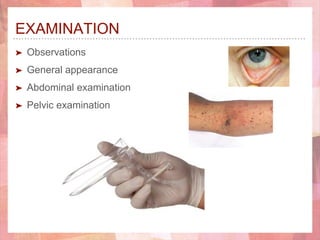
EXAMINATION
➤ Observations
➤ General appearance
➤ Abdominal examination
➤ Pelvic examination
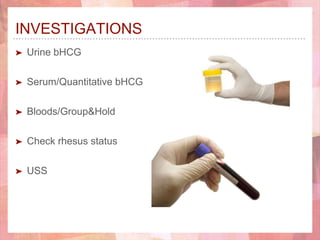
INVESTIGATIONS
➤ Urine bHCG
➤ Serum/Quantitative bHCG
➤ Bloods/Group&Hold
➤ Check rhesus status
➤ USS
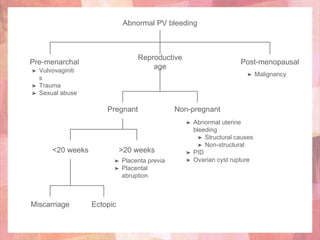
CAUSES OF PV
BLEEDING
Abnormal PV bleeding
Reproductive
age
Pregnant
<20 weeks
EctopicMiscarriage
Pre-menarchal
➤ Vulvovaginiti
s
➤ Trauma
➤ Sexual abuse
Non-pregnant
➤ Abnormal uterine
bleeding
➤ Structural causes
➤ Non-structural
➤ PID
➤ Ovarian cyst rupture
Post-menopausal
➤ Malignancy
>20 weeks
➤ Placenta previa
➤ Placental
abruption
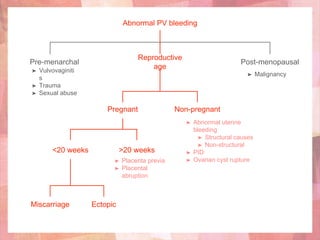
Abnormal PV bleeding
Reproductive
age
Pregnant
<20 weeks
EctopicMiscarriage
Pre-menarchal
➤ Vulvovaginiti
s
➤ Trauma
➤ Sexual abuse
Non-pregnant
➤ Abnormal uterine
bleeding
➤ Structural causes
➤ Non-structural
➤ PID
➤ Ovarian cyst rupture
Post-menopausal
➤ Malignancy
>20 weeks
➤ Placenta previa
➤ Placental
abruption
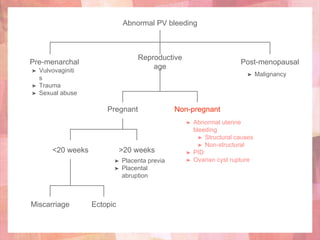
Abnormal PV bleeding
Reproductive
age
Pregnant
<20 weeks
EctopicMiscarriage
Pre-menarchal
➤ Vulvovaginiti
s
➤ Trauma
➤ Sexual abuse
Non-pregnant
➤ Abnormal uterine
bleeding
➤ Structural causes
➤ Non-structural
➤ PID
➤ Ovarian cyst rupture
Post-menopausal
➤ Malignancy
>20 weeks
➤ Placenta previa
➤ Placental
abruption
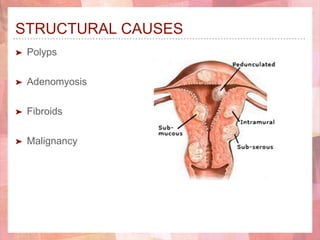
STRUCTURAL CAUSES
➤ Polyps
➤ Adenomyosis
➤ Fibroids
➤ Malignancy
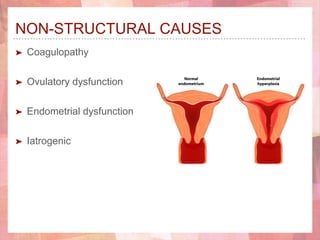
NON-STRUCTURAL CAUSES
➤ Coagulopathy
➤ Ovulatory dysfunction
➤ Endometrial dysfunction
➤ Iatrogenic
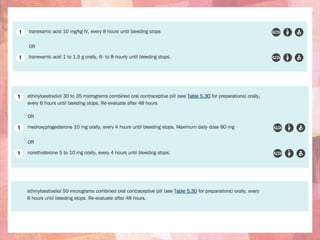
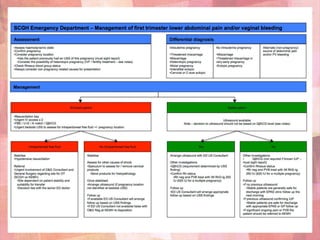
MANAGEMENT AND DISPOSITION
Pharmacological options
MANAGEMENT AND DISPOSITION
Pharmacological options
Caution with VTE risk
Outpatient follow up with USS to identify structural causes +/-
gynaecology follow up
Abnormal PV bleeding
Reproductive
age
Pregnant
<20 weeks
EctopicMiscarriage
Pre-menarchal
➤ Vulvovaginiti
s
➤ Trauma
➤ Sexual abuse
Non-pregnant
➤ Abnormal uterine
bleeding
➤ Structural causes
➤ Non-structural
➤ PID
➤ Ovarian cyst rupture
Post-menopausal
➤ Malignancy
>20 weeks
➤ Placenta previa
➤ Placental
abruption
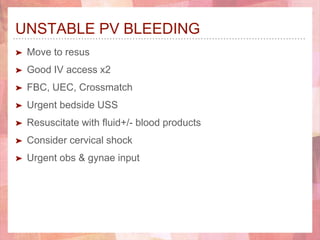
UNSTABLE PV BLEEDING
➤ Move to resus
➤ Good IV access x2
➤ FBC, UEC, Crossmatch
➤ Urgent bedside USS
➤ Resuscitate with fluid+/- blood products
➤ Consider cervical shock
➤ Urgent obs & gynae input
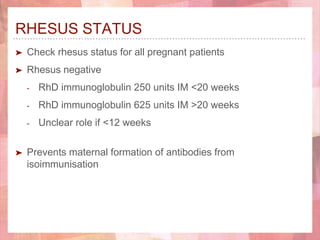
RHESUS STATUS
➤ Check rhesus status for all pregnant patients
➤ Rhesus negative
- RhD immunoglobulin 250 units IM <20 weeks
- RhD immunoglobulin 625 units IM >20 weeks
- Unclear role if <12 weeks
➤ Prevents maternal formation of antibodies from
isoimmunisation
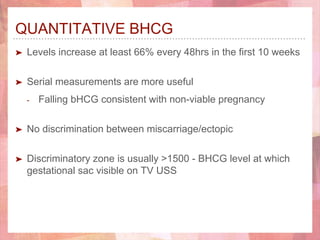
QUANTITATIVE BHCG
➤ Levels increase at least 66% every 48hrs in the first 10 weeks
➤ Serial measurements are more useful
- Falling bHCG consistent with non-viable pregnancy
➤ No discrimination between miscarriage/ectopic
➤ Discriminatory zone is usually >1500 - BHCG level at which
gestational sac visible on TV USS
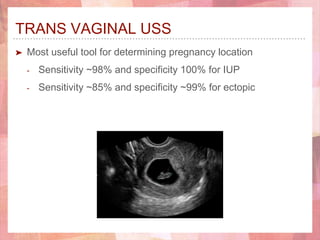
TRANS VAGINAL USS
➤ Most useful tool for determining pregnancy location
- Sensitivity ~98% and specificity 100% for IUP
- Sensitivity ~85% and specificity ~99% for ectopic
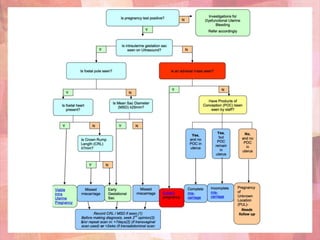
➤ Viable intrauterine pregnancy or threatened miscarriage
➤ Miscarriage
➤ Ectopic
➤ Pregnancy of unknown location
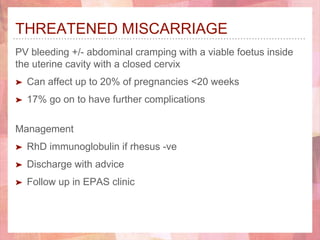
THREATENED MISCARRIAGE
PV bleeding +/- abdominal cramping with a viable foetus inside
the uterine cavity with a closed cervix
➤ Can affect up to 20% of pregnancies <20 weeks
➤ 17% go on to have further complications
Management
➤ RhD immunoglobulin if rhesus -ve
➤ Discharge with advice
➤ Follow up in EPAS clinic
MISCARRIAGE
Pregnancy loss before the 20th week of gestation
➤ 8-20% of pregnancies
➤ Most common in 1st trimester
➤ Risk factors include - advancing maternal age, previous
miscarriage and smoking
Inevitable
INEVITABLE MISCARRIAGE
Spontaneous miscarriage than can’t be stopped
➤ Persistant lower abdominal cramps and heavy PV bleeding
➤ Cervical os open
➤ Products of conception often visible
Inevitable
Incomplete
INCOMPLETE MISCARRIAGE
Part of the products of conception is retained in the uterus
➤ Persistant cramps and heavy PV bleeding
Inevitable
Incomplete
Complete
COMPLETE MISCARRIAGE
All products of conception expelled
➤ Cramps and PV bleeding stop
➤ Cervical os closed
Inevitable
Incomplete
Complete
Missed
MISSED MISCARRIAGE
Foetal demise picked up on USS
➤ Products of conception retained
➤ Sometimes get an asymptomatic brownish discharge
ECTOPIC
Ectopic pregnancy occurs when the developing blastocyst
becomes implanted at a site other than the endometrium of the
uterine cavity
➤ 1-2% of pregnancies but 6-16% of pregnancies that present to
ED with symptoms
➤ High morbidity and mortality - 10-15% of all pregnancy deaths
➤ Risk factors include previous ectopics, previous tubal surgery,
previous PID & smoking
CLINICAL PICTURE
➤ History
- Bleeding
- Abdominal pain
- Amenorrhoea
➤ Examination
- Lower abdominal tenderness/mass
- Shock
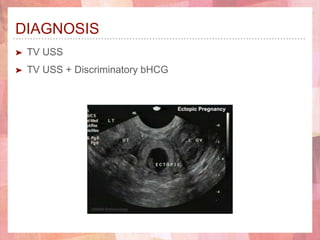
DIAGNOSIS
➤ TV USS
➤ TV USS + Discriminatory bHCG
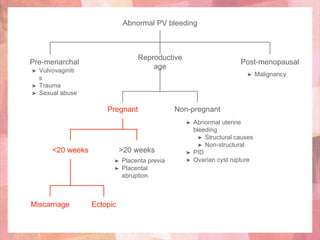
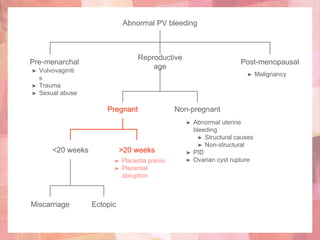
Abnormal PV bleeding
Reproductive
age
Pre-menarchal Post-menopausal
Pregnant Non-pregnant
>20 weeks<20 weeks
EctopicMiscarriage
➤ Vulvovaginiti
s
➤ Trauma
➤ Sexual abuse
➤ Abnormal uterine
bleeding
➤ Structural causes
➤ Non-structural
➤ PID
➤ Ovarian cyst rupture
➤ Malignancy
➤ Placenta previa
➤ Placental
abruption
DO NOT PERFORM A PELVIC
EXAMINATION ON ANY PATIENT
WITH PV BLEEDING WHO IS IN THE
THIRD TRIMESTER OF THEIR
PREGNANCY
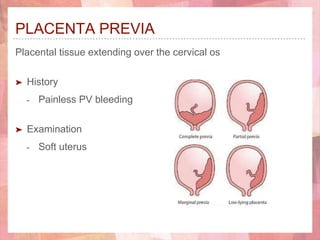
PLACENTA PREVIA
Placental tissue extending over the cervical os
➤ History
- Painless PV bleeding
➤ Examination
- Soft uterus
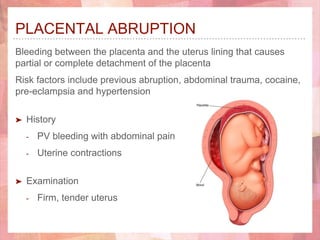
PLACENTAL ABRUPTION
Bleeding between the placenta and the uterus lining that causes
partial or complete detachment of the placenta
Risk factors include previous abruption, abdominal trauma, cocaine,
pre-eclampsia and hypertension
➤ History
- PV bleeding with abdominal pain
- Uterine contractions
➤ Examination
- Firm, tender uterus
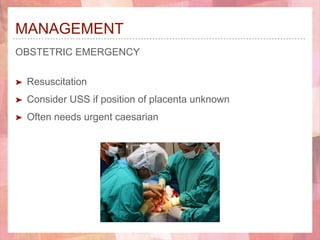
MANAGEMENT
OBSTETRIC EMERGENCY
➤ Resuscitation
➤ Consider USS if position of placenta unknown
➤ Often needs urgent caesarian
LEARNING
POINTS
➤ A patient with PV bleeding is pregnant until proven otherwise
➤ Don’t do a PV examination on a patient with PV bleeding who
is in the third trimester of pregnancy
➤ Don’t forget Rhesus status
➤ All the information you could ever possibly need is online
REFERENCES
KEMH clinical guidelines - http://www.kemh.health.wa.gov.au/development/manuals/
SCGH clinical guidelines - management of 1st trimester pain and bleeding -
http://scghed.com/2015/11/scgh-early-pregnancy-guideline-102015/
eTG Complete - Menstrual disorders - https://tgldcdp-tg-org-
au.smhslibresources.health.wa.gov.au/viewTopic?topicfile=menstrual-
disorders&guidelineName=Endocrinology#toc_d1e84
Approach to vaginal bleeding in the emergency department - https://www-uptodate-
com.smhslibresources.health.wa.gov.au/contents/approach-to-vaginal-bleeding-in-the-emergency-
department?source=search_result&search=vaginal%20bleeding&selectedTitle=1~150
Diagnosis and management - Emergency Medicine - Seventh Edition. Anthony FT Brown and
Michael D Cadogan. CRC Press.
THANK-YOU

PV Bleeding

  • 1.
    ED MANAGEMENT OF PVBLEEDING CME JUNE 2017
  • 2.
    ➤ Common EDpresentation - 20-40% of pregnancies have 1st trimester bleeding ➤ Wide range of differential diagnoses ➤ Can be life-threatening ➤ Distressing INTRODUCTION
  • 3.
    Assessment of patient Importantcauses Management/Disposition
  • 4.
  • 5.
    TWO IMPORTANT QUESTIONS Stableor unstable ? Pregnant or not ?
  • 6.
    HISTORY ➤ Amount orvolume of bleeding and duration ➤ Relation to menstrual cycle ➤ Normal cycle ➤ Other symptoms ➤ Gynae/Obstetric history including IVF ➤ PMH/FH ➤ Drugs
  • 7.
    EXAMINATION ➤ Observations ➤ Generalappearance ➤ Abdominal examination ➤ Pelvic examination
  • 8.
    INVESTIGATIONS ➤ Urine bHCG ➤Serum/Quantitative bHCG ➤ Bloods/Group&Hold ➤ Check rhesus status ➤ USS
  • 9.
  • 10.
    Abnormal PV bleeding Reproductive age Pregnant <20weeks EctopicMiscarriage Pre-menarchal ➤ Vulvovaginiti s ➤ Trauma ➤ Sexual abuse Non-pregnant ➤ Abnormal uterine bleeding ➤ Structural causes ➤ Non-structural ➤ PID ➤ Ovarian cyst rupture Post-menopausal ➤ Malignancy >20 weeks ➤ Placenta previa ➤ Placental abruption
  • 11.
    Abnormal PV bleeding Reproductive age Pregnant <20weeks EctopicMiscarriage Pre-menarchal ➤ Vulvovaginiti s ➤ Trauma ➤ Sexual abuse Non-pregnant ➤ Abnormal uterine bleeding ➤ Structural causes ➤ Non-structural ➤ PID ➤ Ovarian cyst rupture Post-menopausal ➤ Malignancy >20 weeks ➤ Placenta previa ➤ Placental abruption
  • 12.
    Abnormal PV bleeding Reproductive age Pregnant <20weeks EctopicMiscarriage Pre-menarchal ➤ Vulvovaginiti s ➤ Trauma ➤ Sexual abuse Non-pregnant ➤ Abnormal uterine bleeding ➤ Structural causes ➤ Non-structural ➤ PID ➤ Ovarian cyst rupture Post-menopausal ➤ Malignancy >20 weeks ➤ Placenta previa ➤ Placental abruption
  • 13.
    STRUCTURAL CAUSES ➤ Polyps ➤Adenomyosis ➤ Fibroids ➤ Malignancy
  • 14.
    NON-STRUCTURAL CAUSES ➤ Coagulopathy ➤Ovulatory dysfunction ➤ Endometrial dysfunction ➤ Iatrogenic
  • 15.
  • 17.
    MANAGEMENT AND DISPOSITION Pharmacologicaloptions Caution with VTE risk Outpatient follow up with USS to identify structural causes +/- gynaecology follow up
  • 18.
    Abnormal PV bleeding Reproductive age Pregnant <20weeks EctopicMiscarriage Pre-menarchal ➤ Vulvovaginiti s ➤ Trauma ➤ Sexual abuse Non-pregnant ➤ Abnormal uterine bleeding ➤ Structural causes ➤ Non-structural ➤ PID ➤ Ovarian cyst rupture Post-menopausal ➤ Malignancy >20 weeks ➤ Placenta previa ➤ Placental abruption
  • 19.
    UNSTABLE PV BLEEDING ➤Move to resus ➤ Good IV access x2 ➤ FBC, UEC, Crossmatch ➤ Urgent bedside USS ➤ Resuscitate with fluid+/- blood products ➤ Consider cervical shock ➤ Urgent obs & gynae input
  • 20.
    RHESUS STATUS ➤ Checkrhesus status for all pregnant patients ➤ Rhesus negative - RhD immunoglobulin 250 units IM <20 weeks - RhD immunoglobulin 625 units IM >20 weeks - Unclear role if <12 weeks ➤ Prevents maternal formation of antibodies from isoimmunisation
  • 21.
    QUANTITATIVE BHCG ➤ Levelsincrease at least 66% every 48hrs in the first 10 weeks ➤ Serial measurements are more useful - Falling bHCG consistent with non-viable pregnancy ➤ No discrimination between miscarriage/ectopic ➤ Discriminatory zone is usually >1500 - BHCG level at which gestational sac visible on TV USS
  • 22.
    TRANS VAGINAL USS ➤Most useful tool for determining pregnancy location - Sensitivity ~98% and specificity 100% for IUP - Sensitivity ~85% and specificity ~99% for ectopic
  • 24.
    ➤ Viable intrauterinepregnancy or threatened miscarriage ➤ Miscarriage ➤ Ectopic ➤ Pregnancy of unknown location
  • 25.
    THREATENED MISCARRIAGE PV bleeding+/- abdominal cramping with a viable foetus inside the uterine cavity with a closed cervix ➤ Can affect up to 20% of pregnancies <20 weeks ➤ 17% go on to have further complications Management ➤ RhD immunoglobulin if rhesus -ve ➤ Discharge with advice ➤ Follow up in EPAS clinic
  • 26.
    MISCARRIAGE Pregnancy loss beforethe 20th week of gestation ➤ 8-20% of pregnancies ➤ Most common in 1st trimester ➤ Risk factors include - advancing maternal age, previous miscarriage and smoking
  • 27.
  • 28.
    INEVITABLE MISCARRIAGE Spontaneous miscarriagethan can’t be stopped ➤ Persistant lower abdominal cramps and heavy PV bleeding ➤ Cervical os open ➤ Products of conception often visible
  • 29.
  • 30.
    INCOMPLETE MISCARRIAGE Part ofthe products of conception is retained in the uterus ➤ Persistant cramps and heavy PV bleeding
  • 31.
  • 32.
    COMPLETE MISCARRIAGE All productsof conception expelled ➤ Cramps and PV bleeding stop ➤ Cervical os closed
  • 33.
  • 34.
    MISSED MISCARRIAGE Foetal demisepicked up on USS ➤ Products of conception retained ➤ Sometimes get an asymptomatic brownish discharge
  • 35.
    ECTOPIC Ectopic pregnancy occurswhen the developing blastocyst becomes implanted at a site other than the endometrium of the uterine cavity ➤ 1-2% of pregnancies but 6-16% of pregnancies that present to ED with symptoms ➤ High morbidity and mortality - 10-15% of all pregnancy deaths ➤ Risk factors include previous ectopics, previous tubal surgery, previous PID & smoking
  • 36.
    CLINICAL PICTURE ➤ History -Bleeding - Abdominal pain - Amenorrhoea ➤ Examination - Lower abdominal tenderness/mass - Shock
  • 37.
    DIAGNOSIS ➤ TV USS ➤TV USS + Discriminatory bHCG
  • 39.
    Abnormal PV bleeding Reproductive age Pre-menarchalPost-menopausal Pregnant Non-pregnant >20 weeks<20 weeks EctopicMiscarriage ➤ Vulvovaginiti s ➤ Trauma ➤ Sexual abuse ➤ Abnormal uterine bleeding ➤ Structural causes ➤ Non-structural ➤ PID ➤ Ovarian cyst rupture ➤ Malignancy ➤ Placenta previa ➤ Placental abruption
  • 40.
    DO NOT PERFORMA PELVIC EXAMINATION ON ANY PATIENT WITH PV BLEEDING WHO IS IN THE THIRD TRIMESTER OF THEIR PREGNANCY
  • 41.
    PLACENTA PREVIA Placental tissueextending over the cervical os ➤ History - Painless PV bleeding ➤ Examination - Soft uterus
  • 42.
    PLACENTAL ABRUPTION Bleeding betweenthe placenta and the uterus lining that causes partial or complete detachment of the placenta Risk factors include previous abruption, abdominal trauma, cocaine, pre-eclampsia and hypertension ➤ History - PV bleeding with abdominal pain - Uterine contractions ➤ Examination - Firm, tender uterus
  • 43.
    MANAGEMENT OBSTETRIC EMERGENCY ➤ Resuscitation ➤Consider USS if position of placenta unknown ➤ Often needs urgent caesarian
  • 44.
  • 45.
    ➤ A patientwith PV bleeding is pregnant until proven otherwise ➤ Don’t do a PV examination on a patient with PV bleeding who is in the third trimester of pregnancy ➤ Don’t forget Rhesus status ➤ All the information you could ever possibly need is online
  • 46.
    REFERENCES KEMH clinical guidelines- http://www.kemh.health.wa.gov.au/development/manuals/ SCGH clinical guidelines - management of 1st trimester pain and bleeding - http://scghed.com/2015/11/scgh-early-pregnancy-guideline-102015/ eTG Complete - Menstrual disorders - https://tgldcdp-tg-org- au.smhslibresources.health.wa.gov.au/viewTopic?topicfile=menstrual- disorders&guidelineName=Endocrinology#toc_d1e84 Approach to vaginal bleeding in the emergency department - https://www-uptodate- com.smhslibresources.health.wa.gov.au/contents/approach-to-vaginal-bleeding-in-the-emergency- department?source=search_result&search=vaginal%20bleeding&selectedTitle=1~150 Diagnosis and management - Emergency Medicine - Seventh Edition. Anthony FT Brown and Michael D Cadogan. CRC Press.
  • 47.