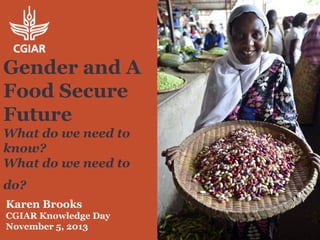
Gender and A
Food Secure
Future
What do we need to
know?
What do we need to
do?
Karen Brooks
CGIAR Knowledge Day
November 5, 2013
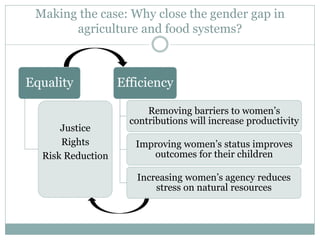
Making the case: Why close the gender gap in
agriculture and food systems?

Equality

Justice
Rights
Risk Reduction

Efficiency
Removing barriers to women’s
contributions will increase productivity
Improving women’s status improves
outcomes for their children
Increasing women’s agency reduces
stress on natural resources
Value Proposition: Gender and System Level Outcomes
Reduced
rural
poverty

• Eliminating barriers to women’s labor participation
in some sectors would reduce gender productivity
gap by one third to one half (WDR 2012)

Increased
food
security

• Equalizing access to agricultural resources could
increase yields by 20-30% and reduce the
world’s hungry by 12-17% (SOFA 2011,
Quisumbing, et al., forthcoming)

Improved
nutrition
and health

• Nutritional supplementation for girls influences
the growth of their children (Behrman, Calderon,
Preston, Hoddinott, Martorell, Stein, 2009)

Sustainable
natural
resource
management

• A woman with secure ownership rights is more
likely to invest in sustainable farming practices
(Otsuka, et al., 2003)

Clear case should lead to clear actions…
…but heterogeneity intervenes
Women and men experience gender together with other dimensions of
life: interactions matter.

Bolsa Família, a conditional cash
transfer program with female
beneficiaries, increases women’s
decisionmaking, but with
heterogeneity in effects:
 Effect driven by urban
households
 In rural households, program
does not increase and possibly
reduces women’s
decisionmaking power

Source: de Brauw, Gilligan, Hoddinott, and Roy (2013)

Average proportion reporting female decision
making power regarding specific decisions,
Bolsa Família transfer recipients and
nonrecipients, 2009.
Action requires knowledge of interactions; heterogeneity

Progress in:

…and less so in:

 Education

 Mobility

 Fertility
 Labor force

participation

 Mortality
 Job choice
 Earning gaps
 House and care work

 Asset ownership
 Agency
All relate centrally to agricultural innovation and reduction of rural poverty.
This is core challenge of CRP gender strategies
System-wide

For CRPs
 Identify key barriers
 Understand

heterogeneity that
matters


Research agenda

 Work with

implementation partners
to design interventions
 Address scale
 Monitor outcomes

 Identify policy and institutional

issues with greatest gender impact
 Diagnose
o Barriers that work of CGIAR can
address
o Barriers that work of CGIAR can
address in partnership
o Barriers best left to others
o Extrapolation, generalizability
o Comparative research
 Improve the data and methods


collect sex-disaggregated data and
gender analysis
“When market
signals, formal
institutions, and
income growth
all come
together to
support
investments in
women, gender
equality can and
does improve
very quickly.”
- WDR 2012

Photo Credit: Neil Palmer, CIAT
Orange Fleshed Sweet Potato
A major accomplishment
of CGIAR and partners

Gender lens speeds
adoption

 Gender in decisions on

land use
 Gender in
communication
Probability of adoption highest on
parcels jointly controlled by men and
women, but where women lead in
deciding crops grown. Communication
strategy must recognize limits of
communication within households.
Source: Gender, Agriculture, and Assets Project (GAAP)
Closing the gender knowledge gap
Strategic:
 Collecting and analyzing sex-disaggregated data: progress in
agreeing on a set of minimum standards for inclusion of sex
disaggregation in most data collection
 Continuing empirical work on gender issues in agriculture;
especially comparative research and meta studies
 Working with partners to explore alternative design and
delivery mechanisms to meet context-specific gender needs
 Evaluating outcomes: focus on gendered impacts of
agricultural interventions
 Generalizing with caution: moving beyond the specific
Source: Quisumbing, et al. (eds.), forthcoming. Gender in Agriculture: Closing the Knowledge Gap. Springer.
Thank
you

Photo Credit: Neil Palmer, CIAT

Gender and a food secure future: What do we need to know? What do we need to do?

  • 1.
    Gender and A FoodSecure Future What do we need to know? What do we need to do? Karen Brooks CGIAR Knowledge Day November 5, 2013
  • 2.
    Making the case:Why close the gender gap in agriculture and food systems? Equality Justice Rights Risk Reduction Efficiency Removing barriers to women’s contributions will increase productivity Improving women’s status improves outcomes for their children Increasing women’s agency reduces stress on natural resources
  • 3.
    Value Proposition: Genderand System Level Outcomes Reduced rural poverty • Eliminating barriers to women’s labor participation in some sectors would reduce gender productivity gap by one third to one half (WDR 2012) Increased food security • Equalizing access to agricultural resources could increase yields by 20-30% and reduce the world’s hungry by 12-17% (SOFA 2011, Quisumbing, et al., forthcoming) Improved nutrition and health • Nutritional supplementation for girls influences the growth of their children (Behrman, Calderon, Preston, Hoddinott, Martorell, Stein, 2009) Sustainable natural resource management • A woman with secure ownership rights is more likely to invest in sustainable farming practices (Otsuka, et al., 2003) Clear case should lead to clear actions…
  • 4.
    …but heterogeneity intervenes Womenand men experience gender together with other dimensions of life: interactions matter. Bolsa Família, a conditional cash transfer program with female beneficiaries, increases women’s decisionmaking, but with heterogeneity in effects:  Effect driven by urban households  In rural households, program does not increase and possibly reduces women’s decisionmaking power Source: de Brauw, Gilligan, Hoddinott, and Roy (2013) Average proportion reporting female decision making power regarding specific decisions, Bolsa Família transfer recipients and nonrecipients, 2009.
  • 5.
    Action requires knowledgeof interactions; heterogeneity Progress in: …and less so in:  Education  Mobility  Fertility  Labor force participation  Mortality  Job choice  Earning gaps  House and care work  Asset ownership  Agency All relate centrally to agricultural innovation and reduction of rural poverty.
  • 6.
    This is corechallenge of CRP gender strategies System-wide For CRPs  Identify key barriers  Understand heterogeneity that matters  Research agenda  Work with implementation partners to design interventions  Address scale  Monitor outcomes  Identify policy and institutional issues with greatest gender impact  Diagnose o Barriers that work of CGIAR can address o Barriers that work of CGIAR can address in partnership o Barriers best left to others o Extrapolation, generalizability o Comparative research  Improve the data and methods  collect sex-disaggregated data and gender analysis
  • 7.
    “When market signals, formal institutions,and income growth all come together to support investments in women, gender equality can and does improve very quickly.” - WDR 2012 Photo Credit: Neil Palmer, CIAT
  • 8.
    Orange Fleshed SweetPotato A major accomplishment of CGIAR and partners Gender lens speeds adoption  Gender in decisions on land use  Gender in communication Probability of adoption highest on parcels jointly controlled by men and women, but where women lead in deciding crops grown. Communication strategy must recognize limits of communication within households. Source: Gender, Agriculture, and Assets Project (GAAP)
  • 9.
    Closing the genderknowledge gap Strategic:  Collecting and analyzing sex-disaggregated data: progress in agreeing on a set of minimum standards for inclusion of sex disaggregation in most data collection  Continuing empirical work on gender issues in agriculture; especially comparative research and meta studies  Working with partners to explore alternative design and delivery mechanisms to meet context-specific gender needs  Evaluating outcomes: focus on gendered impacts of agricultural interventions  Generalizing with caution: moving beyond the specific Source: Quisumbing, et al. (eds.), forthcoming. Gender in Agriculture: Closing the Knowledge Gap. Springer.
  • 10.