Update on Livestock and Fish research program
output 2: Gender and value chains

Hikuepi Katjiuongua, Froukje Kruijssen and Emily Ouma
Livestock and Fish Gender Working Group
Workshop and Planning Meeting
Addis Ababa, Ethiopia, 14-18 October 2013
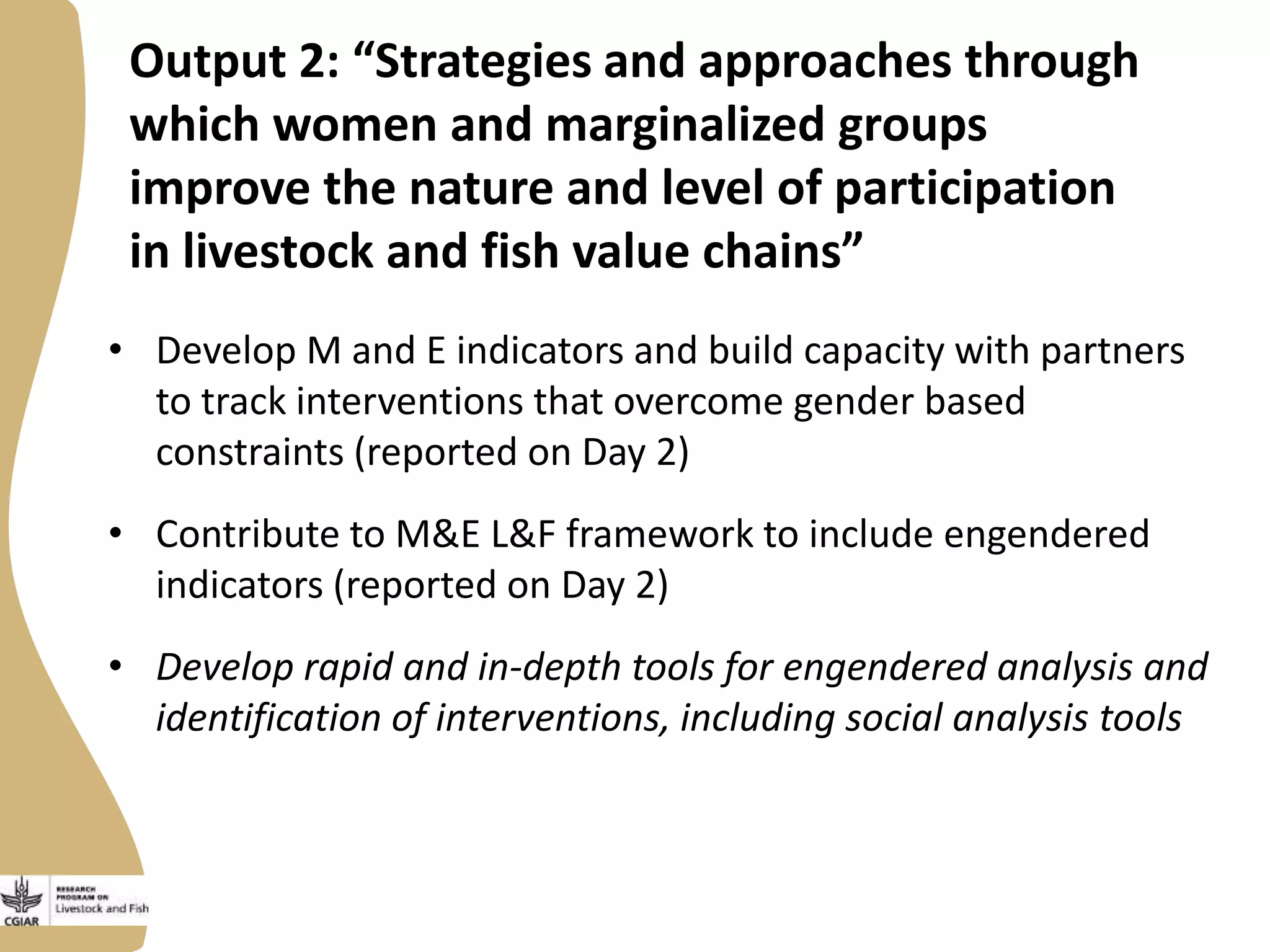
Output 2: “Strategies and approaches through
which women and marginalized groups
improve the nature and level of participation
in livestock and fish value chains”
• Develop M and E indicators and build capacity with partners
to track interventions that overcome gender based
constraints (reported on Day 2)

• Contribute to M&E L&F framework to include engendered
indicators (reported on Day 2)
• Develop rapid and in-depth tools for engendered analysis and
identification of interventions, including social analysis tools
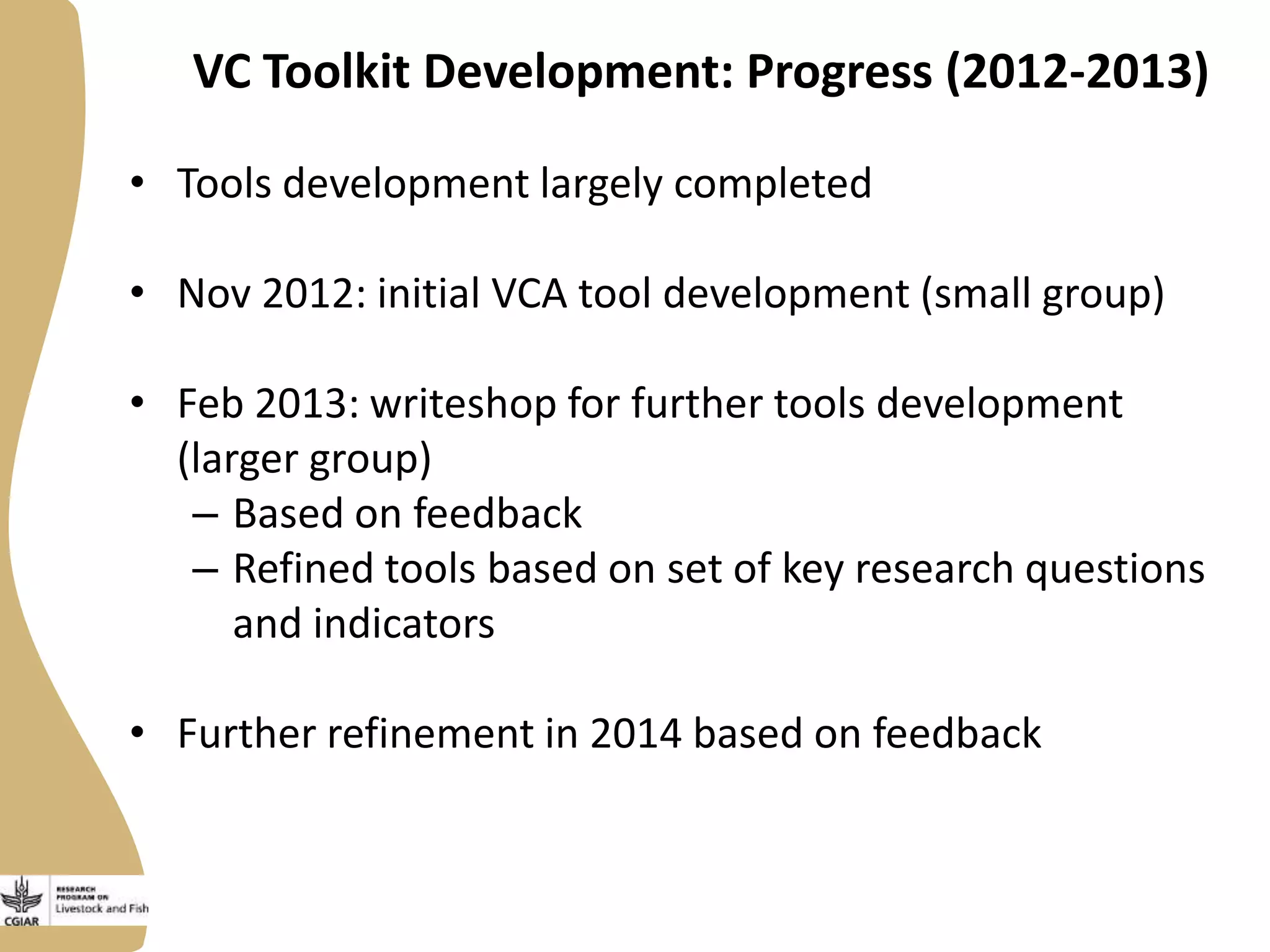
VC Toolkit Development: Progress (2012-2013)
• Tools development largely completed
• Nov 2012: initial VCA tool development (small group)
• Feb 2013: writeshop for further tools development
(larger group)
– Based on feedback
– Refined tools based on set of key research questions
and indicators
• Further refinement in 2014 based on feedback
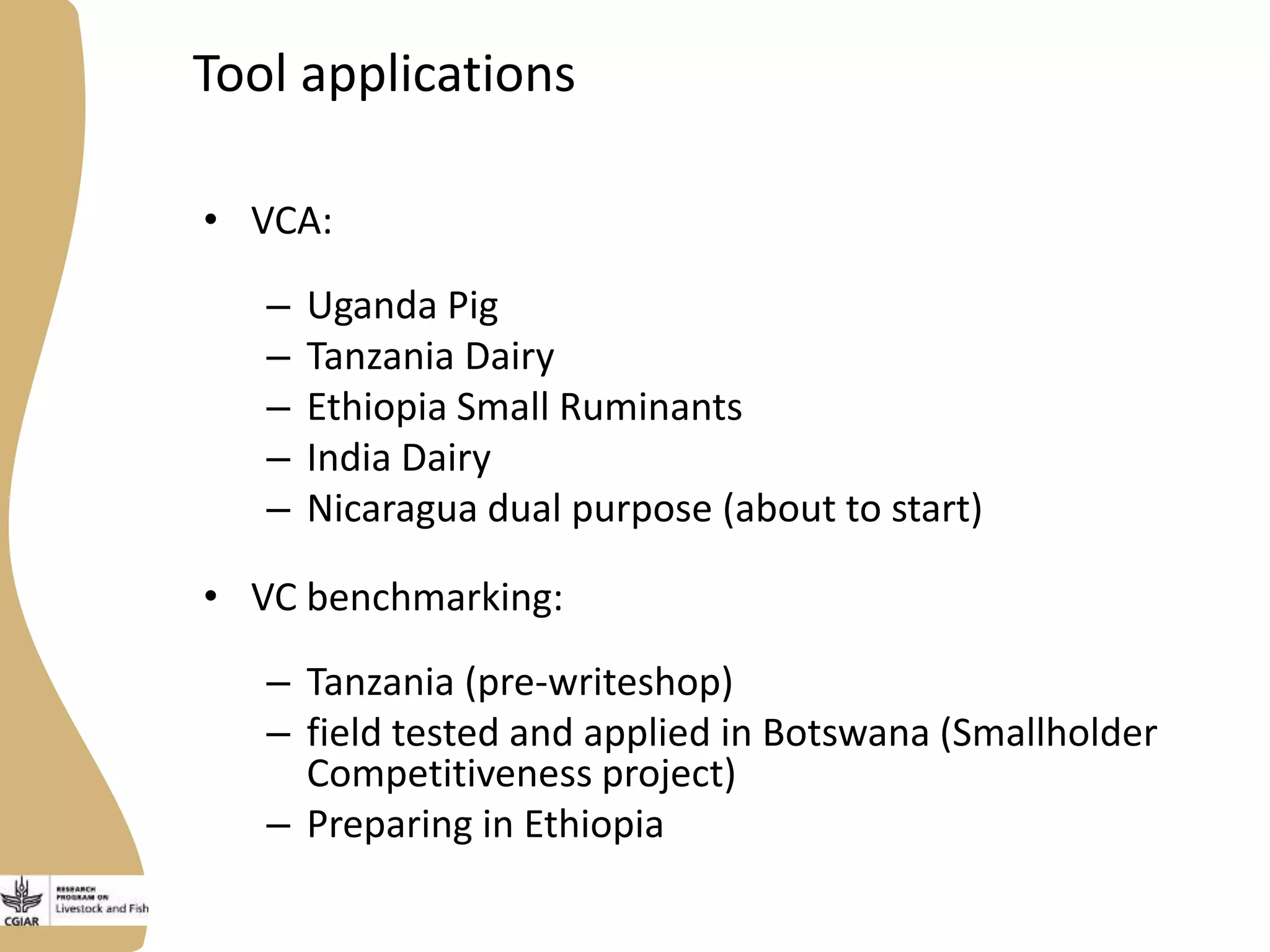
Tool applications
• VCA:

–
–
–
–
–

Uganda Pig
Tanzania Dairy
Ethiopia Small Ruminants
India Dairy
Nicaragua dual purpose (about to start)

• VC benchmarking:
– Tanzania (pre-writeshop)
– field tested and applied in Botswana (Smallholder
Competitiveness project)
– Preparing in Ethiopia
VC Toolkit Development: Next steps
• Reviewing usage & usefulness of the tools (2014)
• Development of database and guidelines for training,
implementation analysis and review

• Tracking of tool usage and revision based on lessons learned
(2014)
• Simplify wiki, make it easier for users
• Internal review process of tools, reports , best-bets
– Decide on process for feedback on content, consistency
and quality
• Address question on tool ‘harmonization’:
– Tools are being adapted, but what common themes &
questions are being kept?
• Discuss & agree on prioritization process for identifying
best-bets interventions & ex ante analysis
Some challenges
• How do the tools relate to the IDO and M&E indicators?
– Do the tools capture the needed/proposed gender M&E
indicators? If not, how do we address this?
– What impact assessment methods/approaches will be
used to assess the impact of the L&F program (overall
and for each VC and theme)?

– Is the current level of communication among the L&F
value chains sufficient to foster learning as they move
along with their respective work plans? If not, how do
we best achieve this?
Application of the VCA tools: experiences
from the Uganda pig value chain
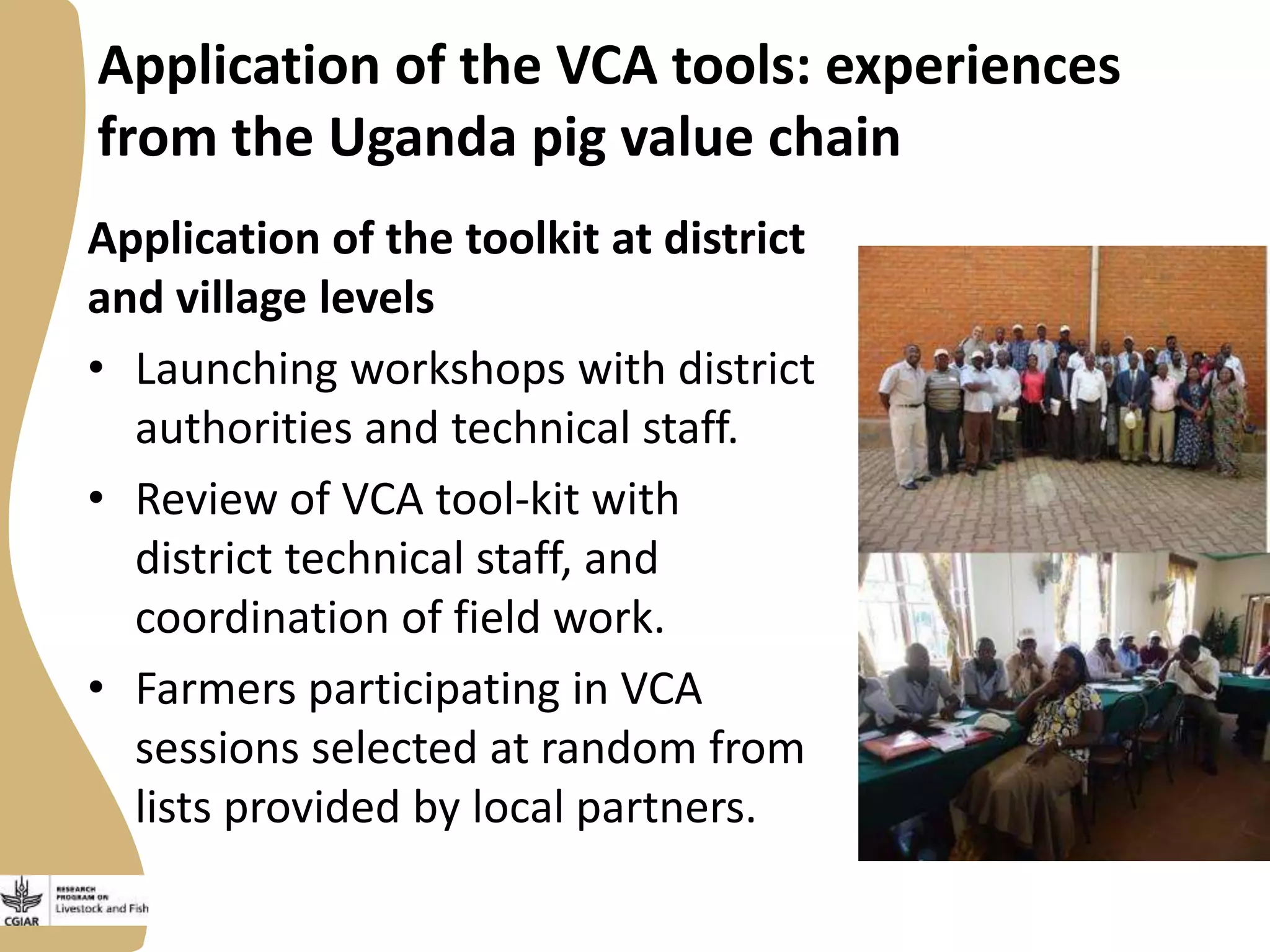
Application of the toolkit at district
and village levels
• Launching workshops with district
authorities and technical staff.
• Review of VCA tool-kit with
district technical staff, and
coordination of field work.
• Farmers participating in VCA
sessions selected at random from
lists provided by local partners.
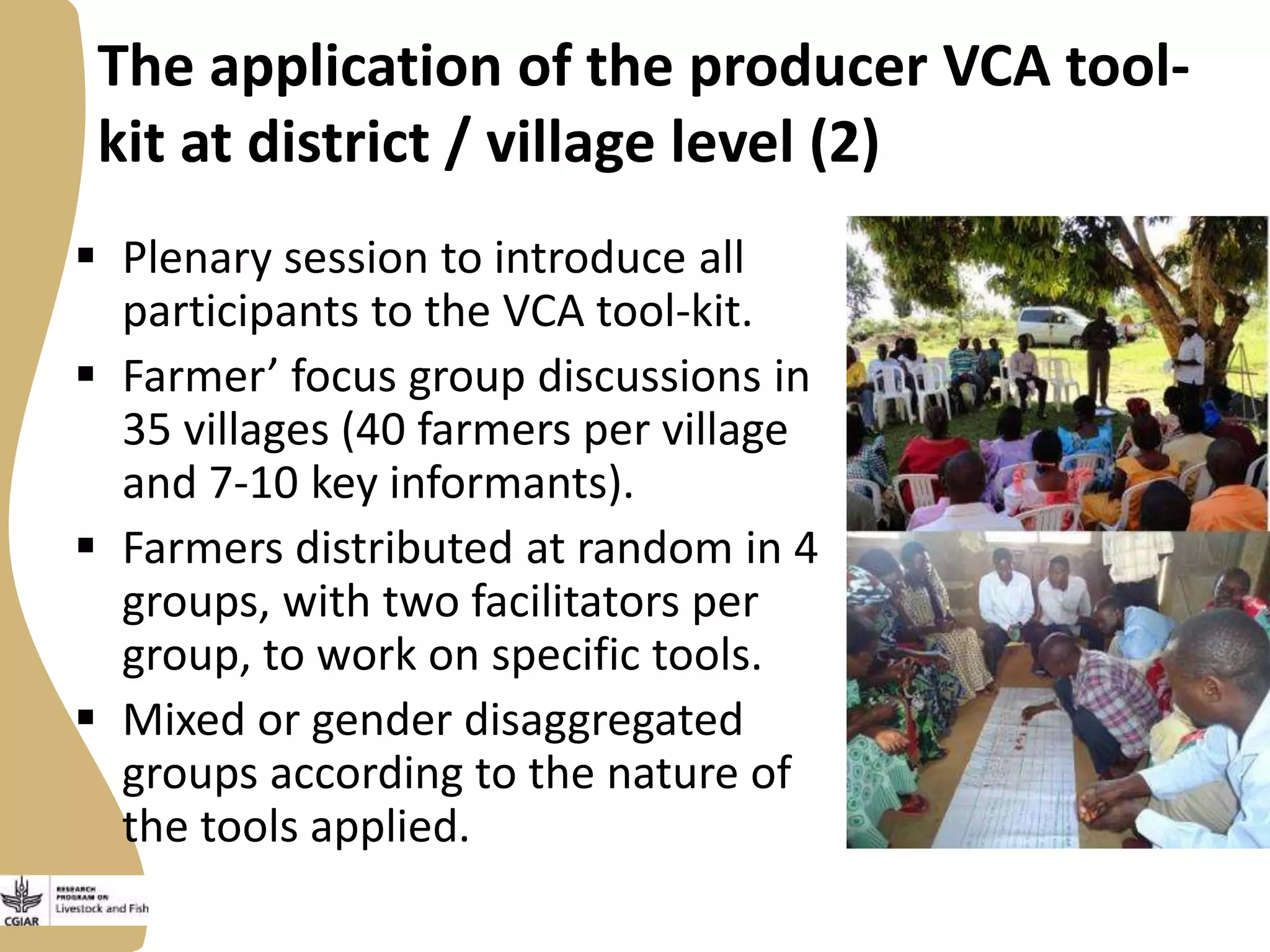
The application of the producer VCA toolkit at district / village level (2)
 Plenary session to introduce all
participants to the VCA tool-kit.
 Farmer’ focus group discussions in
35 villages (40 farmers per village
and 7-10 key informants).
 Farmers distributed at random in 4
groups, with two facilitators per
group, to work on specific tools.
 Mixed or gender disaggregated
groups according to the nature of
the tools applied.
The application of the producer VCA tool-kit
at district / village level (3)
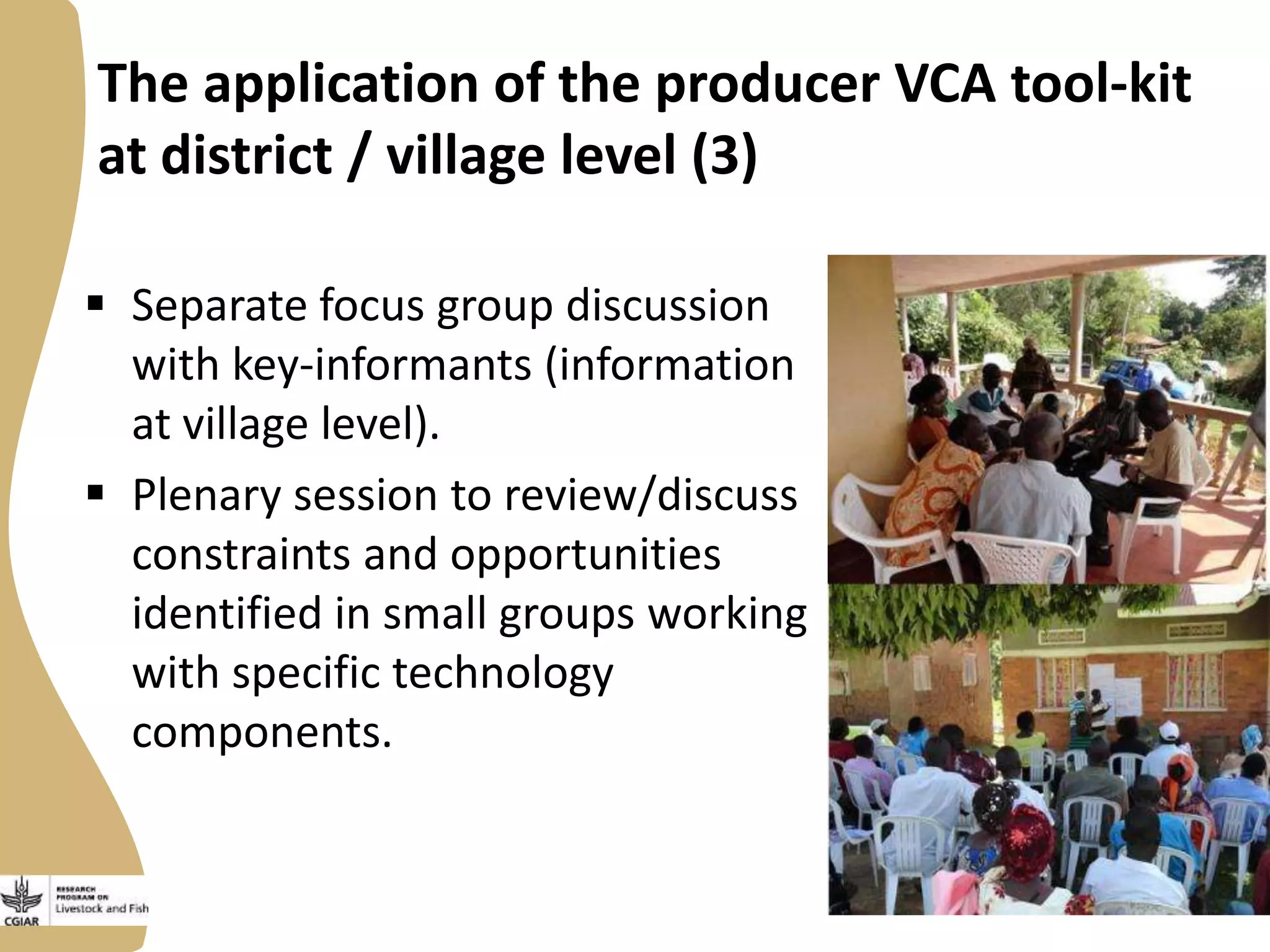
 Separate focus group discussion
with key-informants (information
at village level).
 Plenary session to review/discuss
constraints and opportunities
identified in small groups working
with specific technology
components.
The application of the VCA tool-kit at district
/ village level (4)
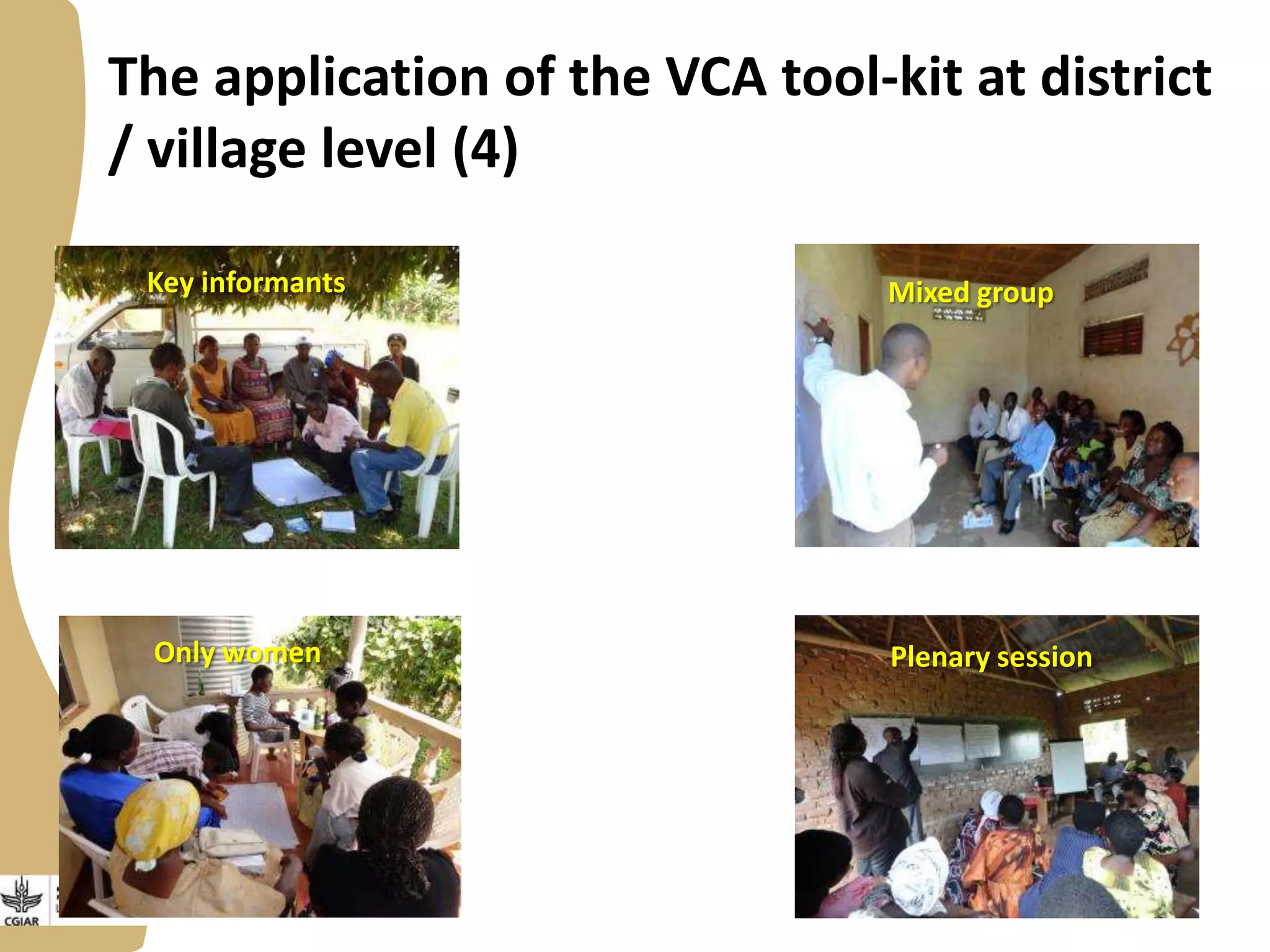
Key informants

Mixed group

Only women

Plenary session
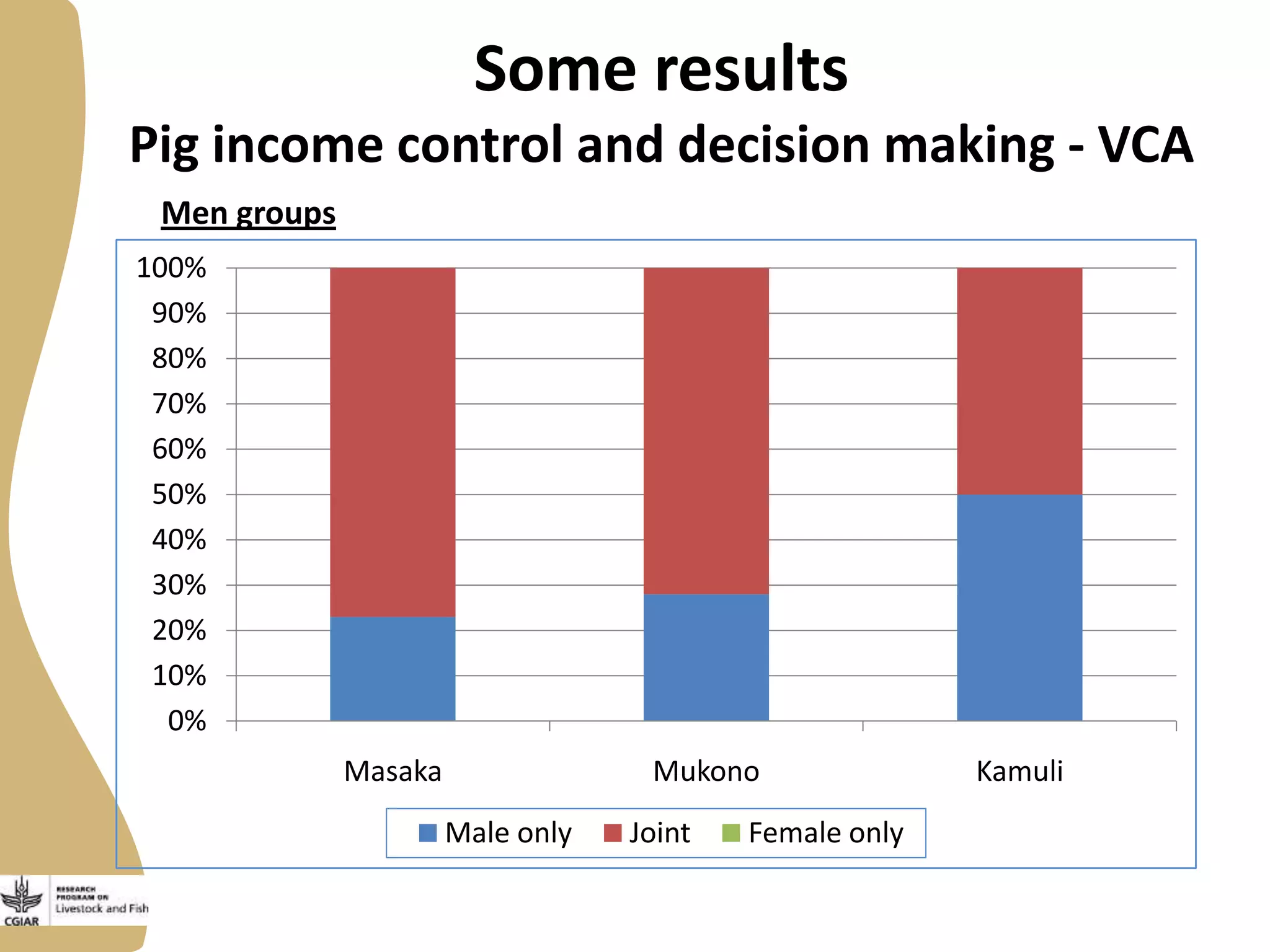
Some results
Pig income control and decision making - VCA
Men groups
100%
90%
80%
70%
60%
50%
40%
30%
20%
10%
0%
Masaka

Mukono
Male only

Joint

Female only

Kamuli
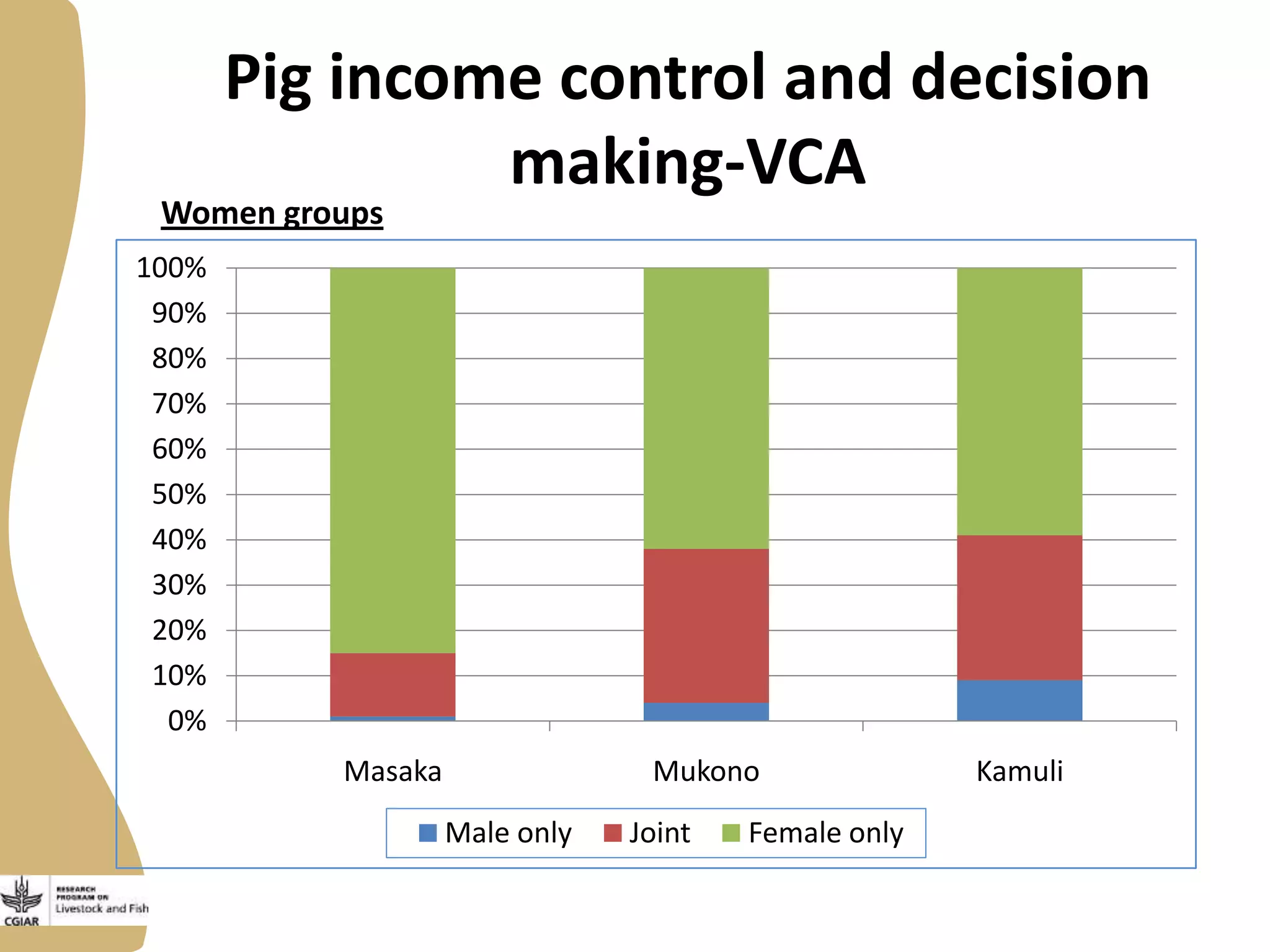
Pig income control and decision
making-VCA

Women groups
100%
90%
80%
70%
60%
50%
40%
30%
20%
10%
0%

Masaka

Mukono
Male only

Joint

Female only

Kamuli
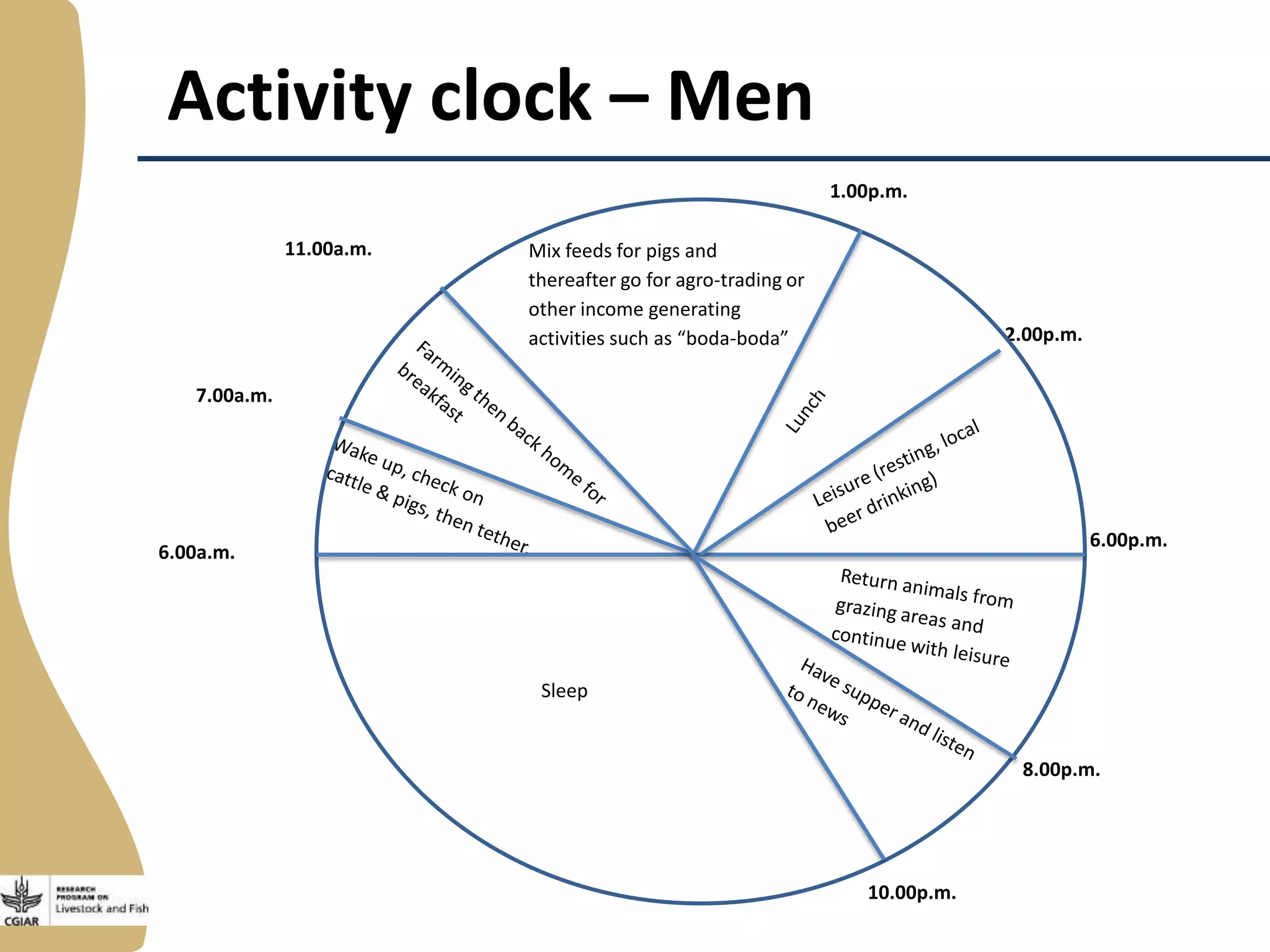
Activity clock – Men
1.00p.m.
11.00a.m.

Mix feeds for pigs and
thereafter go for agro-trading or
other income generating
activities such as “boda-boda”

2.00p.m.

7.00a.m.

6.00p.m.

6.00a.m.

Sleep

8.00p.m.

10.00p.m.
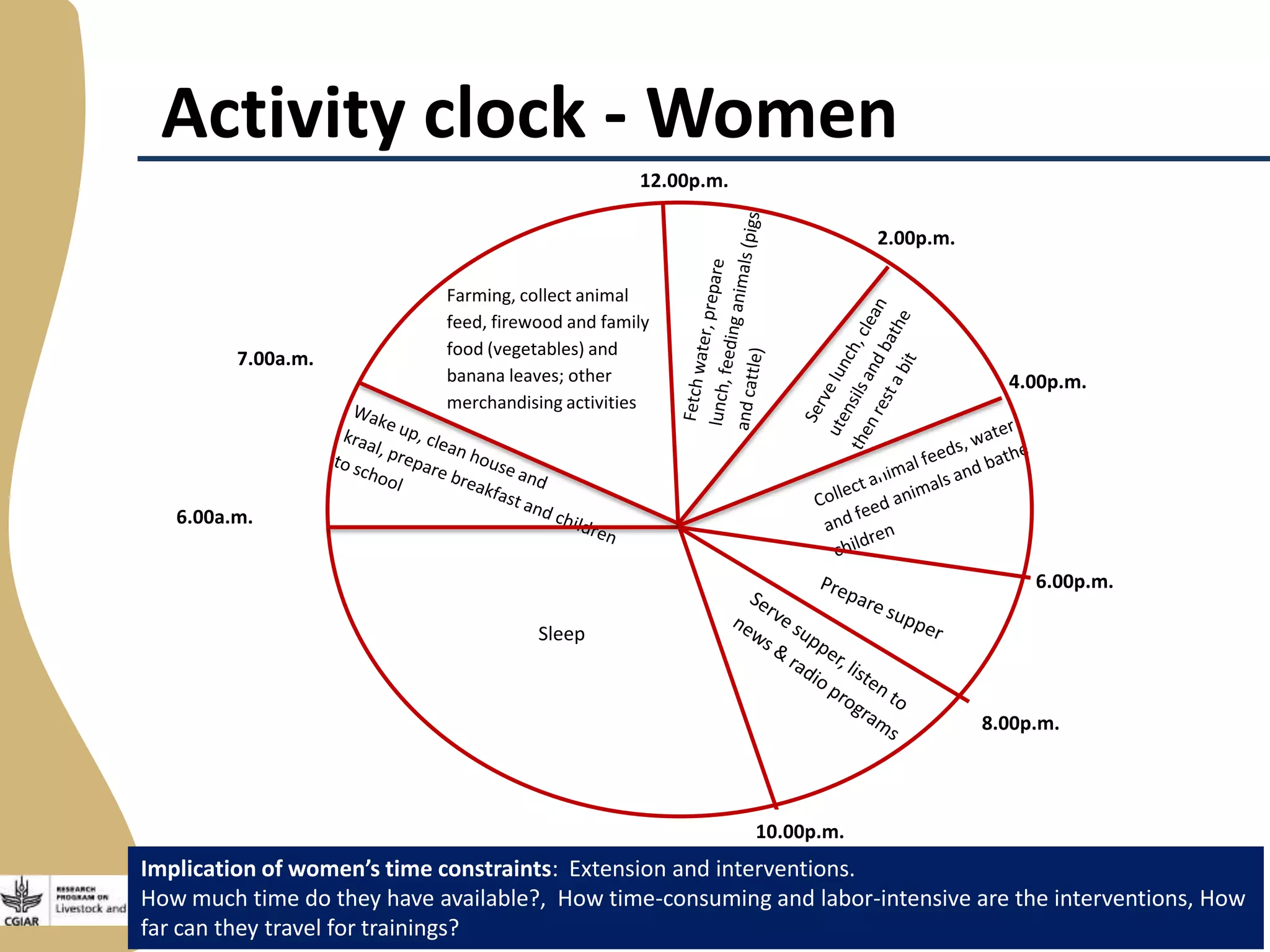
Activity clock - Women
12.00p.m.
2.00p.m.

7.00a.m.

Farming, collect animal
feed, firewood and family
food (vegetables) and
banana leaves; other
merchandising activities

4.00p.m.

6.00a.m.
6.00p.m.
Sleep

8.00p.m.

10.00p.m.

Implication of women’s time constraints: Extension and interventions.
How much time do they have available?, How time-consuming and labor-intensive are the interventions, How
far can they travel for trainings?
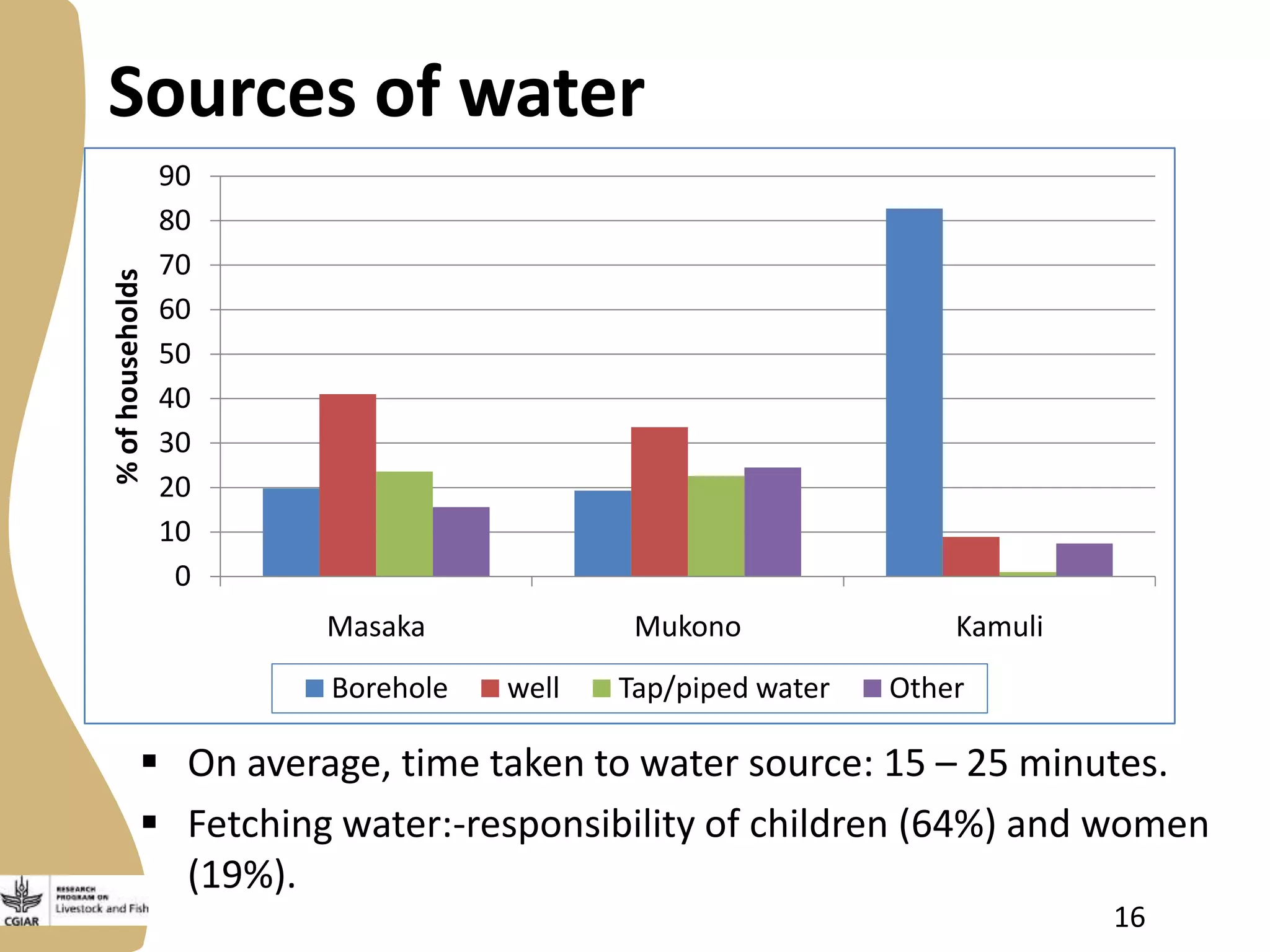
% of households

Sources of water
90
80
70
60
50
40
30
20
10
0
Masaka
Borehole

Mukono
well

Tap/piped water

Kamuli
Other

 On average, time taken to water source: 15 – 25 minutes.
 Fetching water:-responsibility of children (64%) and women
(19%).
16
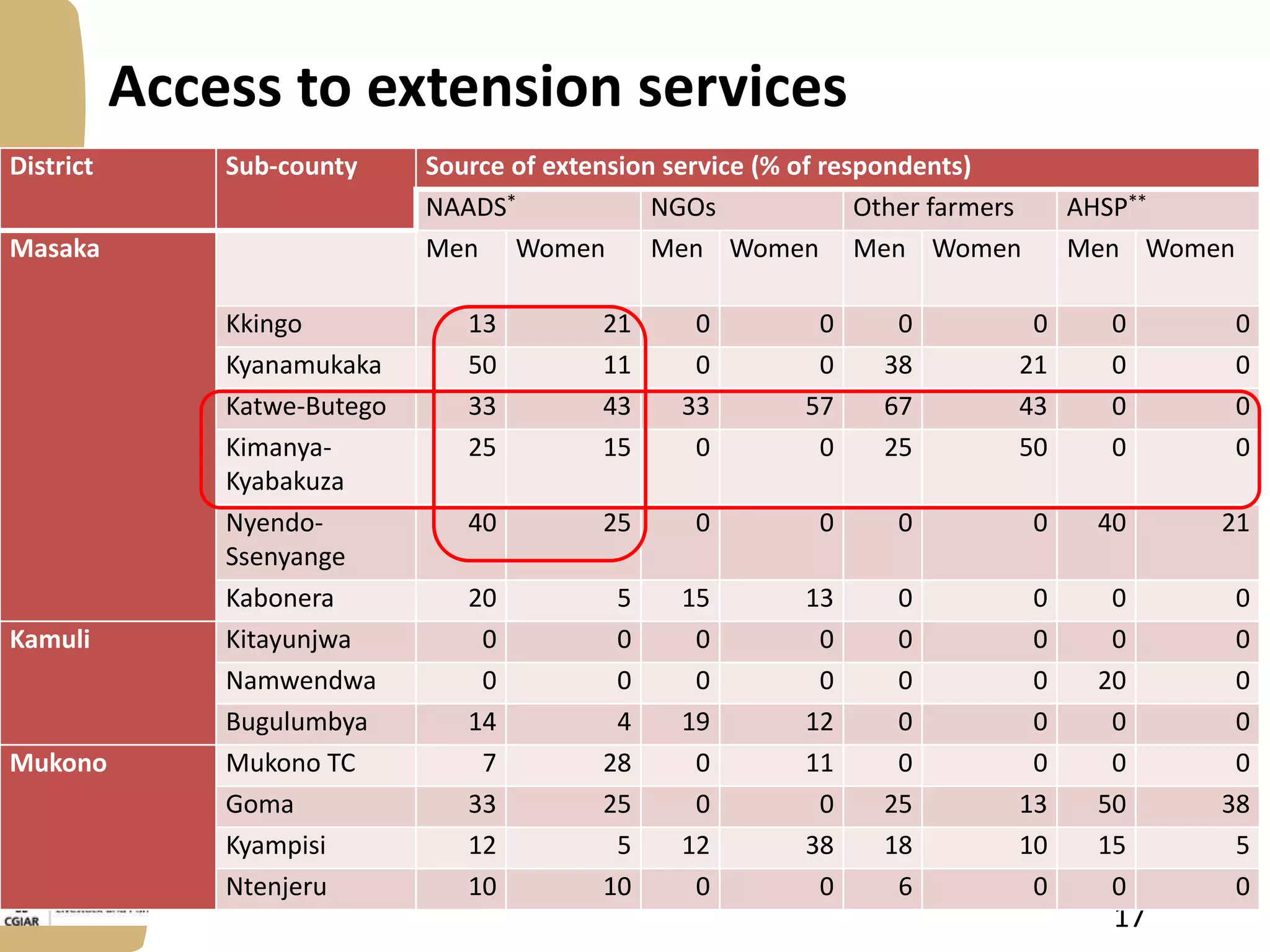
Access to extension services
District

Sub-county

Masaka

Kamuli

Mukono

Kkingo
Kyanamukaka
Katwe-Butego
KimanyaKyabakuza
NyendoSsenyange
Kabonera
Kitayunjwa
Namwendwa
Bugulumbya
Mukono TC
Goma
Kyampisi
Ntenjeru

Source of extension service (% of respondents)
NAADS*
NGOs
Other farmers
Men Women
Men Women Men Women

AHSP**
Men Women

13
50
33
25

21
11
43
15

0
0
33
0

0
0
57
0

0
38
67
25

0
21
43
50

0
0
0
0

0
0
0
0

40

25

0

0

0

0

40

21

20
0
0
14
7
33
12
10

5
0
0
4
28
25
5
10

15
0
0
19
0
0
12
0

13
0
0
12
11
0
38
0

0
0
0
0
0
25
18
6

0
0
0
0
0
13
10
0

0
0
20
0
0
50
15
0

0
0
0
0
0
38
5
0

17
Application of VCA toolkit – other
value chain actors








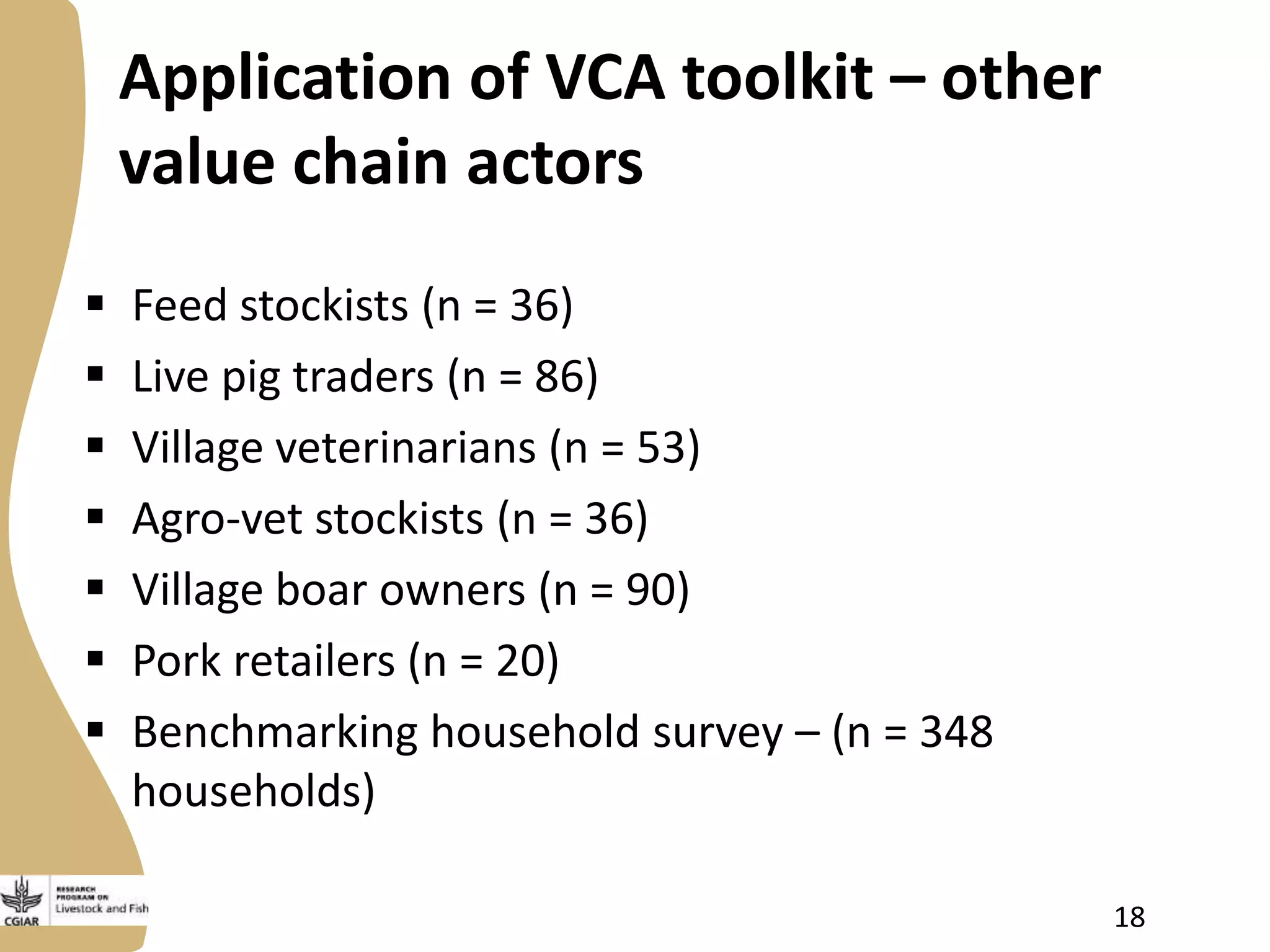
Feed stockists (n = 36)
Live pig traders (n = 86)
Village veterinarians (n = 53)
Agro-vet stockists (n = 36)
Village boar owners (n = 90)
Pork retailers (n = 20)
Benchmarking household survey – (n = 348
households)
18
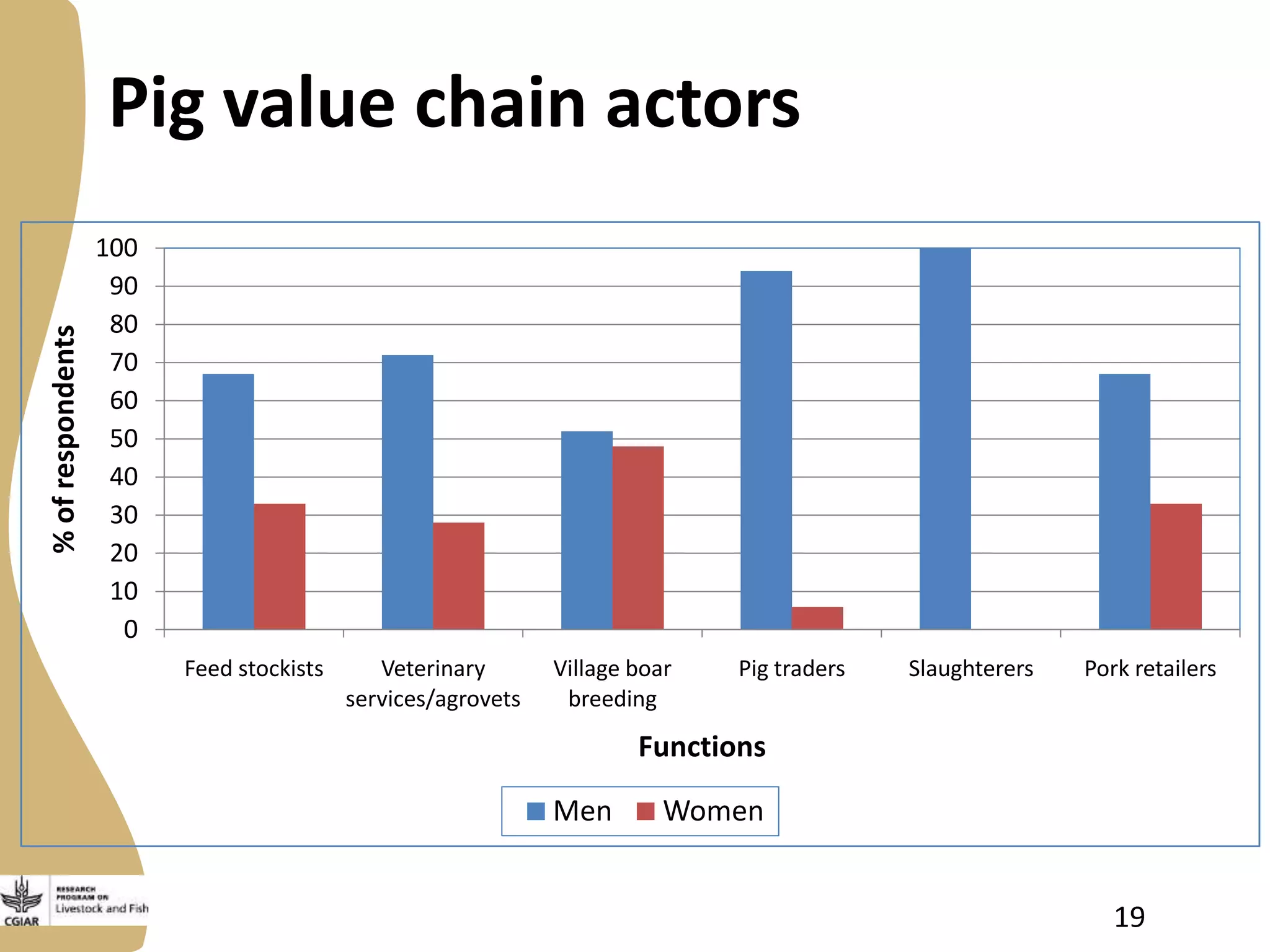
% of respondents

Pig value chain actors
100
90
80
70
60
50
40
30
20
10
0
Feed stockists

Veterinary
services/agrovets

Village boar
breeding

Pig traders

Slaughterers

Pork retailers

Functions
Men

Women
19
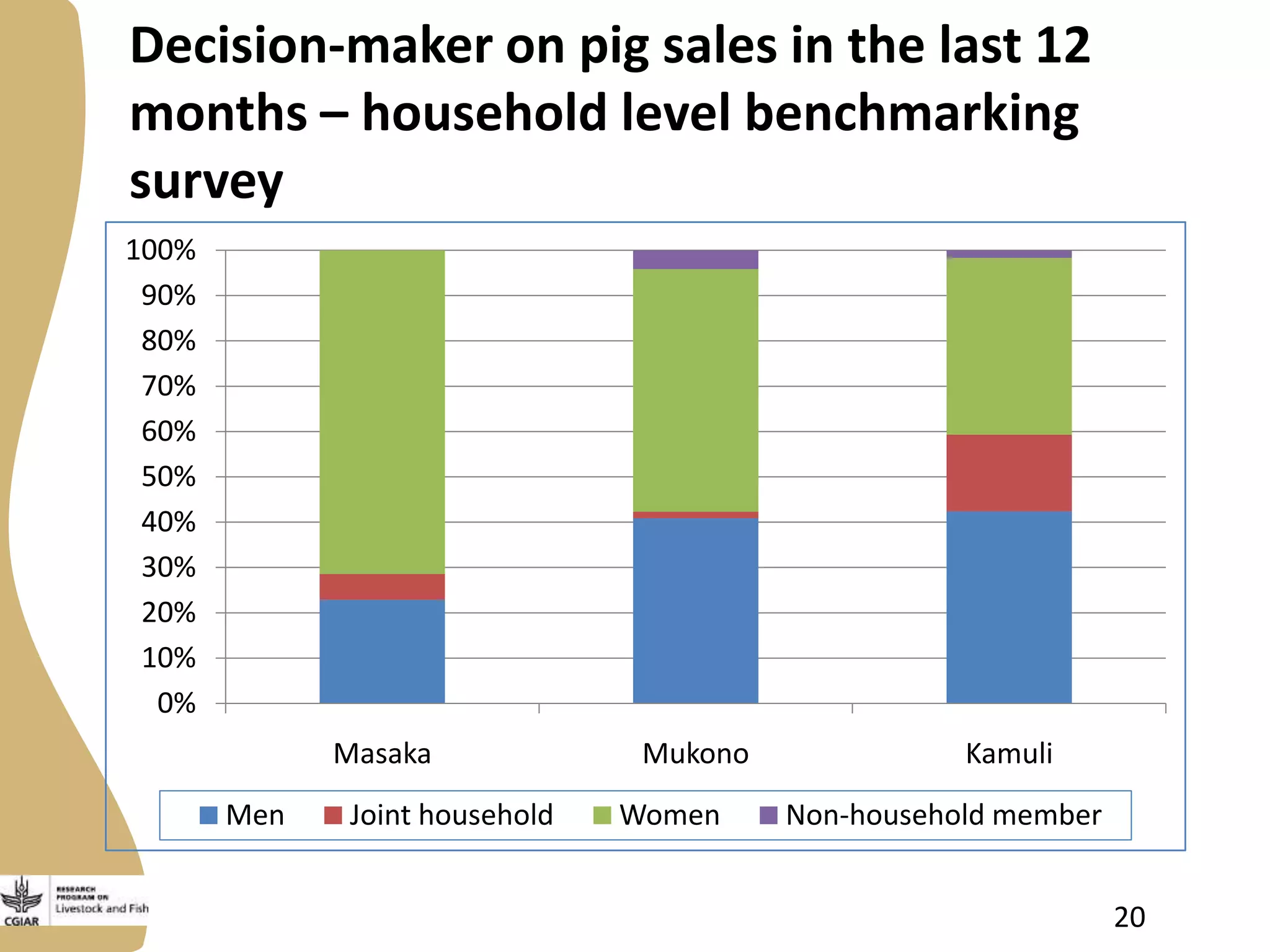
Decision-maker on pig sales in the last 12
months – household level benchmarking
survey
100%
90%
80%
70%
60%
50%
40%
30%
20%
10%
0%
Masaka
Men

Joint household

Mukono
Women

Kamuli
Non-household member
20
Application of the VCA tools: Key lessons
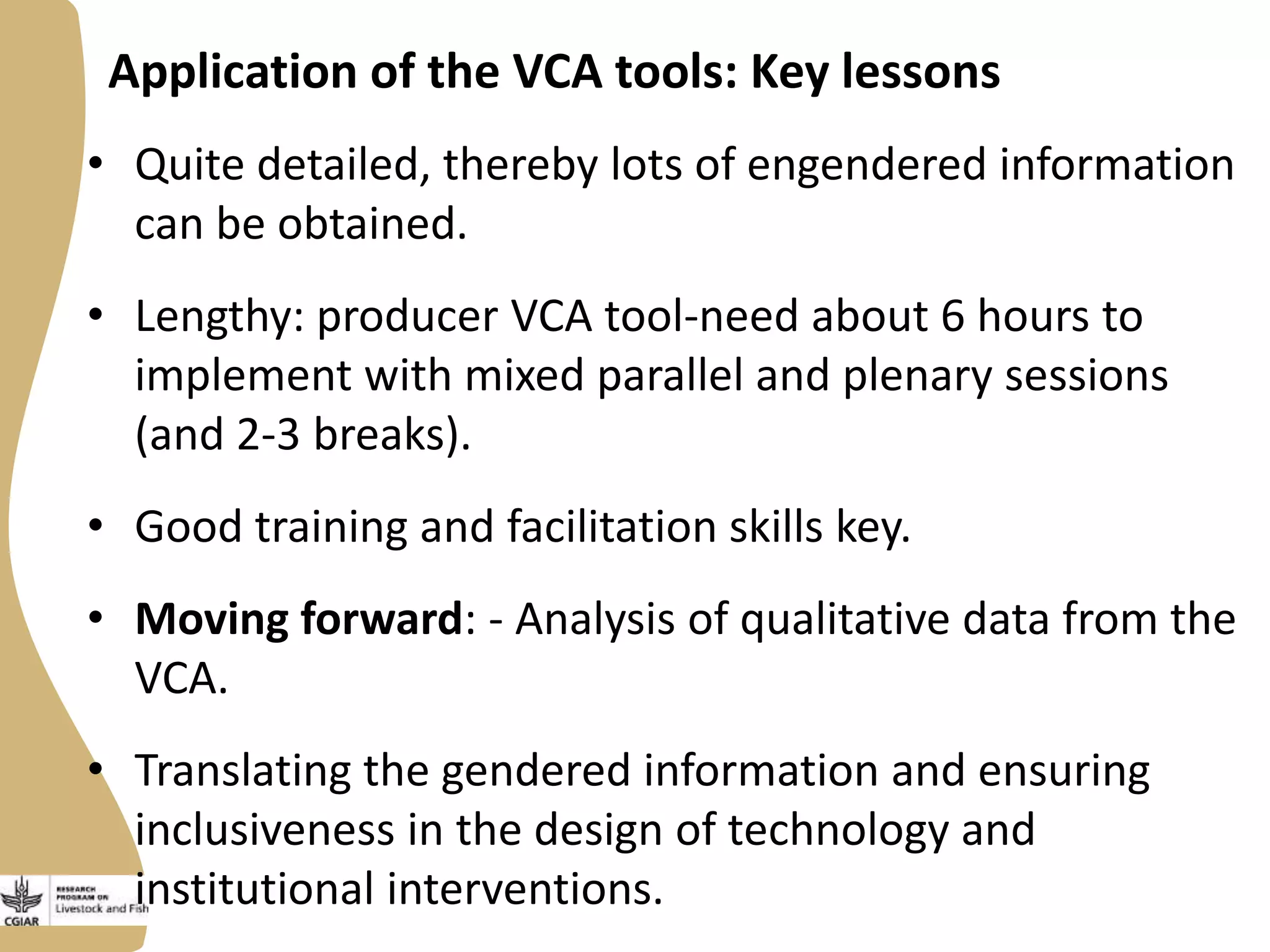
• Quite detailed, thereby lots of engendered information
can be obtained.
• Lengthy: producer VCA tool-need about 6 hours to
implement with mixed parallel and plenary sessions
(and 2-3 breaks).
• Good training and facilitation skills key.
• Moving forward: - Analysis of qualitative data from the
VCA.

• Translating the gendered information and ensuring
inclusiveness in the design of technology and
institutional interventions.
CGIAR Research Program on Livestock and Fish
livestockfish.cgiar.org

CGIAR is a global partnership that unites organizations engaged in research for a food secure future. The CGIAR
Research Program on Livestock and Fish aims to increase the productivity of small-scale livestock and fish systems
in sustainable ways, making meat, milk and fish more available and affordable across the developing world.

Update on Livestock and Fish research program output 2: Gender and value chains

  • 1.
    Update on Livestockand Fish research program output 2: Gender and value chains Hikuepi Katjiuongua, Froukje Kruijssen and Emily Ouma Livestock and Fish Gender Working Group Workshop and Planning Meeting Addis Ababa, Ethiopia, 14-18 October 2013
  • 2.
    Output 2: “Strategiesand approaches through which women and marginalized groups improve the nature and level of participation in livestock and fish value chains” • Develop M and E indicators and build capacity with partners to track interventions that overcome gender based constraints (reported on Day 2) • Contribute to M&E L&F framework to include engendered indicators (reported on Day 2) • Develop rapid and in-depth tools for engendered analysis and identification of interventions, including social analysis tools
  • 3.
    VC Toolkit Development:Progress (2012-2013) • Tools development largely completed • Nov 2012: initial VCA tool development (small group) • Feb 2013: writeshop for further tools development (larger group) – Based on feedback – Refined tools based on set of key research questions and indicators • Further refinement in 2014 based on feedback
  • 4.
    Tool applications • VCA: – – – – – UgandaPig Tanzania Dairy Ethiopia Small Ruminants India Dairy Nicaragua dual purpose (about to start) • VC benchmarking: – Tanzania (pre-writeshop) – field tested and applied in Botswana (Smallholder Competitiveness project) – Preparing in Ethiopia
  • 5.
    VC Toolkit Development:Next steps • Reviewing usage & usefulness of the tools (2014) • Development of database and guidelines for training, implementation analysis and review • Tracking of tool usage and revision based on lessons learned (2014) • Simplify wiki, make it easier for users • Internal review process of tools, reports , best-bets – Decide on process for feedback on content, consistency and quality • Address question on tool ‘harmonization’: – Tools are being adapted, but what common themes & questions are being kept? • Discuss & agree on prioritization process for identifying best-bets interventions & ex ante analysis
  • 6.
    Some challenges • Howdo the tools relate to the IDO and M&E indicators? – Do the tools capture the needed/proposed gender M&E indicators? If not, how do we address this? – What impact assessment methods/approaches will be used to assess the impact of the L&F program (overall and for each VC and theme)? – Is the current level of communication among the L&F value chains sufficient to foster learning as they move along with their respective work plans? If not, how do we best achieve this?
  • 7.
    Application of theVCA tools: experiences from the Uganda pig value chain Application of the toolkit at district and village levels • Launching workshops with district authorities and technical staff. • Review of VCA tool-kit with district technical staff, and coordination of field work. • Farmers participating in VCA sessions selected at random from lists provided by local partners.
  • 8.
    The application ofthe producer VCA toolkit at district / village level (2)  Plenary session to introduce all participants to the VCA tool-kit.  Farmer’ focus group discussions in 35 villages (40 farmers per village and 7-10 key informants).  Farmers distributed at random in 4 groups, with two facilitators per group, to work on specific tools.  Mixed or gender disaggregated groups according to the nature of the tools applied.
  • 9.
    The application ofthe producer VCA tool-kit at district / village level (3)  Separate focus group discussion with key-informants (information at village level).  Plenary session to review/discuss constraints and opportunities identified in small groups working with specific technology components.
  • 10.
    The application ofthe VCA tool-kit at district / village level (4) Key informants Mixed group Only women Plenary session
  • 11.
    Some results Pig incomecontrol and decision making - VCA Men groups 100% 90% 80% 70% 60% 50% 40% 30% 20% 10% 0% Masaka Mukono Male only Joint Female only Kamuli
  • 12.
    Pig income controland decision making-VCA Women groups 100% 90% 80% 70% 60% 50% 40% 30% 20% 10% 0% Masaka Mukono Male only Joint Female only Kamuli
  • 13.
    Activity clock –Men 1.00p.m. 11.00a.m. Mix feeds for pigs and thereafter go for agro-trading or other income generating activities such as “boda-boda” 2.00p.m. 7.00a.m. 6.00p.m. 6.00a.m. Sleep 8.00p.m. 10.00p.m.
  • 14.
    Activity clock -Women 12.00p.m. 2.00p.m. 7.00a.m. Farming, collect animal feed, firewood and family food (vegetables) and banana leaves; other merchandising activities 4.00p.m. 6.00a.m. 6.00p.m. Sleep 8.00p.m. 10.00p.m. Implication of women’s time constraints: Extension and interventions. How much time do they have available?, How time-consuming and labor-intensive are the interventions, How far can they travel for trainings?
  • 15.
    % of households Sourcesof water 90 80 70 60 50 40 30 20 10 0 Masaka Borehole Mukono well Tap/piped water Kamuli Other  On average, time taken to water source: 15 – 25 minutes.  Fetching water:-responsibility of children (64%) and women (19%). 16
  • 16.
    Access to extensionservices District Sub-county Masaka Kamuli Mukono Kkingo Kyanamukaka Katwe-Butego KimanyaKyabakuza NyendoSsenyange Kabonera Kitayunjwa Namwendwa Bugulumbya Mukono TC Goma Kyampisi Ntenjeru Source of extension service (% of respondents) NAADS* NGOs Other farmers Men Women Men Women Men Women AHSP** Men Women 13 50 33 25 21 11 43 15 0 0 33 0 0 0 57 0 0 38 67 25 0 21 43 50 0 0 0 0 0 0 0 0 40 25 0 0 0 0 40 21 20 0 0 14 7 33 12 10 5 0 0 4 28 25 5 10 15 0 0 19 0 0 12 0 13 0 0 12 11 0 38 0 0 0 0 0 0 25 18 6 0 0 0 0 0 13 10 0 0 0 20 0 0 50 15 0 0 0 0 0 0 38 5 0 17
  • 17.
    Application of VCAtoolkit – other value chain actors        Feed stockists (n = 36) Live pig traders (n = 86) Village veterinarians (n = 53) Agro-vet stockists (n = 36) Village boar owners (n = 90) Pork retailers (n = 20) Benchmarking household survey – (n = 348 households) 18
  • 18.
    % of respondents Pigvalue chain actors 100 90 80 70 60 50 40 30 20 10 0 Feed stockists Veterinary services/agrovets Village boar breeding Pig traders Slaughterers Pork retailers Functions Men Women 19
  • 19.
    Decision-maker on pigsales in the last 12 months – household level benchmarking survey 100% 90% 80% 70% 60% 50% 40% 30% 20% 10% 0% Masaka Men Joint household Mukono Women Kamuli Non-household member 20
  • 20.
    Application of theVCA tools: Key lessons • Quite detailed, thereby lots of engendered information can be obtained. • Lengthy: producer VCA tool-need about 6 hours to implement with mixed parallel and plenary sessions (and 2-3 breaks). • Good training and facilitation skills key. • Moving forward: - Analysis of qualitative data from the VCA. • Translating the gendered information and ensuring inclusiveness in the design of technology and institutional interventions.
  • 21.
    CGIAR Research Programon Livestock and Fish livestockfish.cgiar.org CGIAR is a global partnership that unites organizations engaged in research for a food secure future. The CGIAR Research Program on Livestock and Fish aims to increase the productivity of small-scale livestock and fish systems in sustainable ways, making meat, milk and fish more available and affordable across the developing world.

Editor's Notes

  • #5 Page title minimum of 30 points and maximumof two linesMain point 6 point smaller than slide titleBullet points 4 point less than main pointFont type is CalibriIt is advised in one slide maximum 6 bulletsWe recommend you use images on slidesYou can change partner logos on front pageYou have to duplicate this slide for more inside pages
  • #7 Page title minimum of 30 points and maximumof two linesMain point 6 point smaller than slide titleBullet points 4 point less than main pointFont type is CalibriIt is advised in one slide maximum 6 bulletsWe recommend you use images on slidesYou can change partner logos on front pageYou have to duplicate this slide for more inside pages
  • #8 Page title minimum of 30 points and maximumof two linesMain point 6 point smaller than slide titleBullet points 4 point less than main pointFont type is CalibriIt is advised in one slide maximum 6 bulletsWe recommend you use images on slidesYou can change partner logos on front pageYou have to duplicate this slide for more inside pages
  • #13 GomaNamwendwa – pig income control by men due to family headship.Income control, largely a shared responsibility.In a no. of R-R domains, pig income decisions are made by men.In Goma – Men are the decision makers (head of household).
  • #14 In locations where men indicate pig income control as a man’s domain, the women groups indicate it as a shared responsibility.Women, indicate that they are the main decision-makers – the enterprise is theirs and they are the ones who make decisions.
  • #15 1. Amount of leisure time