Update on Gender in CGIAR 
Intermediate Development 
Outcomes (IDOs) 
Nancy Johnson, IFPRI 
A4NH Gender-Nutrition Methods Workshop II, December 2-4, 2014 
Bioversity International - Rome, Italy
Overview 
• Background on IDOs 
• Current version results framework 
• Issues for discussion
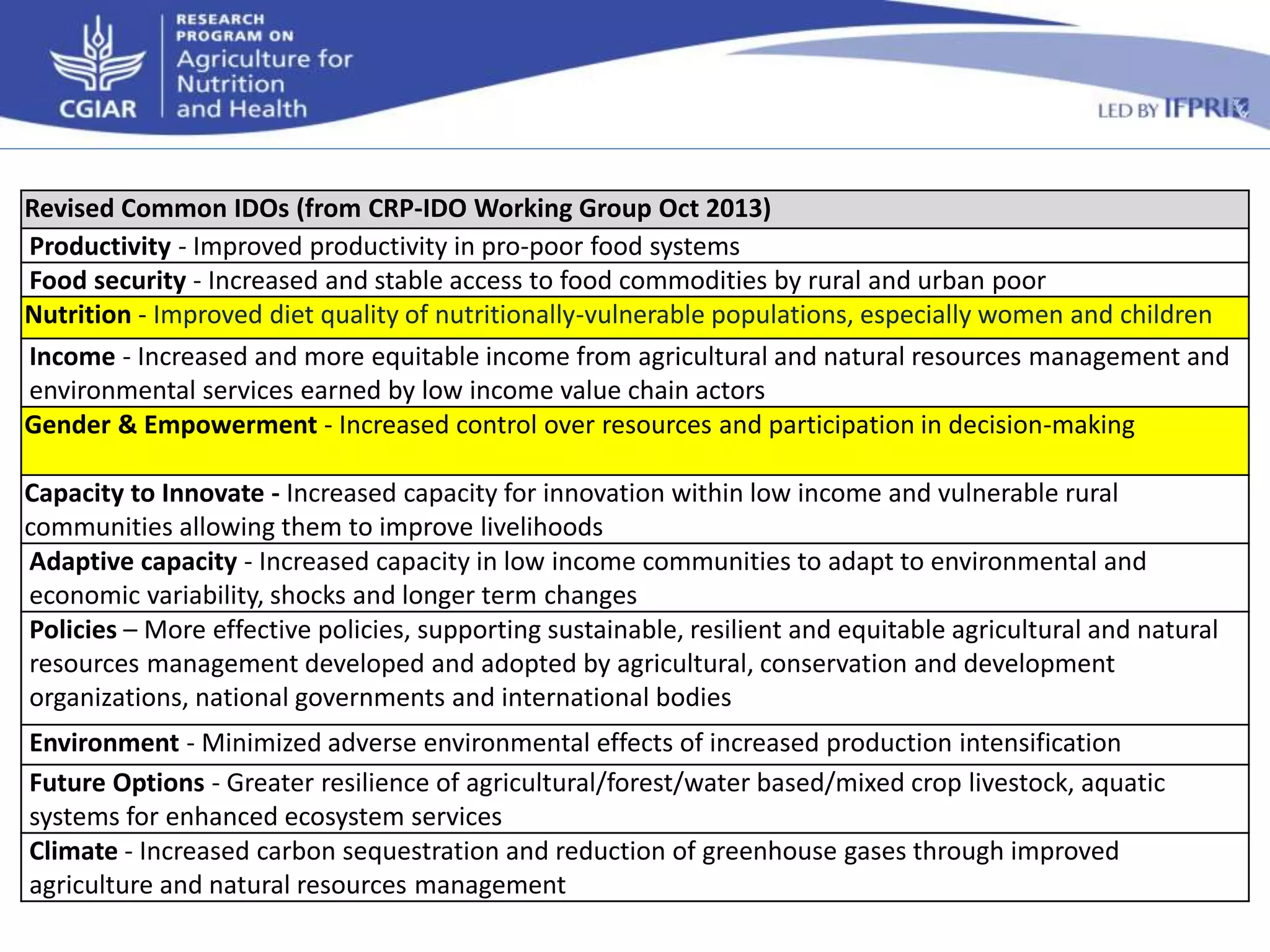
Revised Common IDOs (from CRP-IDO Working Group Oct 2013) 
Productivity - Improved productivity in pro-poor food systems 
Food security - Increased and stable access to food commodities by rural and urban poor 
Nutrition - Improved diet quality of nutritionally-vulnerable populations, especially women and children 
Income - Increased and more equitable income from agricultural and natural resources management and 
environmental services earned by low income value chain actors 
Gender & Empowerment - Increased control over resources and participation in decision-making 
Capacity to Innovate - Increased capacity for innovation within low income and vulnerable rural 
communities allowing them to improve livelihoods 
Adaptive capacity - Increased capacity in low income communities to adapt to environmental and 
economic variability, shocks and longer term changes 
Policies – More effective policies, supporting sustainable, resilient and equitable agricultural and natural 
resources management developed and adopted by agricultural, conservation and development 
organizations, national governments and international bodies 
Environment - Minimized adverse environmental effects of increased production intensification 
Future Options - Greater resilience of agricultural/forest/water based/mixed crop livestock, aquatic 
systems for enhanced ecosystem services 
Climate - Increased carbon sequestration and reduction of greenhouse gases through improved 
agriculture and natural resources management
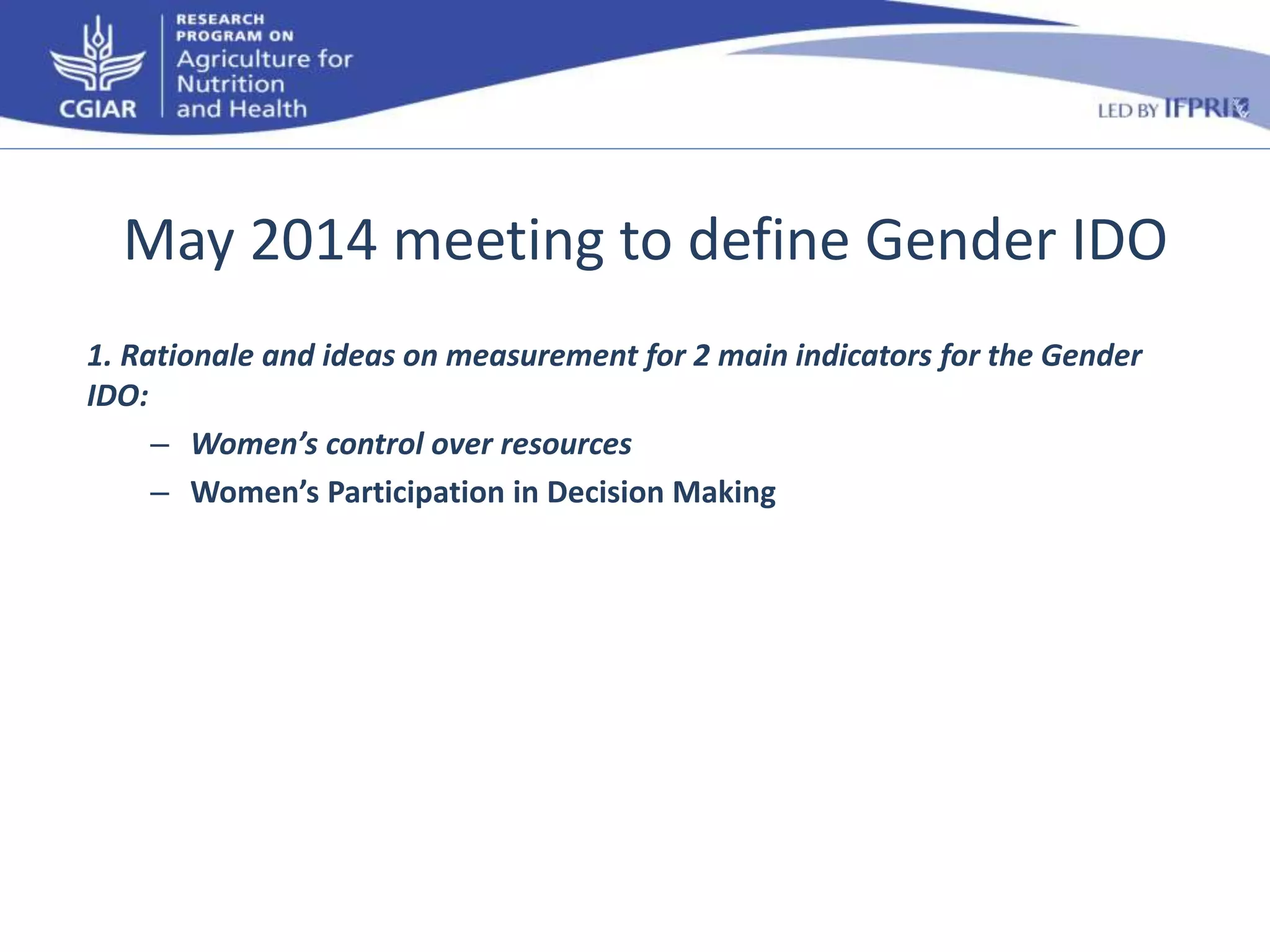
May 2014 meeting to define Gender IDO 
1. Rationale and ideas on measurement for 2 main indicators for the Gender 
IDO: 
– Women’s control over resources 
– Women’s Participation in Decision Making
Women’s Participation in Decision Making 
Rationale: Decision-making refers to decision-making by 
individuals about their management of agriculture and natural 
resources and related life choices... Increased participation in 
decision-making includes both a greater degree of participation 
in specific decisions that relate to women’s own wellbeing and 
that of their households and an expansion of the range of 
decisions and available choices in which women (and their 
families and communities) can participate. 
Measurement: This indicator is based on participation in three 
areas of decision-making 
– Decisions over own labor 
– Decisions over own income 
– Decisions made in groups or collective organization.
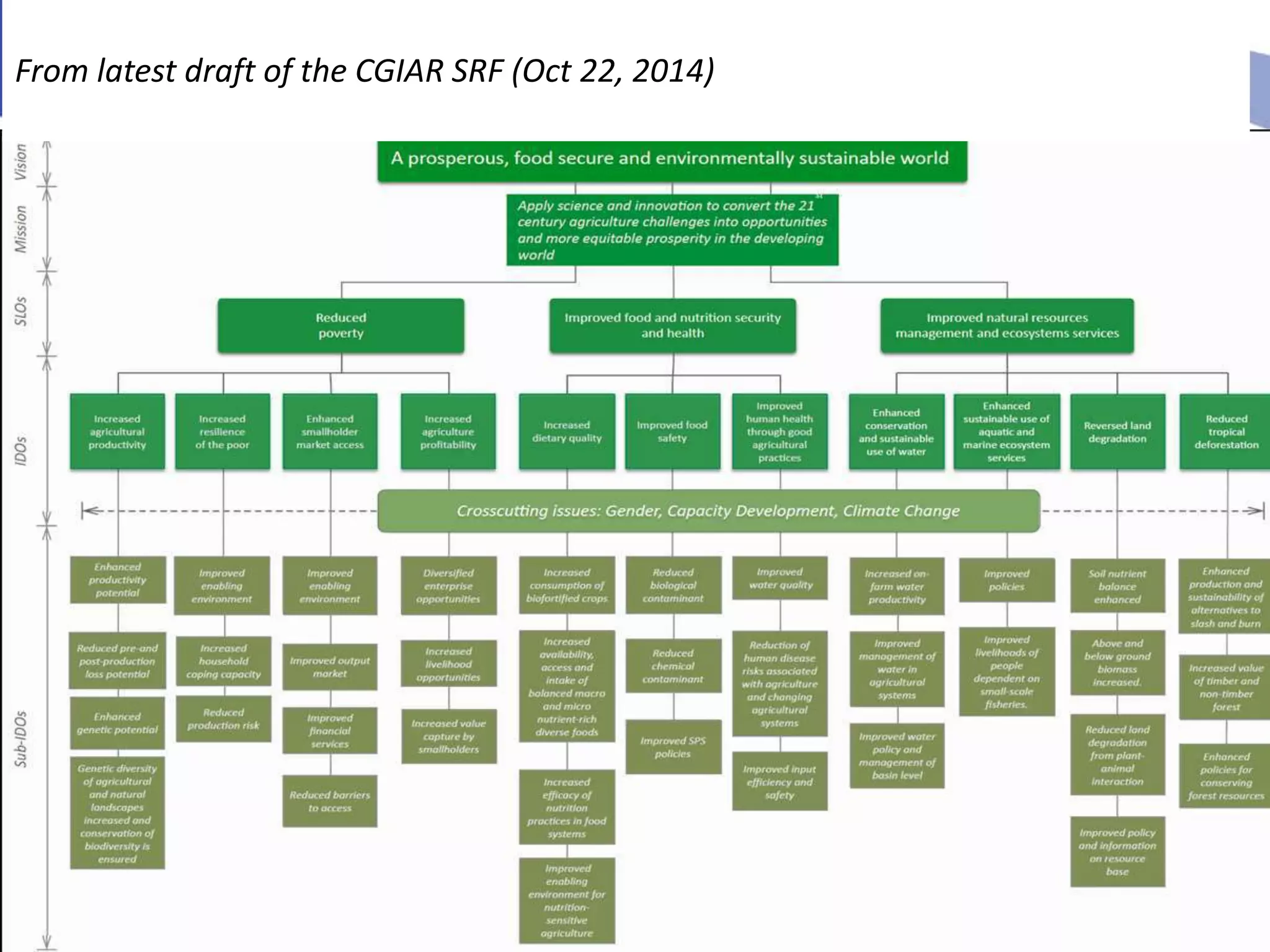
From latest draft of the CGIAR SRF (Oct 22, 2014)
Where are women? 
• Mission: To harness science and innovation to 
meet the multi-sectoral challenges of the 21st 
century with a focus on enabling the poor and 
women to benefit from economic growth in 
the agri-food sector in the face of climate 
change 
• Many IDO and sub-IDO indicators are 
specifically are measured for women
Where is gender? 
• Part of the research strategy 
– One of the sub-principles underlying the research strategy is 
that CGIAR research will “foster and promote gender equity” 
– From discussion cross-cutting science initiatives 
• “A gender lens will ensure that developed and promoted products and 
services are either gender neutral or specifically address the needs of 
women actors along the value chain to increase their influence over 
resources and decision-making processes” (p 15).
Issues for discussion 
• SRF is a work in progress, but needs to be 
finalized soon. 
– Consultation process is ongoing (see next two slides) 
• Work on indicators of women’s empowerment is 
ongoing 
• CRP willingness/ability to commit resources to 
gender research, in the absence of a gender IDO?
Dear A4NH Partners, 
The CGIAR is developing a new Strategy and Results Framework, that will guide both the structure and 
content of the CGIAR’s research over the next years. We have been asked to forward the information 
below on providing input and feedback into the developing Strategy and results framework. Please see 
below, and provide your input as soon as you can. 
Many thanks, 
John 
John McDermott 
Director, The CGIAR Research Program on Agriculture for Nutrition and Health (A4NH) 
------------------------------------------------------------------------------------------- 
What should be priorities for International Agricultural Research for Development? 
As the first part of the GCARD3 consultations, CGIAR and GFAR are inviting stakeholders and partners 
to share their inputs and feedback on international research priorities, as proposed in the draft 
Strategy and Results Framework for future work of the CGIAR. 
The consultation has been launched here: http://ifpri.us5.list-manage1. 
com/track/click?u=c2f9baea83698b4cd1f826c85&id=3b8b188932&e=0818c2f548
We appreciate that this is a busy time of year and do hope that you can take some time to participate 
in the consultations. Your opinions and comments are very much valued in ensuring that the CGIAR has 
a robust and inclusive Strategy and Results Framework that reflects its role and guides its future work. 
A summary document for the consultation is available at: http://ifpri.us5.list-manage. 
com/track/click?u=c2f9baea83698b4cd1f826c85&id=ac78abee04&e=0818c2f548 
There are many ways by which you can have your say on these plans: 
• a dedicated email address has been set up to receive feedback directly - partnerships@cgiar.org • a 
survey at http://ifpri.us5.list-manage. 
com/track/click?u=c2f9baea83698b4cd1f826c85&id=51eac569ad&e=0818c2f548 
• an online version of the Strategy and Results Framework is available for comments at 
www.cgiar.org/srfe-consultation • there will be weekly ‘call-in’ programs set up for conversations and 
questions (schedule to be announced) 
All feedback and comments will be collected and publicly shared on a dedicated online space at 
www.cgiar.org/srfconsultation 
Respond and feel invited to share this widely with your contacts please! 
Thank you in advance for your productive comments and suggestions towards strengthening the SRF.

Day 1 - Johnson - Update on Gender in CGIAR Intermediate Development Outcomes (IDOs)

  • 1.
    Update on Genderin CGIAR Intermediate Development Outcomes (IDOs) Nancy Johnson, IFPRI A4NH Gender-Nutrition Methods Workshop II, December 2-4, 2014 Bioversity International - Rome, Italy
  • 2.
    Overview • Backgroundon IDOs • Current version results framework • Issues for discussion
  • 3.
    Revised Common IDOs(from CRP-IDO Working Group Oct 2013) Productivity - Improved productivity in pro-poor food systems Food security - Increased and stable access to food commodities by rural and urban poor Nutrition - Improved diet quality of nutritionally-vulnerable populations, especially women and children Income - Increased and more equitable income from agricultural and natural resources management and environmental services earned by low income value chain actors Gender & Empowerment - Increased control over resources and participation in decision-making Capacity to Innovate - Increased capacity for innovation within low income and vulnerable rural communities allowing them to improve livelihoods Adaptive capacity - Increased capacity in low income communities to adapt to environmental and economic variability, shocks and longer term changes Policies – More effective policies, supporting sustainable, resilient and equitable agricultural and natural resources management developed and adopted by agricultural, conservation and development organizations, national governments and international bodies Environment - Minimized adverse environmental effects of increased production intensification Future Options - Greater resilience of agricultural/forest/water based/mixed crop livestock, aquatic systems for enhanced ecosystem services Climate - Increased carbon sequestration and reduction of greenhouse gases through improved agriculture and natural resources management
  • 4.
    May 2014 meetingto define Gender IDO 1. Rationale and ideas on measurement for 2 main indicators for the Gender IDO: – Women’s control over resources – Women’s Participation in Decision Making
  • 5.
    Women’s Participation inDecision Making Rationale: Decision-making refers to decision-making by individuals about their management of agriculture and natural resources and related life choices... Increased participation in decision-making includes both a greater degree of participation in specific decisions that relate to women’s own wellbeing and that of their households and an expansion of the range of decisions and available choices in which women (and their families and communities) can participate. Measurement: This indicator is based on participation in three areas of decision-making – Decisions over own labor – Decisions over own income – Decisions made in groups or collective organization.
  • 6.
    From latest draftof the CGIAR SRF (Oct 22, 2014)
  • 7.
    Where are women? • Mission: To harness science and innovation to meet the multi-sectoral challenges of the 21st century with a focus on enabling the poor and women to benefit from economic growth in the agri-food sector in the face of climate change • Many IDO and sub-IDO indicators are specifically are measured for women
  • 8.
    Where is gender? • Part of the research strategy – One of the sub-principles underlying the research strategy is that CGIAR research will “foster and promote gender equity” – From discussion cross-cutting science initiatives • “A gender lens will ensure that developed and promoted products and services are either gender neutral or specifically address the needs of women actors along the value chain to increase their influence over resources and decision-making processes” (p 15).
  • 9.
    Issues for discussion • SRF is a work in progress, but needs to be finalized soon. – Consultation process is ongoing (see next two slides) • Work on indicators of women’s empowerment is ongoing • CRP willingness/ability to commit resources to gender research, in the absence of a gender IDO?
  • 10.
    Dear A4NH Partners, The CGIAR is developing a new Strategy and Results Framework, that will guide both the structure and content of the CGIAR’s research over the next years. We have been asked to forward the information below on providing input and feedback into the developing Strategy and results framework. Please see below, and provide your input as soon as you can. Many thanks, John John McDermott Director, The CGIAR Research Program on Agriculture for Nutrition and Health (A4NH) ------------------------------------------------------------------------------------------- What should be priorities for International Agricultural Research for Development? As the first part of the GCARD3 consultations, CGIAR and GFAR are inviting stakeholders and partners to share their inputs and feedback on international research priorities, as proposed in the draft Strategy and Results Framework for future work of the CGIAR. The consultation has been launched here: http://ifpri.us5.list-manage1. com/track/click?u=c2f9baea83698b4cd1f826c85&id=3b8b188932&e=0818c2f548
  • 11.
    We appreciate thatthis is a busy time of year and do hope that you can take some time to participate in the consultations. Your opinions and comments are very much valued in ensuring that the CGIAR has a robust and inclusive Strategy and Results Framework that reflects its role and guides its future work. A summary document for the consultation is available at: http://ifpri.us5.list-manage. com/track/click?u=c2f9baea83698b4cd1f826c85&id=ac78abee04&e=0818c2f548 There are many ways by which you can have your say on these plans: • a dedicated email address has been set up to receive feedback directly - partnerships@cgiar.org • a survey at http://ifpri.us5.list-manage. com/track/click?u=c2f9baea83698b4cd1f826c85&id=51eac569ad&e=0818c2f548 • an online version of the Strategy and Results Framework is available for comments at www.cgiar.org/srfe-consultation • there will be weekly ‘call-in’ programs set up for conversations and questions (schedule to be announced) All feedback and comments will be collected and publicly shared on a dedicated online space at www.cgiar.org/srfconsultation Respond and feel invited to share this widely with your contacts please! Thank you in advance for your productive comments and suggestions towards strengthening the SRF.

Editor's Notes

  • #2 IDO important for this workshop. Nutrition is an important and new outcome for some of the CRPs—and gender is an important mediator for nut outcomes from ag. Nut community has thought a lot this, especially the pathways, but there is more to do.
  • #4 11 common IDOs working groups around definitions Our first meeting last year was about that—dietary diversity, with emphasis on gender. CRPs invited here have nutrition IDOs.
  • #8 In July, a donor-led process reviewed progress to date on SRF and proposed a revised version. Not very visible