Improving JSR Practices at Country
Level: Achievements and Gaps in
Southern Africa
Greenwell Matchaya, Coordinator for ReSAKSS
Southern Africa (SA), International Water
Management Institute (IWMI), South Africa
g.matchaya@cigar.org
What is a Joint Sector Review (JSR)?
 A joint sector review (JSR) is one way of
operationalizing the mutual accountability
framework at country level
 The JSR process creates a platform to:
» assess the performance and results of the
agriculture sector
» assist governments in setting sector policy
and priorities
» assess how well state and non state actors
have implemented pledges and commitments
(laid out in NAIPs, and other agreements)
Purpose and benefits of the Joint Sector Review
 The primary purpose of a JSR is to determine and evaluate
observed results of sector performance and their comparison
with the intended results or targets
 Therefore, the JSR:
» allows diverse stakeholders to get insights into and
influence overall policies and priorities of the sector
» serves as a management and policy support tool for
inclusive stakeholder planning, programming, budget
preparation and execution, monitoring and evaluation, and
overall development of the sector
 Existing country JSRs need strengthening in terms of design,
stakeholder inclusion, data analysis, dialogue and improved
quality of implementation.
Principles of a Joint Sector Review
 National ownership and leadership
 Relevance to NAIP or cooperation agreement
 Inclusive participation
 Commitment to results by all participants
 Impartiality and evidence-based
 Enhance national planning
 Sensitivity to gender
 Learning experience
What the JSR process does for a country
Describe and analyze the structure, conduct
and performance (SCP) of the sector against
mutually-agreed milestones and targets
Identify strengths, weaknesses,
opportunities and threats (SWOT) in the
sector
Based on the results and findings in the
above, make recommendations for
improving performance in the sector.
What is monitored in a Joint Sector Review
 Development results e.g. income growth, poverty and
hunger reduction, food and nutrition security, etc
 Overall agricultural sector growth target, with specific
subsector and commodity targets
 Required financial and non-financial resources to
effectively implement the plan
 Policies, programs, institutions, and implementation
processes
 Linkages (including pathways to achieve the development
results), enabling environment and assumptions
Roadmap for undertaking a Joint Sector Review
 Set up a JSR steering committee chaired
by Ministry of Agriculture
 Establish JSR secretariat
 Develop terms of reference for the JSR
 Mobilize resources
 Constitute review team
 Undertake the review and dialogue
 Draw implementation and follow-up plan
for the recommendations from the JSR
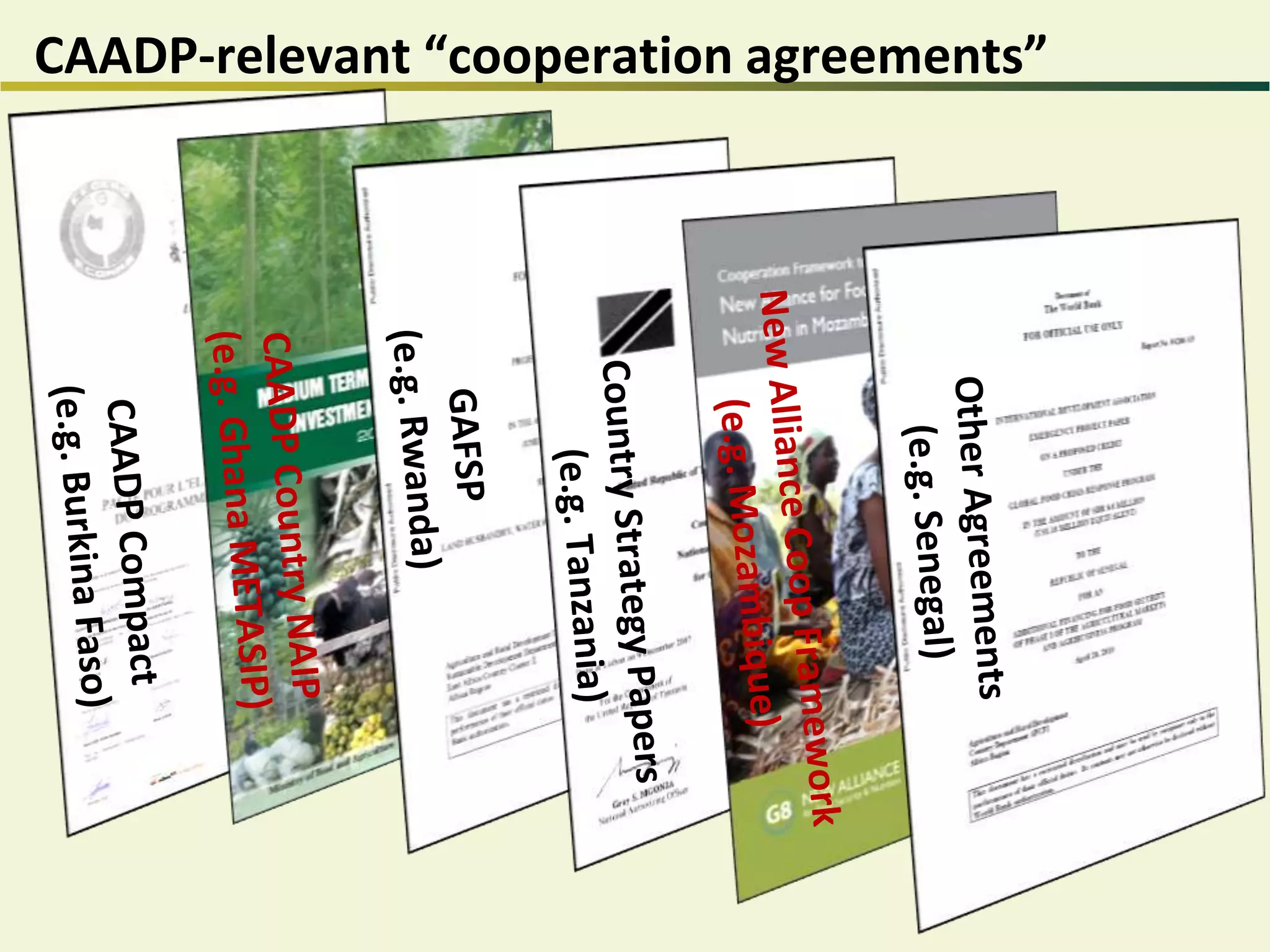
CAADP-relevant “cooperation agreements”
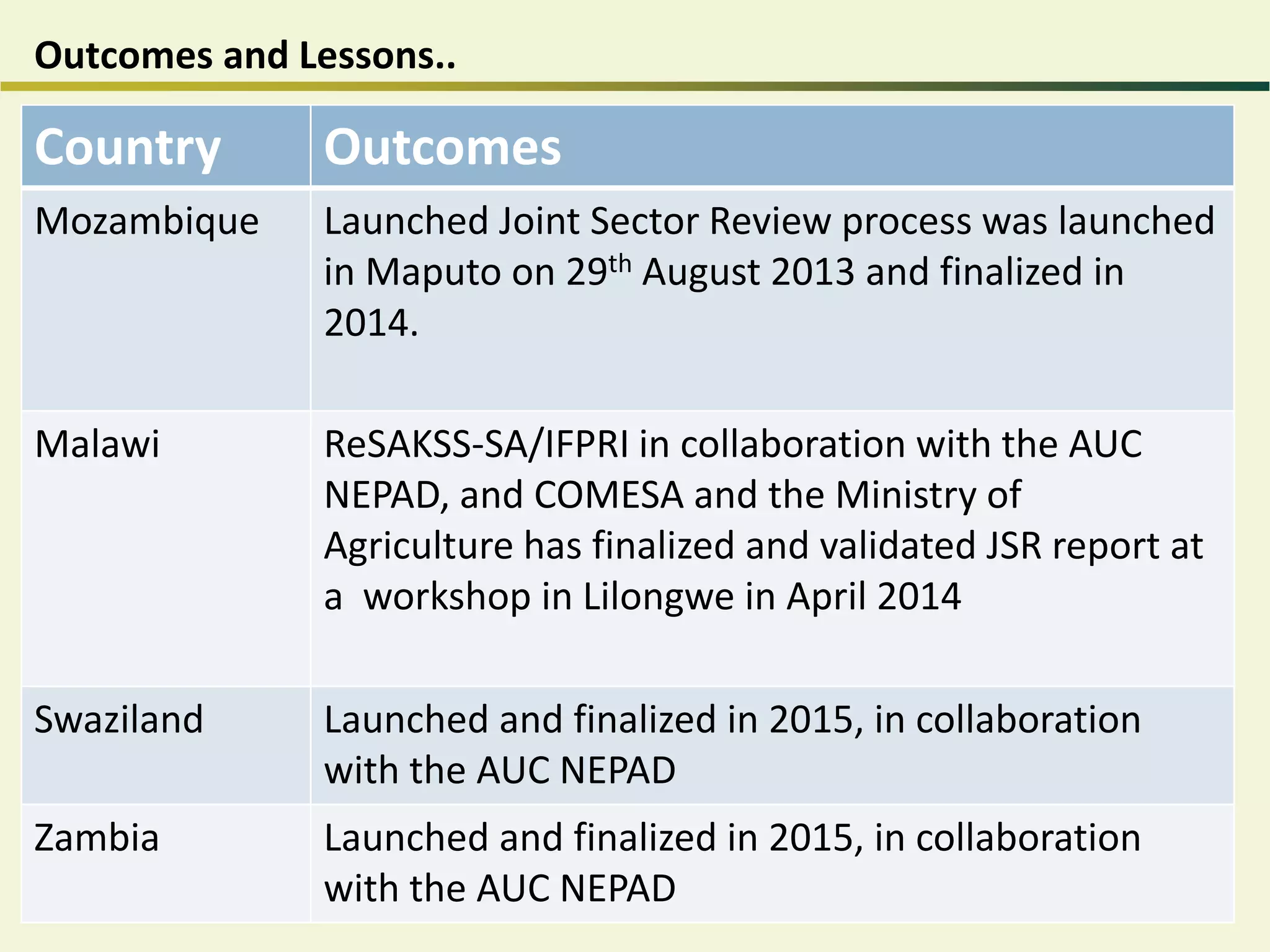
Outcomes and Lessons..
Country Outcomes
Mozambique Launched Joint Sector Review process was launched
in Maputo on 29th August 2013 and finalized in
2014.
Malawi ReSAKSS-SA/IFPRI in collaboration with the AUC
NEPAD, and COMESA and the Ministry of
Agriculture has finalized and validated JSR report at
a workshop in Lilongwe in April 2014
Swaziland Launched and finalized in 2015, in collaboration
with the AUC NEPAD
Zambia Launched and finalized in 2015, in collaboration
with the AUC NEPAD
Outcomes
 Countries are using outcomes of the JSR
assessments as well as ATORs
» to support policy review and dialogue
processes.
 In 2015, Malawi JSR followed the JSR
assessment recommendations by ReSAKSS
 Swaziland’s demand for more technical
support in M&E increased following JSR
assessment that revealed gaps
Outcomes
 JSR work has stimulated demand for more
data and hence, strong M&E
 Results from the JSR assessment reports
used in compiling the New Alliance report
for 2013-2014 in Mozambique
 Countries demanding more work on linkages
of policies, indicators of investments to
development results
Outcomes -Malawi
• Recommendations from JSR assessments have helped
country to set up ambitious agenda on the JSR process
• Malawi has incorporated lessons from JSR Assessment
exercise into their JSR process
• JSR processes were largely Ministry of Agriculture
focused but are now more inclusive following Mutual
accountability process
• However need to further enhance CSO and private
sector participation
• Issues raised from JSR process delegated to technical
working groups under ASWAp for action
Outcomes-Mozambique
• Various Ministries report progress within their sectors
at annual review.
• Adoption of the CAADP Compact further strengthened
review process. Private sector involvement became
stronger after adoption of CAADP
• Implementation of the G8NA further strengthening the
process
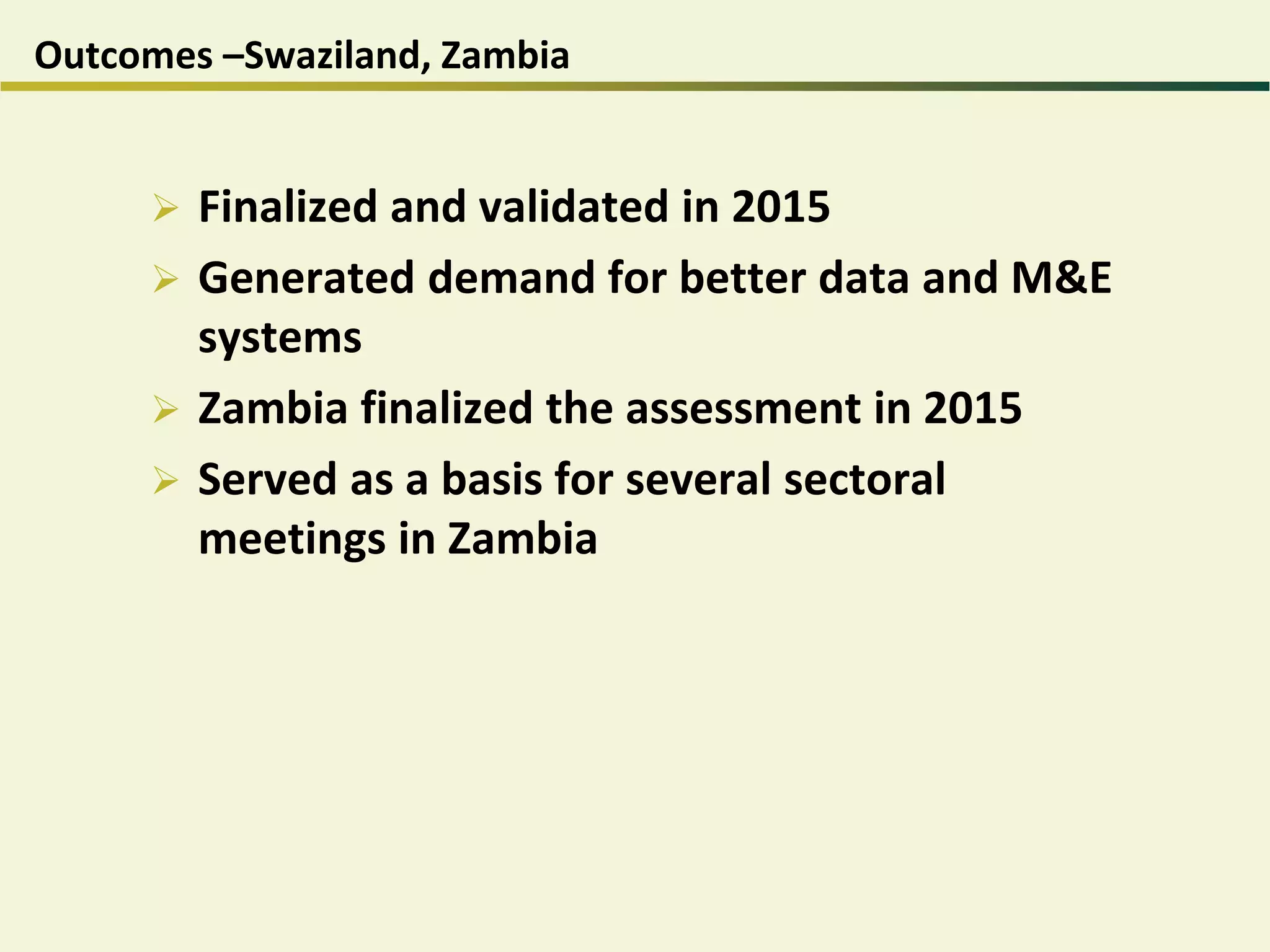
Outcomes –Swaziland, Zambia
 Finalized and validated in 2015
 Generated demand for better data and M&E
systems
 Zambia finalized the assessment in 2015
 Served as a basis for several sectoral
meetings in Zambia
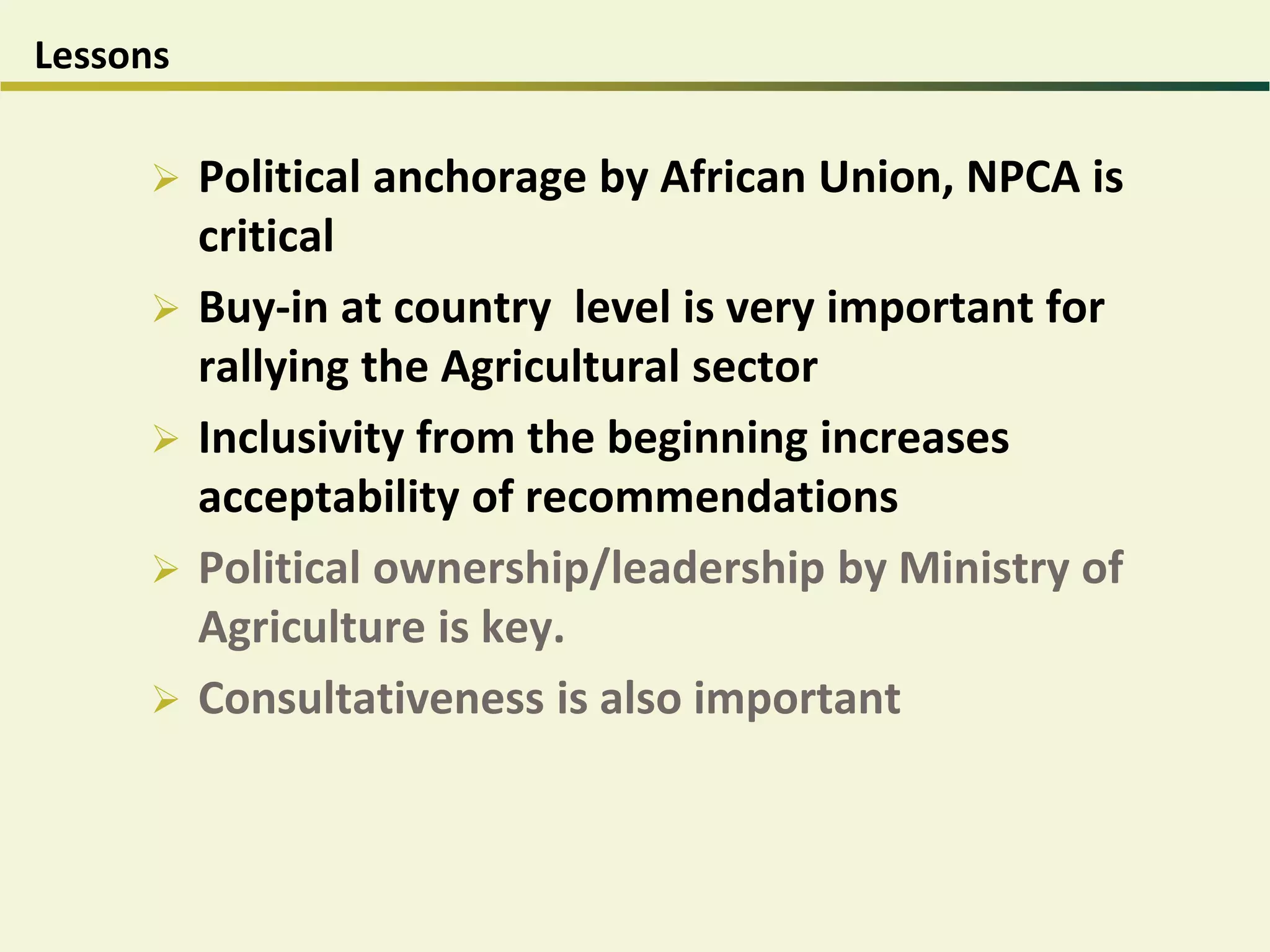
Lessons
 Political anchorage by African Union, NPCA is
critical
 Buy-in at country level is very important for
rallying the Agricultural sector
 Inclusivity from the beginning increases
acceptability of recommendations
 Political ownership/leadership by Ministry of
Agriculture is key.
 Consultativeness is also important
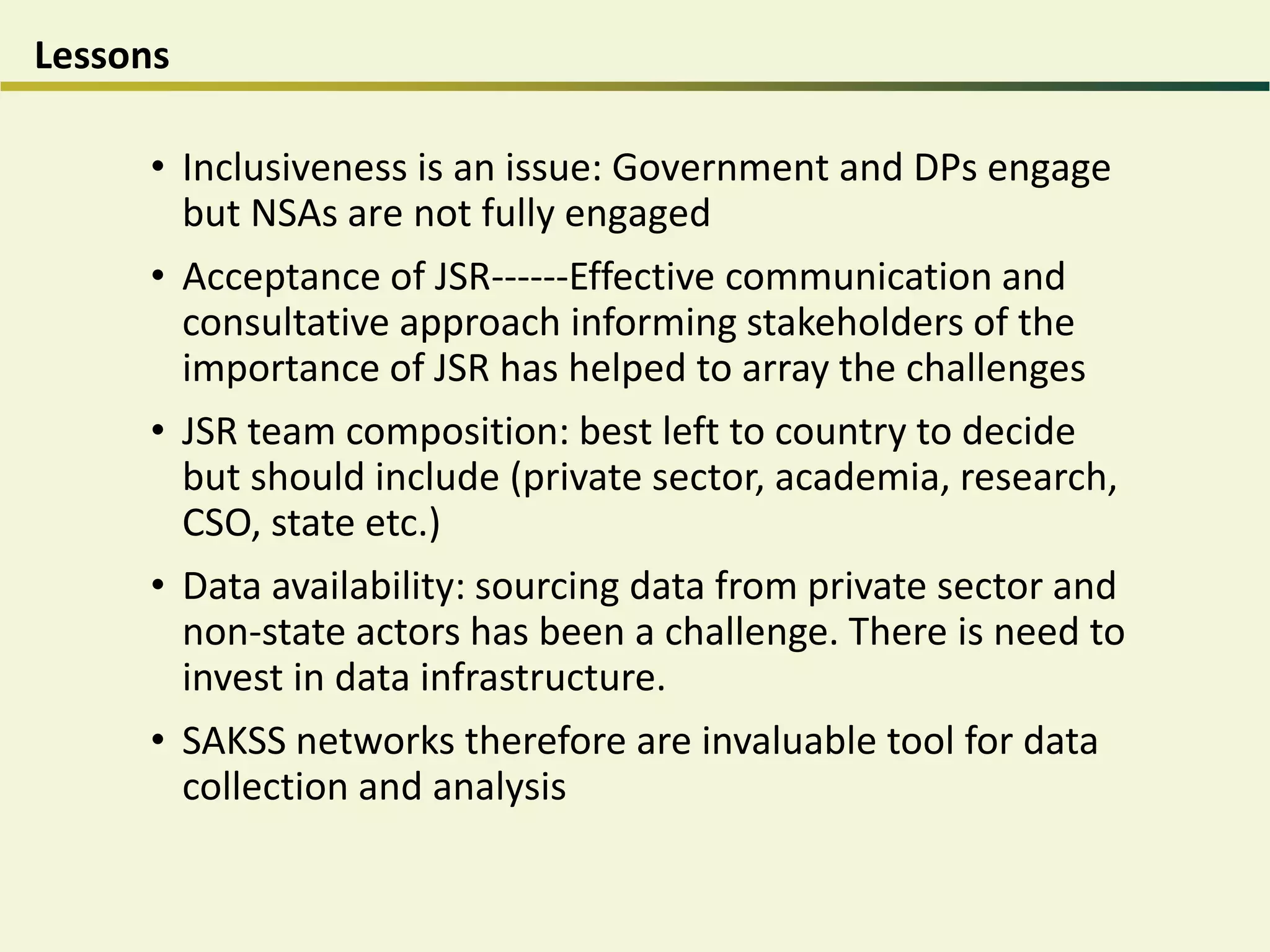
Lessons
• Inclusiveness is an issue: Government and DPs engage
but NSAs are not fully engaged
• Acceptance of JSR------Effective communication and
consultative approach informing stakeholders of the
importance of JSR has helped to array the challenges
• JSR team composition: best left to country to decide
but should include (private sector, academia, research,
CSO, state etc.)
• Data availability: sourcing data from private sector and
non-state actors has been a challenge. There is need to
invest in data infrastructure.
• SAKSS networks therefore are invaluable tool for data
collection and analysis
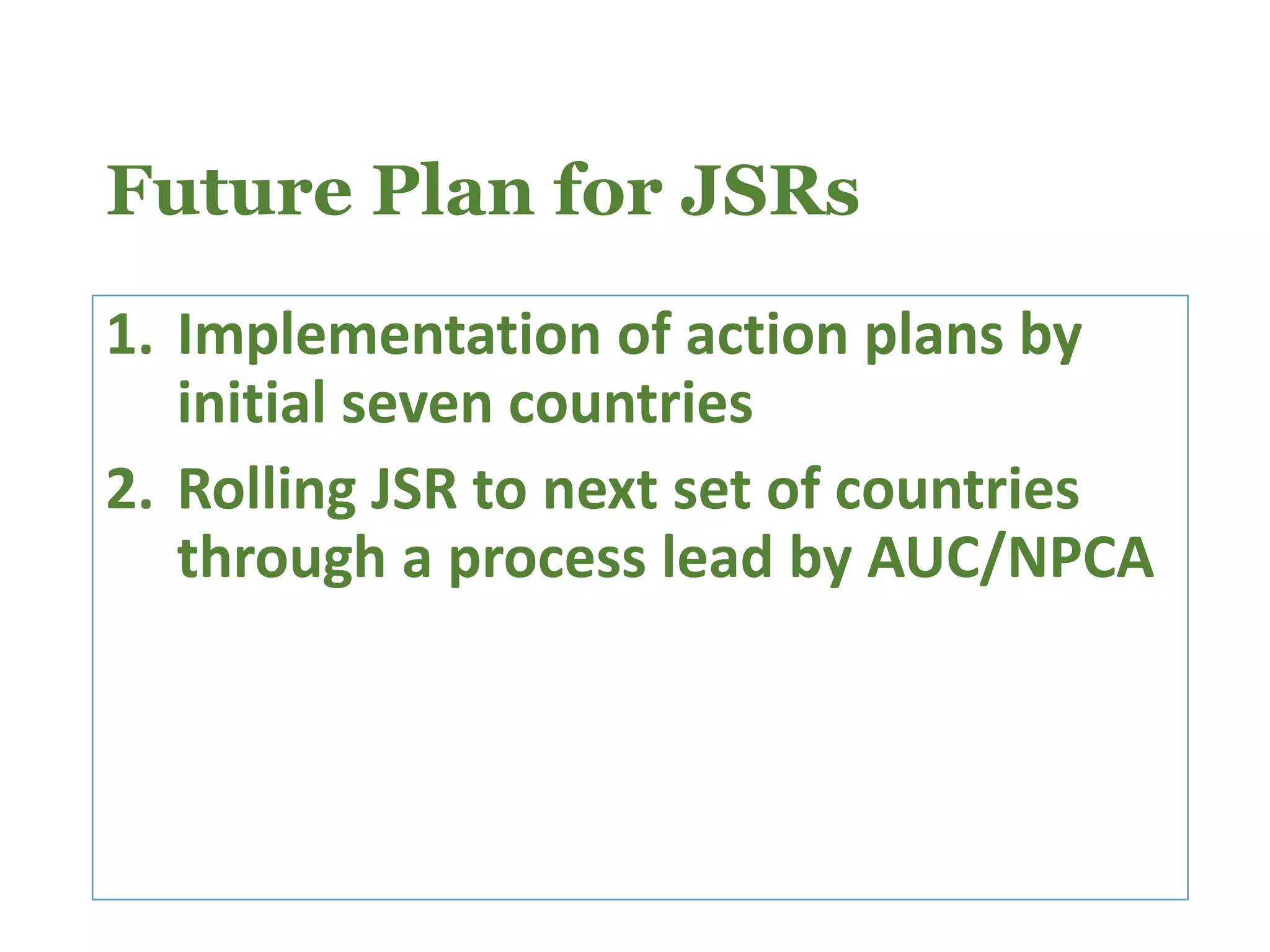
Future Plan for JSRs
1. Implementation of action plans by
initial seven countries
2. Rolling JSR to next set of countries
through a process lead by AUC/NPCA

Improving JSR Practices at Country Level: Achievements and Gaps in Southern Africa

  • 1.
    Improving JSR Practicesat Country Level: Achievements and Gaps in Southern Africa Greenwell Matchaya, Coordinator for ReSAKSS Southern Africa (SA), International Water Management Institute (IWMI), South Africa g.matchaya@cigar.org
  • 2.
    What is aJoint Sector Review (JSR)?  A joint sector review (JSR) is one way of operationalizing the mutual accountability framework at country level  The JSR process creates a platform to: » assess the performance and results of the agriculture sector » assist governments in setting sector policy and priorities » assess how well state and non state actors have implemented pledges and commitments (laid out in NAIPs, and other agreements)
  • 3.
    Purpose and benefitsof the Joint Sector Review  The primary purpose of a JSR is to determine and evaluate observed results of sector performance and their comparison with the intended results or targets  Therefore, the JSR: » allows diverse stakeholders to get insights into and influence overall policies and priorities of the sector » serves as a management and policy support tool for inclusive stakeholder planning, programming, budget preparation and execution, monitoring and evaluation, and overall development of the sector  Existing country JSRs need strengthening in terms of design, stakeholder inclusion, data analysis, dialogue and improved quality of implementation.
  • 4.
    Principles of aJoint Sector Review  National ownership and leadership  Relevance to NAIP or cooperation agreement  Inclusive participation  Commitment to results by all participants  Impartiality and evidence-based  Enhance national planning  Sensitivity to gender  Learning experience
  • 5.
    What the JSRprocess does for a country Describe and analyze the structure, conduct and performance (SCP) of the sector against mutually-agreed milestones and targets Identify strengths, weaknesses, opportunities and threats (SWOT) in the sector Based on the results and findings in the above, make recommendations for improving performance in the sector.
  • 6.
    What is monitoredin a Joint Sector Review  Development results e.g. income growth, poverty and hunger reduction, food and nutrition security, etc  Overall agricultural sector growth target, with specific subsector and commodity targets  Required financial and non-financial resources to effectively implement the plan  Policies, programs, institutions, and implementation processes  Linkages (including pathways to achieve the development results), enabling environment and assumptions
  • 7.
    Roadmap for undertakinga Joint Sector Review  Set up a JSR steering committee chaired by Ministry of Agriculture  Establish JSR secretariat  Develop terms of reference for the JSR  Mobilize resources  Constitute review team  Undertake the review and dialogue  Draw implementation and follow-up plan for the recommendations from the JSR
  • 8.
  • 9.
    Outcomes and Lessons.. CountryOutcomes Mozambique Launched Joint Sector Review process was launched in Maputo on 29th August 2013 and finalized in 2014. Malawi ReSAKSS-SA/IFPRI in collaboration with the AUC NEPAD, and COMESA and the Ministry of Agriculture has finalized and validated JSR report at a workshop in Lilongwe in April 2014 Swaziland Launched and finalized in 2015, in collaboration with the AUC NEPAD Zambia Launched and finalized in 2015, in collaboration with the AUC NEPAD
  • 10.
    Outcomes  Countries areusing outcomes of the JSR assessments as well as ATORs » to support policy review and dialogue processes.  In 2015, Malawi JSR followed the JSR assessment recommendations by ReSAKSS  Swaziland’s demand for more technical support in M&E increased following JSR assessment that revealed gaps
  • 11.
    Outcomes  JSR workhas stimulated demand for more data and hence, strong M&E  Results from the JSR assessment reports used in compiling the New Alliance report for 2013-2014 in Mozambique  Countries demanding more work on linkages of policies, indicators of investments to development results
  • 12.
    Outcomes -Malawi • Recommendationsfrom JSR assessments have helped country to set up ambitious agenda on the JSR process • Malawi has incorporated lessons from JSR Assessment exercise into their JSR process • JSR processes were largely Ministry of Agriculture focused but are now more inclusive following Mutual accountability process • However need to further enhance CSO and private sector participation • Issues raised from JSR process delegated to technical working groups under ASWAp for action
  • 13.
    Outcomes-Mozambique • Various Ministriesreport progress within their sectors at annual review. • Adoption of the CAADP Compact further strengthened review process. Private sector involvement became stronger after adoption of CAADP • Implementation of the G8NA further strengthening the process
  • 14.
    Outcomes –Swaziland, Zambia Finalized and validated in 2015  Generated demand for better data and M&E systems  Zambia finalized the assessment in 2015  Served as a basis for several sectoral meetings in Zambia
  • 15.
    Lessons  Political anchorageby African Union, NPCA is critical  Buy-in at country level is very important for rallying the Agricultural sector  Inclusivity from the beginning increases acceptability of recommendations  Political ownership/leadership by Ministry of Agriculture is key.  Consultativeness is also important
  • 16.
    Lessons • Inclusiveness isan issue: Government and DPs engage but NSAs are not fully engaged • Acceptance of JSR------Effective communication and consultative approach informing stakeholders of the importance of JSR has helped to array the challenges • JSR team composition: best left to country to decide but should include (private sector, academia, research, CSO, state etc.) • Data availability: sourcing data from private sector and non-state actors has been a challenge. There is need to invest in data infrastructure. • SAKSS networks therefore are invaluable tool for data collection and analysis
  • 17.
    Future Plan forJSRs 1. Implementation of action plans by initial seven countries 2. Rolling JSR to next set of countries through a process lead by AUC/NPCA