Trauma:
Epidemiology
Warfare Injuries
Mechanism Of Injury
DR AMIT GUPTA
ADDITIONAL PROFESSOR
DEPT. OF SURGERY
INTRODUCTION
Trauma or injury: damage to the body caused by an exchange with
environmental energy that is beyond the body's resilience
 Injury and trauma represent a major health problem worldwide.
 Everyday around the world almost 16,000 people die from various injuries.
 12% of the global burden of disease
 Road traffic injuries are a major cause of mortality
 22.8% in the overall burden of death related to injuries
 Injury is the third most important cause of mortality and the main cause of death among
1 to 40-year-olds.
 Road traffic injuries represent only a fraction of the trauma spectrum
WARFARE INJURIES
War has plagued humanity since the dawn of time
Celsus a addressed the management of battlefield casualties in the first century AD.
Introduction of gunpowder in the 14th century dramatically changed the nature of
battlefield injuries.
Advances in surgical management of war wounds followed advances in weapon
technology
 Musculoskeletal injuries represent approximately 70% of all war
 Ratio lower limb/upper limb is approximately 3/2, more than 50% of extremity fractures
are open.
 Injuries to the head, chest, and/or abdomen have a higher mortality rate
 Bullets: main cause of penetrating injury to the limbs
 Recently replaced by fragmenting weapons such as bombs, shells, grenades, and
landmines
 Blast injuries are in general dirtier than gunshot wounds and carry a higher potential for
infection
Years of Potential Life Lost
18.00%
16.40%
24.80%
40.80%
Injury
Cancer
Heart Disease
All Other Diseases
MECHANISMS OF INJURY:
BLUNT TRAUMA
 Pedestrian vs Vehicle
 Falls
Mechanisms of Injury:
Special Situations
• Explosions
– Blunt + penetrating + burns
• Burns
• Crush injuries
• Drowning
• Hypothermia/ exposure
COMPRESSION INJURY
 Frontal brain contusion
 Pneumothorax
 Rupture of Left
hemidiaphragm
 Small bowel rupture
 Chance fracture
DECELERATION INJURY
 Aortic tear
 Fixed descending aorta
 Mobile arch
 Acute subdural brain
hematoma
 Kidney avulsion
 Splenic pedicle
GUN SHOT WOUNDS: MECHANISM
 Energy transfer
 Shape/size of bullet
 Distance to target
 Velocity (most important)
 Kinetic energy = (Mass × Velocity2
)/2
 Surface area distributed
 Tumble and yaw
 Fragmentation
 Anatomy
 Viscoelasticity
 Muscle
 organs
STAB WOUNDS
 Mechanism
 Blunt: Crush injury
 Sharp:Tissue disruption
 Extent of Injury
 Weapon size, length, sharpness, penetration
 Severe injury
 Chest and abdomen
 4+ wounds
WEAPONS
 Some wound characteristics of different weapons
 The power of a missile depends on how much kinetic
energy is given up when it strikes tissue.
 The energy :
formula E = mv2
m= mass and v= velocity.
BULLETS
 Small entrance wound and a large exit
wound.
 Fragmentation of the bullet will cause severe
wounds
FRAGMENTS
 Caused by explosive devices, such as;
 Bombs, mortars, shells, rockets and grenades.
 The distance between the wounded person and the explosion determines the
outcome.
 The blast wave from an explosion might cause rupture of the ear drums and of
gas-containing viscera, such as the stomach or bowels
 hemorrhage in the lungs, without any penetrating wound.
MINES
 Exploding devices
 Traumatic amputation of foot or leg,
 Combined with multiple severe wounds.
 The wounds are all severely contaminated by mud, grass, pieces of
shoes and clothes
PRINCIPLES OF MANAGEMENT OF WAR WOUNDS:
 Complete wound excision
 Delayed primary closure
 No internal bone fixation
 Antibiotics
 Antitetanus
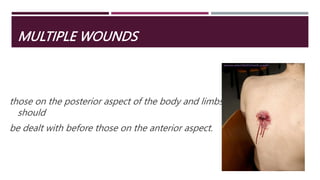
MULTIPLE WOUNDS
those on the posterior aspect of the body and limbs
should
be dealt with before those on the anterior aspect.
EARLY AND THOROUGH WOUND EXCISION
 Reduces chances of death from gas gangrene or
generalized infection;
 Reduces the number of operations
 Allows delayed primary closure to be successful.
 Shortens the stay in hospital.
 Wounds should not have dressings changed until delayed primary
closure (DPC)
 The exception to this will be when:
1. persisting contamination
2. infection develop
TREATMENT OF A SOFT TISSUE WOUND
1. Excision of the wound
2. Delayed primary closure
Wounds should be left wide open, without any suture of skin or deep
structures.
 All dead muscle must be excised.
 Dead muscle is the ideal medium for clostridial infection leading to
gas gangrene.
 The track of the missile may be surrounded by dead muscle.
 Must be excised until: healthy, contractile, bleeding muscle is found.
DELAYED PRIMARY CLOSURE
 Within seven days of injury.
 By simple approximation of the deep structures and skin, without
tension.
WMDs
CBRNE
HAZMATs
PPE

trauma.ppt

  • 1.
    Trauma: Epidemiology Warfare Injuries Mechanism OfInjury DR AMIT GUPTA ADDITIONAL PROFESSOR DEPT. OF SURGERY
  • 2.
    INTRODUCTION Trauma or injury:damage to the body caused by an exchange with environmental energy that is beyond the body's resilience
  • 3.
     Injury andtrauma represent a major health problem worldwide.  Everyday around the world almost 16,000 people die from various injuries.  12% of the global burden of disease  Road traffic injuries are a major cause of mortality  22.8% in the overall burden of death related to injuries  Injury is the third most important cause of mortality and the main cause of death among 1 to 40-year-olds.  Road traffic injuries represent only a fraction of the trauma spectrum
  • 4.
    WARFARE INJURIES War hasplagued humanity since the dawn of time Celsus a addressed the management of battlefield casualties in the first century AD. Introduction of gunpowder in the 14th century dramatically changed the nature of battlefield injuries. Advances in surgical management of war wounds followed advances in weapon technology
  • 5.
     Musculoskeletal injuriesrepresent approximately 70% of all war  Ratio lower limb/upper limb is approximately 3/2, more than 50% of extremity fractures are open.  Injuries to the head, chest, and/or abdomen have a higher mortality rate  Bullets: main cause of penetrating injury to the limbs  Recently replaced by fragmenting weapons such as bombs, shells, grenades, and landmines  Blast injuries are in general dirtier than gunshot wounds and carry a higher potential for infection
  • 6.
    Years of PotentialLife Lost 18.00% 16.40% 24.80% 40.80% Injury Cancer Heart Disease All Other Diseases
  • 7.
    MECHANISMS OF INJURY: BLUNTTRAUMA  Pedestrian vs Vehicle  Falls
  • 8.
    Mechanisms of Injury: SpecialSituations • Explosions – Blunt + penetrating + burns • Burns • Crush injuries • Drowning • Hypothermia/ exposure
  • 9.
    COMPRESSION INJURY  Frontalbrain contusion  Pneumothorax  Rupture of Left hemidiaphragm  Small bowel rupture  Chance fracture
  • 10.
    DECELERATION INJURY  Aortictear  Fixed descending aorta  Mobile arch  Acute subdural brain hematoma  Kidney avulsion  Splenic pedicle
  • 11.
    GUN SHOT WOUNDS:MECHANISM  Energy transfer  Shape/size of bullet  Distance to target  Velocity (most important)  Kinetic energy = (Mass × Velocity2 )/2  Surface area distributed  Tumble and yaw  Fragmentation  Anatomy  Viscoelasticity  Muscle  organs
  • 12.
    STAB WOUNDS  Mechanism Blunt: Crush injury  Sharp:Tissue disruption  Extent of Injury  Weapon size, length, sharpness, penetration  Severe injury  Chest and abdomen  4+ wounds
  • 13.
    WEAPONS  Some woundcharacteristics of different weapons  The power of a missile depends on how much kinetic energy is given up when it strikes tissue.  The energy : formula E = mv2 m= mass and v= velocity.
  • 14.
    BULLETS  Small entrancewound and a large exit wound.  Fragmentation of the bullet will cause severe wounds
  • 15.
    FRAGMENTS  Caused byexplosive devices, such as;  Bombs, mortars, shells, rockets and grenades.  The distance between the wounded person and the explosion determines the outcome.  The blast wave from an explosion might cause rupture of the ear drums and of gas-containing viscera, such as the stomach or bowels  hemorrhage in the lungs, without any penetrating wound.
  • 16.
    MINES  Exploding devices Traumatic amputation of foot or leg,  Combined with multiple severe wounds.  The wounds are all severely contaminated by mud, grass, pieces of shoes and clothes
  • 17.
    PRINCIPLES OF MANAGEMENTOF WAR WOUNDS:  Complete wound excision  Delayed primary closure  No internal bone fixation  Antibiotics  Antitetanus
  • 18.
    MULTIPLE WOUNDS those onthe posterior aspect of the body and limbs should be dealt with before those on the anterior aspect.
  • 19.
    EARLY AND THOROUGHWOUND EXCISION  Reduces chances of death from gas gangrene or generalized infection;  Reduces the number of operations  Allows delayed primary closure to be successful.  Shortens the stay in hospital.
  • 20.
     Wounds shouldnot have dressings changed until delayed primary closure (DPC)  The exception to this will be when: 1. persisting contamination 2. infection develop
  • 21.
    TREATMENT OF ASOFT TISSUE WOUND 1. Excision of the wound 2. Delayed primary closure Wounds should be left wide open, without any suture of skin or deep structures.
  • 22.
     All deadmuscle must be excised.  Dead muscle is the ideal medium for clostridial infection leading to gas gangrene.  The track of the missile may be surrounded by dead muscle.  Must be excised until: healthy, contractile, bleeding muscle is found.
  • 23.
    DELAYED PRIMARY CLOSURE Within seven days of injury.  By simple approximation of the deep structures and skin, without tension.
  • 24.