The linguistic sounds suffer a great quantity of changes, valuable
both in the normal flow of the language and in the course of the
time, and such changes are known as Phonological Processes.
Pharies (2007)
Betancourt y Galiffa (2009)
If we take into account that the oral production is considered as the
process of producing, receiving and processing the information from a
communicative and pragmatic point of view (Brown, 1994), we may
comprehend the influence it has over the knowledge and effective
employment of the Phonological Processes, since they allow the
learners to increase their fluency while expressing their ideas, and
consequently to improve the quality and precision of their oral
production.
Betancourt y Galiffa (2009)
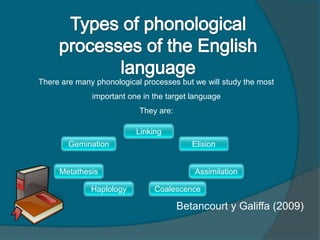
There are many phonological processes but we will study the most
important one in the target language
They are:
Betancourt y Galiffa (2009)
Haplology Coalescence
Gemination
Metathesis
Elision
Assimilation
Linking
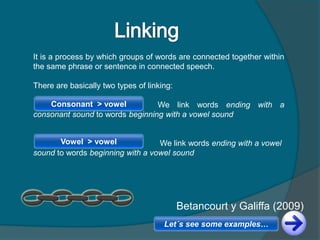
It is a process by which groups of words are connected together within
the same phrase or sentence in connected speech.
There are basically two types of linking:
We link words ending with a
consonant sound to words beginning with a vowel sound
We link words ending with a vowel
sound to words beginning with a vowel sound
Consonant > vowel
Vowel > vowel
Betancourt y Galiffa (2009)
Let´s see some examples…
For example, in the phrase "turn off":
If our lips are round at the end of the first word, we insert a W
sound
If our lips are wide at the end of the first word, we insert a Y
sound:
We write it like this turn off
We say it like this: tur noff
We write it like this: too often who is so I do all
We say it like this: tooWoften whoWis soWI doWall
We write it like this: Kay is I am the end she asked
We say it like this: KayYis IYam theYend sheYasked
Betancourt y Galiffa (2009)
Is the omission of one or more sounds (such as a vowel, a consonant, or a
whole syllable) in a word or phrase, producing a result that is easier for the
speaker to pronounce. Sometimes, sounds may be elided for euphonic
effect.
Betancourt y Galiffa (2009)
Let´s see some examples…
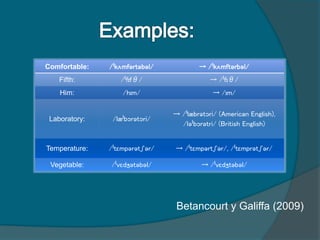
Comfortable: /ˈkʌmfərtəbəl/ → /ˈkʌmftərbəl/
Fifth: /ˈfɪfθ/ → /ˈfɪθ/
Him: /hɪm/ → /ɪm/
Laboratory: /læˈbɔrətɔri/
→ /ˈlæbrətɔri/ (American English),
/ləˈbɔrətri/ (British English)
Temperature: /ˈtɛmpərətʃər/ → /ˈtɛmpərtʃər/, /ˈtɛmprətʃər/
Vegetable: /ˈvɛdʒətəbəl/ → /ˈvɛdʒtəbəl/
Betancourt y Galiffa (2009)
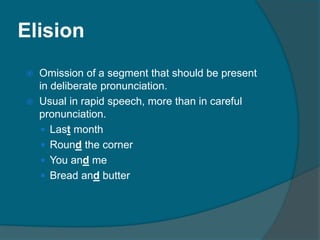
Elision
 Omission of a segment that should be present
in deliberate pronunciation.
 Usual in rapid speech, more than in careful
pronunciation.
 Last month
 Round the corner
 You and me
 Bread and butter
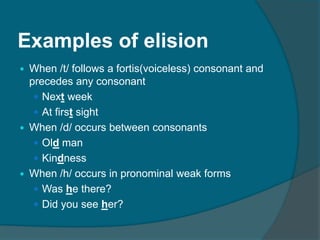
Examples of elision
 When /t/ follows a fortis(voiceless) consonant and
precedes any consonant
 Next week
 At first sight
 When /d/ occurs between consonants
 Old man
 Kindness
 When /h/ occurs in pronominal weak forms
 Was he there?
 Did you see her?
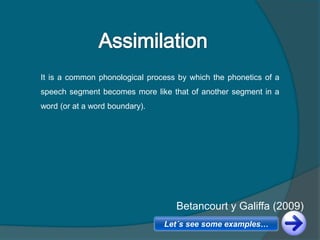
It is a common phonological process by which the phonetics of a
speech segment becomes more like that of another segment in a
word (or at a word boundary).
Betancourt y Galiffa (2009)
Let´s see some examples…
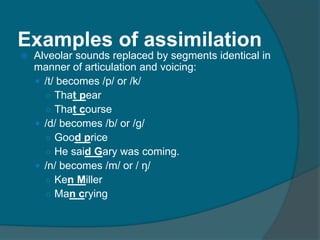
Examples of assimilation
 Alveolar sounds replaced by segments identical in
manner of articulation and voicing:
 /t/ becomes /p/ or /k/
○ That pear
○ That course
 /d/ becomes /b/ or /g/
○ Good price
○ He said Gary was coming.
 /n/ becomes /m/ or / ŋ/
○ Ken Miller
○ Man crying
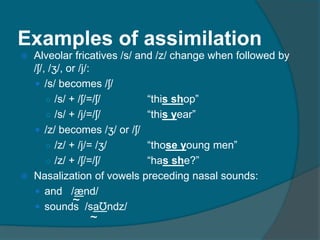
Examples of assimilation
 Alveolar fricatives /s/ and /z/ change when followed by
/ʃ/, /ʒ/, or /j/:
 /s/ becomes /ʃ/
○ /s/ + /ʃ/=/ʃ/ “this shop”
○ /s/ + /j/=/ʃ/ “this year”
 /z/ becomes /ʒ/ or /ʃ/
○ /z/ + /j/= /ʒ/ “those young men”
○ /z/ + /ʃ/=/ʃ/ “has she?”
 Nasalization of vowels preceding nasal sounds:
 and /ænd/
 sounds /saƱndz/
~
~
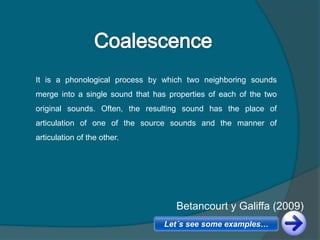
It is a phonological process by which two neighboring sounds
merge into a single sound that has properties of each of the two
original sounds. Often, the resulting sound has the place of
articulation of one of the source sounds and the manner of
articulation of the other.
Betancourt y Galiffa (2009)
Let´s see some examples…
Sing [sɪŋ]
Educate /ˈɛdʒuːkeɪt/
Graduate /ˈɡrædʒuːeɪt/
Measure /ˈmɛʒər/
Betancourt y Galiffa (2009)
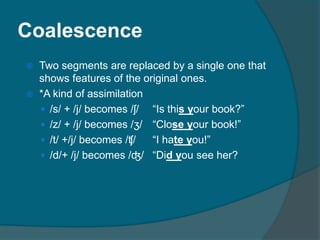
Coalescence
 Two segments are replaced by a single one that
shows features of the original ones.
 *A kind of assimilation
 /s/ + /j/ becomes /ʃ/ “Is this your book?”
 /z/ + /j/ becomes /ʒ/ “Close your book!”
 /t/ +/j/ becomes /ʧ/ “I hate you!”
 /d/+ /j/ becomes /ʤ/ “Did you see her?
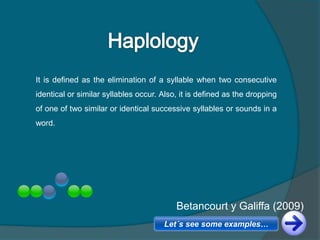
It is defined as the elimination of a syllable when two consecutive
identical or similar syllables occur. Also, it is defined as the dropping
of one of two similar or identical successive syllables or sounds in a
word.
Betancourt y Galiffa (2009)
Let´s see some examples…
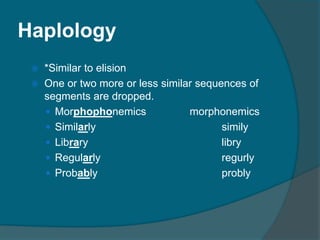
Haplology
 *Similar to elision
 One or two more or less similar sequences of
segments are dropped.
 Morphophonemics morphonemics
 Similarly simily
 Library libry
 Regularly regurly
 Probably probly
Betancourt y Galiffa (2009)
Let´s see some examples…
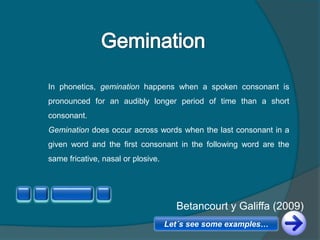
In phonetics, gemination happens when a spoken consonant is
pronounced for an audibly longer period of time than a short
consonant.
Gemination does occur across words when the last consonant in a
given word and the first consonant in the following word are the
same fricative, nasal or plosive.
Calm man [kɑːˈmːæn]
This saddle [ðɪˈsːædəl]
Black coat [blæˈkːoʊt]
Back kick [ˈbækːɪk]
Orange juice [ˈɒrɪndʒ dʒuːs]
Betancourt y Galiffa (2009)

phonological processes3243565454334342.pptx

  • 2.
    The linguistic soundssuffer a great quantity of changes, valuable both in the normal flow of the language and in the course of the time, and such changes are known as Phonological Processes. Pharies (2007) Betancourt y Galiffa (2009)
  • 3.
    If we takeinto account that the oral production is considered as the process of producing, receiving and processing the information from a communicative and pragmatic point of view (Brown, 1994), we may comprehend the influence it has over the knowledge and effective employment of the Phonological Processes, since they allow the learners to increase their fluency while expressing their ideas, and consequently to improve the quality and precision of their oral production. Betancourt y Galiffa (2009)
  • 4.
    There are manyphonological processes but we will study the most important one in the target language They are: Betancourt y Galiffa (2009) Haplology Coalescence Gemination Metathesis Elision Assimilation Linking
  • 5.
    It is aprocess by which groups of words are connected together within the same phrase or sentence in connected speech. There are basically two types of linking: We link words ending with a consonant sound to words beginning with a vowel sound We link words ending with a vowel sound to words beginning with a vowel sound Consonant > vowel Vowel > vowel Betancourt y Galiffa (2009) Let´s see some examples…
  • 6.
    For example, inthe phrase "turn off": If our lips are round at the end of the first word, we insert a W sound If our lips are wide at the end of the first word, we insert a Y sound: We write it like this turn off We say it like this: tur noff We write it like this: too often who is so I do all We say it like this: tooWoften whoWis soWI doWall We write it like this: Kay is I am the end she asked We say it like this: KayYis IYam theYend sheYasked Betancourt y Galiffa (2009)
  • 7.
    Is the omissionof one or more sounds (such as a vowel, a consonant, or a whole syllable) in a word or phrase, producing a result that is easier for the speaker to pronounce. Sometimes, sounds may be elided for euphonic effect. Betancourt y Galiffa (2009) Let´s see some examples…
  • 8.
    Comfortable: /ˈkʌmfərtəbəl/ →/ˈkʌmftərbəl/ Fifth: /ˈfɪfθ/ → /ˈfɪθ/ Him: /hɪm/ → /ɪm/ Laboratory: /læˈbɔrətɔri/ → /ˈlæbrətɔri/ (American English), /ləˈbɔrətri/ (British English) Temperature: /ˈtɛmpərətʃər/ → /ˈtɛmpərtʃər/, /ˈtɛmprətʃər/ Vegetable: /ˈvɛdʒətəbəl/ → /ˈvɛdʒtəbəl/ Betancourt y Galiffa (2009)
  • 9.
    Elision  Omission ofa segment that should be present in deliberate pronunciation.  Usual in rapid speech, more than in careful pronunciation.  Last month  Round the corner  You and me  Bread and butter
  • 10.
    Examples of elision When /t/ follows a fortis(voiceless) consonant and precedes any consonant  Next week  At first sight  When /d/ occurs between consonants  Old man  Kindness  When /h/ occurs in pronominal weak forms  Was he there?  Did you see her?
  • 11.
    It is acommon phonological process by which the phonetics of a speech segment becomes more like that of another segment in a word (or at a word boundary). Betancourt y Galiffa (2009) Let´s see some examples…
  • 12.
    Examples of assimilation Alveolar sounds replaced by segments identical in manner of articulation and voicing:  /t/ becomes /p/ or /k/ ○ That pear ○ That course  /d/ becomes /b/ or /g/ ○ Good price ○ He said Gary was coming.  /n/ becomes /m/ or / ŋ/ ○ Ken Miller ○ Man crying
  • 13.
    Examples of assimilation Alveolar fricatives /s/ and /z/ change when followed by /ʃ/, /ʒ/, or /j/:  /s/ becomes /ʃ/ ○ /s/ + /ʃ/=/ʃ/ “this shop” ○ /s/ + /j/=/ʃ/ “this year”  /z/ becomes /ʒ/ or /ʃ/ ○ /z/ + /j/= /ʒ/ “those young men” ○ /z/ + /ʃ/=/ʃ/ “has she?”  Nasalization of vowels preceding nasal sounds:  and /ænd/  sounds /saƱndz/ ~ ~
  • 14.
    It is aphonological process by which two neighboring sounds merge into a single sound that has properties of each of the two original sounds. Often, the resulting sound has the place of articulation of one of the source sounds and the manner of articulation of the other. Betancourt y Galiffa (2009) Let´s see some examples…
  • 15.
    Sing [sɪŋ] Educate /ˈɛdʒuːkeɪt/ Graduate/ˈɡrædʒuːeɪt/ Measure /ˈmɛʒər/ Betancourt y Galiffa (2009)
  • 16.
    Coalescence  Two segmentsare replaced by a single one that shows features of the original ones.  *A kind of assimilation  /s/ + /j/ becomes /ʃ/ “Is this your book?”  /z/ + /j/ becomes /ʒ/ “Close your book!”  /t/ +/j/ becomes /ʧ/ “I hate you!”  /d/+ /j/ becomes /ʤ/ “Did you see her?
  • 17.
    It is definedas the elimination of a syllable when two consecutive identical or similar syllables occur. Also, it is defined as the dropping of one of two similar or identical successive syllables or sounds in a word. Betancourt y Galiffa (2009) Betancourt y Galiffa (2009) Let´s see some examples…
  • 18.
    Haplology  *Similar toelision  One or two more or less similar sequences of segments are dropped.  Morphophonemics morphonemics  Similarly simily  Library libry  Regularly regurly  Probably probly
  • 19.
    Betancourt y Galiffa(2009) Betancourt y Galiffa (2009) Let´s see some examples… In phonetics, gemination happens when a spoken consonant is pronounced for an audibly longer period of time than a short consonant. Gemination does occur across words when the last consonant in a given word and the first consonant in the following word are the same fricative, nasal or plosive.
  • 20.
    Calm man [kɑːˈmːæn] Thissaddle [ðɪˈsːædəl] Black coat [blæˈkːoʊt] Back kick [ˈbækːɪk] Orange juice [ˈɒrɪndʒ dʒuːs] Betancourt y Galiffa (2009)