Assimilation
Assimilation is the influence of a sound on a neighboring sound so that
the two sounds become similar or the same. In linguistics, assimilation is
a common phonological process by which one sound becomes more like
a nearby sound. Assimilation occurs when two sounds come together
and change or melt in to a new sound.
Examples
In English "handbag" ( /ˈhændˌbæɡ/) is often pronounced /ˈhæmbæɡ/ in rapid speech. This is
because the [m] and [b] sounds are both bilabial consonants and their places of articulation are
similar; whereas the sequence [d]-[b] has different places but similar manner of articulation causing
the [n] sound to sometimes assimilate to [m] before the [b]. By contrast, the word "cupboard",
historically a compound of "cup" /kʌp/ and "board" /bɔːrd/, is always pronounced /ˈkʌbərd/ and
never /ˈkʌpbɔːrd/, even in slow, highly articulated speech.
Cf
It stands for final consonant.
Examples
Ink pot
Work Hard
Egg Yolk
Ci
It stands for initial consonant.
Examples
Weak
Kite
Black
Manner of assimilation
Full assimilation
Full assimilation is also known as complete assimilation. As mentioned previously, a
sound may change and become like another. For example, the phrase “That Place”/
ðæt ple s/ becomes / ðæp ple s/ . It is clear that the /t/ sound is totally, or completely,
ɪ ɪ
assimilated to the /p/ sound and becomes identical to the one in the next word
Partial assimilation
Partial ɑssimilation of sounds does not always occur completely. Sometimes
sounds partially assimilate with the surrounding sounds. For example, the
phrase 'ten bikes' is pronounced as /tembaiks/ instead of /ten baiks/. Here,
the alveolar sound /n/ changes to /m/ which is a bilabial sound under the
influence of/b/ which is also a bilabial sound.
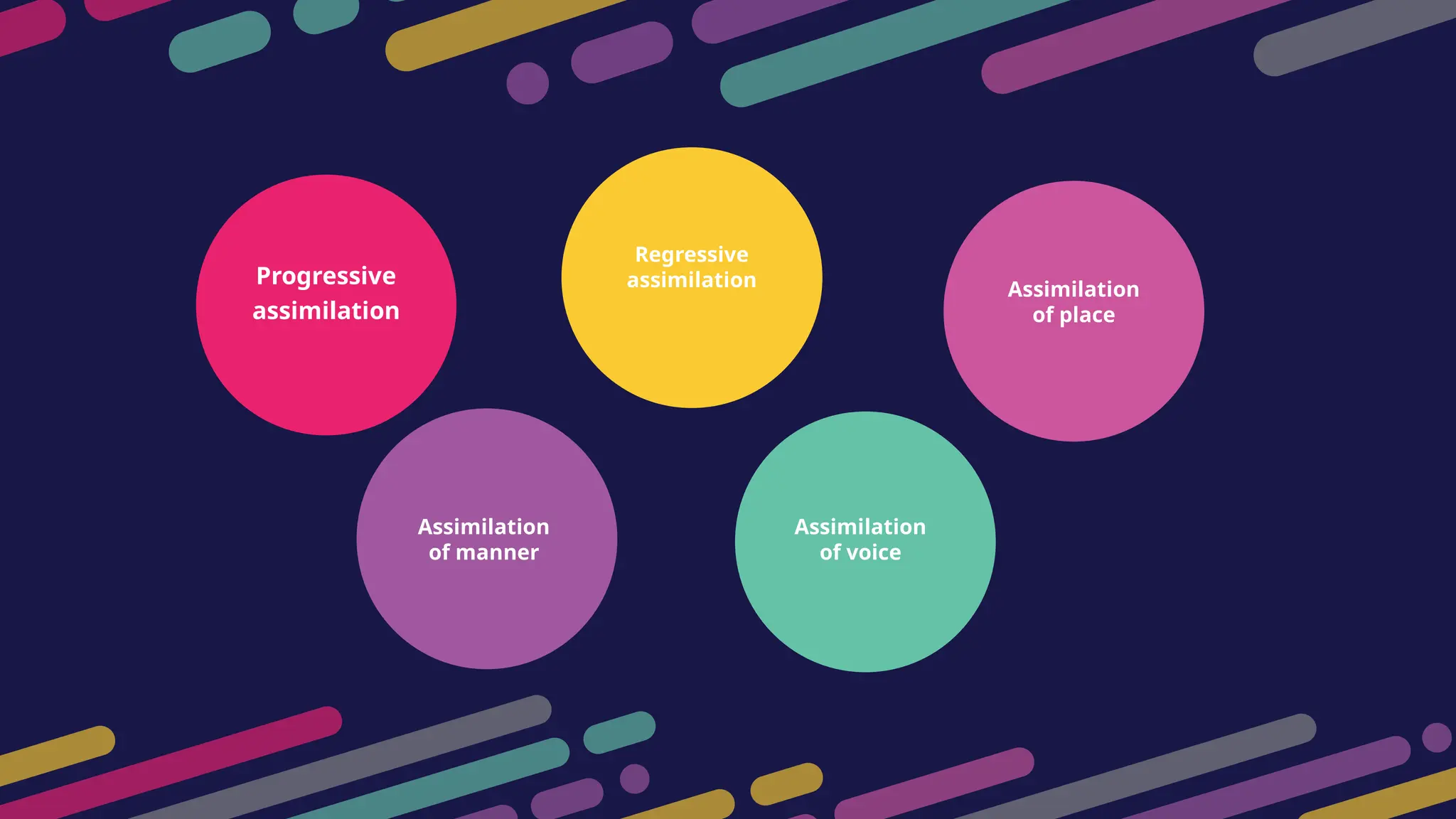
Types of assimilation
Assimilation
of manner
Regressive
assimilation
Progressive
assimilation
Assimilation
of voice
Assimilation
of place
Progressive assimilation
Progressive assimilation is also known as preservative assimilation. This
assimilation is said to be progressive when the feature of a phoneme are
modified by the feature of the phoneme before it.
Examples
Read this: ri:d dis
Those years: ðauʒ ʒiars
Regressive assimilation
The change in phoneme characteristics due to influence of a sound
occuring later in the sound. Therefore, regressive assimilation occurs
when the feature of a phoneme are modified by those of the phoneme
following it.
Example
Good bye: gub bai:
Big car: bIk ka:
Assimilation of Place
When a sound changes its place of articulation to another place, it is
called assimilation of place. This change of place depends on the place
of articulation of the neighboring sounds.
Examples
That car: /ðæk kar/
Bad girl: /bæg gɜːl/
Bad boy: /bæb bɔɪ/
Assimilation of manner
Assimilation of manner refers to two neighboring sounds becoming
similar in their manner of articulation. It is usually heard in very rapid
speech.
Examples
In “That side” /ðæs saɪd/ and in “good night” /gʊn naɪt/. In /ðæs saɪd/,
the plosive /t/ becomes fricative /s/, and in /gʊn naɪt/, the plosive /d/
becomes nasal /n/.
Assimilation of voice
It is difficult to produce a consonant cluster, in many languages including
English, with different voicing values for the consonants, particularly if
the consonants are fricatives or plosives.
Examples
dogs /d gz/: /s/ becomes /z/ to agree in voicing with /g/.
cats / kæts/: /s/ remains /s/ to agree in voicing with /t/.
voiced / vɔɪst/: /t/ agrees in voicing with /s/.
Importance of assimilation
When a sound adopts features of another sound, the process of
articulation becomes much easier. According to them, assimilation
involves ease of articulation pressures and it is an important means of
making pronunciation easier.
It has many types and forms including place, manner, voicing, progressive,
regressive, that can be either full or partial assimilation. Furthermore,
assimilation occurs because of the development of languages, and under
the effects of the surrounding sounds. This leads us to say that the major
function of assimilation is to ease articulation.
Thank you
Any questions?

Assimilation in Linguistics

  • 1.
  • 2.
    Assimilation is theinfluence of a sound on a neighboring sound so that the two sounds become similar or the same. In linguistics, assimilation is a common phonological process by which one sound becomes more like a nearby sound. Assimilation occurs when two sounds come together and change or melt in to a new sound.
  • 3.
  • 4.
    In English "handbag"( /ˈhændˌbæɡ/) is often pronounced /ˈhæmbæɡ/ in rapid speech. This is because the [m] and [b] sounds are both bilabial consonants and their places of articulation are similar; whereas the sequence [d]-[b] has different places but similar manner of articulation causing the [n] sound to sometimes assimilate to [m] before the [b]. By contrast, the word "cupboard", historically a compound of "cup" /kʌp/ and "board" /bɔːrd/, is always pronounced /ˈkʌbərd/ and never /ˈkʌpbɔːrd/, even in slow, highly articulated speech.
  • 5.
    Cf It stands forfinal consonant. Examples Ink pot Work Hard Egg Yolk
  • 6.
    Ci It stands forinitial consonant. Examples Weak Kite Black
  • 7.
  • 8.
    Full assimilation Full assimilationis also known as complete assimilation. As mentioned previously, a sound may change and become like another. For example, the phrase “That Place”/ ðæt ple s/ becomes / ðæp ple s/ . It is clear that the /t/ sound is totally, or completely, ɪ ɪ assimilated to the /p/ sound and becomes identical to the one in the next word
  • 9.
    Partial assimilation Partial ɑssimilationof sounds does not always occur completely. Sometimes sounds partially assimilate with the surrounding sounds. For example, the phrase 'ten bikes' is pronounced as /tembaiks/ instead of /ten baiks/. Here, the alveolar sound /n/ changes to /m/ which is a bilabial sound under the influence of/b/ which is also a bilabial sound.
  • 10.
  • 11.
  • 12.
    Progressive assimilation Progressive assimilationis also known as preservative assimilation. This assimilation is said to be progressive when the feature of a phoneme are modified by the feature of the phoneme before it.
  • 13.
    Examples Read this: ri:ddis Those years: ðauʒ ʒiars
  • 14.
    Regressive assimilation The changein phoneme characteristics due to influence of a sound occuring later in the sound. Therefore, regressive assimilation occurs when the feature of a phoneme are modified by those of the phoneme following it.
  • 15.
    Example Good bye: gubbai: Big car: bIk ka:
  • 16.
    Assimilation of Place Whena sound changes its place of articulation to another place, it is called assimilation of place. This change of place depends on the place of articulation of the neighboring sounds.
  • 17.
    Examples That car: /ðækkar/ Bad girl: /bæg gɜːl/ Bad boy: /bæb bɔɪ/
  • 18.
    Assimilation of manner Assimilationof manner refers to two neighboring sounds becoming similar in their manner of articulation. It is usually heard in very rapid speech.
  • 19.
    Examples In “That side”/ðæs saɪd/ and in “good night” /gʊn naɪt/. In /ðæs saɪd/, the plosive /t/ becomes fricative /s/, and in /gʊn naɪt/, the plosive /d/ becomes nasal /n/.
  • 20.
    Assimilation of voice Itis difficult to produce a consonant cluster, in many languages including English, with different voicing values for the consonants, particularly if the consonants are fricatives or plosives.
  • 21.
    Examples dogs /d gz/:/s/ becomes /z/ to agree in voicing with /g/. cats / kæts/: /s/ remains /s/ to agree in voicing with /t/. voiced / vɔɪst/: /t/ agrees in voicing with /s/.
  • 22.
    Importance of assimilation Whena sound adopts features of another sound, the process of articulation becomes much easier. According to them, assimilation involves ease of articulation pressures and it is an important means of making pronunciation easier.
  • 23.
    It has manytypes and forms including place, manner, voicing, progressive, regressive, that can be either full or partial assimilation. Furthermore, assimilation occurs because of the development of languages, and under the effects of the surrounding sounds. This leads us to say that the major function of assimilation is to ease articulation.
  • 24.
  • 25.