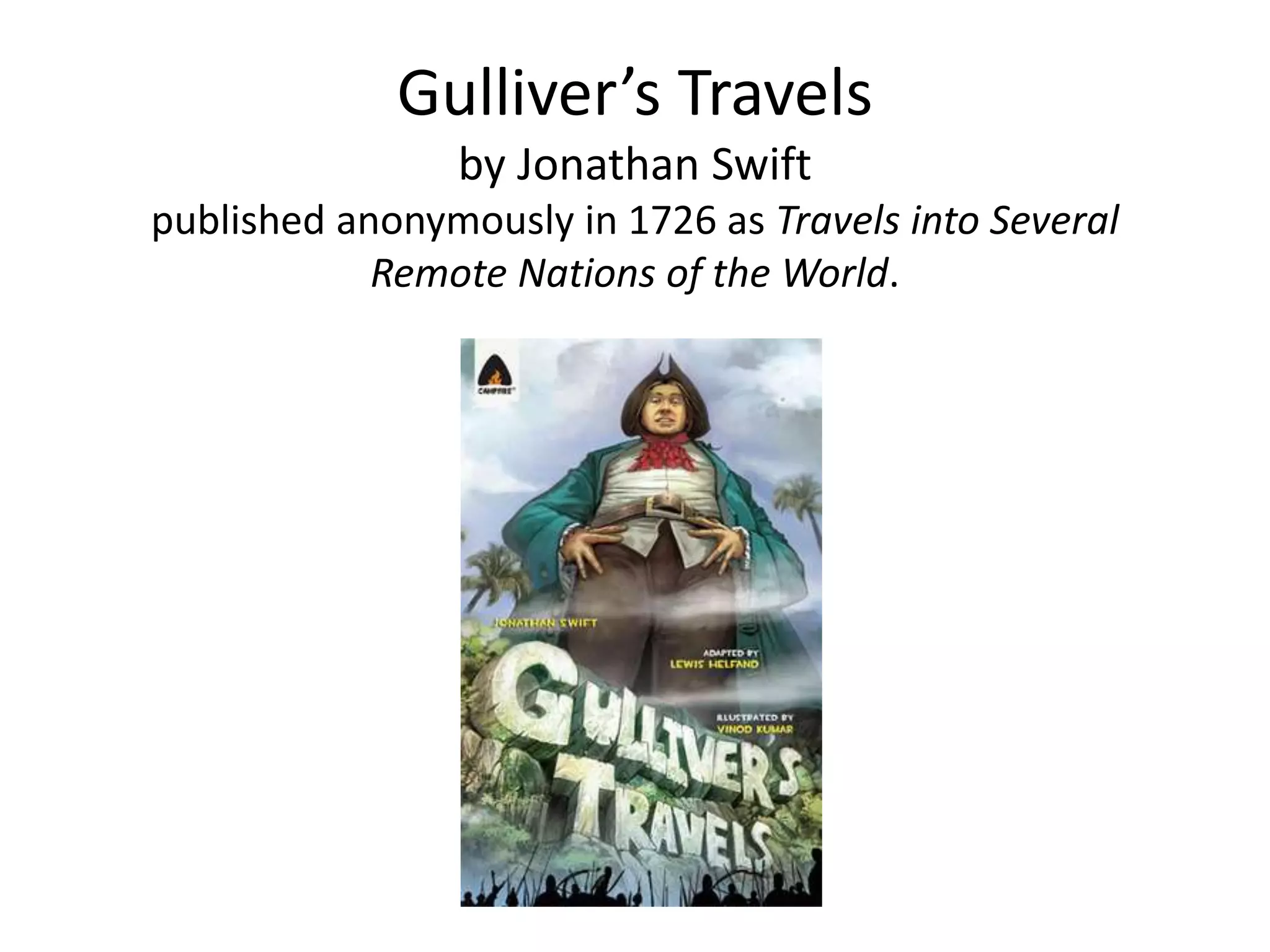
Gulliver’s Travels 
by Jonathan Swift 
published anonymously in 1726 as Travels into Several 
Remote Nations of the World.
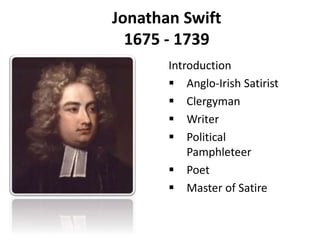
Jonathan Swift 
1675 - 1739 
Introduction 
 Anglo-Irish Satirist 
 Clergyman 
 Writer 
 Political 
Pamphleteer 
 Poet 
 Master of Satire
Gulliver's Travels – 1726 
four-part satirical novel 
Lemuel Gulliver dreamt of travelling the world. But when a 
violent storm claims his ship and casts him adrift among 
unchartered lands, he is taken to places that he had never 
imagined could exist. 
Gulliver travels to Lilliput, where the inhabitants measure just 
centimeters tall, and to Brobdingnag, where they tower into the 
sky like giants. Then he goes to an island floating above the 
clouds, after which he visits a race of immortals, and finds 
himself stranded in a land ruled by horses. Face to face with 
warring armies and power-hungry kings, each new journey 
makes Gulliver more desperate to find a way back home. But 
once he discovers the truth about his own land and himself, 
returning home becomes the last thing he desires.
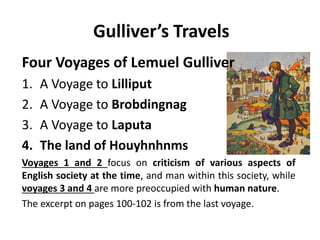
Gulliver’s Travels 
Four Voyages of Lemuel Gulliver 
1. A Voyage to Lilliput 
2. A Voyage to Brobdingnag 
3. A Voyage to Laputa 
4. The land of Houyhnhnms 
Voyages 1 and 2 focus on criticism of various aspects of 
English society at the time, and man within this society, while 
voyages 3 and 4 are more preoccupied with human nature. 
The excerpt on pages 100-102 is from the last voyage.
Characters on Pp 100-102 
• Gulliver - the protagonist and 
the narrator of the story. 
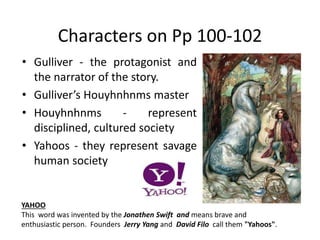
• Gulliver’s Houyhnhnms master 
• Houyhnhnms - represent 
disciplined, cultured society 
• Yahoos - they represent savage 
human society 
YAHOO 
This word was invented by the Jonathen Swift and means brave and 
enthusiastic person. Founders Jerry Yang and David Filo call them "Yahoos".
Satire Definition 
“Satire is genre of literature, and sometimes 
graphic, and performing arts, in which vices, 
follies, abuses, and shortcoming are held up to 
ridicule, ideally with the intent of shaming 
individuals and/or society into improvement” 
The novel can be read as a powerful attack on 
man's wickedness and stupidity.
Fourth Voyage 
The Land of Houyhnhnms: 
Satire on human moral shortcomings and on 
mankind: 
Gulliver quickly learns the language of 
houyhnhnms and tells them about his 
country where human beings rule and 
horses are trained to work for them. 
Houyhnhnms find this unbelievable.
Fourth Voyage 
The Land of Houyhnhnms: 
• Gulliver talks about what leads to war. 
• Gulliver tells them about law and order in his nation 
• Humans (Europeans) are described as yahoos. 
• Greed and selfishness is a part of human nature. 
• Houyhnhnms live in social harmony and have more 
humanity than humans. 
• Swift challenges the traditional idea that humans are 
rational animals.

Gulliver's Travels

  • 1.
    Gulliver’s Travels byJonathan Swift published anonymously in 1726 as Travels into Several Remote Nations of the World.
  • 2.
    Jonathan Swift 1675- 1739 Introduction  Anglo-Irish Satirist  Clergyman  Writer  Political Pamphleteer  Poet  Master of Satire
  • 3.
    Gulliver's Travels –1726 four-part satirical novel Lemuel Gulliver dreamt of travelling the world. But when a violent storm claims his ship and casts him adrift among unchartered lands, he is taken to places that he had never imagined could exist. Gulliver travels to Lilliput, where the inhabitants measure just centimeters tall, and to Brobdingnag, where they tower into the sky like giants. Then he goes to an island floating above the clouds, after which he visits a race of immortals, and finds himself stranded in a land ruled by horses. Face to face with warring armies and power-hungry kings, each new journey makes Gulliver more desperate to find a way back home. But once he discovers the truth about his own land and himself, returning home becomes the last thing he desires.
  • 4.
    Gulliver’s Travels FourVoyages of Lemuel Gulliver 1. A Voyage to Lilliput 2. A Voyage to Brobdingnag 3. A Voyage to Laputa 4. The land of Houyhnhnms Voyages 1 and 2 focus on criticism of various aspects of English society at the time, and man within this society, while voyages 3 and 4 are more preoccupied with human nature. The excerpt on pages 100-102 is from the last voyage.
  • 5.
    Characters on Pp100-102 • Gulliver - the protagonist and the narrator of the story. • Gulliver’s Houyhnhnms master • Houyhnhnms - represent disciplined, cultured society • Yahoos - they represent savage human society YAHOO This word was invented by the Jonathen Swift and means brave and enthusiastic person. Founders Jerry Yang and David Filo call them "Yahoos".
  • 6.
    Satire Definition “Satireis genre of literature, and sometimes graphic, and performing arts, in which vices, follies, abuses, and shortcoming are held up to ridicule, ideally with the intent of shaming individuals and/or society into improvement” The novel can be read as a powerful attack on man's wickedness and stupidity.
  • 7.
    Fourth Voyage TheLand of Houyhnhnms: Satire on human moral shortcomings and on mankind: Gulliver quickly learns the language of houyhnhnms and tells them about his country where human beings rule and horses are trained to work for them. Houyhnhnms find this unbelievable.
  • 8.
    Fourth Voyage TheLand of Houyhnhnms: • Gulliver talks about what leads to war. • Gulliver tells them about law and order in his nation • Humans (Europeans) are described as yahoos. • Greed and selfishness is a part of human nature. • Houyhnhnms live in social harmony and have more humanity than humans. • Swift challenges the traditional idea that humans are rational animals.

Editor's Notes

  • #2 Gulliver’s Travels, four-part satirical novel by Jonathan Swift, published anonymously in 1726 as Travels into Several Remote Nations of the World.
  • #6 The Emperor of Liliput The farmer- Gulliver’s master in Brobdingnag Glumdalclitch- the farmer’s daughter The Queen and the King of Brobdingnag Lord Munodi- Lord of Lagado, Laputa island