Jonathan Swift’s  Gulliver’s Travels  (1726), most famous and enduring work is a political and social satire about man’s abuse of his greatest gift, human reasoning. It is written in the form of a travel journal containing four voyages undertaken by Gulliver.  II.Brobdingnagians  I.Lilliputian  III.Laputa  IV.Houyhnhnms
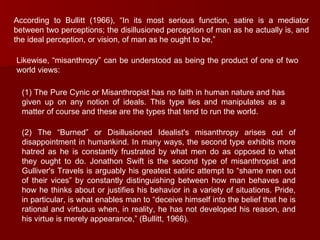
According to Bullitt (1966), “In its most serious function, satire is a mediator between two perceptions; the disillusioned perception of man as he actually is, and the ideal perception, or vision, of man as he ought to be,”  Likewise, “misanthropy” can be understood as being the product of one of two world views:  (1) The Pure Cynic or Misanthropist has no faith in human nature and has given up on any notion of ideals. This type lies and manipulates as a matter of course and these are the types that tend to run the world.  (2) The “Burned” or Disillusioned Idealist's misanthropy arises out of disappointment in humankind. In many ways, the second type exhibits more hatred as he is constantly frustrated by what men do as opposed to what they ought to do. Jonathon Swift is the second type of misanthropist and Gulliver's Travels is arguably his greatest satiric attempt to “shame men out of their vices” by constantly distinguishing between how man behaves and how he thinks about or justifies his behavior in a variety of situations. Pride, in particular, is what enables man to “deceive himself into the belief that he is rational and virtuous when, in reality, he has not developed his reason, and his virtue is merely appearance,” (Bullitt, 1966).
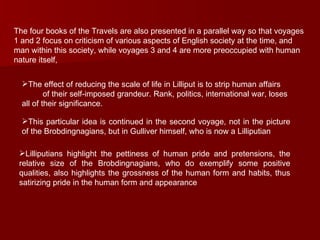
The four books of the Travels are also presented in a parallel way so that voyages 1 and 2 focus on criticism of various aspects of English society at the time, and man within this society, while voyages 3 and 4 are more preoccupied with human nature itself,  The effect of reducing the scale of life in Lilliput is to strip human affairs  of their self-imposed grandeur. Rank, politics, international war, loses all of their significance.  This particular idea is continued in the second voyage, not in the picture of the Brobdingnagians, but in Gulliver himself, who is now a Lilliputian  Lilliputians highlight the pettiness of human pride and pretensions, the relative size of the Brobdingnagians, who do exemplify some positive qualities, also highlights the grossness of the human form and habits, thus satirizing pride in the human form and appearance
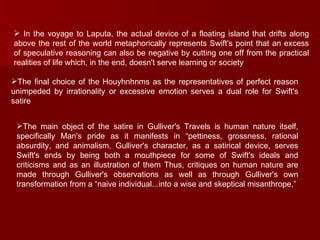
In the voyage to Laputa, the actual device of a floating island that drifts along above the rest of the world metaphorically represents Swift's point that an excess of speculative reasoning can also be negative by cutting one off from the practical realities of life which, in the end, doesn't serve learning or society  The final choice of the Houyhnhnms as the representatives of perfect reason unimpeded by irrationality or excessive emotion serves a dual role for Swift's satire  The main object of the satire in Gulliver's Travels is human nature itself, specifically Man's pride as it manifests in “pettiness, grossness, rational absurdity, and animalism, Gulliver's character, as a satirical device, serves Swift's ends by being both a mouthpiece for some of Swift's ideals and criticisms and as an illustration of them Thus, critiques on human nature are made through Gulliver's observations as well as through Gulliver's own transformation from a “naive individual...into a wise and skeptical misanthrope,”
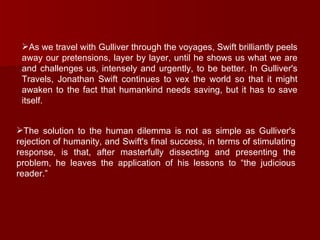
As we travel with Gulliver through the voyages, Swift brilliantly peels away our pretensions, layer by layer, until he shows us what we are and challenges us, intensely and urgently, to be better. In Gulliver's Travels, Jonathan Swift continues to vex the world so that it might awaken to the fact that humankind needs saving, but it has to save itself.  The solution to the human dilemma is not as simple as Gulliver's rejection of humanity, and Swift's final success, in terms of stimulating response, is that, after masterfully dissecting and presenting the problem, he leaves the application of his lessons to “the judicious reader.”

Gulliver

  • 1.
    Jonathan Swift’s Gulliver’s Travels (1726), most famous and enduring work is a political and social satire about man’s abuse of his greatest gift, human reasoning. It is written in the form of a travel journal containing four voyages undertaken by Gulliver. II.Brobdingnagians I.Lilliputian III.Laputa IV.Houyhnhnms
  • 2.
    According to Bullitt(1966), “In its most serious function, satire is a mediator between two perceptions; the disillusioned perception of man as he actually is, and the ideal perception, or vision, of man as he ought to be,” Likewise, “misanthropy” can be understood as being the product of one of two world views: (1) The Pure Cynic or Misanthropist has no faith in human nature and has given up on any notion of ideals. This type lies and manipulates as a matter of course and these are the types that tend to run the world. (2) The “Burned” or Disillusioned Idealist's misanthropy arises out of disappointment in humankind. In many ways, the second type exhibits more hatred as he is constantly frustrated by what men do as opposed to what they ought to do. Jonathon Swift is the second type of misanthropist and Gulliver's Travels is arguably his greatest satiric attempt to “shame men out of their vices” by constantly distinguishing between how man behaves and how he thinks about or justifies his behavior in a variety of situations. Pride, in particular, is what enables man to “deceive himself into the belief that he is rational and virtuous when, in reality, he has not developed his reason, and his virtue is merely appearance,” (Bullitt, 1966).
  • 3.
    The four booksof the Travels are also presented in a parallel way so that voyages 1 and 2 focus on criticism of various aspects of English society at the time, and man within this society, while voyages 3 and 4 are more preoccupied with human nature itself, The effect of reducing the scale of life in Lilliput is to strip human affairs of their self-imposed grandeur. Rank, politics, international war, loses all of their significance. This particular idea is continued in the second voyage, not in the picture of the Brobdingnagians, but in Gulliver himself, who is now a Lilliputian Lilliputians highlight the pettiness of human pride and pretensions, the relative size of the Brobdingnagians, who do exemplify some positive qualities, also highlights the grossness of the human form and habits, thus satirizing pride in the human form and appearance
  • 4.
    In the voyageto Laputa, the actual device of a floating island that drifts along above the rest of the world metaphorically represents Swift's point that an excess of speculative reasoning can also be negative by cutting one off from the practical realities of life which, in the end, doesn't serve learning or society The final choice of the Houyhnhnms as the representatives of perfect reason unimpeded by irrationality or excessive emotion serves a dual role for Swift's satire The main object of the satire in Gulliver's Travels is human nature itself, specifically Man's pride as it manifests in “pettiness, grossness, rational absurdity, and animalism, Gulliver's character, as a satirical device, serves Swift's ends by being both a mouthpiece for some of Swift's ideals and criticisms and as an illustration of them Thus, critiques on human nature are made through Gulliver's observations as well as through Gulliver's own transformation from a “naive individual...into a wise and skeptical misanthrope,”
  • 5.
    As we travelwith Gulliver through the voyages, Swift brilliantly peels away our pretensions, layer by layer, until he shows us what we are and challenges us, intensely and urgently, to be better. In Gulliver's Travels, Jonathan Swift continues to vex the world so that it might awaken to the fact that humankind needs saving, but it has to save itself. The solution to the human dilemma is not as simple as Gulliver's rejection of humanity, and Swift's final success, in terms of stimulating response, is that, after masterfully dissecting and presenting the problem, he leaves the application of his lessons to “the judicious reader.”