Focus:
The Digital
Revolution
(Chapter 2 – pp. 48-58)
Media in Motion
• Media (communication) (noun, pl) tools used
to store and deliver information or data.
• Make a list of the forms of media you have
access to on a daily basis. Which are the
most important to you? Use these subtitles;
Types of media
• Advertising media various media, content,
buying and placement for advertising
• Digital news media, mass media focused on
media
communicating news
• Print media, communications delivered via
media
paper or canvas
• Recording medium, devices used to store
medium
information
• Social media, media disseminated through
media
social interactions
The internet is bidirectional
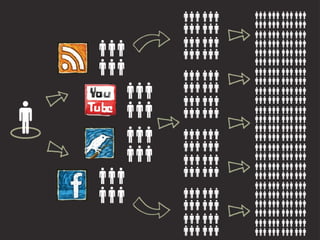
• Bidirectional means the ability to exchange
information online, to upload as well as
online
download.
• The internet is an astonishing boon to
humanity gathering up and concentrating
information and ideas that were scattered so
broadly around the world that hardly anyone
could profit from them.
• Strengthened English as a global language
• Write down some benefits of the net;
Benefits of internet
• The world’s meetinghouse, where people
gather to chat, gossip, argue, show off and flirt.
• Quick access to loads of information,
• Searching and filtering tools,
• Easy way to share opinions with small
interested groups of people or with “the whole
world”• List some disadvantages;
Disadvantages
• For some people, the very idea of reading a
book (paper copy) has come to seem oldfashioned, maybe like making your own dress
or shirt.
• A recent study of adults between 18 and 30
spent thirty percent of their leisure time online
• It is often assumed that the time we spend on
the net comes from the time we used to
spend watching TV. But statistics suggest
otherwise.
Disadvantages
• Net use has gone up, television viewing has
either held steady or increased.
increased
• In other words the growth in our online time
has expanded the total amount of time we
spend in front of screens.
• Whenever we switch on the computer we are
immediately plunged into interruption
technologies
• List ways in which this affects us;
Generation Net – young adults
• Drop in people reading words printed on paper
(down 29%)
• The www is deeply integrated into our daily lives
– at home, at work and at school
• Special-purpose media tools replaced by allpurpose tool e.g. before: tv, tape recorder,
telephone, radio etc…
• Fragmentation of the media and our ability to
concentrate
• Forms our behavior and shapes our perceptions
Generation Net – young adults
• Newspaper industry faces severe financial challenges.
Are there papers you know of that have closed down
because of the internet?
• Many producers are chopping up their products to fit
shorter attention spans of online customers. Can you
think of any examples?
• Magazines have trimmed the length of their articles and
introduced more summaries and navigational aids to
make scanning of their content easier.
• Libraries have changed – from the silence of turning
pages to the tapping of keys
Tasks P44-45
• Answer questions 1-6 in your note books
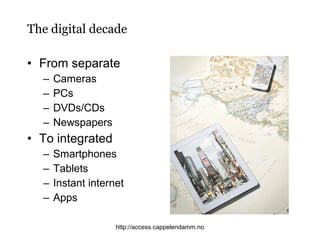
The digital decade
• From separate
–
–
–
–

Cameras
PCs
DVDs/CDs
Newspapers

• To integrated
–
–
–
–

Smartphones
Tablets
Instant internet
Apps
http://access.cappelendamm.no
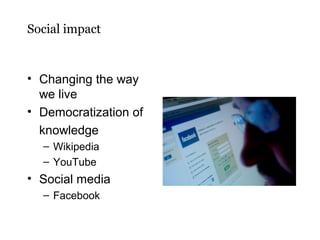
Social impact

• Changing the way
we live
• Democratization of
knowledge
– Wikipedia
– YouTube

• Social media
– Facebook
Downloading entertainment

• File-sharing websites
– Pirate Bay

• Corporate websites
– The istore

• Live online “feeds”
– Sports, Concerts

• Interactive computer
games
– Second Life
New problems

• WikiLeaks
– What’s secret?

• Circulating videos
– Who’s responsible?

• Censorship
– By whom?

• Bullying
– How to stop it?
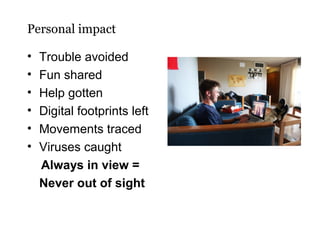
Personal impact
•
•
•
•
•
•

Trouble avoided
Fun shared
Help gotten
Digital footprints left
Movements traced
Viruses caught
Always in view =
Never out of sight
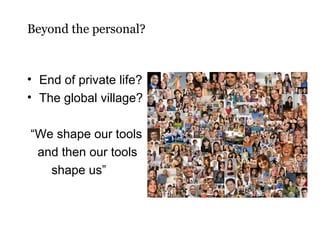
Beyond the personal?

• End of private life?
• The global village?
“We shape our tools
and then our tools
shape us”

Focus the digital revolution

  • 1.
  • 2.
    Media in Motion •Media (communication) (noun, pl) tools used to store and deliver information or data. • Make a list of the forms of media you have access to on a daily basis. Which are the most important to you? Use these subtitles;
  • 3.
    Types of media •Advertising media various media, content, buying and placement for advertising • Digital news media, mass media focused on media communicating news • Print media, communications delivered via media paper or canvas • Recording medium, devices used to store medium information • Social media, media disseminated through media social interactions
  • 4.
    The internet isbidirectional • Bidirectional means the ability to exchange information online, to upload as well as online download. • The internet is an astonishing boon to humanity gathering up and concentrating information and ideas that were scattered so broadly around the world that hardly anyone could profit from them. • Strengthened English as a global language • Write down some benefits of the net;
  • 6.
    Benefits of internet •The world’s meetinghouse, where people gather to chat, gossip, argue, show off and flirt. • Quick access to loads of information, • Searching and filtering tools, • Easy way to share opinions with small interested groups of people or with “the whole world”• List some disadvantages;
  • 7.
    Disadvantages • For somepeople, the very idea of reading a book (paper copy) has come to seem oldfashioned, maybe like making your own dress or shirt. • A recent study of adults between 18 and 30 spent thirty percent of their leisure time online • It is often assumed that the time we spend on the net comes from the time we used to spend watching TV. But statistics suggest otherwise.
  • 8.
    Disadvantages • Net usehas gone up, television viewing has either held steady or increased. increased • In other words the growth in our online time has expanded the total amount of time we spend in front of screens. • Whenever we switch on the computer we are immediately plunged into interruption technologies • List ways in which this affects us;
  • 9.
    Generation Net –young adults • Drop in people reading words printed on paper (down 29%) • The www is deeply integrated into our daily lives – at home, at work and at school • Special-purpose media tools replaced by allpurpose tool e.g. before: tv, tape recorder, telephone, radio etc… • Fragmentation of the media and our ability to concentrate • Forms our behavior and shapes our perceptions
  • 10.
    Generation Net –young adults • Newspaper industry faces severe financial challenges. Are there papers you know of that have closed down because of the internet? • Many producers are chopping up their products to fit shorter attention spans of online customers. Can you think of any examples? • Magazines have trimmed the length of their articles and introduced more summaries and navigational aids to make scanning of their content easier. • Libraries have changed – from the silence of turning pages to the tapping of keys
  • 11.
    Tasks P44-45 • Answerquestions 1-6 in your note books
  • 12.
    The digital decade •From separate – – – – Cameras PCs DVDs/CDs Newspapers • To integrated – – – – Smartphones Tablets Instant internet Apps http://access.cappelendamm.no
  • 13.
    Social impact • Changingthe way we live • Democratization of knowledge – Wikipedia – YouTube • Social media – Facebook
  • 14.
    Downloading entertainment • File-sharingwebsites – Pirate Bay • Corporate websites – The istore • Live online “feeds” – Sports, Concerts • Interactive computer games – Second Life
  • 15.
    New problems • WikiLeaks –What’s secret? • Circulating videos – Who’s responsible? • Censorship – By whom? • Bullying – How to stop it?
  • 16.
    Personal impact • • • • • • Trouble avoided Funshared Help gotten Digital footprints left Movements traced Viruses caught Always in view = Never out of sight
  • 17.
    Beyond the personal? •End of private life? • The global village? “We shape our tools and then our tools shape us”