HSS- 102 
Name of the group: SUNSHINE 
Scribe: Sujoy Saha 20101095 
Group Members: 
Sujoy Saha Anilkumar Tolamatti 20101001 Ayush Nagar 20101076 Golu Parte 20101066 Himanshu Rajmane 20101017 Sangamesh Sarangamath 20101036 Viraj Doddihal 20101078 Vyankatesh Rajmane 20101090 Yovhan Landge 20101091 
Date of submission: 15/04/2011.
GRAMMAR OF FLOWER 
If we observe a flower carefully, say china rose, we will see that 
1. a flower has a peduncle, green in colour, which carries it with the stem of a plant. 
2. It also has sepals which are coming out from the peduncle and inside it there are petals which are coming out from the centre of the sepals. 
3. sepals are green and five in number. 
4. Petals are red and also five in number. 
Take another flower, Streptocarpus; 
1. petals of this flower are purple. 
2. other thing looks similar. 
We can generalize, 
A1. flower are composed of peduncle, sepals and petals. 
A2. It has five sepals arises from peduncle 
A3. Five coloured petals come out from the centre of the calyxs. 
Another important observations is that 
1. sepals make an outer whorl, namely calyx, and petals do make an inner whorl, namely corrola. Both together forms a floral envelope – we call them perianth. 
2.in the envelope, there are an extra organ, coming out of that, more precisely they made of two kind of rodlike structure, one carpel, and another is stamen. 
So now we get, 
B1. Flowers are made up of peduncle, floral envelope, stamen, and carpel.
B2.envelope has petals and sepals, five each. 
B3. Inside the floral envelope there is carpel and stamen. 
But if we try to apply the above theory to define the whole flower world, one anomalies may come, that is the number of petals in a flower. Probably most of us have never taken the time to examine very carefully the number or arrangement of petals on a flower. If we were to do so, several things would become apparent. First, we would find that the number of petals on a flower is often follow a definite pattern. We decided to conduct an experiments to find whether mathematical relationships exist in this case: 
-Count the number of the flower petals. 
different flowers – lily, iris, buttercup, wild rose, larkspur, columbine, delphiniums, ragwort, corn marigold, cineraria, aster, black-eyed susan, chicory, plantain, pyrethrum, michaelmas daisies, the asteraceae family, white calla lily, euphorbia, trillium, bloodroot, sunflower, fuchsia 
 1 petal: white calla lily 
 2 petal : euphorbia 
 3 petals: lily, iris, trillium 
 4 petals: fuchsia 
 5 petals: buttercup, wild rose, larkspur, columbine (aquilegia) 
 8 petals: delphiniums, bloodroot 
 13 petals: ragwort, corn marigold, cineraria, 
 21 petals: aster, black-eyed susan, chicory 
 34 petals: plantain, pyrethrum 
 55, 89 petals: michaelmas daisies, the asteraceae family 
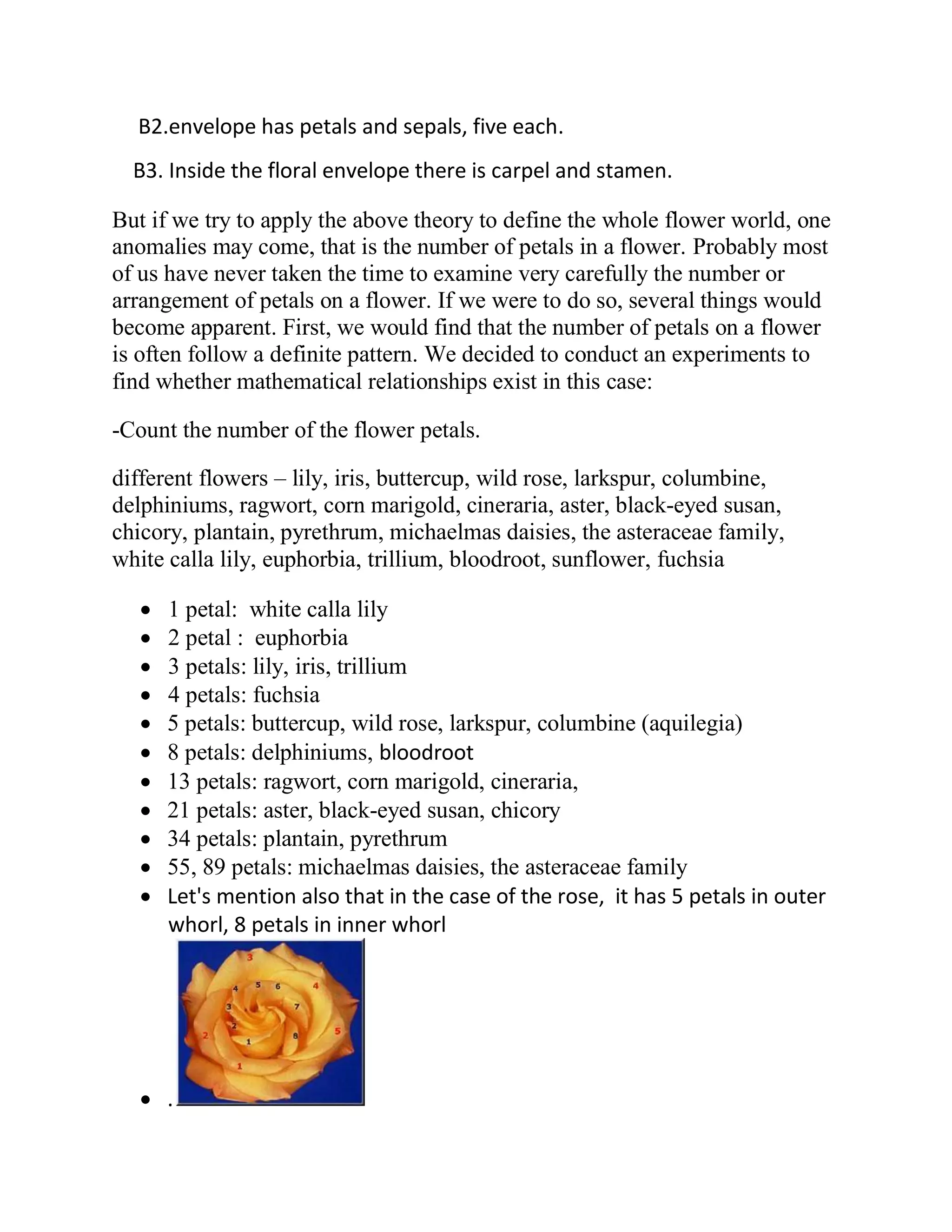
 Let's mention also that in the case of the rose, it has 5 petals in outer whorl, 8 petals in inner whorl 
 .
Are these numbers the product of chance? No! They all belong to the Fibonacci sequence: 1, 2, 3, 5, 8, 13, 21, 34, 55, 89, 144, etc (Otherwise it's usually a number in the series x 2) 
So, we can correct the above mentioned proposition B2, say, 
B2.flowers has petals in Fibonacci numbers. 
Observations: 
1. 75% of the Flowers exhibited Fibonacci qualities 
2. 81.8% of the Plants' petals or leaves exhibited Fibonacci qualities 
we would find that the number of petals on a flower, that still has all of its petals intact and has not lost any, for many flowers is a Fibonacci number: 
My hypothesis was proven correct. In fact, not only do we see the Fibonacci numbers more often than random, we see them more than 75% of the time. 
we would find that the number of petals on a flower, that still has all of its petals intact and has not lost any, for many flowers is a Fibonacci number. a fact to be taken in consideration when playing "she loves me, she loves me not". In saying that daisies have 34 petals, one is generalizing about the species - but any individual member of the species may deviate from this general pattern. There is more likelihood of a possible under development than over- development, so that 33 is more common than 35. 
THE END

GRAMMAR OF FLOWER

  • 1.
    HSS- 102 Nameof the group: SUNSHINE Scribe: Sujoy Saha 20101095 Group Members: Sujoy Saha Anilkumar Tolamatti 20101001 Ayush Nagar 20101076 Golu Parte 20101066 Himanshu Rajmane 20101017 Sangamesh Sarangamath 20101036 Viraj Doddihal 20101078 Vyankatesh Rajmane 20101090 Yovhan Landge 20101091 Date of submission: 15/04/2011.
  • 2.
    GRAMMAR OF FLOWER If we observe a flower carefully, say china rose, we will see that 1. a flower has a peduncle, green in colour, which carries it with the stem of a plant. 2. It also has sepals which are coming out from the peduncle and inside it there are petals which are coming out from the centre of the sepals. 3. sepals are green and five in number. 4. Petals are red and also five in number. Take another flower, Streptocarpus; 1. petals of this flower are purple. 2. other thing looks similar. We can generalize, A1. flower are composed of peduncle, sepals and petals. A2. It has five sepals arises from peduncle A3. Five coloured petals come out from the centre of the calyxs. Another important observations is that 1. sepals make an outer whorl, namely calyx, and petals do make an inner whorl, namely corrola. Both together forms a floral envelope – we call them perianth. 2.in the envelope, there are an extra organ, coming out of that, more precisely they made of two kind of rodlike structure, one carpel, and another is stamen. So now we get, B1. Flowers are made up of peduncle, floral envelope, stamen, and carpel.
  • 3.
    B2.envelope has petalsand sepals, five each. B3. Inside the floral envelope there is carpel and stamen. But if we try to apply the above theory to define the whole flower world, one anomalies may come, that is the number of petals in a flower. Probably most of us have never taken the time to examine very carefully the number or arrangement of petals on a flower. If we were to do so, several things would become apparent. First, we would find that the number of petals on a flower is often follow a definite pattern. We decided to conduct an experiments to find whether mathematical relationships exist in this case: -Count the number of the flower petals. different flowers – lily, iris, buttercup, wild rose, larkspur, columbine, delphiniums, ragwort, corn marigold, cineraria, aster, black-eyed susan, chicory, plantain, pyrethrum, michaelmas daisies, the asteraceae family, white calla lily, euphorbia, trillium, bloodroot, sunflower, fuchsia  1 petal: white calla lily  2 petal : euphorbia  3 petals: lily, iris, trillium  4 petals: fuchsia  5 petals: buttercup, wild rose, larkspur, columbine (aquilegia)  8 petals: delphiniums, bloodroot  13 petals: ragwort, corn marigold, cineraria,  21 petals: aster, black-eyed susan, chicory  34 petals: plantain, pyrethrum  55, 89 petals: michaelmas daisies, the asteraceae family  Let's mention also that in the case of the rose, it has 5 petals in outer whorl, 8 petals in inner whorl  .
  • 4.
    Are these numbersthe product of chance? No! They all belong to the Fibonacci sequence: 1, 2, 3, 5, 8, 13, 21, 34, 55, 89, 144, etc (Otherwise it's usually a number in the series x 2) So, we can correct the above mentioned proposition B2, say, B2.flowers has petals in Fibonacci numbers. Observations: 1. 75% of the Flowers exhibited Fibonacci qualities 2. 81.8% of the Plants' petals or leaves exhibited Fibonacci qualities we would find that the number of petals on a flower, that still has all of its petals intact and has not lost any, for many flowers is a Fibonacci number: My hypothesis was proven correct. In fact, not only do we see the Fibonacci numbers more often than random, we see them more than 75% of the time. we would find that the number of petals on a flower, that still has all of its petals intact and has not lost any, for many flowers is a Fibonacci number. a fact to be taken in consideration when playing "she loves me, she loves me not". In saying that daisies have 34 petals, one is generalizing about the species - but any individual member of the species may deviate from this general pattern. There is more likelihood of a possible under development than over- development, so that 33 is more common than 35. THE END