GST
(Goods and Services Tax)
NAME: PARMAR PRATIK V.
ROLL NO. 239
COURSE: BACHELOR OF COMMERCE
SEMESTER: 6 DIVISION: ”D”
SPECIALIZATION: BUSINESS ANALYTICS
TOPIC: GST (GOODS AND SERVICE TAX)
SUBMITTED TO : PROF. DR. AVANI VYAS | PROF. MAYURI THAKKAR
DATE: 28TH MARCH,2024
GST
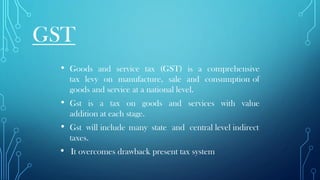
• Goods and service tax (GST) is a comprehensive
tax levy on manufacture, sale and consumption of
goods and service at a national level.
• Gst is a tax on goods and services with value
addition at each stage.
• Gst will include many state and central level indirect
taxes.
• It overcomes drawback present tax system
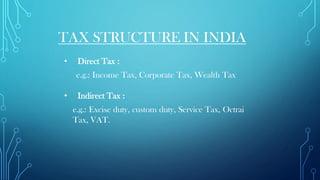
TAX STRUCTURE IN INDIA
• Direct Tax :
e.g.: Income Tax, Corporate Tax, Wealth Tax
• Indirect Tax :
e.g.: Excise duty, custom duty, Service Tax, Octrai
Tax, VAT.
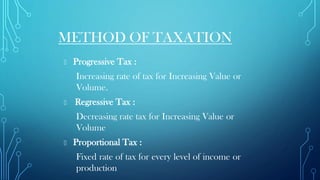
METHOD OF TAXATION
Progressive Tax :
Increasing rate of tax for Increasing Value or
Volume.
Regressive Tax :
Decreasing rate tax for Increasing Value or
Volume
Proportional Tax :
Fixed rate of tax for every level of income or
production
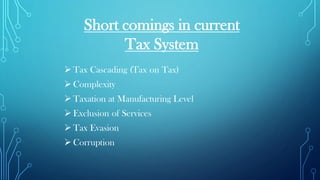
Short comings in current
Tax System
➢ Tax Cascading (Tax on Tax)
➢ Complexity
➢ Taxation at Manufacturing Level
➢ Exclusion of Services
➢ Tax Evasion
➢ Corruption
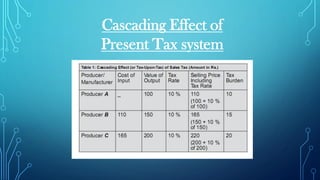
Cascading Effect of
Present Tax system
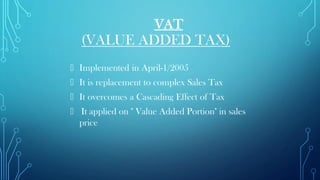
VAT
(VALUE ADDED TAX)
Implemented in April-1/2005
It is replacement to complex Sales Tax
It overcomes a Cascading Effect of Tax
It applied on " Value Added Portion" in sales
price
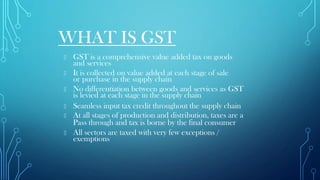
WHAT IS GST
GST is a comprehensive value added tax on goods
and services
It is collected on value added at each stage of sale
or purchase in the supply chain
No differentiation between goods and services as GST
is levied at each stage in the supply chain
Seamless input tax credit throughout the supply chain
At all stages of production and distribution, taxes are a
Pass through and tax is borne by the final consumer
All sectors are taxed with very few exceptions /
exemptions
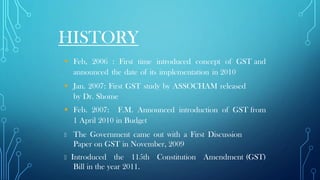
HISTORY
▪ Feb, 2006 : First time introduced concept of GST and
announced the date of its implementation in 2010
▪ Jan. 2007: First GST study by ASSOCHAM released
by Dr. Shome
▪ Feb. 2007: F.M. Announced introduction of GST from
1 April 2010 in Budget
The Government came out with a First Discussion
Paper on GST in November, 2009
Introduced the 115th Constitution Amendment (GST)
Bill in the year 2011.
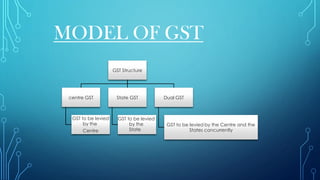
MODEL OF GST
GST Structure
centre GST
GST to be levied
by the
Centre
State GST
GST to be levied
by the
State
Dual GST
GST to be levied by the Centre and the
States concurrently
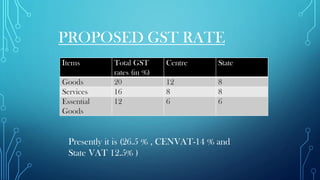
PROPOSED GST RATE
Presently it is (26.5 % , CENVAT-14 % and
State VAT 12.5% )
Items Total GST
rates (in %)
Centre State
Goods 20 12 8
Services 16 8 8
Essential
Goods
12 6 6
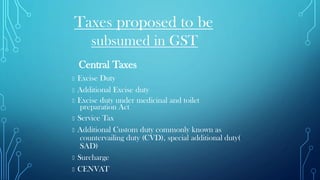
Taxes proposed to be
subsumed in GST
Central Taxes
Excise Duty
Additional Excise duty
Excise duty under medicinal and toilet
preparation Act
Service Tax
Additional Custom duty commonly known as
countervailing duty (CVD), special additional duty(
SAD)
Surcharge
CENVAT
Taxes proposed to be
subsumed in GST
State Taxes
Value added tax (VAT)
Entertainment tax levied by states
Luxury Tax
Tax on Lottery, betting and gambling
Entry tax other than for local bodies
(Octroi)
PRODUCT EXCLUDED FROM
GST
Petroleum Product
Alcohol
Tobacco Product
WHY DOES INDIA NEED GST
• GST is being introduced majorly due to 2 reason
1. The current indirect tax structure is full of uncertainties due to multiple rates.
2. Due to multiple rates there are multiple forms.
• GST the tax complexity in the prevailing tax regime.
BENEFITS OF GST
Transparent Tax System
Uniform Tax system Across India
Reduce Tax Evasion
Export will be more competitive
GST – ADVANTAGES
• As a developing country, India needs a transparent & unambiguous tax structure
• A complex tax structure with multiple rates of taxes
• Multiple taxes across the supply chain
• High transaction cost in the hands of the tax payers
• Increased tax collections due to wider tax base and better compliance
• Improvement in international cost competitiveness of indigenous goods and
services.
• Enhancement in efficiency in manufacture and distribution due to economies of
scale
• GST encourages an unbiased tax structure that is neutral to business processes,
business models, organization structure, product substitutes and geographical
locations
• Helping as a weapon against corruption
• GST operates on a negative list i.e. All goods and services are subject to GST unless
specifically exempted
•
GST : PROPOSED KEY FEATURES
➢Dual GST : central GST & state GST
➢Destination based state GST
➢Uniform classification
➢Uniform forms – returns, Challans ( in electronic mode)
➢No cascading of central and state taxes
➢Cross credit between Centre and state not allowed
➢Tax levied from production to consumption
Thank You
By Pratik Parmar

gstppt-160315173425.pdf and GST implementation

  • 1.
  • 2.
    NAME: PARMAR PRATIKV. ROLL NO. 239 COURSE: BACHELOR OF COMMERCE SEMESTER: 6 DIVISION: ”D” SPECIALIZATION: BUSINESS ANALYTICS TOPIC: GST (GOODS AND SERVICE TAX) SUBMITTED TO : PROF. DR. AVANI VYAS | PROF. MAYURI THAKKAR DATE: 28TH MARCH,2024
  • 3.
    GST • Goods andservice tax (GST) is a comprehensive tax levy on manufacture, sale and consumption of goods and service at a national level. • Gst is a tax on goods and services with value addition at each stage. • Gst will include many state and central level indirect taxes. • It overcomes drawback present tax system
  • 4.
    TAX STRUCTURE ININDIA • Direct Tax : e.g.: Income Tax, Corporate Tax, Wealth Tax • Indirect Tax : e.g.: Excise duty, custom duty, Service Tax, Octrai Tax, VAT.
  • 5.
    METHOD OF TAXATION ProgressiveTax : Increasing rate of tax for Increasing Value or Volume. Regressive Tax : Decreasing rate tax for Increasing Value or Volume Proportional Tax : Fixed rate of tax for every level of income or production
  • 6.
    Short comings incurrent Tax System ➢ Tax Cascading (Tax on Tax) ➢ Complexity ➢ Taxation at Manufacturing Level ➢ Exclusion of Services ➢ Tax Evasion ➢ Corruption
  • 7.
  • 8.
    VAT (VALUE ADDED TAX) Implementedin April-1/2005 It is replacement to complex Sales Tax It overcomes a Cascading Effect of Tax It applied on " Value Added Portion" in sales price
  • 9.
    WHAT IS GST GSTis a comprehensive value added tax on goods and services It is collected on value added at each stage of sale or purchase in the supply chain No differentiation between goods and services as GST is levied at each stage in the supply chain Seamless input tax credit throughout the supply chain At all stages of production and distribution, taxes are a Pass through and tax is borne by the final consumer All sectors are taxed with very few exceptions / exemptions
  • 10.
    HISTORY ▪ Feb, 2006: First time introduced concept of GST and announced the date of its implementation in 2010 ▪ Jan. 2007: First GST study by ASSOCHAM released by Dr. Shome ▪ Feb. 2007: F.M. Announced introduction of GST from 1 April 2010 in Budget The Government came out with a First Discussion Paper on GST in November, 2009 Introduced the 115th Constitution Amendment (GST) Bill in the year 2011.
  • 11.
    MODEL OF GST GSTStructure centre GST GST to be levied by the Centre State GST GST to be levied by the State Dual GST GST to be levied by the Centre and the States concurrently
  • 12.
    PROPOSED GST RATE Presentlyit is (26.5 % , CENVAT-14 % and State VAT 12.5% ) Items Total GST rates (in %) Centre State Goods 20 12 8 Services 16 8 8 Essential Goods 12 6 6
  • 13.
    Taxes proposed tobe subsumed in GST Central Taxes Excise Duty Additional Excise duty Excise duty under medicinal and toilet preparation Act Service Tax Additional Custom duty commonly known as countervailing duty (CVD), special additional duty( SAD) Surcharge CENVAT
  • 14.
    Taxes proposed tobe subsumed in GST State Taxes Value added tax (VAT) Entertainment tax levied by states Luxury Tax Tax on Lottery, betting and gambling Entry tax other than for local bodies (Octroi)
  • 15.
    PRODUCT EXCLUDED FROM GST PetroleumProduct Alcohol Tobacco Product
  • 16.
    WHY DOES INDIANEED GST • GST is being introduced majorly due to 2 reason 1. The current indirect tax structure is full of uncertainties due to multiple rates. 2. Due to multiple rates there are multiple forms. • GST the tax complexity in the prevailing tax regime.
  • 17.
    BENEFITS OF GST TransparentTax System Uniform Tax system Across India Reduce Tax Evasion Export will be more competitive
  • 18.
    GST – ADVANTAGES •As a developing country, India needs a transparent & unambiguous tax structure • A complex tax structure with multiple rates of taxes • Multiple taxes across the supply chain • High transaction cost in the hands of the tax payers • Increased tax collections due to wider tax base and better compliance • Improvement in international cost competitiveness of indigenous goods and services. • Enhancement in efficiency in manufacture and distribution due to economies of scale • GST encourages an unbiased tax structure that is neutral to business processes, business models, organization structure, product substitutes and geographical locations • Helping as a weapon against corruption • GST operates on a negative list i.e. All goods and services are subject to GST unless specifically exempted •
  • 19.
    GST : PROPOSEDKEY FEATURES ➢Dual GST : central GST & state GST ➢Destination based state GST ➢Uniform classification ➢Uniform forms – returns, Challans ( in electronic mode) ➢No cascading of central and state taxes ➢Cross credit between Centre and state not allowed ➢Tax levied from production to consumption
  • 20.