GSM BASED
TRANSFORMER
FAULT DETECTION
SYSTEM
1
CONTENTS
 Introduction
 Objective
 Transformer faults
 Hardware required
 Description of components used
 Block Diagram
 Working
 Flowchart
 Program Execution and Testing
 Results
 Conclusion
2
INTRODUCTION
 Transformers are the vital part of the transmission and
distribution system.
 Since transformers are expensive, the faults should be
rectified before it occurs.
 Monitoring the transformers for problems before they occur
can prevent faults that are costly to repair.
 Current systems can provide information about the state of
a transformer, but are either offline or very expensive to
implement.
3
OBJECTIVE
 To develop low cost solution for monitoring health condition
of remotely located distribution transformers using GSM
technology to prevent premature failure of distribution
transformers and improving reliability of services to the
customers.
 To rescue the transformer from the high fault, before it
occurs. Thus reducing the discrepancy in the transmission
and distribution of power to the consumers.
4
TRANSFORMER FAULT
ANALYSIS
 Over load
The load current in excess of the transformer name-plate rating
decreases the insulation life span.
 Over temperature
Due to over voltage and over current, temp. of oil increases which
causes failure of insulation of transformer winding.
 Over excitation
It results in excess flux, which causes transformer heating and in-
creases exciting current, noise, and vibration.
 Oil level fault
As oil level decreases, the insulation of the transformer gets
affected.
5
HARDWARE REQUIRED
 Current transformer
 Power transformer
 Thermistor
 Oil sensor
 Micro-controller (89S51)
 Converter (ADC0808)
 LCD display
 GSM modem
 Relay.
6
CT AND THERMISTOR
 Current Transformer
Current or voltage transformer are essential for protection and
control. The behavior of current and voltage transformer
during and after the occurrence of fault is critical in electrical
protection.
 Thermistor
Thermistors are special solid temperature sensors. There are
basically two broad types, NTC-Negative Temperature used
mostly in temperature sensing and PTC-Positive Temperature
Coefficient, used mostly in electric current control.
7
OIL LEVEL SENSOR
 Oil level sensor is a float connected angular
potentiometer. Float is immersed in oil and its
mechanical output is given to angular potentiometer.
When there is any mechanical movement of float,
there is voltage generation corresponding to
mechanical movement of float. That voltage is used
for oil level monitoring.
8
ANALOG TO DIGITAL
CONVERTER
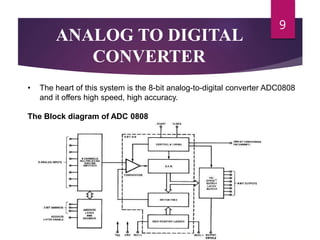
• The heart of this system is the 8-bit analog-to-digital converter ADC0808
and it offers high speed, high accuracy.
The Block diagram of ADC 0808
9
MICROCONTROLLER
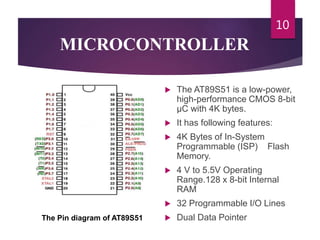
 The AT89S51 is a low-power,
high-performance CMOS 8-bit
μC with 4K bytes.
 It has following features:
 4K Bytes of In-System
Programmable (ISP) Flash
Memory.
 4 V to 5.5V Operating
Range.128 x 8-bit Internal
RAM
 32 Programmable I/O Lines
 Dual Data PointerThe Pin diagram of AT89S51
10
GSM
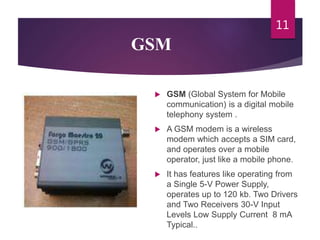
 GSM (Global System for Mobile
communication) is a digital mobile
telephony system .
 A GSM modem is a wireless
modem which accepts a SIM card,
and operates over a mobile
operator, just like a mobile phone.
 It has features like operating from
a Single 5-V Power Supply,
operates up to 120 kb. Two Drivers
and Two Receivers 30-V Input
Levels Low Supply Current 8 mA
Typical..
11
BLOCK DIAGRAM
12
WORKING
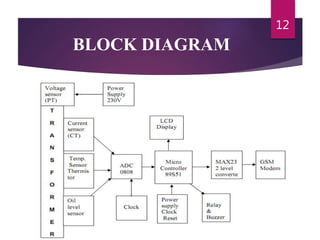
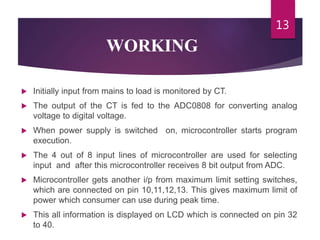
 Initially input from mains to load is monitored by CT.
 The output of the CT is fed to the ADC0808 for converting analog
voltage to digital voltage.
 When power supply is switched on, microcontroller starts program
execution.
 The 4 out of 8 input lines of microcontroller are used for selecting
input and after this microcontroller receives 8 bit output from ADC.
 Microcontroller gets another i/p from maximum limit setting switches,
which are connected on pin 10,11,12,13. This gives maximum limit of
power which consumer can use during peak time.
 This all information is displayed on LCD which is connected on pin 32
to 40.
13
WORKING (Contd,.)
 This i/p is compare with maximum limit setting. Display both those
data on LCD.
 If the i/p (i.e) power consumption exceeds the maximum limit then
initially an alert is sent to the configured numbers. This alert is
given by microcontroller through pin 14.
 Then microcontroller again check power consumption by
customer, if it decreases then alert stops or else a signal is
triggered on pin 15, which is fed to relay.
 Then, the relay switches off the supply to consumer for
predetermined time limit. After this time limit completion again the
supply resumes.
14
15
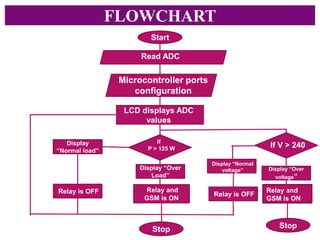
FLOWCHART
Start
If
P > 125 W
Display “Normal
voltage” Display “Over
voltage”
Relay is OFF
Display
“Normal load”
Relay is OFF
Relay and
GSM is ON
Display “Over
Load”
Microcontroller ports
configuration
Read ADC
LCD displays ADC
values
If V > 240
Relay and
GSM is ON
Stop Stop
PROGRAM EXECUTION
AND TESTING
 The program for microcontroller is in embedded C language.
 For AT89S51 controller Atmel programmer is used.
 After successful program burning, microcontroller becomes ready for use
 For example, Let us consider the four parameter of transformer to be
tested:
 180 >Voltage > 260 --Voltage Fault
 Temperature > 400C --Temperature fault
 Power > 125W --Over load
 Oil level < 10 ml ---Oil level fault
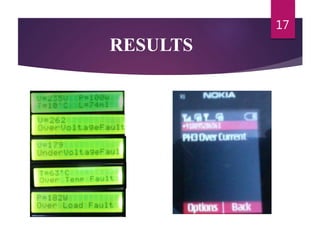
 If any change occurred in above rating, it is shown in LCD and same data
is sent as SMS and at the same time transformer gets disconnected from
supply with the help of relay.
16
RESULTS
17
CONCLUSION
 Transformers are among the most generic and expensive
equipment, hence the regular monitoring health condition of
transformer is essential.
 Since, it is possible to receive fault information of transformer
through GSM technology.
 So one can able to take possible solution before converting fault
in to fatal situation.
 This is the technique of increasing the life of a transformer in a
decreased cost of power system operation.
18
19

Gsm based transformer fault detection system

  • 1.
  • 2.
    CONTENTS  Introduction  Objective Transformer faults  Hardware required  Description of components used  Block Diagram  Working  Flowchart  Program Execution and Testing  Results  Conclusion 2
  • 3.
    INTRODUCTION  Transformers arethe vital part of the transmission and distribution system.  Since transformers are expensive, the faults should be rectified before it occurs.  Monitoring the transformers for problems before they occur can prevent faults that are costly to repair.  Current systems can provide information about the state of a transformer, but are either offline or very expensive to implement. 3
  • 4.
    OBJECTIVE  To developlow cost solution for monitoring health condition of remotely located distribution transformers using GSM technology to prevent premature failure of distribution transformers and improving reliability of services to the customers.  To rescue the transformer from the high fault, before it occurs. Thus reducing the discrepancy in the transmission and distribution of power to the consumers. 4
  • 5.
    TRANSFORMER FAULT ANALYSIS  Overload The load current in excess of the transformer name-plate rating decreases the insulation life span.  Over temperature Due to over voltage and over current, temp. of oil increases which causes failure of insulation of transformer winding.  Over excitation It results in excess flux, which causes transformer heating and in- creases exciting current, noise, and vibration.  Oil level fault As oil level decreases, the insulation of the transformer gets affected. 5
  • 6.
    HARDWARE REQUIRED  Currenttransformer  Power transformer  Thermistor  Oil sensor  Micro-controller (89S51)  Converter (ADC0808)  LCD display  GSM modem  Relay. 6
  • 7.
    CT AND THERMISTOR Current Transformer Current or voltage transformer are essential for protection and control. The behavior of current and voltage transformer during and after the occurrence of fault is critical in electrical protection.  Thermistor Thermistors are special solid temperature sensors. There are basically two broad types, NTC-Negative Temperature used mostly in temperature sensing and PTC-Positive Temperature Coefficient, used mostly in electric current control. 7
  • 8.
    OIL LEVEL SENSOR Oil level sensor is a float connected angular potentiometer. Float is immersed in oil and its mechanical output is given to angular potentiometer. When there is any mechanical movement of float, there is voltage generation corresponding to mechanical movement of float. That voltage is used for oil level monitoring. 8
  • 9.
    ANALOG TO DIGITAL CONVERTER •The heart of this system is the 8-bit analog-to-digital converter ADC0808 and it offers high speed, high accuracy. The Block diagram of ADC 0808 9
  • 10.
    MICROCONTROLLER  The AT89S51is a low-power, high-performance CMOS 8-bit μC with 4K bytes.  It has following features:  4K Bytes of In-System Programmable (ISP) Flash Memory.  4 V to 5.5V Operating Range.128 x 8-bit Internal RAM  32 Programmable I/O Lines  Dual Data PointerThe Pin diagram of AT89S51 10
  • 11.
    GSM  GSM (GlobalSystem for Mobile communication) is a digital mobile telephony system .  A GSM modem is a wireless modem which accepts a SIM card, and operates over a mobile operator, just like a mobile phone.  It has features like operating from a Single 5-V Power Supply, operates up to 120 kb. Two Drivers and Two Receivers 30-V Input Levels Low Supply Current 8 mA Typical.. 11
  • 12.
  • 13.
    WORKING  Initially inputfrom mains to load is monitored by CT.  The output of the CT is fed to the ADC0808 for converting analog voltage to digital voltage.  When power supply is switched on, microcontroller starts program execution.  The 4 out of 8 input lines of microcontroller are used for selecting input and after this microcontroller receives 8 bit output from ADC.  Microcontroller gets another i/p from maximum limit setting switches, which are connected on pin 10,11,12,13. This gives maximum limit of power which consumer can use during peak time.  This all information is displayed on LCD which is connected on pin 32 to 40. 13
  • 14.
    WORKING (Contd,.)  Thisi/p is compare with maximum limit setting. Display both those data on LCD.  If the i/p (i.e) power consumption exceeds the maximum limit then initially an alert is sent to the configured numbers. This alert is given by microcontroller through pin 14.  Then microcontroller again check power consumption by customer, if it decreases then alert stops or else a signal is triggered on pin 15, which is fed to relay.  Then, the relay switches off the supply to consumer for predetermined time limit. After this time limit completion again the supply resumes. 14
  • 15.
    15 FLOWCHART Start If P > 125W Display “Normal voltage” Display “Over voltage” Relay is OFF Display “Normal load” Relay is OFF Relay and GSM is ON Display “Over Load” Microcontroller ports configuration Read ADC LCD displays ADC values If V > 240 Relay and GSM is ON Stop Stop
  • 16.
    PROGRAM EXECUTION AND TESTING The program for microcontroller is in embedded C language.  For AT89S51 controller Atmel programmer is used.  After successful program burning, microcontroller becomes ready for use  For example, Let us consider the four parameter of transformer to be tested:  180 >Voltage > 260 --Voltage Fault  Temperature > 400C --Temperature fault  Power > 125W --Over load  Oil level < 10 ml ---Oil level fault  If any change occurred in above rating, it is shown in LCD and same data is sent as SMS and at the same time transformer gets disconnected from supply with the help of relay. 16
  • 17.
  • 18.
    CONCLUSION  Transformers areamong the most generic and expensive equipment, hence the regular monitoring health condition of transformer is essential.  Since, it is possible to receive fault information of transformer through GSM technology.  So one can able to take possible solution before converting fault in to fatal situation.  This is the technique of increasing the life of a transformer in a decreased cost of power system operation. 18
  • 19.