Digital Storage Oscilloscope
• Storage cathode ray tube has several limitations.
as follows,
1. There is a short duration of time, in which it can preserve a
stored waveform, so the waveform may lose.
2. Trace of storage tube is not as fine as that of a normal CRT.
3. Writing rate of the storage tube is less than that of a
conventional CRT which in turn limits the speed of the
analog storage oscilloscope.
4. It is more expensive than a conventional CRT and requires
additional power supplies.
5. Only one image can be stored. For comparing two traces
they are to be superimposed on the same and displayed
together.
Digital storage oscilloscope is used to limit these limitations. In
DSO, the waveform to be stored is digitized, stored in a digital
memory and retrieved for display on the storage oscilloscope.
Stored waveform is continuously displayed by repeatedly
scanning it. Therefore a conventional
CRT can also be used for the display. The stored display can be
displayed continuously as long as the power is applied to the
memory which can be supplied from a small battery.
Digitized waveform can be analyzed by oscilloscope or by reading
the contents of the memory into the computer. Display of the
stored data is possible in both amplitude versus time and x-y
modes.
In DSO, fast memory readout is used for CRT display in addition
to this a slow readout is also possible which is used for
development of hard copy externally.
• the block diagram of DSO as consists of,
• 1. Data acquisition
• 2. Storage
• 3. Data display.
• Data acquisition is earned out with the help of both analog to digital and
digital to analog converters, which is used for digitizing, storing and
displaying analog waveforms. Overall operation is controlled by control
circuit which is usually consists of microprocessor.
• Data acquisition portion of the system consist of a Sample-and-Hold (S/H)
circuit and an analog to digital converter (ADC) which continuously
samples and digitizes the input signal at a rate determined by the sample
clock and transmit the digitized data to memory for storage. The control
circuit determines whether the successive data points are stored in
successive memory location or not, which is done by continuously
updating the memories.
• When the memory is full, the next data point from the ADC is stored in the
first memory location writing over the old data.
• The data acquisition and the storage process is continues till the control
circuit receive a trigger signal from either the input waveform or an
external trigger source. When the triggering occurs, the system stops and
enters into the display mode of operation in which all or some part of the
memory data is repetitively displayed on the cathode ray tube.
• In display operation, two DACs are used which gives
horizontal and vertical deflection voltage for the CRT Data
from the memory gives the vertical deflection of the
electron beam, while the time base counter gives the
horizontal deflection in the form of staircase sweep signal.
The screen display consist of discrete dots representing the
various data points but the number of dot is very large as
1000 or more that they tend to blend together and appear
to be a smooth continuous waveform.
The display operation ends when the operator presses a
front-panel button and commands the digital storage
oscilloscope to begin a new data acquisition cycle.
• DSO use the digital memory. It can store data as required with out
degradation.
• DSO also uses for complex processing of the signal with high speed
with the help of digital signal processing circuits .
• in this A/D converter use to create the data that is stored in
microprocessors memory, and data sent to display on screen
• DSO convert analog in to digital form using to A/D convertor ,it
stores digital data in memory.
• then processes the signals and to be display on screen.
• the wave form is stored in digital ,advantage of using DSO ,that
stored data can be used to visualize the signal at any time.
Advantages :-
• Allows for automation.
• In this, slow traces like the temperature variation across a
day can be recorded
• With colour Bigger and brighter display, to distinguish
multiple traces
• peak detection
Disadvantage:-
• Digital Oscilloscope is the limited refresh rate of the screen
Digital Storage
Oscilloscope (DSO):
1. It can store the given signal indefinitely
as long as the small amount of power
is supplied to the memory.
2. It always collects the data and stops
when triggered.
3. It employs normal CRT, hence the cost of
the tube is much cheaper than the
storage tube used in ASO.
4. It can produce bright image even for
high frequency signals.
5. In this oscilloscope, time base is
generated, by a crystal clock.
6. It has higher resolution than ASO.
7. It has less operating speed than ASO.
8. Because of aliasing effect the useful
storage ' bandwidth is limited.
Conventional Storage Oscilloscope
(Analog Storage Oscilloscope (ASO)):
1. In this oscilloscope heavy amount-of
power is to be supplied to the storage
CRT.
2. It collects the data only after triggering.
3. The cost of the tube is costlier than the
storage tube used in DSO.
4. It cannot produce bright image for high
frequency signals.
5. In this oscilloscope, time base is
generated by a ramp circuit.
6. It has lower resolution than DSO.
7. It has high operating speed than DSO.
8. It doesn't have aliasing effect
Digital recorders
• In digital recording, the analog signal of a sound is
converted into a stream of discrete numbers,
representing the changes in air pressure through time;
thus making an abstract template for the original
sound.
• The analog signal is transmitted from the input device
to an analog to digital converter (ADC). The ADC
converts this signal to a series of binary numbers. The
count of the numbers produced per second is called
the sample rate. A bundle of wires transmits these
numbers into storage, usually a flash memory chip.
• An analog recording is one where a property or characteristic of a
physical recording medium is made to vary in a manner analogous
to the variations in air pressure of the original sound. Generally, the
air pressure variations are first converted (by a transducer such as a
microphone) into an electrical analog signal in which either the
instantaneous voltage or current is directly proportional to the
instantaneous air pressure (or is a function of the pressure). The
variations of the electrical signal in turn are converted to variations
in the recording medium by a recording machine such as a tape
recorder or record cutter—the variable property of the medium is
modulated by the signal. Examples of properties that are modified
are the magnetization of magnetic tape or the deviation (or
displacement) of the groove of a gramophone disc from a smooth,
flat spiral track.
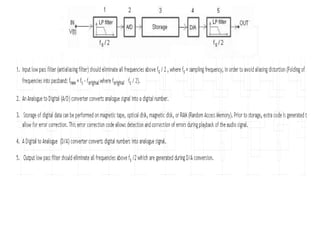
• A digital recording is produced by converting the physical properties
of the original sound into a sequence of numbers, which can then
be stored and read back for reproduction. Normally, the sound is
transduced (as by a microphone) to an analog signal in the same
way as for analog recording, and then the analog signal is digitized,
or converted to a digital signal, through an analog-to-digital
converter and then recorded onto a digital storage medium such as
a compact disc or hard disk.
PEN-DRIVING MECHANISM
• The rotary motion of the galvanometer coil has to
be converted into a visible graphical record. This
can be done in a number of ways.
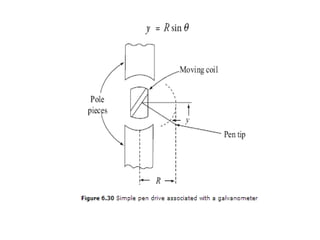
• a simple system for this purpose in which a pen
is attached at the tip of the galvanometer needle.
As the coil rotates under the influence of the
signal current, the pen also rotates in the same
manner.
• The tile distance covered by the pen tip from the
axis of the system (y) as a result of the coil
rotation of ‘q’ is of the form
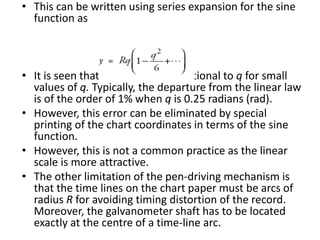
• This can be written using series expansion for the sine
function as
• It is seen that y is directly proportional to q for small
values of q. Typically, the departure from the linear law
is of the order of 1% when q is 0.25 radians (rad).
• However, this error can be eliminated by special
printing of the chart coordinates in terms of the sine
function.
• However, this is not a common practice as the linear
scale is more attractive.
• The other limitation of the pen-driving mechanism is
that the time lines on the chart paper must be arcs of
radius R for avoiding timing distortion of the record.
Moreover, the galvanometer shaft has to be located
exactly at the centre of a time-line arc.

DSO.pptx

  • 1.
    Digital Storage Oscilloscope •Storage cathode ray tube has several limitations. as follows, 1. There is a short duration of time, in which it can preserve a stored waveform, so the waveform may lose. 2. Trace of storage tube is not as fine as that of a normal CRT. 3. Writing rate of the storage tube is less than that of a conventional CRT which in turn limits the speed of the analog storage oscilloscope. 4. It is more expensive than a conventional CRT and requires additional power supplies. 5. Only one image can be stored. For comparing two traces they are to be superimposed on the same and displayed together.
  • 3.
    Digital storage oscilloscopeis used to limit these limitations. In DSO, the waveform to be stored is digitized, stored in a digital memory and retrieved for display on the storage oscilloscope. Stored waveform is continuously displayed by repeatedly scanning it. Therefore a conventional CRT can also be used for the display. The stored display can be displayed continuously as long as the power is applied to the memory which can be supplied from a small battery. Digitized waveform can be analyzed by oscilloscope or by reading the contents of the memory into the computer. Display of the stored data is possible in both amplitude versus time and x-y modes. In DSO, fast memory readout is used for CRT display in addition to this a slow readout is also possible which is used for development of hard copy externally.
  • 4.
    • the blockdiagram of DSO as consists of, • 1. Data acquisition • 2. Storage • 3. Data display. • Data acquisition is earned out with the help of both analog to digital and digital to analog converters, which is used for digitizing, storing and displaying analog waveforms. Overall operation is controlled by control circuit which is usually consists of microprocessor. • Data acquisition portion of the system consist of a Sample-and-Hold (S/H) circuit and an analog to digital converter (ADC) which continuously samples and digitizes the input signal at a rate determined by the sample clock and transmit the digitized data to memory for storage. The control circuit determines whether the successive data points are stored in successive memory location or not, which is done by continuously updating the memories. • When the memory is full, the next data point from the ADC is stored in the first memory location writing over the old data. • The data acquisition and the storage process is continues till the control circuit receive a trigger signal from either the input waveform or an external trigger source. When the triggering occurs, the system stops and enters into the display mode of operation in which all or some part of the memory data is repetitively displayed on the cathode ray tube.
  • 5.
    • In displayoperation, two DACs are used which gives horizontal and vertical deflection voltage for the CRT Data from the memory gives the vertical deflection of the electron beam, while the time base counter gives the horizontal deflection in the form of staircase sweep signal. The screen display consist of discrete dots representing the various data points but the number of dot is very large as 1000 or more that they tend to blend together and appear to be a smooth continuous waveform. The display operation ends when the operator presses a front-panel button and commands the digital storage oscilloscope to begin a new data acquisition cycle.
  • 6.
    • DSO usethe digital memory. It can store data as required with out degradation. • DSO also uses for complex processing of the signal with high speed with the help of digital signal processing circuits . • in this A/D converter use to create the data that is stored in microprocessors memory, and data sent to display on screen • DSO convert analog in to digital form using to A/D convertor ,it stores digital data in memory. • then processes the signals and to be display on screen. • the wave form is stored in digital ,advantage of using DSO ,that stored data can be used to visualize the signal at any time.
  • 7.
    Advantages :- • Allowsfor automation. • In this, slow traces like the temperature variation across a day can be recorded • With colour Bigger and brighter display, to distinguish multiple traces • peak detection Disadvantage:- • Digital Oscilloscope is the limited refresh rate of the screen
  • 8.
    Digital Storage Oscilloscope (DSO): 1.It can store the given signal indefinitely as long as the small amount of power is supplied to the memory. 2. It always collects the data and stops when triggered. 3. It employs normal CRT, hence the cost of the tube is much cheaper than the storage tube used in ASO. 4. It can produce bright image even for high frequency signals. 5. In this oscilloscope, time base is generated, by a crystal clock. 6. It has higher resolution than ASO. 7. It has less operating speed than ASO. 8. Because of aliasing effect the useful storage ' bandwidth is limited. Conventional Storage Oscilloscope (Analog Storage Oscilloscope (ASO)): 1. In this oscilloscope heavy amount-of power is to be supplied to the storage CRT. 2. It collects the data only after triggering. 3. The cost of the tube is costlier than the storage tube used in DSO. 4. It cannot produce bright image for high frequency signals. 5. In this oscilloscope, time base is generated by a ramp circuit. 6. It has lower resolution than DSO. 7. It has high operating speed than DSO. 8. It doesn't have aliasing effect
  • 9.
    Digital recorders • Indigital recording, the analog signal of a sound is converted into a stream of discrete numbers, representing the changes in air pressure through time; thus making an abstract template for the original sound. • The analog signal is transmitted from the input device to an analog to digital converter (ADC). The ADC converts this signal to a series of binary numbers. The count of the numbers produced per second is called the sample rate. A bundle of wires transmits these numbers into storage, usually a flash memory chip.
  • 10.
    • An analogrecording is one where a property or characteristic of a physical recording medium is made to vary in a manner analogous to the variations in air pressure of the original sound. Generally, the air pressure variations are first converted (by a transducer such as a microphone) into an electrical analog signal in which either the instantaneous voltage or current is directly proportional to the instantaneous air pressure (or is a function of the pressure). The variations of the electrical signal in turn are converted to variations in the recording medium by a recording machine such as a tape recorder or record cutter—the variable property of the medium is modulated by the signal. Examples of properties that are modified are the magnetization of magnetic tape or the deviation (or displacement) of the groove of a gramophone disc from a smooth, flat spiral track. • A digital recording is produced by converting the physical properties of the original sound into a sequence of numbers, which can then be stored and read back for reproduction. Normally, the sound is transduced (as by a microphone) to an analog signal in the same way as for analog recording, and then the analog signal is digitized, or converted to a digital signal, through an analog-to-digital converter and then recorded onto a digital storage medium such as a compact disc or hard disk.
  • 12.
    PEN-DRIVING MECHANISM • Therotary motion of the galvanometer coil has to be converted into a visible graphical record. This can be done in a number of ways. • a simple system for this purpose in which a pen is attached at the tip of the galvanometer needle. As the coil rotates under the influence of the signal current, the pen also rotates in the same manner. • The tile distance covered by the pen tip from the axis of the system (y) as a result of the coil rotation of ‘q’ is of the form
  • 14.
    • This canbe written using series expansion for the sine function as • It is seen that y is directly proportional to q for small values of q. Typically, the departure from the linear law is of the order of 1% when q is 0.25 radians (rad). • However, this error can be eliminated by special printing of the chart coordinates in terms of the sine function. • However, this is not a common practice as the linear scale is more attractive. • The other limitation of the pen-driving mechanism is that the time lines on the chart paper must be arcs of radius R for avoiding timing distortion of the record. Moreover, the galvanometer shaft has to be located exactly at the centre of a time-line arc.