








GROWTH ANDGROWTH AND
DEVELOPMENTDEVELOPMENT
Basic conceptsBasic concepts
www.indiandentalacademy.comwww.indiandentalacademy.com
DEFINITIONSDEFINITIONS
GROWTHGROWTH
According to J.X.HUXLEYAccording to J.X.HUXLEY
““The self multiplication of living substance”The self multiplication of living substance”
According to KROGMANAccording to KROGMAN
““Increase in size, change in proportion andIncrease in size, change in proportion and
progressive complexity”progressive complexity”
According to MOYER`SAccording to MOYER`S
““Quantitative aspect of biologic development perQuantitative aspect of biologic development per
unit time”unit time” www.indiandentalacademy.comwww.indiandentalacademy.com
DEFINITIONSDEFINITIONS
According to TODDAccording to TODD
““ An inrease in size”An inrease in size”
According to MERIDITHAccording to MERIDITH
““Entire series of sequential anatomic andEntire series of sequential anatomic and
physiologic changes taking place from the beginning ofphysiologic changes taking place from the beginning of
prenatal life to senility”prenatal life to senility”
According to MOSSAccording to MOSS
““Change in any morphological parameterChange in any morphological parameter
which is measurable”which is measurable”www.indiandentalacademy.comwww.indiandentalacademy.com
DEVELOPMENTDEVELOPMENT
 According to TODDAccording to TODD
““Progress towards maturity”Progress towards maturity”
www.indiandentalacademy.comwww.indiandentalacademy.com
DIFFERENTIATIONDIFFERENTIATION
According to MOYER`SAccording to MOYER`S ““Differentiation is the changeDifferentiation is the change
from a generalized cell or tissue to one that is morefrom a generalized cell or tissue to one that is more
specialised.”specialised.”
www.indiandentalacademy.comwww.indiandentalacademy.com
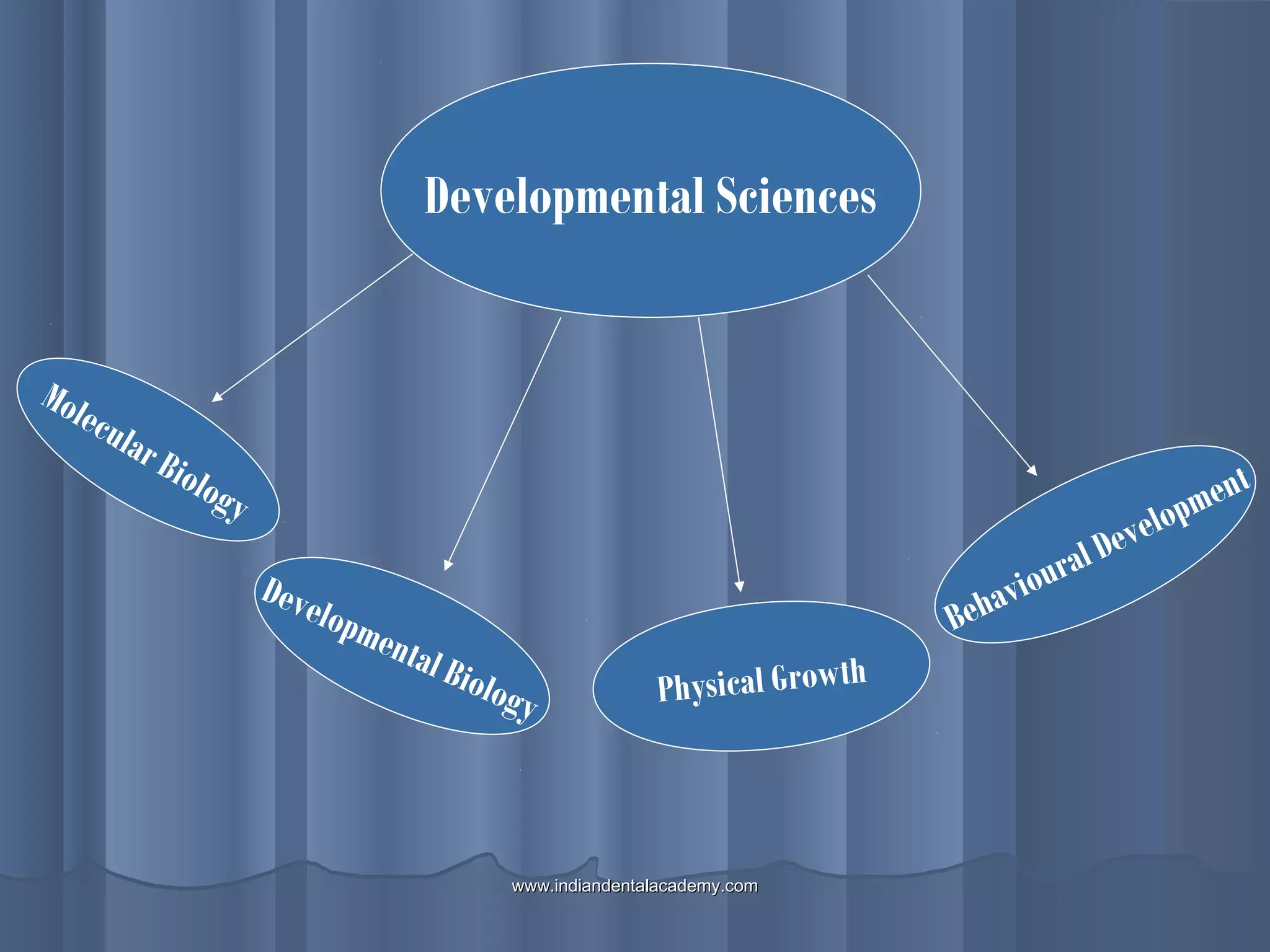
Molecular Biology
Developmental Sciences
Developmental Biology
Behavioural Development
Physical Growth
www.indiandentalacademy.comwww.indiandentalacademy.com
Molecular biologyMolecular biology
It includes molecularIt includes molecular genetics, biophysics, and geneticgenetics, biophysics, and genetic
engineering.engineering.
Developmental biologyDevelopmental biology
It includes cellular biology ,embryology, teratology,It includes cellular biology ,embryology, teratology,
reproductive biology and perinatal biology.reproductive biology and perinatal biology.
Developmental oral biologyDevelopmental oral biology
concerned with craniofacial growth and development.concerned with craniofacial growth and development.
Physical GrowthPhysical Growth
The field of physical growth is the study of organ andThe field of physical growth is the study of organ and
body growth.body growth. www.indiandentalacademy.comwww.indiandentalacademy.com
It includes analysis of such morphogenesis, height andIt includes analysis of such morphogenesis, height and
weight, growth rates, retarded growth, metabolicweight, growth rates, retarded growth, metabolic
disturbances in growth, developmental physical fitness,disturbances in growth, developmental physical fitness,
pubescence and morphometrics.pubescence and morphometrics.
Behavioral developmentBehavioral development
As the child grows physically,pattern of interactionsAs the child grows physically,pattern of interactions
develop with the environment. (i.e. Behavior)develop with the environment. (i.e. Behavior)
Behavior appears in typical sequences duringBehavior appears in typical sequences during
development just as the physical attributes of the bodydevelopment just as the physical attributes of the body
appear in an expected pattern.appear in an expected pattern.
www.indiandentalacademy.comwww.indiandentalacademy.com
Scientists studying behavioral development includeScientists studying behavioral development include
embryologists, developmental psychologists,embryologists, developmental psychologists,
psychiatrists, physiologists, physiologic psychologists,psychiatrists, physiologists, physiologic psychologists,
and geneticists.and geneticists.
www.indiandentalacademy.comwww.indiandentalacademy.com
GROWTH PATTERN, VARIABILITY AND TIMINGGROWTH PATTERN, VARIABILITY AND TIMING
(A)PATTERN(A)PATTERN
Pattern reflects proportionality, usually of a complexPattern reflects proportionality, usually of a complex
set of proportions rather than just a single proportionalset of proportions rather than just a single proportional
relationship.relationship.
The physical arrangement of body at one time is aThe physical arrangement of body at one time is a
pattern of spatially proportioned parts.pattern of spatially proportioned parts.
www.indiandentalacademy.comwww.indiandentalacademy.com
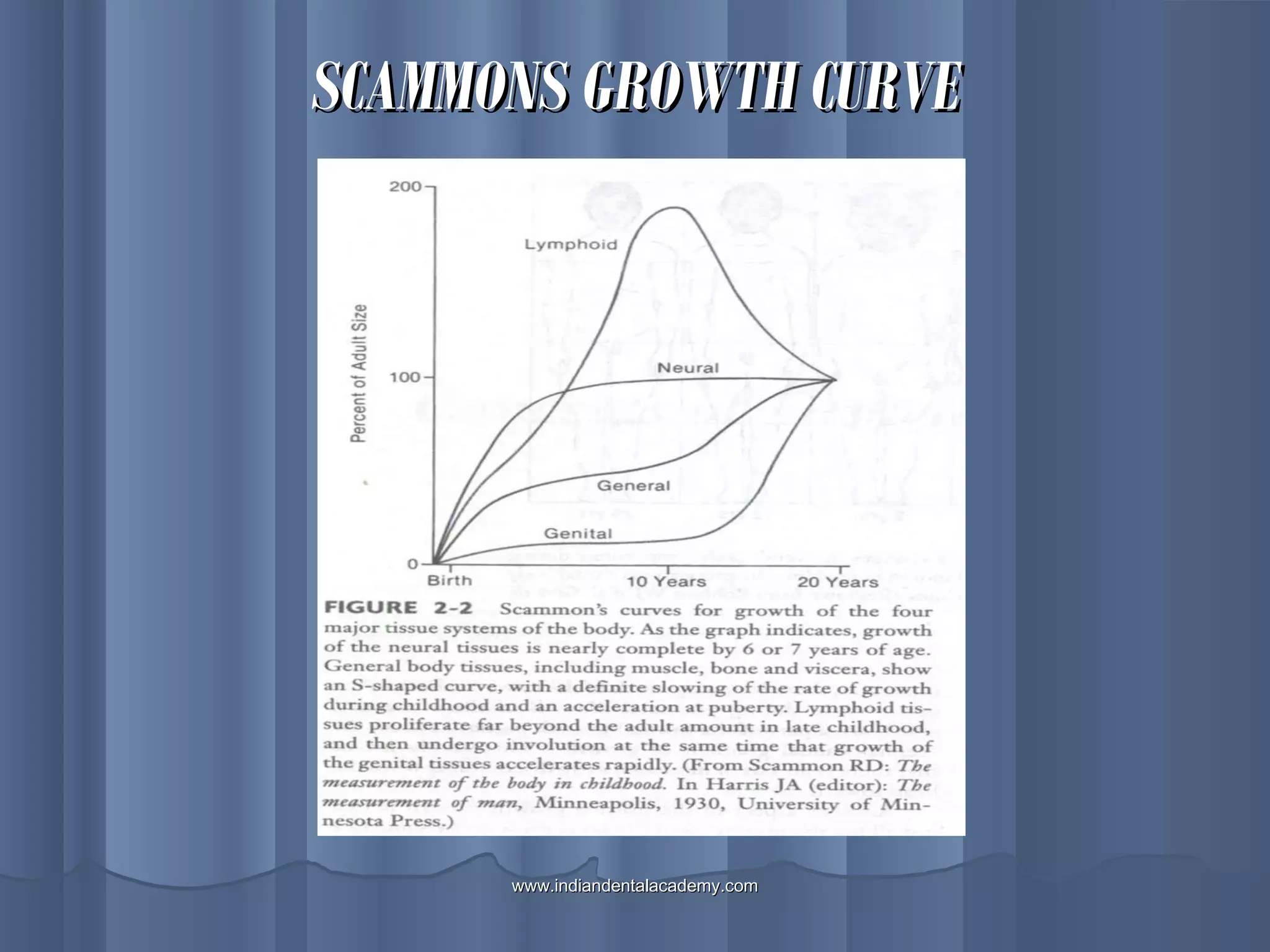
SCAMMONS GROWTH CURVESCAMMONS GROWTH CURVE
www.indiandentalacademy.comwww.indiandentalacademy.com
Not all body systems grows at the same rate.Not all body systems grows at the same rate.
The muscular and skeletal elements grows faster thanThe muscular and skeletal elements grows faster than
the brain and central nervous system as reflected inthe brain and central nervous system as reflected in
relative decrease of head size.relative decrease of head size.
www.indiandentalacademy.comwww.indiandentalacademy.com
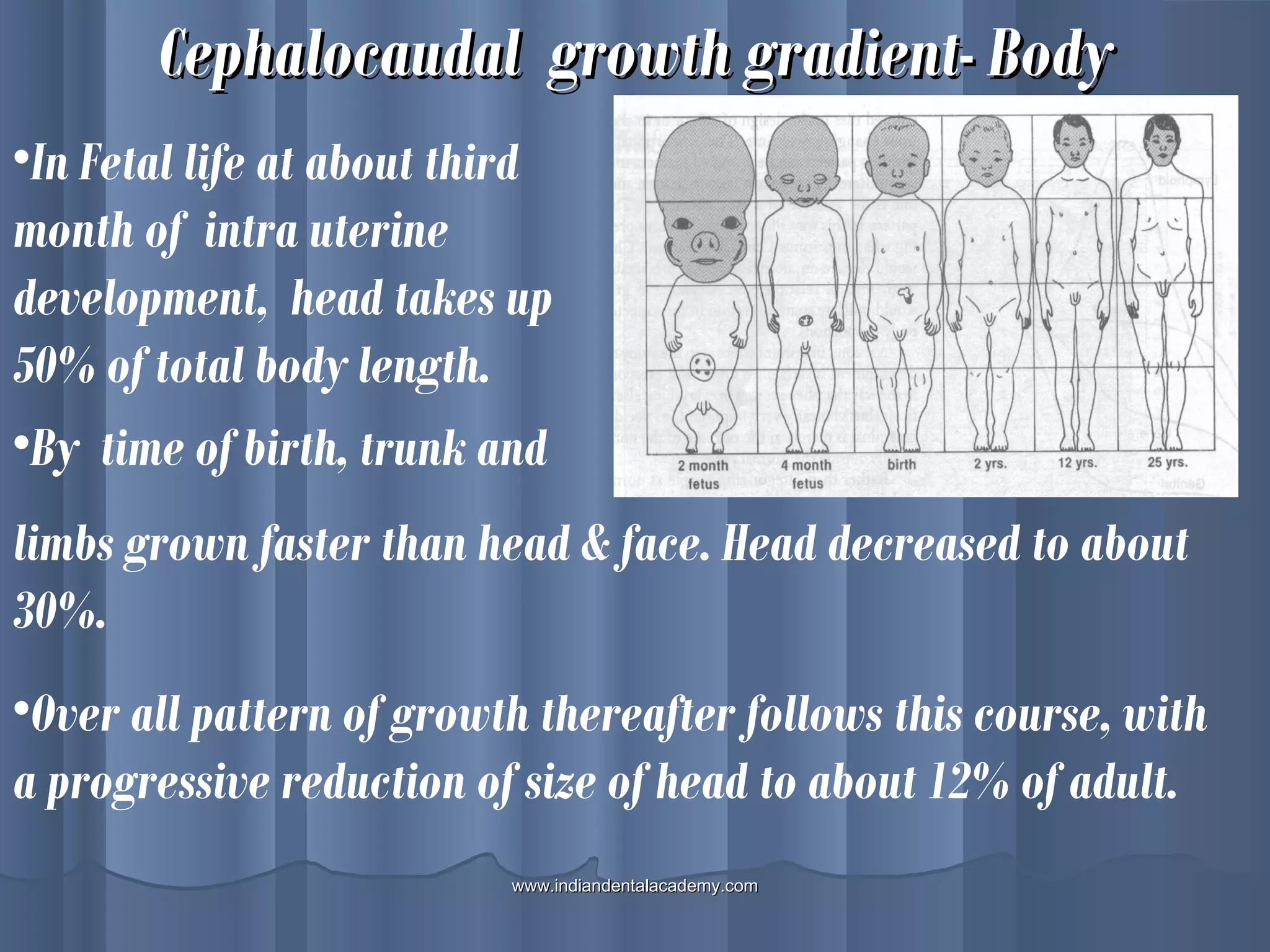
Cephalocaudal growth gradient- BodyCephalocaudal growth gradient- Body
•In Fetal life at about third
month of intra uterine
development, head takes up
50% of total body length.
•By time of birth, trunk and
limbs grown faster than head & face. Head decreased to about
30%.
•Over all pattern of growth thereafter follows this course, with
a progressive reduction of size of head to about 12% of adult.
www.indiandentalacademy.comwww.indiandentalacademy.com
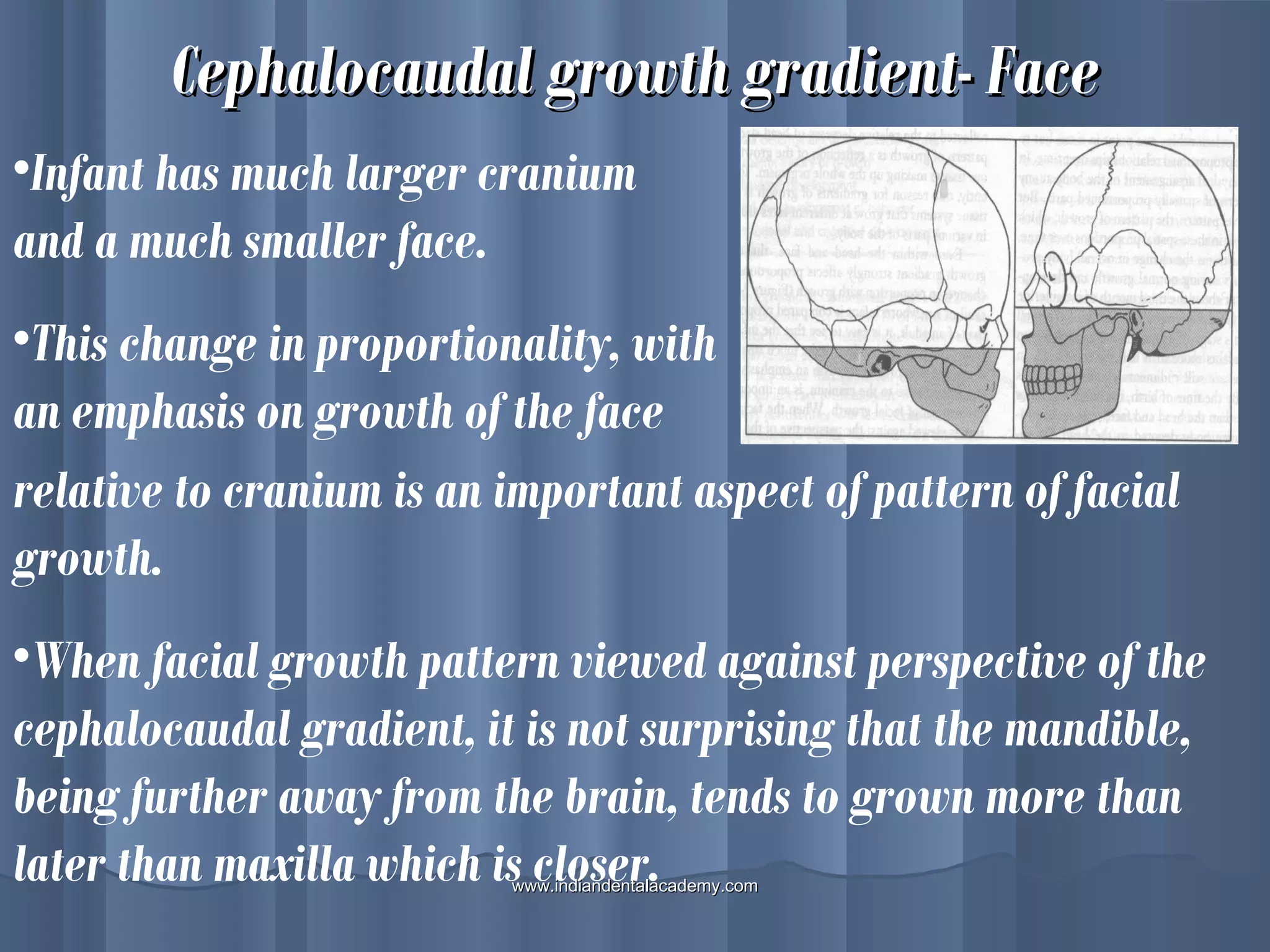
Cephalocaudal growth gradient- FaceCephalocaudal growth gradient- Face
•Infant has much larger cranium
and a much smaller face.
•This change in proportionality, with
an emphasis on growth of the face
relative to cranium is an important aspect of pattern of facial
growth.
•When facial growth pattern viewed against perspective of the
cephalocaudal gradient, it is not surprising that the mandible,
being further away from the brain, tends to grown more than
later than maxilla which is closer.www.indiandentalacademy.comwww.indiandentalacademy.com
(B)VARIABILITY(B)VARIABILITY
The second important concept in the study of growthThe second important concept in the study of growth
and development is variabilityand development is variability
It is very important clinically, to decide whether anIt is very important clinically, to decide whether an
individual is merely at the extreme of the normalindividual is merely at the extreme of the normal
variation or falls from outside.variation or falls from outside.
Rather than categorizing people as normal orRather than categorizing people as normal or
abnormal, it is more useful to think in terms ofabnormal, it is more useful to think in terms of
deviations from the usual pattern and to expressdeviations from the usual pattern and to express
variability quantitatively.variability quantitatively.
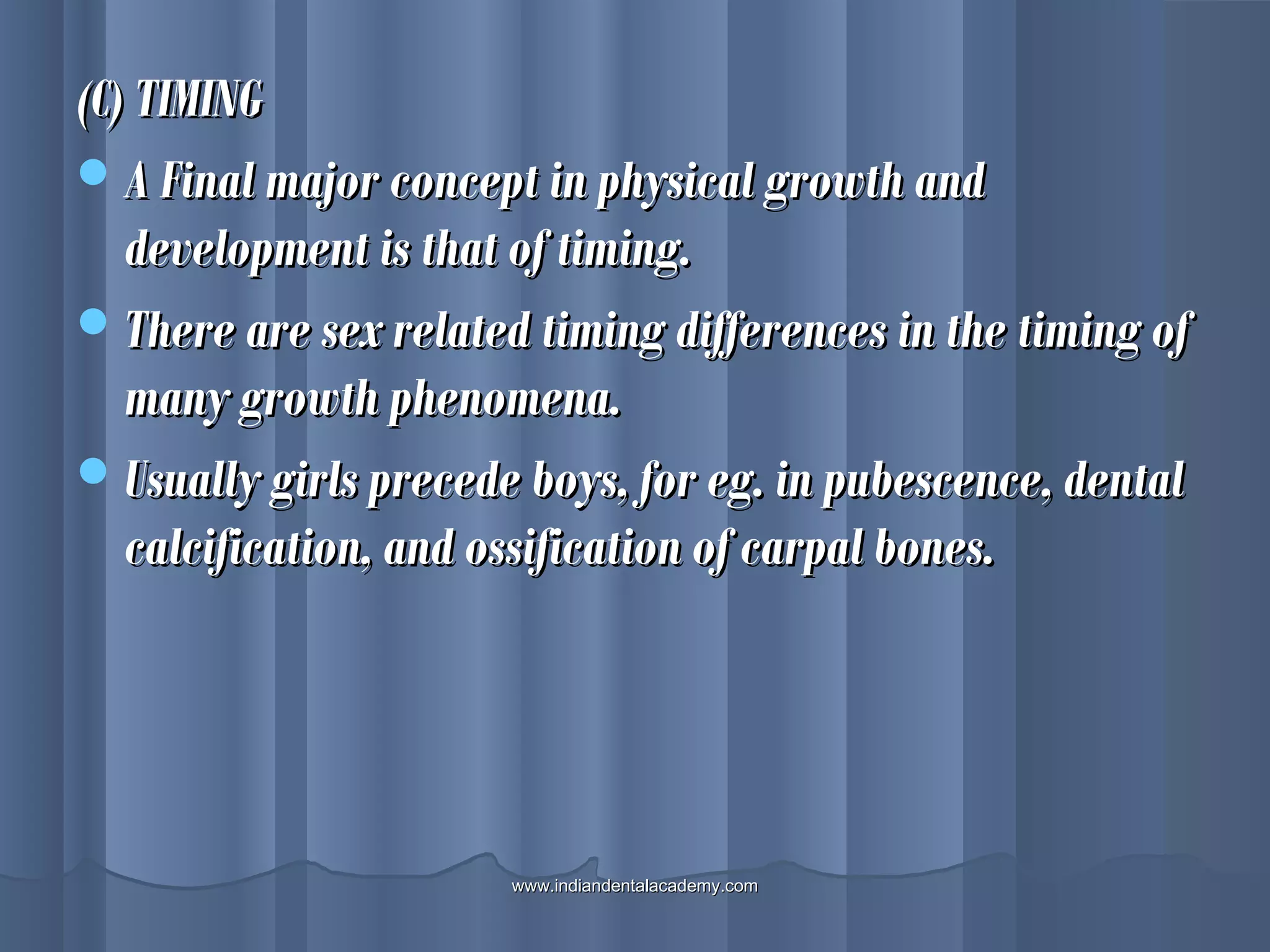
one way to do this is to evaluate a given child relativeone way to do this is to evaluate a given child relative
to peers on a standard growth chart.to peers on a standard growth chart.www.indiandentalacademy.comwww.indiandentalacademy.com
GROWTH CHARTSGROWTH CHARTS
www.indiandentalacademy.comwww.indiandentalacademy.com
(C) TIMING(C) TIMING
A Final major concept in physical growth andA Final major concept in physical growth and
development is that of timing.development is that of timing.
There are sex related timing differences in the timing ofThere are sex related timing differences in the timing of
many growth phenomena.many growth phenomena.
Usually girls precede boys, for eg. in pubescence, dentalUsually girls precede boys, for eg. in pubescence, dental
calcification, and ossification of carpal bones.calcification, and ossification of carpal bones.
www.indiandentalacademy.comwww.indiandentalacademy.com
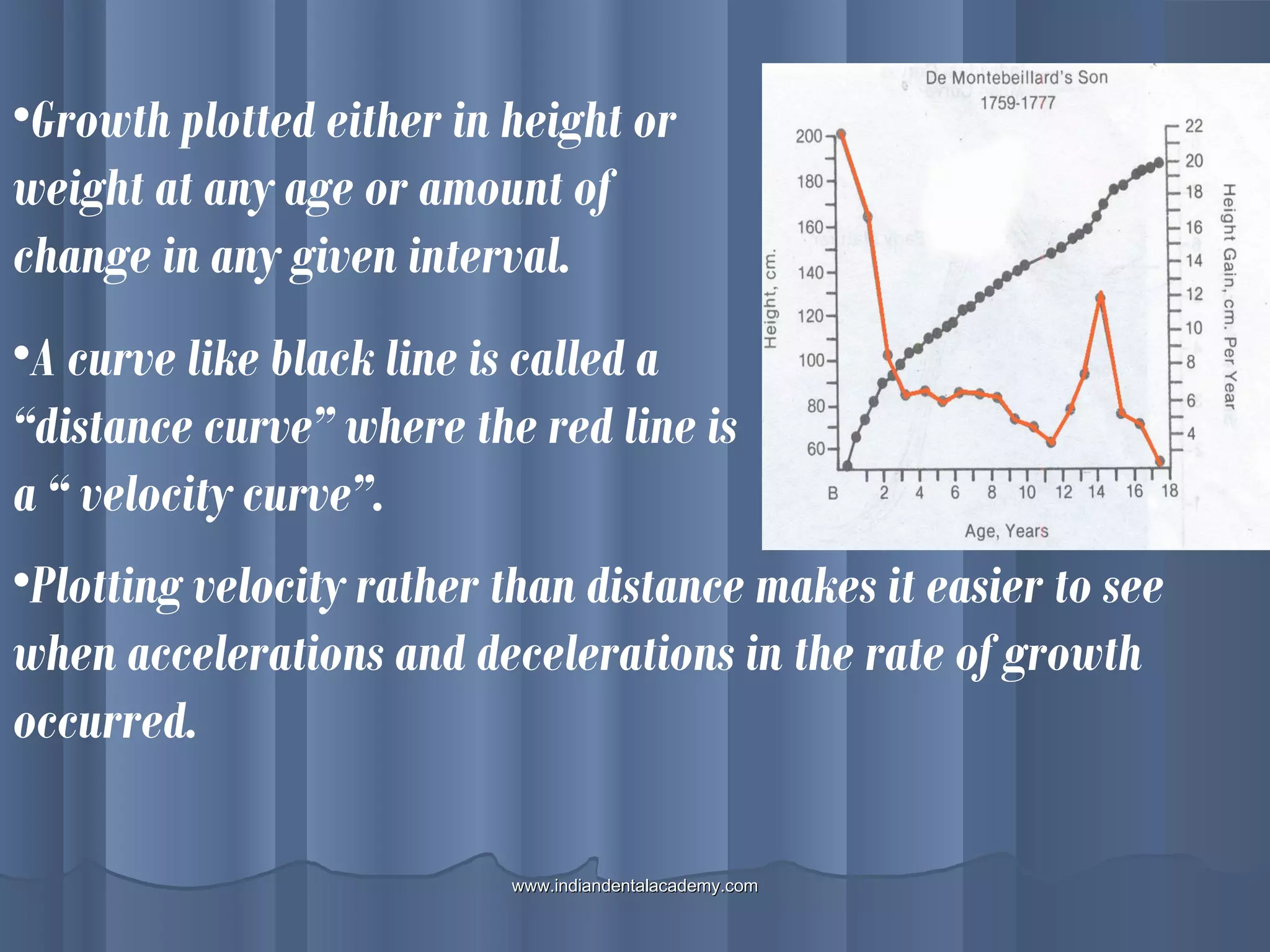
•Growth plotted either in height or
weight at any age or amount of
change in any given interval.
•A curve like black line is called a
“distance curve” where the red line is
a “ velocity curve”.
•Plotting velocity rather than distance makes it easier to see
when accelerations and decelerations in the rate of growth
occurred.
www.indiandentalacademy.comwww.indiandentalacademy.com
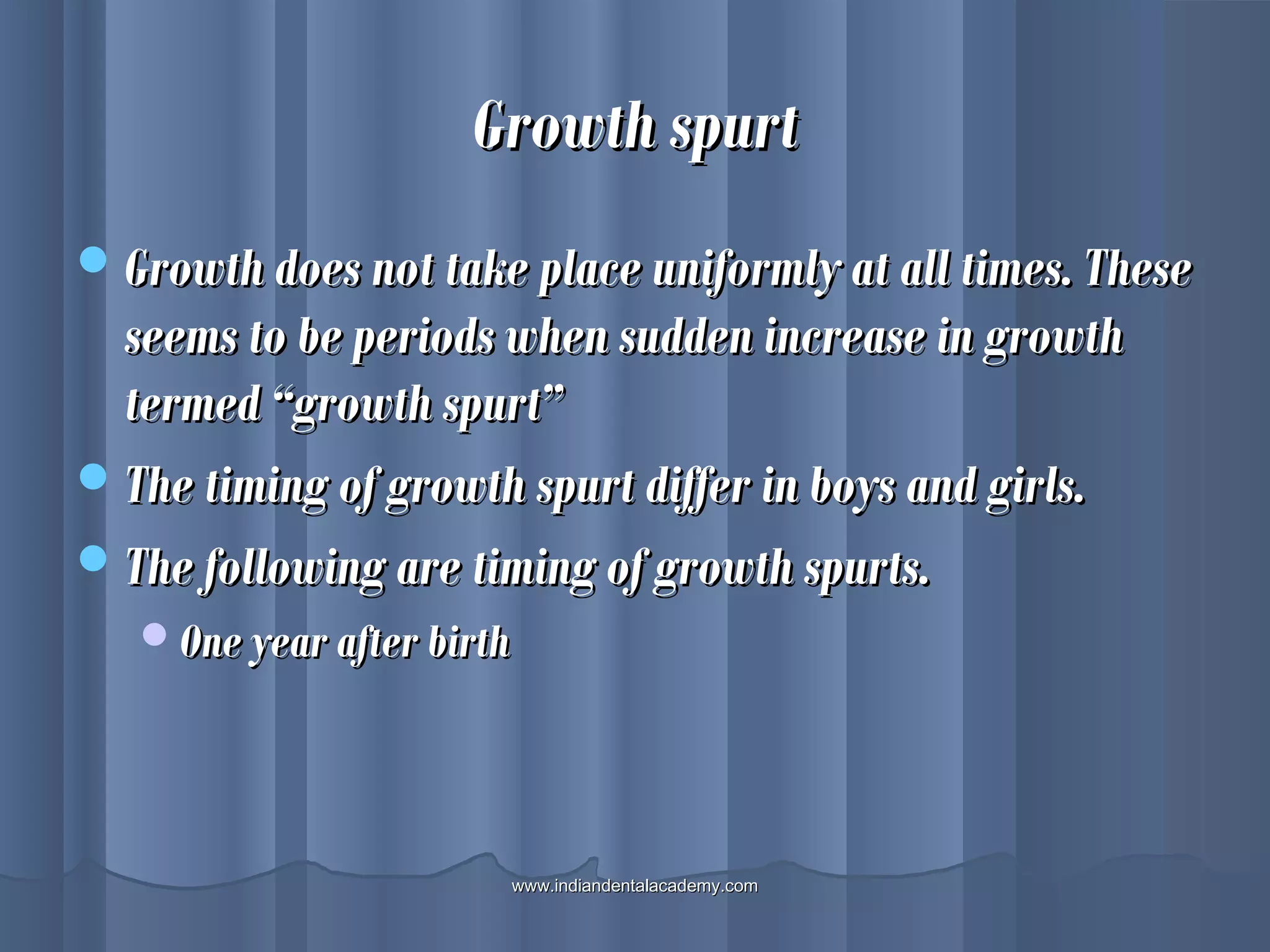
Growth spurtGrowth spurt
Growth does not take place uniformly at all times. TheseGrowth does not take place uniformly at all times. These
seems to be periods when sudden increase in growthseems to be periods when sudden increase in growth
termed “growth spurt”termed “growth spurt”
The timing of growth spurt differ in boys and girls.The timing of growth spurt differ in boys and girls.
The following are timing of growth spurts.The following are timing of growth spurts.
One year after birthOne year after birth
www.indiandentalacademy.comwww.indiandentalacademy.com
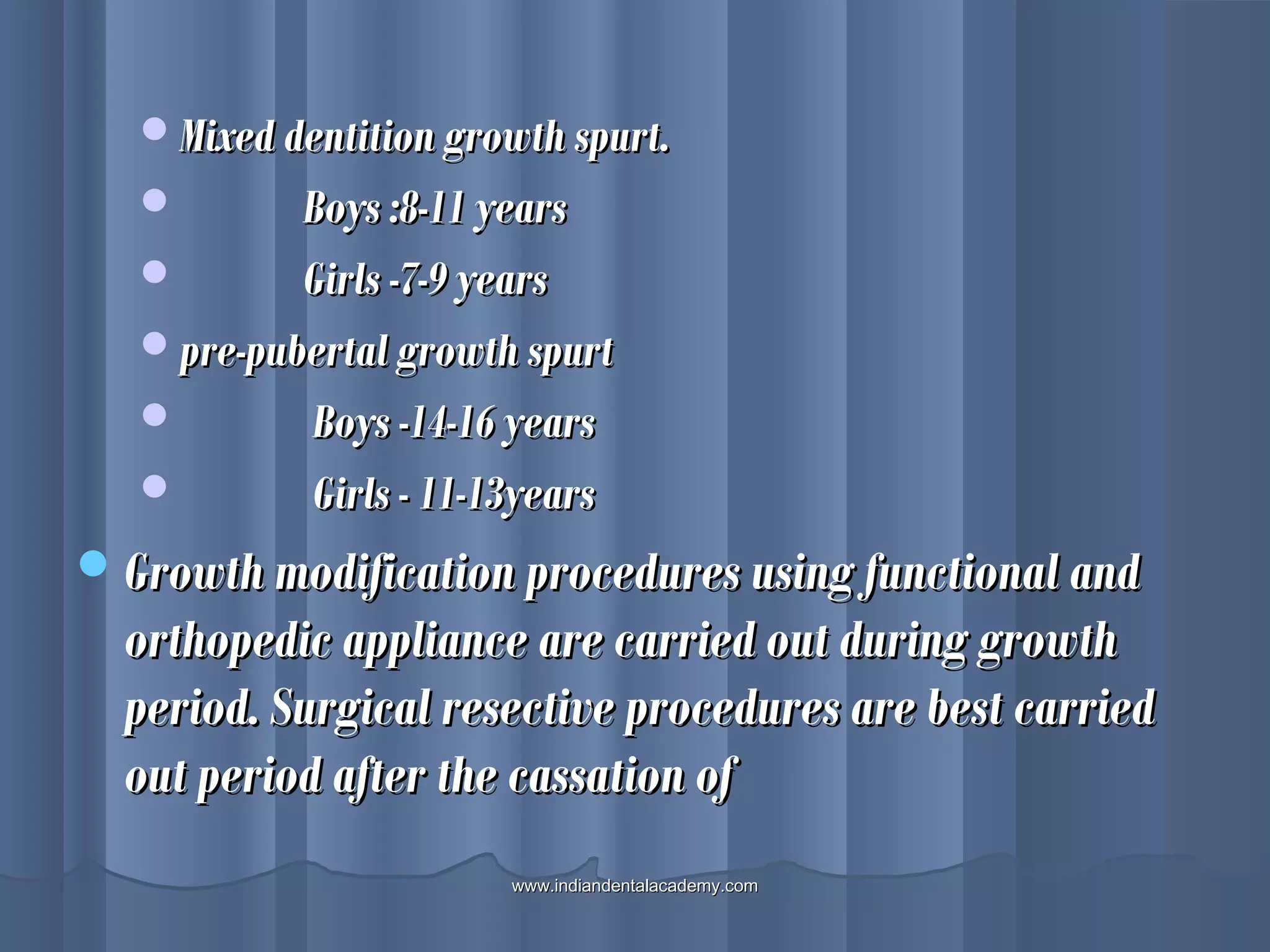
Mixed dentition growth spurt.Mixed dentition growth spurt.
 Boys :8-11 yearsBoys :8-11 years
 Girls -7-9 yearsGirls -7-9 years
pre-pubertal growth spurtpre-pubertal growth spurt
 Boys -14-16 yearsBoys -14-16 years
 Girls - 11-13yearsGirls - 11-13years
Growth modification procedures using functional andGrowth modification procedures using functional and
orthopedic appliance are carried out during growthorthopedic appliance are carried out during growth
period. Surgical resective procedures are best carriedperiod. Surgical resective procedures are best carried
out period after the cassation ofout period after the cassation of
www.indiandentalacademy.comwww.indiandentalacademy.com
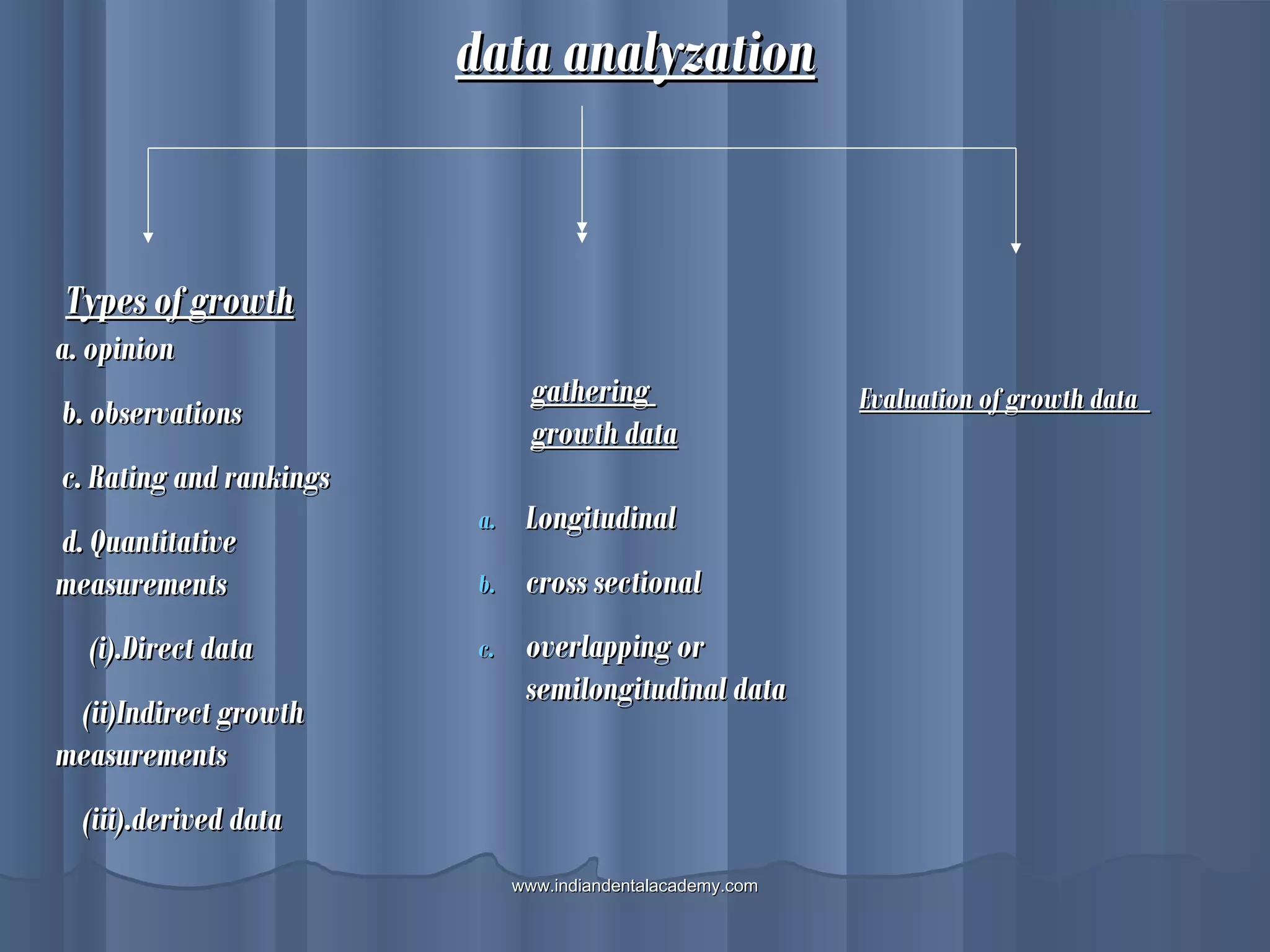
data analyzationdata analyzation
Types of growthTypes of growth
gatheringgathering
growth datagrowth data
Evaluation of growth dataEvaluation of growth data
a. opiniona. opinion
b. observationsb. observations
c. Rating and rankingsc. Rating and rankings
d. Quantitatived. Quantitative
measurementsmeasurements
(i).Direct data(i).Direct data
(ii)Indirect growth(ii)Indirect growth
measurementsmeasurements
(iii).derived data(iii).derived data
a.a. LongitudinalLongitudinal
b.b. cross sectionalcross sectional
c.c. overlapping oroverlapping or
semilongitudinal datasemilongitudinal data
www.indiandentalacademy.comwww.indiandentalacademy.com
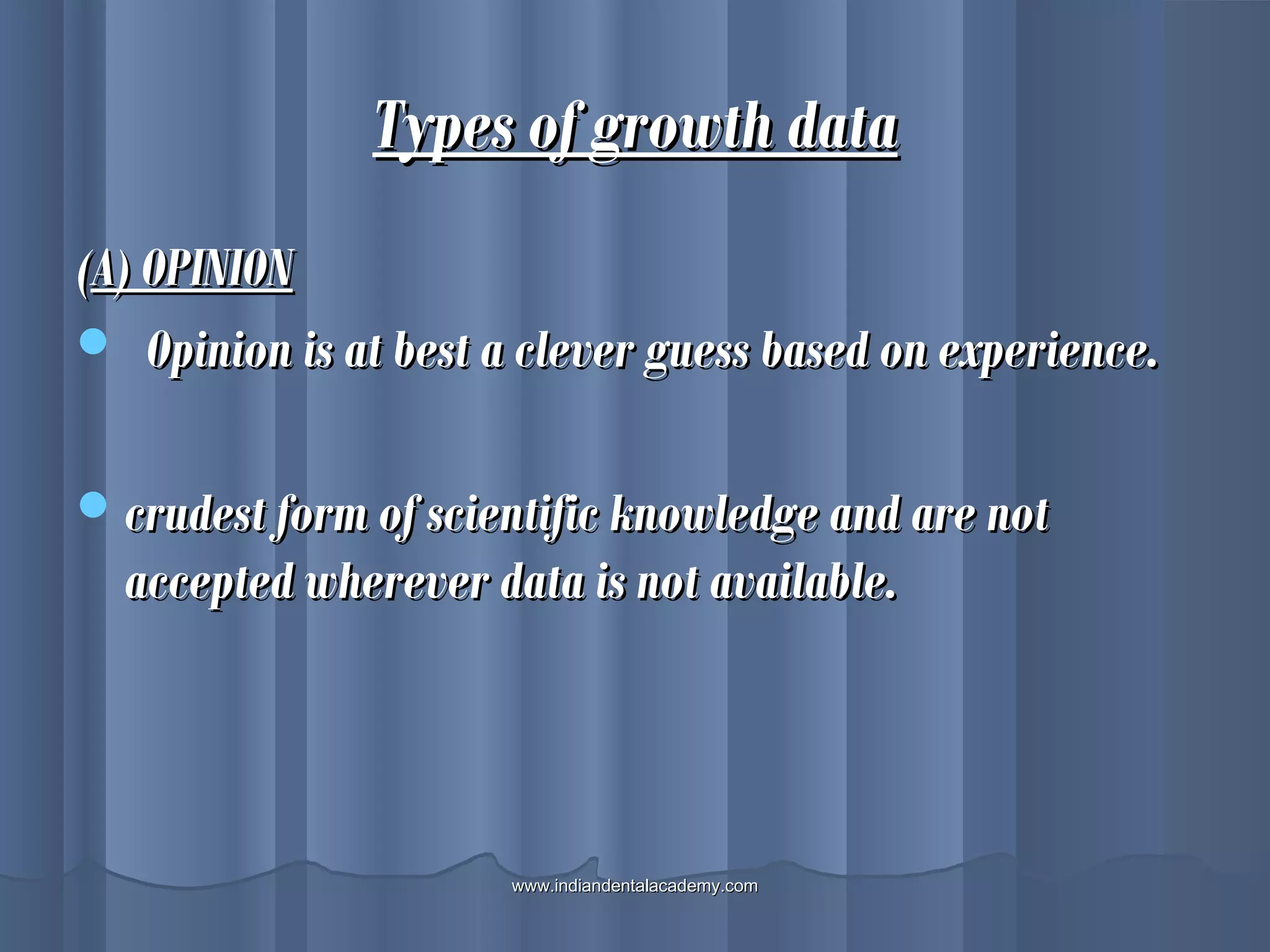
Types of growth dataTypes of growth data
((A) OPINIONA) OPINION
 Opinion is at best a clever guess based on experience.Opinion is at best a clever guess based on experience.
crudest form of scientific knowledge and are notcrudest form of scientific knowledge and are not
accepted wherever data is not available.accepted wherever data is not available.
www.indiandentalacademy.comwww.indiandentalacademy.com
(B) OBSERVATIONS(B) OBSERVATIONS
 Observations are useful for studying all-or-noneObservations are useful for studying all-or-none
phenomena.phenomena.
eg. congenital absence of teetheg. congenital absence of teeth
www.indiandentalacademy.comwww.indiandentalacademy.com
(C) RATINGS AND RANKINGS(C) RATINGS AND RANKINGS
Ratings make use of comparisons with conventionalRatings make use of comparisons with conventional
accepted or scales or classification.accepted or scales or classification.
Ranking may array data in ordered sequencesRanking may array data in ordered sequences
according to value.according to value.
This method used for evaluation of ear shape, eyeThis method used for evaluation of ear shape, eye
colour and fingerprints.colour and fingerprints.
www.indiandentalacademy.comwww.indiandentalacademy.com
(D) QUANTITATIVE MEASUREMENTS(D) QUANTITATIVE MEASUREMENTS
Quantitation minimizes misunderstanding and permitsQuantitation minimizes misunderstanding and permits
the testing of hypotheses by other workers.the testing of hypotheses by other workers.
1)Direct data- data derived from measurements1)Direct data- data derived from measurements
taken on the living person or cadaver by means oftaken on the living person or cadaver by means of
calipers, scales, measuring tapes and other measuringcalipers, scales, measuring tapes and other measuring
devices.devices.
Measuring of teeth with a boley gauge in the mouth of aMeasuring of teeth with a boley gauge in the mouth of a
patient produces direct data.patient produces direct data.
www.indiandentalacademy.comwww.indiandentalacademy.com
Indirect growth measurements-Indirect growth measurements-
measurements taken frommeasurements taken from sources other thansources other than the actualthe actual
person.person.
e.g. photographs, dental casts or cephalograms.e.g. photographs, dental casts or cephalograms.
Derived data- obtained by comparing at least two orDerived data- obtained by comparing at least two or
more measurements.more measurements.
e.g. In a person, mandible grew 2mm between ages 7e.g. In a person, mandible grew 2mm between ages 7
and 8, the 2mm have actually been measured; ratherand 8, the 2mm have actually been measured; rather
the mandibular length at 7 years has been substractedthe mandibular length at 7 years has been substracted
from the mandibular length at 8years and thefrom the mandibular length at 8years and the
increment thus derived is assumed to represent growth.increment thus derived is assumed to represent growth.www.indiandentalacademy.comwww.indiandentalacademy.com
METHODS OF GATHERING GROWTH DATAMETHODS OF GATHERING GROWTH DATA
(A) Longitudinal(A) Longitudinal
Measurement made of the same person or group at regularMeasurement made of the same person or group at regular
intervals through time are longitudinal measurements.intervals through time are longitudinal measurements.
1)Advantages of the longitudinal method.1)Advantages of the longitudinal method.
variability in development among individuals within thevariability in development among individuals within the
group is put in proper perspective.group is put in proper perspective.
The specific developmental pattern of an individual can beThe specific developmental pattern of an individual can be
studied, permitting serial comparisons.studied, permitting serial comparisons.
Temporary temporal problems in sampling are smoothed outTemporary temporal problems in sampling are smoothed out
with time, and an unusual event or a mistake in measuring iswith time, and an unusual event or a mistake in measuring is
more easily seen and corrections made.more easily seen and corrections made.www.indiandentalacademy.comwww.indiandentalacademy.com
DISADVANTAGE OF THE LONGITUDINAL METHOD.DISADVANTAGE OF THE LONGITUDINAL METHOD.
TIME- If one wish to study the growth of the human face from theTIME- If one wish to study the growth of the human face from the
birth to adulthood by means of longitudinal data, it will take a lifebirth to adulthood by means of longitudinal data, it will take a life
time to gather the data.time to gather the data.
EXPENSE- Longitudinal studies necessitate the maintenance ofEXPENSE- Longitudinal studies necessitate the maintenance of
laboratories, research personnel, and data storage for a long timelaboratories, research personnel, and data storage for a long time
and thus are costly.and thus are costly.
ATTRITION-The parents of children in longitudinal studies changeATTRITION-The parents of children in longitudinal studies change
their places of residence or lose interest in the study and sometheir places of residence or lose interest in the study and some
children die. The result is a gradual diminution in sample size.children die. The result is a gradual diminution in sample size.
AVERAGING- The changes in average size of a group of individualsAVERAGING- The changes in average size of a group of individuals
do not adequately indicate the sequence of events that is folleweddo not adequately indicate the sequence of events that is follewed
by any single individual.by any single individual.
www.indiandentalacademy.comwww.indiandentalacademy.com
(b) Cross sectional(b) Cross sectional
Measurement made of different individuals or differentMeasurement made of different individuals or different
samples and studied at different periods are cross-sectionalsamples and studied at different periods are cross-sectional
measurements.measurements.
Advantages of the cross-sectional method.Advantages of the cross-sectional method.
It is quicker.It is quicker.
It is less costlyIt is less costly
Because it is simpler to get large samples by the cross-Because it is simpler to get large samples by the cross-
sectional method, statistical treatment of the data sometimessectional method, statistical treatment of the data sometimes
is made easier.is made easier.
The method allows repeating of studies more readily.The method allows repeating of studies more readily.
The method is used for cadavers, skeletons and aracheologicThe method is used for cadavers, skeletons and aracheologic
data.data. www.indiandentalacademy.comwww.indiandentalacademy.com
Disadvantages of the cross-sectional methodDisadvantages of the cross-sectional method
It must always be assumed that the groups being measuredIt must always be assumed that the groups being measured
and compared are similar. Cross sectional group averagesand compared are similar. Cross sectional group averages
tend to obscure individual variations. This is particularlytend to obscure individual variations. This is particularly
obfuscating when studying the timing of developmentalobfuscating when studying the timing of developmental
events, for example, the onset of pubescence or theevents, for example, the onset of pubescence or the
adolescent growth spurt.adolescent growth spurt.
Craniomeric, anthropometric and cephalometric dataCraniomeric, anthropometric and cephalometric data
can be expressed as cross sectionally.can be expressed as cross sectionally.
www.indiandentalacademy.comwww.indiandentalacademy.com
(c) Overlapping or semi longitudinal data(c) Overlapping or semi longitudinal data
Longitudinal and cross sectional methods are combined byLongitudinal and cross sectional methods are combined by
some workers to seek the advantages of each.some workers to seek the advantages of each.
In this way one might compress 15 years of study intoIn this way one might compress 15 years of study into
3years of gathering data, each sub sample including3years of gathering data, each sub sample including
children studied for the same number of years but startedchildren studied for the same number of years but started
at different ages.at different ages.
e.g.subsample A-3 TO 6 YEARSe.g.subsample A-3 TO 6 YEARS
subsample B-4 TO 7 YEARSsubsample B-4 TO 7 YEARS
subsample C- 5 TO 8 YEARSsubsample C- 5 TO 8 YEARS
www.indiandentalacademy.comwww.indiandentalacademy.com
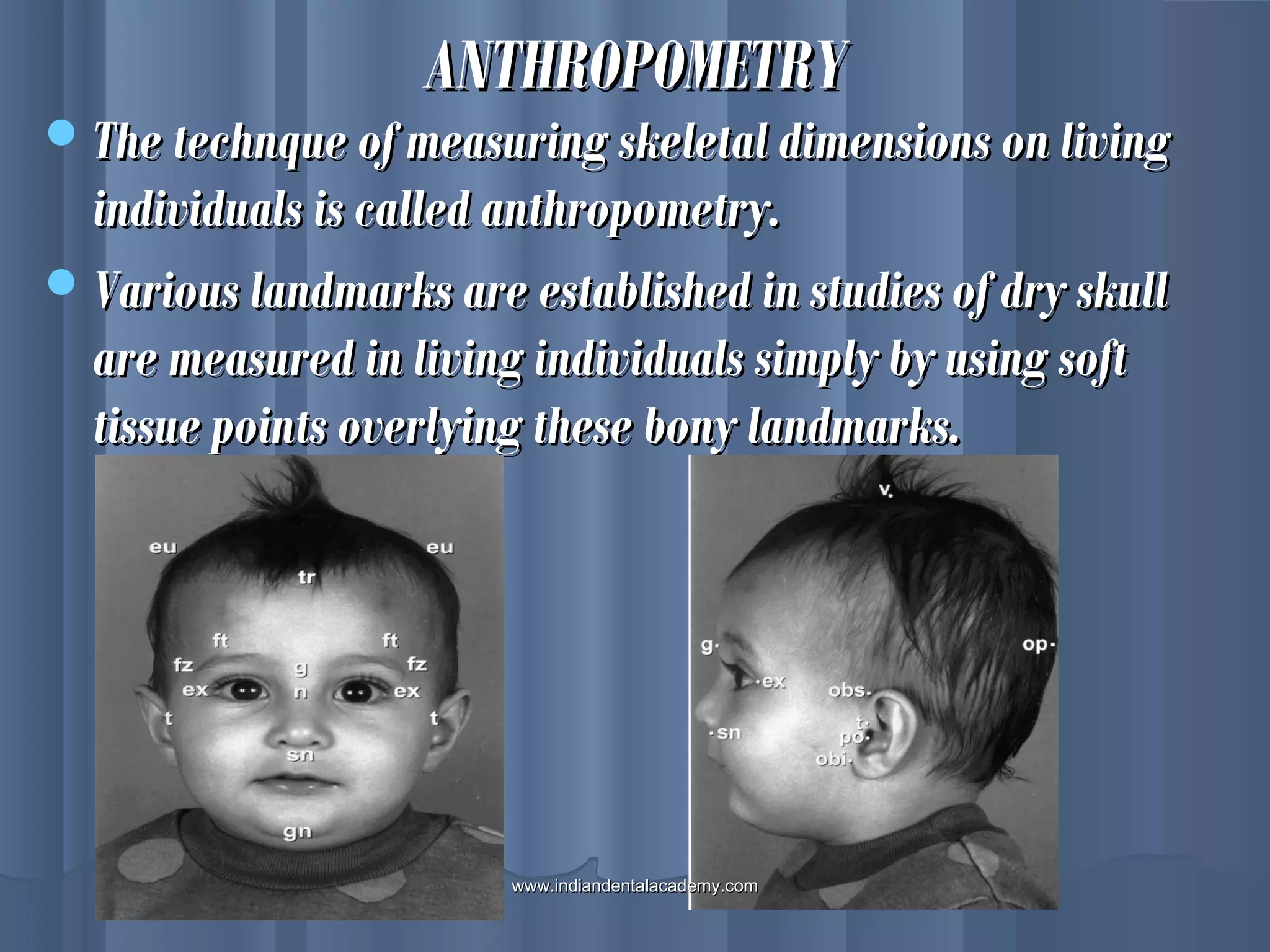
ANTHROPOMETRYANTHROPOMETRY
The technque of measuring skeletal dimensions on livingThe technque of measuring skeletal dimensions on living
individuals is called anthropometry.individuals is called anthropometry.
Various landmarks are established in studies of dry skullVarious landmarks are established in studies of dry skull
are measured in living individuals simply by using softare measured in living individuals simply by using soft
tissue points overlying these bony landmarks.tissue points overlying these bony landmarks.
www.indiandentalacademy.comwww.indiandentalacademy.com
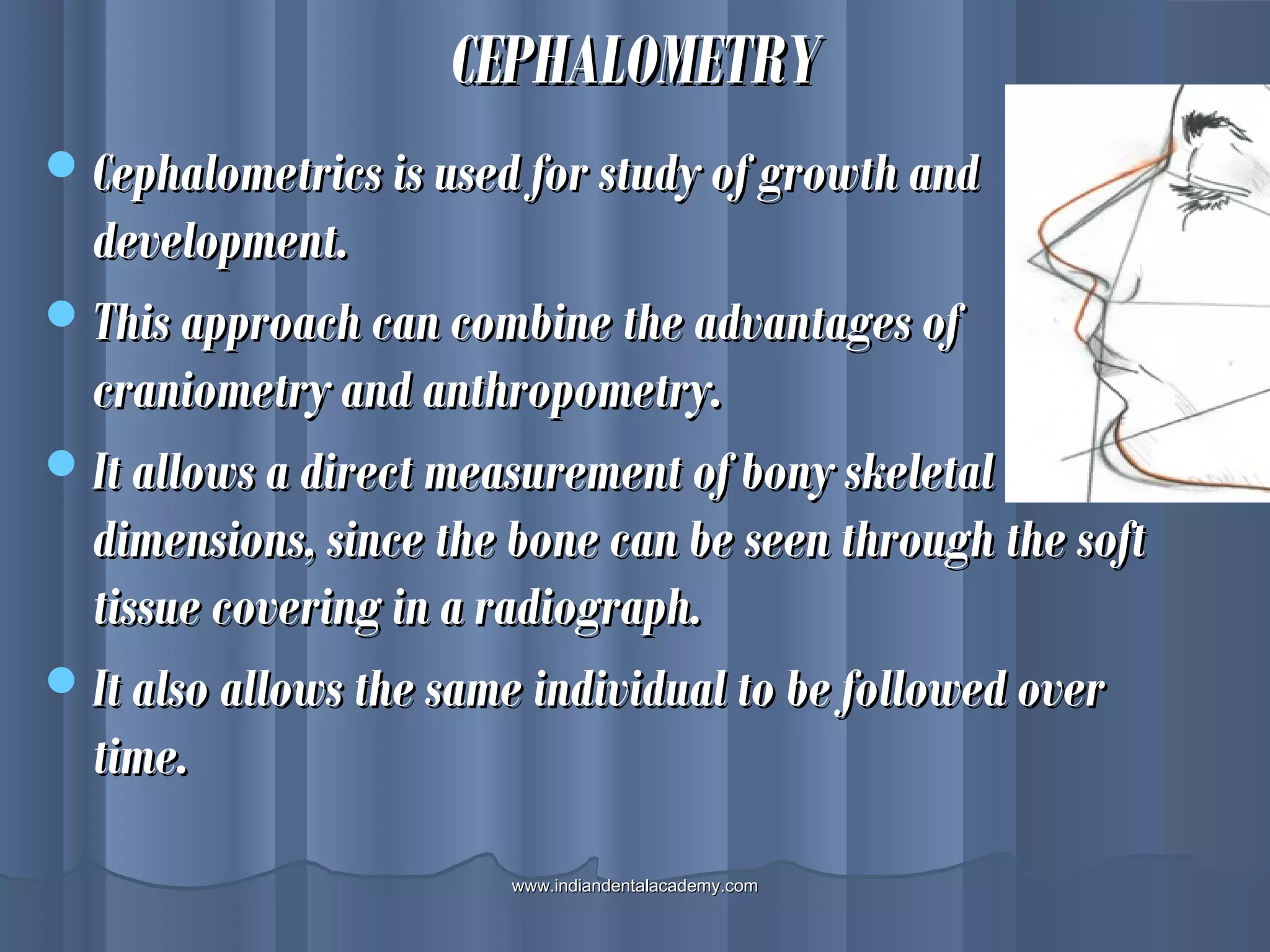
CEPHALOMETRYCEPHALOMETRY
Cephalometrics is used for study of growth andCephalometrics is used for study of growth and
development.development.
This approach can combine the advantages ofThis approach can combine the advantages of
craniometry and anthropometry.craniometry and anthropometry.
It allows a direct measurement of bony skeletalIt allows a direct measurement of bony skeletal
dimensions, since the bone can be seen through the softdimensions, since the bone can be seen through the soft
tissue covering in a radiograph.tissue covering in a radiograph.
It also allows the same individual to be followed overIt also allows the same individual to be followed over
time.time.
www.indiandentalacademy.comwww.indiandentalacademy.com
EVALUATION OF GROWTH AND DATAEVALUATION OF GROWTH AND DATA
Evaluation of growth data is one the most complicatedEvaluation of growth data is one the most complicated
and fascinating branches of statistics.and fascinating branches of statistics.
Many facts of growth lie hidden in ‘clinicians’ orMany facts of growth lie hidden in ‘clinicians’ or
‘scientists’ crude hunches and can be bared for further‘scientists’ crude hunches and can be bared for further
study only by careful and imaginative statisticalstudy only by careful and imaginative statistical
dissection.dissection.
www.indiandentalacademy.comwww.indiandentalacademy.com
VARIABLES AFFECTING PHYSICAL GROWTHVARIABLES AFFECTING PHYSICAL GROWTH
HEREDITYHEREDITY
NUTRITIONNUTRITION
ILLNESSILLNESS
RACERACE
CLIMATE AND SEASONAL EFFECTS ON GROWTHCLIMATE AND SEASONAL EFFECTS ON GROWTH
ADULT PHYSIQUEADULT PHYSIQUE
SOCIOECNOMIC FACTORSSOCIOECNOMIC FACTORS
EXERCISEEXERCISE
FAMILY SIZE AND BIRTH ORDERFAMILY SIZE AND BIRTH ORDER
SECULAR TRENDSSECULAR TRENDS

www.indiandentalacademy.comwww.indiandentalacademy.com
HEREDITYHEREDITY
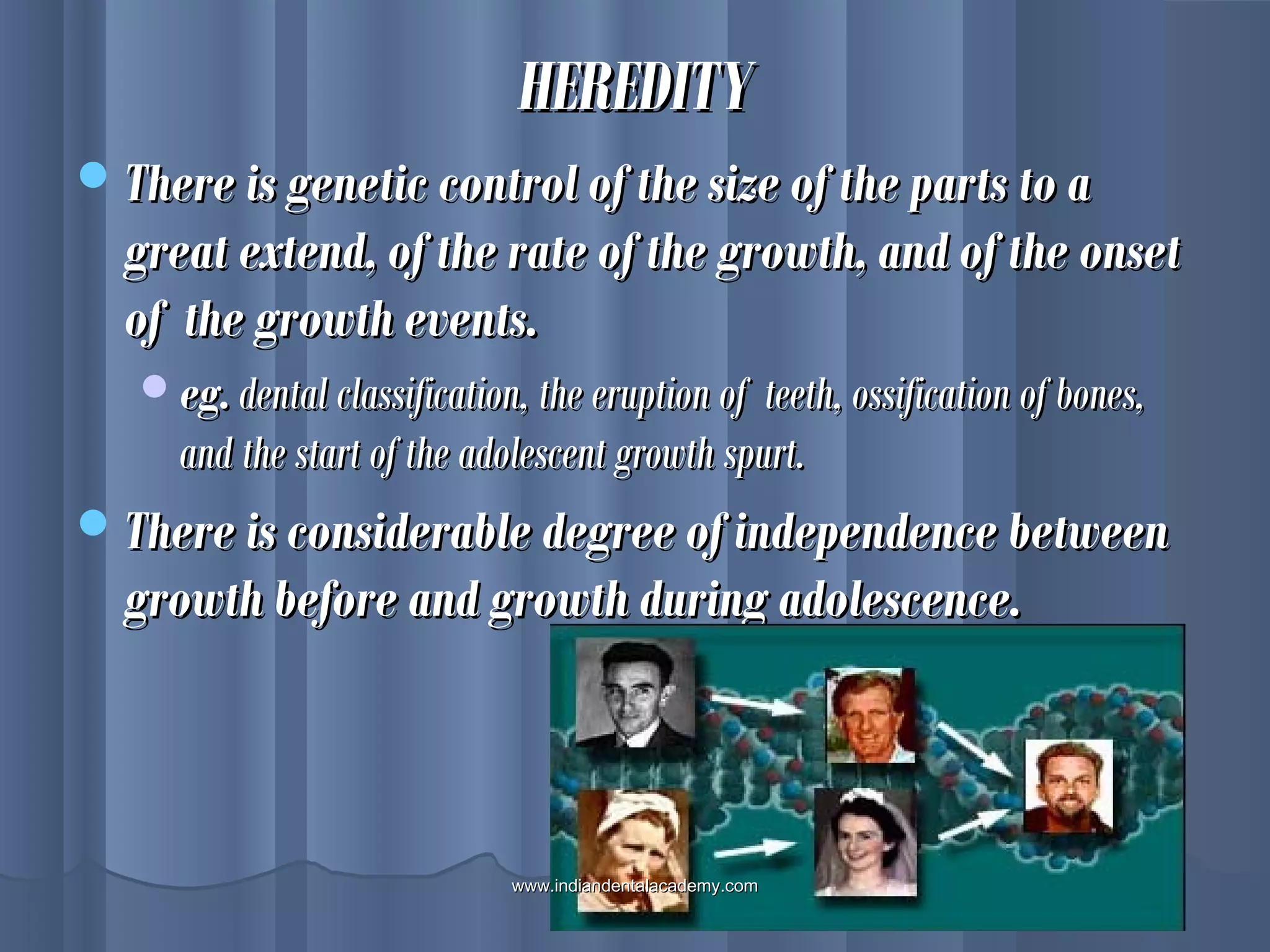
There is genetic control of the size of the parts to aThere is genetic control of the size of the parts to a
great extend, of the rate of the growth, and of the onsetgreat extend, of the rate of the growth, and of the onset
of the growth events.of the growth events.
eg.eg. dental classification, the eruption of teeth, ossification of bones,dental classification, the eruption of teeth, ossification of bones,
and the start of the adolescent growth spurt.and the start of the adolescent growth spurt.
There is considerable degree of independence betweenThere is considerable degree of independence between
growth before and growth during adolescence.growth before and growth during adolescence.
www.indiandentalacademy.comwww.indiandentalacademy.com
NUTRITIONNUTRITION
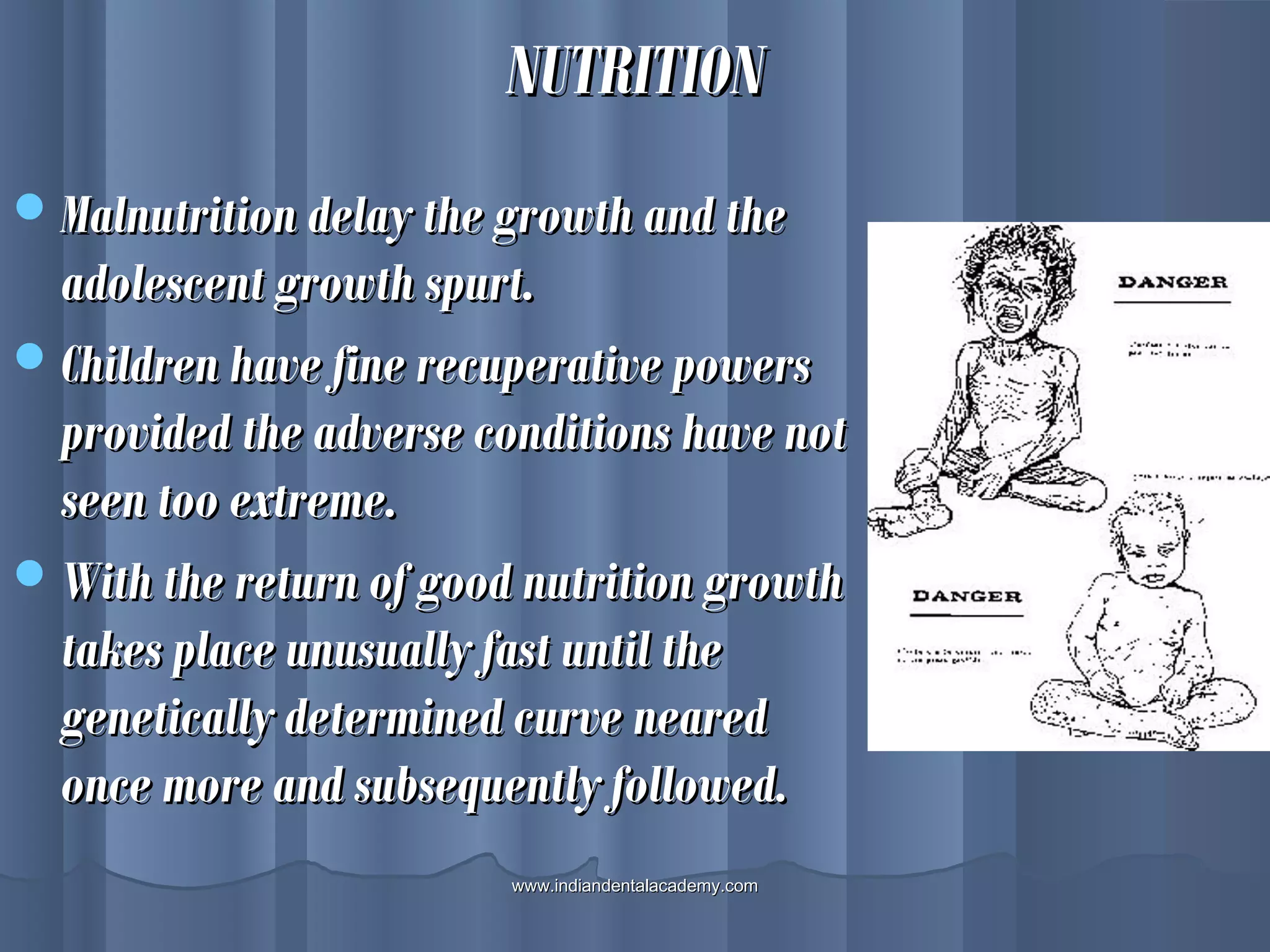
Malnutrition delay the growth and theMalnutrition delay the growth and the
adolescent growth spurt.adolescent growth spurt.
Children have fine recuperative powersChildren have fine recuperative powers
provided the adverse conditions have notprovided the adverse conditions have not
seen too extreme.seen too extreme.
With the return of good nutrition growthWith the return of good nutrition growth
takes place unusually fast until thetakes place unusually fast until the
genetically determined curve nearedgenetically determined curve neared
once more and subsequently followed.once more and subsequently followed.
www.indiandentalacademy.comwww.indiandentalacademy.com
ILLNESSILLNESS
The usually minor childhood illness does not have muchThe usually minor childhood illness does not have much
effect on physical growth.effect on physical growth.
Serious prolonged and debilitating illness have aSerious prolonged and debilitating illness have a
marked effect on growthmarked effect on growth
www.indiandentalacademy.comwww.indiandentalacademy.com
RACERACE
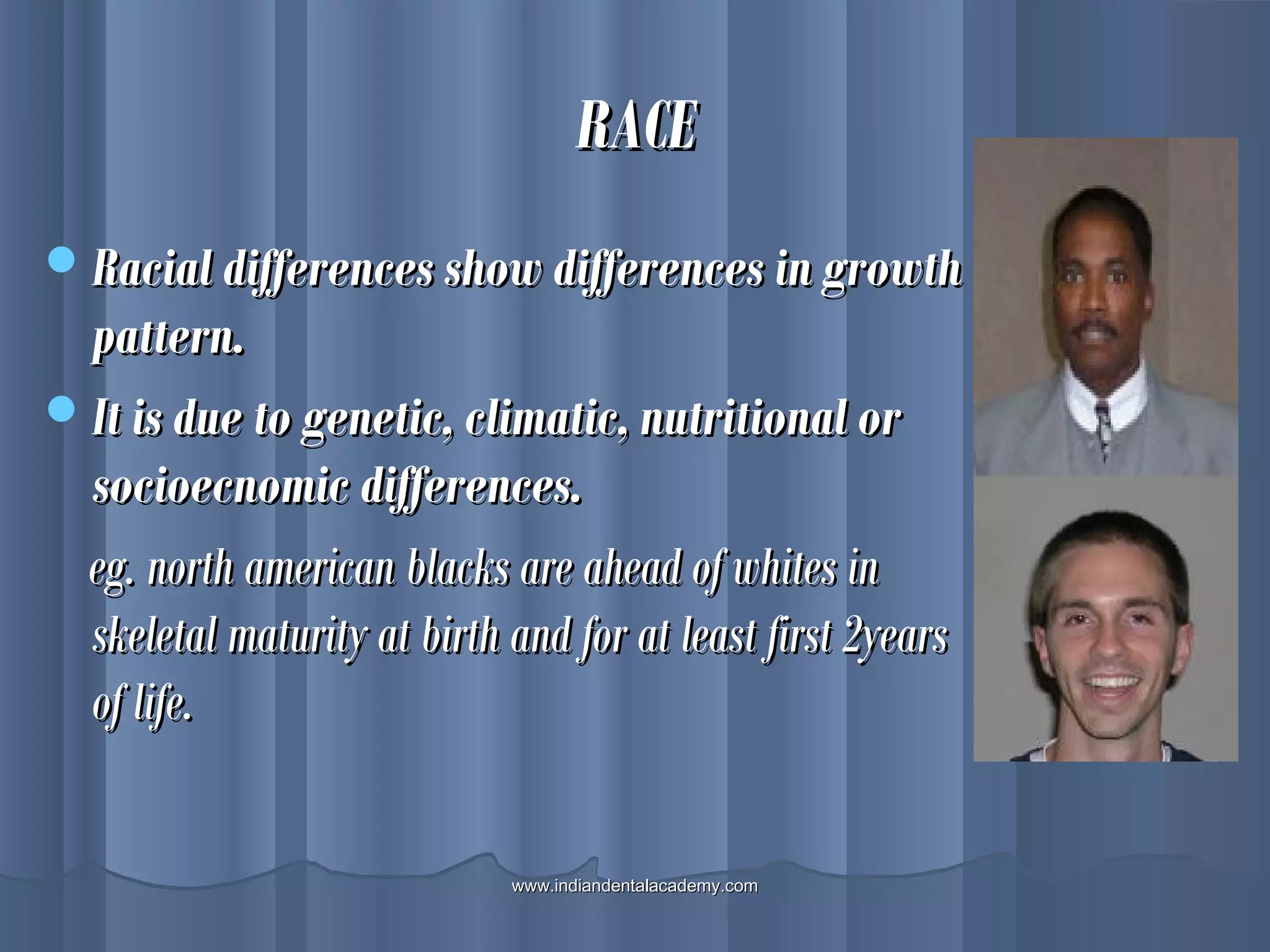
Racial differences show differences in growthRacial differences show differences in growth
pattern.pattern.
It is due to genetic, climatic, nutritional orIt is due to genetic, climatic, nutritional or
socioecnomic differences.socioecnomic differences.
eg. north american blacks are ahead of whites ineg. north american blacks are ahead of whites in
skeletal maturity at birth and for at least first 2yearsskeletal maturity at birth and for at least first 2years
of life.of life.
www.indiandentalacademy.comwww.indiandentalacademy.com
CLIMATIC AND SEASONAL EFFECTS OF GROWTHCLIMATIC AND SEASONAL EFFECTS OF GROWTH
There is a general tendency for those living in coldThere is a general tendency for those living in cold
climates to have greater proportion of adipose tissueclimates to have greater proportion of adipose tissue
and much has been made of the skeletal variationsand much has been made of the skeletal variations
associated with variations in climate.associated with variations in climate.
There is seasonal variations in the growth rate ofThere is seasonal variations in the growth rate of
children and in the weight of newborn babies.children and in the weight of newborn babies.
Contray to popular belief, climate has little direct effectContray to popular belief, climate has little direct effect
on the rate of growth.on the rate of growth.
www.indiandentalacademy.comwww.indiandentalacademy.com
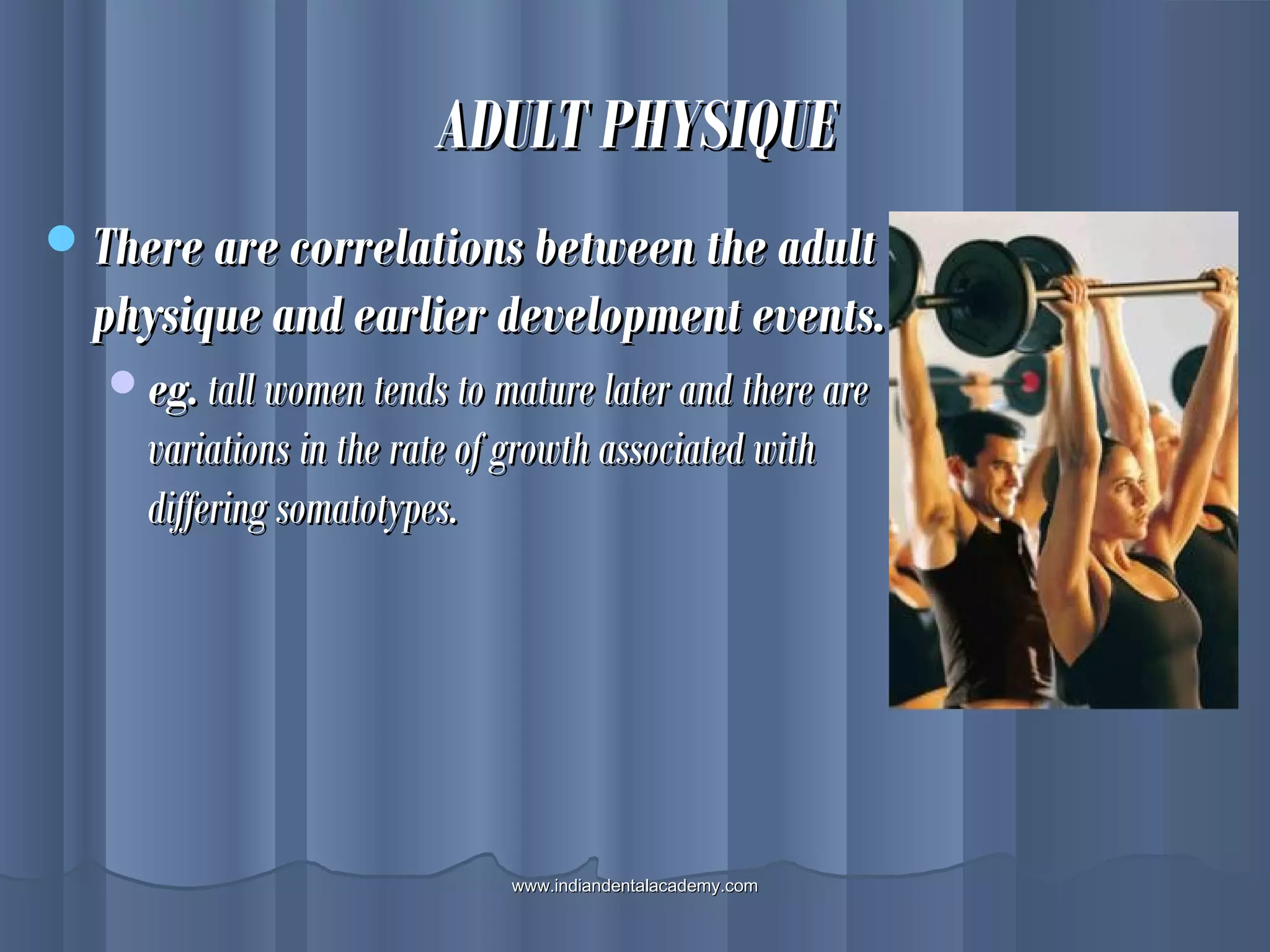
ADULT PHYSIQUEADULT PHYSIQUE
There are correlations between the adultThere are correlations between the adult
physique and earlier development events.physique and earlier development events.
eg.eg. tall women tends to mature later and there aretall women tends to mature later and there are
variations in the rate of growth associated withvariations in the rate of growth associated with
differing somatotypes.differing somatotypes.
www.indiandentalacademy.comwww.indiandentalacademy.com
SOCIO ECONOMIC FACTORSSOCIO ECONOMIC FACTORS
Children living in favorable socioeconomic conditionsChildren living in favorable socioeconomic conditions
tend to be larger, display different types of growth andtend to be larger, display different types of growth and
show variation timing of growth when compared withshow variation timing of growth when compared with
disadvantaged children.disadvantaged children.
eg. height and weight ratios.eg. height and weight ratios.
www.indiandentalacademy.comwww.indiandentalacademy.com
EXERCISEEXERCISE
A strong case for the effects of exerciseA strong case for the effects of exercise
on linear growth has not been made in aon linear growth has not been made in a
quantitative fashion.quantitative fashion.
children who exercise strenuously andchildren who exercise strenuously and
regularly have not been shown to growregularly have not been shown to grow
more favorably.more favorably.
www.indiandentalacademy.comwww.indiandentalacademy.com
FAMILY SIZE AND BIRTH ORDERFAMILY SIZE AND BIRTH ORDER
There are differences in the sizes of theThere are differences in the sizes of the
individuals. in their maturational level ofindividuals. in their maturational level of
achievement, and in their intelligenceachievement, and in their intelligence
that can be correlated with the size of thethat can be correlated with the size of the
family from which they came.family from which they came.
First born children tend to weight less atFirst born children tend to weight less at
birth and ultimately achieve less staturebirth and ultimately achieve less stature
and a higher I.Q.and a higher I.Q.
www.indiandentalacademy.comwww.indiandentalacademy.com
SECULAR TRENDSSECULAR TRENDS
Size and maturational changes in large populations canSize and maturational changes in large populations can
be shown to be occuring with time that, as yet have notbe shown to be occuring with time that, as yet have not
been well explained.been well explained.
e.g. Fifteen year old boys are approximately 5 inchese.g. Fifteen year old boys are approximately 5 inches
taller than 15 year old boys were 50 years ago.taller than 15 year old boys were 50 years ago.
www.indiandentalacademy.comwww.indiandentalacademy.com
Psychological disturbancePsychological disturbance
It has been shown that children experiencing stressfulIt has been shown that children experiencing stressful
conditions display an inhibition of growth hormone.conditions display an inhibition of growth hormone.
When the emotional stress is removed they begin againWhen the emotional stress is removed they begin again
to secrete growth hormone normally, and ‘catch up’to secrete growth hormone normally, and ‘catch up’
growth is seen.growth is seen.
www.indiandentalacademy.comwww.indiandentalacademy.com
The evaluation of physical growthThe evaluation of physical growth
WHY ASSESS……?WHY ASSESS……?
For the identification of grossly abnormal pathologic growth.For the identification of grossly abnormal pathologic growth.
For the recognition and diagnosis of significant deviation fromFor the recognition and diagnosis of significant deviation from
normal growth.normal growth.
For the planning of therapy.For the planning of therapy.
For the determination of efficacy of therapy.For the determination of efficacy of therapy.
www.indiandentalacademy.comwww.indiandentalacademy.com
Questions to be asked…Questions to be asked…
1. What is the status of the patient at the moment…?1. What is the status of the patient at the moment…?
2. What is progress of grow to date…?2. What is progress of grow to date…?
3. How does he/she compare with others…?3. How does he/she compare with others…?
4. How does he/she fit family pattern…?4. How does he/she fit family pattern…?
5. What will he/she do in the future…?5. What will he/she do in the future…?
www.indiandentalacademy.comwww.indiandentalacademy.com
Rudiments of bone growthRudiments of bone growth
1.1.OSTEOGENESIS.OSTEOGENESIS.
a) Endochondral bone formation.a) Endochondral bone formation.
Mesenchymal tissueMesenchymal tissue
CartilageCartilage
Cartilage cells hypertrophy, calcification of matrix,Cartilage cells hypertrophy, calcification of matrix,
degeneration of cells.degeneration of cells.
Osteogenic tissues invade the dying and disintegratingOsteogenic tissues invade the dying and disintegrating
cartilage and replace it.cartilage and replace it.www.indiandentalacademy.comwww.indiandentalacademy.com
Endochondrial bone formationEndochondrial bone formation
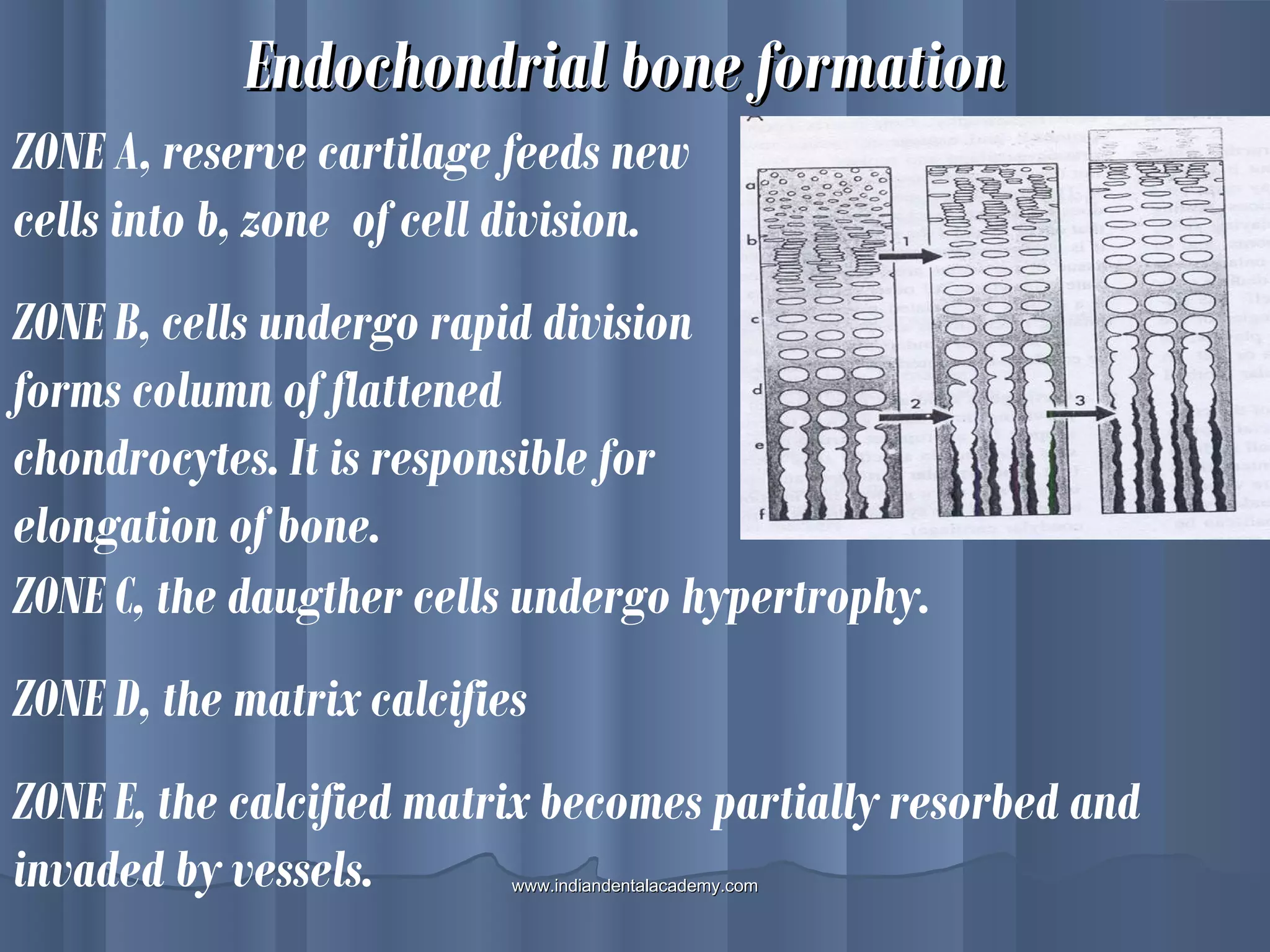
ZONE A, reserve cartilage feeds new
cells into b, zone of cell division.
ZONE B, cells undergo rapid division
forms column of flattened
chondrocytes. It is responsible for
elongation of bone.
ZONE C, the daugther cells undergo hypertrophy.
ZONE D, the matrix calcifies
ZONE E, the calcified matrix becomes partially resorbed and
invaded by vessels. www.indiandentalacademy.comwww.indiandentalacademy.com
ZONE F, undifferentiated cells carried in by sproutsZONE F, undifferentiated cells carried in by sprouts
provide osteoblasts, which in turn deposit a thin crust ofprovide osteoblasts, which in turn deposit a thin crust of
bone on the remnants of the calcified cartilage matrix.bone on the remnants of the calcified cartilage matrix.
Entire process is continuous and repetitive, one zoneEntire process is continuous and repetitive, one zone
transferring into next.transferring into next.
ZONE B changed directly to ZONE C ( arrow1).ZONE B changed directly to ZONE C ( arrow1).
ZONE D INTO ZONE E (arrow2).ZONE D INTO ZONE E (arrow2).
ZONE E INTO ZONE F(arrow3).ZONE E INTO ZONE F(arrow3).
As entire cartilage grows in a linear direction towardAs entire cartilage grows in a linear direction toward
top of illustration bone replacement follows.top of illustration bone replacement follows.
www.indiandentalacademy.comwww.indiandentalacademy.com
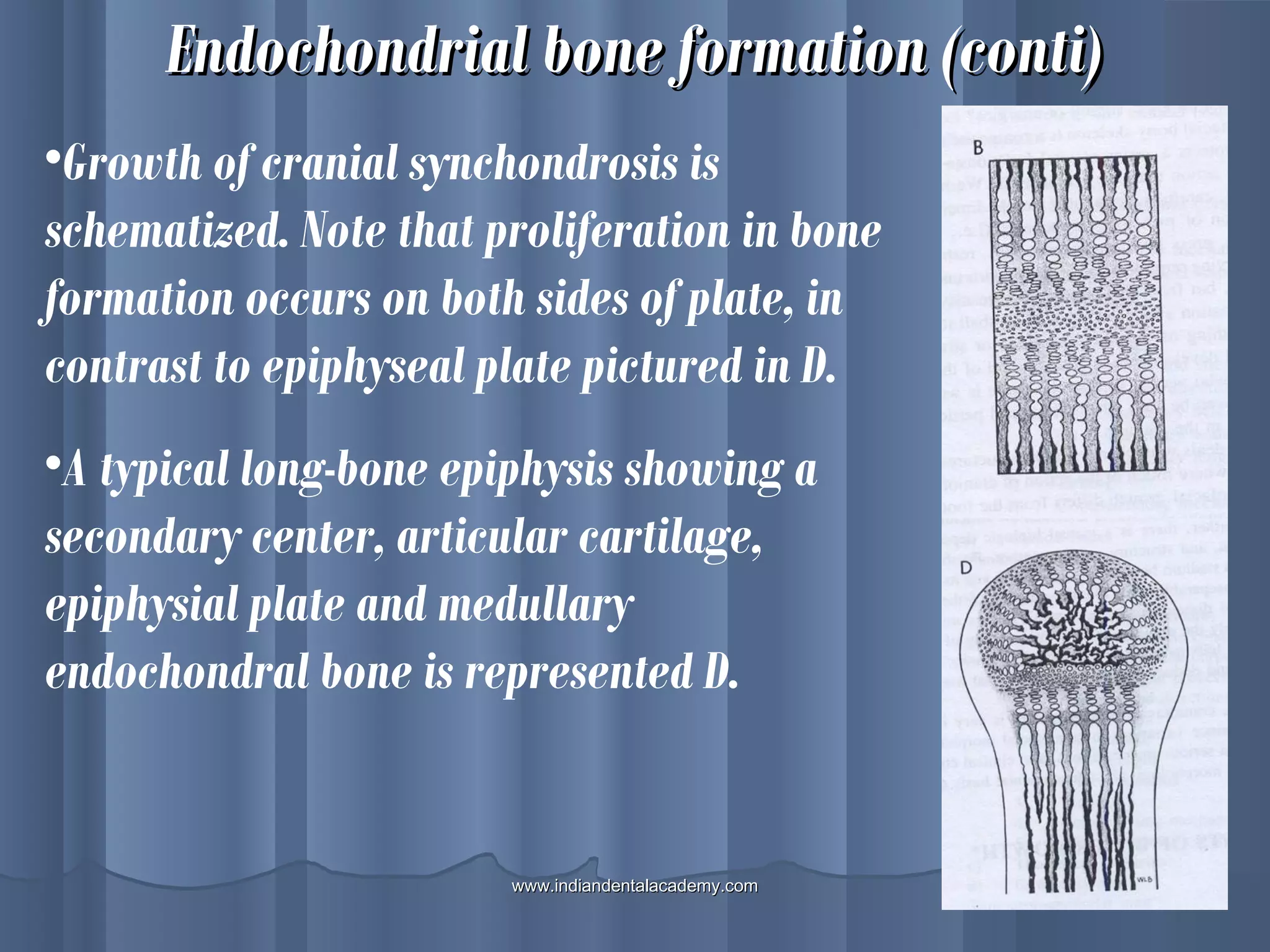
Endochondrial bone formation (conti)Endochondrial bone formation (conti)
•Growth of cranial synchondrosis is
schematized. Note that proliferation in bone
formation occurs on both sides of plate, in
contrast to epiphyseal plate pictured in D.
•A typical long-bone epiphysis showing a
secondary center, articular cartilage,
epiphysial plate and medullary
endochondral bone is represented D.
www.indiandentalacademy.comwww.indiandentalacademy.com
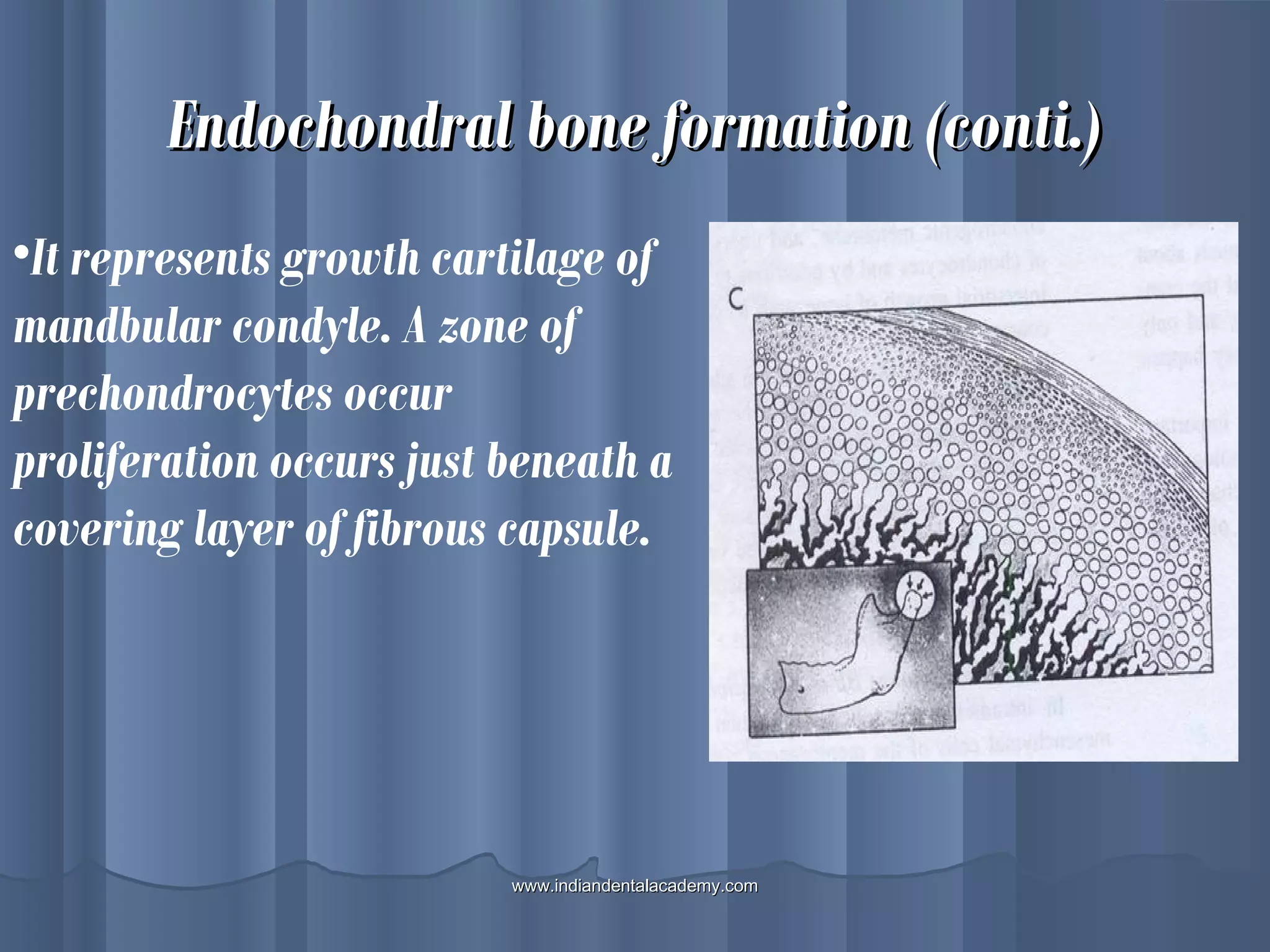
Endochondral bone formation (conti.)Endochondral bone formation (conti.)
•It represents growth cartilage of
mandbular condyle. A zone of
prechondrocytes occur
proliferation occurs just beneath a
covering layer of fibrous capsule.
www.indiandentalacademy.comwww.indiandentalacademy.com
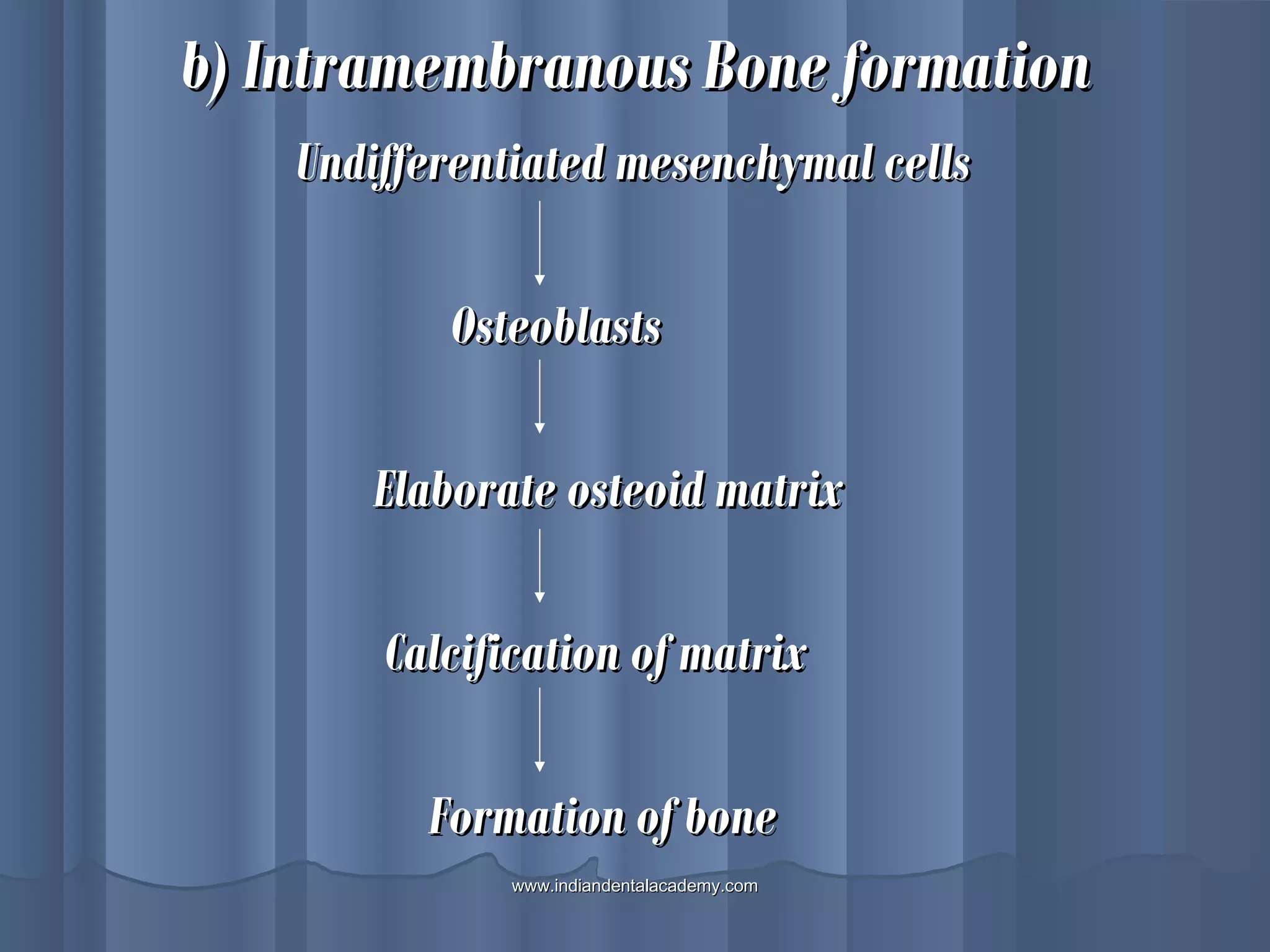
b) Intramembranous Bone formationb) Intramembranous Bone formation
Undifferentiated mesenchymal cellsUndifferentiated mesenchymal cells
OsteoblastsOsteoblasts
Elaborate osteoid matrixElaborate osteoid matrix
Calcification of matrixCalcification of matrix
Formation of boneFormation of bone
www.indiandentalacademy.comwww.indiandentalacademy.com
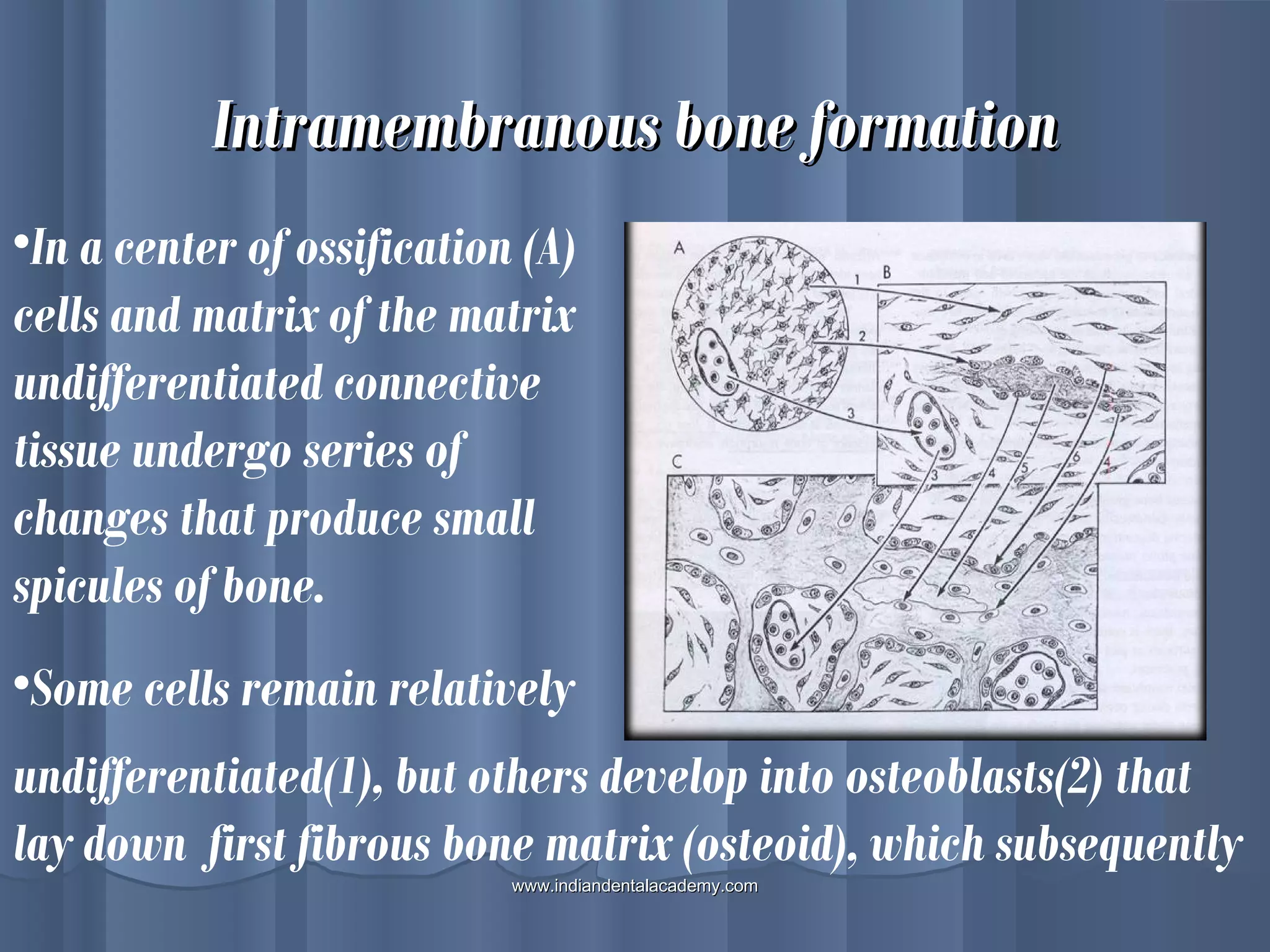
Intramembranous bone formationIntramembranous bone formation
•In a center of ossification (A)
cells and matrix of the matrix
undifferentiated connective
tissue undergo series of
changes that produce small
spicules of bone.
•Some cells remain relatively
undifferentiated(1), but others develop into osteoblasts(2) that
lay down first fibrous bone matrix (osteoid), which subsequently
www.indiandentalacademy.comwww.indiandentalacademy.com
become mineralized as in stage B.become mineralized as in stage B.
Original blood vessels are retained in close proximity toOriginal blood vessels are retained in close proximity to
the formative bony trabeculae(3).the formative bony trabeculae(3).
As bone deposition by osteoblasts continues, some ofAs bone deposition by osteoblasts continues, some of
these cells are enclosed by their own deposits andthese cells are enclosed by their own deposits and
become osteocytes(4).become osteocytes(4).
Some undifferentiated cells develop into newSome undifferentiated cells develop into new
osteoblasts(6) and other remaining osteoblasts undergoosteoblasts(6) and other remaining osteoblasts undergo
cell division to accommodate enlargement ofcell division to accommodate enlargement of
trabeculae.trabeculae.
Outline of an early bone spicule(5) is shown in enlargedOutline of an early bone spicule(5) is shown in enlarged
trabeculae for reference.trabeculae for reference.www.indiandentalacademy.comwww.indiandentalacademy.com
Blood vessels have now become enclosed in the fine,Blood vessels have now become enclosed in the fine,
cancellous spaces (c) .cancellous spaces (c) .
This spaces also contain scattering fibers ,This spaces also contain scattering fibers ,
undifferentiated connective tissue cells, and osteoblasts.undifferentiated connective tissue cells, and osteoblasts.
www.indiandentalacademy.comwww.indiandentalacademy.com
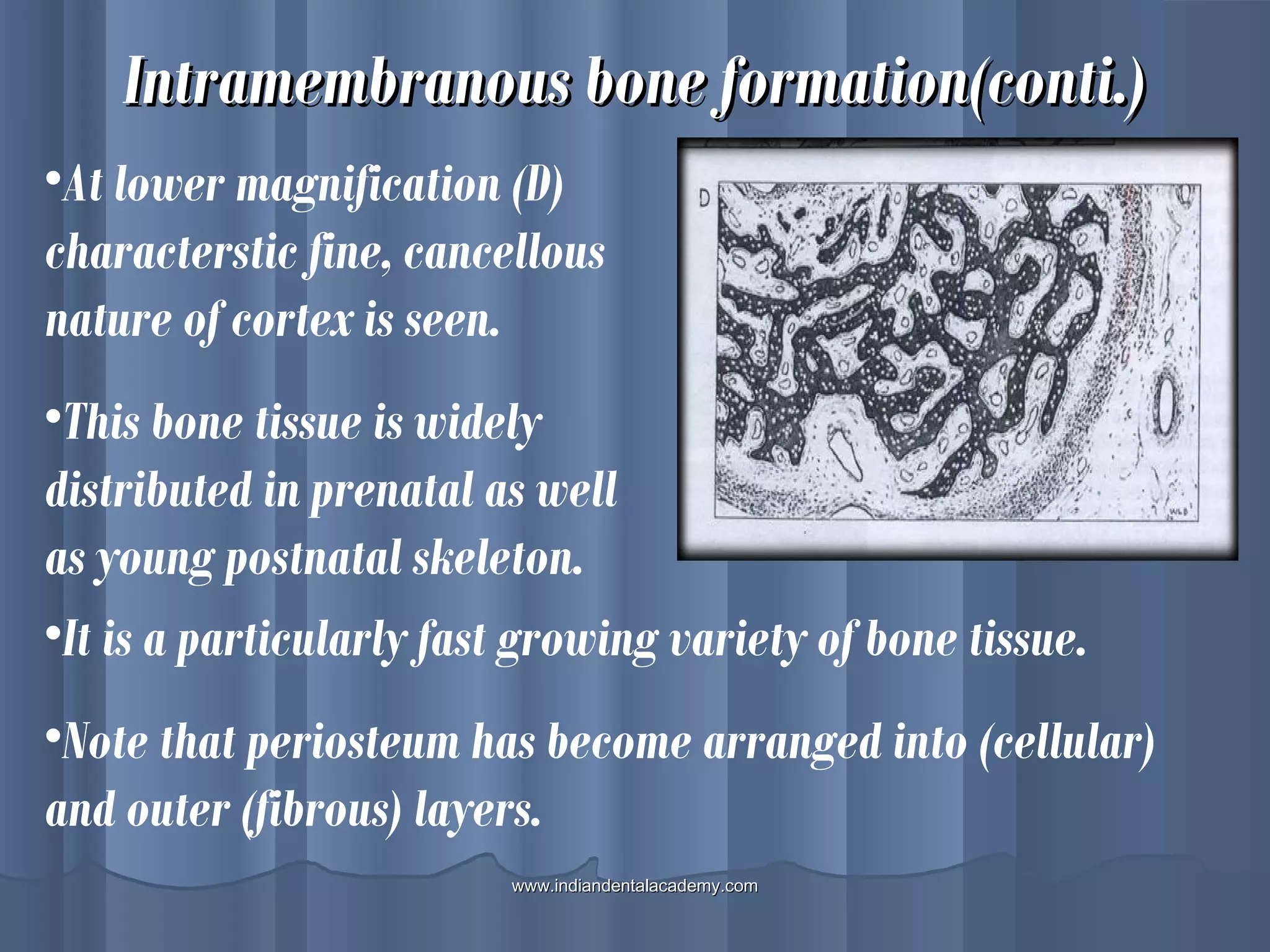
Intramembranous bone formation(conti.)Intramembranous bone formation(conti.)
•At lower magnification (D)
characterstic fine, cancellous
nature of cortex is seen.
•This bone tissue is widely
distributed in prenatal as well
as young postnatal skeleton.
•It is a particularly fast growing variety of bone tissue.
•Note that periosteum has become arranged into (cellular)
and outer (fibrous) layers.
www.indiandentalacademy.comwww.indiandentalacademy.com
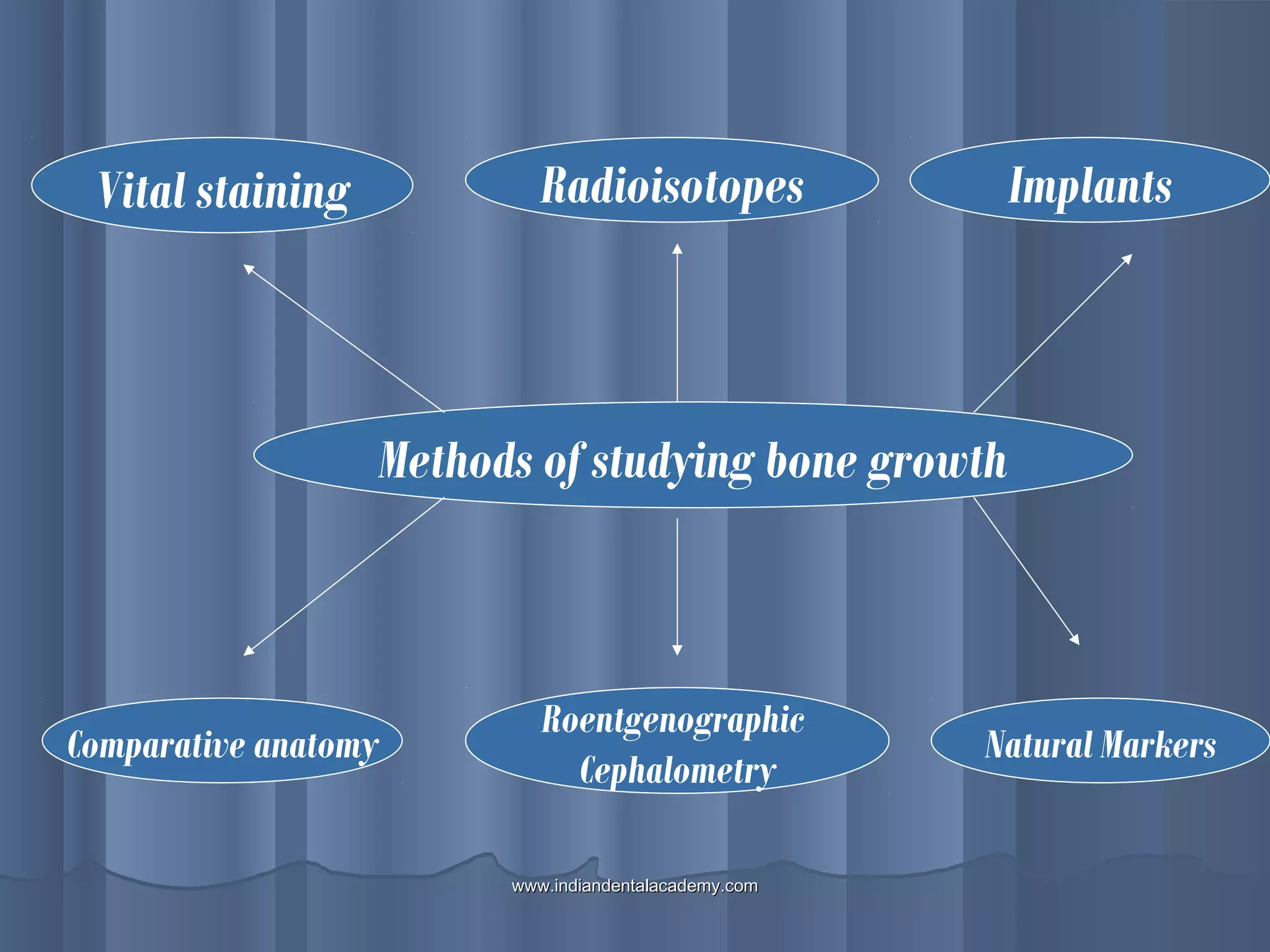
Methods of studying bone growth
Vital staining Radioisotopes Implants
Comparative anatomy
Roentgenographic
Cephalometry
Natural Markers
www.indiandentalacademy.comwww.indiandentalacademy.com
Vital stainingVital staining
Procion and Tetracycline are used extensively in boneProcion and Tetracycline are used extensively in bone
research.research.
The primary value of vital dyes lies depicting theThe primary value of vital dyes lies depicting the
pattern of post natal bone deposition over an extendedpattern of post natal bone deposition over an extended
period in one animal.period in one animal.
www.indiandentalacademy.comwww.indiandentalacademy.com
RadioisotopesRadioisotopes
Radioisotope material is injected and after a time,Radioisotope material is injected and after a time,
located within the growing bones by means of Geigerlocated within the growing bones by means of Geiger
counters or autoradiographic techniques.counters or autoradiographic techniques.
In latter method , bones or sections of bones are placedIn latter method , bones or sections of bones are placed
against photographic emulsions that are exposed byagainst photographic emulsions that are exposed by
emission of radiation from the radioactive substance.emission of radiation from the radioactive substance.
www.indiandentalacademy.comwww.indiandentalacademy.com
ImplantsImplants
These serve as radiographic reference markers forThese serve as radiographic reference markers for
serial cephalometric analysis.serial cephalometric analysis.
The method allows precise orientation of serialThe method allows precise orientation of serial
cephalograms and information on the amount and sitescephalograms and information on the amount and sites
of bone growth.of bone growth.
This method is useful because bone does not growThis method is useful because bone does not grow
interstitially and therefore implants inside a bone areinterstitially and therefore implants inside a bone are
stablestable
www.indiandentalacademy.comwww.indiandentalacademy.com
Comparative AnatomyComparative Anatomy
Significant contributions to our knowledge of humanSignificant contributions to our knowledge of human
facial growth have been provided throughfacial growth have been provided through
comparisions with other species.comparisions with other species.
Not only can experimental work done more readily onNot only can experimental work done more readily on
animals but often basic principles common to growth inanimals but often basic principles common to growth in
all species are first recognized and defined by studies inall species are first recognized and defined by studies in
comparative anatomy.comparative anatomy.
www.indiandentalacademy.comwww.indiandentalacademy.com
Roentegenographic cephalometryRoentegenographic cephalometry
Cephaometry has contributed significantly to ourCephaometry has contributed significantly to our
knowledge of human craniofacial skeletal growth, andknowledge of human craniofacial skeletal growth, and
cephalometric methods are used rountinely, not onlycephalometric methods are used rountinely, not only
for the study of facial growth but also for orthodonticfor the study of facial growth but also for orthodontic
diagnosis, treatment planning and the assessment ofdiagnosis, treatment planning and the assessment of
therapeutic results.therapeutic results.
www.indiandentalacademy.comwww.indiandentalacademy.com
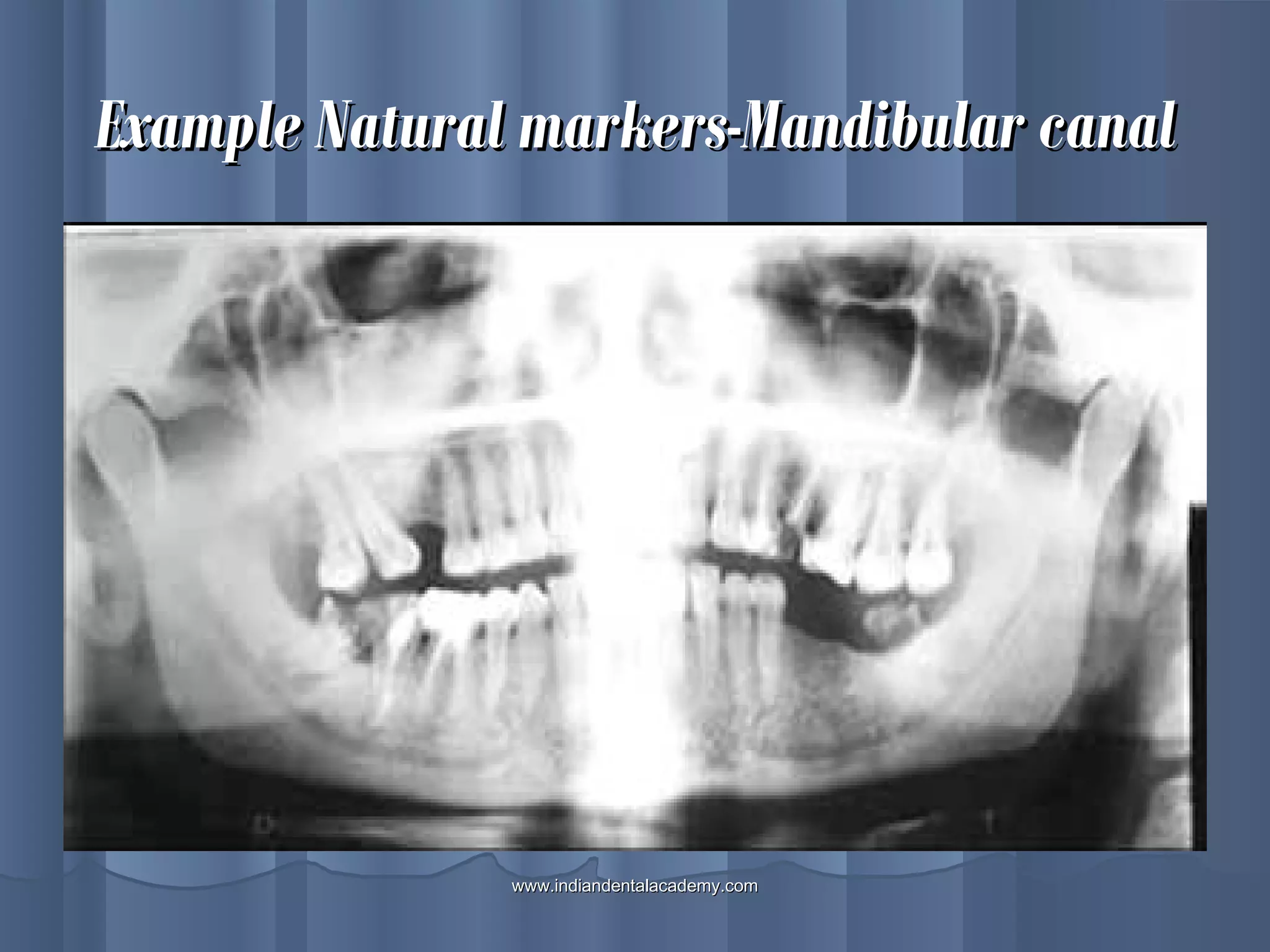
Natural markersNatural markers
The persistance of certain developmental features hasThe persistance of certain developmental features has
led to their use as natural markers.led to their use as natural markers.
By means of serial radiography trabeculae, nutrientBy means of serial radiography trabeculae, nutrient
canals and lines of arrested growth can be used forcanals and lines of arrested growth can be used for
reference to study deposition, resorption andreference to study deposition, resorption and
remodeling.remodeling.
e.g. Trabeculae, Nutrient canals.e.g. Trabeculae, Nutrient canals.
www.indiandentalacademy.comwww.indiandentalacademy.com
Example Natural markers-Mandibular canalExample Natural markers-Mandibular canal
www.indiandentalacademy.comwww.indiandentalacademy.com
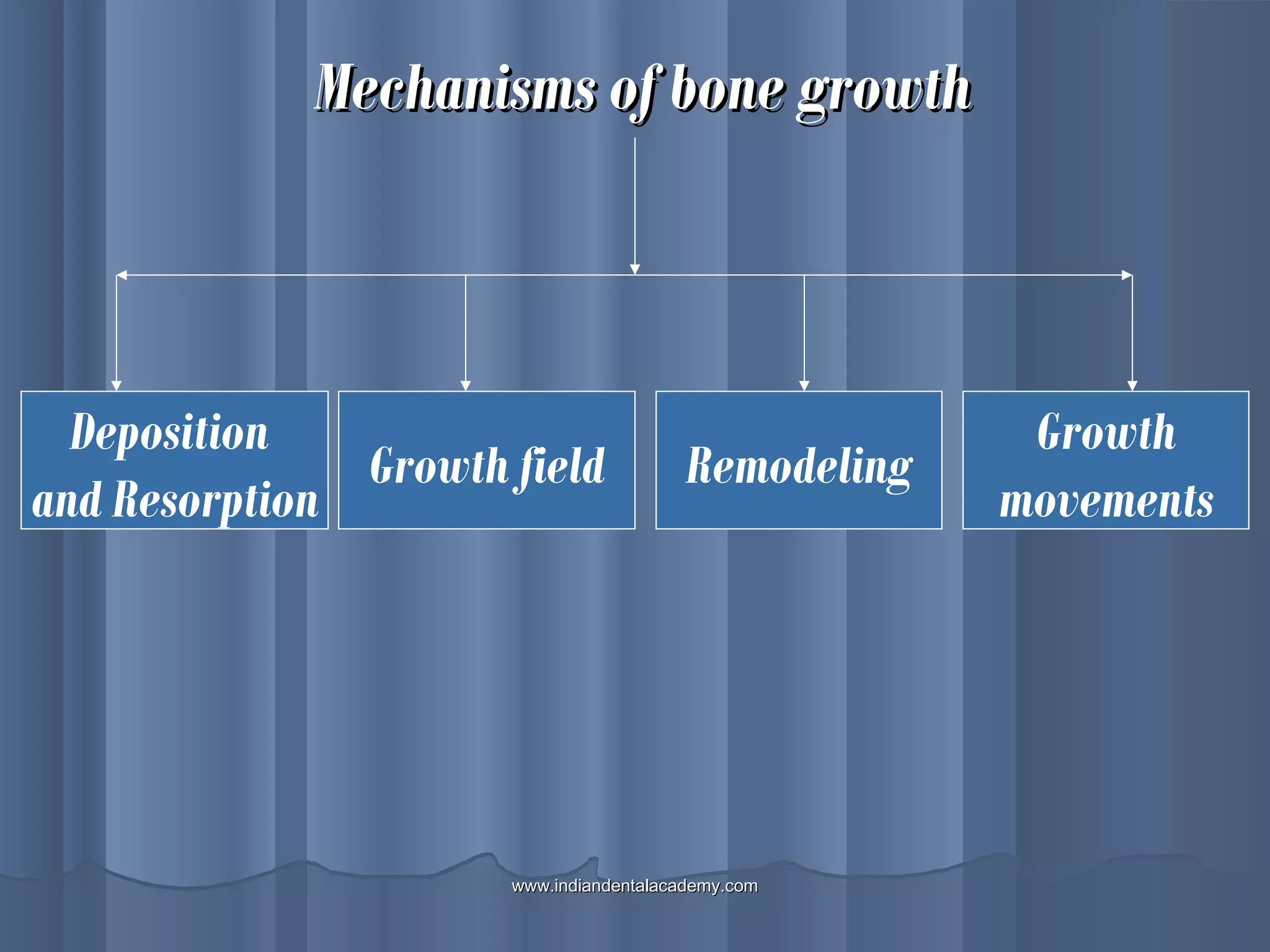
Mechanisms of bone growthMechanisms of bone growth
Deposition
and Resorption
Growth field Remodeling
Growth
movements
www.indiandentalacademy.comwww.indiandentalacademy.com
Deposition and ResorptionDeposition and Resorption
On one side of the bony cortex new bone is added, onOn one side of the bony cortex new bone is added, on
the other side, bone is taken away.the other side, bone is taken away.
Deposition occurs on the surface of facing the directionDeposition occurs on the surface of facing the direction
of growth.of growth.
Resorption occurs on the surface facing away.Resorption occurs on the surface facing away.
The result is a process termed cortical drift, a gradualThe result is a process termed cortical drift, a gradual
moment of growing area of the bone.moment of growing area of the bone.
www.indiandentalacademy.comwww.indiandentalacademy.com
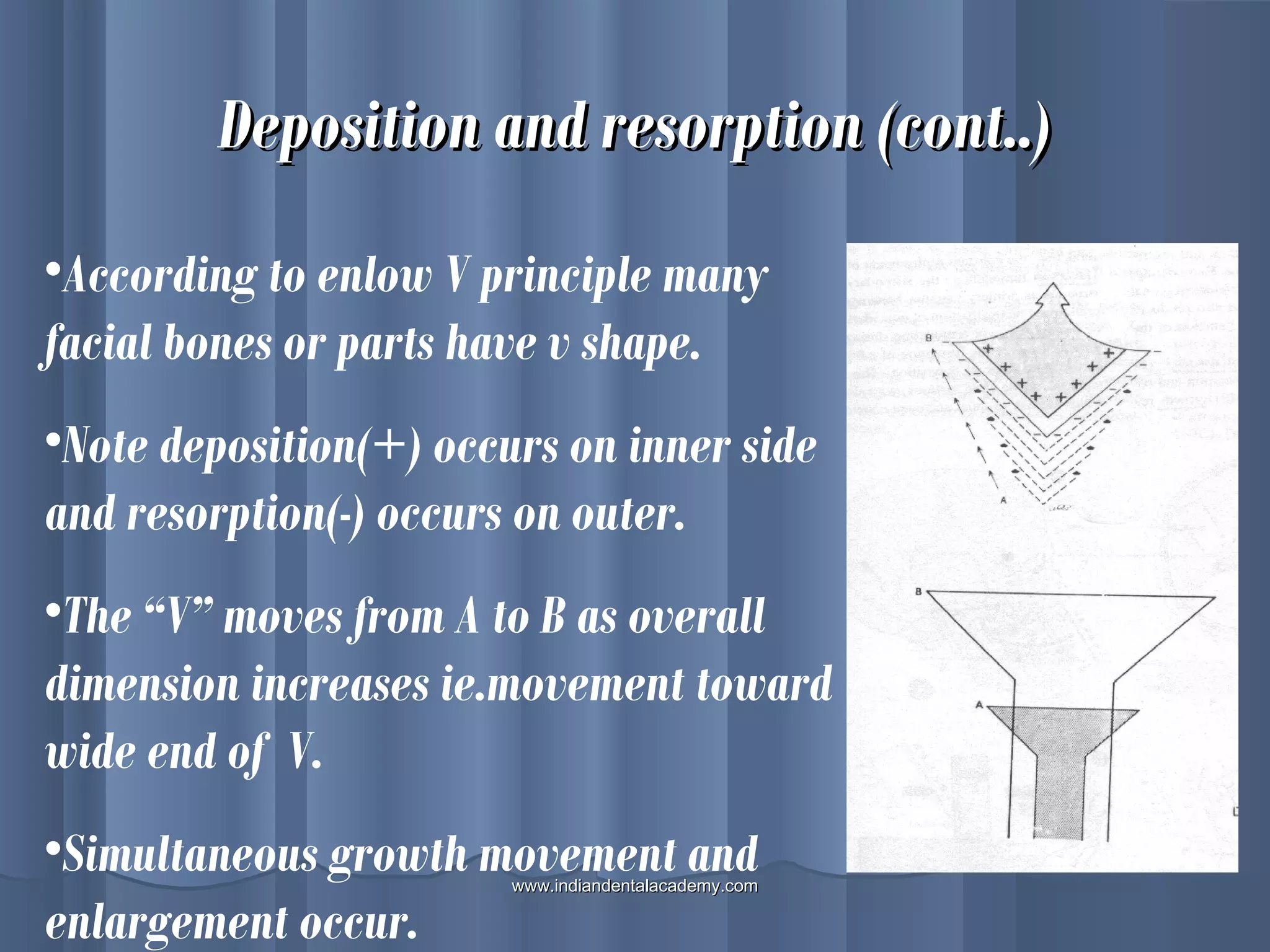
Deposition and resorption (cont..)Deposition and resorption (cont..)
•According to enlow V principle many
facial bones or parts have v shape.
•Note deposition(+) occurs on inner side
and resorption(-) occurs on outer.
•The “V” moves from A to B as overall
dimension increases ie.movement toward
wide end of V.
•Simultaneous growth movement and
enlargement occur.
www.indiandentalacademy.comwww.indiandentalacademy.com
All surfaces, inside and outside of every bone areAll surfaces, inside and outside of every bone are
covered by an irregular pattern of “growth fields”covered by an irregular pattern of “growth fields”
comprised of various soft tissue osteogenic membranecomprised of various soft tissue osteogenic membrane
or cartilages.or cartilages.
 Hard bone tissue does not contain genetic program forHard bone tissue does not contain genetic program for
growth ,rather the determinants of bone growth residegrowth ,rather the determinants of bone growth reside
in the bone’s investing soft tissue- muscle, integument,in the bone’s investing soft tissue- muscle, integument,
mucosa, blood vessels, nerves etc..mucosa, blood vessels, nerves etc..
Varying activities and rates of growth of these fieldsVarying activities and rates of growth of these fields
are basis for differential growth processes that produceare basis for differential growth processes that produce
bone of irregular shapes.bone of irregular shapes.
GROWTH FIELDSGROWTH FIELDS
www.indiandentalacademy.comwww.indiandentalacademy.com
REMODELLINGREMODELLING
The required differential growth activity necessary forThe required differential growth activity necessary for
bone shaping termed remodelling.bone shaping termed remodelling.
It involves simultaneous deposition and resorption onIt involves simultaneous deposition and resorption on
all inner and outer surface of entire bone.all inner and outer surface of entire bone.
Remodelling a basic part of growth process, not onlyRemodelling a basic part of growth process, not only
provides regional changes in shape, dimensions, andprovides regional changes in shape, dimensions, and
proportions. It also produces regional adjustments thatproportions. It also produces regional adjustments that
adapt to the developing function of bone and its variousadapt to the developing function of bone and its various
growing soft tissues.growing soft tissues.
www.indiandentalacademy.comwww.indiandentalacademy.com
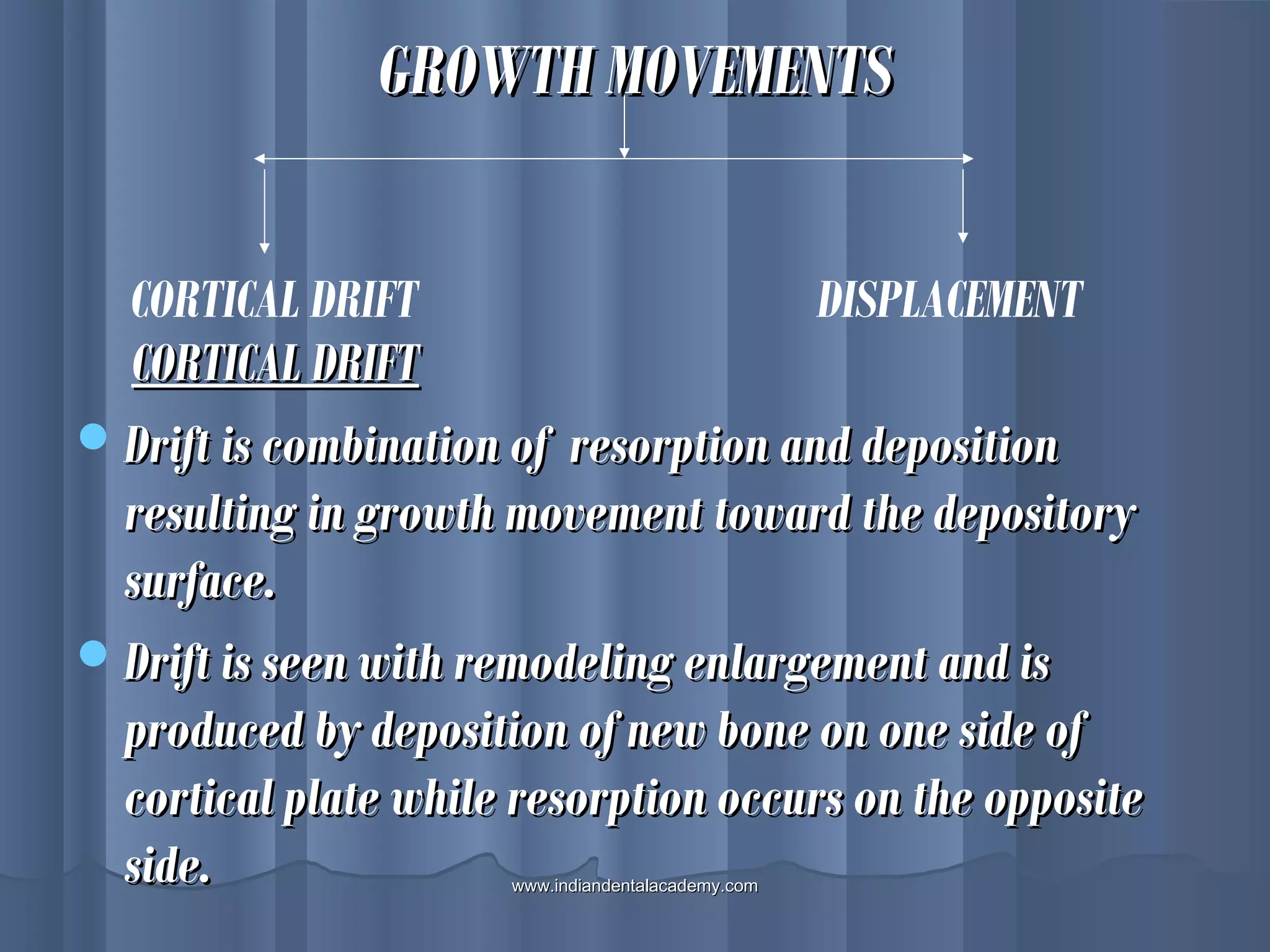
GROWTH MOVEMENTSGROWTH MOVEMENTS
CORTICAL DRIFTCORTICAL DRIFT
Drift is combination of resorption and depositionDrift is combination of resorption and deposition
resulting in growth movement toward the depositoryresulting in growth movement toward the depository
surface.surface.
Drift is seen with remodeling enlargement and isDrift is seen with remodeling enlargement and is
produced by deposition of new bone on one side ofproduced by deposition of new bone on one side of
cortical plate while resorption occurs on the oppositecortical plate while resorption occurs on the opposite
side.side.
CORTICAL DRIFT DISPLACEMENT
www.indiandentalacademy.comwww.indiandentalacademy.com
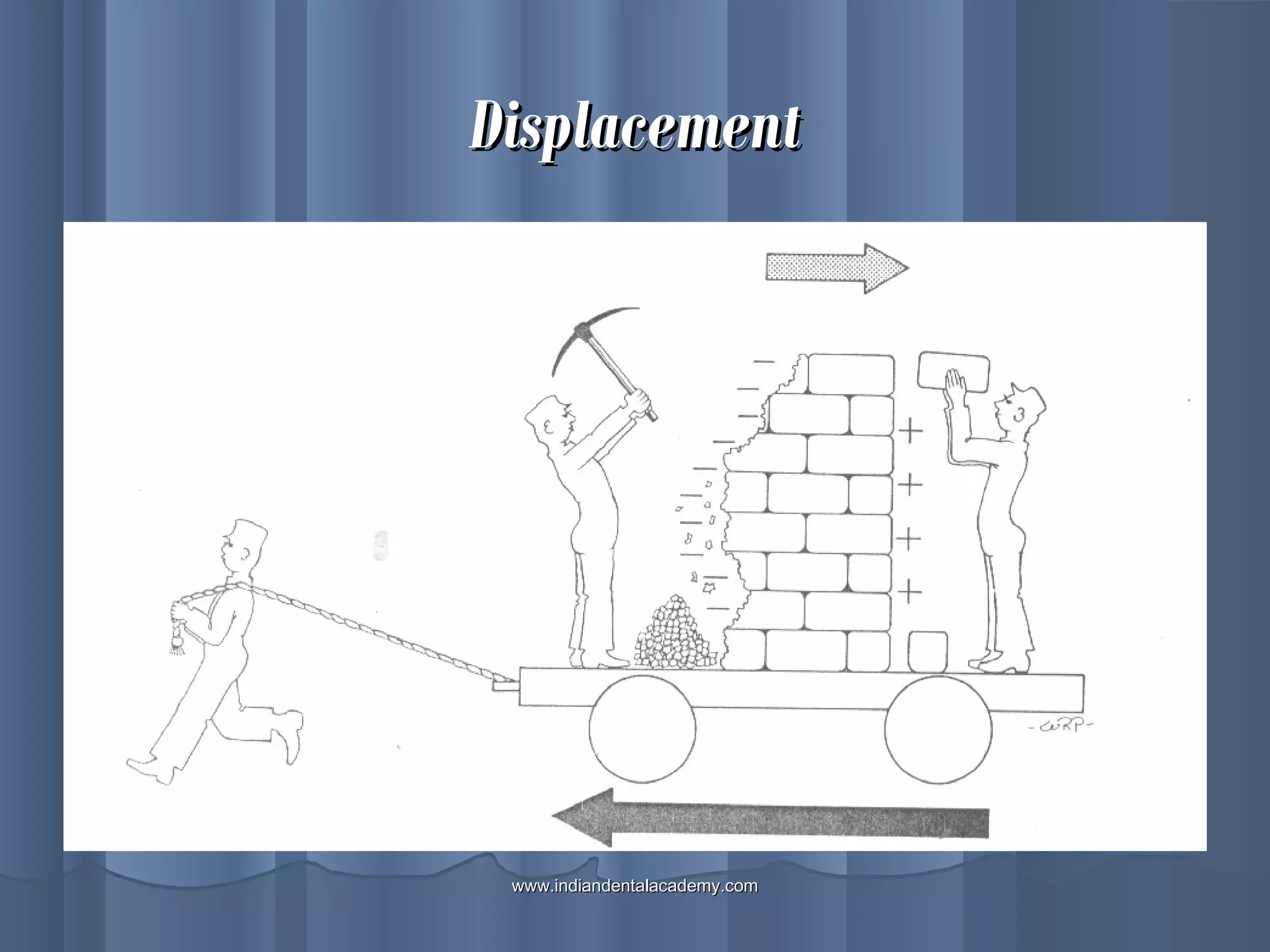
DISPLACEMENTDISPLACEMENT
It is on the other hand is movement of whole bone as aIt is on the other hand is movement of whole bone as a
unit.unit.
As a bone is carried away from its articulation withAs a bone is carried away from its articulation with
other bones, growth remodeling simultaneouslyother bones, growth remodeling simultaneously
maintains relationship of bone to each other.maintains relationship of bone to each other.
e.g. as entire mandible is displaced from its articulatione.g. as entire mandible is displaced from its articulation
in the glenoid fossa , it is necessary for condyle andin the glenoid fossa , it is necessary for condyle and
ramus to move upward and backward to maintainramus to move upward and backward to maintain
relationships.relationships.
www.indiandentalacademy.comwww.indiandentalacademy.com
DisplacementDisplacement
www.indiandentalacademy.comwww.indiandentalacademy.com
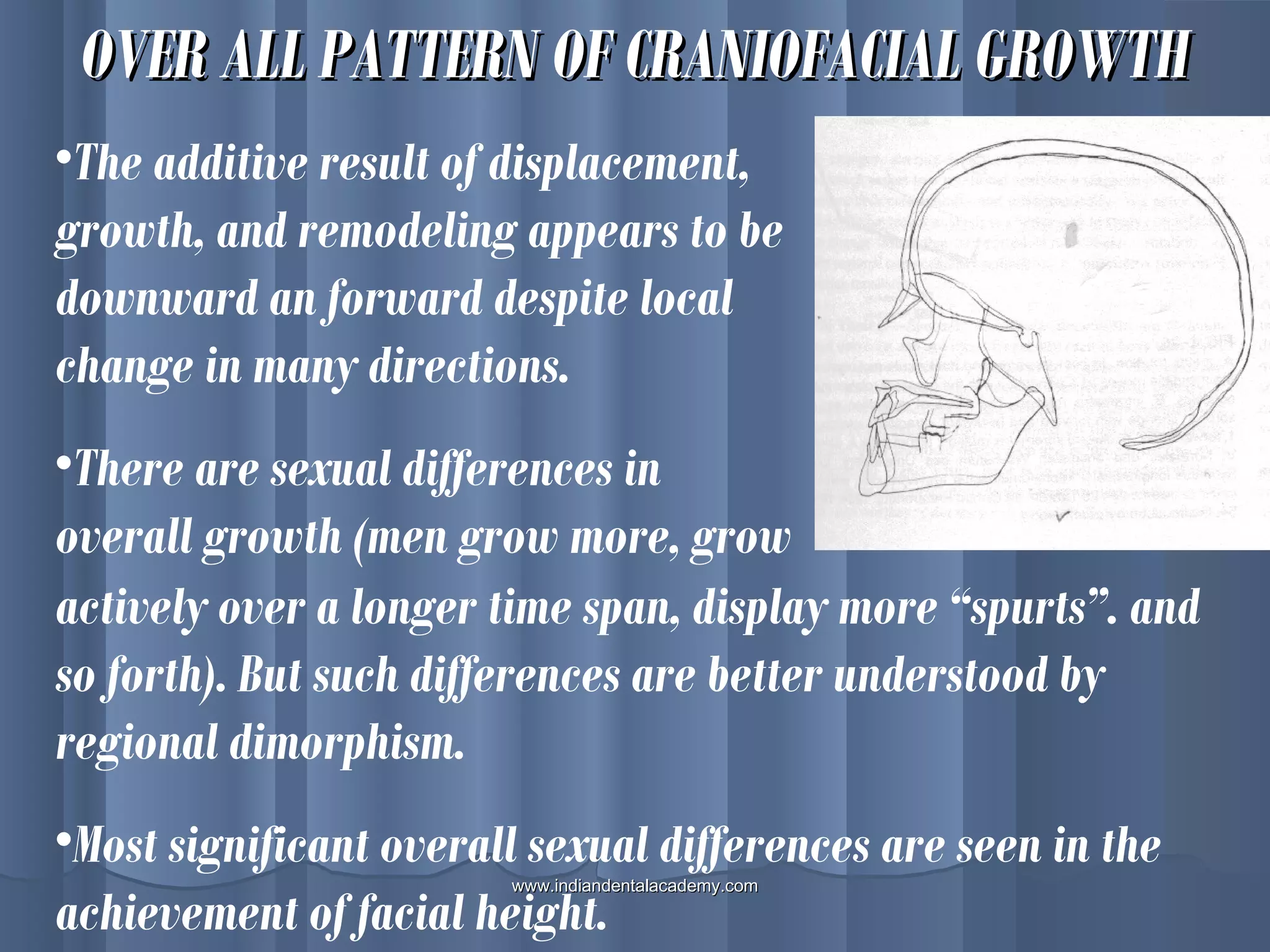
OVER ALL PATTERN OF CRANIOFACIAL GROWTHOVER ALL PATTERN OF CRANIOFACIAL GROWTH
•The additive result of displacement,
growth, and remodeling appears to be
downward an forward despite local
change in many directions.
•There are sexual differences in
overall growth (men grow more, grow
actively over a longer time span, display more “spurts”. and
so forth). But such differences are better understood by
regional dimorphism.
•Most significant overall sexual differences are seen in the
achievement of facial height.
www.indiandentalacademy.comwww.indiandentalacademy.com
RACIAL AND ETHNIC DIFFERENCESRACIAL AND ETHNIC DIFFERENCES
The literature on racial morphologic craniofacialThe literature on racial morphologic craniofacial
diversity is detailed and extensive but there are fewdiversity is detailed and extensive but there are few
studies on growth differences among racial, ethnic, andstudies on growth differences among racial, ethnic, and
national groups.national groups.
Most extensively reported on are north american whitesMost extensively reported on are north american whites
and Europeans. Serial cephalometric data of northand Europeans. Serial cephalometric data of north
american blacks exist but not fully analyzed.american blacks exist but not fully analyzed.
International orthodontic clinical literature suggestsInternational orthodontic clinical literature suggests
different distribution of malocclusions among to namedifferent distribution of malocclusions among to name
obvious examples Japanese, Italians,swedes,British,andobvious examples Japanese, Italians,swedes,British,and
north american whites.north american whites.www.indiandentalacademy.comwww.indiandentalacademy.com
““ADULT” CRANIOFACIAL GROWTHADULT” CRANIOFACIAL GROWTH
BEHRENTS STUDY RESULTSBEHRENTS STUDY RESULTS
Craniofacial size and shape changes continue past 17Craniofacial size and shape changes continue past 17
years to oldest age studied.years to oldest age studied.
Significant sexual dimorphism exists: men are larger atSignificant sexual dimorphism exists: men are larger at
all ages, they grow more and their adult growth isall ages, they grow more and their adult growth is
more apt to persist along the same vectors ofmore apt to persist along the same vectors of
adolescent growth .adolescent growth .
Women showed periods of increased rates ofWomen showed periods of increased rates of
craniofacial growth, apparently related to time ofcraniofacial growth, apparently related to time of
pregnancies.pregnancies.
(conti…)www.indiandentalacademy.comwww.indiandentalacademy.com
Skeletal changes resulted from continuous localizedSkeletal changes resulted from continuous localized
remodeling, producing differential alterations in sizeremodeling, producing differential alterations in size
and shape.and shape.
The amount of growth were not sufficient to serve as aThe amount of growth were not sufficient to serve as a
basis for practical adult orthopedic or functionalbasis for practical adult orthopedic or functional
appliance therapy.appliance therapy.
The amount of growth were sufficient however, toThe amount of growth were sufficient however, to
cause significant adaptations in mandibular orientationcause significant adaptations in mandibular orientation
and occlusal relations.and occlusal relations.
www.indiandentalacademy.comwww.indiandentalacademy.com
Prediction of GrowthPrediction of Growth
A number of methods are available for this. These cannotA number of methods are available for this. These cannot
go into details concerning certain aspects such as:go into details concerning certain aspects such as:
Age related individual peculiarites.Age related individual peculiarites.
Growth changes in untreated cases, compared with those inGrowth changes in untreated cases, compared with those in
treated cases, taking into account treatment mechanism and thetreated cases, taking into account treatment mechanism and the
age of the patient at the beginning of treatment.age of the patient at the beginning of treatment.
Growth changes occurring after conclusion of treatment.Growth changes occurring after conclusion of treatment.
www.indiandentalacademy.comwww.indiandentalacademy.com
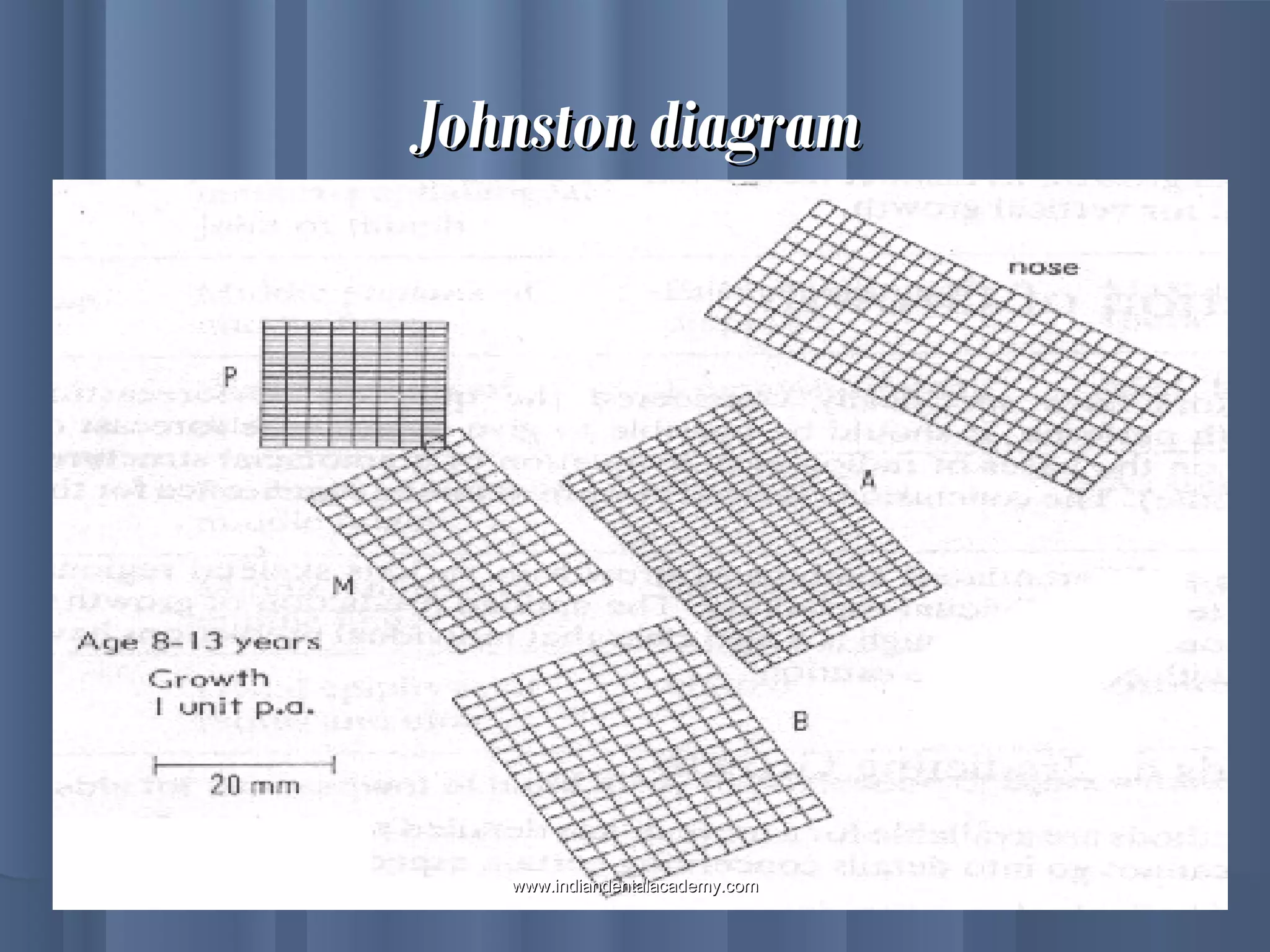
Johnston methodJohnston method
LE JOHNSTON has produced a diagram on the assumptionLE JOHNSTON has produced a diagram on the assumption
of regular annual changes and an average direction ofof regular annual changes and an average direction of
growth. He states that accurate prediction can be madegrowth. He states that accurate prediction can be made
in 65% of cases.in 65% of cases.
Johnston simplified method of generating a long-termJohnston simplified method of generating a long-term
forecast by use of a printed ‘forecast grid’. Each pointforecast by use of a printed ‘forecast grid’. Each point
was advanced one grid unit per year, using a standardwas advanced one grid unit per year, using a standard
S-N orientation registered at S.S-N orientation registered at S.
www.indiandentalacademy.comwww.indiandentalacademy.com
Johnston diagramJohnston diagram
www.indiandentalacademy.comwww.indiandentalacademy.com
Growth in S-N LineGrowth in S-N Line
A number methods are based on average increase in S-NA number methods are based on average increase in S-N
line using this for differentiated prediction of verticalline using this for differentiated prediction of vertical
and sagittal growth changes.and sagittal growth changes.
The reliability of this method is said to be 70%.The reliability of this method is said to be 70%.
www.indiandentalacademy.comwww.indiandentalacademy.com
Ricketts short term predictionRicketts short term prediction
This makes distinction between vertical and horizontalThis makes distinction between vertical and horizontal
growth.growth.
The method is said to be 80% reliable.The method is said to be 80% reliable.
www.indiandentalacademy.comwww.indiandentalacademy.com
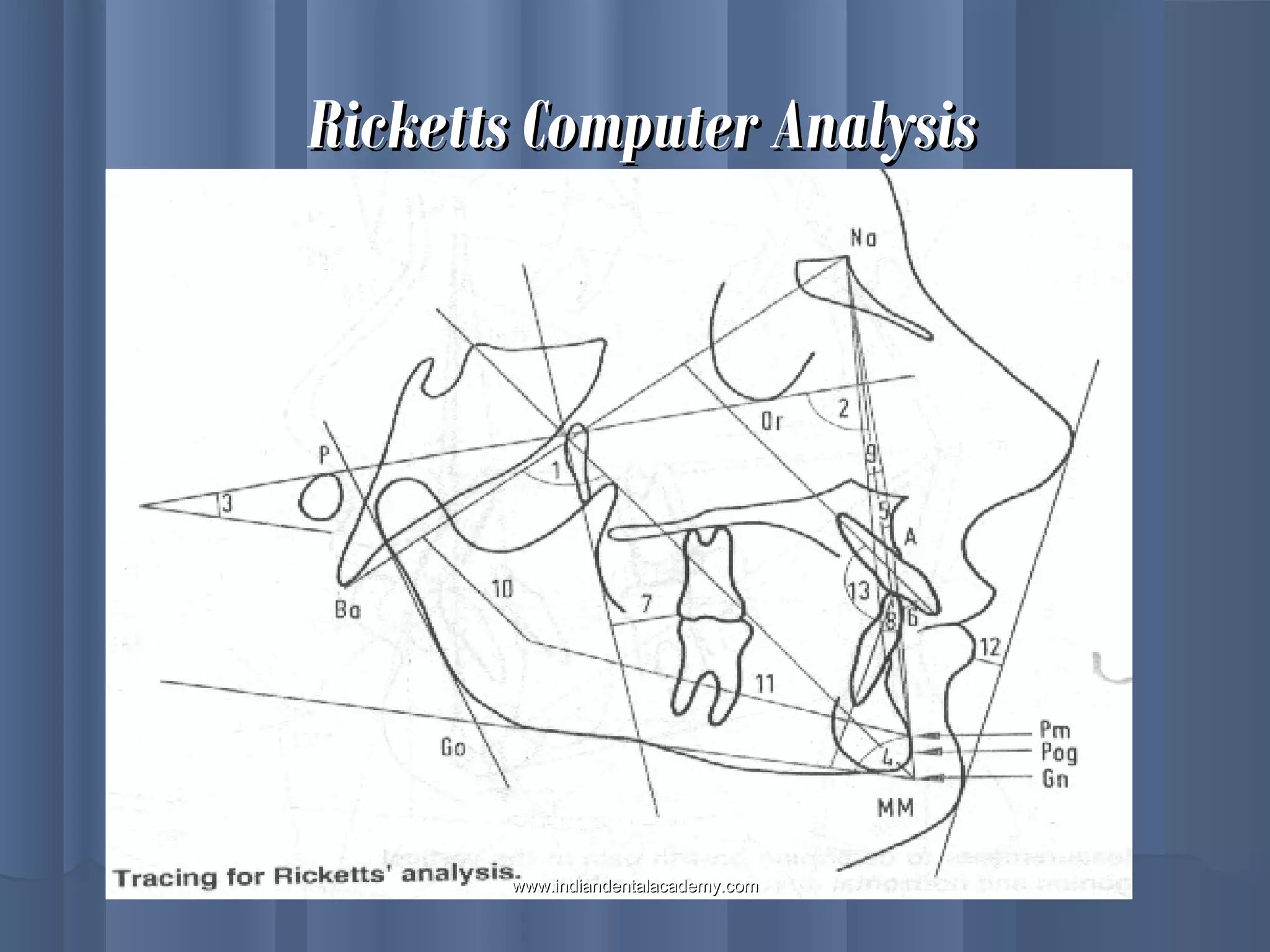
Ricketts Computer AnalysisRicketts Computer Analysis
www.indiandentalacademy.comwww.indiandentalacademy.com
Basic materials are cephalometric data relating toBasic materials are cephalometric data relating to
structural synthesis stored in the computer, with astructural synthesis stored in the computer, with a
structural analysis done in the individual case.structural analysis done in the individual case.
Individual assessment again based on statistical meanIndividual assessment again based on statistical mean
values.values.
This computer diagnosis requires patient to be a certainThis computer diagnosis requires patient to be a certain
age and is also limited to specific treatment techniques.age and is also limited to specific treatment techniques.
www.indiandentalacademy.comwww.indiandentalacademy.com
CONCLUSIONCONCLUSION
To the biologist growth and development are theTo the biologist growth and development are the
normal changes from birth to death in an individualnormal changes from birth to death in an individual
organism. The evaluation of the growth andorganism. The evaluation of the growth and
development of the individual patient is an importantdevelopment of the individual patient is an important
part of orthodontics as a basis of comparison with thepart of orthodontics as a basis of comparison with the
normal as a means of discovering and diagnosing malnormal as a means of discovering and diagnosing mal
development (malocclusion), and as the foundation fordevelopment (malocclusion), and as the foundation for
planning orthodontic treatment.planning orthodontic treatment.
www.indiandentalacademy.comwww.indiandentalacademy.com

Growth and development (2)

  • 1.
    GROWTH ANDGROWTH AND DEVELOPMENTDEVELOPMENT BasicconceptsBasic concepts www.indiandentalacademy.comwww.indiandentalacademy.com
  • 2.
    DEFINITIONSDEFINITIONS GROWTHGROWTH According to J.X.HUXLEYAccordingto J.X.HUXLEY ““The self multiplication of living substance”The self multiplication of living substance” According to KROGMANAccording to KROGMAN ““Increase in size, change in proportion andIncrease in size, change in proportion and progressive complexity”progressive complexity” According to MOYER`SAccording to MOYER`S ““Quantitative aspect of biologic development perQuantitative aspect of biologic development per unit time”unit time” www.indiandentalacademy.comwww.indiandentalacademy.com
  • 3.
    DEFINITIONSDEFINITIONS According to TODDAccordingto TODD ““ An inrease in size”An inrease in size” According to MERIDITHAccording to MERIDITH ““Entire series of sequential anatomic andEntire series of sequential anatomic and physiologic changes taking place from the beginning ofphysiologic changes taking place from the beginning of prenatal life to senility”prenatal life to senility” According to MOSSAccording to MOSS ““Change in any morphological parameterChange in any morphological parameter which is measurable”which is measurable”www.indiandentalacademy.comwww.indiandentalacademy.com
  • 4.
    DEVELOPMENTDEVELOPMENT  According toTODDAccording to TODD ““Progress towards maturity”Progress towards maturity” www.indiandentalacademy.comwww.indiandentalacademy.com
  • 5.
    DIFFERENTIATIONDIFFERENTIATION According to MOYER`SAccordingto MOYER`S ““Differentiation is the changeDifferentiation is the change from a generalized cell or tissue to one that is morefrom a generalized cell or tissue to one that is more specialised.”specialised.” www.indiandentalacademy.comwww.indiandentalacademy.com
  • 6.
    Molecular Biology Developmental Sciences DevelopmentalBiology Behavioural Development Physical Growth www.indiandentalacademy.comwww.indiandentalacademy.com
  • 7.
    Molecular biologyMolecular biology Itincludes molecularIt includes molecular genetics, biophysics, and geneticgenetics, biophysics, and genetic engineering.engineering. Developmental biologyDevelopmental biology It includes cellular biology ,embryology, teratology,It includes cellular biology ,embryology, teratology, reproductive biology and perinatal biology.reproductive biology and perinatal biology. Developmental oral biologyDevelopmental oral biology concerned with craniofacial growth and development.concerned with craniofacial growth and development. Physical GrowthPhysical Growth The field of physical growth is the study of organ andThe field of physical growth is the study of organ and body growth.body growth. www.indiandentalacademy.comwww.indiandentalacademy.com
  • 8.
    It includes analysisof such morphogenesis, height andIt includes analysis of such morphogenesis, height and weight, growth rates, retarded growth, metabolicweight, growth rates, retarded growth, metabolic disturbances in growth, developmental physical fitness,disturbances in growth, developmental physical fitness, pubescence and morphometrics.pubescence and morphometrics. Behavioral developmentBehavioral development As the child grows physically,pattern of interactionsAs the child grows physically,pattern of interactions develop with the environment. (i.e. Behavior)develop with the environment. (i.e. Behavior) Behavior appears in typical sequences duringBehavior appears in typical sequences during development just as the physical attributes of the bodydevelopment just as the physical attributes of the body appear in an expected pattern.appear in an expected pattern. www.indiandentalacademy.comwww.indiandentalacademy.com
  • 9.
    Scientists studying behavioraldevelopment includeScientists studying behavioral development include embryologists, developmental psychologists,embryologists, developmental psychologists, psychiatrists, physiologists, physiologic psychologists,psychiatrists, physiologists, physiologic psychologists, and geneticists.and geneticists. www.indiandentalacademy.comwww.indiandentalacademy.com
  • 10.
    GROWTH PATTERN, VARIABILITYAND TIMINGGROWTH PATTERN, VARIABILITY AND TIMING (A)PATTERN(A)PATTERN Pattern reflects proportionality, usually of a complexPattern reflects proportionality, usually of a complex set of proportions rather than just a single proportionalset of proportions rather than just a single proportional relationship.relationship. The physical arrangement of body at one time is aThe physical arrangement of body at one time is a pattern of spatially proportioned parts.pattern of spatially proportioned parts. www.indiandentalacademy.comwww.indiandentalacademy.com
  • 11.
    SCAMMONS GROWTH CURVESCAMMONSGROWTH CURVE www.indiandentalacademy.comwww.indiandentalacademy.com
  • 12.
    Not all bodysystems grows at the same rate.Not all body systems grows at the same rate. The muscular and skeletal elements grows faster thanThe muscular and skeletal elements grows faster than the brain and central nervous system as reflected inthe brain and central nervous system as reflected in relative decrease of head size.relative decrease of head size. www.indiandentalacademy.comwww.indiandentalacademy.com
  • 13.
    Cephalocaudal growth gradient-BodyCephalocaudal growth gradient- Body •In Fetal life at about third month of intra uterine development, head takes up 50% of total body length. •By time of birth, trunk and limbs grown faster than head & face. Head decreased to about 30%. •Over all pattern of growth thereafter follows this course, with a progressive reduction of size of head to about 12% of adult. www.indiandentalacademy.comwww.indiandentalacademy.com
  • 14.
    Cephalocaudal growth gradient-FaceCephalocaudal growth gradient- Face •Infant has much larger cranium and a much smaller face. •This change in proportionality, with an emphasis on growth of the face relative to cranium is an important aspect of pattern of facial growth. •When facial growth pattern viewed against perspective of the cephalocaudal gradient, it is not surprising that the mandible, being further away from the brain, tends to grown more than later than maxilla which is closer.www.indiandentalacademy.comwww.indiandentalacademy.com
  • 15.
    (B)VARIABILITY(B)VARIABILITY The second importantconcept in the study of growthThe second important concept in the study of growth and development is variabilityand development is variability It is very important clinically, to decide whether anIt is very important clinically, to decide whether an individual is merely at the extreme of the normalindividual is merely at the extreme of the normal variation or falls from outside.variation or falls from outside. Rather than categorizing people as normal orRather than categorizing people as normal or abnormal, it is more useful to think in terms ofabnormal, it is more useful to think in terms of deviations from the usual pattern and to expressdeviations from the usual pattern and to express variability quantitatively.variability quantitatively. one way to do this is to evaluate a given child relativeone way to do this is to evaluate a given child relative to peers on a standard growth chart.to peers on a standard growth chart.www.indiandentalacademy.comwww.indiandentalacademy.com
  • 16.
  • 17.
    (C) TIMING(C) TIMING AFinal major concept in physical growth andA Final major concept in physical growth and development is that of timing.development is that of timing. There are sex related timing differences in the timing ofThere are sex related timing differences in the timing of many growth phenomena.many growth phenomena. Usually girls precede boys, for eg. in pubescence, dentalUsually girls precede boys, for eg. in pubescence, dental calcification, and ossification of carpal bones.calcification, and ossification of carpal bones. www.indiandentalacademy.comwww.indiandentalacademy.com
  • 18.
    •Growth plotted eitherin height or weight at any age or amount of change in any given interval. •A curve like black line is called a “distance curve” where the red line is a “ velocity curve”. •Plotting velocity rather than distance makes it easier to see when accelerations and decelerations in the rate of growth occurred. www.indiandentalacademy.comwww.indiandentalacademy.com
  • 19.
    Growth spurtGrowth spurt Growthdoes not take place uniformly at all times. TheseGrowth does not take place uniformly at all times. These seems to be periods when sudden increase in growthseems to be periods when sudden increase in growth termed “growth spurt”termed “growth spurt” The timing of growth spurt differ in boys and girls.The timing of growth spurt differ in boys and girls. The following are timing of growth spurts.The following are timing of growth spurts. One year after birthOne year after birth www.indiandentalacademy.comwww.indiandentalacademy.com
  • 20.
    Mixed dentition growthspurt.Mixed dentition growth spurt.  Boys :8-11 yearsBoys :8-11 years  Girls -7-9 yearsGirls -7-9 years pre-pubertal growth spurtpre-pubertal growth spurt  Boys -14-16 yearsBoys -14-16 years  Girls - 11-13yearsGirls - 11-13years Growth modification procedures using functional andGrowth modification procedures using functional and orthopedic appliance are carried out during growthorthopedic appliance are carried out during growth period. Surgical resective procedures are best carriedperiod. Surgical resective procedures are best carried out period after the cassation ofout period after the cassation of www.indiandentalacademy.comwww.indiandentalacademy.com
  • 21.
    data analyzationdata analyzation Typesof growthTypes of growth gatheringgathering growth datagrowth data Evaluation of growth dataEvaluation of growth data a. opiniona. opinion b. observationsb. observations c. Rating and rankingsc. Rating and rankings d. Quantitatived. Quantitative measurementsmeasurements (i).Direct data(i).Direct data (ii)Indirect growth(ii)Indirect growth measurementsmeasurements (iii).derived data(iii).derived data a.a. LongitudinalLongitudinal b.b. cross sectionalcross sectional c.c. overlapping oroverlapping or semilongitudinal datasemilongitudinal data www.indiandentalacademy.comwww.indiandentalacademy.com
  • 22.
    Types of growthdataTypes of growth data ((A) OPINIONA) OPINION  Opinion is at best a clever guess based on experience.Opinion is at best a clever guess based on experience. crudest form of scientific knowledge and are notcrudest form of scientific knowledge and are not accepted wherever data is not available.accepted wherever data is not available. www.indiandentalacademy.comwww.indiandentalacademy.com
  • 23.
    (B) OBSERVATIONS(B) OBSERVATIONS Observations are useful for studying all-or-noneObservations are useful for studying all-or-none phenomena.phenomena. eg. congenital absence of teetheg. congenital absence of teeth www.indiandentalacademy.comwww.indiandentalacademy.com
  • 24.
    (C) RATINGS ANDRANKINGS(C) RATINGS AND RANKINGS Ratings make use of comparisons with conventionalRatings make use of comparisons with conventional accepted or scales or classification.accepted or scales or classification. Ranking may array data in ordered sequencesRanking may array data in ordered sequences according to value.according to value. This method used for evaluation of ear shape, eyeThis method used for evaluation of ear shape, eye colour and fingerprints.colour and fingerprints. www.indiandentalacademy.comwww.indiandentalacademy.com
  • 25.
    (D) QUANTITATIVE MEASUREMENTS(D)QUANTITATIVE MEASUREMENTS Quantitation minimizes misunderstanding and permitsQuantitation minimizes misunderstanding and permits the testing of hypotheses by other workers.the testing of hypotheses by other workers. 1)Direct data- data derived from measurements1)Direct data- data derived from measurements taken on the living person or cadaver by means oftaken on the living person or cadaver by means of calipers, scales, measuring tapes and other measuringcalipers, scales, measuring tapes and other measuring devices.devices. Measuring of teeth with a boley gauge in the mouth of aMeasuring of teeth with a boley gauge in the mouth of a patient produces direct data.patient produces direct data. www.indiandentalacademy.comwww.indiandentalacademy.com
  • 26.
    Indirect growth measurements-Indirectgrowth measurements- measurements taken frommeasurements taken from sources other thansources other than the actualthe actual person.person. e.g. photographs, dental casts or cephalograms.e.g. photographs, dental casts or cephalograms. Derived data- obtained by comparing at least two orDerived data- obtained by comparing at least two or more measurements.more measurements. e.g. In a person, mandible grew 2mm between ages 7e.g. In a person, mandible grew 2mm between ages 7 and 8, the 2mm have actually been measured; ratherand 8, the 2mm have actually been measured; rather the mandibular length at 7 years has been substractedthe mandibular length at 7 years has been substracted from the mandibular length at 8years and thefrom the mandibular length at 8years and the increment thus derived is assumed to represent growth.increment thus derived is assumed to represent growth.www.indiandentalacademy.comwww.indiandentalacademy.com
  • 27.
    METHODS OF GATHERINGGROWTH DATAMETHODS OF GATHERING GROWTH DATA (A) Longitudinal(A) Longitudinal Measurement made of the same person or group at regularMeasurement made of the same person or group at regular intervals through time are longitudinal measurements.intervals through time are longitudinal measurements. 1)Advantages of the longitudinal method.1)Advantages of the longitudinal method. variability in development among individuals within thevariability in development among individuals within the group is put in proper perspective.group is put in proper perspective. The specific developmental pattern of an individual can beThe specific developmental pattern of an individual can be studied, permitting serial comparisons.studied, permitting serial comparisons. Temporary temporal problems in sampling are smoothed outTemporary temporal problems in sampling are smoothed out with time, and an unusual event or a mistake in measuring iswith time, and an unusual event or a mistake in measuring is more easily seen and corrections made.more easily seen and corrections made.www.indiandentalacademy.comwww.indiandentalacademy.com
  • 28.
    DISADVANTAGE OF THELONGITUDINAL METHOD.DISADVANTAGE OF THE LONGITUDINAL METHOD. TIME- If one wish to study the growth of the human face from theTIME- If one wish to study the growth of the human face from the birth to adulthood by means of longitudinal data, it will take a lifebirth to adulthood by means of longitudinal data, it will take a life time to gather the data.time to gather the data. EXPENSE- Longitudinal studies necessitate the maintenance ofEXPENSE- Longitudinal studies necessitate the maintenance of laboratories, research personnel, and data storage for a long timelaboratories, research personnel, and data storage for a long time and thus are costly.and thus are costly. ATTRITION-The parents of children in longitudinal studies changeATTRITION-The parents of children in longitudinal studies change their places of residence or lose interest in the study and sometheir places of residence or lose interest in the study and some children die. The result is a gradual diminution in sample size.children die. The result is a gradual diminution in sample size. AVERAGING- The changes in average size of a group of individualsAVERAGING- The changes in average size of a group of individuals do not adequately indicate the sequence of events that is folleweddo not adequately indicate the sequence of events that is follewed by any single individual.by any single individual. www.indiandentalacademy.comwww.indiandentalacademy.com
  • 29.
    (b) Cross sectional(b)Cross sectional Measurement made of different individuals or differentMeasurement made of different individuals or different samples and studied at different periods are cross-sectionalsamples and studied at different periods are cross-sectional measurements.measurements. Advantages of the cross-sectional method.Advantages of the cross-sectional method. It is quicker.It is quicker. It is less costlyIt is less costly Because it is simpler to get large samples by the cross-Because it is simpler to get large samples by the cross- sectional method, statistical treatment of the data sometimessectional method, statistical treatment of the data sometimes is made easier.is made easier. The method allows repeating of studies more readily.The method allows repeating of studies more readily. The method is used for cadavers, skeletons and aracheologicThe method is used for cadavers, skeletons and aracheologic data.data. www.indiandentalacademy.comwww.indiandentalacademy.com
  • 30.
    Disadvantages of thecross-sectional methodDisadvantages of the cross-sectional method It must always be assumed that the groups being measuredIt must always be assumed that the groups being measured and compared are similar. Cross sectional group averagesand compared are similar. Cross sectional group averages tend to obscure individual variations. This is particularlytend to obscure individual variations. This is particularly obfuscating when studying the timing of developmentalobfuscating when studying the timing of developmental events, for example, the onset of pubescence or theevents, for example, the onset of pubescence or the adolescent growth spurt.adolescent growth spurt. Craniomeric, anthropometric and cephalometric dataCraniomeric, anthropometric and cephalometric data can be expressed as cross sectionally.can be expressed as cross sectionally. www.indiandentalacademy.comwww.indiandentalacademy.com
  • 31.
    (c) Overlapping orsemi longitudinal data(c) Overlapping or semi longitudinal data Longitudinal and cross sectional methods are combined byLongitudinal and cross sectional methods are combined by some workers to seek the advantages of each.some workers to seek the advantages of each. In this way one might compress 15 years of study intoIn this way one might compress 15 years of study into 3years of gathering data, each sub sample including3years of gathering data, each sub sample including children studied for the same number of years but startedchildren studied for the same number of years but started at different ages.at different ages. e.g.subsample A-3 TO 6 YEARSe.g.subsample A-3 TO 6 YEARS subsample B-4 TO 7 YEARSsubsample B-4 TO 7 YEARS subsample C- 5 TO 8 YEARSsubsample C- 5 TO 8 YEARS www.indiandentalacademy.comwww.indiandentalacademy.com
  • 32.
    ANTHROPOMETRYANTHROPOMETRY The technque ofmeasuring skeletal dimensions on livingThe technque of measuring skeletal dimensions on living individuals is called anthropometry.individuals is called anthropometry. Various landmarks are established in studies of dry skullVarious landmarks are established in studies of dry skull are measured in living individuals simply by using softare measured in living individuals simply by using soft tissue points overlying these bony landmarks.tissue points overlying these bony landmarks. www.indiandentalacademy.comwww.indiandentalacademy.com
  • 33.
    CEPHALOMETRYCEPHALOMETRY Cephalometrics is usedfor study of growth andCephalometrics is used for study of growth and development.development. This approach can combine the advantages ofThis approach can combine the advantages of craniometry and anthropometry.craniometry and anthropometry. It allows a direct measurement of bony skeletalIt allows a direct measurement of bony skeletal dimensions, since the bone can be seen through the softdimensions, since the bone can be seen through the soft tissue covering in a radiograph.tissue covering in a radiograph. It also allows the same individual to be followed overIt also allows the same individual to be followed over time.time. www.indiandentalacademy.comwww.indiandentalacademy.com
  • 34.
    EVALUATION OF GROWTHAND DATAEVALUATION OF GROWTH AND DATA Evaluation of growth data is one the most complicatedEvaluation of growth data is one the most complicated and fascinating branches of statistics.and fascinating branches of statistics. Many facts of growth lie hidden in ‘clinicians’ orMany facts of growth lie hidden in ‘clinicians’ or ‘scientists’ crude hunches and can be bared for further‘scientists’ crude hunches and can be bared for further study only by careful and imaginative statisticalstudy only by careful and imaginative statistical dissection.dissection. www.indiandentalacademy.comwww.indiandentalacademy.com
  • 35.
    VARIABLES AFFECTING PHYSICALGROWTHVARIABLES AFFECTING PHYSICAL GROWTH HEREDITYHEREDITY NUTRITIONNUTRITION ILLNESSILLNESS RACERACE CLIMATE AND SEASONAL EFFECTS ON GROWTHCLIMATE AND SEASONAL EFFECTS ON GROWTH ADULT PHYSIQUEADULT PHYSIQUE SOCIOECNOMIC FACTORSSOCIOECNOMIC FACTORS EXERCISEEXERCISE FAMILY SIZE AND BIRTH ORDERFAMILY SIZE AND BIRTH ORDER SECULAR TRENDSSECULAR TRENDS  www.indiandentalacademy.comwww.indiandentalacademy.com
  • 36.
    HEREDITYHEREDITY There is geneticcontrol of the size of the parts to aThere is genetic control of the size of the parts to a great extend, of the rate of the growth, and of the onsetgreat extend, of the rate of the growth, and of the onset of the growth events.of the growth events. eg.eg. dental classification, the eruption of teeth, ossification of bones,dental classification, the eruption of teeth, ossification of bones, and the start of the adolescent growth spurt.and the start of the adolescent growth spurt. There is considerable degree of independence betweenThere is considerable degree of independence between growth before and growth during adolescence.growth before and growth during adolescence. www.indiandentalacademy.comwww.indiandentalacademy.com
  • 37.
    NUTRITIONNUTRITION Malnutrition delay thegrowth and theMalnutrition delay the growth and the adolescent growth spurt.adolescent growth spurt. Children have fine recuperative powersChildren have fine recuperative powers provided the adverse conditions have notprovided the adverse conditions have not seen too extreme.seen too extreme. With the return of good nutrition growthWith the return of good nutrition growth takes place unusually fast until thetakes place unusually fast until the genetically determined curve nearedgenetically determined curve neared once more and subsequently followed.once more and subsequently followed. www.indiandentalacademy.comwww.indiandentalacademy.com
  • 38.
    ILLNESSILLNESS The usually minorchildhood illness does not have muchThe usually minor childhood illness does not have much effect on physical growth.effect on physical growth. Serious prolonged and debilitating illness have aSerious prolonged and debilitating illness have a marked effect on growthmarked effect on growth www.indiandentalacademy.comwww.indiandentalacademy.com
  • 39.
    RACERACE Racial differences showdifferences in growthRacial differences show differences in growth pattern.pattern. It is due to genetic, climatic, nutritional orIt is due to genetic, climatic, nutritional or socioecnomic differences.socioecnomic differences. eg. north american blacks are ahead of whites ineg. north american blacks are ahead of whites in skeletal maturity at birth and for at least first 2yearsskeletal maturity at birth and for at least first 2years of life.of life. www.indiandentalacademy.comwww.indiandentalacademy.com
  • 40.
    CLIMATIC AND SEASONALEFFECTS OF GROWTHCLIMATIC AND SEASONAL EFFECTS OF GROWTH There is a general tendency for those living in coldThere is a general tendency for those living in cold climates to have greater proportion of adipose tissueclimates to have greater proportion of adipose tissue and much has been made of the skeletal variationsand much has been made of the skeletal variations associated with variations in climate.associated with variations in climate. There is seasonal variations in the growth rate ofThere is seasonal variations in the growth rate of children and in the weight of newborn babies.children and in the weight of newborn babies. Contray to popular belief, climate has little direct effectContray to popular belief, climate has little direct effect on the rate of growth.on the rate of growth. www.indiandentalacademy.comwww.indiandentalacademy.com
  • 41.
    ADULT PHYSIQUEADULT PHYSIQUE Thereare correlations between the adultThere are correlations between the adult physique and earlier development events.physique and earlier development events. eg.eg. tall women tends to mature later and there aretall women tends to mature later and there are variations in the rate of growth associated withvariations in the rate of growth associated with differing somatotypes.differing somatotypes. www.indiandentalacademy.comwww.indiandentalacademy.com
  • 42.
    SOCIO ECONOMIC FACTORSSOCIOECONOMIC FACTORS Children living in favorable socioeconomic conditionsChildren living in favorable socioeconomic conditions tend to be larger, display different types of growth andtend to be larger, display different types of growth and show variation timing of growth when compared withshow variation timing of growth when compared with disadvantaged children.disadvantaged children. eg. height and weight ratios.eg. height and weight ratios. www.indiandentalacademy.comwww.indiandentalacademy.com
  • 43.
    EXERCISEEXERCISE A strong casefor the effects of exerciseA strong case for the effects of exercise on linear growth has not been made in aon linear growth has not been made in a quantitative fashion.quantitative fashion. children who exercise strenuously andchildren who exercise strenuously and regularly have not been shown to growregularly have not been shown to grow more favorably.more favorably. www.indiandentalacademy.comwww.indiandentalacademy.com
  • 44.
    FAMILY SIZE ANDBIRTH ORDERFAMILY SIZE AND BIRTH ORDER There are differences in the sizes of theThere are differences in the sizes of the individuals. in their maturational level ofindividuals. in their maturational level of achievement, and in their intelligenceachievement, and in their intelligence that can be correlated with the size of thethat can be correlated with the size of the family from which they came.family from which they came. First born children tend to weight less atFirst born children tend to weight less at birth and ultimately achieve less staturebirth and ultimately achieve less stature and a higher I.Q.and a higher I.Q. www.indiandentalacademy.comwww.indiandentalacademy.com
  • 45.
    SECULAR TRENDSSECULAR TRENDS Sizeand maturational changes in large populations canSize and maturational changes in large populations can be shown to be occuring with time that, as yet have notbe shown to be occuring with time that, as yet have not been well explained.been well explained. e.g. Fifteen year old boys are approximately 5 inchese.g. Fifteen year old boys are approximately 5 inches taller than 15 year old boys were 50 years ago.taller than 15 year old boys were 50 years ago. www.indiandentalacademy.comwww.indiandentalacademy.com
  • 46.
    Psychological disturbancePsychological disturbance Ithas been shown that children experiencing stressfulIt has been shown that children experiencing stressful conditions display an inhibition of growth hormone.conditions display an inhibition of growth hormone. When the emotional stress is removed they begin againWhen the emotional stress is removed they begin again to secrete growth hormone normally, and ‘catch up’to secrete growth hormone normally, and ‘catch up’ growth is seen.growth is seen. www.indiandentalacademy.comwww.indiandentalacademy.com
  • 47.
    The evaluation ofphysical growthThe evaluation of physical growth WHY ASSESS……?WHY ASSESS……? For the identification of grossly abnormal pathologic growth.For the identification of grossly abnormal pathologic growth. For the recognition and diagnosis of significant deviation fromFor the recognition and diagnosis of significant deviation from normal growth.normal growth. For the planning of therapy.For the planning of therapy. For the determination of efficacy of therapy.For the determination of efficacy of therapy. www.indiandentalacademy.comwww.indiandentalacademy.com
  • 48.
    Questions to beasked…Questions to be asked… 1. What is the status of the patient at the moment…?1. What is the status of the patient at the moment…? 2. What is progress of grow to date…?2. What is progress of grow to date…? 3. How does he/she compare with others…?3. How does he/she compare with others…? 4. How does he/she fit family pattern…?4. How does he/she fit family pattern…? 5. What will he/she do in the future…?5. What will he/she do in the future…? www.indiandentalacademy.comwww.indiandentalacademy.com
  • 49.
    Rudiments of bonegrowthRudiments of bone growth 1.1.OSTEOGENESIS.OSTEOGENESIS. a) Endochondral bone formation.a) Endochondral bone formation. Mesenchymal tissueMesenchymal tissue CartilageCartilage Cartilage cells hypertrophy, calcification of matrix,Cartilage cells hypertrophy, calcification of matrix, degeneration of cells.degeneration of cells. Osteogenic tissues invade the dying and disintegratingOsteogenic tissues invade the dying and disintegrating cartilage and replace it.cartilage and replace it.www.indiandentalacademy.comwww.indiandentalacademy.com
  • 50.
    Endochondrial bone formationEndochondrialbone formation ZONE A, reserve cartilage feeds new cells into b, zone of cell division. ZONE B, cells undergo rapid division forms column of flattened chondrocytes. It is responsible for elongation of bone. ZONE C, the daugther cells undergo hypertrophy. ZONE D, the matrix calcifies ZONE E, the calcified matrix becomes partially resorbed and invaded by vessels. www.indiandentalacademy.comwww.indiandentalacademy.com
  • 51.
    ZONE F, undifferentiatedcells carried in by sproutsZONE F, undifferentiated cells carried in by sprouts provide osteoblasts, which in turn deposit a thin crust ofprovide osteoblasts, which in turn deposit a thin crust of bone on the remnants of the calcified cartilage matrix.bone on the remnants of the calcified cartilage matrix. Entire process is continuous and repetitive, one zoneEntire process is continuous and repetitive, one zone transferring into next.transferring into next. ZONE B changed directly to ZONE C ( arrow1).ZONE B changed directly to ZONE C ( arrow1). ZONE D INTO ZONE E (arrow2).ZONE D INTO ZONE E (arrow2). ZONE E INTO ZONE F(arrow3).ZONE E INTO ZONE F(arrow3). As entire cartilage grows in a linear direction towardAs entire cartilage grows in a linear direction toward top of illustration bone replacement follows.top of illustration bone replacement follows. www.indiandentalacademy.comwww.indiandentalacademy.com
  • 52.
    Endochondrial bone formation(conti)Endochondrial bone formation (conti) •Growth of cranial synchondrosis is schematized. Note that proliferation in bone formation occurs on both sides of plate, in contrast to epiphyseal plate pictured in D. •A typical long-bone epiphysis showing a secondary center, articular cartilage, epiphysial plate and medullary endochondral bone is represented D. www.indiandentalacademy.comwww.indiandentalacademy.com
  • 53.
    Endochondral bone formation(conti.)Endochondral bone formation (conti.) •It represents growth cartilage of mandbular condyle. A zone of prechondrocytes occur proliferation occurs just beneath a covering layer of fibrous capsule. www.indiandentalacademy.comwww.indiandentalacademy.com
  • 54.
    b) Intramembranous Boneformationb) Intramembranous Bone formation Undifferentiated mesenchymal cellsUndifferentiated mesenchymal cells OsteoblastsOsteoblasts Elaborate osteoid matrixElaborate osteoid matrix Calcification of matrixCalcification of matrix Formation of boneFormation of bone www.indiandentalacademy.comwww.indiandentalacademy.com
  • 55.
    Intramembranous bone formationIntramembranousbone formation •In a center of ossification (A) cells and matrix of the matrix undifferentiated connective tissue undergo series of changes that produce small spicules of bone. •Some cells remain relatively undifferentiated(1), but others develop into osteoblasts(2) that lay down first fibrous bone matrix (osteoid), which subsequently www.indiandentalacademy.comwww.indiandentalacademy.com
  • 56.
    become mineralized asin stage B.become mineralized as in stage B. Original blood vessels are retained in close proximity toOriginal blood vessels are retained in close proximity to the formative bony trabeculae(3).the formative bony trabeculae(3). As bone deposition by osteoblasts continues, some ofAs bone deposition by osteoblasts continues, some of these cells are enclosed by their own deposits andthese cells are enclosed by their own deposits and become osteocytes(4).become osteocytes(4). Some undifferentiated cells develop into newSome undifferentiated cells develop into new osteoblasts(6) and other remaining osteoblasts undergoosteoblasts(6) and other remaining osteoblasts undergo cell division to accommodate enlargement ofcell division to accommodate enlargement of trabeculae.trabeculae. Outline of an early bone spicule(5) is shown in enlargedOutline of an early bone spicule(5) is shown in enlarged trabeculae for reference.trabeculae for reference.www.indiandentalacademy.comwww.indiandentalacademy.com
  • 57.
    Blood vessels havenow become enclosed in the fine,Blood vessels have now become enclosed in the fine, cancellous spaces (c) .cancellous spaces (c) . This spaces also contain scattering fibers ,This spaces also contain scattering fibers , undifferentiated connective tissue cells, and osteoblasts.undifferentiated connective tissue cells, and osteoblasts. www.indiandentalacademy.comwww.indiandentalacademy.com
  • 58.
    Intramembranous bone formation(conti.)Intramembranousbone formation(conti.) •At lower magnification (D) characterstic fine, cancellous nature of cortex is seen. •This bone tissue is widely distributed in prenatal as well as young postnatal skeleton. •It is a particularly fast growing variety of bone tissue. •Note that periosteum has become arranged into (cellular) and outer (fibrous) layers. www.indiandentalacademy.comwww.indiandentalacademy.com
  • 59.
    Methods of studyingbone growth Vital staining Radioisotopes Implants Comparative anatomy Roentgenographic Cephalometry Natural Markers www.indiandentalacademy.comwww.indiandentalacademy.com
  • 60.
    Vital stainingVital staining Procionand Tetracycline are used extensively in boneProcion and Tetracycline are used extensively in bone research.research. The primary value of vital dyes lies depicting theThe primary value of vital dyes lies depicting the pattern of post natal bone deposition over an extendedpattern of post natal bone deposition over an extended period in one animal.period in one animal. www.indiandentalacademy.comwww.indiandentalacademy.com
  • 61.
    RadioisotopesRadioisotopes Radioisotope material isinjected and after a time,Radioisotope material is injected and after a time, located within the growing bones by means of Geigerlocated within the growing bones by means of Geiger counters or autoradiographic techniques.counters or autoradiographic techniques. In latter method , bones or sections of bones are placedIn latter method , bones or sections of bones are placed against photographic emulsions that are exposed byagainst photographic emulsions that are exposed by emission of radiation from the radioactive substance.emission of radiation from the radioactive substance. www.indiandentalacademy.comwww.indiandentalacademy.com
  • 62.
    ImplantsImplants These serve asradiographic reference markers forThese serve as radiographic reference markers for serial cephalometric analysis.serial cephalometric analysis. The method allows precise orientation of serialThe method allows precise orientation of serial cephalograms and information on the amount and sitescephalograms and information on the amount and sites of bone growth.of bone growth. This method is useful because bone does not growThis method is useful because bone does not grow interstitially and therefore implants inside a bone areinterstitially and therefore implants inside a bone are stablestable www.indiandentalacademy.comwww.indiandentalacademy.com
  • 63.
    Comparative AnatomyComparative Anatomy Significantcontributions to our knowledge of humanSignificant contributions to our knowledge of human facial growth have been provided throughfacial growth have been provided through comparisions with other species.comparisions with other species. Not only can experimental work done more readily onNot only can experimental work done more readily on animals but often basic principles common to growth inanimals but often basic principles common to growth in all species are first recognized and defined by studies inall species are first recognized and defined by studies in comparative anatomy.comparative anatomy. www.indiandentalacademy.comwww.indiandentalacademy.com
  • 64.
    Roentegenographic cephalometryRoentegenographic cephalometry Cephaometryhas contributed significantly to ourCephaometry has contributed significantly to our knowledge of human craniofacial skeletal growth, andknowledge of human craniofacial skeletal growth, and cephalometric methods are used rountinely, not onlycephalometric methods are used rountinely, not only for the study of facial growth but also for orthodonticfor the study of facial growth but also for orthodontic diagnosis, treatment planning and the assessment ofdiagnosis, treatment planning and the assessment of therapeutic results.therapeutic results. www.indiandentalacademy.comwww.indiandentalacademy.com
  • 65.
    Natural markersNatural markers Thepersistance of certain developmental features hasThe persistance of certain developmental features has led to their use as natural markers.led to their use as natural markers. By means of serial radiography trabeculae, nutrientBy means of serial radiography trabeculae, nutrient canals and lines of arrested growth can be used forcanals and lines of arrested growth can be used for reference to study deposition, resorption andreference to study deposition, resorption and remodeling.remodeling. e.g. Trabeculae, Nutrient canals.e.g. Trabeculae, Nutrient canals. www.indiandentalacademy.comwww.indiandentalacademy.com
  • 66.
    Example Natural markers-MandibularcanalExample Natural markers-Mandibular canal www.indiandentalacademy.comwww.indiandentalacademy.com
  • 67.
    Mechanisms of bonegrowthMechanisms of bone growth Deposition and Resorption Growth field Remodeling Growth movements www.indiandentalacademy.comwww.indiandentalacademy.com
  • 68.
    Deposition and ResorptionDepositionand Resorption On one side of the bony cortex new bone is added, onOn one side of the bony cortex new bone is added, on the other side, bone is taken away.the other side, bone is taken away. Deposition occurs on the surface of facing the directionDeposition occurs on the surface of facing the direction of growth.of growth. Resorption occurs on the surface facing away.Resorption occurs on the surface facing away. The result is a process termed cortical drift, a gradualThe result is a process termed cortical drift, a gradual moment of growing area of the bone.moment of growing area of the bone. www.indiandentalacademy.comwww.indiandentalacademy.com
  • 69.
    Deposition and resorption(cont..)Deposition and resorption (cont..) •According to enlow V principle many facial bones or parts have v shape. •Note deposition(+) occurs on inner side and resorption(-) occurs on outer. •The “V” moves from A to B as overall dimension increases ie.movement toward wide end of V. •Simultaneous growth movement and enlargement occur. www.indiandentalacademy.comwww.indiandentalacademy.com
  • 70.
    All surfaces, insideand outside of every bone areAll surfaces, inside and outside of every bone are covered by an irregular pattern of “growth fields”covered by an irregular pattern of “growth fields” comprised of various soft tissue osteogenic membranecomprised of various soft tissue osteogenic membrane or cartilages.or cartilages.  Hard bone tissue does not contain genetic program forHard bone tissue does not contain genetic program for growth ,rather the determinants of bone growth residegrowth ,rather the determinants of bone growth reside in the bone’s investing soft tissue- muscle, integument,in the bone’s investing soft tissue- muscle, integument, mucosa, blood vessels, nerves etc..mucosa, blood vessels, nerves etc.. Varying activities and rates of growth of these fieldsVarying activities and rates of growth of these fields are basis for differential growth processes that produceare basis for differential growth processes that produce bone of irregular shapes.bone of irregular shapes. GROWTH FIELDSGROWTH FIELDS www.indiandentalacademy.comwww.indiandentalacademy.com
  • 71.
    REMODELLINGREMODELLING The required differentialgrowth activity necessary forThe required differential growth activity necessary for bone shaping termed remodelling.bone shaping termed remodelling. It involves simultaneous deposition and resorption onIt involves simultaneous deposition and resorption on all inner and outer surface of entire bone.all inner and outer surface of entire bone. Remodelling a basic part of growth process, not onlyRemodelling a basic part of growth process, not only provides regional changes in shape, dimensions, andprovides regional changes in shape, dimensions, and proportions. It also produces regional adjustments thatproportions. It also produces regional adjustments that adapt to the developing function of bone and its variousadapt to the developing function of bone and its various growing soft tissues.growing soft tissues. www.indiandentalacademy.comwww.indiandentalacademy.com
  • 72.
    GROWTH MOVEMENTSGROWTH MOVEMENTS CORTICALDRIFTCORTICAL DRIFT Drift is combination of resorption and depositionDrift is combination of resorption and deposition resulting in growth movement toward the depositoryresulting in growth movement toward the depository surface.surface. Drift is seen with remodeling enlargement and isDrift is seen with remodeling enlargement and is produced by deposition of new bone on one side ofproduced by deposition of new bone on one side of cortical plate while resorption occurs on the oppositecortical plate while resorption occurs on the opposite side.side. CORTICAL DRIFT DISPLACEMENT www.indiandentalacademy.comwww.indiandentalacademy.com
  • 73.
    DISPLACEMENTDISPLACEMENT It is onthe other hand is movement of whole bone as aIt is on the other hand is movement of whole bone as a unit.unit. As a bone is carried away from its articulation withAs a bone is carried away from its articulation with other bones, growth remodeling simultaneouslyother bones, growth remodeling simultaneously maintains relationship of bone to each other.maintains relationship of bone to each other. e.g. as entire mandible is displaced from its articulatione.g. as entire mandible is displaced from its articulation in the glenoid fossa , it is necessary for condyle andin the glenoid fossa , it is necessary for condyle and ramus to move upward and backward to maintainramus to move upward and backward to maintain relationships.relationships. www.indiandentalacademy.comwww.indiandentalacademy.com
  • 74.
  • 75.
    OVER ALL PATTERNOF CRANIOFACIAL GROWTHOVER ALL PATTERN OF CRANIOFACIAL GROWTH •The additive result of displacement, growth, and remodeling appears to be downward an forward despite local change in many directions. •There are sexual differences in overall growth (men grow more, grow actively over a longer time span, display more “spurts”. and so forth). But such differences are better understood by regional dimorphism. •Most significant overall sexual differences are seen in the achievement of facial height. www.indiandentalacademy.comwww.indiandentalacademy.com
  • 76.
    RACIAL AND ETHNICDIFFERENCESRACIAL AND ETHNIC DIFFERENCES The literature on racial morphologic craniofacialThe literature on racial morphologic craniofacial diversity is detailed and extensive but there are fewdiversity is detailed and extensive but there are few studies on growth differences among racial, ethnic, andstudies on growth differences among racial, ethnic, and national groups.national groups. Most extensively reported on are north american whitesMost extensively reported on are north american whites and Europeans. Serial cephalometric data of northand Europeans. Serial cephalometric data of north american blacks exist but not fully analyzed.american blacks exist but not fully analyzed. International orthodontic clinical literature suggestsInternational orthodontic clinical literature suggests different distribution of malocclusions among to namedifferent distribution of malocclusions among to name obvious examples Japanese, Italians,swedes,British,andobvious examples Japanese, Italians,swedes,British,and north american whites.north american whites.www.indiandentalacademy.comwww.indiandentalacademy.com
  • 77.
    ““ADULT” CRANIOFACIAL GROWTHADULT”CRANIOFACIAL GROWTH BEHRENTS STUDY RESULTSBEHRENTS STUDY RESULTS Craniofacial size and shape changes continue past 17Craniofacial size and shape changes continue past 17 years to oldest age studied.years to oldest age studied. Significant sexual dimorphism exists: men are larger atSignificant sexual dimorphism exists: men are larger at all ages, they grow more and their adult growth isall ages, they grow more and their adult growth is more apt to persist along the same vectors ofmore apt to persist along the same vectors of adolescent growth .adolescent growth . Women showed periods of increased rates ofWomen showed periods of increased rates of craniofacial growth, apparently related to time ofcraniofacial growth, apparently related to time of pregnancies.pregnancies. (conti…)www.indiandentalacademy.comwww.indiandentalacademy.com
  • 78.
    Skeletal changes resultedfrom continuous localizedSkeletal changes resulted from continuous localized remodeling, producing differential alterations in sizeremodeling, producing differential alterations in size and shape.and shape. The amount of growth were not sufficient to serve as aThe amount of growth were not sufficient to serve as a basis for practical adult orthopedic or functionalbasis for practical adult orthopedic or functional appliance therapy.appliance therapy. The amount of growth were sufficient however, toThe amount of growth were sufficient however, to cause significant adaptations in mandibular orientationcause significant adaptations in mandibular orientation and occlusal relations.and occlusal relations. www.indiandentalacademy.comwww.indiandentalacademy.com
  • 79.
    Prediction of GrowthPredictionof Growth A number of methods are available for this. These cannotA number of methods are available for this. These cannot go into details concerning certain aspects such as:go into details concerning certain aspects such as: Age related individual peculiarites.Age related individual peculiarites. Growth changes in untreated cases, compared with those inGrowth changes in untreated cases, compared with those in treated cases, taking into account treatment mechanism and thetreated cases, taking into account treatment mechanism and the age of the patient at the beginning of treatment.age of the patient at the beginning of treatment. Growth changes occurring after conclusion of treatment.Growth changes occurring after conclusion of treatment. www.indiandentalacademy.comwww.indiandentalacademy.com
  • 80.
    Johnston methodJohnston method LEJOHNSTON has produced a diagram on the assumptionLE JOHNSTON has produced a diagram on the assumption of regular annual changes and an average direction ofof regular annual changes and an average direction of growth. He states that accurate prediction can be madegrowth. He states that accurate prediction can be made in 65% of cases.in 65% of cases. Johnston simplified method of generating a long-termJohnston simplified method of generating a long-term forecast by use of a printed ‘forecast grid’. Each pointforecast by use of a printed ‘forecast grid’. Each point was advanced one grid unit per year, using a standardwas advanced one grid unit per year, using a standard S-N orientation registered at S.S-N orientation registered at S. www.indiandentalacademy.comwww.indiandentalacademy.com
  • 81.
  • 82.
    Growth in S-NLineGrowth in S-N Line A number methods are based on average increase in S-NA number methods are based on average increase in S-N line using this for differentiated prediction of verticalline using this for differentiated prediction of vertical and sagittal growth changes.and sagittal growth changes. The reliability of this method is said to be 70%.The reliability of this method is said to be 70%. www.indiandentalacademy.comwww.indiandentalacademy.com
  • 83.
    Ricketts short termpredictionRicketts short term prediction This makes distinction between vertical and horizontalThis makes distinction between vertical and horizontal growth.growth. The method is said to be 80% reliable.The method is said to be 80% reliable. www.indiandentalacademy.comwww.indiandentalacademy.com
  • 84.
    Ricketts Computer AnalysisRickettsComputer Analysis www.indiandentalacademy.comwww.indiandentalacademy.com
  • 85.
    Basic materials arecephalometric data relating toBasic materials are cephalometric data relating to structural synthesis stored in the computer, with astructural synthesis stored in the computer, with a structural analysis done in the individual case.structural analysis done in the individual case. Individual assessment again based on statistical meanIndividual assessment again based on statistical mean values.values. This computer diagnosis requires patient to be a certainThis computer diagnosis requires patient to be a certain age and is also limited to specific treatment techniques.age and is also limited to specific treatment techniques. www.indiandentalacademy.comwww.indiandentalacademy.com
  • 86.
    CONCLUSIONCONCLUSION To the biologistgrowth and development are theTo the biologist growth and development are the normal changes from birth to death in an individualnormal changes from birth to death in an individual organism. The evaluation of the growth andorganism. The evaluation of the growth and development of the individual patient is an importantdevelopment of the individual patient is an important part of orthodontics as a basis of comparison with thepart of orthodontics as a basis of comparison with the normal as a means of discovering and diagnosing malnormal as a means of discovering and diagnosing mal development (malocclusion), and as the foundation fordevelopment (malocclusion), and as the foundation for planning orthodontic treatment.planning orthodontic treatment. www.indiandentalacademy.comwww.indiandentalacademy.com
  • 87.