Group Dynamics … or managing a multi-headed entity…
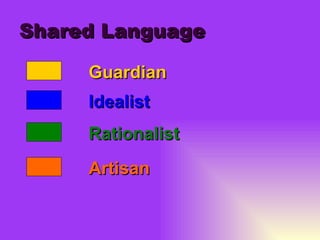
Shared Language Guardian Idealist Rationalist Artisan
Your Type as a Leader GUARDIAN Emphasis on structure, closure, and order; adherence to the chain of command What do you look like as a leader? Jennifer Lopez in  The Wedding Planner
Your Type as a Leader Idealists Persuasive and often inspirational, with behavior that emphasizes personal relationships, shared values and group harmony What do you look like as a leader? Woody in a  Toy Story
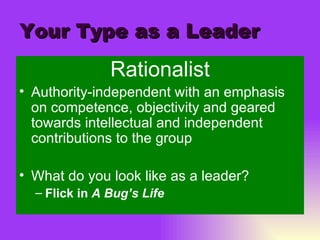
Your Type as a Leader Rationalist Authority-independent with an emphasis on competence, objectivity and geared towards intellectual and independent contributions to the group What do you look like as a leader? Flick in  A Bug’s Life
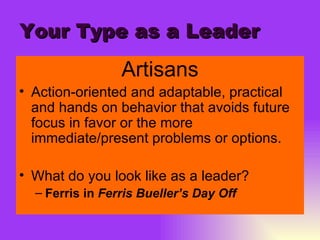
Your Type as a Leader Artisans Action-oriented and adaptable, practical and hands on behavior that avoids future focus in favor or the more immediate/present problems or options. What do you look like as a leader? Ferris in  Ferris Bueller’s Day Off
Some Questions Why did we do all that? How do you use what you have learned as a trip leader? How will you know the color/type of each of your participants? Why should you figure it out? What will you do with that knowledge?
Leading Groups Using Type To effectively lead a group, you need to understand each individual and flex your style to his/her type. To effectively lead a group, you also need to understand a group will develop its own, SUPER personality.
 
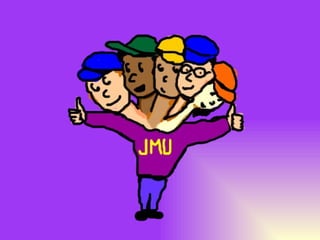
Group Personality Unless you have only 4 people and each one is one of the 4 colors…the group will have a dominant personality that people will bend to…their Group Color The group shown on the previous slide will start showing signs of being an Idealist after it interacts together for a period of time.
Watching for Types Remember, even understanding True Colors extremely well doesn’t make you the expert on another person’s personality…s/he will always be the expert.
Watching for Type Guardian Chain of command Structure Order Decisive Practical Leading Guardians Give clear answers, don’t be wishy-washy, timeliness, and consistency Rationalist Problem first, people second Logic Competency Wordsmiths/Debaters Leading Rationalists Give constructive criticism, allow freedom for ideas, give harder assignments
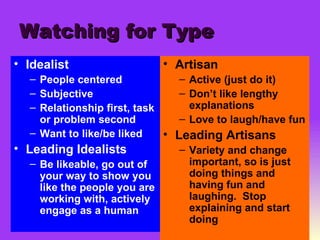
Watching for Type Idealist People centered Subjective Relationship first, task or problem second Want to like/be liked Leading Idealists Be likeable, go out of your way to show you like the people you are working with, actively engage as a human Artisan Active (just do it) Don’t like lengthy explanations Love to laugh/have fun Leading Artisans Variety and change important, so is just doing things and having fun and laughing.  Stop explaining and start doing
Group Personality/Development Groups have a personality Groups develop along those personality lines.
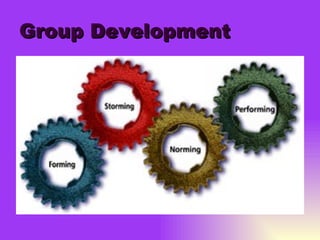
Group Development
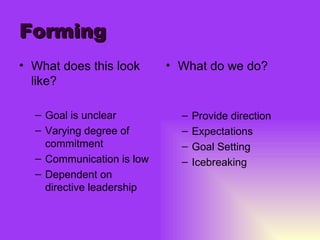
Forming What does this look like? Goal is unclear Varying degree of commitment Communication is low Dependent on directive leadership What do we do? Provide direction Expectations Goal Setting Icebreaking
Forming Guardians :  “What is expected?” Rationalists :  “Why are we doing this in this way?” Idealists :  “Who are you?  Who are you?  Who am I?” Artisans :   “When are we getting started?”
Storming What does this look like? Differences over roles and goals Counterproductive behaviors Uncertain about how to deal with issues Independence Communication issues erupt What do we do? Team build Involve group more in decisions Define and redefine expectations Coach members through struggles Seek commonality
Storming Guardians :  “Everybody needs to know their role and get this done in the predetermined, agreed-upon manner.” Rationalists :  “Everyone else is incompetent and I can’t be expected to work with these people.” Idealists :  “Why can’t we get along?” or “I do everything for everyone else and this is how I am repaid!” Artisans :   “EVERYONE SHUT UP and do something!”
Norming What does this look like? Group gains confidence Goals are clarified Interdependent relationships Group achieves goals more effectively What do we do? Provide open times for group to share ideas Work towards consensus Facilitate leadership opportunities for group members
Norming Guardians :  “Good now that the system is in place and everyone understands their role, we can get our tasks accomplished.” Rationalists :  “This is working for the time being and I believe this group can handle change if it comes up.” Idealists :  “I’m glad that we had that bit of misunderstanding because our sense of who we are is stronger and now we all know how to talk to each other.” Artisans :   “Did something happen there?”
Performing What does this look like? Group take responsibility for self and tasks Effective leadership from all members Group facilitates itself Group works to benefit the whole team What do we do? Still seek to improve relationships and work Celebrate successes Test for better methods and processes
Performing Guardians :  “We are a well-ordered and well-maintained SERVICE MACHINE!!!” Rationalists :  “It appears that our goal is clear, our method for achieving the goal is sound, and our communication and readiness for change are intact.” Idealists :  “I love you guys…WE DO GREAT WORK!!!” Artisans :   “What’s next?”
STORMING?!?!?? Storming is feared for many reasons: Guardians :  Disrupts the chain or flow of the organization Rationalists :  It is non-productive and doesn’t seem like a logical or rational use of group time. Idealists :  People could get their feelings hurt Artisans :   It’s a lot of talk…no action…generally no fun
STORMING?!?!?? How different leaders lead through it: Guardians :  Remind Guardians of their duty to the group.  They will respond to this by being a good “second in command.” Rationalists :  Ask the Rationalist for ideas on how to get through the conflict.  Also, explain the theory of development.  They may not believe it, but they’ll give it a chance. Idealists :  Explain to the Idealist that this will strengthen the bonds between people if they can get through it. Artisans :  Do team-builders or active initiatives to illustrate the process.
The Process Just as individuals develop over time, so do groups Your job is to help to move them through the process (including Storming)
Dual Relationships This is where a relationship exists beyond trip leader and _________  [insert participant, co-trip leader, etc.)
Dual Relationships What to do? TALK!!! Don’t assume it will be bad, good, or not a factor at all – because it will be one of the above. Set expectations! What is each person’s role as defined by their ASB position How will we act in front of others on this trip? When can we act as our secondary relationship? What will we do if our secondary relationship shows or things get ugly?
Dual Relationships The key is: TALK to each other and set clear expectations for how you will act!
Questions?

Group Dynamics and Team Development

  • 1.
    Group Dynamics …or managing a multi-headed entity…
  • 2.
    Shared Language GuardianIdealist Rationalist Artisan
  • 3.
    Your Type asa Leader GUARDIAN Emphasis on structure, closure, and order; adherence to the chain of command What do you look like as a leader? Jennifer Lopez in The Wedding Planner
  • 4.
    Your Type asa Leader Idealists Persuasive and often inspirational, with behavior that emphasizes personal relationships, shared values and group harmony What do you look like as a leader? Woody in a Toy Story
  • 5.
    Your Type asa Leader Rationalist Authority-independent with an emphasis on competence, objectivity and geared towards intellectual and independent contributions to the group What do you look like as a leader? Flick in A Bug’s Life
  • 6.
    Your Type asa Leader Artisans Action-oriented and adaptable, practical and hands on behavior that avoids future focus in favor or the more immediate/present problems or options. What do you look like as a leader? Ferris in Ferris Bueller’s Day Off
  • 7.
    Some Questions Whydid we do all that? How do you use what you have learned as a trip leader? How will you know the color/type of each of your participants? Why should you figure it out? What will you do with that knowledge?
  • 8.
    Leading Groups UsingType To effectively lead a group, you need to understand each individual and flex your style to his/her type. To effectively lead a group, you also need to understand a group will develop its own, SUPER personality.
  • 9.
  • 10.
    Group Personality Unlessyou have only 4 people and each one is one of the 4 colors…the group will have a dominant personality that people will bend to…their Group Color The group shown on the previous slide will start showing signs of being an Idealist after it interacts together for a period of time.
  • 11.
    Watching for TypesRemember, even understanding True Colors extremely well doesn’t make you the expert on another person’s personality…s/he will always be the expert.
  • 12.
    Watching for TypeGuardian Chain of command Structure Order Decisive Practical Leading Guardians Give clear answers, don’t be wishy-washy, timeliness, and consistency Rationalist Problem first, people second Logic Competency Wordsmiths/Debaters Leading Rationalists Give constructive criticism, allow freedom for ideas, give harder assignments
  • 13.
    Watching for TypeIdealist People centered Subjective Relationship first, task or problem second Want to like/be liked Leading Idealists Be likeable, go out of your way to show you like the people you are working with, actively engage as a human Artisan Active (just do it) Don’t like lengthy explanations Love to laugh/have fun Leading Artisans Variety and change important, so is just doing things and having fun and laughing. Stop explaining and start doing
  • 14.
    Group Personality/Development Groupshave a personality Groups develop along those personality lines.
  • 15.
  • 16.
    Forming What doesthis look like? Goal is unclear Varying degree of commitment Communication is low Dependent on directive leadership What do we do? Provide direction Expectations Goal Setting Icebreaking
  • 17.
    Forming Guardians : “What is expected?” Rationalists : “Why are we doing this in this way?” Idealists : “Who are you? Who are you? Who am I?” Artisans : “When are we getting started?”
  • 18.
    Storming What doesthis look like? Differences over roles and goals Counterproductive behaviors Uncertain about how to deal with issues Independence Communication issues erupt What do we do? Team build Involve group more in decisions Define and redefine expectations Coach members through struggles Seek commonality
  • 19.
    Storming Guardians : “Everybody needs to know their role and get this done in the predetermined, agreed-upon manner.” Rationalists : “Everyone else is incompetent and I can’t be expected to work with these people.” Idealists : “Why can’t we get along?” or “I do everything for everyone else and this is how I am repaid!” Artisans : “EVERYONE SHUT UP and do something!”
  • 20.
    Norming What doesthis look like? Group gains confidence Goals are clarified Interdependent relationships Group achieves goals more effectively What do we do? Provide open times for group to share ideas Work towards consensus Facilitate leadership opportunities for group members
  • 21.
    Norming Guardians : “Good now that the system is in place and everyone understands their role, we can get our tasks accomplished.” Rationalists : “This is working for the time being and I believe this group can handle change if it comes up.” Idealists : “I’m glad that we had that bit of misunderstanding because our sense of who we are is stronger and now we all know how to talk to each other.” Artisans : “Did something happen there?”
  • 22.
    Performing What doesthis look like? Group take responsibility for self and tasks Effective leadership from all members Group facilitates itself Group works to benefit the whole team What do we do? Still seek to improve relationships and work Celebrate successes Test for better methods and processes
  • 23.
    Performing Guardians : “We are a well-ordered and well-maintained SERVICE MACHINE!!!” Rationalists : “It appears that our goal is clear, our method for achieving the goal is sound, and our communication and readiness for change are intact.” Idealists : “I love you guys…WE DO GREAT WORK!!!” Artisans : “What’s next?”
  • 24.
    STORMING?!?!?? Storming isfeared for many reasons: Guardians : Disrupts the chain or flow of the organization Rationalists : It is non-productive and doesn’t seem like a logical or rational use of group time. Idealists : People could get their feelings hurt Artisans : It’s a lot of talk…no action…generally no fun
  • 25.
    STORMING?!?!?? How differentleaders lead through it: Guardians : Remind Guardians of their duty to the group. They will respond to this by being a good “second in command.” Rationalists : Ask the Rationalist for ideas on how to get through the conflict. Also, explain the theory of development. They may not believe it, but they’ll give it a chance. Idealists : Explain to the Idealist that this will strengthen the bonds between people if they can get through it. Artisans : Do team-builders or active initiatives to illustrate the process.
  • 26.
    The Process Justas individuals develop over time, so do groups Your job is to help to move them through the process (including Storming)
  • 27.
    Dual Relationships Thisis where a relationship exists beyond trip leader and _________ [insert participant, co-trip leader, etc.)
  • 28.
    Dual Relationships Whatto do? TALK!!! Don’t assume it will be bad, good, or not a factor at all – because it will be one of the above. Set expectations! What is each person’s role as defined by their ASB position How will we act in front of others on this trip? When can we act as our secondary relationship? What will we do if our secondary relationship shows or things get ugly?
  • 29.
    Dual Relationships Thekey is: TALK to each other and set clear expectations for how you will act!
  • 30.