Big Data Use in Retail 
Supply Chains 
Drs. Mark Barratt, Anníbal Sodero 
and Yao Jin
Acknowledgements 
• The researchers are grateful for the financial and collaborative support 
of CSCMP for this research project. 
• We appreciate the opportunity to partner with CSCMP and the CSCMP 
Research Strategies Committee on this research endeavor. 
• Additionally, we appreciate the support of the Supply Chain Alumni 
Group at Miami University and the Supply Chain Management Research 
Center at the University of Arkansas in helping us collect the research 
data. 
• Finally, we offer our sincere thanks to the individuals and firms that 
participated in the research process, who were promised anonymity in 
exchange for their participation.
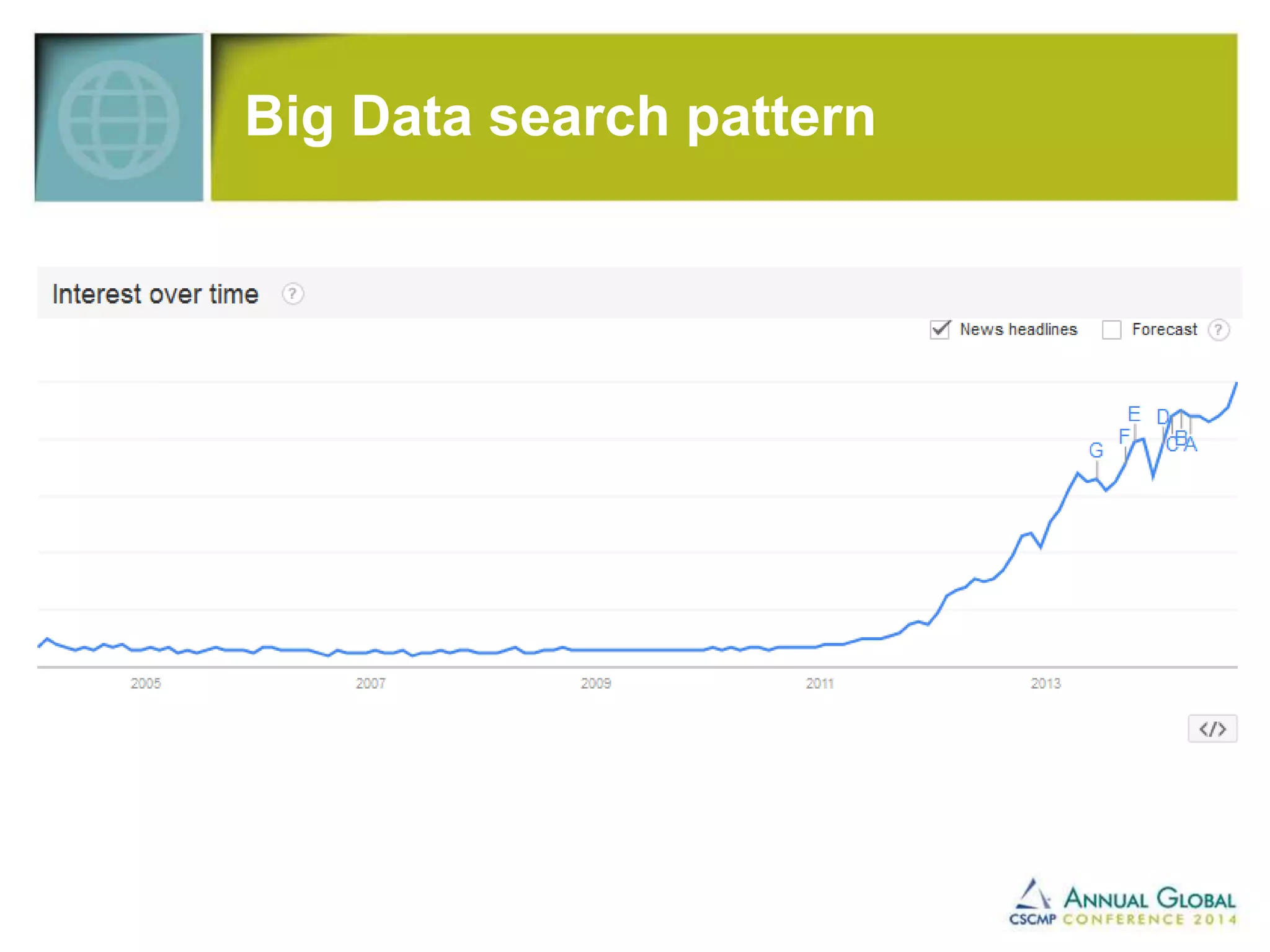
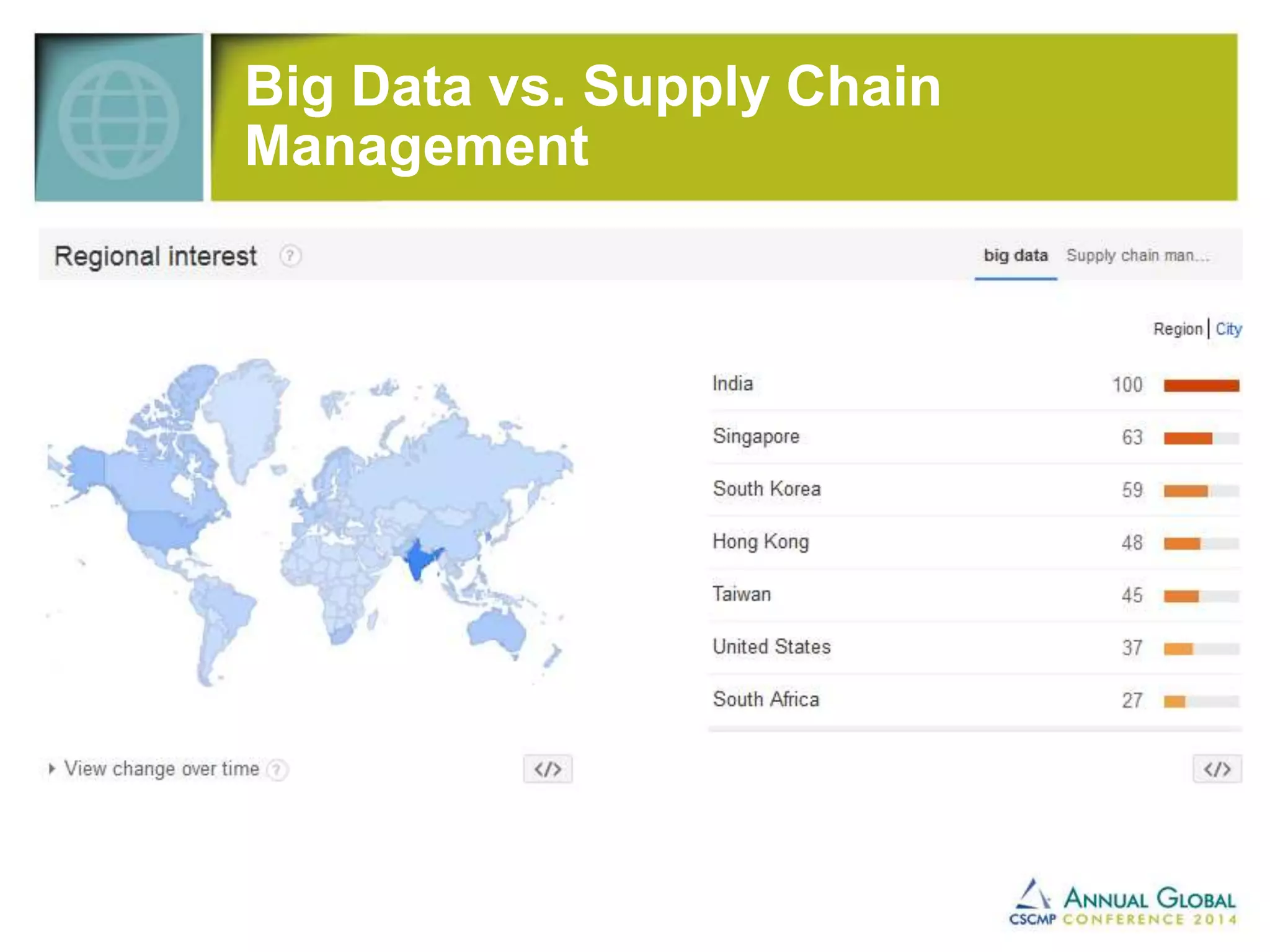
Big Data search pattern
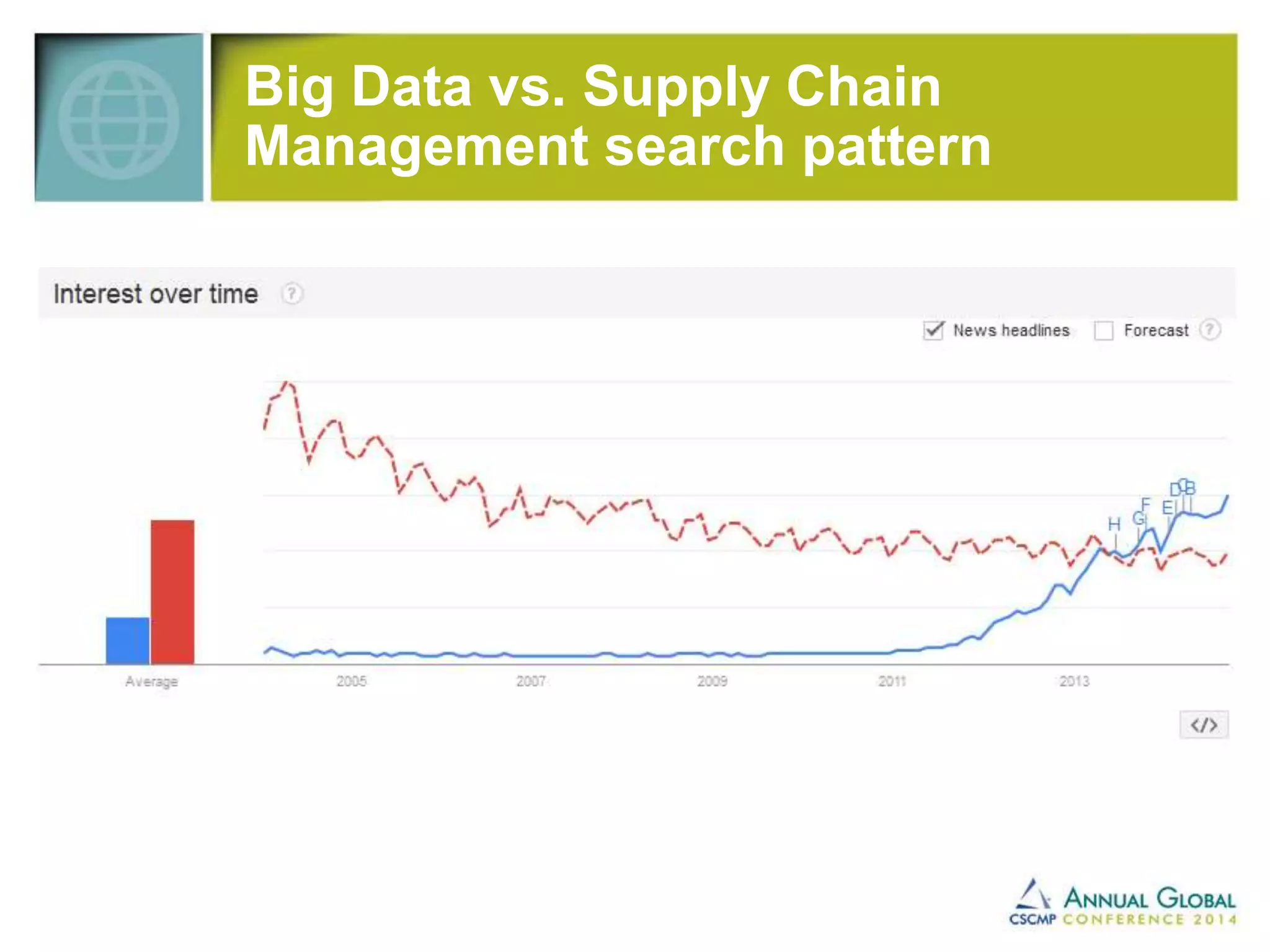
Big Data vs. Supply Chain 
Management search pattern
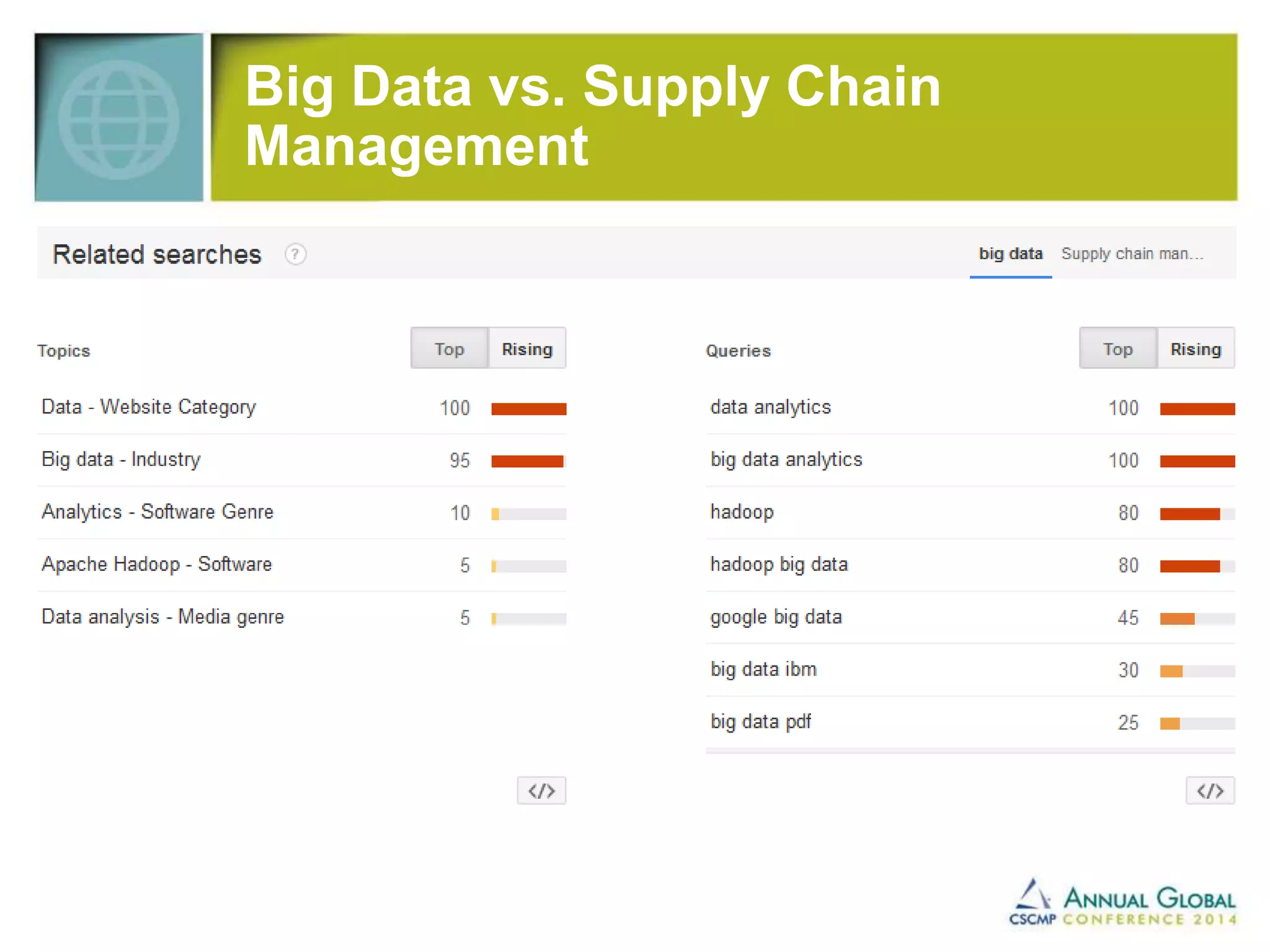
Big Data vs. Supply Chain 
Management
Big Data vs. Supply Chain 
Management
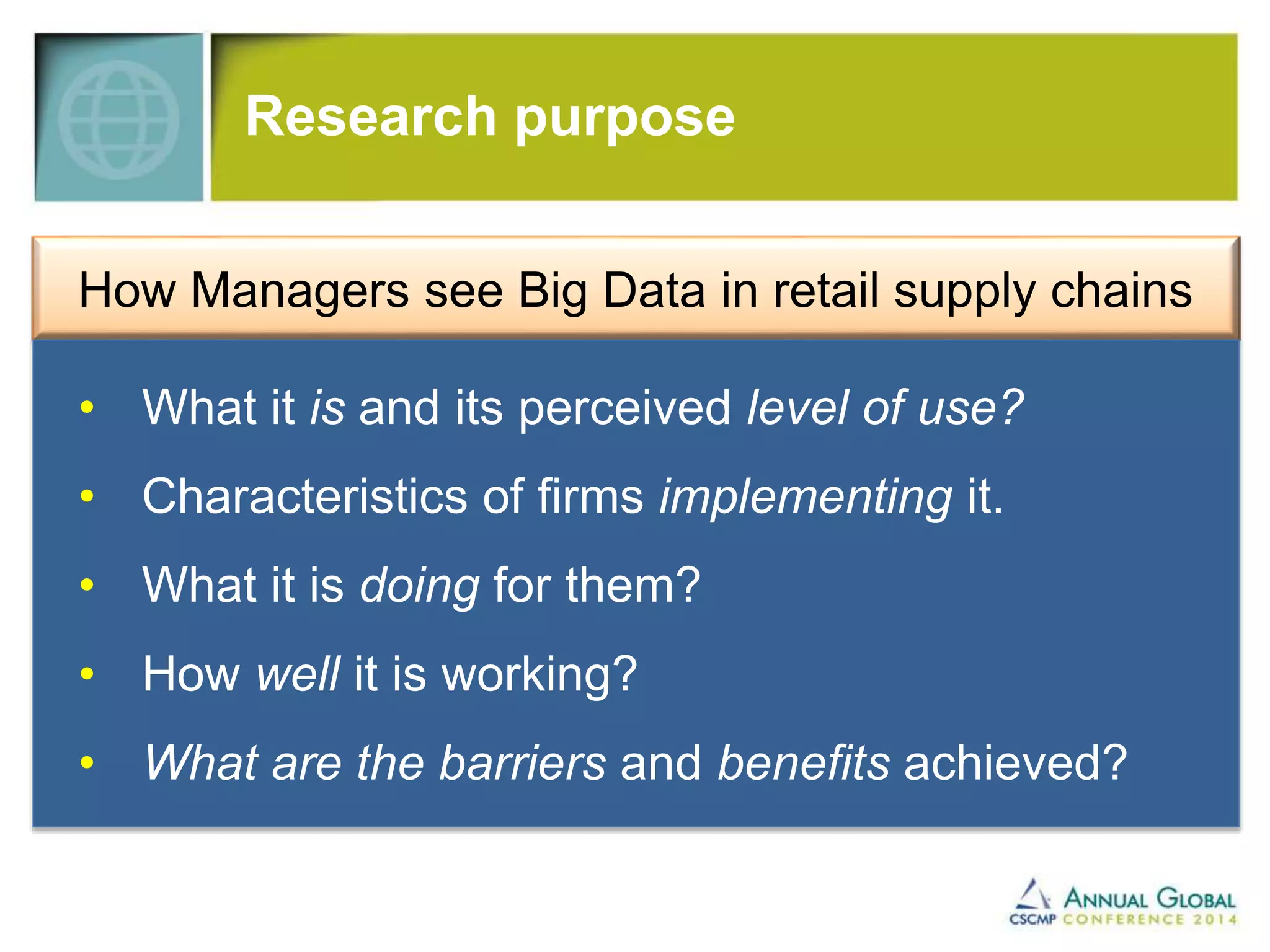
Research purpose 
How Managers see Big Data in retail supply chains 
• What it is and its perceived level of use? 
• Characteristics of firms implementing it. 
• What it is doing for them? 
• How well it is working? 
• What are the barriers and benefits achieved?
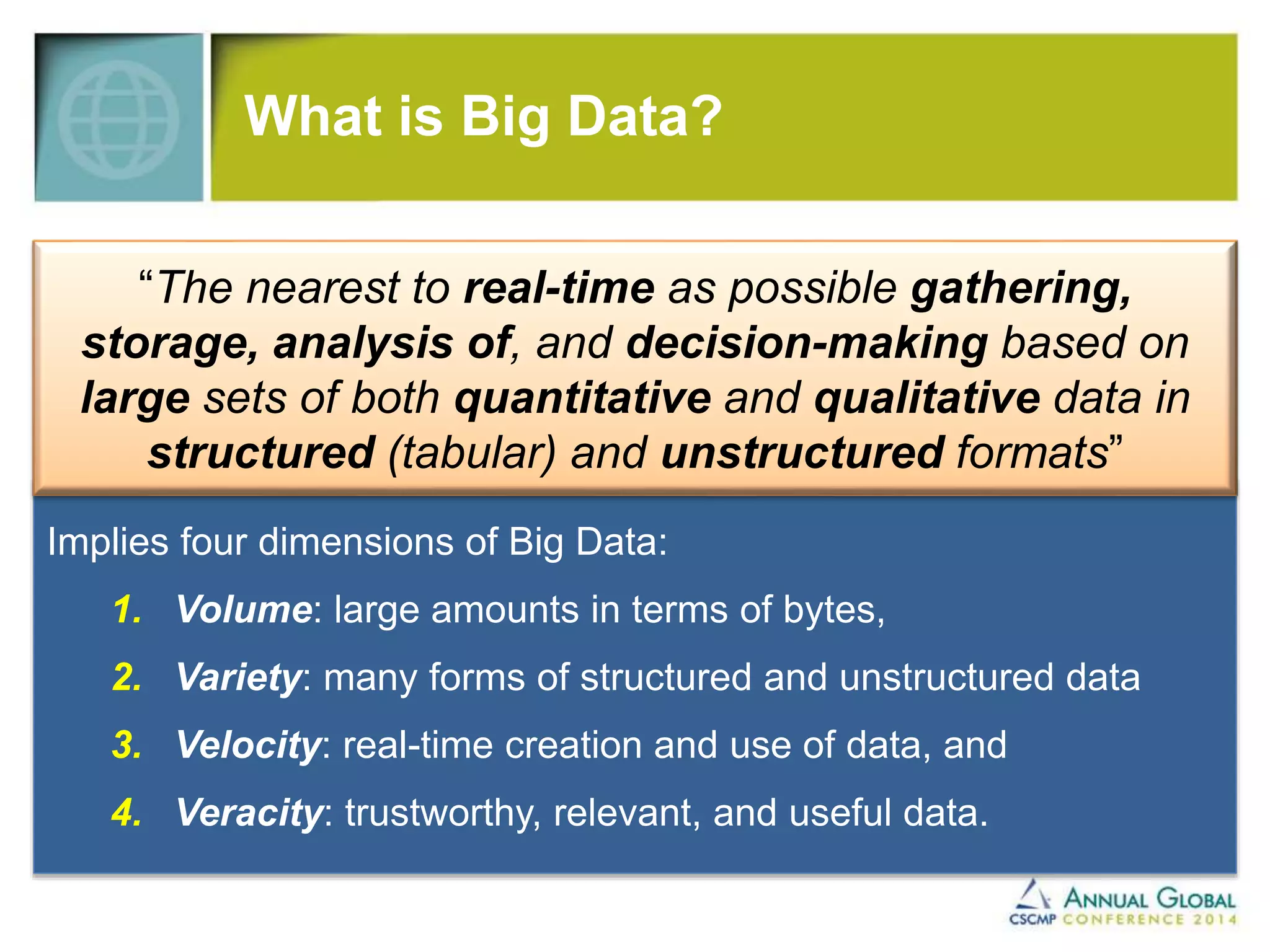
What is Big Data? 
“The nearest to real-time as possible gathering, 
storage, analysis of, and decision-making based on 
large sets of both quantitative and qualitative data in 
structured (tabular) and unstructured formats” 
Implies four dimensions of Big Data: 
1. Volume: large amounts in terms of bytes, 
2. Variety: many forms of structured and unstructured data 
3. Velocity: real-time creation and use of data, and 
4. Veracity: trustworthy, relevant, and useful data.
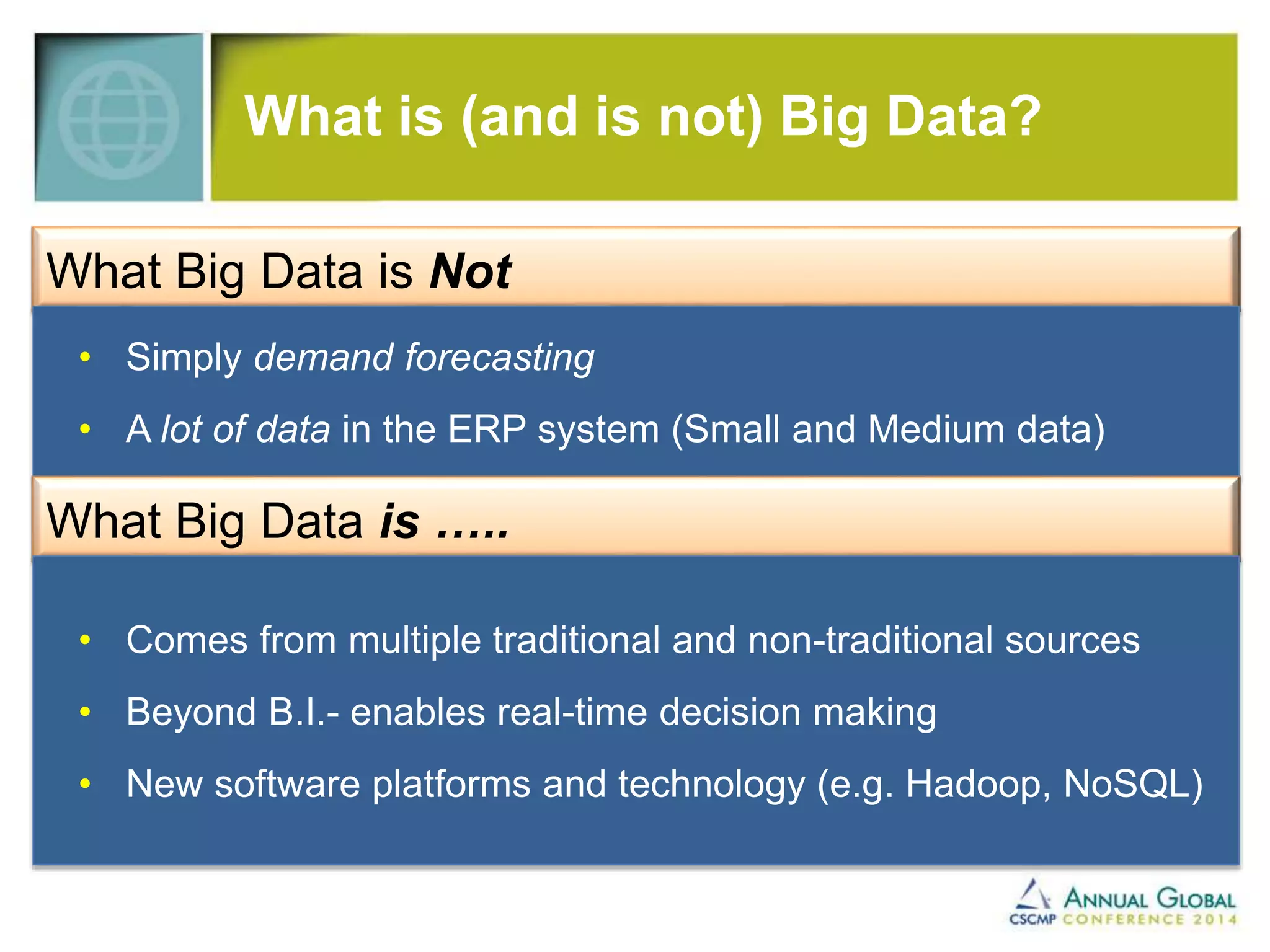
What is (and is not) Big Data? 
What Big Data is Not 
• Simply demand forecasting 
• A lot of data in the ERP system (Small and Medium data) 
What Big Data is ….. 
• Comes from multiple traditional and non-traditional sources 
• Beyond B.I.- enables real-time decision making 
• New software platforms and technology (e.g. Hadoop, NoSQL)
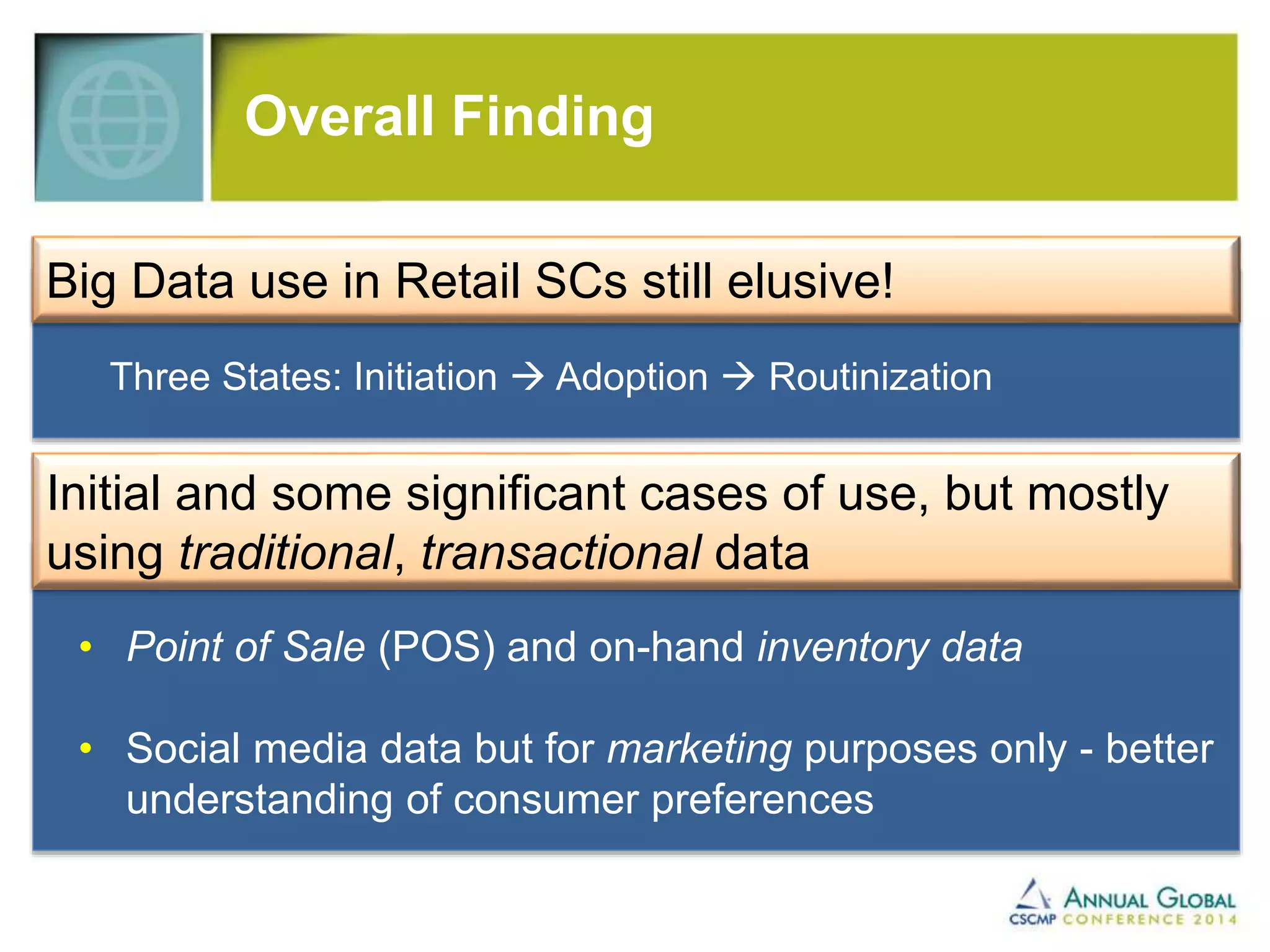
Overall Finding 
Big Data use in Retail SCs still elusive! 
Three States: Initiation  Adoption  Routinization 
Initial and some significant cases of use, but mostly 
using traditional, transactional data 
• Point of Sale (POS) and on-hand inventory data 
• Social media data but for marketing purposes only - better 
understanding of consumer preferences
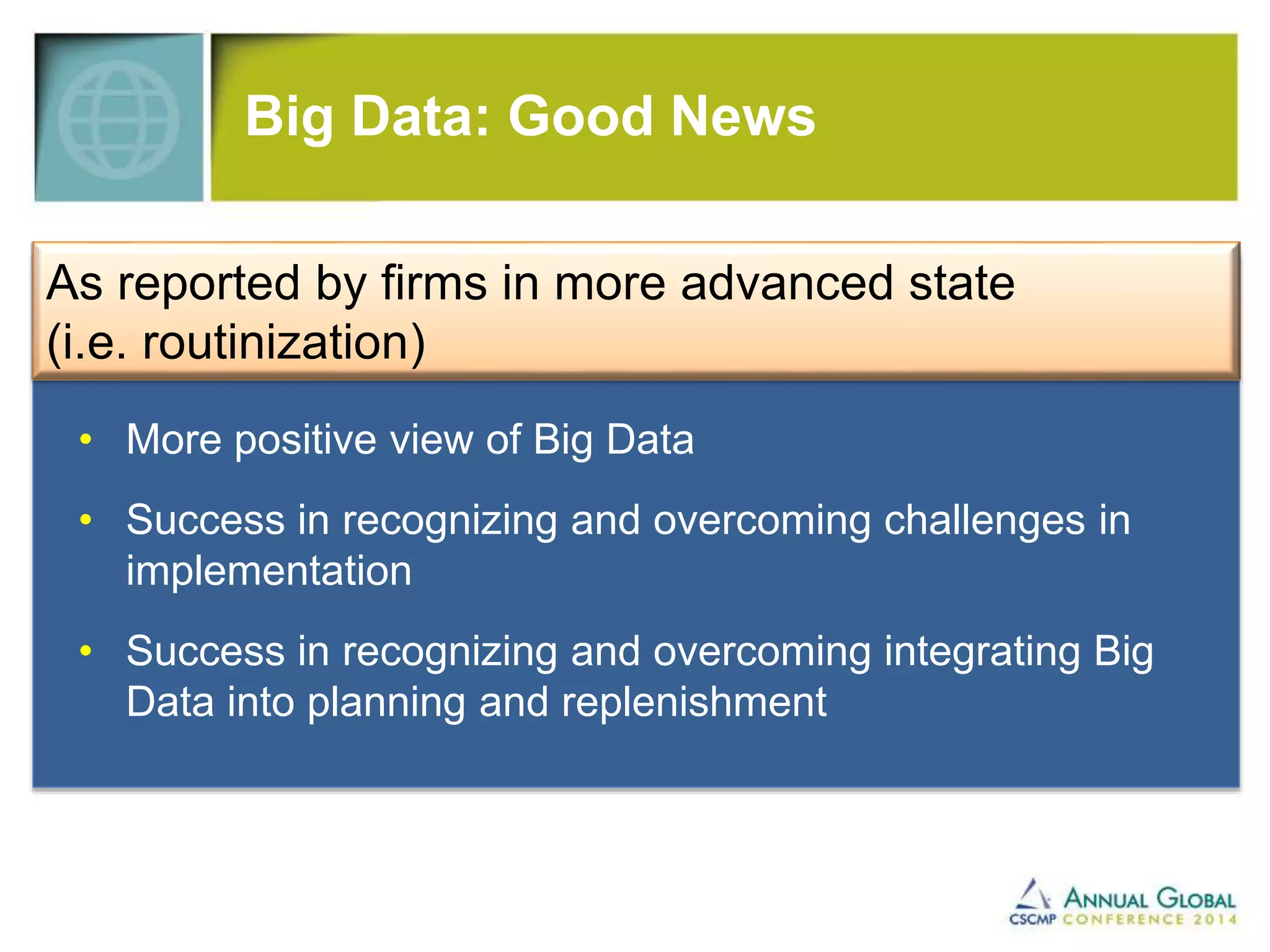
Big Data: Good News 
As reported by firms in more advanced state 
(i.e. routinization) 
• More positive view of Big Data 
• Success in recognizing and overcoming challenges in 
implementation 
• Success in recognizing and overcoming integrating Big 
Data into planning and replenishment
Research Overview
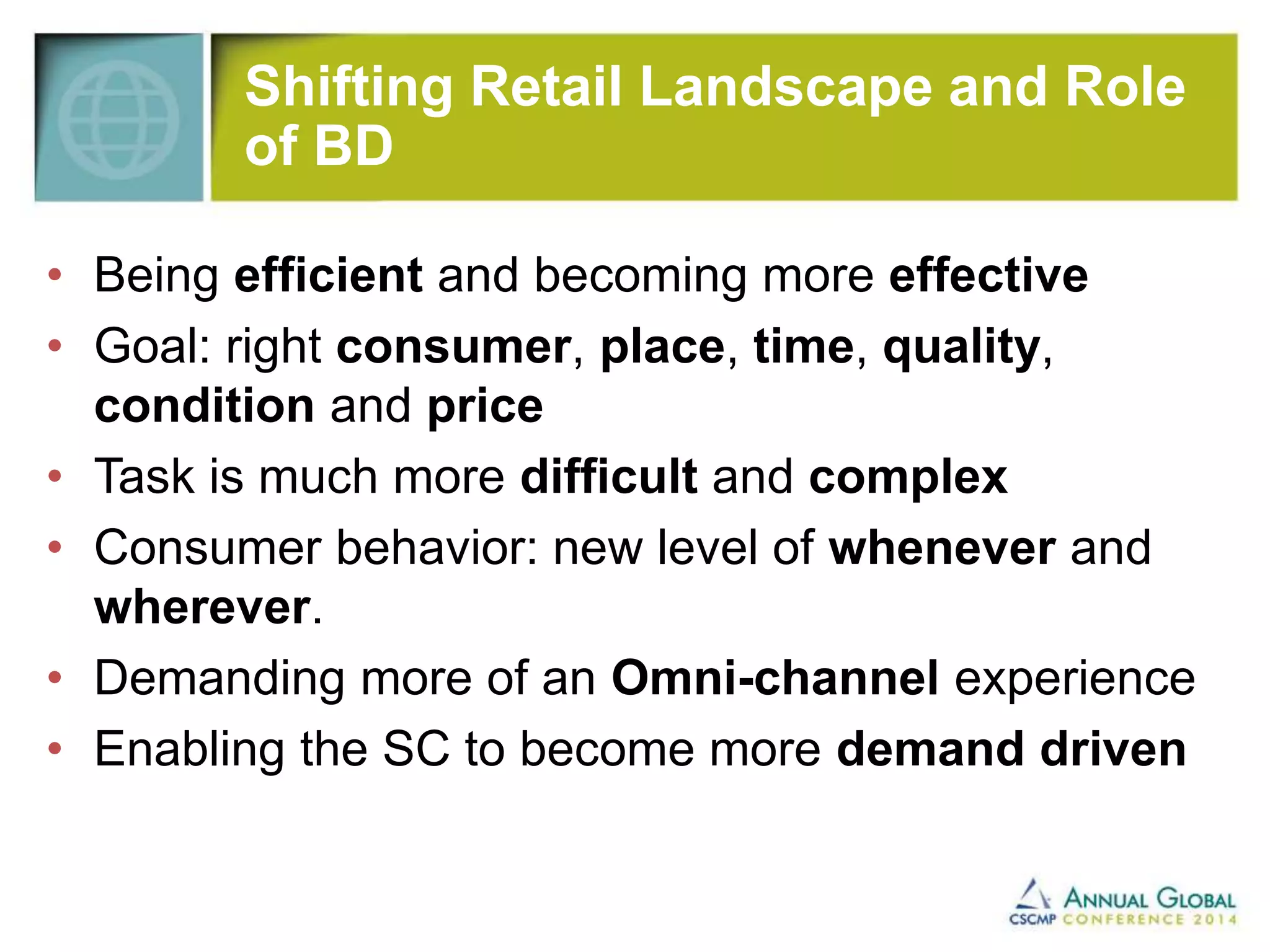
Shifting Retail Landscape and Role 
of BD 
• Being efficient and becoming more effective 
• Goal: right consumer, place, time, quality, 
condition and price 
• Task is much more difficult and complex 
• Consumer behavior: new level of whenever and 
wherever. 
• Demanding more of an Omni-channel experience 
• Enabling the SC to become more demand driven
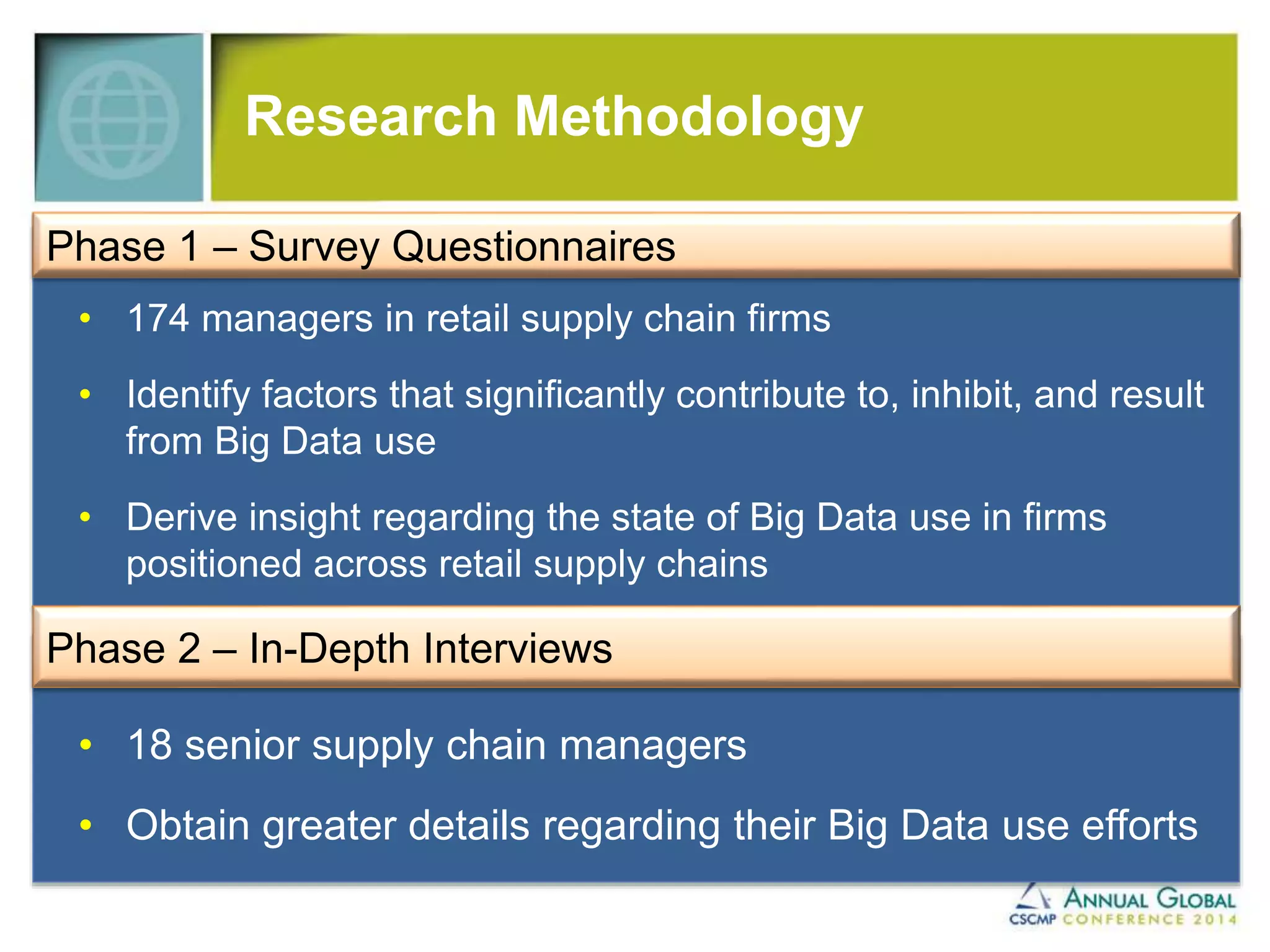
Research Methodology 
Phase 1 – Survey Questionnaires 
• 174 managers in retail supply chain firms 
• Identify factors that significantly contribute to, inhibit, and result 
from Big Data use 
• Derive insight regarding the state of Big Data use in firms 
positioned across retail supply chains 
Phase 2 – In-Depth Interviews 
• 18 senior supply chain managers 
• Obtain greater details regarding their Big Data use efforts
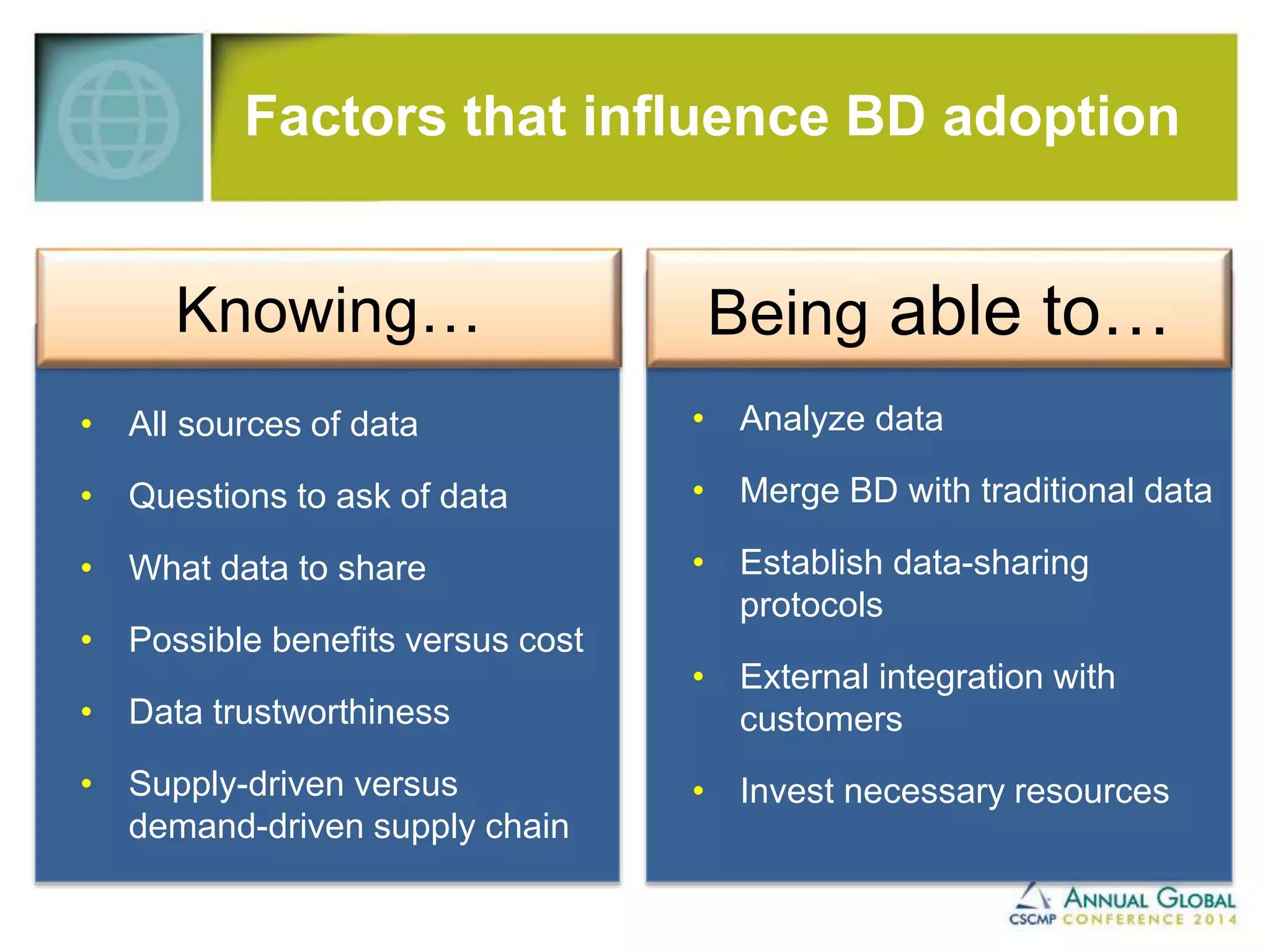
Factors that influence BD adoption 
Knowing… Being able to… 
• Analyze data 
• Merge BD with traditional data 
• Establish data-sharing 
protocols 
• External integration with 
customers 
• Invest necessary resources 
• All sources of data 
• Questions to ask of data 
• What data to share 
• Possible benefits versus cost 
• Data trustworthiness 
• Supply-driven versus 
demand-driven supply chain
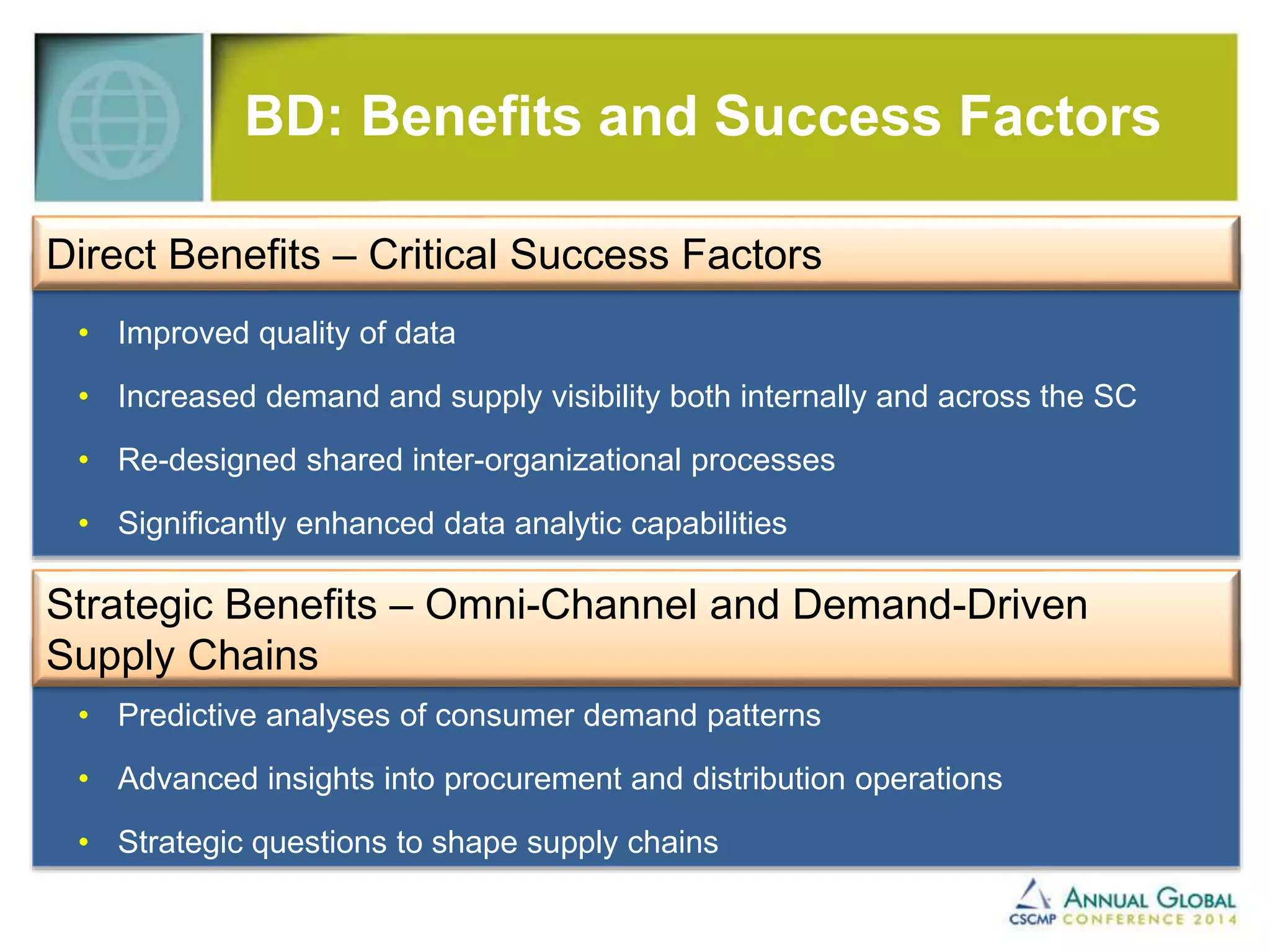
BD: Benefits and Success Factors 
Direct Benefits – Critical Success Factors 
• Improved quality of data 
• Increased demand and supply visibility both internally and across the SC 
• Re-designed shared inter-organizational processes 
• Significantly enhanced data analytic capabilities 
Strategic Benefits – Omni-Channel and Demand-Driven 
Supply Chains 
• Predictive analyses of consumer demand patterns 
• Advanced insights into procurement and distribution operations 
• Strategic questions to shape supply chains
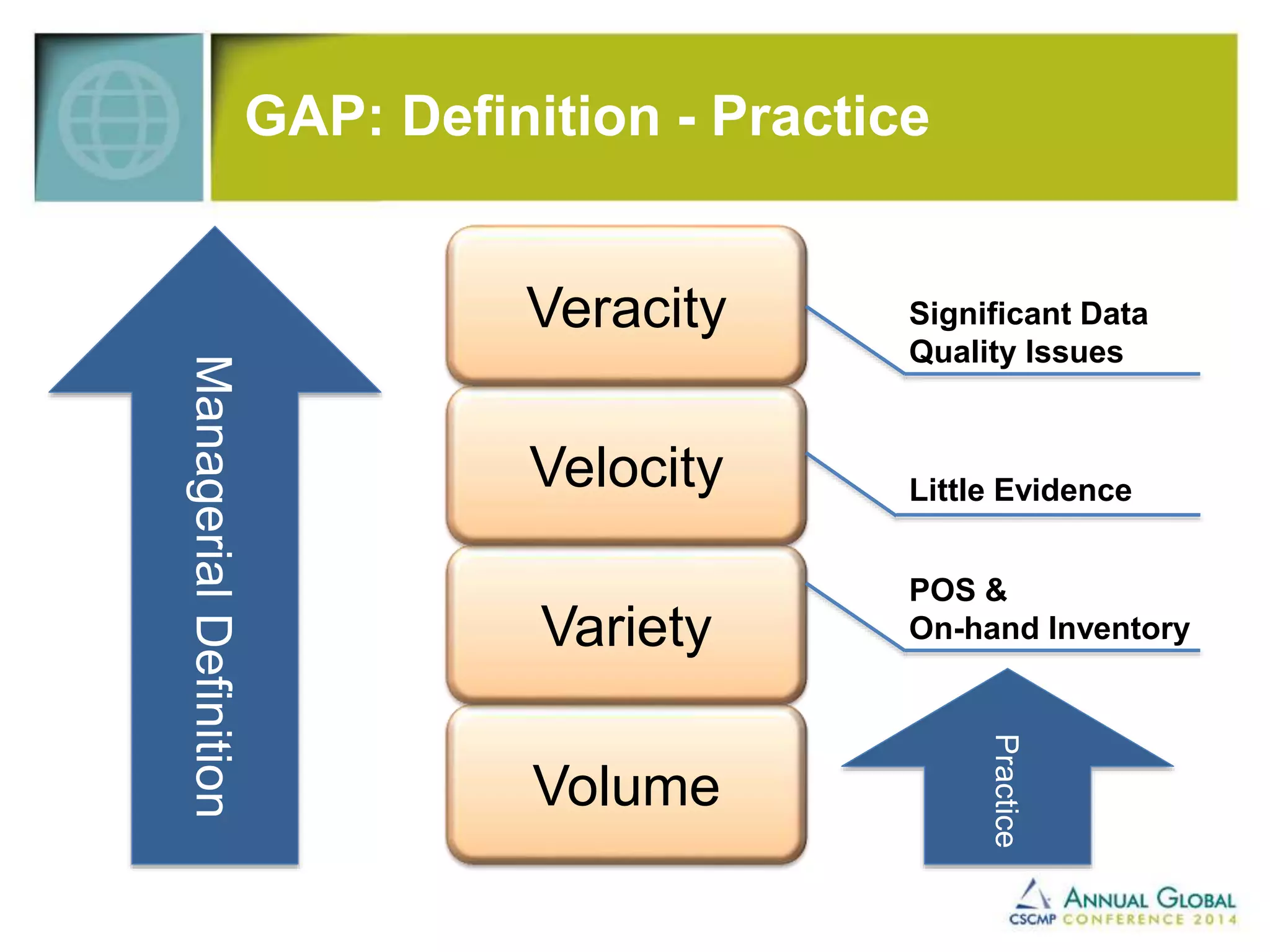
GAP: Definition - Practice 
Veracity 
Velocity 
Variety 
Volume 
Managerial Definition 
Significant Data 
Quality Issues 
Little Evidence 
POS & 
On-hand Inventory 
Practice
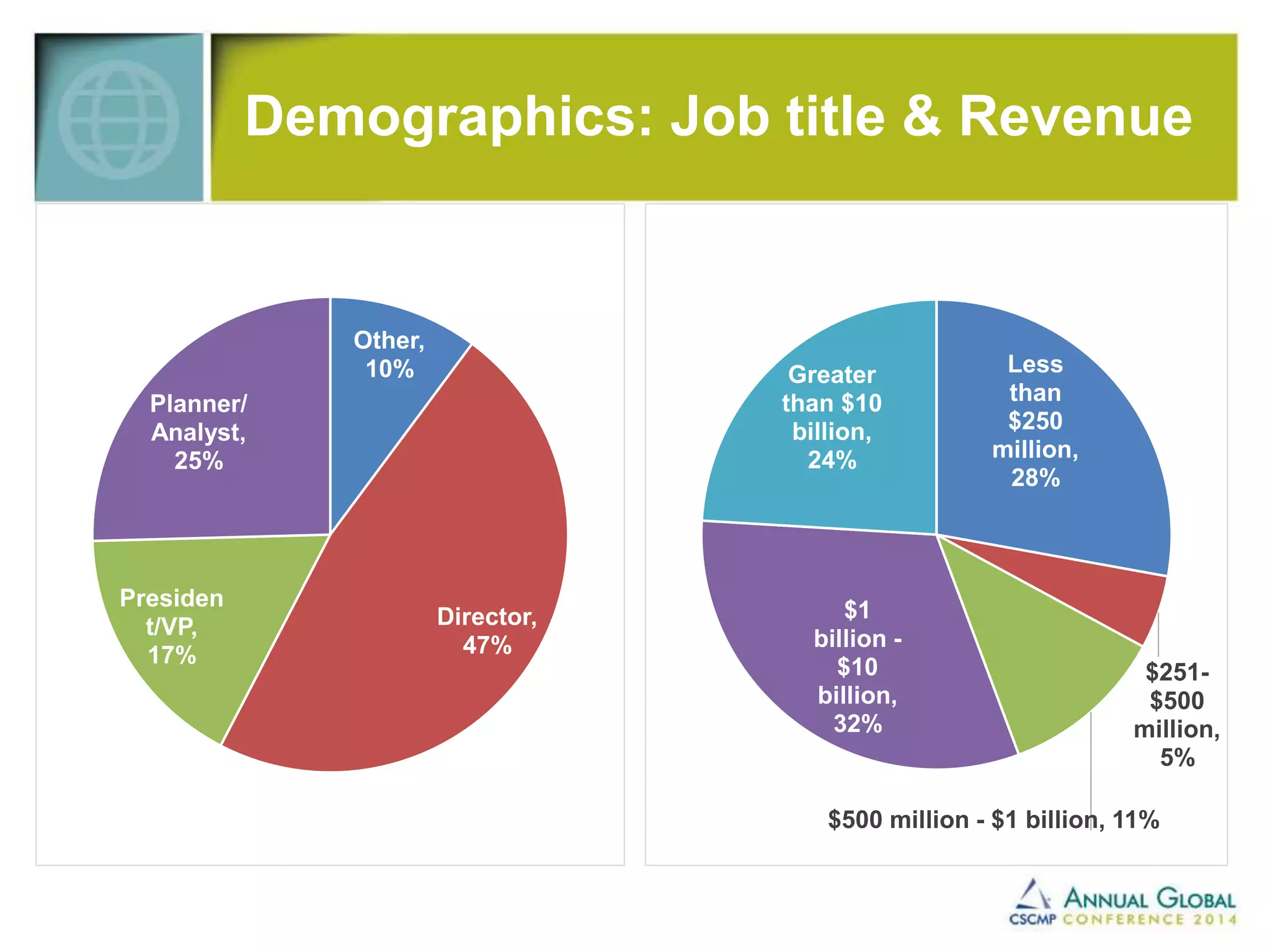
Demographics: Job title & Revenue 
Other, 
10% 
Director, 
47% 
Planner/ 
Analyst, 
25% 
Presiden 
t/VP, 
17% 
Less 
than 
$250 
million, 
28% 
$251- 
$500 
million, 
5% 
Greater 
than $10 
billion, 
24% 
$1 
billion - 
$10 
billion, 
32% 
$500 million - $1 billion, 11%
Acceptance and Purpose
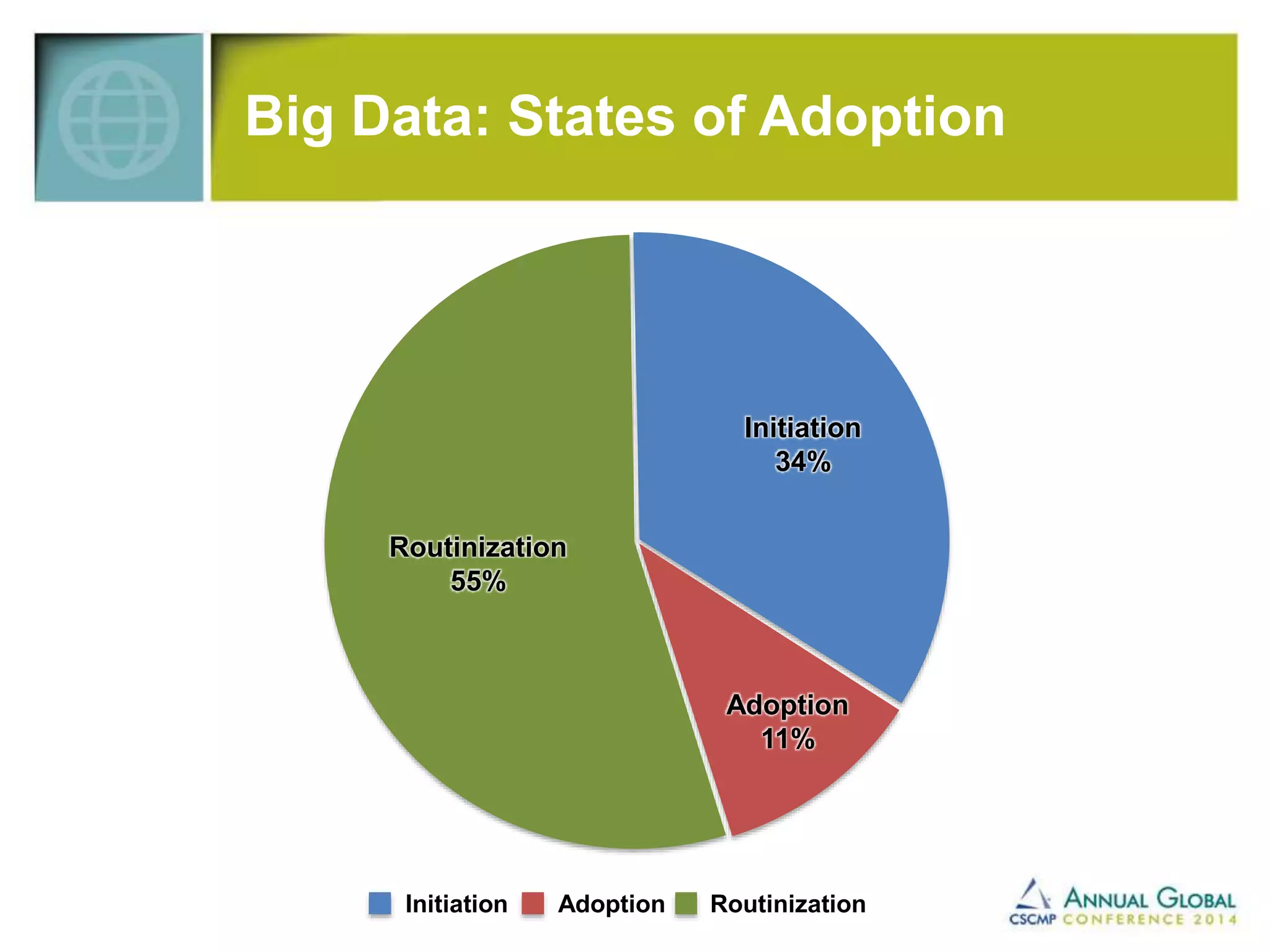
Big Data: States of Adoption 
Initiation 
34% 
Adoption 
11% 
Routinization 
55% 
Initiation Adoption Routinization
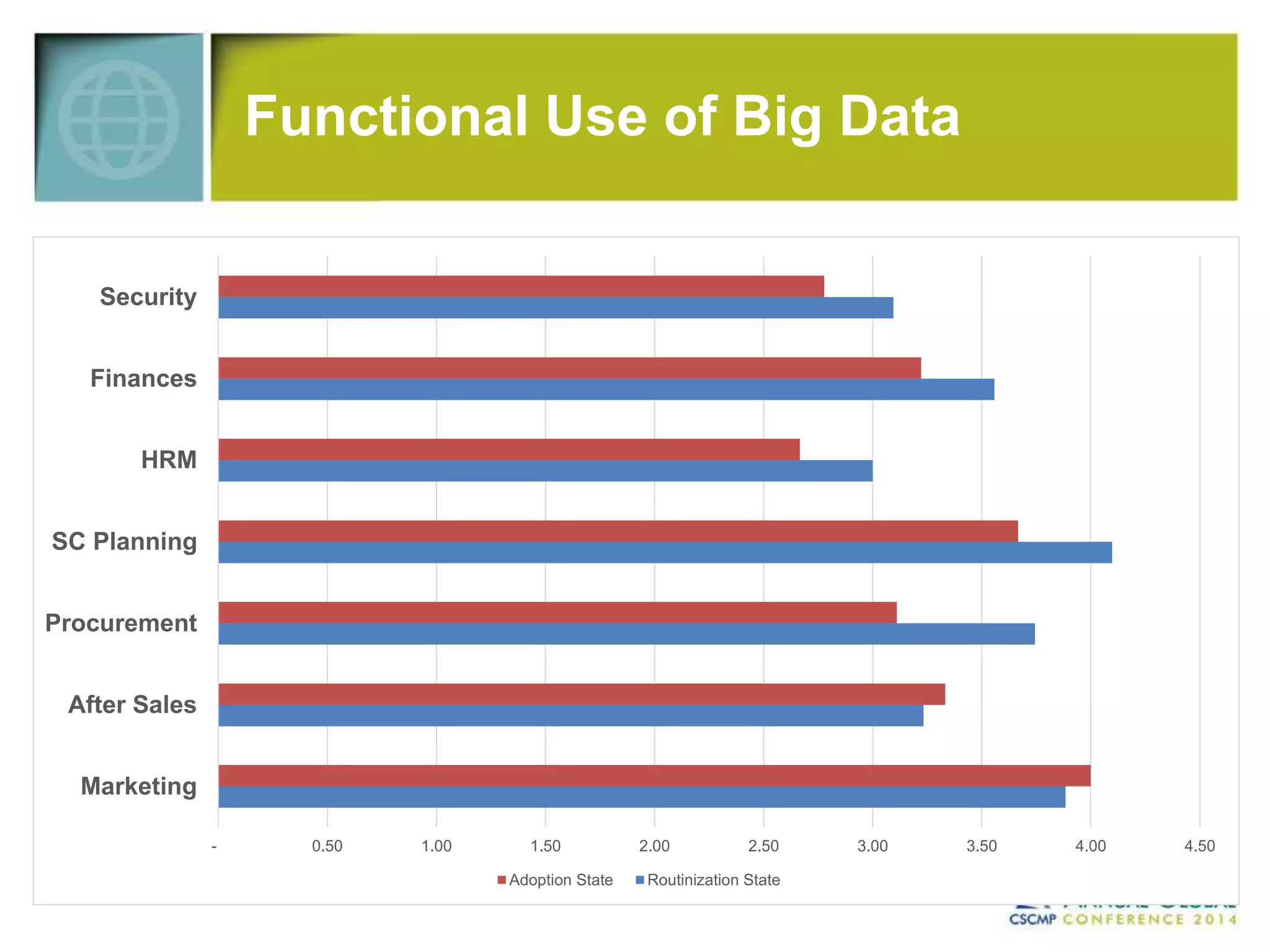
Functional Use of Big Data 
- 0.50 1.00 1.50 2.00 2.50 3.00 3.50 4.00 4.50 
Security 
Finances 
HRM 
SC Planning 
Procurement 
After Sales 
Marketing 
Adoption State Routinization State
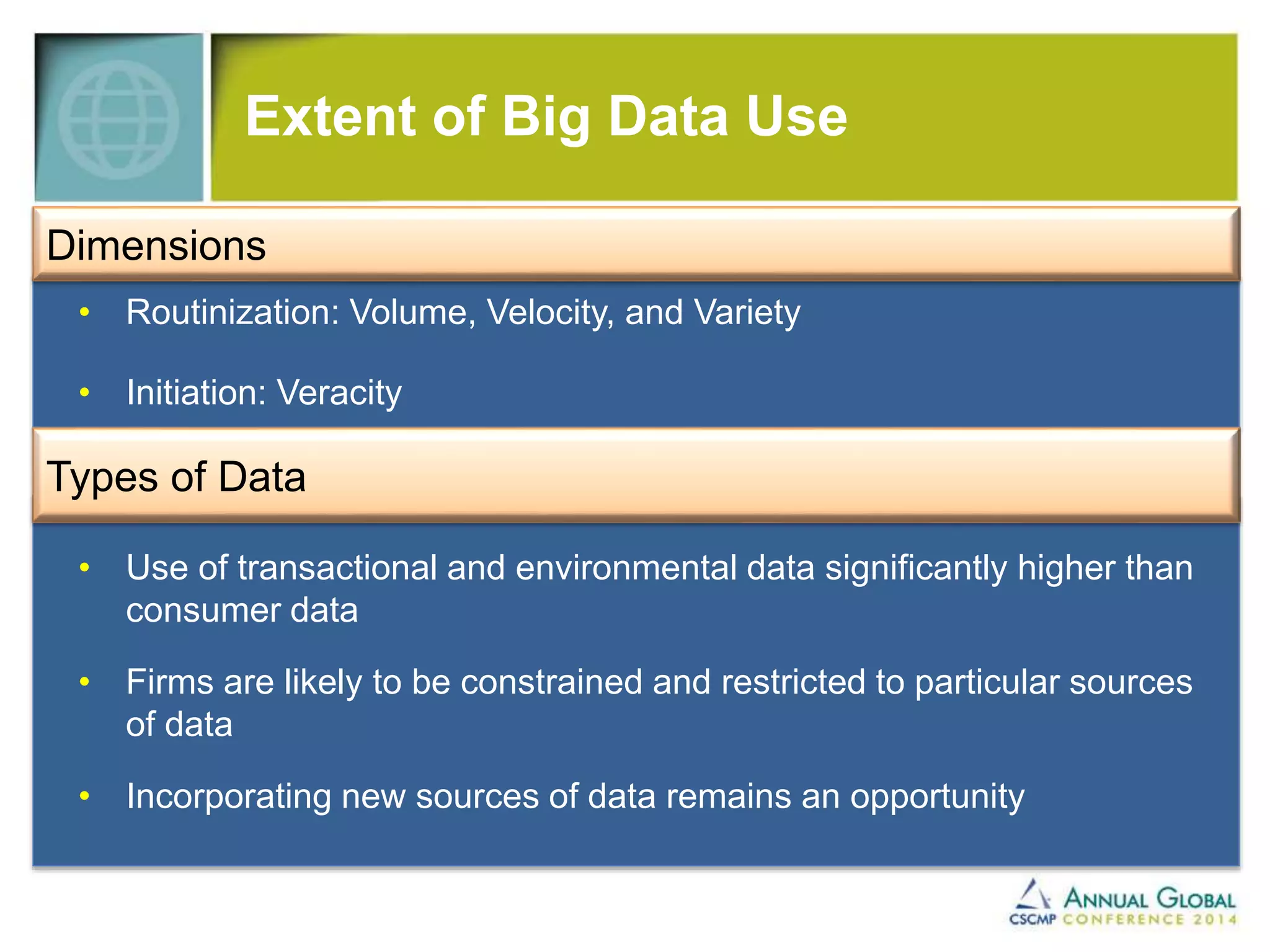
Extent of Big Data Use 
Dimensions 
• Routinization: Volume, Velocity, and Variety 
• Initiation: Veracity 
Types of Data 
• Use of transactional and environmental data significantly higher than 
consumer data 
• Firms are likely to be constrained and restricted to particular sources 
of data 
• Incorporating new sources of data remains an opportunity
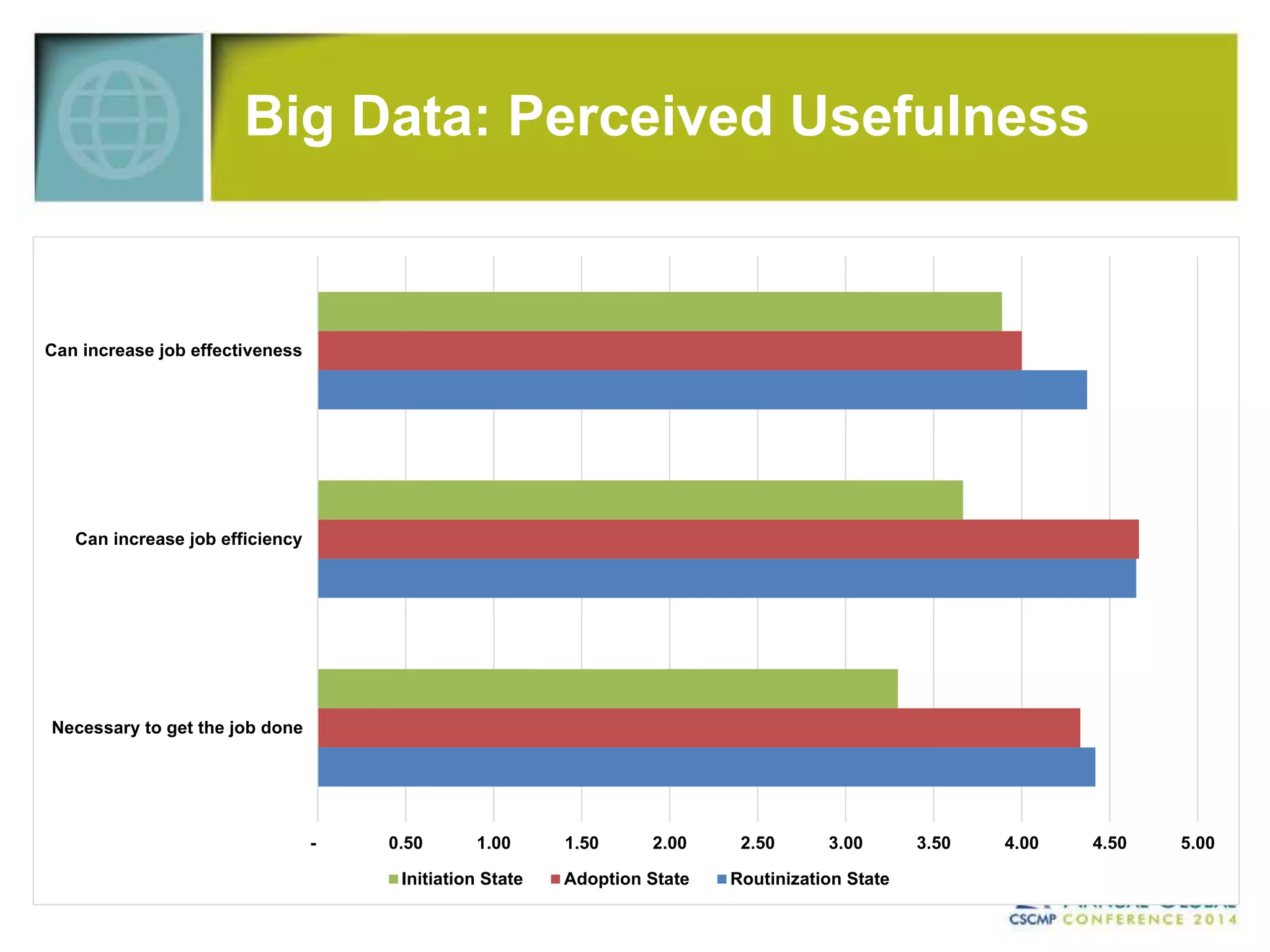
Big Data: Perceived Usefulness 
- 0.50 1.00 1.50 2.00 2.50 3.00 3.50 4.00 4.50 5.00 
Can increase job effectiveness 
Can increase job efficiency 
Necessary to get the job done 
Initiation State Adoption State Routinization State
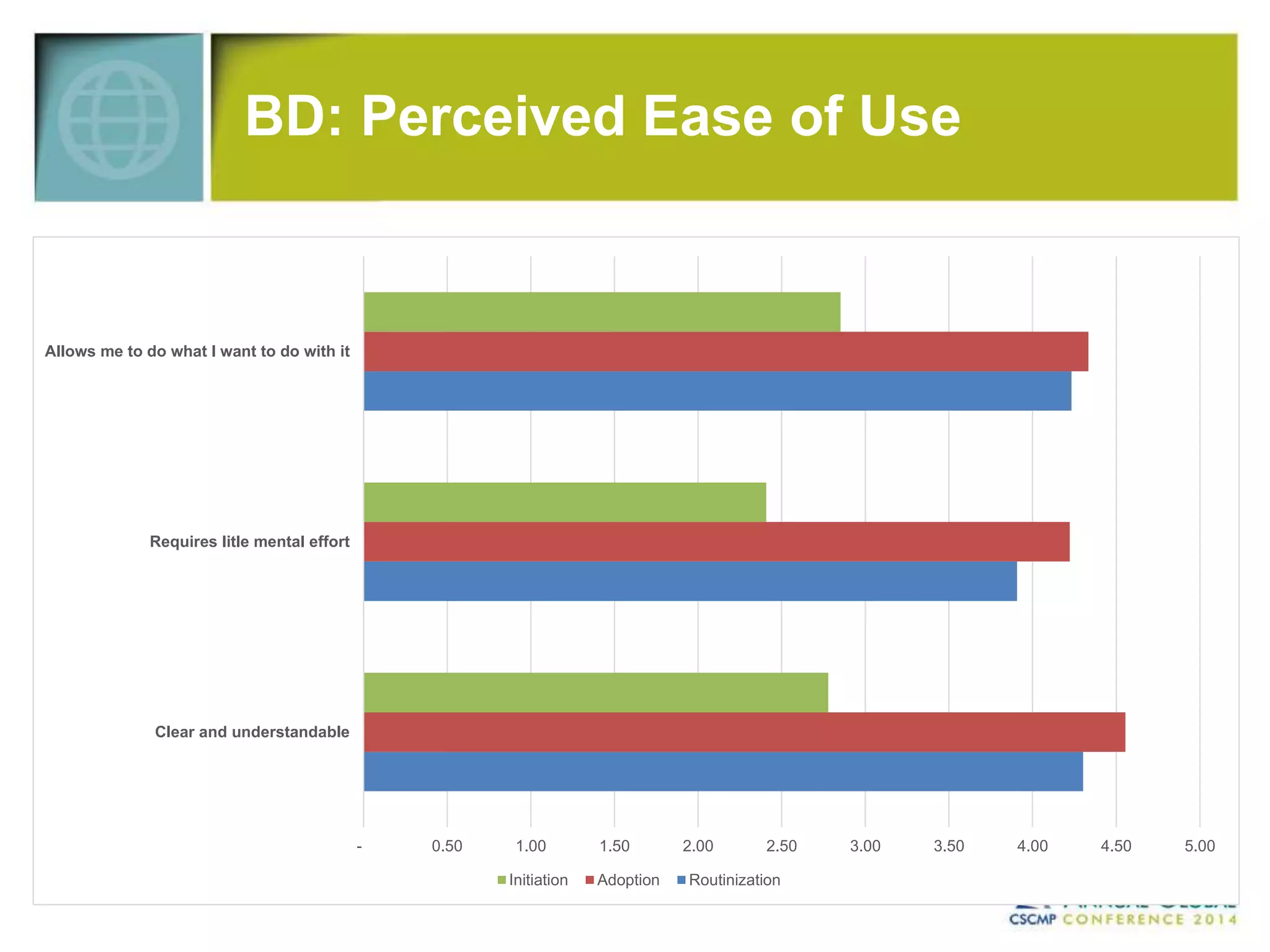
BD: Perceived Ease of Use 
- 0.50 1.00 1.50 2.00 2.50 3.00 3.50 4.00 4.50 5.00 
Allows me to do what I want to do with it 
Requires litle mental effort 
Clear and understandable 
Initiation Adoption Routinization
Organizational 
Capabilities
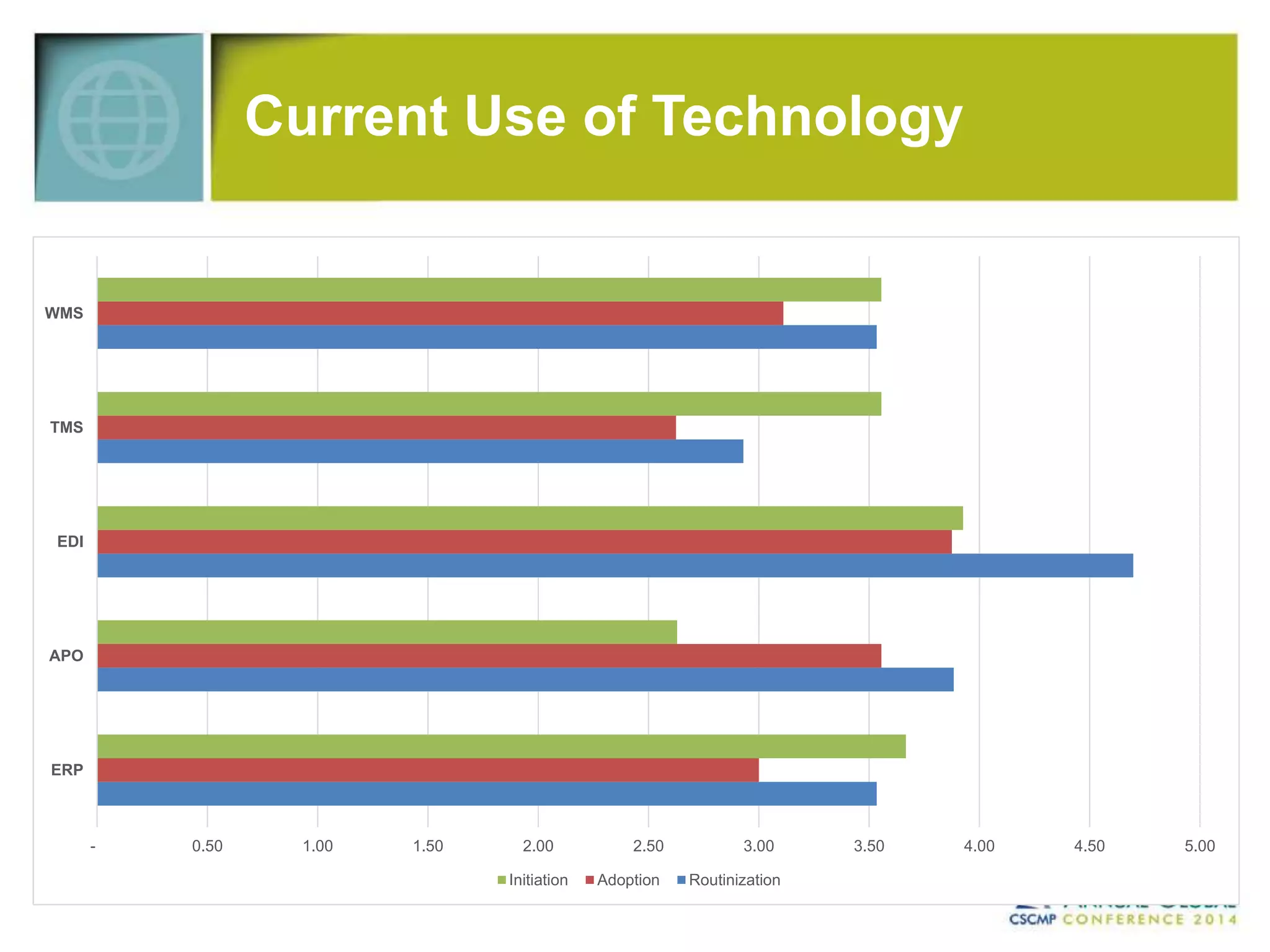
Current Use of Technology 
- 0.50 1.00 1.50 2.00 2.50 3.00 3.50 4.00 4.50 5.00 
WMS 
TMS 
EDI 
APO 
ERP 
Initiation Adoption Routinization
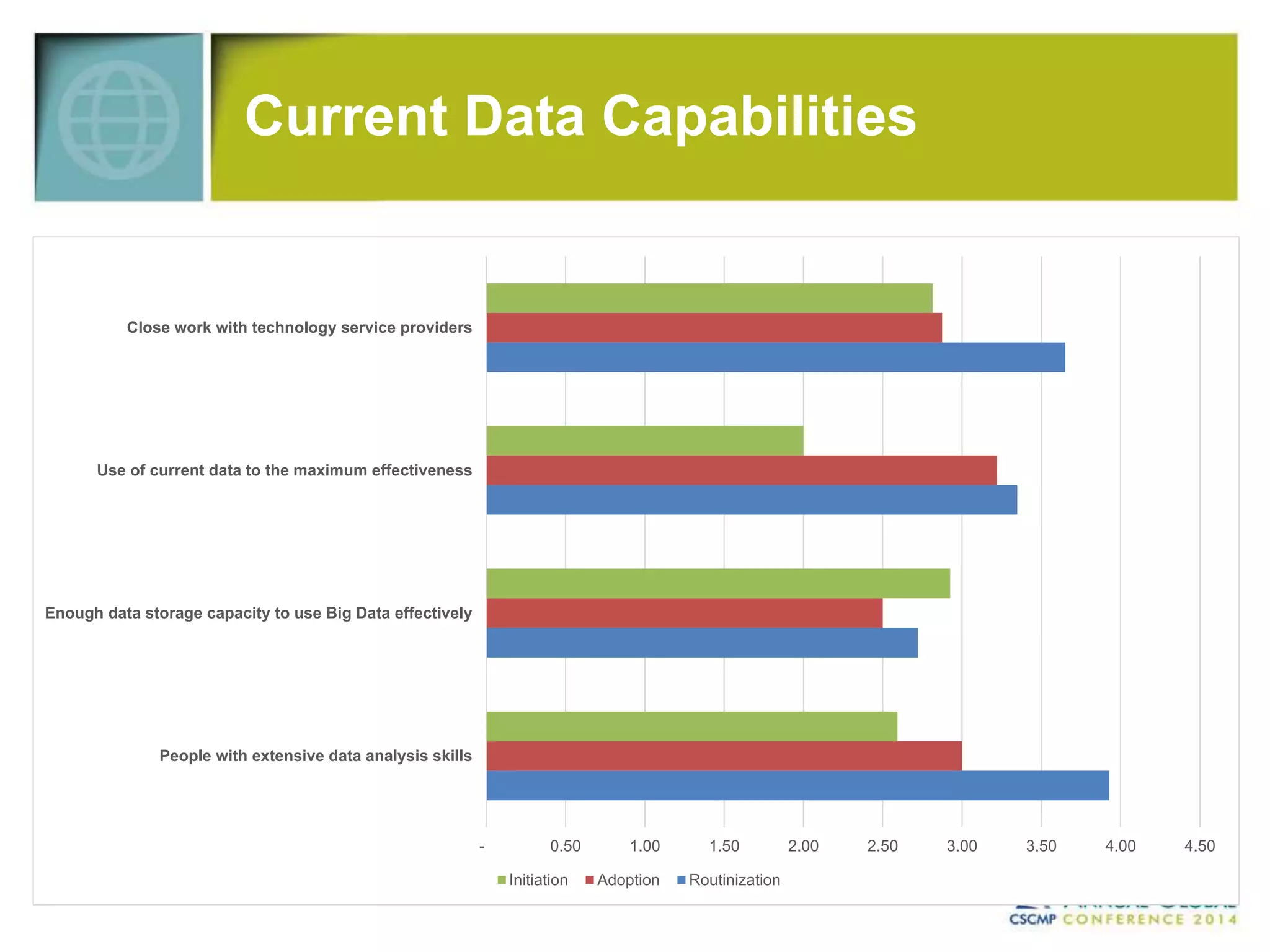
Current Data Capabilities 
- 0.50 1.00 1.50 2.00 2.50 3.00 3.50 4.00 4.50 
Close work with technology service providers 
Use of current data to the maximum effectiveness 
Enough data storage capacity to use Big Data effectively 
People with extensive data analysis skills 
Initiation Adoption Routinization
Organizational 
Environment and Design
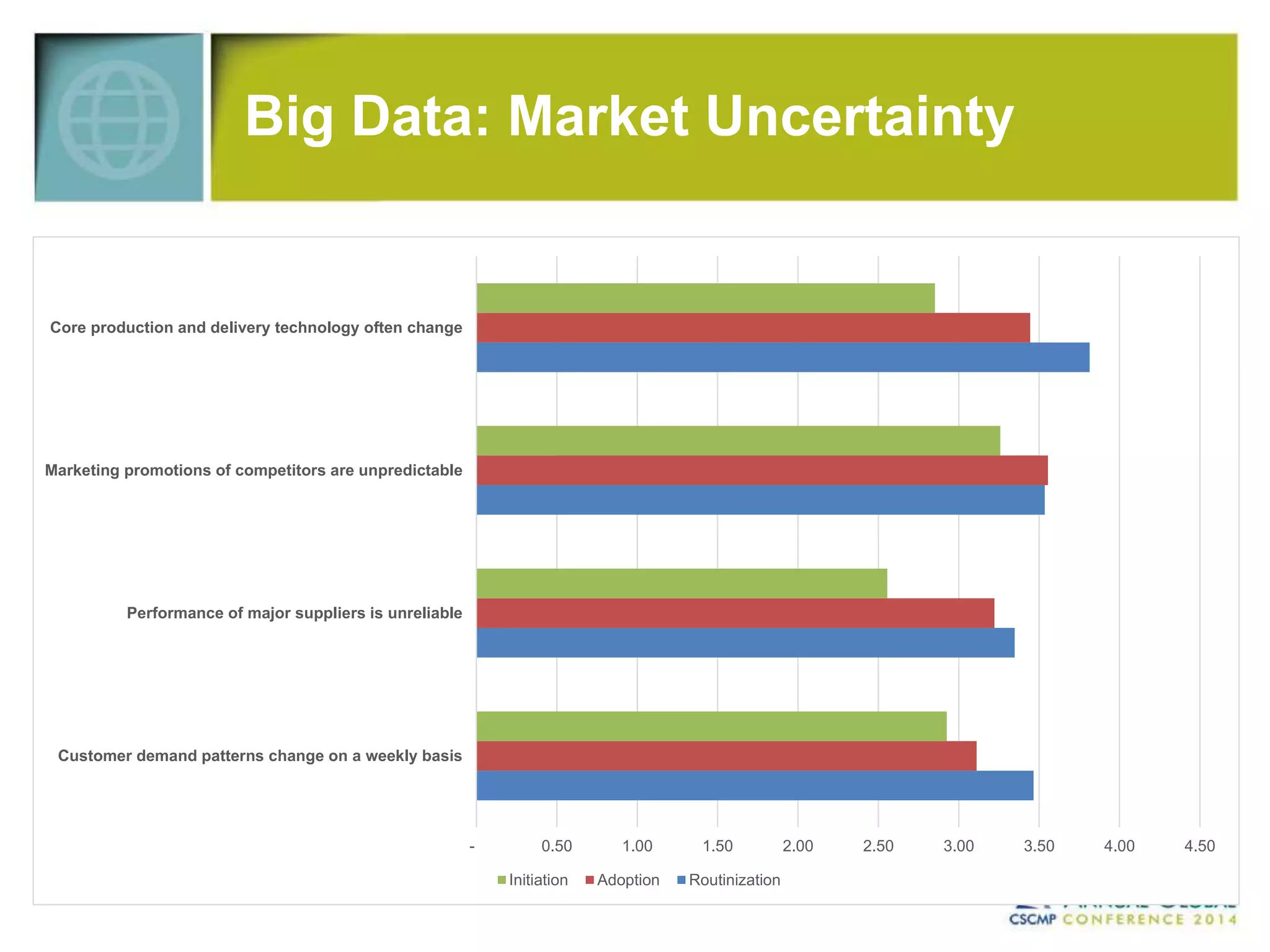
Big Data: Market Uncertainty 
- 0.50 1.00 1.50 2.00 2.50 3.00 3.50 4.00 4.50 
Core production and delivery technology often change 
Marketing promotions of competitors are unpredictable 
Performance of major suppliers is unreliable 
Customer demand patterns change on a weekly basis 
Initiation Adoption Routinization
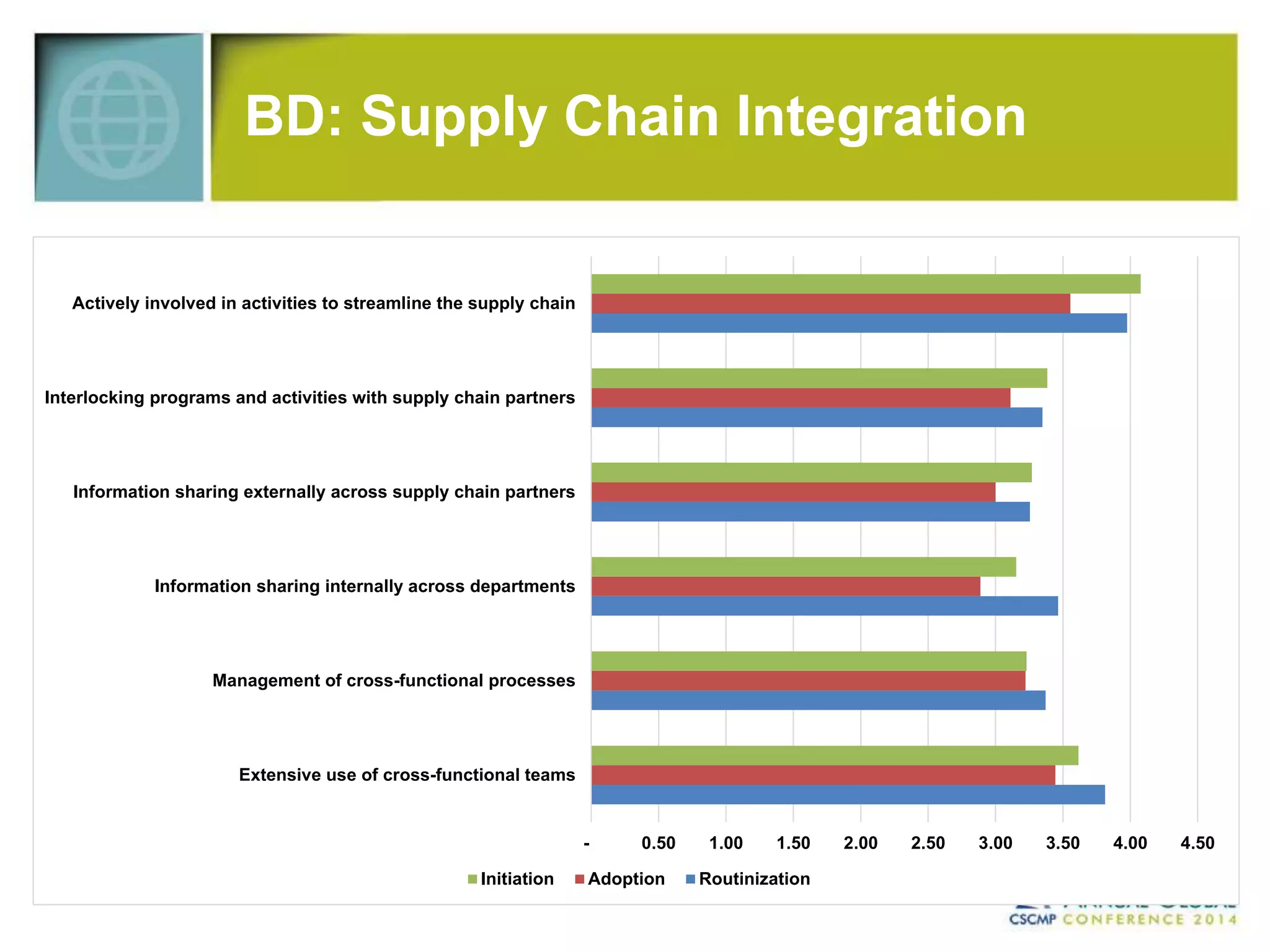
BD: Supply Chain Integration 
- 0.50 1.00 1.50 2.00 2.50 3.00 3.50 4.00 4.50 
Actively involved in activities to streamline the supply chain 
Interlocking programs and activities with supply chain partners 
Information sharing externally across supply chain partners 
Information sharing internally across departments 
Management of cross-functional processes 
Extensive use of cross-functional teams 
Initiation Adoption Routinization
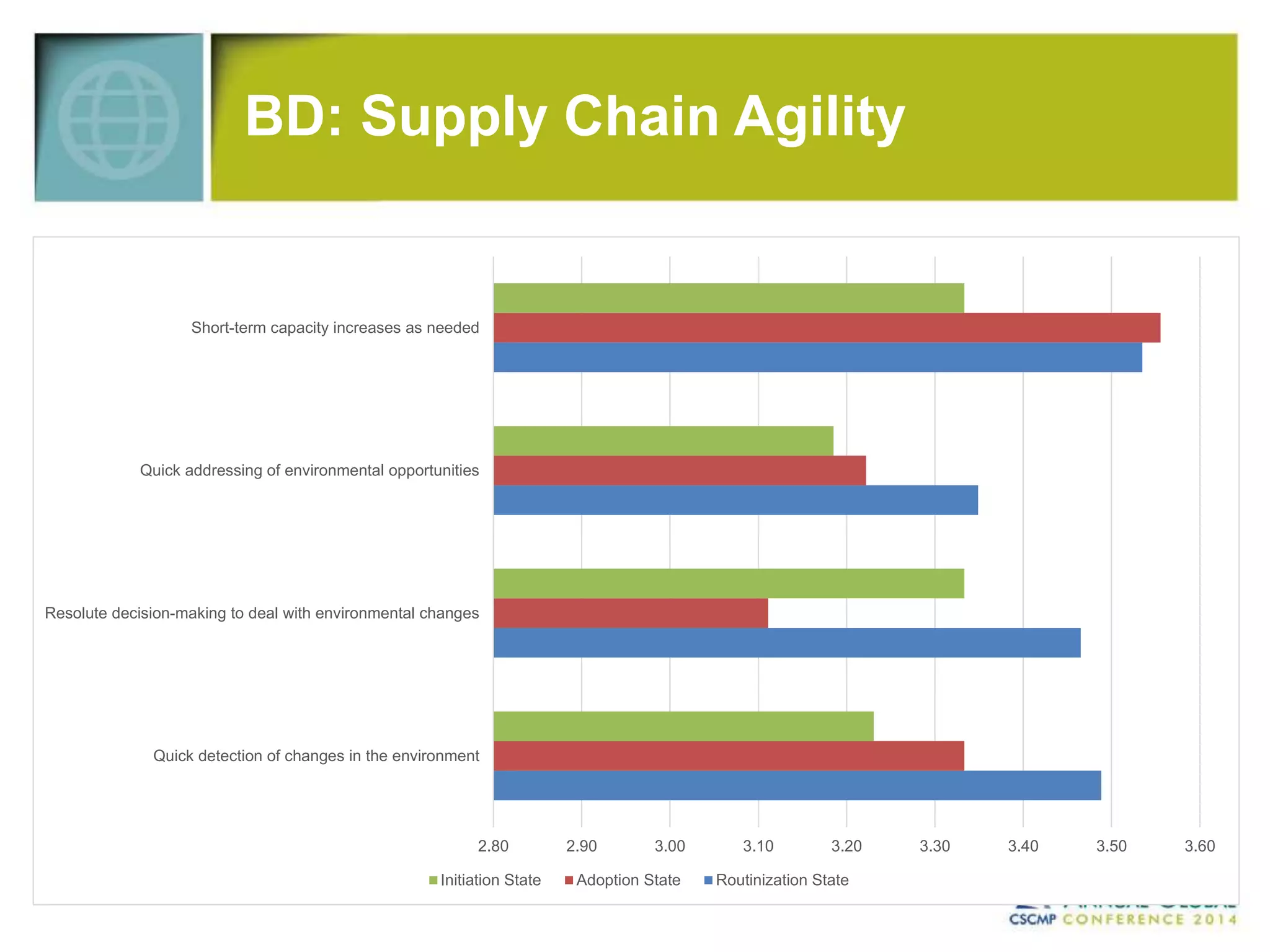
BD: Supply Chain Agility 
Short-term capacity increases as needed 
Quick addressing of environmental opportunities 
Resolute decision-making to deal with environmental changes 
Quick detection of changes in the environment 
2.80 2.90 3.00 3.10 3.20 3.30 3.40 3.50 3.60 
Initiation State Adoption State Routinization State
Operational and Financial 
Performance
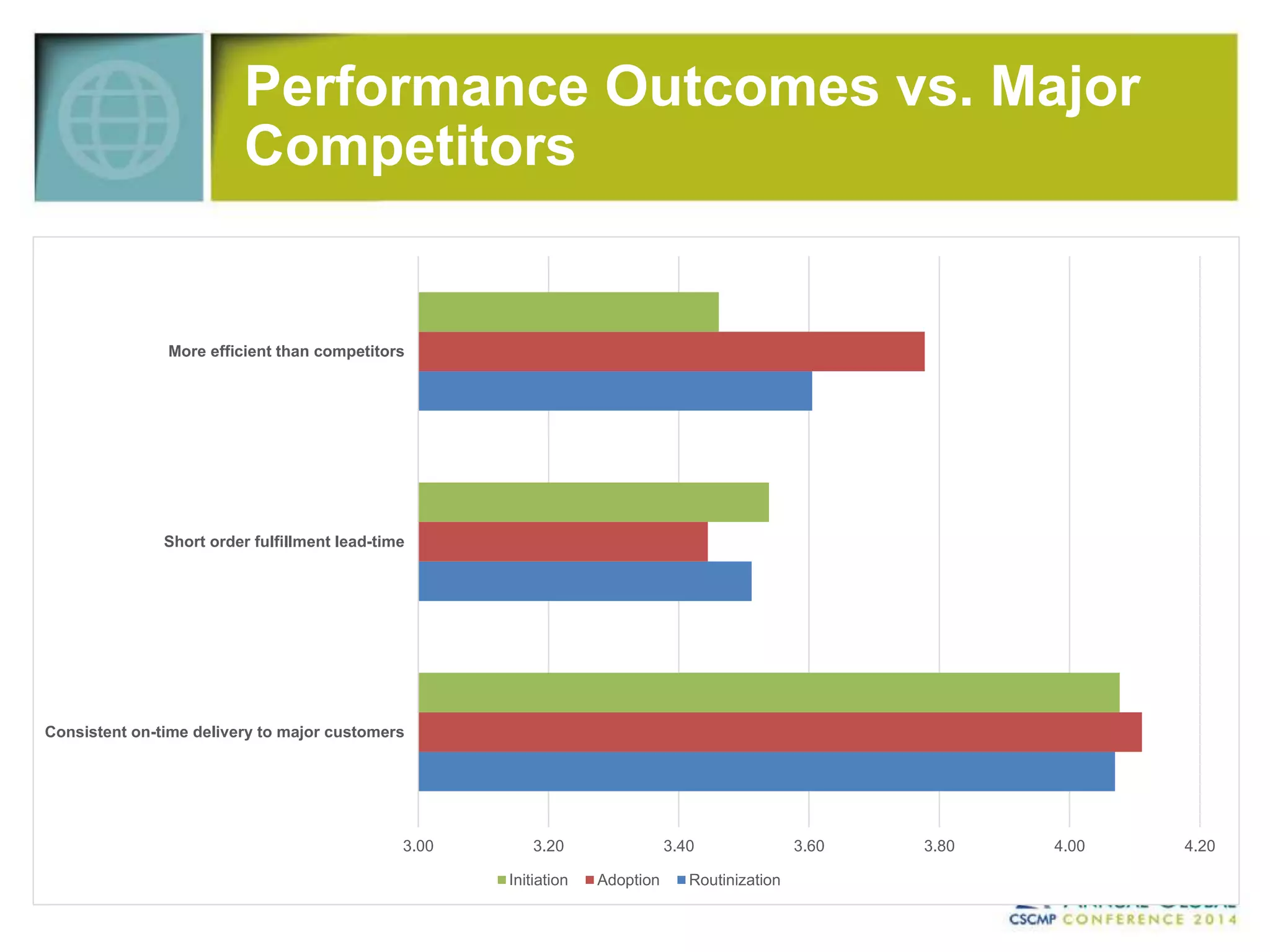
Performance Outcomes vs. Major 
Competitors 
More efficient than competitors 
Short order fulfillment lead-time 
Consistent on-time delivery to major customers 
3.00 3.20 3.40 3.60 3.80 4.00 4.20 
Initiation Adoption Routinization
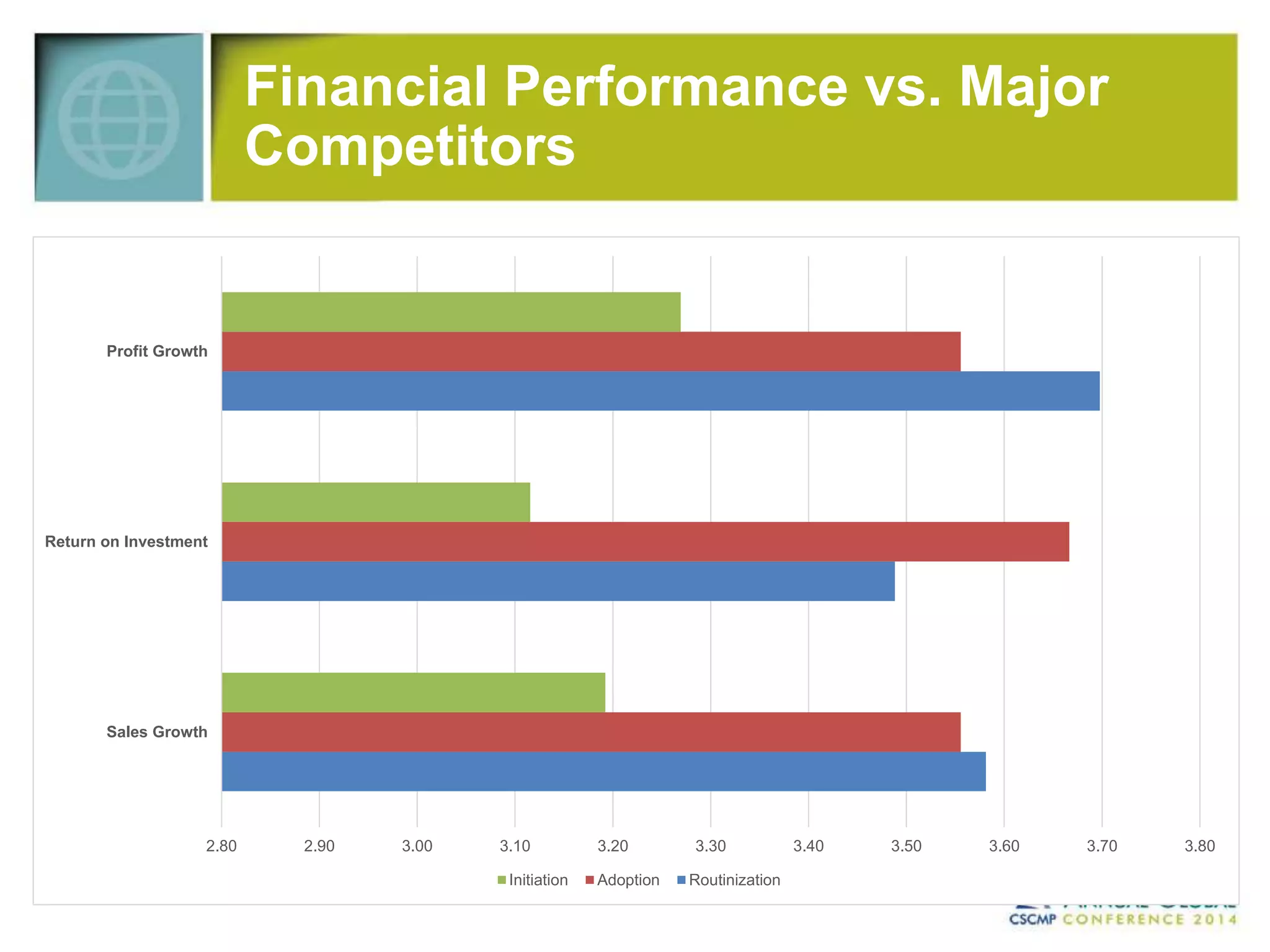
Financial Performance vs. Major 
Competitors 
Profit Growth 
Return on Investment 
Sales Growth 
2.80 2.90 3.00 3.10 3.20 3.30 3.40 3.50 3.60 3.70 3.80 
Initiation Adoption Routinization
Conclusions
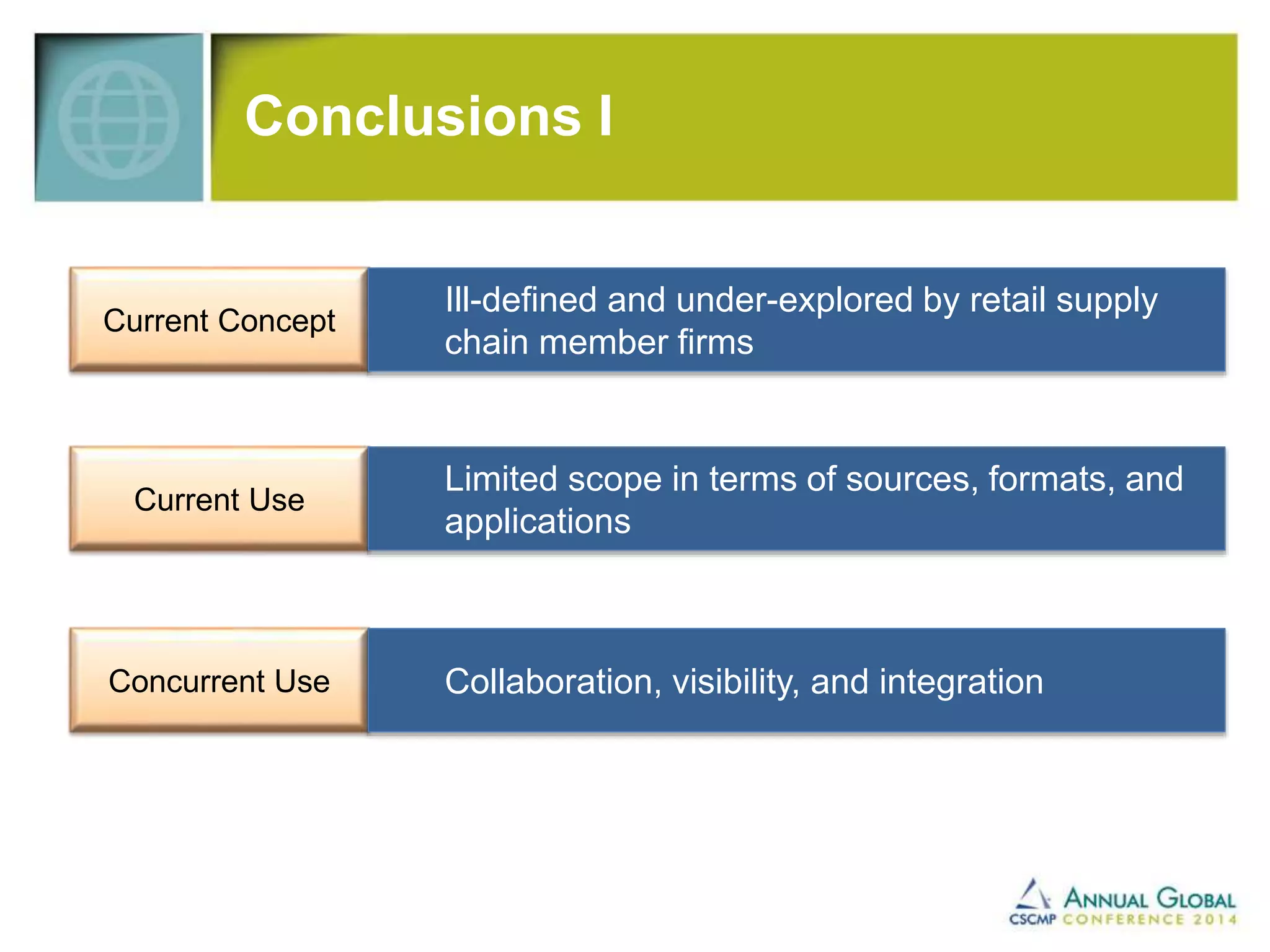
Conclusions I 
Current Concept 
Ill-defined and under-explored by retail supply 
chain member firms 
Current Use 
Limited scope in terms of sources, formats, and 
applications 
Concurrent Use Collaboration, visibility, and integration
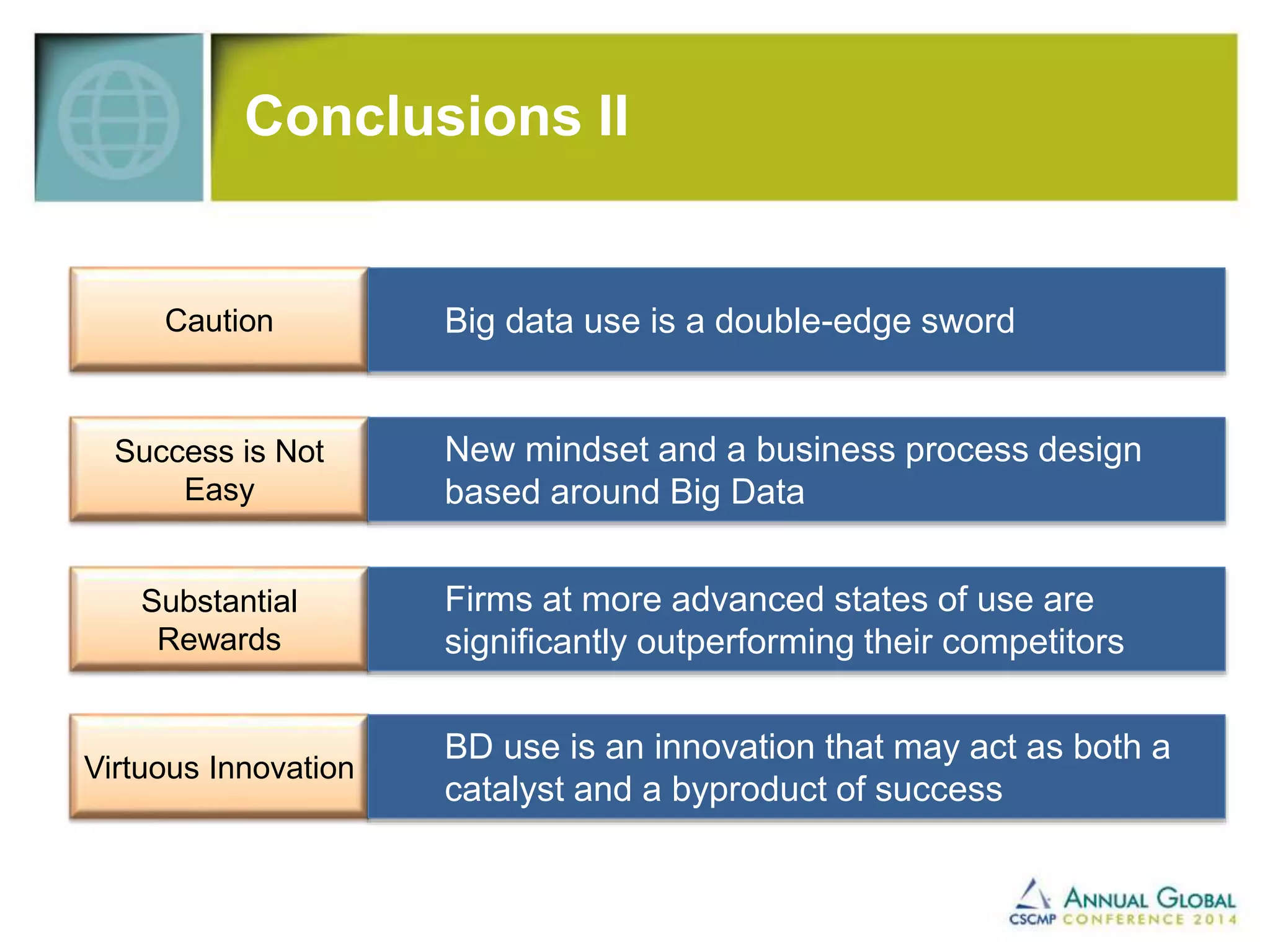
Conclusions II 
Caution Big data use is a double-edge sword 
Success is Not 
Easy 
New mindset and a business process design 
based around Big Data 
Substantial 
Rewards 
Firms at more advanced states of use are 
significantly outperforming their competitors 
Virtuous Innovation 
BD use is an innovation that may act as both a 
catalyst and a byproduct of success
Speakers 
• Anníbal Sodero 
– Assistant Professor, Department of Supply Chain Management 
– Sam M. Walton College of Business, University of Arkansas 
– Email: asodero@walton.uark.edu 
• Mark Barratt 
– Associate Professor, Department of Management 
– College of Business, Marquette University 
– Email: mark.barratt@marquette.edu 
• Yao “Henry” Jin 
– Neil R. Anderson Assistant Professor of Supply Chain Management 
– Farmer School of Business, Miami University 
– Email: jiny3@miamioh.edu
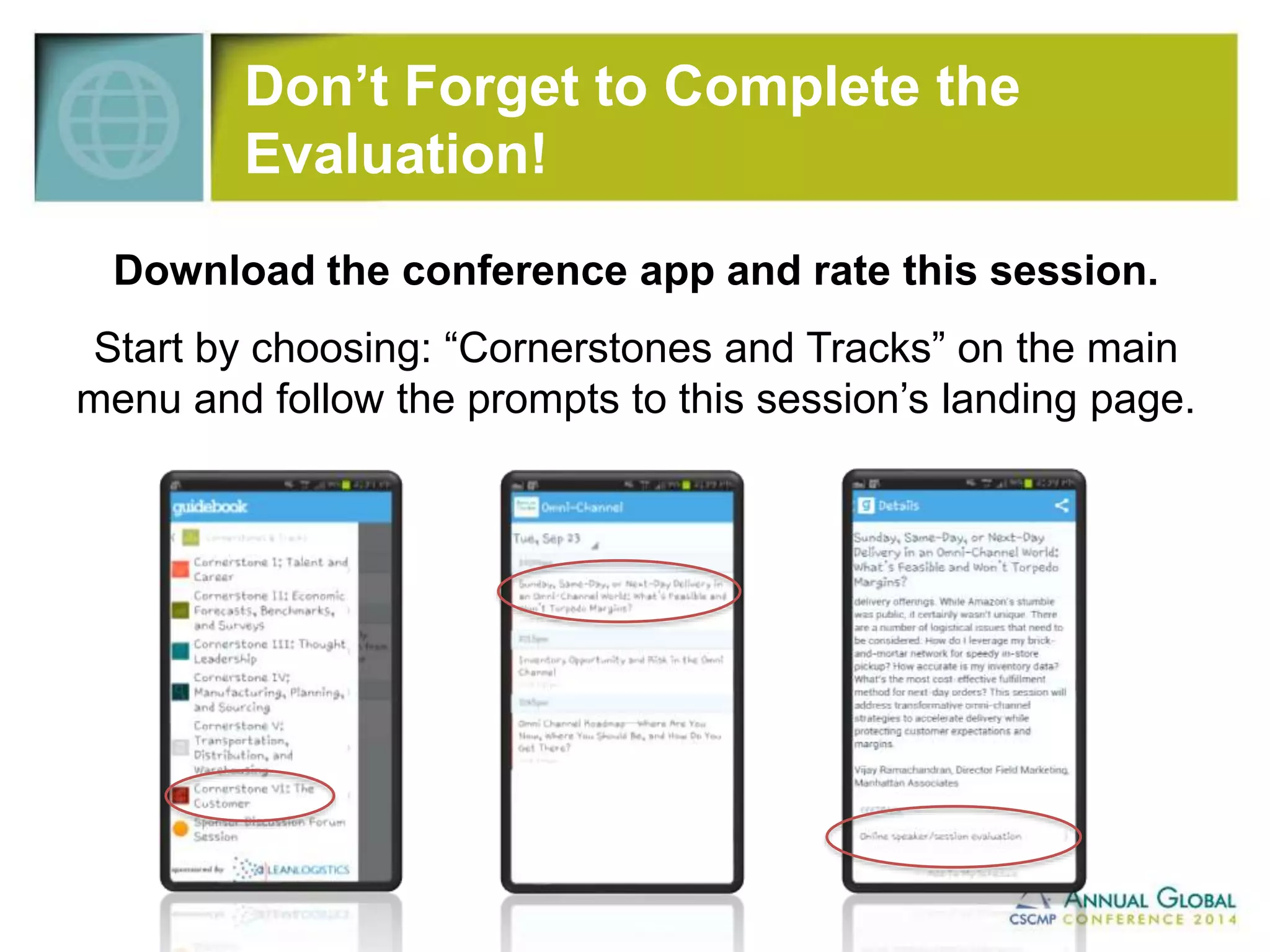
Don’t Forget to Complete the 
Evaluation! 
Download the conference app and rate this session. 
Start by choosing: “Cornerstones and Tracks” on the main 
menu and follow the prompts to this session’s landing page.

CSCMP 2014: Big Data Use in Retail Supply Chains

  • 1.
    Big Data Usein Retail Supply Chains Drs. Mark Barratt, Anníbal Sodero and Yao Jin
  • 2.
    Acknowledgements • Theresearchers are grateful for the financial and collaborative support of CSCMP for this research project. • We appreciate the opportunity to partner with CSCMP and the CSCMP Research Strategies Committee on this research endeavor. • Additionally, we appreciate the support of the Supply Chain Alumni Group at Miami University and the Supply Chain Management Research Center at the University of Arkansas in helping us collect the research data. • Finally, we offer our sincere thanks to the individuals and firms that participated in the research process, who were promised anonymity in exchange for their participation.
  • 3.
  • 4.
    Big Data vs.Supply Chain Management search pattern
  • 5.
    Big Data vs.Supply Chain Management
  • 6.
    Big Data vs.Supply Chain Management
  • 7.
    Research purpose HowManagers see Big Data in retail supply chains • What it is and its perceived level of use? • Characteristics of firms implementing it. • What it is doing for them? • How well it is working? • What are the barriers and benefits achieved?
  • 8.
    What is BigData? “The nearest to real-time as possible gathering, storage, analysis of, and decision-making based on large sets of both quantitative and qualitative data in structured (tabular) and unstructured formats” Implies four dimensions of Big Data: 1. Volume: large amounts in terms of bytes, 2. Variety: many forms of structured and unstructured data 3. Velocity: real-time creation and use of data, and 4. Veracity: trustworthy, relevant, and useful data.
  • 9.
    What is (andis not) Big Data? What Big Data is Not • Simply demand forecasting • A lot of data in the ERP system (Small and Medium data) What Big Data is ….. • Comes from multiple traditional and non-traditional sources • Beyond B.I.- enables real-time decision making • New software platforms and technology (e.g. Hadoop, NoSQL)
  • 10.
    Overall Finding BigData use in Retail SCs still elusive! Three States: Initiation  Adoption  Routinization Initial and some significant cases of use, but mostly using traditional, transactional data • Point of Sale (POS) and on-hand inventory data • Social media data but for marketing purposes only - better understanding of consumer preferences
  • 11.
    Big Data: GoodNews As reported by firms in more advanced state (i.e. routinization) • More positive view of Big Data • Success in recognizing and overcoming challenges in implementation • Success in recognizing and overcoming integrating Big Data into planning and replenishment
  • 12.
  • 13.
    Shifting Retail Landscapeand Role of BD • Being efficient and becoming more effective • Goal: right consumer, place, time, quality, condition and price • Task is much more difficult and complex • Consumer behavior: new level of whenever and wherever. • Demanding more of an Omni-channel experience • Enabling the SC to become more demand driven
  • 14.
    Research Methodology Phase1 – Survey Questionnaires • 174 managers in retail supply chain firms • Identify factors that significantly contribute to, inhibit, and result from Big Data use • Derive insight regarding the state of Big Data use in firms positioned across retail supply chains Phase 2 – In-Depth Interviews • 18 senior supply chain managers • Obtain greater details regarding their Big Data use efforts
  • 15.
    Factors that influenceBD adoption Knowing… Being able to… • Analyze data • Merge BD with traditional data • Establish data-sharing protocols • External integration with customers • Invest necessary resources • All sources of data • Questions to ask of data • What data to share • Possible benefits versus cost • Data trustworthiness • Supply-driven versus demand-driven supply chain
  • 16.
    BD: Benefits andSuccess Factors Direct Benefits – Critical Success Factors • Improved quality of data • Increased demand and supply visibility both internally and across the SC • Re-designed shared inter-organizational processes • Significantly enhanced data analytic capabilities Strategic Benefits – Omni-Channel and Demand-Driven Supply Chains • Predictive analyses of consumer demand patterns • Advanced insights into procurement and distribution operations • Strategic questions to shape supply chains
  • 17.
    GAP: Definition -Practice Veracity Velocity Variety Volume Managerial Definition Significant Data Quality Issues Little Evidence POS & On-hand Inventory Practice
  • 18.
    Demographics: Job title& Revenue Other, 10% Director, 47% Planner/ Analyst, 25% Presiden t/VP, 17% Less than $250 million, 28% $251- $500 million, 5% Greater than $10 billion, 24% $1 billion - $10 billion, 32% $500 million - $1 billion, 11%
  • 19.
  • 20.
    Big Data: Statesof Adoption Initiation 34% Adoption 11% Routinization 55% Initiation Adoption Routinization
  • 21.
    Functional Use ofBig Data - 0.50 1.00 1.50 2.00 2.50 3.00 3.50 4.00 4.50 Security Finances HRM SC Planning Procurement After Sales Marketing Adoption State Routinization State
  • 22.
    Extent of BigData Use Dimensions • Routinization: Volume, Velocity, and Variety • Initiation: Veracity Types of Data • Use of transactional and environmental data significantly higher than consumer data • Firms are likely to be constrained and restricted to particular sources of data • Incorporating new sources of data remains an opportunity
  • 23.
    Big Data: PerceivedUsefulness - 0.50 1.00 1.50 2.00 2.50 3.00 3.50 4.00 4.50 5.00 Can increase job effectiveness Can increase job efficiency Necessary to get the job done Initiation State Adoption State Routinization State
  • 24.
    BD: Perceived Easeof Use - 0.50 1.00 1.50 2.00 2.50 3.00 3.50 4.00 4.50 5.00 Allows me to do what I want to do with it Requires litle mental effort Clear and understandable Initiation Adoption Routinization
  • 25.
  • 26.
    Current Use ofTechnology - 0.50 1.00 1.50 2.00 2.50 3.00 3.50 4.00 4.50 5.00 WMS TMS EDI APO ERP Initiation Adoption Routinization
  • 27.
    Current Data Capabilities - 0.50 1.00 1.50 2.00 2.50 3.00 3.50 4.00 4.50 Close work with technology service providers Use of current data to the maximum effectiveness Enough data storage capacity to use Big Data effectively People with extensive data analysis skills Initiation Adoption Routinization
  • 28.
  • 29.
    Big Data: MarketUncertainty - 0.50 1.00 1.50 2.00 2.50 3.00 3.50 4.00 4.50 Core production and delivery technology often change Marketing promotions of competitors are unpredictable Performance of major suppliers is unreliable Customer demand patterns change on a weekly basis Initiation Adoption Routinization
  • 30.
    BD: Supply ChainIntegration - 0.50 1.00 1.50 2.00 2.50 3.00 3.50 4.00 4.50 Actively involved in activities to streamline the supply chain Interlocking programs and activities with supply chain partners Information sharing externally across supply chain partners Information sharing internally across departments Management of cross-functional processes Extensive use of cross-functional teams Initiation Adoption Routinization
  • 31.
    BD: Supply ChainAgility Short-term capacity increases as needed Quick addressing of environmental opportunities Resolute decision-making to deal with environmental changes Quick detection of changes in the environment 2.80 2.90 3.00 3.10 3.20 3.30 3.40 3.50 3.60 Initiation State Adoption State Routinization State
  • 32.
  • 33.
    Performance Outcomes vs.Major Competitors More efficient than competitors Short order fulfillment lead-time Consistent on-time delivery to major customers 3.00 3.20 3.40 3.60 3.80 4.00 4.20 Initiation Adoption Routinization
  • 34.
    Financial Performance vs.Major Competitors Profit Growth Return on Investment Sales Growth 2.80 2.90 3.00 3.10 3.20 3.30 3.40 3.50 3.60 3.70 3.80 Initiation Adoption Routinization
  • 35.
  • 36.
    Conclusions I CurrentConcept Ill-defined and under-explored by retail supply chain member firms Current Use Limited scope in terms of sources, formats, and applications Concurrent Use Collaboration, visibility, and integration
  • 37.
    Conclusions II CautionBig data use is a double-edge sword Success is Not Easy New mindset and a business process design based around Big Data Substantial Rewards Firms at more advanced states of use are significantly outperforming their competitors Virtuous Innovation BD use is an innovation that may act as both a catalyst and a byproduct of success
  • 38.
    Speakers • AnníbalSodero – Assistant Professor, Department of Supply Chain Management – Sam M. Walton College of Business, University of Arkansas – Email: asodero@walton.uark.edu • Mark Barratt – Associate Professor, Department of Management – College of Business, Marquette University – Email: mark.barratt@marquette.edu • Yao “Henry” Jin – Neil R. Anderson Assistant Professor of Supply Chain Management – Farmer School of Business, Miami University – Email: jiny3@miamioh.edu
  • 39.
    Don’t Forget toComplete the Evaluation! Download the conference app and rate this session. Start by choosing: “Cornerstones and Tracks” on the main menu and follow the prompts to this session’s landing page.