Digitalisation of Supply Chains
By Michael Lynham
HND BA [Hons.] MSc. MSc. MMII
Michael Lynham
HND BA [Hons.] MSc. MSc. MMII
Immediate Past Marketing & Business Development Manager with the Chartered
Institute of Logistics & Transport Ireland [CILT]
Currently in the Office of Vice President for Global Relation at Trinity College Dublin
Email: micklynham@gmail.com
ie.linkedin.com/pub/micheal-lynham-mmii/82/b69/594/
• @MickLynham
Content
1. Supply Chain Ecosystem
2. The Evolution of the Supply Chain
3. Drivers of Digital Transformation
4. Industry Research
5. Digital Supply Chain - 8 Key Components
6. Case Study - Nespresso
Supply Chain Ecosystem
• Standardised Process – Product – Customer
• Next few years – Changes within Supply Chain
• Advent of Digital Supply Chain
• Information available in real-time
• Objective of Digital Supply Chains – Built a new
supply network = Resilient & Responsive
• Digital Supply Chain Ecosystem =REALITY
What is Digitalisation of Supply Chain ?
Utilising digital technologies and processes to
enable supply chains to be more effectively and
efficiently managed, creating business networks
and increasing the overall supply chain visibility
within the network.
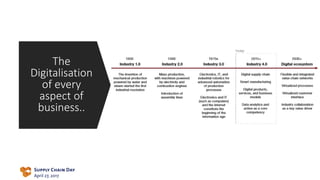
The
Digitalisation
of every
aspect of
business..
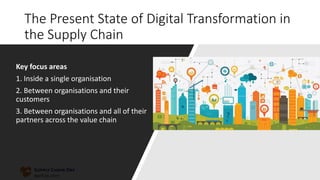
The Present State of Digital Transformation in
the Supply Chain
Key focus areas
1. Inside a single organisation
2. Between organisations and their
customers
3. Between organisations and all of their
partners across the value chain
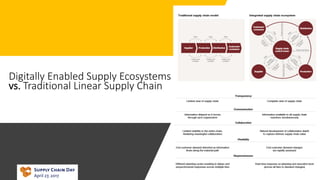
Digitally Enabled Supply Ecosystems
vs. Traditional Linear Supply Chain
Drivers of Digital
Transformation
1. New Technologies
2. Customers
3. Employees
4. Business Partners
Industry Research
75% of organisations say that digital
transformation of the supply chain is
“important or very important”
50% say that Digital Transformation is
“very important”
[The study surveyed 337 executives from some of the largest global
manufacturing and retail organizations from over
20 different countries around the world]
Industry Research
33% of companies have started digitalising their
supply chains
72% of companies expect to
be fully digitalised within
5 years
[The study surveyed 2,000 supply chain respondents – PWC, 2016]
Digital Supply Chain –
Economic Benefits
• Improved Efficiencies by 4.1% annually
• Boosted Revenues by 2.9% annually
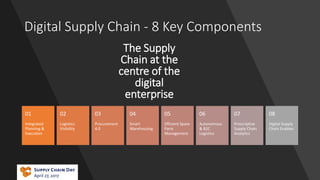
Digital Supply Chain - 8 Key Components
Integrated
Planning &
Execution
01
Logistics
Visibility
02
Procurement
4.0
03
Smart
Warehousing
04
Efficient Spare
Parts
Management
05
Autonomous
& B2C
Logistics
06
Prescriptive
Supply Chain
Analytics
07
Digital Supply
Chain Enables
08
The Supply
Chain at the
centre of the
digital
enterprise
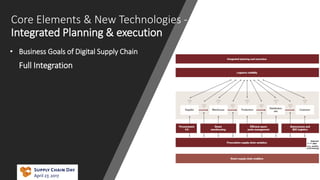
• Business Goals of Digital Supply Chain
Full Integration
Core Elements & New Technologies -
Integrated Planning & execution
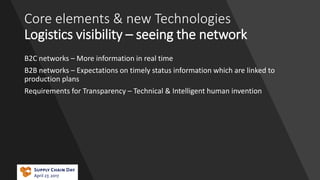
Core elements & new Technologies
Logistics visibility – seeing the network
B2C networks – More information in real time
B2B networks – Expectations on timely status information which are linked to
production plans
Requirements for Transparency – Technical & Intelligent human invention
Single platform
Consolidated & enriched
with cross referenced
information
[Social media]
Linked within the platform
& put through additional
analytics and simulation
runs
Logistics visibility – seeing the network
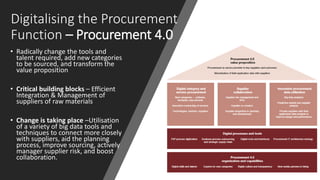
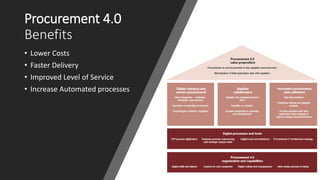
Digitalising the Procurement
Function – Procurement 4.0
• Radically change the tools and
talent required, add new categories
to be sourced, and transform the
value proposition
• Critical building blocks – Efficient
Integration & Management of
suppliers of raw materials
• Change is taking place –Utilisation
of a variety of big data tools and
techniques to connect more closely
with suppliers, aid the planning
process, improve sourcing, actively
manager supplier risk, and boost
collaboration.
Procurement 4.0
Benefits
• Lower Costs
• Faster Delivery
• Improved Level of Service
• Increase Automated processes
Core elements & new Technologies
Smart warehousing – robots at work
- Strategic Tool
- Improve efficiently & safety
- Inbound logistics
- RFID sensors – Information about what has been delivered
- Management system – Automatically allots storage space
- Inside the warehouse – Management software will constantly update in real time
- Flying Drones – Potential ?
- Wearables & augmented reality systems
Core elements & new Technologies
Smart warehousing – robots at work
DHL & Ricoh
Augmented Reality System
Employees navigate routes via glasses graphic displays
RESULTS
- 10 order pickers
- 9,000 orders fulfilled
- 20,000 items
- Overall picking efficiency increased by 25%
- Orders packed by Robots
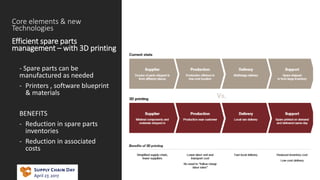
Core elements & new
Technologies
Efficient spare parts
management – with 3D printing
- Spare parts can be
manufactured as needed
- Printers , software blueprint
& materials
BENEFITS
- Reduction in spare parts
inventories
- Reduction in associated
costs
Core elements & new Technologies
Autonomous & B2C logistics – robotic transport
- Driverless vehicles - mapping software
- Other robotics innovations
- Autonomous truck convoys – Reduce need for humans drivers
- Internal sensors – Access fleet damage to cargo & maintenance requirements
BENEFITS
- Reduced human error
- Reduced emissions [more efficient operations, routing and convoying of trucks]
- Lower labour costs
- More reliable delivery times
Core elements & new Technologies
Prescriptive supply chain analytics
- Big data analytics
- Sophisticated signals from market [s]
- Optimise any factors within the entire chain
- Actively modify the chain
- Prescriptive data – Scenario planning
Core elements & new Technologies
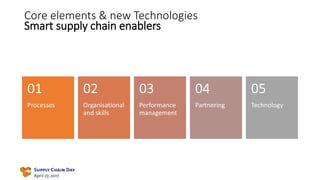
Smart supply chain enablers
Processes
01
Organisational
and skills
02
Performance
management
03
Partnering
04
Technology
05
Case Study - Nespresso
• Goal – Provide customers with the perfect coffee
experience
• Incorporated Technology to achieve this goal
• Trigger – Deeper understanding of customers and
manage complex buying processes
• Utilised – Customer Engagement Solutions [Cloud], Full-
fledged sales solution [entire buying cycle; pricing,
quotes and orders], external data sources like; social
media
• Benefits – Greater penetration of markets, higher sales
and user adoption and greater visibility. Enhanced
business processes. Shorter delivery times [4 weeks].
Single optimised view of their supply chain
Thank You!

Digitalisation of Supply Chains by Michael Lynham

  • 1.
    Digitalisation of SupplyChains By Michael Lynham HND BA [Hons.] MSc. MSc. MMII
  • 2.
    Michael Lynham HND BA[Hons.] MSc. MSc. MMII Immediate Past Marketing & Business Development Manager with the Chartered Institute of Logistics & Transport Ireland [CILT] Currently in the Office of Vice President for Global Relation at Trinity College Dublin Email: micklynham@gmail.com ie.linkedin.com/pub/micheal-lynham-mmii/82/b69/594/ • @MickLynham
  • 3.
    Content 1. Supply ChainEcosystem 2. The Evolution of the Supply Chain 3. Drivers of Digital Transformation 4. Industry Research 5. Digital Supply Chain - 8 Key Components 6. Case Study - Nespresso
  • 4.
    Supply Chain Ecosystem •Standardised Process – Product – Customer • Next few years – Changes within Supply Chain • Advent of Digital Supply Chain • Information available in real-time • Objective of Digital Supply Chains – Built a new supply network = Resilient & Responsive • Digital Supply Chain Ecosystem =REALITY
  • 5.
    What is Digitalisationof Supply Chain ? Utilising digital technologies and processes to enable supply chains to be more effectively and efficiently managed, creating business networks and increasing the overall supply chain visibility within the network.
  • 6.
  • 7.
    The Present Stateof Digital Transformation in the Supply Chain Key focus areas 1. Inside a single organisation 2. Between organisations and their customers 3. Between organisations and all of their partners across the value chain
  • 8.
    Digitally Enabled SupplyEcosystems vs. Traditional Linear Supply Chain
  • 9.
    Drivers of Digital Transformation 1.New Technologies 2. Customers 3. Employees 4. Business Partners
  • 10.
    Industry Research 75% oforganisations say that digital transformation of the supply chain is “important or very important” 50% say that Digital Transformation is “very important” [The study surveyed 337 executives from some of the largest global manufacturing and retail organizations from over 20 different countries around the world]
  • 11.
    Industry Research 33% ofcompanies have started digitalising their supply chains 72% of companies expect to be fully digitalised within 5 years [The study surveyed 2,000 supply chain respondents – PWC, 2016]
  • 12.
    Digital Supply Chain– Economic Benefits • Improved Efficiencies by 4.1% annually • Boosted Revenues by 2.9% annually
  • 13.
    Digital Supply Chain- 8 Key Components Integrated Planning & Execution 01 Logistics Visibility 02 Procurement 4.0 03 Smart Warehousing 04 Efficient Spare Parts Management 05 Autonomous & B2C Logistics 06 Prescriptive Supply Chain Analytics 07 Digital Supply Chain Enables 08 The Supply Chain at the centre of the digital enterprise
  • 14.
    • Business Goalsof Digital Supply Chain Full Integration Core Elements & New Technologies - Integrated Planning & execution
  • 15.
    Core elements &new Technologies Logistics visibility – seeing the network B2C networks – More information in real time B2B networks – Expectations on timely status information which are linked to production plans Requirements for Transparency – Technical & Intelligent human invention
  • 16.
    Single platform Consolidated &enriched with cross referenced information [Social media] Linked within the platform & put through additional analytics and simulation runs Logistics visibility – seeing the network
  • 17.
    Digitalising the Procurement Function– Procurement 4.0 • Radically change the tools and talent required, add new categories to be sourced, and transform the value proposition • Critical building blocks – Efficient Integration & Management of suppliers of raw materials • Change is taking place –Utilisation of a variety of big data tools and techniques to connect more closely with suppliers, aid the planning process, improve sourcing, actively manager supplier risk, and boost collaboration.
  • 18.
    Procurement 4.0 Benefits • LowerCosts • Faster Delivery • Improved Level of Service • Increase Automated processes
  • 19.
    Core elements &new Technologies Smart warehousing – robots at work - Strategic Tool - Improve efficiently & safety - Inbound logistics - RFID sensors – Information about what has been delivered - Management system – Automatically allots storage space - Inside the warehouse – Management software will constantly update in real time - Flying Drones – Potential ? - Wearables & augmented reality systems
  • 20.
    Core elements &new Technologies Smart warehousing – robots at work DHL & Ricoh Augmented Reality System Employees navigate routes via glasses graphic displays RESULTS - 10 order pickers - 9,000 orders fulfilled - 20,000 items - Overall picking efficiency increased by 25% - Orders packed by Robots
  • 21.
    Core elements &new Technologies Efficient spare parts management – with 3D printing - Spare parts can be manufactured as needed - Printers , software blueprint & materials BENEFITS - Reduction in spare parts inventories - Reduction in associated costs
  • 22.
    Core elements &new Technologies Autonomous & B2C logistics – robotic transport - Driverless vehicles - mapping software - Other robotics innovations - Autonomous truck convoys – Reduce need for humans drivers - Internal sensors – Access fleet damage to cargo & maintenance requirements BENEFITS - Reduced human error - Reduced emissions [more efficient operations, routing and convoying of trucks] - Lower labour costs - More reliable delivery times
  • 23.
    Core elements &new Technologies Prescriptive supply chain analytics - Big data analytics - Sophisticated signals from market [s] - Optimise any factors within the entire chain - Actively modify the chain - Prescriptive data – Scenario planning
  • 24.
    Core elements &new Technologies Smart supply chain enablers Processes 01 Organisational and skills 02 Performance management 03 Partnering 04 Technology 05
  • 25.
    Case Study -Nespresso • Goal – Provide customers with the perfect coffee experience • Incorporated Technology to achieve this goal • Trigger – Deeper understanding of customers and manage complex buying processes • Utilised – Customer Engagement Solutions [Cloud], Full- fledged sales solution [entire buying cycle; pricing, quotes and orders], external data sources like; social media • Benefits – Greater penetration of markets, higher sales and user adoption and greater visibility. Enhanced business processes. Shorter delivery times [4 weeks]. Single optimised view of their supply chain
  • 26.