SUBSURFACE GROUNDWATER
AND WATER TABLE
Geology
for
Civil
Engineers
MEMBERS
Abdulbari M. Abdulgafar
Amer Hakam A. Bantuas
Moh'd Al-farissy M. Macabato
Moh'd Noor Macacuna
Rahim Macarambon
Ren T. Banac
Yusri Hakim
GROUP 4
TABLE OF CONTENTS
2
History
Definition Formation Types of
Groundwater
Methods
3 4 5
Groundwater Flow,
Distribution, and
Quality
Sustainable
Groundwater
Management
Types of Aquifers Groundwater
Contamination
11 12 13 14 15
Impacts of
Groundwater
Contamination
Water Table Prevention and
Mitigation
Water table and
Factors affecting water
table
Groundwater and
water table
fluctuation
Sources of
Groundwater
Contamination
1
10
9
8
7
6
DID YOU KNOW?
T
R
I
V
I
A
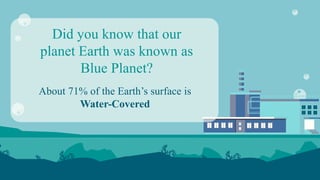
Did you know that our
planet Earth was known as
Blue Planet?
About 71% of the Earth’s surface is
Water-Covered
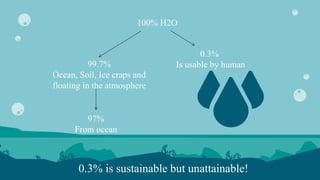
100% H2O
99.7%
Ocean, Soil, Ice craps and
floating in the atmosphere
97%
From ocean
0.3% is sustainable but unattainable!
0.3%
Is usable by human
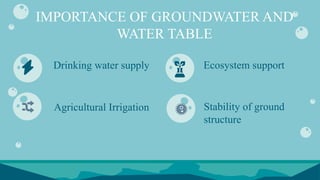
IMPORTANCE OF GROUNDWATER AND
WATER TABLE
Drinking water supply Ecosystem support
Stability of ground
structure
Agricultural Irrigation
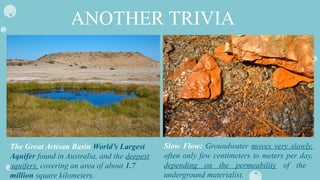
ANOTHER TRIVIA
Slow Flow: Groundwater moves very slowly,
often only few centimeters to meters per day,
depending on the permeability of the
underground materialist.
The Great Artisan Basin World’s Largest
Aquifer found in Australia, and the deepest
aquifers, covering an area of about 1.7
million square kilometers.
DEFINITION OF SUBSURFACE
GROUNDWATER AND WATER
TABLE
01
SUBSURFACE GROUNDWATER
AND WATER TABLE
"Subsurface Groundwater" is stored in the spaces
between soil, sand, and rock beneath the Earth's surface.
It’s a crucial resource for drinking, irrigation, and
ecosystems.
Whilst, the “Water Table” is the upper boundary of this
groundwater, changing with rainfall and extraction.
HISTORY OF SUBSURFACE
GROUNDWATER AND
WATER TABLE
02
HISTORY OF SUBSURFACE
GROUNDWATER AND WATER TABLE
 Ancient Civilization: Where early human settlements were
established near spring and wells.
 384—322 BC: The Greek philosopher Aristotle made an
early observations regarding groundwater and its behavior.
 Roman Empire: Aqueducts and wells were constructed.
 In the 17th
Century: French Hydraulic engineer Pierre
Perrault and naturalist Edme Mariotte studying the
hydrological cycle.
 In the 19th
Century: Henry Darcy a French engineer,
developed Darcy's Law, a fundamental equation.
 In the 20th Century: Scientists leading to a deeper
understanding of how groundwater interacts with surface
water and the environment.
 Present Day: Focus more on sustainable management.
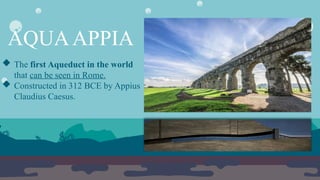
AQUAAPPIA
 The first Aqueduct in the world
that can be seen in Rome.
 Constructed in 312 BCE by Appius
Claudius Caesus.
FORMATION OF
GROUNDWATER
03
FORMATION OF GROUNDWATER
Groundwater begins with infiltration of water
from precipitation, which percolates down
through the soil and accumulates in aquifers, a
natural underground reservoirs that store
water.
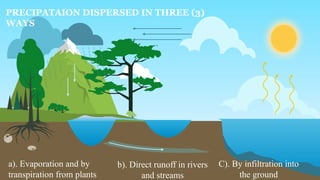
PRECIPATAION DISPERSED IN THREE (3)
WAYS
a). Evaporation and by
transpiration from plants
b). Direct runoff in rivers
and streams
C). By infiltration into
the ground
TYPES OF
GROUNDWATER
04
THREE (3) TYPES OF GROUNDWATER
Freshwater Groundwater that has low concentrations
of dissolved salts, making it suitable for drinking and
irrigation.
Brackish Water Groundwater with higher salinity than
freshwater but lower than seawater, often found in
coastal areas or under certain geological conditions.
Saltwater Intrusion Occurs when seawater moves into
freshwater aquifers, typically due to over-extraction of
groundwater from coastal aquifers.
METHODS OF
GROUNDWATER
EXPLORATION
05
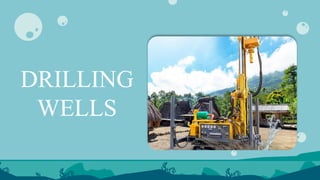
DRILLING
WELLS
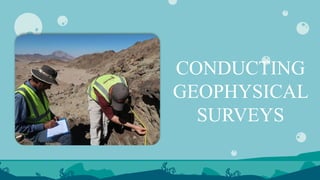
CONDUCTING
GEOPHYSICAL
SURVEYS
TYPES OF
AQUIFERS
06
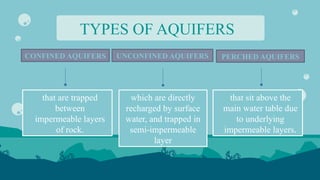
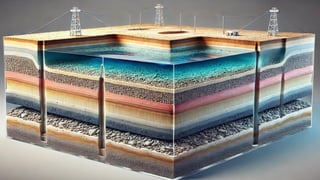
TYPES OF AQUIFERS
CONFINED AQUIFERS UNCONFINED AQUIFERS PERCHED AQUIFERS
which are directly
recharged by surface
water, and trapped in
semi-impermeable
layer
that sit above the
main water table due
to underlying
impermeable layers.
that are trapped
between
impermeable layers
of rock.
GROUNDWATER FLOW,
DISTRIBUTION, AND
QUALITY
07
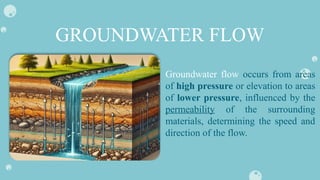
GROUNDWATER FLOW
Groundwater flow occurs from areas
of high pressure or elevation to areas
of lower pressure, influenced by the
permeability of the surrounding
materials, determining the speed and
direction of the flow.
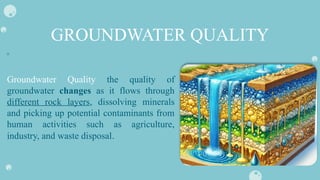
GROUNDWATER QUALITY
Groundwater Quality the quality of
groundwater changes as it flows through
different rock layers, dissolving minerals
and picking up potential contaminants from
human activities such as agriculture,
industry, and waste disposal.
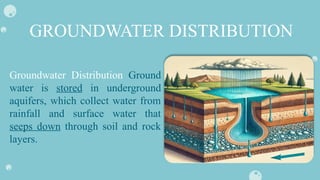
GROUNDWATER DISTRIBUTION
Groundwater Distribution Ground
water is stored in underground
aquifers, which collect water from
rainfall and surface water that
seeps down through soil and rock
layers.
SUSTAINABLE
GROUNDWATER
MANAGEMENT
08
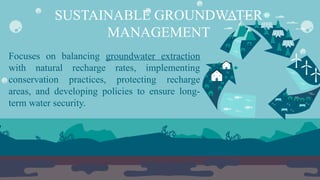
Focuses on balancing groundwater extraction
with natural recharge rates, implementing
conservation practices, protecting recharge
areas, and developing policies to ensure long-
term water security.
SUSTAINABLE GROUNDWATER
MANAGEMENT
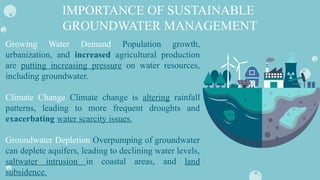
Growing Water Demand Population growth,
urbanization, and increased agricultural production
are putting increasing pressure on water resources,
including groundwater.
Climate Change Climate change is altering rainfall
patterns, leading to more frequent droughts and
exacerbating water scarcity issues.
Groundwater Depletion Overpumping of groundwater
can deplete aquifers, leading to declining water levels,
saltwater intrusion in coastal areas, and land
subsidence.
IMPORTANCE OF SUSTAINABLE
GROUNDWATER MANAGEMENT
09 GROUNDWATER
CONTAMINATION
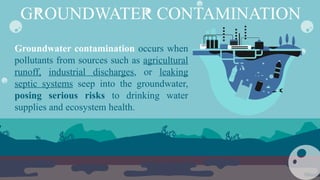
GROUNDWATER CONTAMINATION
Groundwater contamination occurs when
pollutants from sources such as agricultural
runoff, industrial discharges, or leaking
septic systems seep into the groundwater,
posing serious risks to drinking water
supplies and ecosystem health.
SOURCES OF
GROUNDWATER
CONTAMINATION
10
TWO (2) SOURCES OF GROUNDWATER
CONTAMINATION
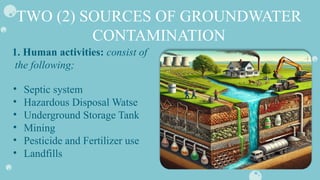
• Septic system
• Hazardous Disposal Watse
• Underground Storage Tank
• Mining
• Pesticide and Fertilizer use
• Landfills
1. Human activities: consist of
the following;
SOURCES OF GROUNDWATER
CONTAMINATION
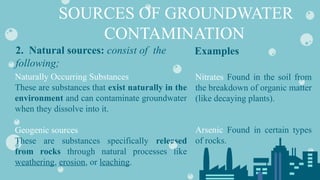
2. Natural sources: consist of the
following;
Naturally Occurring Substances
These are substances that exist naturally in the
environment and can contaminate groundwater
when they dissolve into it.
Geogenic sources
These are substances specifically released
from rocks through natural processes like
weathering, erosion, or leaching.
Nitrates Found in the soil from
the breakdown of organic matter
(like decaying plants).
Arsenic Found in certain types
of rocks.
Examples
IMPACT OF
GROUNDWATER
CONTAMINATION
11
THREE (3) IMPACTS OF GROUNDWATER
CONTAMINATION
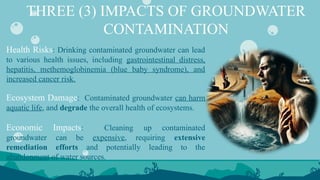
Health Risks: Drinking contaminated groundwater can lead
to various health issues, including gastrointestinal distress,
hepatitis, methemoglobinemia (blue baby syndrome), and
increased cancer risk.
Ecosystem Damage: Contaminated groundwater can harm
aquatic life, and degrade the overall health of ecosystems.
Economic Impacts: Cleaning up contaminated
groundwater can be expensive, requiring extensive
remediation efforts and potentially leading to the
abandonment of water sources.
PREVENTION AND
MITIGATION
12
PROPER WASTE
DISPOSAL
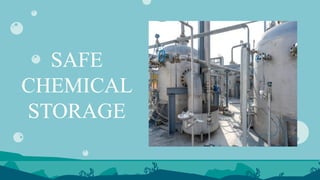
SAFE
CHEMICAL
STORAGE
MINIMIZE
CHEMICAL USE
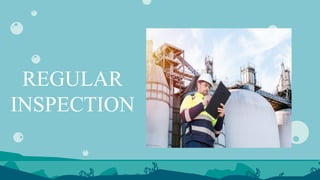
REGULAR
INSPECTION
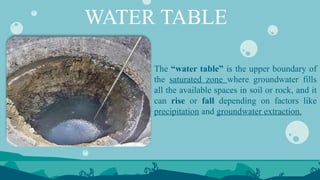
WATER TABLE
The “water table” is the upper boundary of
the saturated zone where groundwater fills
all the available spaces in soil or rock, and it
can rise or fall depending on factors like
precipitation and groundwater extraction.
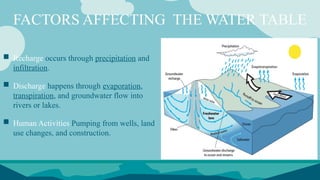
FACTORS AFFECTING THE WATER TABLE
 Recharge occurs through precipitation and
infiltration.
 Discharge happens through evaporation,
transpiration, and groundwater flow into
rivers or lakes.
 Human Activities Pumping from wells, land
use changes, and construction.
13
GROUNDWATER AND
WATER TABLE
FLUCTUATIONS
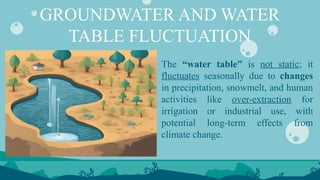
GROUNDWATER AND WATER
TABLE FLUCTUATION
The “water table” is not static; it
fluctuates seasonally due to changes
in precipitation, snowmelt, and human
activities like over-extraction for
irrigation or industrial use, with
potential long-term effects from
climate change.
EQUIPMENTS
14
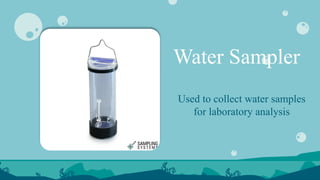
Water Sampler
Used to collect water samples
for laboratory analysis
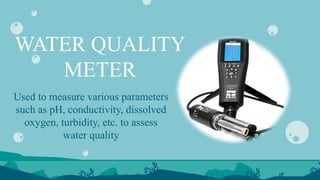
WATER QUALITY
METER
Used to measure various parameters
such as pH, conductivity, dissolved
oxygen, turbidity, etc. to assess
water quality
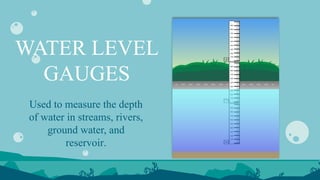
WATER LEVEL
GAUGES
Used to measure the depth
of water in streams, rivers,
ground water, and
reservoir.
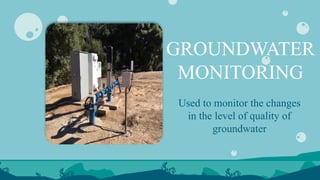
GROUNDWATER
MONITORING
Used to monitor the changes
in the level of quality of
groundwater
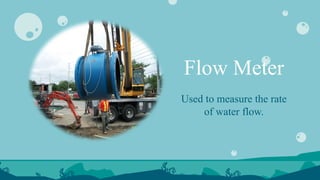
Flow Meter
Used to measure the rate
of water flow.
IMPORTANCE OF
GROUNDWATER
15
PHILIPPINE
WATER CRISIS
16
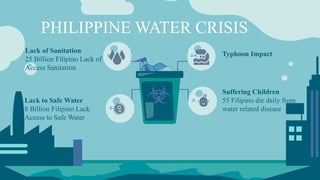
Lack of Sanitation
25 Billion Filipino Lack of
Access Sanitation
Lack to Safe Water
8 Billion Filipino Lack
Access to Safe Water
Suffering Children
55 Filipino die daily from
water related disease
Typhoon Impact
PHILIPPINE WATER CRISIS
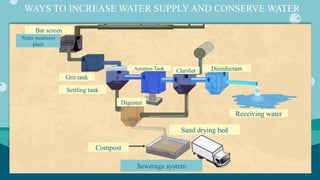
WAYS TO INCREASE WATER SUPPLY AND CONSERVE WATER
Water treatment
plant
Grit tank
Settling tank
Digester
Aeration Tank Clarifier Disinfectant
Sand drying bed
Receiving water
Compost
Sewerage system
Bar screen
W.H. Auden
“Thousand have lived without love,
not one without water”
“In every drop of water, there is a story of
life"
Leena Arif
References:
Aristotle. (340 BC). Meteorology. Retrieved from [ancient texts repository or online library].
Vitruvius. (1st century BC). De Architectura. Retrieved from [ancient texts repository or online library].
Perrault, P. (1674). De l’origine des fontaines. Retrieved from [historical texts repository or library].
Mariotte, E. (1686). Memoires pour servir à l’histoire de l’acquisition des fontaines. Retrieved from [historical
texts repository or library].
Darcy, H. (1856). Recherches expérimentales sur le mouvement de l’eau dans les tuyaux. Retrieved from
[historical texts repository or library].
Websites and Online Resources
Australian Government, Department of Agriculture, Water and the Environment. (n.d.). Great Artesian Basin.
Retrieved from [https://www.agriculture.gov.au/water/groundwater/great-artesian-basin](https://
www.agriculture.gov.au/water/groundwater/great-artesian-basin)
U.S. Geological Survey (USGS). (n.d.). Groundwater. Retrieved from
[https://www.usgs.gov/mission-areas/water-resources/science/groundwater](https://www.usgs.gov/
mission-areas/water-resources/science/groundwater)
Journal of Archaeological Science. (Various articles). Retrieved from [journal database].

LEARN GROUP 4 (SUBSRFACE GROUNDWATER).pptx

  • 1.
    SUBSURFACE GROUNDWATER AND WATERTABLE Geology for Civil Engineers MEMBERS Abdulbari M. Abdulgafar Amer Hakam A. Bantuas Moh'd Al-farissy M. Macabato Moh'd Noor Macacuna Rahim Macarambon Ren T. Banac Yusri Hakim GROUP 4
  • 2.
    TABLE OF CONTENTS 2 History DefinitionFormation Types of Groundwater Methods 3 4 5 Groundwater Flow, Distribution, and Quality Sustainable Groundwater Management Types of Aquifers Groundwater Contamination 11 12 13 14 15 Impacts of Groundwater Contamination Water Table Prevention and Mitigation Water table and Factors affecting water table Groundwater and water table fluctuation Sources of Groundwater Contamination 1 10 9 8 7 6
  • 3.
  • 4.
    Did you knowthat our planet Earth was known as Blue Planet? About 71% of the Earth’s surface is Water-Covered
  • 5.
    100% H2O 99.7% Ocean, Soil,Ice craps and floating in the atmosphere 97% From ocean 0.3% is sustainable but unattainable! 0.3% Is usable by human
  • 6.
    IMPORTANCE OF GROUNDWATERAND WATER TABLE Drinking water supply Ecosystem support Stability of ground structure Agricultural Irrigation
  • 7.
    ANOTHER TRIVIA Slow Flow:Groundwater moves very slowly, often only few centimeters to meters per day, depending on the permeability of the underground materialist. The Great Artisan Basin World’s Largest Aquifer found in Australia, and the deepest aquifers, covering an area of about 1.7 million square kilometers.
  • 8.
  • 9.
    SUBSURFACE GROUNDWATER AND WATERTABLE "Subsurface Groundwater" is stored in the spaces between soil, sand, and rock beneath the Earth's surface. It’s a crucial resource for drinking, irrigation, and ecosystems. Whilst, the “Water Table” is the upper boundary of this groundwater, changing with rainfall and extraction.
  • 10.
  • 11.
    HISTORY OF SUBSURFACE GROUNDWATERAND WATER TABLE  Ancient Civilization: Where early human settlements were established near spring and wells.  384—322 BC: The Greek philosopher Aristotle made an early observations regarding groundwater and its behavior.  Roman Empire: Aqueducts and wells were constructed.  In the 17th Century: French Hydraulic engineer Pierre Perrault and naturalist Edme Mariotte studying the hydrological cycle.  In the 19th Century: Henry Darcy a French engineer, developed Darcy's Law, a fundamental equation.  In the 20th Century: Scientists leading to a deeper understanding of how groundwater interacts with surface water and the environment.  Present Day: Focus more on sustainable management.
  • 12.
    AQUAAPPIA  The firstAqueduct in the world that can be seen in Rome.  Constructed in 312 BCE by Appius Claudius Caesus.
  • 13.
  • 14.
    FORMATION OF GROUNDWATER Groundwaterbegins with infiltration of water from precipitation, which percolates down through the soil and accumulates in aquifers, a natural underground reservoirs that store water.
  • 15.
    PRECIPATAION DISPERSED INTHREE (3) WAYS a). Evaporation and by transpiration from plants b). Direct runoff in rivers and streams C). By infiltration into the ground
  • 16.
  • 17.
    THREE (3) TYPESOF GROUNDWATER Freshwater Groundwater that has low concentrations of dissolved salts, making it suitable for drinking and irrigation. Brackish Water Groundwater with higher salinity than freshwater but lower than seawater, often found in coastal areas or under certain geological conditions. Saltwater Intrusion Occurs when seawater moves into freshwater aquifers, typically due to over-extraction of groundwater from coastal aquifers.
  • 18.
  • 19.
  • 20.
  • 21.
  • 22.
    TYPES OF AQUIFERS CONFINEDAQUIFERS UNCONFINED AQUIFERS PERCHED AQUIFERS which are directly recharged by surface water, and trapped in semi-impermeable layer that sit above the main water table due to underlying impermeable layers. that are trapped between impermeable layers of rock.
  • 24.
  • 25.
    GROUNDWATER FLOW Groundwater flowoccurs from areas of high pressure or elevation to areas of lower pressure, influenced by the permeability of the surrounding materials, determining the speed and direction of the flow.
  • 26.
    GROUNDWATER QUALITY Groundwater Qualitythe quality of groundwater changes as it flows through different rock layers, dissolving minerals and picking up potential contaminants from human activities such as agriculture, industry, and waste disposal.
  • 27.
    GROUNDWATER DISTRIBUTION Groundwater DistributionGround water is stored in underground aquifers, which collect water from rainfall and surface water that seeps down through soil and rock layers.
  • 28.
  • 29.
    Focuses on balancinggroundwater extraction with natural recharge rates, implementing conservation practices, protecting recharge areas, and developing policies to ensure long- term water security. SUSTAINABLE GROUNDWATER MANAGEMENT
  • 30.
    Growing Water DemandPopulation growth, urbanization, and increased agricultural production are putting increasing pressure on water resources, including groundwater. Climate Change Climate change is altering rainfall patterns, leading to more frequent droughts and exacerbating water scarcity issues. Groundwater Depletion Overpumping of groundwater can deplete aquifers, leading to declining water levels, saltwater intrusion in coastal areas, and land subsidence. IMPORTANCE OF SUSTAINABLE GROUNDWATER MANAGEMENT
  • 31.
  • 32.
    GROUNDWATER CONTAMINATION Groundwater contaminationoccurs when pollutants from sources such as agricultural runoff, industrial discharges, or leaking septic systems seep into the groundwater, posing serious risks to drinking water supplies and ecosystem health.
  • 33.
  • 34.
    TWO (2) SOURCESOF GROUNDWATER CONTAMINATION • Septic system • Hazardous Disposal Watse • Underground Storage Tank • Mining • Pesticide and Fertilizer use • Landfills 1. Human activities: consist of the following;
  • 35.
    SOURCES OF GROUNDWATER CONTAMINATION 2.Natural sources: consist of the following; Naturally Occurring Substances These are substances that exist naturally in the environment and can contaminate groundwater when they dissolve into it. Geogenic sources These are substances specifically released from rocks through natural processes like weathering, erosion, or leaching. Nitrates Found in the soil from the breakdown of organic matter (like decaying plants). Arsenic Found in certain types of rocks. Examples
  • 36.
  • 37.
    THREE (3) IMPACTSOF GROUNDWATER CONTAMINATION Health Risks: Drinking contaminated groundwater can lead to various health issues, including gastrointestinal distress, hepatitis, methemoglobinemia (blue baby syndrome), and increased cancer risk. Ecosystem Damage: Contaminated groundwater can harm aquatic life, and degrade the overall health of ecosystems. Economic Impacts: Cleaning up contaminated groundwater can be expensive, requiring extensive remediation efforts and potentially leading to the abandonment of water sources.
  • 38.
  • 39.
  • 40.
  • 41.
  • 42.
  • 43.
    WATER TABLE The “watertable” is the upper boundary of the saturated zone where groundwater fills all the available spaces in soil or rock, and it can rise or fall depending on factors like precipitation and groundwater extraction.
  • 44.
    FACTORS AFFECTING THEWATER TABLE  Recharge occurs through precipitation and infiltration.  Discharge happens through evaporation, transpiration, and groundwater flow into rivers or lakes.  Human Activities Pumping from wells, land use changes, and construction.
  • 45.
  • 46.
    GROUNDWATER AND WATER TABLEFLUCTUATION The “water table” is not static; it fluctuates seasonally due to changes in precipitation, snowmelt, and human activities like over-extraction for irrigation or industrial use, with potential long-term effects from climate change.
  • 47.
  • 48.
    Water Sampler Used tocollect water samples for laboratory analysis
  • 49.
    WATER QUALITY METER Used tomeasure various parameters such as pH, conductivity, dissolved oxygen, turbidity, etc. to assess water quality
  • 50.
    WATER LEVEL GAUGES Used tomeasure the depth of water in streams, rivers, ground water, and reservoir.
  • 51.
    GROUNDWATER MONITORING Used to monitorthe changes in the level of quality of groundwater
  • 52.
    Flow Meter Used tomeasure the rate of water flow.
  • 53.
  • 54.
  • 55.
    Lack of Sanitation 25Billion Filipino Lack of Access Sanitation Lack to Safe Water 8 Billion Filipino Lack Access to Safe Water Suffering Children 55 Filipino die daily from water related disease Typhoon Impact PHILIPPINE WATER CRISIS
  • 56.
    WAYS TO INCREASEWATER SUPPLY AND CONSERVE WATER Water treatment plant Grit tank Settling tank Digester Aeration Tank Clarifier Disinfectant Sand drying bed Receiving water Compost Sewerage system Bar screen
  • 57.
    W.H. Auden “Thousand havelived without love, not one without water”
  • 58.
    “In every dropof water, there is a story of life" Leena Arif
  • 59.
    References: Aristotle. (340 BC).Meteorology. Retrieved from [ancient texts repository or online library]. Vitruvius. (1st century BC). De Architectura. Retrieved from [ancient texts repository or online library]. Perrault, P. (1674). De l’origine des fontaines. Retrieved from [historical texts repository or library]. Mariotte, E. (1686). Memoires pour servir à l’histoire de l’acquisition des fontaines. Retrieved from [historical texts repository or library]. Darcy, H. (1856). Recherches expérimentales sur le mouvement de l’eau dans les tuyaux. Retrieved from [historical texts repository or library]. Websites and Online Resources Australian Government, Department of Agriculture, Water and the Environment. (n.d.). Great Artesian Basin. Retrieved from [https://www.agriculture.gov.au/water/groundwater/great-artesian-basin](https:// www.agriculture.gov.au/water/groundwater/great-artesian-basin) U.S. Geological Survey (USGS). (n.d.). Groundwater. Retrieved from [https://www.usgs.gov/mission-areas/water-resources/science/groundwater](https://www.usgs.gov/ mission-areas/water-resources/science/groundwater) Journal of Archaeological Science. (Various articles). Retrieved from [journal database].