GROUNDWATER
Developed By : Prof. A. K. Baile
Assistant Professor of Engineering Geology
Contents
Here’s what you’ll find in this presentation :
Introduction
Advantages of groundwater
Hydrological cycle
Sources of groundwater
Vertical distribution of groundwater
Porosity
Permeability
Classification of rocks based on porosity & permeability
Artificial recharge of groundwater
Developed By : Prof. A. K. Baile
Assistant Professor of Engineering Geology
INTRODUCTUON
FORMS OF WATER
01
Liquid, Solid & Vapour
02
03
04
What is the differnece between
Hydrology & Hydrogeology?
Study of Surface & Subsurface
Water deals about :
Ouccurrence, Distribution, Movement
and chemistry of all water
Water + Soil & Rock = Groundwater
Developed By : Prof. A. K. Baile
Assistant Professor of Engineering Geology
INTRODUCTUON
FORMS OF WATER
01
Liquid, Solid & Vapour
02
03
04
What is the differnece between
Hydrology & Hydrogeology?
Study of Surface & Subsurface
Water deals about :
Ouccurrence, Distribution, Movement
and chemistry of all water
Water + Soil & Rock = Groundwater
Developed By : Prof. A. K. Baile
Assistant Professor of Engineering Geology
Advantages of
Groundwater
Why under-groundwater
is more advantageous
than the surface
water??????
Developed By : Prof. A. K. Baile
Assistant Professor of Engineering Geology
The insufficient availability of surface water potential
Seasonal changes affect the surface water
The surface water quality may be deteriorates
Always threat of pollution
The groundwater is free from weed seeds plant
organisms, turbidity and bacterial pollution.
Uniform in quality
Dams & Canals systems
Silting problems
Liable to destruction by enemy
Possibility of leakage of surface water
The Earthquake & Landslide
 Area Submerged under the impounded surfacewater
Hydrological Cycle
Developed By : Prof. A. K. Baile
Assistant Professor of Engineering Geology
 Evapo-transpiration
 Condensation
 Precipitation
 Infiltration
 Percolation
 Runoff
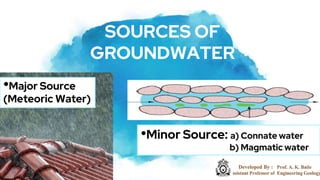
•Major Source
(Meteoric Water)
SOURCES OF
GROUNDWATER
•Minor Source: a) Connate water
b) Magmatic water
Developed By : Prof. A. K. Baile
Assistant Professor of Engineering Geology
VERTICAL DISTRIBUTION OF GROUNDWATER
 Zone of Areation:
 Soil Moisture
zone
 Intermediate
Zone
 Capillary Fringe
● Zone of saturation
Developed By : Prof. A. K. Baile
Assistant Professor of Engineering Geology
Porosity: Percentage of open spaces in a
given volume of rock or sediment
Total volume of voids in the sediments
Porosity= ______________________________
Total volume of Sediments
Developed By : Prof. A. K. Baile
Assistant Professor of Engineering Geology
Porosity:
A B
Amount of Cement
Sorting
A B
A
B
Developed By : Prof. A. K. Baile
Assistant Professor of Engineering Geology
Permeability
The ability of water to flow through soil.
Permeability depends on soil
composition (size and sorting)
Large Particles Small Particles Sorted Particles Unsorted Particles
Developed By : Prof. A. K. Baile
Assistant Professor of Engineering Geology
Large Particles Small Particles
Sorted Particles Unsorted Particles
• More permeable
• Water flows
easily from space
to space
• Less permeable
• It’s hard for
water to find a
path through the
soil
• More permeable
• Plenty of open
spaces that
connect to each
other
• Less permeable
• Small particles fill up
the spaces leaving
little room for water
to move
Developed By : Prof. A. K. Baile
Assistant Professor of Engineering Geology
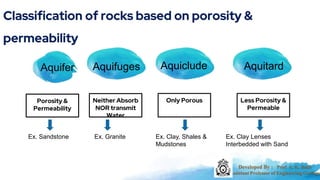
Classification of rocks based on porosity &
permeability
02
Neither Absorb
NOR transmit
Water
Porosity &
Permeability
Ex. Sandstone Ex. Granite Ex. Clay, Shales &
Mudstones
Ex. Clay Lenses
Interbedded with Sand
Aquiclude
Aquifer Aquifuges Aquitard
Only Porous Less Porosity &
Permeable
Developed By : Prof. A. K. Baile
Assistant Professor of Engineering Geology
Types of Aquifer
 Unconfined Aquifer
 Confined Aquifer
 Perched Aquifer
 Semiconfined or leaky
Aquifer
Aquiclude
Aquiclude
Developed By : Prof. A. K. Baile
Assistant Professor of Engineering Geology
Importance of groundwater studies in Civil
Engineering works
Subsurface water conditions are significant for three major
aspects of civil engineering works;
Subsurface water may pose a problem to construction,
It may be an erosive agent that degrades the foundation of the
structure and
Subsurface water may be critical to the functioning of the
structure. Developed By : Prof. A. K. Baile
Assistant Professor of Engineering Geology
Problems Created in Constructions
Tunnel and other underground structures
•Data/ information
•the type of vegetation growth on the site
•the subsurface water survey
• Ground water and seepage pressures
Water Table and Tunnel
Water Tables and Reservoir
Groundwater and Dam
Building Foundations and Failure of Pavements
Importance of groundwater studies in Civil
Engineering works
Developed By : Prof. A. K. Baile
Assistant Professor of Engineering Geology
 Digging pits and shafts
 Construction of percolations dams
i.e. Seepage tank
 Injection or recharge Wells
 Incidental or unplanned recharge
 Induced recharge
 Spreading Methods
Artificial recharge of
groundwater
Developed By : Prof. A. K. Baile
Assistant Professor of Engineering Geology
Site Investigations:
Surface Investigations
 Geological & Geo-botanical
Investigations
 Lithological Control
 Igneous Rock
 Sedimentary Rock
 Metamorphic Rock
 Structural Control
 Fractured & Faulted Zones
 Subsurface Barriers
 Weathered & Vesicular Zone
 Stratigraphic Control
Developed By : Prof. A. K. Baile
Assistant Professor of Engineering Geology
Site
Investigations: Sub- Surface Investigations
 Geophysical Surveys
 Electrical Resistivity Survey
 Ohm’s Law
R= V/I
 Potential, Current & Resistance are measured.
 Instruments Used
• Aquameter
• D. C Potentiometer
• The megger and D. Resistivity meter
Developed By : Prof. A. K. Baile
Assistant Professor of Engineering Geology
ARTIFICIAL RECHARGE
OF GROUND-WATER
CONTENT
• Concept of Recharge
• Need for Artificial Recharge
• Purposes and Principles of Artificial Recharge
• Advantages of Artificial Recharge
• Artificial Recharge Techniques And Designs
Groundwater levels are declining across the country as our withdrawals exceed
the rate of aquifers to naturally replenish themselves, called recharge. One method
of controlling declining water levels is by using artificial groundwater.
Natural recharge,
Artificial recharge
•Concept of Recharge
Developed By : Prof. A. K. Baile
Assistant Professor of Engineering Geology
•Need of Artificial Ground water Recharge
Natural replenishment of ground water reservoir
slow process
exploitation of ground water resources
Resulted
declining ground water levels and depletion of ground water
 Artificial recharge efforts are basically aimed at augmentation of the natural movement of surface water
into ground water reservoir through suitable civil construction techniques.
•Purposes and Principles of Artificial Recharge
Replenish ground water resources in depleted aquifers,
Conserve water for future use,
Control of salt-water encroachment,
Filtration of water,
Control of land subsidence.
•IDENTIFICATION OF AREAS FOR RECHARGE
 Where ground water levels are declining due to over-exploitation
 Where substantial part of the aquifer has already been.
 Where availability of water from wells and hand pumps is
inadequate during the lean months .
 Where ground water quality is poor and there is no alternative
source of water
•SOURCES OF WATER FOR RECHARGE
Precipitation (rainfall) Large roof areas Canals from large reservoirs
Diversion of Natural streams
Properly treated municipal and industrial wastewaters
•ADVANTAGES OF ARTIFICIAL RECHARGE
No large storage structures needed to store water.
Structures required are small and cost-effective
 Enhance the dependable yield of wells and hand pumps
Negligible losses as compared to losses in surface storages
Improved water quality due to dilution of harmful chemicals/ salts
No adverse effects like inundation of large surface areas and loss of crops
No displacement of local population
Reduction in cost of energy for lifting water especially where rise in ground water level is substantial
Utilizes the surplus surface runoff which otherwise drains off
Assessment of the available sources of water would require
consideration of the following factors:
• Available quantity of water
• Time for which the water would be available
• Quality of water and the pretreatment required
• Conveyance system required to bring the water to the recharge site
Developed By : Prof. A. K. Baile
Assistant Professor of Engineering Geology
Spreading Methods • Basin method
• Channel Method
• Ditch and Furrow method
• Flooding method
• Irrigation method
Digging pits or Shafts
• Vertical Shafts
• Lateral Shafts
Injection Well • Recharge Well
Induced Recharge • Pumping Well
METHODS OF ARTIFICIAL RECHARGE
Developed By : Prof. A. K. Baile
Assistant Professor of Engineering Geology
Spreading Methods
BASIN METHOD
Developed By : Prof. A. K. Baile
Assistant Professor of Engineering Geology
 Suitable for Irregular Ground Surface.
 Most Effective water Depth in the basin is 1.25m
 A portion of the flood Water can be stored in the
basin
 Not required much land surface preparation,
 Construction of bund is very simple
CHANNEL SPREADING
Constructing small ‘L’ shaped bunds within a stream channel
This is not useful where rivers/ streams are prone to flash floods
A small flowing channel flows through a relatively wide valley
Spreading Methods
CHANNEL METHOD
Developed By : Prof. A. K. Baile
Assistant Professor of Engineering Geology
Constructing small ‘L’ shaped bunds within a stream channel
This is not useful where rivers/ streams are prone to flash floods
A small flowing channel flows through a relatively wide valley
Spreading Methods
DITCH AND FURROW METHOD
Developed By : Prof. A. K. Baile
Assistant Professor of Engineering Geology
 construction of shallow, flat-bottomed and closely spaced ditches or
furrows.
 Adequate slope to maintain flow velocity and minimum deposition of
sediments
 The widths of the ditches are typically in the range of 0.30 to 1.80 m.
DITCH AND FURROW METHOD
Spreading Methods
FLOODING & IRRIGATION METHOD
Developed By : Prof. A. K. Baile
Assistant Professor of Engineering Geology
 Ideal for lands adjoining rivers or irrigation canals;
 Reduce the evaporation losses;
 The least expensive;
 Very low maintenance costs.
Digging pits or Recharge Shafts Methods
Developed By : Prof. A. K. Baile
Assistant Professor of Engineering Geology
These are the most efficient and cost effective structures to recharge the aquifer
directly. These can be constructed in areas where source of water is available either
for some time or perennially. Following are the site characteristics and design
guidelines:
To be dug manually if the strata is of non-caving nature
If the strata is caving, proper permeable lining in the form of open work, boulder lining
should be provided
The diameter of shaft should normally be more than 2 m.
In the areas where source water is having silt, the shaft should be filled with boulder,
gravel and sand to form an inverted filter.
The injection pipe should be lowered below the water level
Digging pits or Recharge Shafts Methods
Developed By : Prof. A. K. Baile
Assistant Professor of Engineering Geology
The main advantages of this technique are as follows:
It does not require acquisition of LARGE PIECE OF LAND.
There are practically NO LOSSES OF WATER.
OPERATIONAL DUG WELLS can be converted into recharge shafts.
Technology and design of the recharge shaft is SIMPLE.
The recharge is FAST.
Digging pits or Recharge Shafts Methods
Developed By : Prof. A. K. Baile
Assistant Professor of Engineering Geology
VERTICAL SHAFT METHOD
VERTICAL SHAFT WITHOUT INJECTION WELL
Digging pits or Recharge Shafts Methods
Developed By : Prof. A. K. Baile
Assistant Professor of Engineering Geology
VERTICAL SHAFT METHOD VERTICAL SHAFT WITH INJECTION WELL
Injection Well Methods
Developed By : Prof. A. K. Baile
Assistant Professor of Engineering Geology
VERTICAL SHAFT METHOD VERTICAL SHAFT WITH INJECTION WELL
Induced Recharge
Induced recharge involves pumping
water from an aquifer, which is
hydraulically connected with surface
water to induce recharge to the ground
water reservoir. Once hydraulic
connection gets established by the
interception of the cone of depression
and the river recharge boundary, the
surface water sources starts providing
part of the pumping yield
Developed By : Prof. A. K. Baile
Assistant Professor of Engineering Geology
THANK YOU
Developed By : Prof. A. K. Baile
Assistant Professor of Engineering Geology

Groundwater:

  • 1.
    GROUNDWATER Developed By :Prof. A. K. Baile Assistant Professor of Engineering Geology
  • 2.
    Contents Here’s what you’llfind in this presentation : Introduction Advantages of groundwater Hydrological cycle Sources of groundwater Vertical distribution of groundwater Porosity Permeability Classification of rocks based on porosity & permeability Artificial recharge of groundwater Developed By : Prof. A. K. Baile Assistant Professor of Engineering Geology
  • 3.
    INTRODUCTUON FORMS OF WATER 01 Liquid,Solid & Vapour 02 03 04 What is the differnece between Hydrology & Hydrogeology? Study of Surface & Subsurface Water deals about : Ouccurrence, Distribution, Movement and chemistry of all water Water + Soil & Rock = Groundwater Developed By : Prof. A. K. Baile Assistant Professor of Engineering Geology
  • 4.
    INTRODUCTUON FORMS OF WATER 01 Liquid,Solid & Vapour 02 03 04 What is the differnece between Hydrology & Hydrogeology? Study of Surface & Subsurface Water deals about : Ouccurrence, Distribution, Movement and chemistry of all water Water + Soil & Rock = Groundwater Developed By : Prof. A. K. Baile Assistant Professor of Engineering Geology
  • 5.
    Advantages of Groundwater Why under-groundwater ismore advantageous than the surface water?????? Developed By : Prof. A. K. Baile Assistant Professor of Engineering Geology The insufficient availability of surface water potential Seasonal changes affect the surface water The surface water quality may be deteriorates Always threat of pollution The groundwater is free from weed seeds plant organisms, turbidity and bacterial pollution. Uniform in quality Dams & Canals systems Silting problems Liable to destruction by enemy Possibility of leakage of surface water The Earthquake & Landslide  Area Submerged under the impounded surfacewater
  • 6.
    Hydrological Cycle Developed By: Prof. A. K. Baile Assistant Professor of Engineering Geology  Evapo-transpiration  Condensation  Precipitation  Infiltration  Percolation  Runoff
  • 7.
    •Major Source (Meteoric Water) SOURCESOF GROUNDWATER •Minor Source: a) Connate water b) Magmatic water Developed By : Prof. A. K. Baile Assistant Professor of Engineering Geology
  • 8.
    VERTICAL DISTRIBUTION OFGROUNDWATER  Zone of Areation:  Soil Moisture zone  Intermediate Zone  Capillary Fringe ● Zone of saturation Developed By : Prof. A. K. Baile Assistant Professor of Engineering Geology
  • 9.
    Porosity: Percentage ofopen spaces in a given volume of rock or sediment Total volume of voids in the sediments Porosity= ______________________________ Total volume of Sediments Developed By : Prof. A. K. Baile Assistant Professor of Engineering Geology
  • 10.
    Porosity: A B Amount ofCement Sorting A B A B Developed By : Prof. A. K. Baile Assistant Professor of Engineering Geology
  • 11.
    Permeability The ability ofwater to flow through soil. Permeability depends on soil composition (size and sorting) Large Particles Small Particles Sorted Particles Unsorted Particles Developed By : Prof. A. K. Baile Assistant Professor of Engineering Geology
  • 12.
    Large Particles SmallParticles Sorted Particles Unsorted Particles • More permeable • Water flows easily from space to space • Less permeable • It’s hard for water to find a path through the soil • More permeable • Plenty of open spaces that connect to each other • Less permeable • Small particles fill up the spaces leaving little room for water to move Developed By : Prof. A. K. Baile Assistant Professor of Engineering Geology
  • 13.
    Classification of rocksbased on porosity & permeability 02 Neither Absorb NOR transmit Water Porosity & Permeability Ex. Sandstone Ex. Granite Ex. Clay, Shales & Mudstones Ex. Clay Lenses Interbedded with Sand Aquiclude Aquifer Aquifuges Aquitard Only Porous Less Porosity & Permeable Developed By : Prof. A. K. Baile Assistant Professor of Engineering Geology
  • 14.
    Types of Aquifer Unconfined Aquifer  Confined Aquifer  Perched Aquifer  Semiconfined or leaky Aquifer Aquiclude Aquiclude Developed By : Prof. A. K. Baile Assistant Professor of Engineering Geology
  • 15.
    Importance of groundwaterstudies in Civil Engineering works Subsurface water conditions are significant for three major aspects of civil engineering works; Subsurface water may pose a problem to construction, It may be an erosive agent that degrades the foundation of the structure and Subsurface water may be critical to the functioning of the structure. Developed By : Prof. A. K. Baile Assistant Professor of Engineering Geology
  • 16.
    Problems Created inConstructions Tunnel and other underground structures •Data/ information •the type of vegetation growth on the site •the subsurface water survey • Ground water and seepage pressures Water Table and Tunnel Water Tables and Reservoir Groundwater and Dam Building Foundations and Failure of Pavements Importance of groundwater studies in Civil Engineering works Developed By : Prof. A. K. Baile Assistant Professor of Engineering Geology
  • 17.
     Digging pitsand shafts  Construction of percolations dams i.e. Seepage tank  Injection or recharge Wells  Incidental or unplanned recharge  Induced recharge  Spreading Methods Artificial recharge of groundwater Developed By : Prof. A. K. Baile Assistant Professor of Engineering Geology
  • 18.
    Site Investigations: Surface Investigations Geological & Geo-botanical Investigations  Lithological Control  Igneous Rock  Sedimentary Rock  Metamorphic Rock  Structural Control  Fractured & Faulted Zones  Subsurface Barriers  Weathered & Vesicular Zone  Stratigraphic Control Developed By : Prof. A. K. Baile Assistant Professor of Engineering Geology
  • 19.
    Site Investigations: Sub- SurfaceInvestigations  Geophysical Surveys  Electrical Resistivity Survey  Ohm’s Law R= V/I  Potential, Current & Resistance are measured.  Instruments Used • Aquameter • D. C Potentiometer • The megger and D. Resistivity meter Developed By : Prof. A. K. Baile Assistant Professor of Engineering Geology
  • 20.
    ARTIFICIAL RECHARGE OF GROUND-WATER CONTENT •Concept of Recharge • Need for Artificial Recharge • Purposes and Principles of Artificial Recharge • Advantages of Artificial Recharge • Artificial Recharge Techniques And Designs
  • 21.
    Groundwater levels aredeclining across the country as our withdrawals exceed the rate of aquifers to naturally replenish themselves, called recharge. One method of controlling declining water levels is by using artificial groundwater. Natural recharge, Artificial recharge •Concept of Recharge Developed By : Prof. A. K. Baile Assistant Professor of Engineering Geology
  • 22.
    •Need of ArtificialGround water Recharge Natural replenishment of ground water reservoir slow process exploitation of ground water resources Resulted declining ground water levels and depletion of ground water  Artificial recharge efforts are basically aimed at augmentation of the natural movement of surface water into ground water reservoir through suitable civil construction techniques.
  • 23.
    •Purposes and Principlesof Artificial Recharge Replenish ground water resources in depleted aquifers, Conserve water for future use, Control of salt-water encroachment, Filtration of water, Control of land subsidence.
  • 24.
    •IDENTIFICATION OF AREASFOR RECHARGE  Where ground water levels are declining due to over-exploitation  Where substantial part of the aquifer has already been.  Where availability of water from wells and hand pumps is inadequate during the lean months .  Where ground water quality is poor and there is no alternative source of water
  • 25.
    •SOURCES OF WATERFOR RECHARGE Precipitation (rainfall) Large roof areas Canals from large reservoirs Diversion of Natural streams Properly treated municipal and industrial wastewaters
  • 26.
    •ADVANTAGES OF ARTIFICIALRECHARGE No large storage structures needed to store water. Structures required are small and cost-effective  Enhance the dependable yield of wells and hand pumps Negligible losses as compared to losses in surface storages Improved water quality due to dilution of harmful chemicals/ salts No adverse effects like inundation of large surface areas and loss of crops No displacement of local population Reduction in cost of energy for lifting water especially where rise in ground water level is substantial Utilizes the surplus surface runoff which otherwise drains off
  • 27.
    Assessment of theavailable sources of water would require consideration of the following factors: • Available quantity of water • Time for which the water would be available • Quality of water and the pretreatment required • Conveyance system required to bring the water to the recharge site Developed By : Prof. A. K. Baile Assistant Professor of Engineering Geology
  • 28.
    Spreading Methods •Basin method • Channel Method • Ditch and Furrow method • Flooding method • Irrigation method Digging pits or Shafts • Vertical Shafts • Lateral Shafts Injection Well • Recharge Well Induced Recharge • Pumping Well METHODS OF ARTIFICIAL RECHARGE Developed By : Prof. A. K. Baile Assistant Professor of Engineering Geology
  • 29.
    Spreading Methods BASIN METHOD DevelopedBy : Prof. A. K. Baile Assistant Professor of Engineering Geology  Suitable for Irregular Ground Surface.  Most Effective water Depth in the basin is 1.25m  A portion of the flood Water can be stored in the basin  Not required much land surface preparation,  Construction of bund is very simple
  • 30.
    CHANNEL SPREADING Constructing small‘L’ shaped bunds within a stream channel This is not useful where rivers/ streams are prone to flash floods A small flowing channel flows through a relatively wide valley
  • 31.
    Spreading Methods CHANNEL METHOD DevelopedBy : Prof. A. K. Baile Assistant Professor of Engineering Geology Constructing small ‘L’ shaped bunds within a stream channel This is not useful where rivers/ streams are prone to flash floods A small flowing channel flows through a relatively wide valley
  • 32.
    Spreading Methods DITCH ANDFURROW METHOD Developed By : Prof. A. K. Baile Assistant Professor of Engineering Geology  construction of shallow, flat-bottomed and closely spaced ditches or furrows.  Adequate slope to maintain flow velocity and minimum deposition of sediments  The widths of the ditches are typically in the range of 0.30 to 1.80 m.
  • 33.
  • 34.
    Spreading Methods FLOODING &IRRIGATION METHOD Developed By : Prof. A. K. Baile Assistant Professor of Engineering Geology  Ideal for lands adjoining rivers or irrigation canals;  Reduce the evaporation losses;  The least expensive;  Very low maintenance costs.
  • 35.
    Digging pits orRecharge Shafts Methods Developed By : Prof. A. K. Baile Assistant Professor of Engineering Geology These are the most efficient and cost effective structures to recharge the aquifer directly. These can be constructed in areas where source of water is available either for some time or perennially. Following are the site characteristics and design guidelines: To be dug manually if the strata is of non-caving nature If the strata is caving, proper permeable lining in the form of open work, boulder lining should be provided The diameter of shaft should normally be more than 2 m. In the areas where source water is having silt, the shaft should be filled with boulder, gravel and sand to form an inverted filter. The injection pipe should be lowered below the water level
  • 36.
    Digging pits orRecharge Shafts Methods Developed By : Prof. A. K. Baile Assistant Professor of Engineering Geology The main advantages of this technique are as follows: It does not require acquisition of LARGE PIECE OF LAND. There are practically NO LOSSES OF WATER. OPERATIONAL DUG WELLS can be converted into recharge shafts. Technology and design of the recharge shaft is SIMPLE. The recharge is FAST.
  • 37.
    Digging pits orRecharge Shafts Methods Developed By : Prof. A. K. Baile Assistant Professor of Engineering Geology VERTICAL SHAFT METHOD VERTICAL SHAFT WITHOUT INJECTION WELL
  • 38.
    Digging pits orRecharge Shafts Methods Developed By : Prof. A. K. Baile Assistant Professor of Engineering Geology VERTICAL SHAFT METHOD VERTICAL SHAFT WITH INJECTION WELL
  • 39.
    Injection Well Methods DevelopedBy : Prof. A. K. Baile Assistant Professor of Engineering Geology VERTICAL SHAFT METHOD VERTICAL SHAFT WITH INJECTION WELL
  • 40.
    Induced Recharge Induced rechargeinvolves pumping water from an aquifer, which is hydraulically connected with surface water to induce recharge to the ground water reservoir. Once hydraulic connection gets established by the interception of the cone of depression and the river recharge boundary, the surface water sources starts providing part of the pumping yield Developed By : Prof. A. K. Baile Assistant Professor of Engineering Geology
  • 41.
    THANK YOU Developed By: Prof. A. K. Baile Assistant Professor of Engineering Geology