GROUND IMPROVEMENT TECHNOLOGY

- STONE COLUMN TECHNOLOGY
- BAND DRAIN TECHNOLOGY


Sravan MV
Engineer
ALTERNATIVES FOR INADEQUATE GROUND?

   Abandon the site and locate the structure
    elsewhere
   Design deep foundations to carry the weight of
    the structure to competent stratum
    Redesign the structure according to the ground
    conditions
   Improve the properties of the ground prior to
    construction
BASIC PRINCIPLE OF GROUND IMPROVEMENT
          Ground improvement is the modification of
    the ground properties in order to achieve the
    required ground conditions for the particular use
    of the ground.
   Densification of the ground , E.g.: Compaction
   Accelerate the consolidation, E.g.: Vertical drains
   Usage of geo synthetics, E.g.: Geotextiles
   Usage of admixtures, E.g.: Cement stabilization
   Preloading
   Mechanical Stabilization
STONE COLUMN TECHNOLOGY

    It is also known as Vibro replacement or Vibro
    displacement
   Compacted aggregates form as a vertical
    columns to improve the soil conditions.
   Resulting in considerable increase in vertical
    load capacity and to an extent contribute to as
    drains to dissipate pore water pressure.
STONE COLUMN TECHNOLOGY
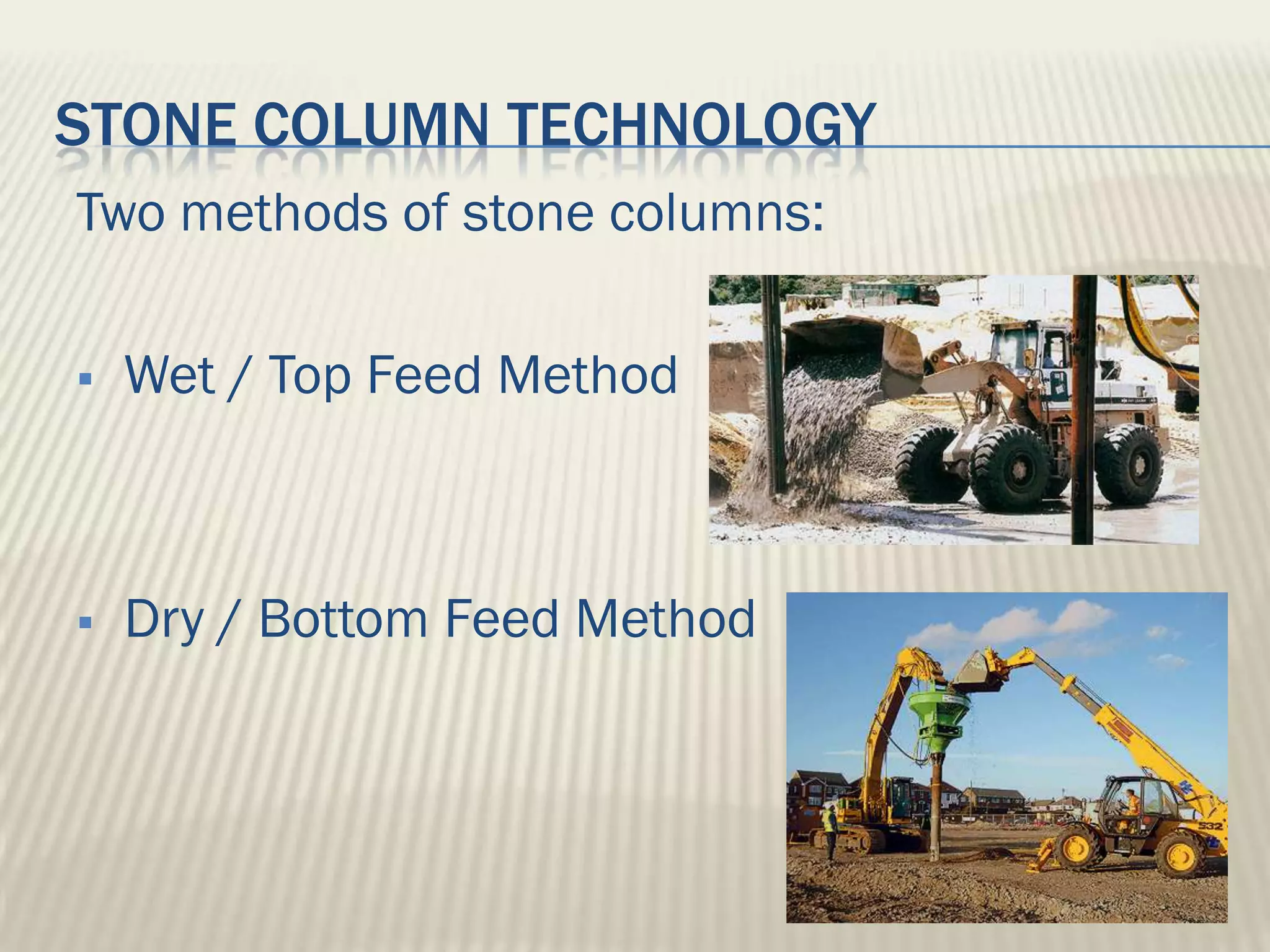
Two methods of stone columns:

   Wet / Top Feed Method


   Dry / Bottom Feed Method
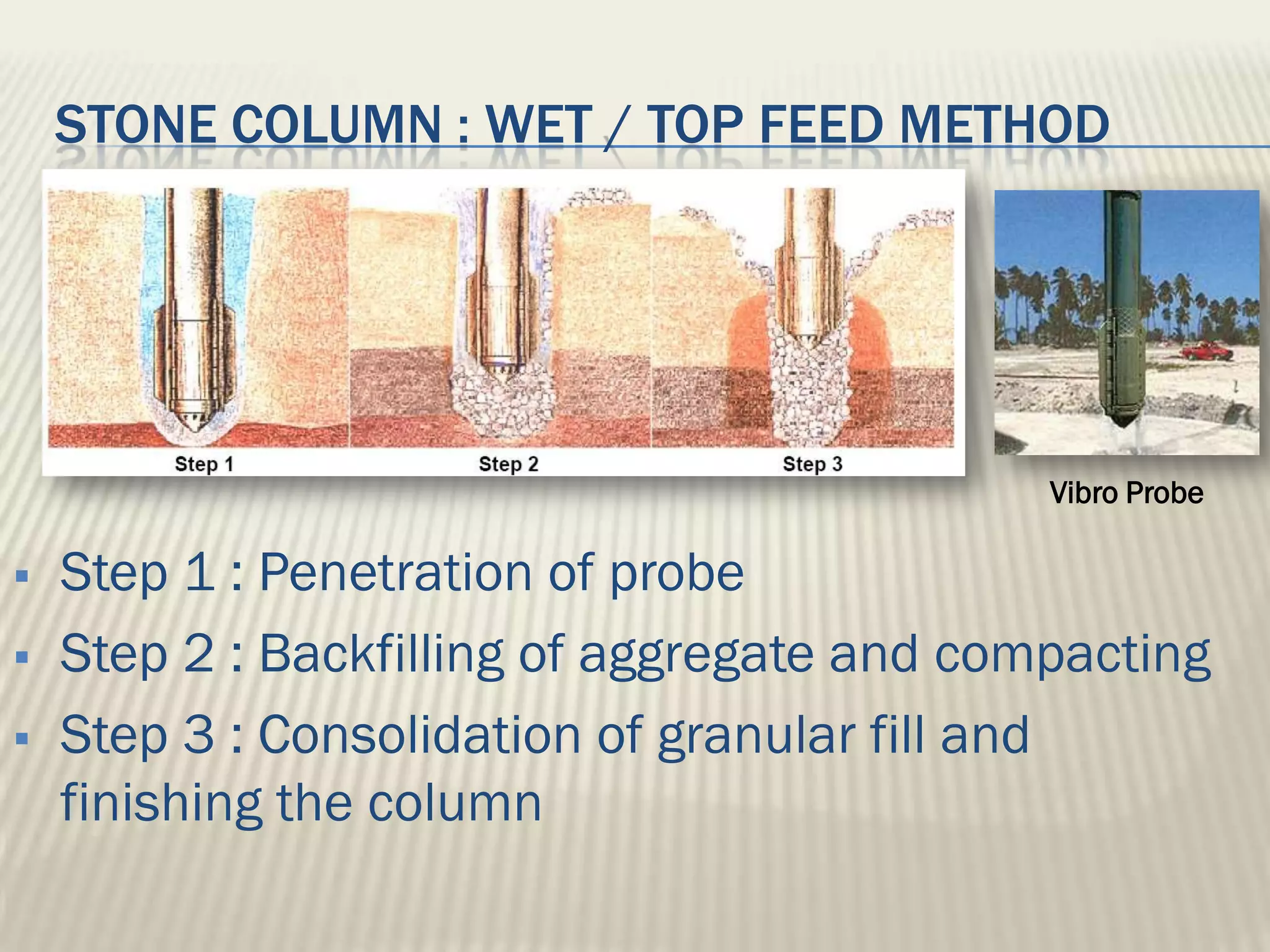
STONE COLUMN : WET / TOP FEED METHOD


                                             Vibro Probe

   Step 1 : Penetration of probe
   Step 2 : Backfilling of aggregate and compacting
   Step 3 : Consolidation of granular fill and
    finishing the column
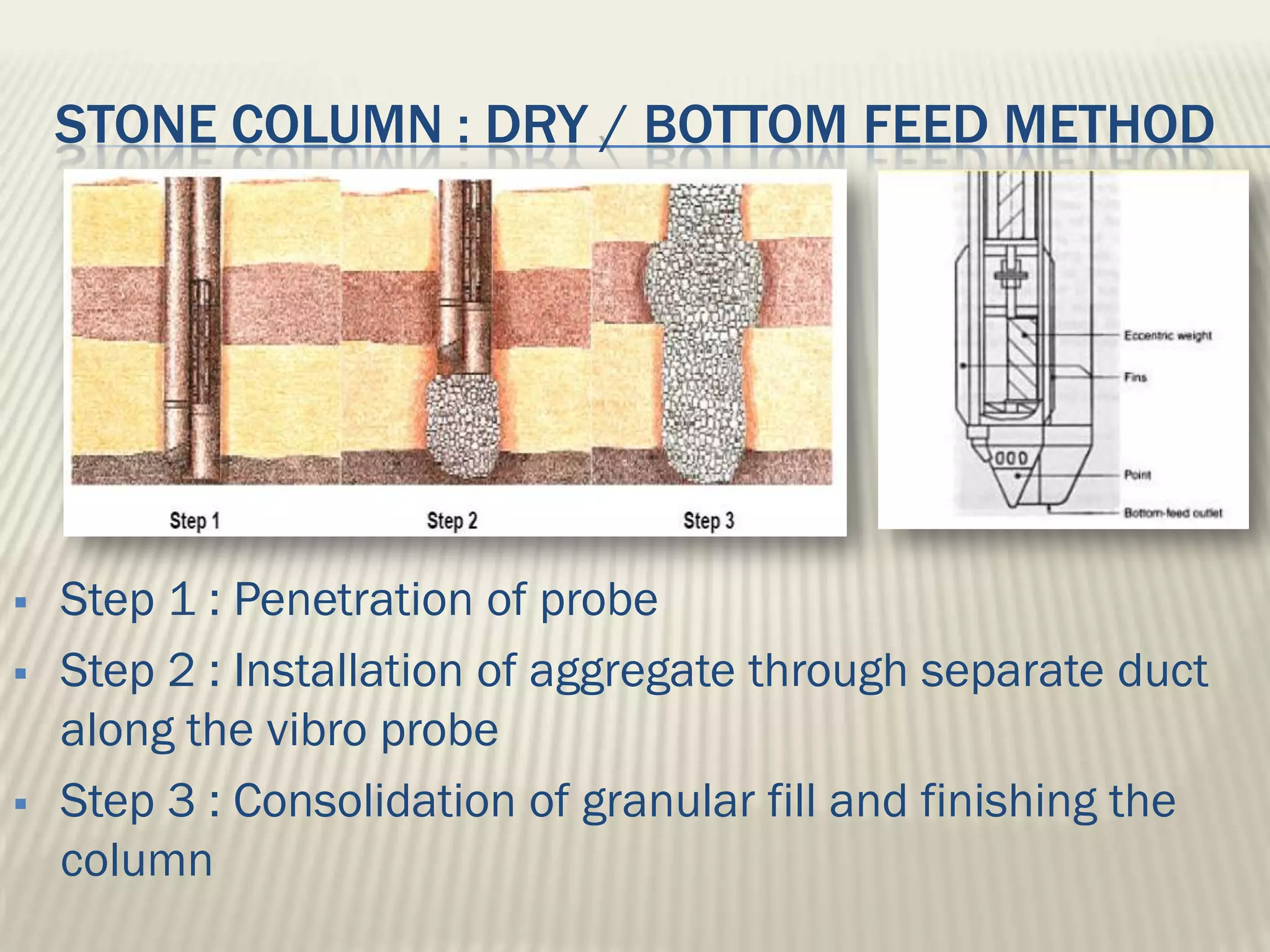
STONE COLUMN : DRY / BOTTOM FEED METHOD


   Step 1 : Penetration of probe
   Step 2 : Installation of aggregate through separate duct
    along the vibro probe
   Step 3 : Consolidation of granular fill and finishing the
    column
STONE COLUMN : ADVANTAGES

   Technically and potentially economical
    alternative for deep compaction.
   Alternative for dynamic compaction, deep
    blasting etc.,
   Quicker than preloading the site
    It increases the bearing capacity, reduces the
    settlements, liquefaction potential.
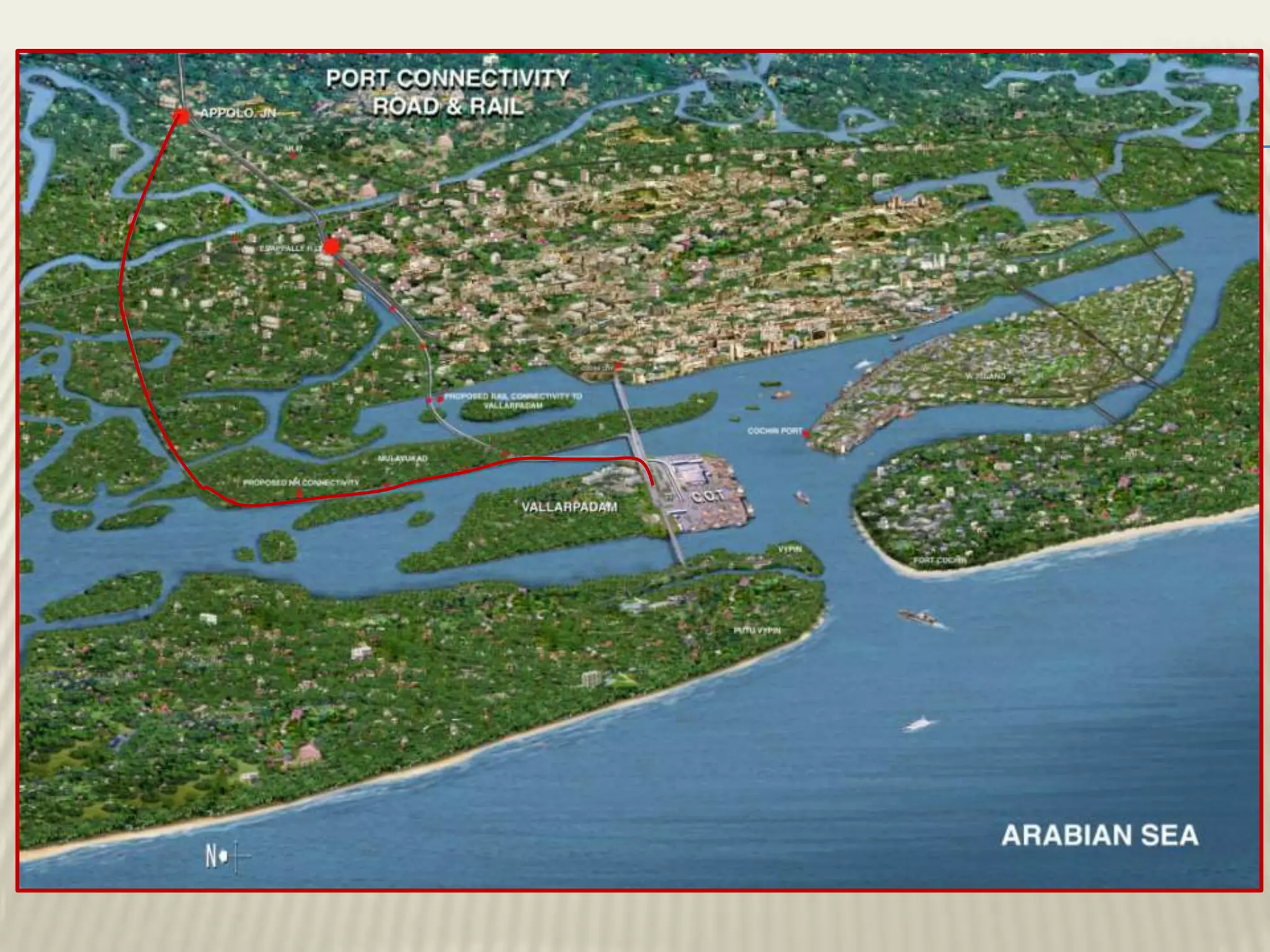
CASE STUDY:
    Four Lane National Highway Connectivity to ICTT –
    Vallarpadam, Kochi
   Connects NH - 47 and NH - 17.
   Project cost was revised from 329.46 cr to 571.20 cr due
    to ground improvement, bridges and retaining walls.
   Road Length – 17.2km, total length of bridges – 2.93km.
   Ground improvement works – 10km.
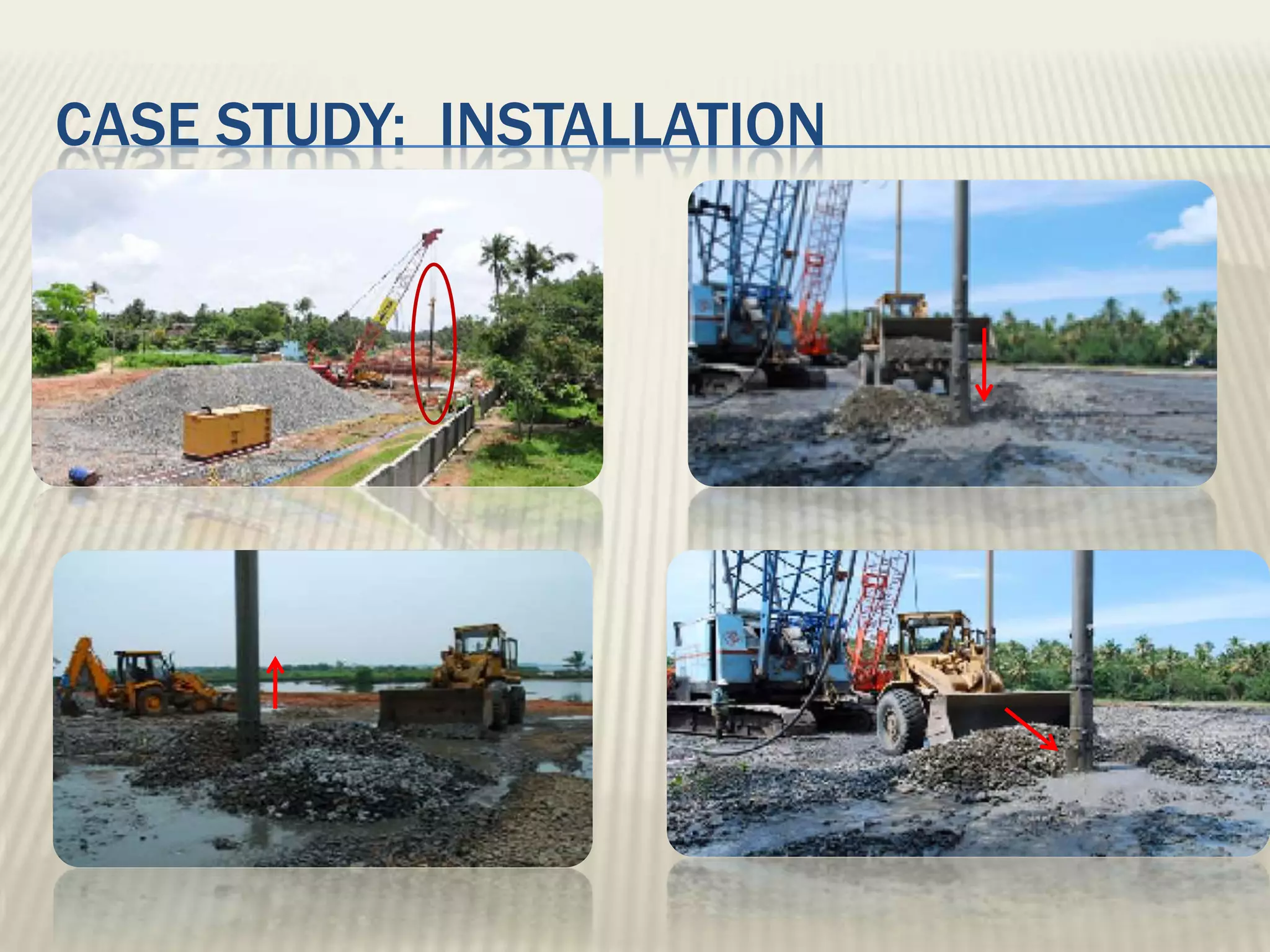
   Wet /Top method of installation was used.
   Stone columns where installed in 15 locations between
    Ch, 0.245 and 16.210
CASE STUDY: INSTALLATION
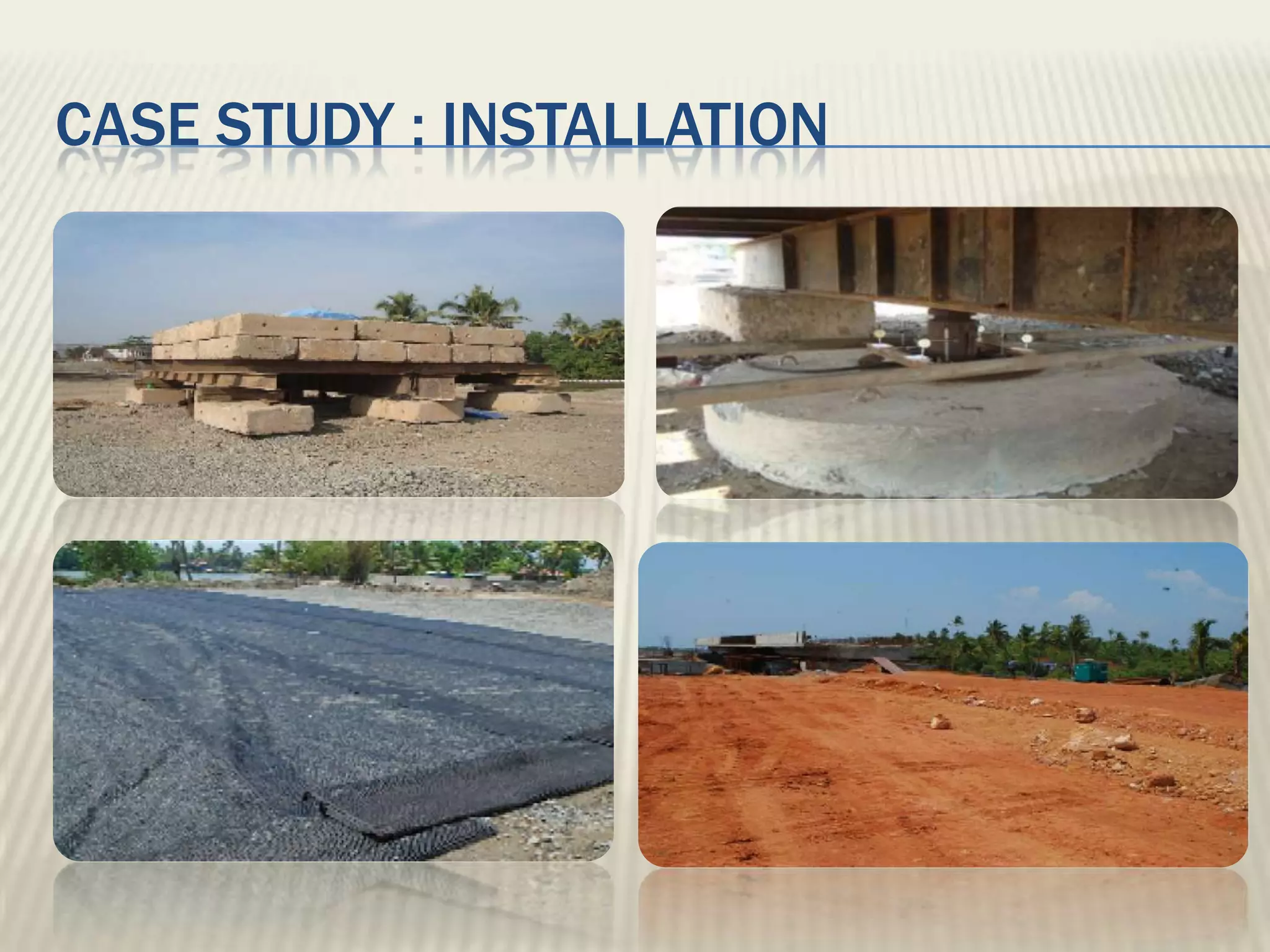
CASE STUDY : INSTALLATION
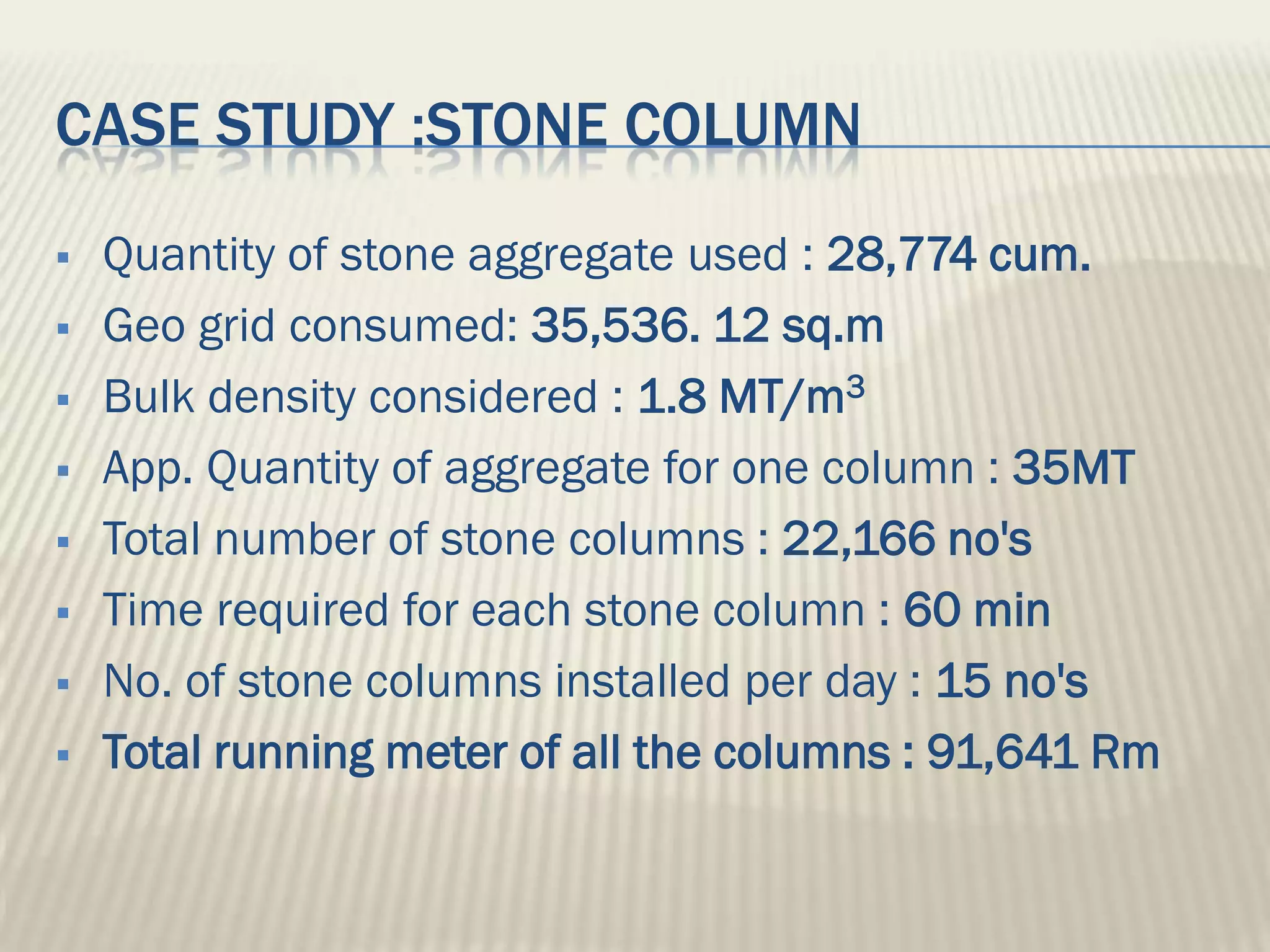
CASE STUDY :STONE COLUMN
   Quantity of stone aggregate used : 28,774 cum.
   Geo grid consumed: 35,536. 12 sq.m
   Bulk density considered : 1.8 MT/m3
   App. Quantity of aggregate for one column : 35MT
   Total number of stone columns : 22,166 no's
   Time required for each stone column : 60 min
   No. of stone columns installed per day : 15 no's
   Total running meter of all the columns : 91,641 Rm
BAND DRAIN TECHNOLOGY
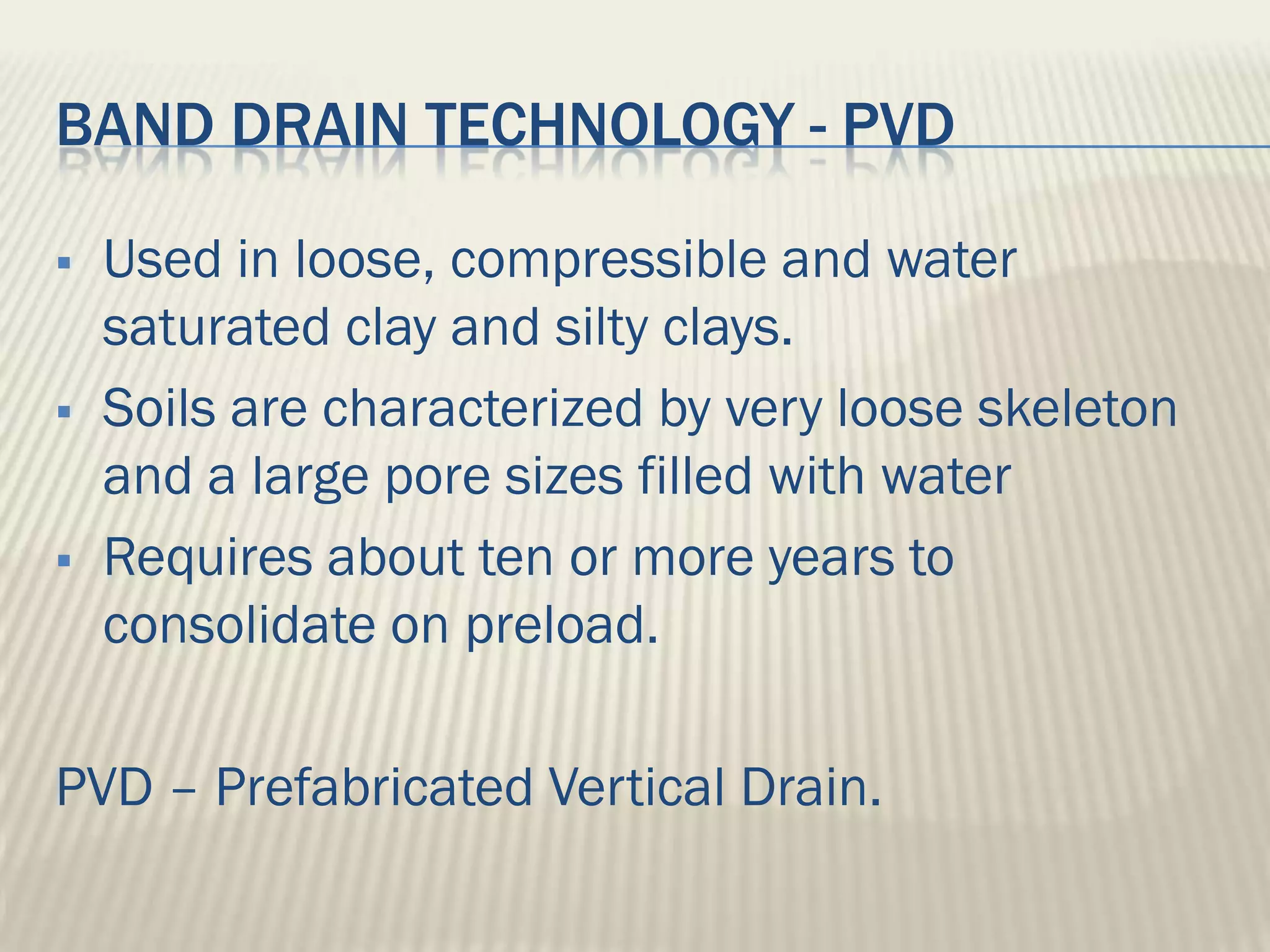
BAND DRAIN TECHNOLOGY - PVD

   Used in loose, compressible and water
    saturated clay and silty clays.
   Soils are characterized by very loose skeleton
    and a large pore sizes filled with water
   Requires about ten or more years to
    consolidate on preload.

PVD – Prefabricated Vertical Drain.
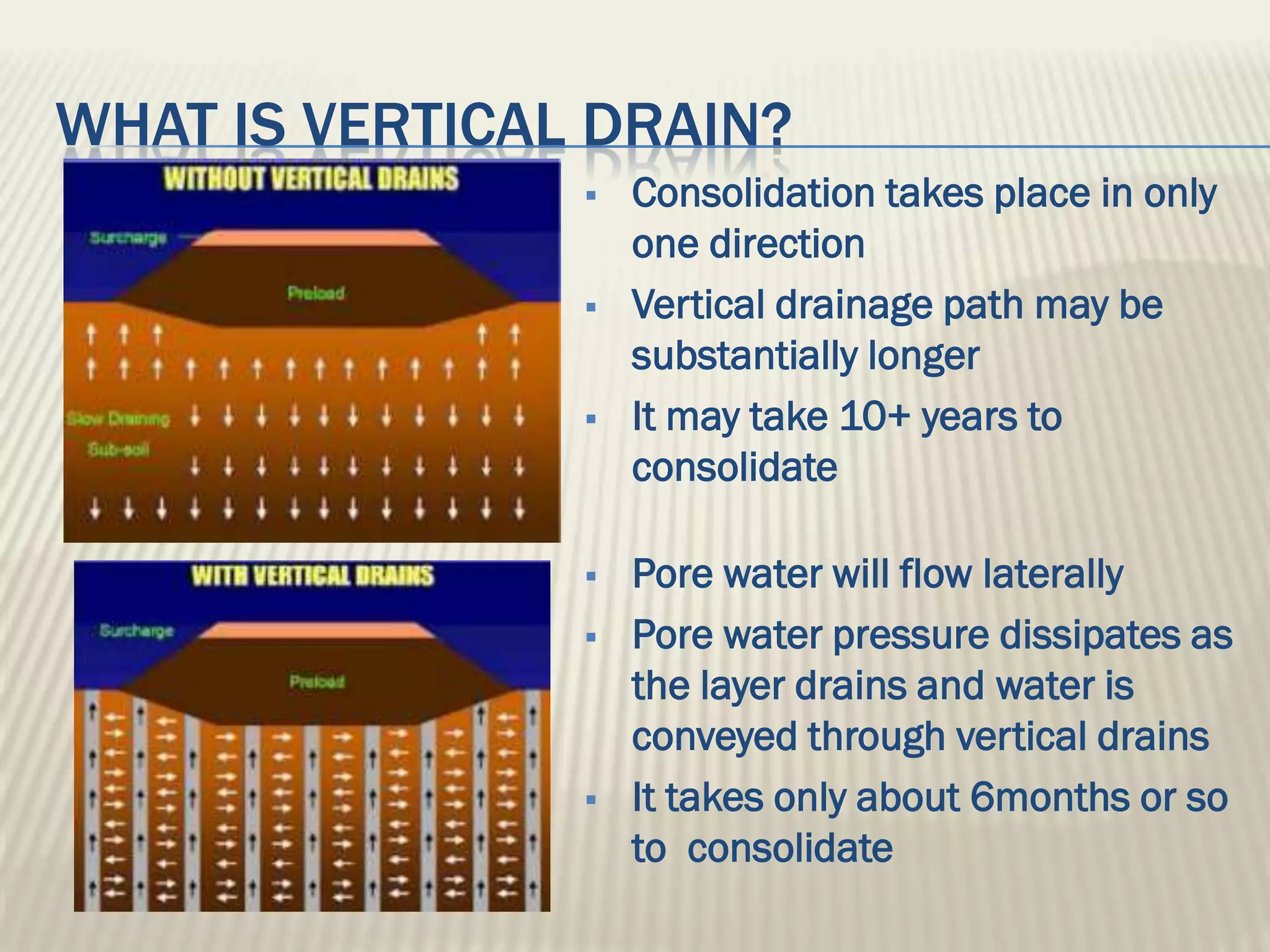
WHAT IS VERTICAL DRAIN?
                   Consolidation takes place in only
                    one direction
                   Vertical drainage path may be
                    substantially longer
                   It may take 10+ years to
                    consolidate

                   Pore water will flow laterally
                   Pore water pressure dissipates as
                    the layer drains and water is
                    conveyed through vertical drains
                   It takes only about 6months or so
                    to consolidate
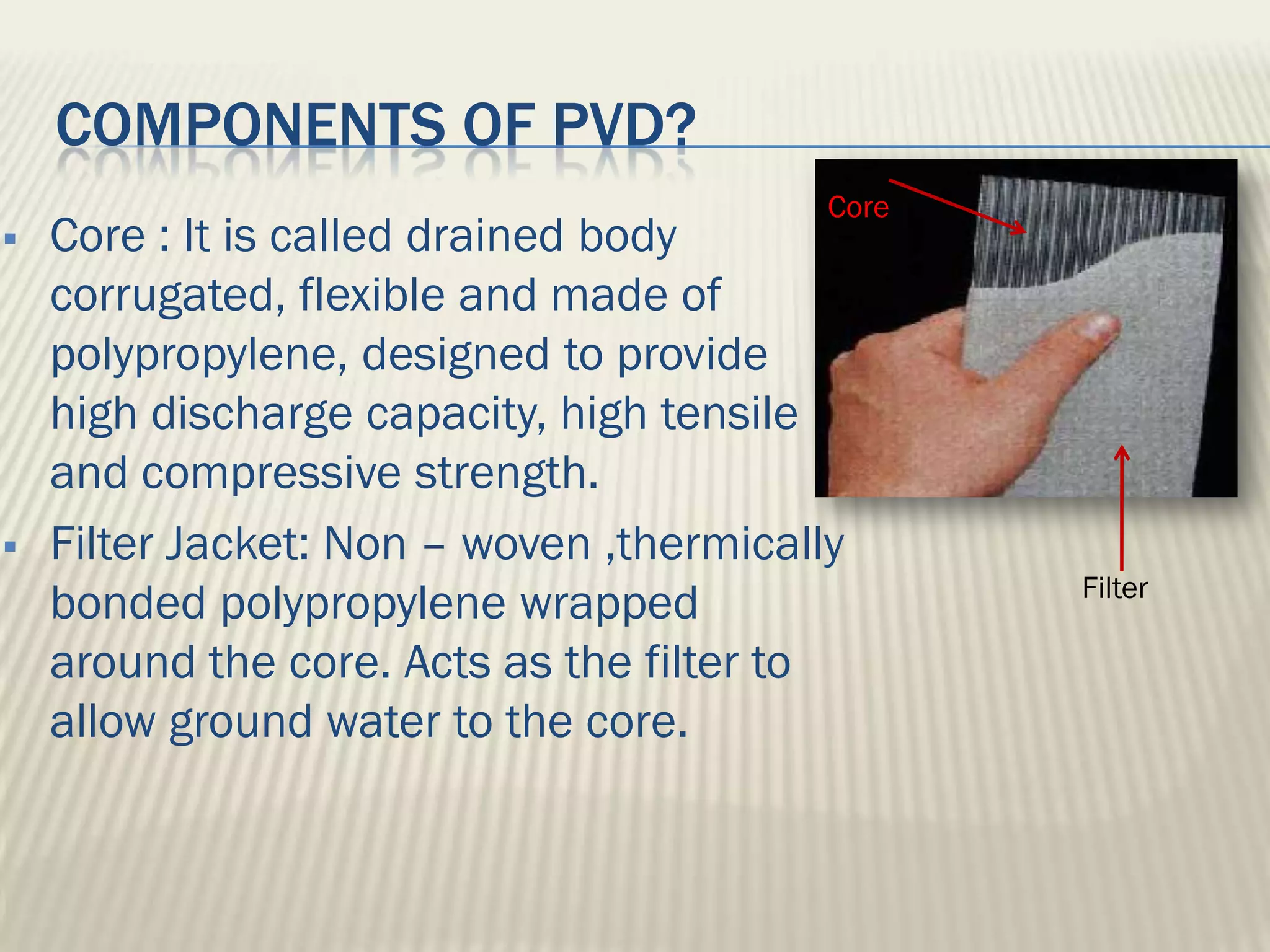
COMPONENTS OF PVD?
                                          Core
   Core : It is called drained body
    corrugated, flexible and made of
    polypropylene, designed to provide
    high discharge capacity, high tensile
    and compressive strength.
   Filter Jacket: Non – woven ,thermically
                                                 Filter
    bonded polypropylene wrapped
    around the core. Acts as the filter to
    allow ground water to the core.
ADVANTAGES OF BAND DRAIN TECHNOLOGY:

   Minimum disturbance to the soil layers during
    installation
   High water discharge capacity
   High tensile strength prevents the collapse of
    flow path.
   Fast and easy installation
   Deep installation up to 40m.
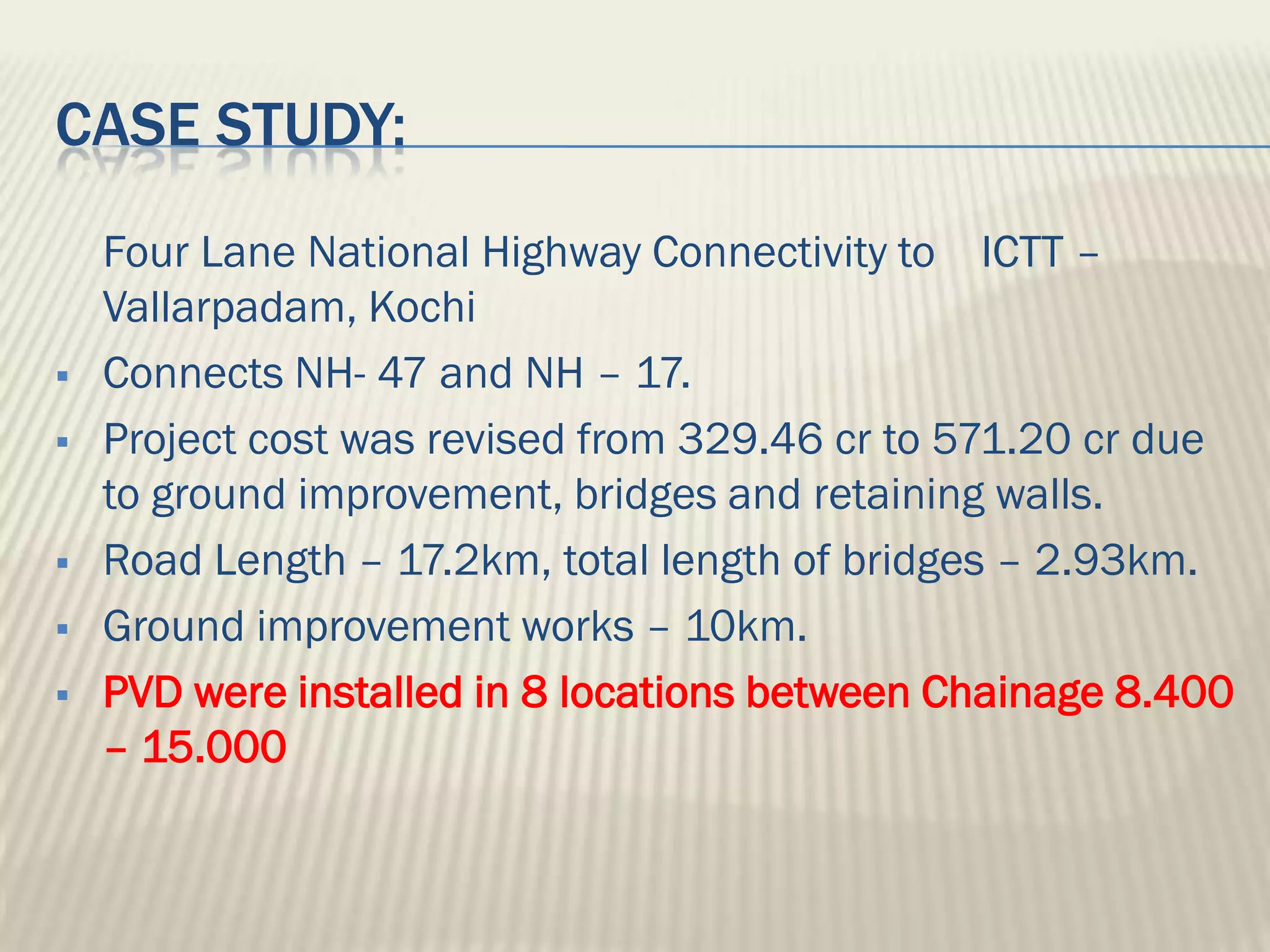
CASE STUDY:
    Four Lane National Highway Connectivity to ICTT –
    Vallarpadam, Kochi
   Connects NH- 47 and NH – 17.
   Project cost was revised from 329.46 cr to 571.20 cr due
    to ground improvement, bridges and retaining walls.
   Road Length – 17.2km, total length of bridges – 2.93km.
   Ground improvement works – 10km.
   PVD were installed in 8 locations between Chainage 8.400
    – 15.000
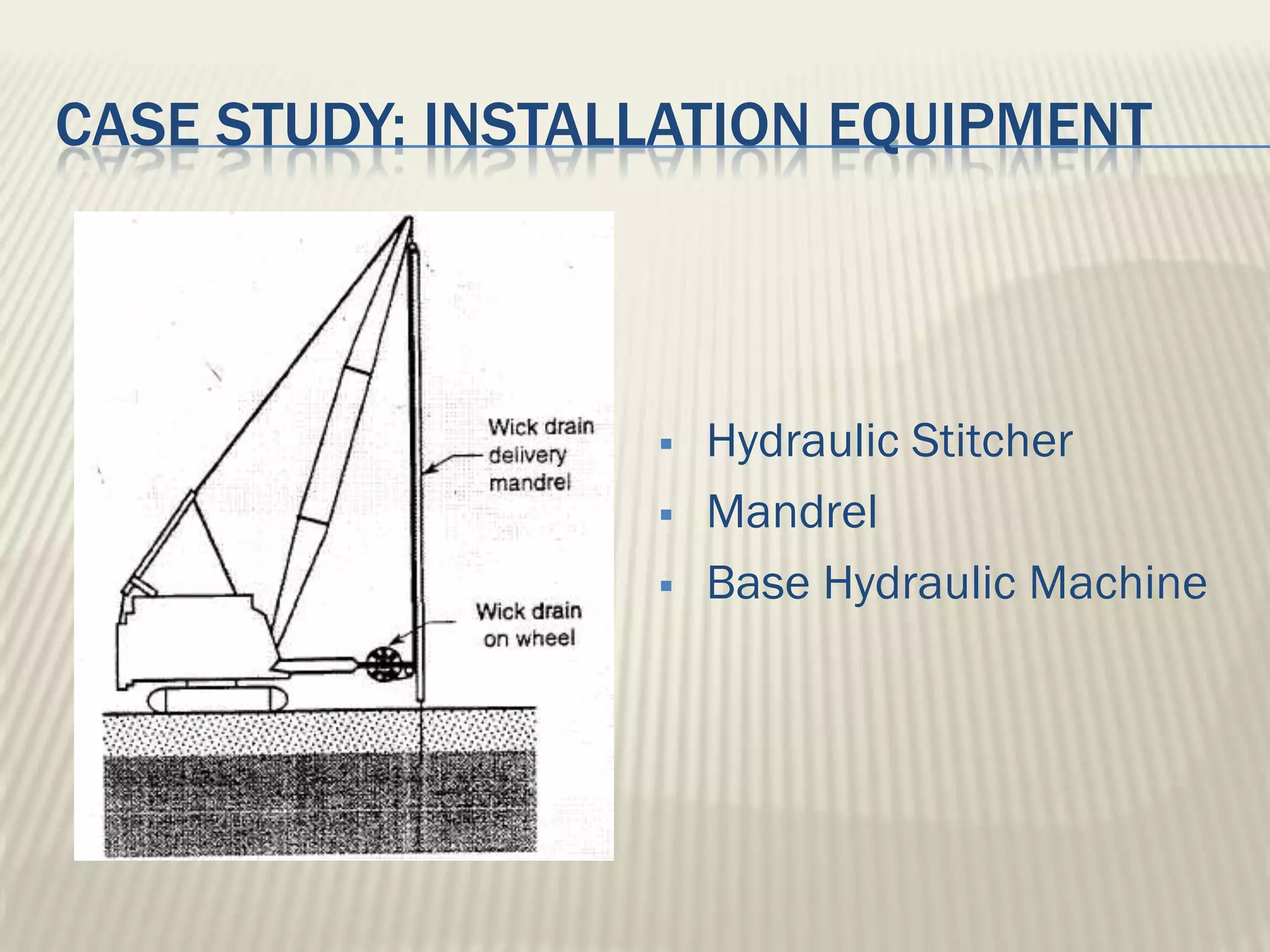
CASE STUDY: INSTALLATION EQUIPMENT


                     Hydraulic Stitcher
                     Mandrel
                     Base Hydraulic Machine
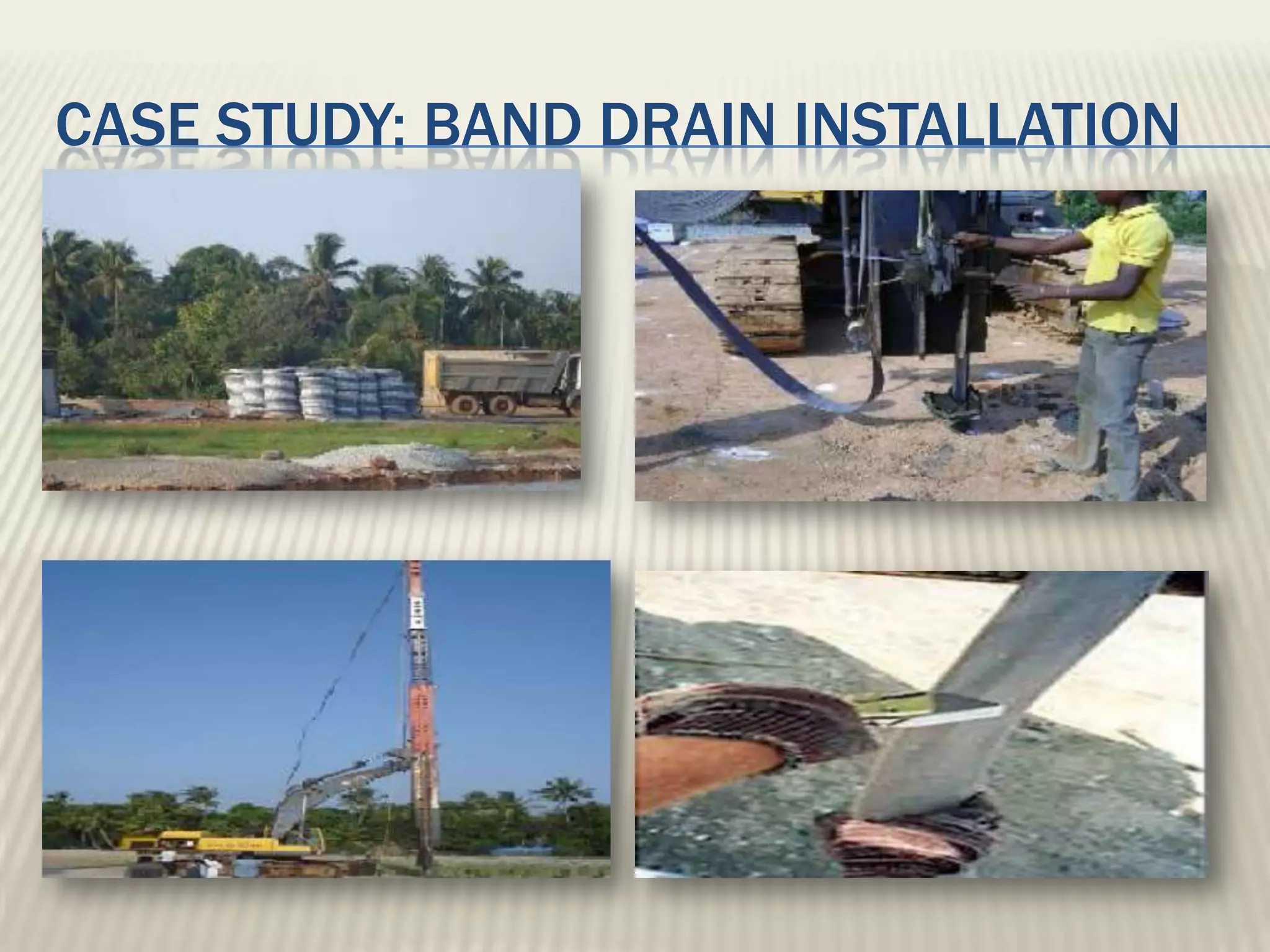
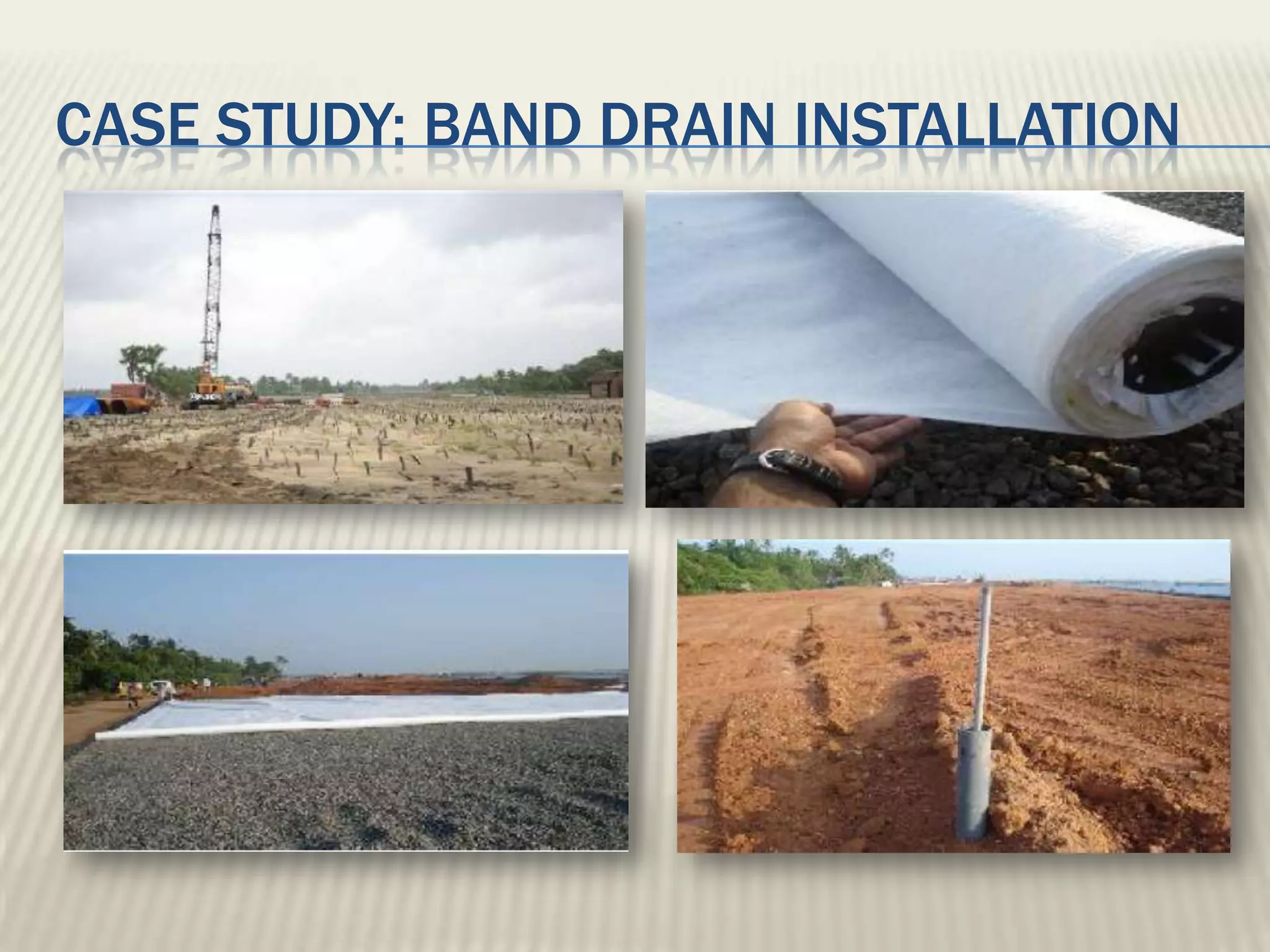
CASE STUDY: BAND DRAIN INSTALLATION
CASE STUDY: BAND DRAIN TECHNOLOGY
   Total length of band drains : 56,21,780 Rm
   Total Granular blanket : 1,23,386 Cum
   Total Geotextiles used : 3,90,714 sq.m
   Time taken for install one band drain of 25m : 1min
   Time taken for splicing the wick : 1 min
CASE STUDY: BAND DRAIN TECHNOLOGY

 After the installation of band
 drains, Casagrande peizometer and plate type
 settlement recorders where installed in order to
 check the settlements
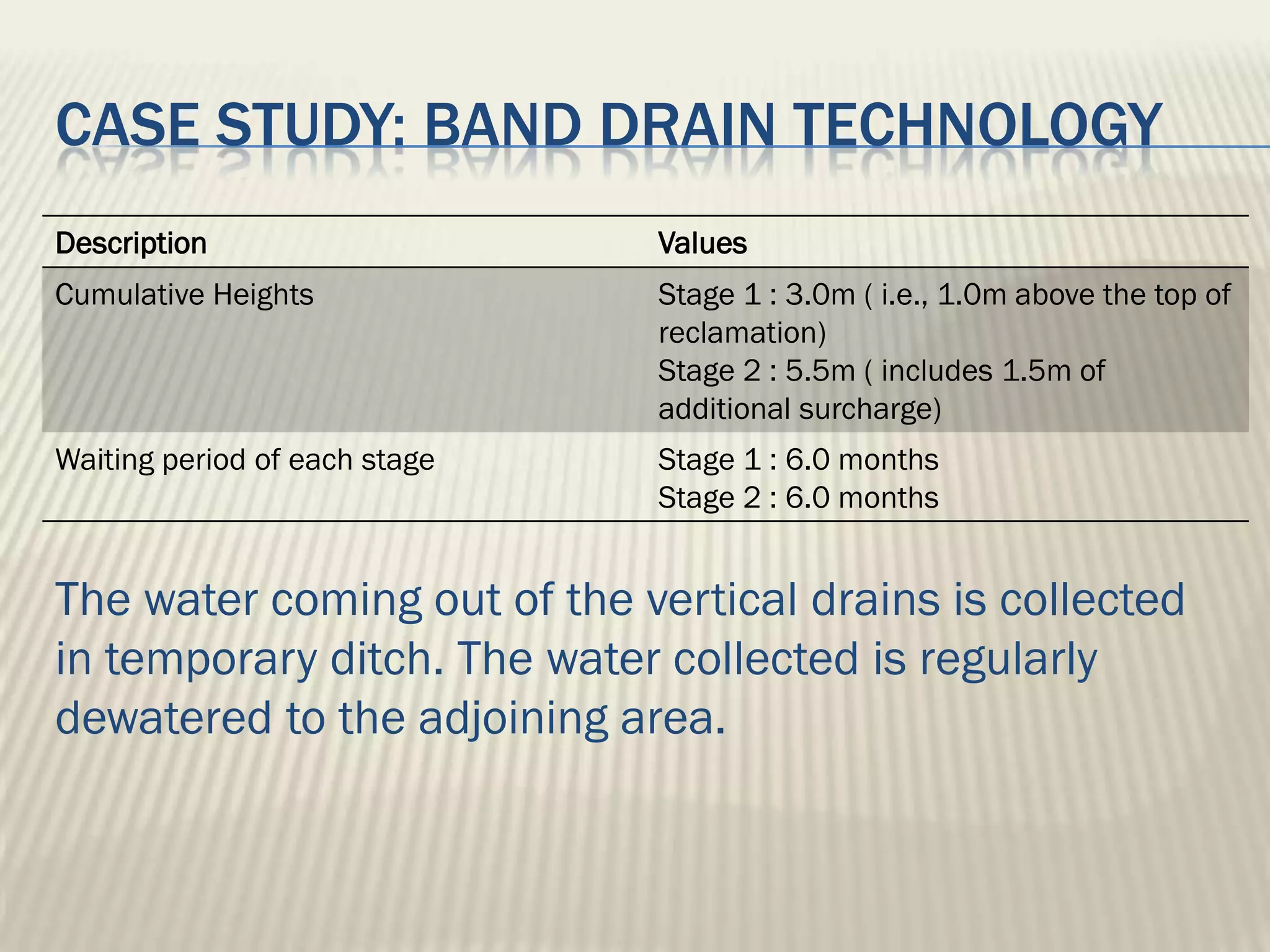
CASE STUDY: BAND DRAIN TECHNOLOGY
Description                    Values
Cumulative Heights             Stage 1 : 3.0m ( i.e., 1.0m above the top of
                               reclamation)
                               Stage 2 : 5.5m ( includes 1.5m of
                               additional surcharge)
Waiting period of each stage   Stage 1 : 6.0 months
                               Stage 2 : 6.0 months


The water coming out of the vertical drains is collected
in temporary ditch. The water collected is regularly
dewatered to the adjoining area.
THANK YOU!

Ground improvement techniques

  • 1.
    GROUND IMPROVEMENT TECHNOLOGY -STONE COLUMN TECHNOLOGY - BAND DRAIN TECHNOLOGY Sravan MV Engineer
  • 2.
    ALTERNATIVES FOR INADEQUATEGROUND?  Abandon the site and locate the structure elsewhere  Design deep foundations to carry the weight of the structure to competent stratum  Redesign the structure according to the ground conditions  Improve the properties of the ground prior to construction
  • 3.
    BASIC PRINCIPLE OFGROUND IMPROVEMENT Ground improvement is the modification of the ground properties in order to achieve the required ground conditions for the particular use of the ground.  Densification of the ground , E.g.: Compaction  Accelerate the consolidation, E.g.: Vertical drains  Usage of geo synthetics, E.g.: Geotextiles  Usage of admixtures, E.g.: Cement stabilization  Preloading  Mechanical Stabilization
  • 4.
  • 5.
    STONE COLUMN TECHNOLOGY  It is also known as Vibro replacement or Vibro displacement  Compacted aggregates form as a vertical columns to improve the soil conditions.  Resulting in considerable increase in vertical load capacity and to an extent contribute to as drains to dissipate pore water pressure.
  • 6.
    STONE COLUMN TECHNOLOGY Twomethods of stone columns:  Wet / Top Feed Method  Dry / Bottom Feed Method
  • 7.
    STONE COLUMN :WET / TOP FEED METHOD Vibro Probe  Step 1 : Penetration of probe  Step 2 : Backfilling of aggregate and compacting  Step 3 : Consolidation of granular fill and finishing the column
  • 8.
    STONE COLUMN :DRY / BOTTOM FEED METHOD  Step 1 : Penetration of probe  Step 2 : Installation of aggregate through separate duct along the vibro probe  Step 3 : Consolidation of granular fill and finishing the column
  • 9.
    STONE COLUMN :ADVANTAGES  Technically and potentially economical alternative for deep compaction.  Alternative for dynamic compaction, deep blasting etc.,  Quicker than preloading the site  It increases the bearing capacity, reduces the settlements, liquefaction potential.
  • 11.
    CASE STUDY: Four Lane National Highway Connectivity to ICTT – Vallarpadam, Kochi  Connects NH - 47 and NH - 17.  Project cost was revised from 329.46 cr to 571.20 cr due to ground improvement, bridges and retaining walls.  Road Length – 17.2km, total length of bridges – 2.93km.  Ground improvement works – 10km.  Wet /Top method of installation was used.  Stone columns where installed in 15 locations between Ch, 0.245 and 16.210
  • 12.
  • 13.
    CASE STUDY :INSTALLATION
  • 14.
    CASE STUDY :STONECOLUMN  Quantity of stone aggregate used : 28,774 cum.  Geo grid consumed: 35,536. 12 sq.m  Bulk density considered : 1.8 MT/m3  App. Quantity of aggregate for one column : 35MT  Total number of stone columns : 22,166 no's  Time required for each stone column : 60 min  No. of stone columns installed per day : 15 no's  Total running meter of all the columns : 91,641 Rm
  • 15.
  • 16.
    BAND DRAIN TECHNOLOGY- PVD  Used in loose, compressible and water saturated clay and silty clays.  Soils are characterized by very loose skeleton and a large pore sizes filled with water  Requires about ten or more years to consolidate on preload. PVD – Prefabricated Vertical Drain.
  • 17.
    WHAT IS VERTICALDRAIN?  Consolidation takes place in only one direction  Vertical drainage path may be substantially longer  It may take 10+ years to consolidate  Pore water will flow laterally  Pore water pressure dissipates as the layer drains and water is conveyed through vertical drains  It takes only about 6months or so to consolidate
  • 18.
    COMPONENTS OF PVD? Core  Core : It is called drained body corrugated, flexible and made of polypropylene, designed to provide high discharge capacity, high tensile and compressive strength.  Filter Jacket: Non – woven ,thermically Filter bonded polypropylene wrapped around the core. Acts as the filter to allow ground water to the core.
  • 19.
    ADVANTAGES OF BANDDRAIN TECHNOLOGY:  Minimum disturbance to the soil layers during installation  High water discharge capacity  High tensile strength prevents the collapse of flow path.  Fast and easy installation  Deep installation up to 40m.
  • 20.
    CASE STUDY: Four Lane National Highway Connectivity to ICTT – Vallarpadam, Kochi  Connects NH- 47 and NH – 17.  Project cost was revised from 329.46 cr to 571.20 cr due to ground improvement, bridges and retaining walls.  Road Length – 17.2km, total length of bridges – 2.93km.  Ground improvement works – 10km.  PVD were installed in 8 locations between Chainage 8.400 – 15.000
  • 21.
    CASE STUDY: INSTALLATIONEQUIPMENT  Hydraulic Stitcher  Mandrel  Base Hydraulic Machine
  • 22.
    CASE STUDY: BANDDRAIN INSTALLATION
  • 23.
    CASE STUDY: BANDDRAIN INSTALLATION
  • 24.
    CASE STUDY: BANDDRAIN TECHNOLOGY  Total length of band drains : 56,21,780 Rm  Total Granular blanket : 1,23,386 Cum  Total Geotextiles used : 3,90,714 sq.m  Time taken for install one band drain of 25m : 1min  Time taken for splicing the wick : 1 min
  • 25.
    CASE STUDY: BANDDRAIN TECHNOLOGY After the installation of band drains, Casagrande peizometer and plate type settlement recorders where installed in order to check the settlements
  • 26.
    CASE STUDY: BANDDRAIN TECHNOLOGY Description Values Cumulative Heights Stage 1 : 3.0m ( i.e., 1.0m above the top of reclamation) Stage 2 : 5.5m ( includes 1.5m of additional surcharge) Waiting period of each stage Stage 1 : 6.0 months Stage 2 : 6.0 months The water coming out of the vertical drains is collected in temporary ditch. The water collected is regularly dewatered to the adjoining area.
  • 27.