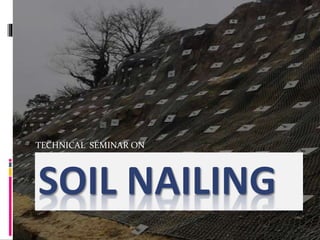
SOIL NAILING
TECHNICAL SEMINAR ON
OVERVEIW
1. INTRODUCTION
2. ORIGIN
3. APPLICATIONS
4. ADVANTAGES
5. LIMITATIONS
6. CONSTRUCTION SEQUENCE
7. TYPICAL SOIL NAIL DETAIL
8. MECHANISM OF SOIL NAILING
9. METHODS OF SOIL NAILING
10. EXAMPLE
11. CONCLUSION
Introduction
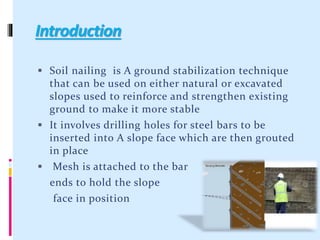
 Soil nailing is A ground stabilization technique
that can be used on either natural or excavated
slopes used to reinforce and strengthen existing
ground to make it more stable
 It involves drilling holes for steel bars to be
inserted into A slope face which are then grouted
in place
 Mesh is attached to the bar
ends to hold the slope
face in position
Origin
 Soil Nailing evolved from the new Austrian
Tunneling method which is a system for
underground excavation in rock.
 This concept of combining passive steel
reinforcement and shortcrete has also been
applied to the stabilisation of rock slopes since
the early 1960’s.
 The first appilication of soil nailing was
implemented in 1972 for a rail road widening
project near Versailles, France.
Contd…
 The technique included installing high-density
grouted soil nails into 60 ft high wall and facing it
with reinforced concrete.
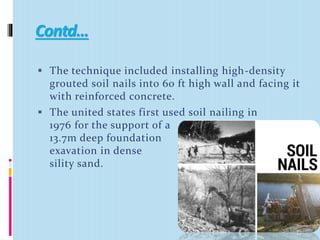
 The united states first used soil nailing in
1976 for the support of a
13.7m deep foundation
exavation in dense
sility sand.
Applications
 Remedial measure to stabilise embankments, and
so on
 Temporary excavation shoring
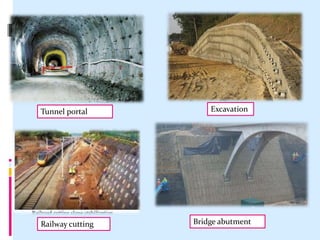
 Tunnel portals
 Roadway cuts
 Under bridge abutments
 Repair and reconstruction of existing retaining
structures
Tunnel portal Excavation
Railway cutting Bridge abutment
ADVANTAGES
 They are good for confined spaces with
restricted access
 There is less environmental impact
 They are relatively quick and easy to install
 They use less material and shoring
 They are flexible enough to be used on new
constructions , temperory structures or on
remoulding processes
 The height is not restricted
 Not suitable for areas with higher water table
 In soils of low shear strength , very high soil nail
density may be required
 Not suitable for permanent use in sensitive and
expansive soils
 Specialist contractors are required
 Extensive 3D modelling may be required
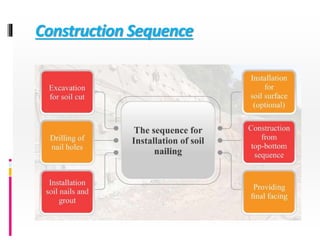
Construction Sequence
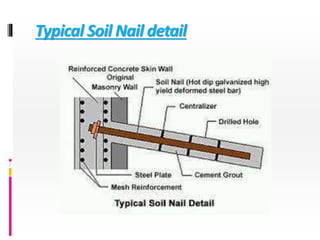
Typical Soil Nail detail
Mechanism of Soil Nailing
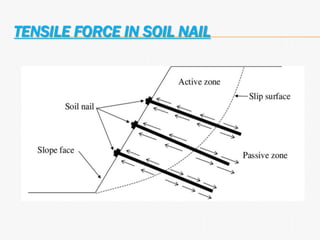
 The soil nail system can be divided into active
and passive region.
 During the slope failure, active region tends to
deform which results in axial displacement
along soil nails which are placed across the
slip plane.
 This results in the development of tensile
forces in soil nail in the passive zone which
resists the deformation of active zone.
 This tension force results in increment of the
normal force coming on slip plane and reduces
the driving shear force.
TENSILE FORCE IN SOIL NAIL
Mechanism of Soil Nailing
Soil nails improve slope stability by:
i. Partial increase in the normal force
and shear resistance along potential
slip surface in frictional soils.
ii. Direct reduction of driving force
along potential slip surface for
cohesive and frictional soils.
iii. Soil nail head and facing provides
containment effect to limit the
deformation near slope surface.
Methods of Soil Nailing
 Drilled and Grouted Soil Nailing
 Driven Soil Nailing
 Self Drilling Soil Nailing
 Jet Grouted Soil Nailing
 Launched Soil Nailing
Drilled and Grouted soil nailing
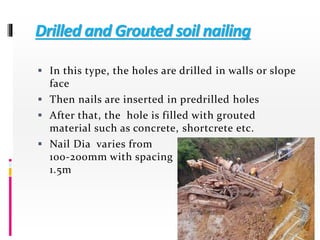
 In this type, the holes are drilled in walls or slope
face
 Then nails are inserted in predrilled holes
 After that, the hole is filled with grouted
material such as concrete, shortcrete etc.
 Nail Dia varies from
100-200mm with spacing of
1.5m
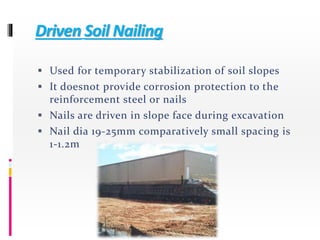
Driven Soil Nailing
 Used for temporary stabilization of soil slopes
 It doesnot provide corrosion protection to the
reinforcement steel or nails
 Nails are driven in slope face during excavation
 Nail dia 19-25mm comparatively small spacing is
1-1.2m
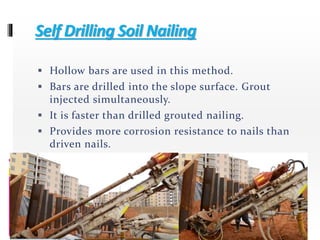
Self Drilling Soil Nailing
 Hollow bars are used in this method.
 Bars are drilled into the slope surface. Grout
injected simultaneously.
 It is faster than drilled grouted nailing.
 Provides more corrosion resistance to nails than
driven nails.
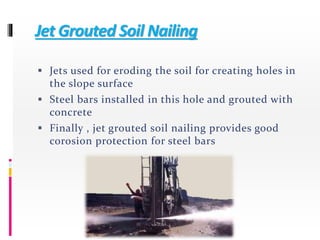
Jet Grouted Soil Nailing
 Jets used for eroding the soil for creating holes in
the slope surface
 Steel bars installed in this hole and grouted with
concrete
 Finally , jet grouted soil nailing provides good
corosion protection for steel bars
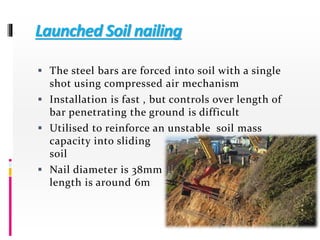
Launched Soil nailing
 The steel bars are forced into soil with a single
shot using compressed air mechanism
 Installation is fast , but controls over length of
bar penetrating the ground is difficult
 Utilised to reinforce an unstable soil mass
capacity into sliding
soil
 Nail diameter is 38mm
length is around 6m
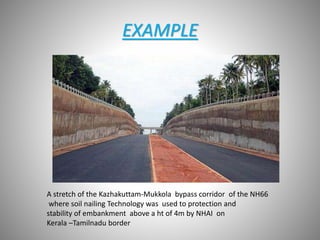
EXAMPLE
A stretch of the Kazhakuttam-Mukkola bypass corridor of the NH66
where soil nailing Technology was used to protection and
stability of embankment above a ht of 4m by NHAI on
Kerala –Tamilnadu border
Conclusion
 Soil nailing is a potential solution of land slide
problems as it is economical and also
applicable in seismic zones.
 It can solve the problem of residential area
upto a great extent.
 It can be used in wide soil types.
Soil nailing

Soil nailing

  • 1.
  • 2.
    OVERVEIW 1. INTRODUCTION 2. ORIGIN 3.APPLICATIONS 4. ADVANTAGES 5. LIMITATIONS 6. CONSTRUCTION SEQUENCE 7. TYPICAL SOIL NAIL DETAIL 8. MECHANISM OF SOIL NAILING 9. METHODS OF SOIL NAILING 10. EXAMPLE 11. CONCLUSION
  • 3.
    Introduction  Soil nailingis A ground stabilization technique that can be used on either natural or excavated slopes used to reinforce and strengthen existing ground to make it more stable  It involves drilling holes for steel bars to be inserted into A slope face which are then grouted in place  Mesh is attached to the bar ends to hold the slope face in position
  • 4.
    Origin  Soil Nailingevolved from the new Austrian Tunneling method which is a system for underground excavation in rock.  This concept of combining passive steel reinforcement and shortcrete has also been applied to the stabilisation of rock slopes since the early 1960’s.  The first appilication of soil nailing was implemented in 1972 for a rail road widening project near Versailles, France.
  • 5.
    Contd…  The techniqueincluded installing high-density grouted soil nails into 60 ft high wall and facing it with reinforced concrete.  The united states first used soil nailing in 1976 for the support of a 13.7m deep foundation exavation in dense sility sand.
  • 6.
    Applications  Remedial measureto stabilise embankments, and so on  Temporary excavation shoring  Tunnel portals  Roadway cuts  Under bridge abutments  Repair and reconstruction of existing retaining structures
  • 7.
    Tunnel portal Excavation Railwaycutting Bridge abutment
  • 8.
    ADVANTAGES  They aregood for confined spaces with restricted access  There is less environmental impact  They are relatively quick and easy to install  They use less material and shoring  They are flexible enough to be used on new constructions , temperory structures or on remoulding processes  The height is not restricted
  • 9.
     Not suitablefor areas with higher water table  In soils of low shear strength , very high soil nail density may be required  Not suitable for permanent use in sensitive and expansive soils  Specialist contractors are required  Extensive 3D modelling may be required
  • 10.
  • 12.
  • 13.
    Mechanism of SoilNailing  The soil nail system can be divided into active and passive region.  During the slope failure, active region tends to deform which results in axial displacement along soil nails which are placed across the slip plane.  This results in the development of tensile forces in soil nail in the passive zone which resists the deformation of active zone.  This tension force results in increment of the normal force coming on slip plane and reduces the driving shear force.
  • 14.
  • 15.
    Mechanism of SoilNailing Soil nails improve slope stability by: i. Partial increase in the normal force and shear resistance along potential slip surface in frictional soils. ii. Direct reduction of driving force along potential slip surface for cohesive and frictional soils. iii. Soil nail head and facing provides containment effect to limit the deformation near slope surface.
  • 16.
    Methods of SoilNailing  Drilled and Grouted Soil Nailing  Driven Soil Nailing  Self Drilling Soil Nailing  Jet Grouted Soil Nailing  Launched Soil Nailing
  • 17.
    Drilled and Groutedsoil nailing  In this type, the holes are drilled in walls or slope face  Then nails are inserted in predrilled holes  After that, the hole is filled with grouted material such as concrete, shortcrete etc.  Nail Dia varies from 100-200mm with spacing of 1.5m
  • 18.
    Driven Soil Nailing Used for temporary stabilization of soil slopes  It doesnot provide corrosion protection to the reinforcement steel or nails  Nails are driven in slope face during excavation  Nail dia 19-25mm comparatively small spacing is 1-1.2m
  • 19.
    Self Drilling SoilNailing  Hollow bars are used in this method.  Bars are drilled into the slope surface. Grout injected simultaneously.  It is faster than drilled grouted nailing.  Provides more corrosion resistance to nails than driven nails.
  • 20.
    Jet Grouted SoilNailing  Jets used for eroding the soil for creating holes in the slope surface  Steel bars installed in this hole and grouted with concrete  Finally , jet grouted soil nailing provides good corosion protection for steel bars
  • 21.
    Launched Soil nailing The steel bars are forced into soil with a single shot using compressed air mechanism  Installation is fast , but controls over length of bar penetrating the ground is difficult  Utilised to reinforce an unstable soil mass capacity into sliding soil  Nail diameter is 38mm length is around 6m
  • 22.
    EXAMPLE A stretch ofthe Kazhakuttam-Mukkola bypass corridor of the NH66 where soil nailing Technology was used to protection and stability of embankment above a ht of 4m by NHAI on Kerala –Tamilnadu border
  • 23.
    Conclusion  Soil nailingis a potential solution of land slide problems as it is economical and also applicable in seismic zones.  It can solve the problem of residential area upto a great extent.  It can be used in wide soil types.