FOR CONSOLIDATION SETTELEMENT
REPORT BY:-
KABRUTI SUBHAM NAYAK
1101110022
CONTENTS
 INTRODUCTION
 BREIF HISTORY
 CONSOLIDATION
 APPROCH
 APPLICATION
 ADVANTAGES
 DISADVANTAGES
 CONCLUSION
 REFERENCE
INTRODUCTION
Soils are deposited or formed under
different environmental conditions.
Man does not have any control on the
process of soil formation.
So, we need to accept as they are and
any construction has to be adapted to
suit the subsoil consideration.
The existing soil at a given site maynot
be suitable for supporting structures like
buildings, bridges, dams etc. because of
safe bearing capacity of soil may not be
adequate to support the provided load.
Although pile foundations may be
adapted in some situation, which often
became too high for low to medium rise
buildings.
IN THAT CASE AN ENGINEER WILL
GO FOR THE FOLLOWING
STEPS……
i. Change the site.
ii. Change the structural design.
iii. Increase expenses.
iv. Go for ground
improvement technique.
GROUND IMPROVEMENT
TECHNIQUES
•Ground improvement in its broadest sense
is the alteration of any property of a soil to
improve its engineering performance.
•Ground improvement for the purpose of
foundation essentially means increasing the
shear strength of the soil and also density of
soil and to decrease the compressibility,
permeability and the settlement, which
makes the soil more water resistance,
durable, and stable.
HISTORY
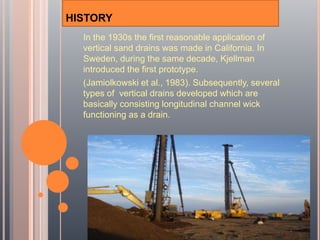
In the 1930s the first reasonable application of
vertical sand drains was made in California. In
Sweden, during the same decade, Kjellman
introduced the first prototype.
(Jamiolkowski et al., 1983). Subsequently, several
types of vertical drains developed which are
basically consisting longitudinal channel wick
functioning as a drain.
CONSOLIDATION OF SOIL
Consolidation is a process by which soils decrease
in volume.
According to ”Karl von Terzaghi” consolidation is any
process which involves a decrease in water content of
saturated soil without replacement of water by air.
In general it is the process in which reduction in
volume takes place by expulsion of water under long
term static loads.
It occurs when stress is applied to a soil that causes
the soil particles to pack together more tightly, therefore
reducing its bulk volume.
When this occurs in a soil that is saturated with water,
water will be squeezed out of the soil.
 When stress is removed from a consolidated soil, the soil
will rebound, regaining some of the volume it had lost in
the consolidation process.
 If the stress is reapplied, the soil will consolidate again
along a recompression curve, defined by the
recompression index.
 The highest stress that it has been subjected to is termed
the pre consolidation stress.
 The over consolidation ratio or OCR is defined as the
highest stress experienced divided by the current stress.
 A soil which is currently experiencing its highest stress is
said to be normally consolidated and to have an OCR of
one.
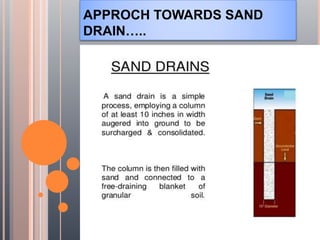
APPROCH TOWARDS SAND
DRAIN…..
Because of its low permeability, the
consolidation settlement of soft clays takes a
long time to complete.
To shorten the consolidation time, vertical
drains are installed together with preloading
either by an embankment or by means of vacuum
pressure.
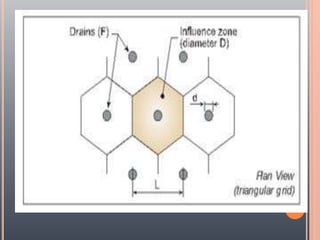
Vertical drains are artificially-created drainage
paths which are inserted into the soft clay
subsoil.
Thus, the pore water squeezed out during
consolidation of the clay due to the hydraulic
gradients created by the preloading, can flow
faster in the horizontal direction towards the
vertical drains.
It is taken advantage of the fact, that most
clay deposits exhibit a higher horizontal
permeability compared to the vertical.
Subsequently, these pore water can flow
freely along the vertical drains vertically
towards the permeable layers.
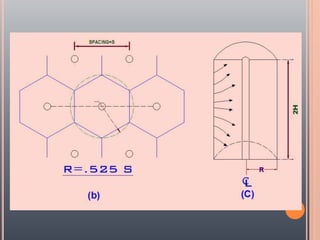
Therefore, the vertical drain installation
reduces the length of the drainage path
and, consequently, accelerates the
consolidation process and allows the clay
to gain rapid strength increase to carry the
new load by its own.
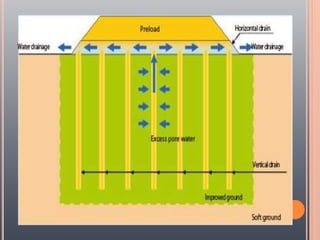
IN ORDER TO ACCELERATE THE PROCESS OF CONSOLIDATION SETTLEMENT FOR THE
CONSTRUCTION OF SOME STRUCTURE, THE USEFUL TECHNIQUE OF BUILDING SAND
DRAINS CAN BE USED.
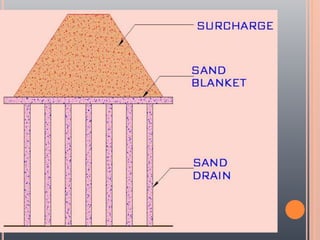
SAND DRAINS ARE CONSTRUCTED BY DRIVING DOWN CASINGS OR HOLLOW
MANDRELS INTO THE SOIL.
THE HOLES ARE THEN FILLED WITH SAND, AFTER WHICH THE CASINGS ARE PARALLEL
OUT.
WHEN A SURCHARGE IS APPLIED AT GROUND SURFACE, THE PORE WATER PRESSURE
IN THE CLAY WILL INCREASE, AND THERE WILL BE DRAINAGE IN THE VERTICAL AND
HORIZONTAL DIRECTIONS.
THE HORIZONTAL DRAINAGE IS INDUCED BY THE SAND DRAINS. HENCE, THE
PROCESS OF DISSIPATION OF EXCESS PORE WATER PRESSURE CREATED BY THE
LOADING (AND HENCE THE SETTLEMENT) IS ACCELERATED.
Airport Runways
Golf Courses
Mine Tailings Consolidation
Tailing Ponds
Swampland/Wetland Development
Building Foundations
Retaining Walls
Parking Lots
Landfills
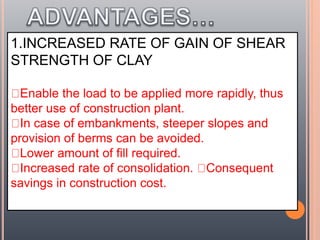
1.INCREASED RATE OF GAIN OF SHEAR
STRENGTH OF CLAY
Enable the load to be applied more rapidly, thus
better use of construction plant.
In case of embankments, steeper slopes and
provision of berms can be avoided.
Lower amount of fill required.
Increased rate of consolidation. Consequent
savings in construction cost.
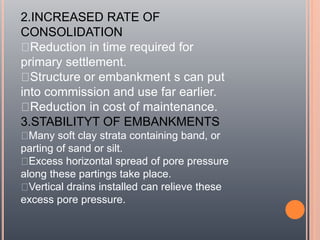
2.INCREASED RATE OF
CONSOLIDATION
Reduction in time required for
primary settlement.
Structure or embankment s can put
into commission and use far earlier.
Reduction in cost of maintenance.
3.STABILITYT OF EMBANKMENTS
Many soft clay strata containing band, or
parting of sand or silt.
Excess horizontal spread of pore pressure
along these partings take place.
Vertical drains installed can relieve these
excess pore pressure.
1. Sand drains effectively reduce the time taken for
consolidation of saturated clay for both stiff and
soft clays.
2. This reduction is much more pronounced in case
of stiff clays where the time taken reduces by
about 6 to 11 times.
3. For both stiff and soft clays, settlement steadily
increases with applied load.
4. The settlement of soft clay was found to be 3 to 5
times more than that for stiff clay.
5. The final settlement does not vary with the
diameter of sand drain.
6. And the time of consolidation steadily decreases
with increase in the diameter of drains.
Asaoka, A. 1978. Observational Procedure of Settlement
Prediction. Soils and Foundations, Vol. 18, No. 4, Dec.
1978. Japanese Society of Soil Mechanics and Foundation
Engineering. pp. 87- 101.
Barron, R. A. 1948. Consolidation of fine-grained soils by
drain wells. Transactions ASCE, Vol. 113, paper 2346, pp.
718-724.
Bergado, D. T., Anderson, L. R., Miura, N.,
Balasubramaniam, A. S. 1996. Soft ground improvement
in lowland and other environments. New York: ASCE
Press.
Bergado, D. T., Manivannan, R., Balasubramaniam, A. S.
1996. Proposed criteria for discharge capacity of
prefabricated vertical drains. Geotextiles and
Geomembranes 14 (1996), 481-505. Chai, J.-C., Carter, J.
P., Hayashi, S. 2005.
Ground Deformation induced by Vacuum Consolidation.
Journal of geotechnical and geoenvironmental
engineering, Vol. 131, No. 12, Dec. 2005, 1552-1561.
sand drain for consolidation settlement

sand drain for consolidation settlement

  • 1.
    FOR CONSOLIDATION SETTELEMENT REPORTBY:- KABRUTI SUBHAM NAYAK 1101110022
  • 2.
    CONTENTS  INTRODUCTION  BREIFHISTORY  CONSOLIDATION  APPROCH  APPLICATION  ADVANTAGES  DISADVANTAGES  CONCLUSION  REFERENCE
  • 3.
    INTRODUCTION Soils are depositedor formed under different environmental conditions. Man does not have any control on the process of soil formation. So, we need to accept as they are and any construction has to be adapted to suit the subsoil consideration.
  • 4.
    The existing soilat a given site maynot be suitable for supporting structures like buildings, bridges, dams etc. because of safe bearing capacity of soil may not be adequate to support the provided load. Although pile foundations may be adapted in some situation, which often became too high for low to medium rise buildings.
  • 6.
    IN THAT CASEAN ENGINEER WILL GO FOR THE FOLLOWING STEPS…… i. Change the site. ii. Change the structural design. iii. Increase expenses. iv. Go for ground improvement technique.
  • 7.
    GROUND IMPROVEMENT TECHNIQUES •Ground improvementin its broadest sense is the alteration of any property of a soil to improve its engineering performance. •Ground improvement for the purpose of foundation essentially means increasing the shear strength of the soil and also density of soil and to decrease the compressibility, permeability and the settlement, which makes the soil more water resistance, durable, and stable.
  • 8.
    HISTORY In the 1930sthe first reasonable application of vertical sand drains was made in California. In Sweden, during the same decade, Kjellman introduced the first prototype. (Jamiolkowski et al., 1983). Subsequently, several types of vertical drains developed which are basically consisting longitudinal channel wick functioning as a drain.
  • 9.
    CONSOLIDATION OF SOIL Consolidationis a process by which soils decrease in volume. According to ”Karl von Terzaghi” consolidation is any process which involves a decrease in water content of saturated soil without replacement of water by air. In general it is the process in which reduction in volume takes place by expulsion of water under long term static loads. It occurs when stress is applied to a soil that causes the soil particles to pack together more tightly, therefore reducing its bulk volume. When this occurs in a soil that is saturated with water, water will be squeezed out of the soil.
  • 10.
     When stressis removed from a consolidated soil, the soil will rebound, regaining some of the volume it had lost in the consolidation process.  If the stress is reapplied, the soil will consolidate again along a recompression curve, defined by the recompression index.  The highest stress that it has been subjected to is termed the pre consolidation stress.  The over consolidation ratio or OCR is defined as the highest stress experienced divided by the current stress.  A soil which is currently experiencing its highest stress is said to be normally consolidated and to have an OCR of one.
  • 11.
  • 13.
    Because of itslow permeability, the consolidation settlement of soft clays takes a long time to complete. To shorten the consolidation time, vertical drains are installed together with preloading either by an embankment or by means of vacuum pressure. Vertical drains are artificially-created drainage paths which are inserted into the soft clay subsoil. Thus, the pore water squeezed out during consolidation of the clay due to the hydraulic gradients created by the preloading, can flow faster in the horizontal direction towards the vertical drains.
  • 14.
    It is takenadvantage of the fact, that most clay deposits exhibit a higher horizontal permeability compared to the vertical. Subsequently, these pore water can flow freely along the vertical drains vertically towards the permeable layers. Therefore, the vertical drain installation reduces the length of the drainage path and, consequently, accelerates the consolidation process and allows the clay to gain rapid strength increase to carry the new load by its own.
  • 15.
    IN ORDER TOACCELERATE THE PROCESS OF CONSOLIDATION SETTLEMENT FOR THE CONSTRUCTION OF SOME STRUCTURE, THE USEFUL TECHNIQUE OF BUILDING SAND DRAINS CAN BE USED. SAND DRAINS ARE CONSTRUCTED BY DRIVING DOWN CASINGS OR HOLLOW MANDRELS INTO THE SOIL. THE HOLES ARE THEN FILLED WITH SAND, AFTER WHICH THE CASINGS ARE PARALLEL OUT. WHEN A SURCHARGE IS APPLIED AT GROUND SURFACE, THE PORE WATER PRESSURE IN THE CLAY WILL INCREASE, AND THERE WILL BE DRAINAGE IN THE VERTICAL AND HORIZONTAL DIRECTIONS. THE HORIZONTAL DRAINAGE IS INDUCED BY THE SAND DRAINS. HENCE, THE PROCESS OF DISSIPATION OF EXCESS PORE WATER PRESSURE CREATED BY THE LOADING (AND HENCE THE SETTLEMENT) IS ACCELERATED.
  • 19.
    Airport Runways Golf Courses MineTailings Consolidation Tailing Ponds Swampland/Wetland Development Building Foundations Retaining Walls Parking Lots Landfills
  • 20.
    1.INCREASED RATE OFGAIN OF SHEAR STRENGTH OF CLAY Enable the load to be applied more rapidly, thus better use of construction plant. In case of embankments, steeper slopes and provision of berms can be avoided. Lower amount of fill required. Increased rate of consolidation. Consequent savings in construction cost.
  • 21.
    2.INCREASED RATE OF CONSOLIDATION Reductionin time required for primary settlement. Structure or embankment s can put into commission and use far earlier. Reduction in cost of maintenance. 3.STABILITYT OF EMBANKMENTS Many soft clay strata containing band, or parting of sand or silt. Excess horizontal spread of pore pressure along these partings take place. Vertical drains installed can relieve these excess pore pressure.
  • 23.
    1. Sand drainseffectively reduce the time taken for consolidation of saturated clay for both stiff and soft clays. 2. This reduction is much more pronounced in case of stiff clays where the time taken reduces by about 6 to 11 times. 3. For both stiff and soft clays, settlement steadily increases with applied load. 4. The settlement of soft clay was found to be 3 to 5 times more than that for stiff clay. 5. The final settlement does not vary with the diameter of sand drain. 6. And the time of consolidation steadily decreases with increase in the diameter of drains.
  • 24.
    Asaoka, A. 1978.Observational Procedure of Settlement Prediction. Soils and Foundations, Vol. 18, No. 4, Dec. 1978. Japanese Society of Soil Mechanics and Foundation Engineering. pp. 87- 101. Barron, R. A. 1948. Consolidation of fine-grained soils by drain wells. Transactions ASCE, Vol. 113, paper 2346, pp. 718-724. Bergado, D. T., Anderson, L. R., Miura, N., Balasubramaniam, A. S. 1996. Soft ground improvement in lowland and other environments. New York: ASCE Press. Bergado, D. T., Manivannan, R., Balasubramaniam, A. S. 1996. Proposed criteria for discharge capacity of prefabricated vertical drains. Geotextiles and Geomembranes 14 (1996), 481-505. Chai, J.-C., Carter, J. P., Hayashi, S. 2005. Ground Deformation induced by Vacuum Consolidation. Journal of geotechnical and geoenvironmental engineering, Vol. 131, No. 12, Dec. 2005, 1552-1561.