Enablers for Maturing your S&OP Processes
Gregory L. Schlegel CPIM, CSP, Jonah
VP Business Development
gschlegel@shertrack.com
January 27, 2011
NEXT GEN S&OP Solution Platform
Lehigh University G 2
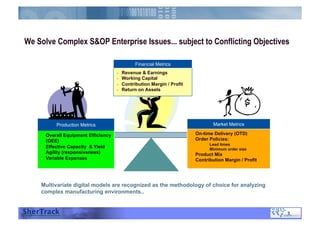
We Solve Complex S&OP Enterprise Issues... subject to Conflicting Objectives
3
Multivariate digital models are recognized as the methodology of choice for analyzing
complex manufacturing environments..
Financial Metrics
  Revenue & Earnings
  Working Capital
  Contribution Margin / Profit
  Return on Assets
Production Metrics
  Overall Equipment Efficiency
(OEE)
  Effective Capacity & Yield
  Agility (responsiveness)
  Variable Expenses
Market Metrics
  On-time Delivery (OTD)
  Order Policies:
  Lead times
  Minimum order size
  Product Mix
  Contribution Margin / Profit
WHAT is Predictive Analytics??
  Predictive analytics… encompasses a variety of techniques from
statistics, data mining and game theory that analyze current and
historical facts to make predictions about future events.
In business, predictive models exploit patterns found in historical
and transactional data to identify risks and opportunities. Models
capture relationships among many factors to allow assessment of
risk or potential associated with a particular set of conditions,
guiding decision making for candidate transactions.
Predictive analytics is used in actuarial science, financial services,
insurance, telecommunications, retail, travel, healthcare,
pharmaceuticals and other fields. But NOT Manufacturing or
Supply Chain!
One of the most well-known applications is credit scoring, which is used
throughout financial services. Scoring models process a customer’s
credit history, loan application, customer data, etc., in order to rank-
order individuals by their likelihood of making future credit payments on
time. A well-known example would be the FICO Score.
4
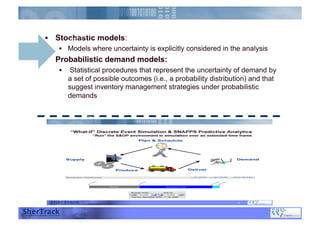
Stochastic & Probabilistic Modeling
  Stochastic models:
  Models where uncertainty is explicitly considered in the analysis
  Probabilistic demand models:
  Statistical procedures that represent the uncertainty of demand by
a set of possible outcomes (i.e., a probability distribution) and that
suggest inventory management strategies under probabilistic
demands
Past & Present Clients (partial))
ROHM & HAAS A Wholly Owned Subsidiary of
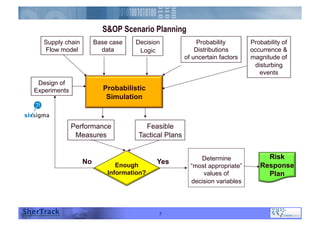
S&OP Scenario Planning
7
Probabilistic
Simulation
Enough
Information?
Risk
Response
Plan
Supply chain
Flow model
Base case
data
Decision
Logic
Probability
Distributions
of uncertain factors
Probability of
occurrence &
magnitude of
disturbing
events
Design of
Experiments
Performance
Measures
Feasible
Tactical Plans
No Yes Determine
“most appropriate”
values of
decision variables
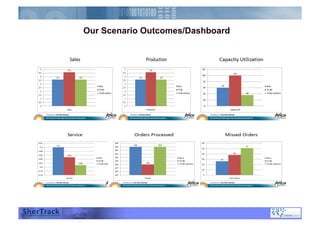
Our Scenario Outcomes/Dashboard
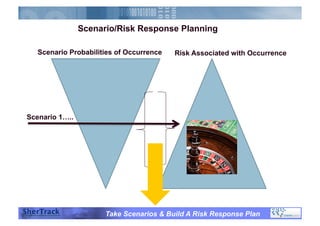
Scenario/Risk Response Planning
Scenario Probabilities of Occurrence
HIGH
LOW
Risk Associated with Occurrence
LOW
HIGH
Take Scenarios & Build A Risk Response Plan
Scenario 1…..
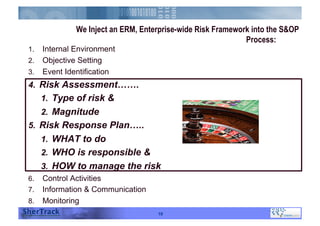
1.  Internal Environment
2.  Objective Setting
3.  Event Identification
4.  Risk Assessment…….
1.  Type of risk &
2.  Magnitude
5.  Risk Response Plan…..
1.  WHAT to do
2.  WHO is responsible &
3.  HOW to manage the risk
6.  Control Activities
7.  Information & Communication
8.  Monitoring
10
We Inject an ERM, Enterprise-wide Risk Framework into the S&OP
Process: What”
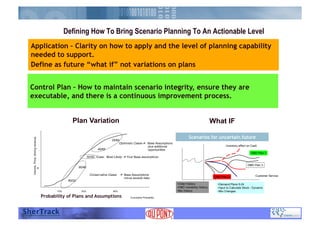
Defining How To Bring Scenario Planning To An Actionable Level
Application – Clarity on how to apply and the level of planning capability
needed to support.
Define as future “what if” not variations on plans
Control Plan – How to maintain scenario integrity, ensure they are
executable, and there is a continuous improvement process.
Probability of Plans and Assumptions
Scenarios for uncertain future
conditions
Plan Variation What IF
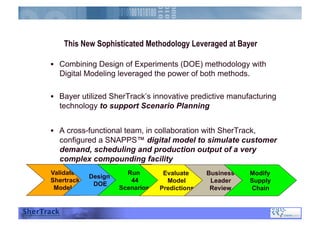
This New Sophisticated Methodology Leveraged at Bayer
  Combining Design of Experiments (DOE) methodology with
Digital Modeling leveraged the power of both methods.
  Bayer utilized SherTrack’s innovative predictive manufacturing
technology to support Scenario Planning
  A cross-functional team, in collaboration with SherTrack,
configured a SNAPPS™ digital model to simulate customer
demand, scheduling and production output of a very
complex compounding facility
Validate
Shertrack
Model
Design
DOE
Run
44
Scenarios
Evaluate
Model
Predictions
Business
Leader
Review
Modify
Supply
Chain
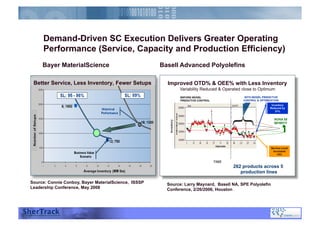
Demand-Driven SC Execution Delivers Greater Operating
Performance (Service, Capacity and Production Efficiency)
Better Service, Less Inventory, Fewer Setups
Source: Connie Conboy, Bayer MaterialScience, ISSSP
Leadership Conference, May 2008
Bayer MaterialScience
262 products across 5
production lines
Improved OTD% & OEE% with Less Inventory
Variability Reduced & Operated close to Optimum
Basell Advanced Polyolefins
Source: Larry Maynard, Basell NA, SPE Polyolefin
Conference, 2/26/2006, Houston
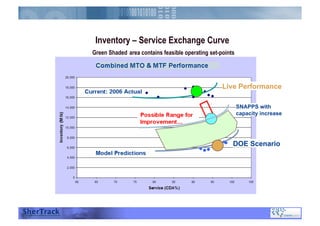
Inventory – Service Exchange Curve
Green Shaded area contains feasible operating set-points
DOE Scenario
Live Performance
SNAPPS with
capacity increase
15
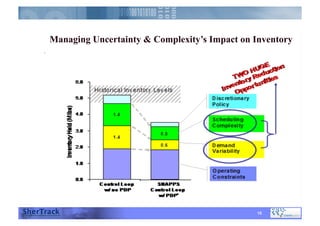
Managing Uncertainty & Complexity’s Impact on Inventory
ROHM & HAAS A Wholly Owned Subsidiary of
  WHY RISK MANAGEMENT in S&OP?
  Competitive advantage
  Reputation & Branding
  Rating agencies & positive analyst
commentary
  Ability to reduce cost of capital
Scenario Planning & Risk Management Conclusions
  The combination of digital modeling, discrete event simulation
and predictive analytics is a very powerful technique for Scenario
Planning in the S&OP arena.
  Very compelling improvements are possible, especially in
complex operations.
  Identifying, codifying and prioritizing risk within the S&OP
enterprise process becomes a critical competitive advantage
  Developing a Risk Response Plan ensures long term
sustainability of Operational Excellence
A powerful environment to evaluate alternatives without
experimenting on customers & the bottom line!
SUMMARY……
  Companies NEED to evaluate their supply chain designs,
policies & practices on a continuous basis rather than
periodically
  Companies SHOULD segment/or Tier their customers and
develop efficient and effective supply chains based on
Total-Cost-to-Serve models
  Companies NEED to incorporate Risk Management tactics
and methods into their S&OP processes
  Companies SHOULD support S&OP Scenario Planning
leveraging Probabilistic Predictive Analytics
19
Enablers for Maturing your S&OP Processes
Gregory L. Schlegel CPIM, CSP, Jonah
VP Business Development
gschlegel@shertrack.com
January 27, 2011

Enablers for Maturing your S&OP Processes, SherTrack

  • 1.
    Enablers for Maturingyour S&OP Processes Gregory L. Schlegel CPIM, CSP, Jonah VP Business Development gschlegel@shertrack.com January 27, 2011
  • 2.
    NEXT GEN S&OPSolution Platform Lehigh University G 2
  • 3.
    We Solve ComplexS&OP Enterprise Issues... subject to Conflicting Objectives 3 Multivariate digital models are recognized as the methodology of choice for analyzing complex manufacturing environments.. Financial Metrics   Revenue & Earnings   Working Capital   Contribution Margin / Profit   Return on Assets Production Metrics   Overall Equipment Efficiency (OEE)   Effective Capacity & Yield   Agility (responsiveness)   Variable Expenses Market Metrics   On-time Delivery (OTD)   Order Policies:   Lead times   Minimum order size   Product Mix   Contribution Margin / Profit
  • 4.
    WHAT is PredictiveAnalytics??   Predictive analytics… encompasses a variety of techniques from statistics, data mining and game theory that analyze current and historical facts to make predictions about future events. In business, predictive models exploit patterns found in historical and transactional data to identify risks and opportunities. Models capture relationships among many factors to allow assessment of risk or potential associated with a particular set of conditions, guiding decision making for candidate transactions. Predictive analytics is used in actuarial science, financial services, insurance, telecommunications, retail, travel, healthcare, pharmaceuticals and other fields. But NOT Manufacturing or Supply Chain! One of the most well-known applications is credit scoring, which is used throughout financial services. Scoring models process a customer’s credit history, loan application, customer data, etc., in order to rank- order individuals by their likelihood of making future credit payments on time. A well-known example would be the FICO Score. 4
  • 5.
    Stochastic & ProbabilisticModeling   Stochastic models:   Models where uncertainty is explicitly considered in the analysis   Probabilistic demand models:   Statistical procedures that represent the uncertainty of demand by a set of possible outcomes (i.e., a probability distribution) and that suggest inventory management strategies under probabilistic demands
  • 6.
    Past & PresentClients (partial)) ROHM & HAAS A Wholly Owned Subsidiary of
  • 7.
    S&OP Scenario Planning 7 Probabilistic Simulation Enough Information? Risk Response Plan Supplychain Flow model Base case data Decision Logic Probability Distributions of uncertain factors Probability of occurrence & magnitude of disturbing events Design of Experiments Performance Measures Feasible Tactical Plans No Yes Determine “most appropriate” values of decision variables
  • 8.
  • 9.
    Scenario/Risk Response Planning ScenarioProbabilities of Occurrence HIGH LOW Risk Associated with Occurrence LOW HIGH Take Scenarios & Build A Risk Response Plan Scenario 1…..
  • 10.
    1.  Internal Environment 2. Objective Setting 3.  Event Identification 4.  Risk Assessment……. 1.  Type of risk & 2.  Magnitude 5.  Risk Response Plan….. 1.  WHAT to do 2.  WHO is responsible & 3.  HOW to manage the risk 6.  Control Activities 7.  Information & Communication 8.  Monitoring 10 We Inject an ERM, Enterprise-wide Risk Framework into the S&OP Process: What”
  • 11.
    Defining How ToBring Scenario Planning To An Actionable Level Application – Clarity on how to apply and the level of planning capability needed to support. Define as future “what if” not variations on plans Control Plan – How to maintain scenario integrity, ensure they are executable, and there is a continuous improvement process. Probability of Plans and Assumptions Scenarios for uncertain future conditions Plan Variation What IF
  • 12.
    This New SophisticatedMethodology Leveraged at Bayer   Combining Design of Experiments (DOE) methodology with Digital Modeling leveraged the power of both methods.   Bayer utilized SherTrack’s innovative predictive manufacturing technology to support Scenario Planning   A cross-functional team, in collaboration with SherTrack, configured a SNAPPS™ digital model to simulate customer demand, scheduling and production output of a very complex compounding facility Validate Shertrack Model Design DOE Run 44 Scenarios Evaluate Model Predictions Business Leader Review Modify Supply Chain
  • 13.
    Demand-Driven SC ExecutionDelivers Greater Operating Performance (Service, Capacity and Production Efficiency) Better Service, Less Inventory, Fewer Setups Source: Connie Conboy, Bayer MaterialScience, ISSSP Leadership Conference, May 2008 Bayer MaterialScience 262 products across 5 production lines Improved OTD% & OEE% with Less Inventory Variability Reduced & Operated close to Optimum Basell Advanced Polyolefins Source: Larry Maynard, Basell NA, SPE Polyolefin Conference, 2/26/2006, Houston
  • 14.
    Inventory – ServiceExchange Curve Green Shaded area contains feasible operating set-points DOE Scenario Live Performance SNAPPS with capacity increase
  • 15.
    15 Managing Uncertainty &Complexity’s Impact on Inventory
  • 16.
    ROHM & HAASA Wholly Owned Subsidiary of
  • 17.
      WHY RISKMANAGEMENT in S&OP?   Competitive advantage   Reputation & Branding   Rating agencies & positive analyst commentary   Ability to reduce cost of capital
  • 18.
    Scenario Planning &Risk Management Conclusions   The combination of digital modeling, discrete event simulation and predictive analytics is a very powerful technique for Scenario Planning in the S&OP arena.   Very compelling improvements are possible, especially in complex operations.   Identifying, codifying and prioritizing risk within the S&OP enterprise process becomes a critical competitive advantage   Developing a Risk Response Plan ensures long term sustainability of Operational Excellence A powerful environment to evaluate alternatives without experimenting on customers & the bottom line!
  • 19.
    SUMMARY……   Companies NEEDto evaluate their supply chain designs, policies & practices on a continuous basis rather than periodically   Companies SHOULD segment/or Tier their customers and develop efficient and effective supply chains based on Total-Cost-to-Serve models   Companies NEED to incorporate Risk Management tactics and methods into their S&OP processes   Companies SHOULD support S&OP Scenario Planning leveraging Probabilistic Predictive Analytics 19
  • 20.
    Enablers for Maturingyour S&OP Processes Gregory L. Schlegel CPIM, CSP, Jonah VP Business Development gschlegel@shertrack.com January 27, 2011