
SAP Thought Leadership Paper
Supply Chain Management


Inventory Optimization
A New Approach to Operational Inventory Planning
Table of Contents

4	   Executive Summary

5	   Inventory Management Has
     Changed
     The Science
     The Business Requirements
     The Application
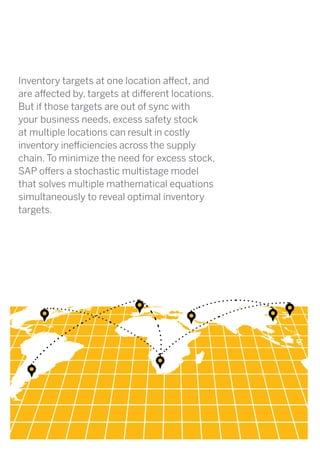
Inventory targets at one location affect, and
are affected by, targets at different locations.
But if those targets are out of sync with
your business needs, excess safety stock
at multiple locations can result in costly
inventory inefficiencies across the supply
chain. To minimize the need for excess stock,
SAP offers a stochastic multistage model
that solves multiple mathematical equations
simultaneously to reveal optimal inventory
targets.
On the Road to Optimization


Executive Summary

In today’s ultracompetitive business             This paper examines how the stochas-
environment, companies can ill afford         tic multistage, multi-inventory model
supply chain inefficiencies. But if plan-     supports inventory optimization. It
ners are using outdated inventory             also looks at how the SAP® Enterprise
management models, it can be challeng-        Inventory Optimization application by
ing to run a tight ship.                      SmartOps uses the model to help supply
   To boost efficiency, run leaner, and       planners execute more effectively. The
drive down supply costs, many organiza-       software enables a collaborative approach
tions are exploring inventory optimiza-       that extends beyond organizational
tion. This technique improves inventory       boundaries while helping planners predict
targets to address the realities of today’s   demand patterns more accurately. And
complex, ever-evolving global supply          an option that provides analytics for
chains.                                       the application delivers executive-level
                                              insights and reporting using a focused
                                              dashboard.


            No planner knows everything, and the
            models that planners work with should
            reflect this reality.


4                                                                               SAP Thought Leadership Paper– Inventory Optimization
The Multistage Model


Inventory Management Has Changed

Traditional approaches to inventory plan-      The Science                                  Dynamic, Not Static
ning are based largely on rules of thumb.                                                   To accommodate constantly changing
Planners develop a set of heuristics           The science behind inventory optimiza-       demand, inventory planners often cobble
for determining safety stock levels, and       tion involves stochastic (probabilistic)     together sets of unconnected static
these rules get handed down. Some              multistage, multi-inventory modeling in      models to ensure proper levels of safety
organizations also use rudimentary             which a sophisticated algorithm is used      stock. In contrast, the multistage model
analysis, in which items are weighted          to assess vast amounts of historic and       is dynamic and can accommodate shift-
on an A-B-C scale with the priority of         real-time information while accounting       ing demand so that peaks and troughs
keeping A-level items in stock. The as-        for multiple variabilities and interdepen-   are balanced out over time. The dynamic
sumptions made for this sort of analysis,      dencies. By enabling the analysis of a       character of the model also allows orga-
however, are typically revisited rarely.       staggering number of variables, con-         nizations to model seasonality, promo-
In fast-changing environments, this            straints, and what-if scenarios, this        tions, and end-of-quarter spikes. It ac-
approach can lead to out-of-stock situa-       model empowers planners to manage            commodates the fact that uncertainty
tions and supply chain inefficiencies.         the complexity of today’s supply chains.     is greater when a company looks farther
   The complexities and uncertainties in       This approach differs from traditional       ahead in time – something traditional
today’s constantly evolving global supply      inventory management models that             approaches cannot do.
chains demand a dynamic new approach.          depend on deterministic, discrete-time
The inventory optimization approach            inventory theory in the following ways.      Data Driven, Not Assumption Based
augments existing enterprise resource                                                       The multistage model recognizes that
planning (ERP) and advanced planning           Molecular, Not Atomic                        organizations work only with finite histor-
and scheduling systems, helping plan-          Traditional inventory management views       ical data. Traditional models, on the other
ners improve operational inventory             the supply chain according to a single-      hand, start with an idealized assumption
targets with item-location-period granu-       stage, single-item model. This model         that planners possess complete knowl-
larity for finished goods, intermediate        sees each stock item and each stage or       edge of demand distribution. No planner
items, or raw materials and components.        stock location as isolated entities with     knows everything, and the models that
The result is better visibility into demand,   few, if any, meaningful dependencies.        planners use should reflect this reality.
enabling planners to modify inventory            The multistage model, in contrast,
and reduce carrying costs without im-          views the supply chain in terms of mole-     Variable, Not Unvarying
pacting customer service levels or sacri-      cules made up of atoms. This reflects        Traditional models lack the mechanisms
ficing product availability. This approach     the reality of today’s multistage supply     to dynamically capture changing values
empowers organizations to improve              chains that include suppliers, numerous      or correct for errors over time. The multi-
performance and more effectively meet          manufacturing stages, subcontractors,        stage model, by contrast, is flexible
the terms of service-level agreements.         vendor-managed inventory, central            enough to continuously incorporate the
                                               warehouses, and multiple distribution        results of ongoing data analysis. This
                                               centers.                                     analysis helps identify forecast errors
                                                                                            and biases so that planners can correct
                                                                                            values and modify assumptions.


SAP Thought Leadership Paper– Inventory Optimization                                                                                  5
The Business Requirements                       Data Input Connectivity                       ment processes. Planners should have
                                                Better outputs require better inputs.         the ability to play out what-if scenarios
The purpose of the multistage model is          Thus, an inventory optimization applica-      and study the ramifications of proposed
to help planners in real-world supply           tion should include data connectivity         actions. Tools that support the visualiza-
planning scenarios. Any application that        modules that can work with a wide range       tion of alternative strategies and the
seeks to leverage the multistage model          of data sources to transform and load         comparison of planned and actual sce-
must meet the following requirements.           raw data easily and automatically. These      narios help businesses predict possible
                                                modules should also accommodate the           outcomes. In this way, they can identify
Enterprise Readiness                            supply chain network structure itself,        effective actions to improve supply chain
Many inventory optimization applica-            which is often the most challenging           efficiency.
tions fail to address the fact that supply      aspect of data connectivity.
planning is a collaborative activity that                                                     Executive Visibility
extends beyond enterprise boundaries.           Built-in Intelligence                         Information is of no value if it is not read-
They are neither scalable nor capable of        The ability to access data is important.      ily accessible to the people who need it.
automating planning processes. What’s           But planners also need to work with that      At-a-glance update mechanisms such
needed is an application that leverages         data. An inventory optimization applica-      as executive dashboards are vital for
the multistage model at an enterprise           tion, then, must support robust analysis      helping planners and senior managers
level. Requirements include visibility          to help planners understand issues in-        to focus on and evaluate supply chain
across multiple ERP applications and            volving forecast bias and accuracy, sup-      performance in regard to established
planning systems, along with support            plier uncertainty, schedule adherence,        targets.
for global inventory planning. This             and more.
allows planners to understand inventory                                                       The Application
liabilities, maintain service levels, and op-   Approval Workflow
erate according to supplier- and vendor-        Planners need to review updated inputs        The SAP Enterprise Inventory Optimiza-
managed inventory business models.              (such as forecasts), perform due dili-        tion application addresses these require-
                                                gence, and approve any modified targets       ments, helping organizations strike the
Flexibility                                     in order to avoid problems downstream.        right balance between service levels and
An inventory optimization application           An inventory optimization application         inventory investment. The application
needs to be flexible enough to accom-           should accommodate this requirement           can be used on a stand-alone basis, if
modate industries as varied as consum-          with automated workflow and alerts that       desired, or as an integrated part of the
er products, chemicals, manufacturing,          allow planners to manage by exception.        SAP ERP application or the SAP Advanced
and high tech. It requires reporting tools                                                    Planning & Optimization component.
that can help validate, analyze, and im-        Continuous Improvement                        In either case, it enables planners to
prove industry-specific supply chain            Supply chains are in constant flux. This is   dynamically determine optimal demand-
information regarding demand, supply,           why inventory optimization applications       driven, time-phased inventory targets for
and production elements.                        need to support continuous improve-           every item at every location throughout
                                                                                              the supply chain.


6                                                                                  SAP Thought Leadership Paper– Inventory Optimization
Learn More
SAP also provides an option for analytics      •• Accurately track and streamline inven-
that helps planners monitor demand,               tory positions throughout the order-       To learn more about how SAP Enterprise
inventory, and supply data against pre-           to-cash value chain, using advanced        Inventory Optimization can help your
scribed targets. The option uses SAP              algorithms that eliminate waste and        organization compete more effectively,
BusinessObjects™ business intelligence            help the organization run leanly           contact your SAP representative today
                                                                                             or visit us online at
solutions with preconfigured data analy-       •• Access real-time, at-a-glance updates
                                                                                             www.sap.com/lines-of-business/scm
sis functionality to populate executive           on supply chain performance, identify-     /inventory-optimization.
dashboards and performance reports.               ing trends and deviations from pre-
                                                  defined targets and refining inventory
The Right Inventory                               strategy accordingly
Specifically, planners can:                    •• Use flexible data filtering to pinpoint
•• Coordinate capacity, inventory, demand,        issues at a granular level, allowing re-
   lead time, and product availability vari-      medial measures to be implemented
   ables to gauge how much inventory              to meet key performance targets
   should be carried by item, location,        •• Visualize “what-if” scenarios, compare
   and time period                                historical trends, and analyze the im-
•• Leverage a multistage modeling                 pact of alternative supply chain
   approach to calculate the relationships        strategies
   among inventories, service levels,
   capacity, and costs across all stocking     In the end, these functionalities enable
   locations and stages – and across           your planners to optimize inventory
   different types of supply chains within     levels throughout the organization,
   organizations and beyond enterprise         helping you improve customer service
   boundaries to support supplier- and         levels while minimizing working capital
   vendor-managed inventory                    requirements. This makes you more
•• Set and manage targets such as safety       efficient and far more competitive.
   stocks more frequently at a more gran-
   ular level, supporting lean processes


SAP Thought Leadership Paper– Inventory Optimization                                                                                  7
www.sap.com/contactsap


CMP4499 (12/08) ©2012 SAP AG. All rights reserved.
SAP R/3, SAP NetWeaver, Duet, PartnerEdge, ByDesign,
    ,
SAP BusinessObjects Explorer, StreamWork, SAP HANA, and
other SAP products and services mentioned herein as well as
their respective logos are trademarks or registered trademarks
of SAP AG in Germany and other countries.

Business Objects and the Business Objects logo, BusinessObjects,
Crystal Reports, Crystal Decisions, Web Intelligence, Xcelsius, and other
Business Objects products and services mentioned herein as well as their
respective logos are trademarks or registered trademarks of Business
Objects Software Ltd. Business Objects is an SAP company.

Sybase and Adaptive Server, iAnywhere, Sybase 365, SQL Anywhere, and
other Sybase products and services mentioned herein as well as their
respective logos are trademarks or registered trademarks of Sybase Inc.
Sybase is an SAP company.

Crossgate, m@gic EDDY, B2B 360°, and B2B 360° Services are registered
trademarks of Crossgate AG in Germany and other countries. Crossgate
is an SAP company.

All other product and service names mentioned are the trademarks of
their respective companies. Data contained in this document serves
informational purposes only. National product specifications may vary.

These materials are subject to change without notice. These materials
are provided by SAP AG and its affiliated companies (“SAP Group”)
for informational purposes only, without representation or warranty of
any kind, and SAP Group shall not be liable for errors or omissions with
respect to the materials. The only warranties for SAP Group products and
services are those that are set forth in the express warranty statements
accompanying such products and services, if any. Nothing herein should
be construed as constituting an additional warranty.

Inventory Optimization - A New Approach to Operational Inventory Planning

  • 1.
    SAP Thought LeadershipPaper Supply Chain Management Inventory Optimization A New Approach to Operational Inventory Planning
  • 2.
    Table of Contents 4 Executive Summary 5 Inventory Management Has Changed The Science The Business Requirements The Application
  • 3.
    Inventory targets atone location affect, and are affected by, targets at different locations. But if those targets are out of sync with your business needs, excess safety stock at multiple locations can result in costly inventory inefficiencies across the supply chain. To minimize the need for excess stock, SAP offers a stochastic multistage model that solves multiple mathematical equations simultaneously to reveal optimal inventory targets.
  • 4.
    On the Roadto Optimization Executive Summary In today’s ultracompetitive business This paper examines how the stochas- environment, companies can ill afford tic multistage, multi-inventory model supply chain inefficiencies. But if plan- supports inventory optimization. It ners are using outdated inventory also looks at how the SAP® Enterprise management models, it can be challeng- Inventory Optimization application by ing to run a tight ship. SmartOps uses the model to help supply To boost efficiency, run leaner, and planners execute more effectively. The drive down supply costs, many organiza- software enables a collaborative approach tions are exploring inventory optimiza- that extends beyond organizational tion. This technique improves inventory boundaries while helping planners predict targets to address the realities of today’s demand patterns more accurately. And complex, ever-evolving global supply an option that provides analytics for chains. the application delivers executive-level insights and reporting using a focused dashboard. No planner knows everything, and the models that planners work with should reflect this reality. 4 SAP Thought Leadership Paper– Inventory Optimization
  • 5.
    The Multistage Model InventoryManagement Has Changed Traditional approaches to inventory plan- The Science Dynamic, Not Static ning are based largely on rules of thumb. To accommodate constantly changing Planners develop a set of heuristics The science behind inventory optimiza- demand, inventory planners often cobble for determining safety stock levels, and tion involves stochastic (probabilistic) together sets of unconnected static these rules get handed down. Some multistage, multi-inventory modeling in models to ensure proper levels of safety organizations also use rudimentary which a sophisticated algorithm is used stock. In contrast, the multistage model analysis, in which items are weighted to assess vast amounts of historic and is dynamic and can accommodate shift- on an A-B-C scale with the priority of real-time information while accounting ing demand so that peaks and troughs keeping A-level items in stock. The as- for multiple variabilities and interdepen- are balanced out over time. The dynamic sumptions made for this sort of analysis, dencies. By enabling the analysis of a character of the model also allows orga- however, are typically revisited rarely. staggering number of variables, con- nizations to model seasonality, promo- In fast-changing environments, this straints, and what-if scenarios, this tions, and end-of-quarter spikes. It ac- approach can lead to out-of-stock situa- model empowers planners to manage commodates the fact that uncertainty tions and supply chain inefficiencies. the complexity of today’s supply chains. is greater when a company looks farther The complexities and uncertainties in This approach differs from traditional ahead in time – something traditional today’s constantly evolving global supply inventory management models that approaches cannot do. chains demand a dynamic new approach. depend on deterministic, discrete-time The inventory optimization approach inventory theory in the following ways. Data Driven, Not Assumption Based augments existing enterprise resource The multistage model recognizes that planning (ERP) and advanced planning Molecular, Not Atomic organizations work only with finite histor- and scheduling systems, helping plan- Traditional inventory management views ical data. Traditional models, on the other ners improve operational inventory the supply chain according to a single- hand, start with an idealized assumption targets with item-location-period granu- stage, single-item model. This model that planners possess complete knowl- larity for finished goods, intermediate sees each stock item and each stage or edge of demand distribution. No planner items, or raw materials and components. stock location as isolated entities with knows everything, and the models that The result is better visibility into demand, few, if any, meaningful dependencies. planners use should reflect this reality. enabling planners to modify inventory The multistage model, in contrast, and reduce carrying costs without im- views the supply chain in terms of mole- Variable, Not Unvarying pacting customer service levels or sacri- cules made up of atoms. This reflects Traditional models lack the mechanisms ficing product availability. This approach the reality of today’s multistage supply to dynamically capture changing values empowers organizations to improve chains that include suppliers, numerous or correct for errors over time. The multi- performance and more effectively meet manufacturing stages, subcontractors, stage model, by contrast, is flexible the terms of service-level agreements. vendor-managed inventory, central enough to continuously incorporate the warehouses, and multiple distribution results of ongoing data analysis. This centers. analysis helps identify forecast errors and biases so that planners can correct values and modify assumptions. SAP Thought Leadership Paper– Inventory Optimization 5
  • 6.
    The Business Requirements Data Input Connectivity ment processes. Planners should have Better outputs require better inputs. the ability to play out what-if scenarios The purpose of the multistage model is Thus, an inventory optimization applica- and study the ramifications of proposed to help planners in real-world supply tion should include data connectivity actions. Tools that support the visualiza- planning scenarios. Any application that modules that can work with a wide range tion of alternative strategies and the seeks to leverage the multistage model of data sources to transform and load comparison of planned and actual sce- must meet the following requirements. raw data easily and automatically. These narios help businesses predict possible modules should also accommodate the outcomes. In this way, they can identify Enterprise Readiness supply chain network structure itself, effective actions to improve supply chain Many inventory optimization applica- which is often the most challenging efficiency. tions fail to address the fact that supply aspect of data connectivity. planning is a collaborative activity that Executive Visibility extends beyond enterprise boundaries. Built-in Intelligence Information is of no value if it is not read- They are neither scalable nor capable of The ability to access data is important. ily accessible to the people who need it. automating planning processes. What’s But planners also need to work with that At-a-glance update mechanisms such needed is an application that leverages data. An inventory optimization applica- as executive dashboards are vital for the multistage model at an enterprise tion, then, must support robust analysis helping planners and senior managers level. Requirements include visibility to help planners understand issues in- to focus on and evaluate supply chain across multiple ERP applications and volving forecast bias and accuracy, sup- performance in regard to established planning systems, along with support plier uncertainty, schedule adherence, targets. for global inventory planning. This and more. allows planners to understand inventory The Application liabilities, maintain service levels, and op- Approval Workflow erate according to supplier- and vendor- Planners need to review updated inputs The SAP Enterprise Inventory Optimiza- managed inventory business models. (such as forecasts), perform due dili- tion application addresses these require- gence, and approve any modified targets ments, helping organizations strike the Flexibility in order to avoid problems downstream. right balance between service levels and An inventory optimization application An inventory optimization application inventory investment. The application needs to be flexible enough to accom- should accommodate this requirement can be used on a stand-alone basis, if modate industries as varied as consum- with automated workflow and alerts that desired, or as an integrated part of the er products, chemicals, manufacturing, allow planners to manage by exception. SAP ERP application or the SAP Advanced and high tech. It requires reporting tools Planning & Optimization component. that can help validate, analyze, and im- Continuous Improvement In either case, it enables planners to prove industry-specific supply chain Supply chains are in constant flux. This is dynamically determine optimal demand- information regarding demand, supply, why inventory optimization applications driven, time-phased inventory targets for and production elements. need to support continuous improve- every item at every location throughout the supply chain. 6 SAP Thought Leadership Paper– Inventory Optimization
  • 7.
    Learn More SAP alsoprovides an option for analytics •• Accurately track and streamline inven- that helps planners monitor demand, tory positions throughout the order- To learn more about how SAP Enterprise inventory, and supply data against pre- to-cash value chain, using advanced Inventory Optimization can help your scribed targets. The option uses SAP algorithms that eliminate waste and organization compete more effectively, BusinessObjects™ business intelligence help the organization run leanly contact your SAP representative today or visit us online at solutions with preconfigured data analy- •• Access real-time, at-a-glance updates www.sap.com/lines-of-business/scm sis functionality to populate executive on supply chain performance, identify- /inventory-optimization. dashboards and performance reports. ing trends and deviations from pre- defined targets and refining inventory The Right Inventory strategy accordingly Specifically, planners can: •• Use flexible data filtering to pinpoint •• Coordinate capacity, inventory, demand, issues at a granular level, allowing re- lead time, and product availability vari- medial measures to be implemented ables to gauge how much inventory to meet key performance targets should be carried by item, location, •• Visualize “what-if” scenarios, compare and time period historical trends, and analyze the im- •• Leverage a multistage modeling pact of alternative supply chain approach to calculate the relationships strategies among inventories, service levels, capacity, and costs across all stocking In the end, these functionalities enable locations and stages – and across your planners to optimize inventory different types of supply chains within levels throughout the organization, organizations and beyond enterprise helping you improve customer service boundaries to support supplier- and levels while minimizing working capital vendor-managed inventory requirements. This makes you more •• Set and manage targets such as safety efficient and far more competitive. stocks more frequently at a more gran- ular level, supporting lean processes SAP Thought Leadership Paper– Inventory Optimization 7
  • 8.
    www.sap.com/contactsap CMP4499 (12/08) ©2012SAP AG. All rights reserved. SAP R/3, SAP NetWeaver, Duet, PartnerEdge, ByDesign, , SAP BusinessObjects Explorer, StreamWork, SAP HANA, and other SAP products and services mentioned herein as well as their respective logos are trademarks or registered trademarks of SAP AG in Germany and other countries. Business Objects and the Business Objects logo, BusinessObjects, Crystal Reports, Crystal Decisions, Web Intelligence, Xcelsius, and other Business Objects products and services mentioned herein as well as their respective logos are trademarks or registered trademarks of Business Objects Software Ltd. Business Objects is an SAP company. Sybase and Adaptive Server, iAnywhere, Sybase 365, SQL Anywhere, and other Sybase products and services mentioned herein as well as their respective logos are trademarks or registered trademarks of Sybase Inc. Sybase is an SAP company. Crossgate, m@gic EDDY, B2B 360°, and B2B 360° Services are registered trademarks of Crossgate AG in Germany and other countries. Crossgate is an SAP company. All other product and service names mentioned are the trademarks of their respective companies. Data contained in this document serves informational purposes only. National product specifications may vary. These materials are subject to change without notice. These materials are provided by SAP AG and its affiliated companies (“SAP Group”) for informational purposes only, without representation or warranty of any kind, and SAP Group shall not be liable for errors or omissions with respect to the materials. The only warranties for SAP Group products and services are those that are set forth in the express warranty statements accompanying such products and services, if any. Nothing herein should be construed as constituting an additional warranty.