• S – 36 LALIT MOHAN
THURIMELLA
• S - 41 MANOJ KUMAR
• S – 82 SUNIL KUMAR
• S – 52 P SIVIAH
• S - 94 SOMESH GILANI
INTRODUCTION
DEFINITION, DESCRIPTION &
BUSINESS APPLICATIONS
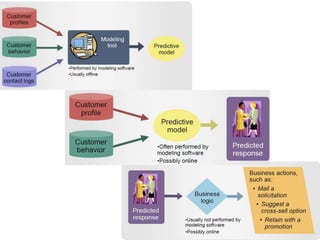
DRIVERS FOR PREDICTIVE
ANALYTICS
PREDICITVE ANALYTICS VS
FORECASTING
PREDICTIVE MODELLING
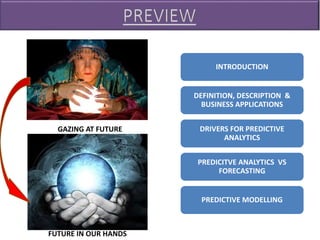
GAZING AT FUTURE
FUTURE IN OUR HANDS
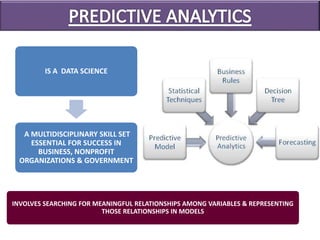
IS A DATA SCIENCE
A MULTIDISCIPLINARY SKILL SET
ESSENTIAL FOR SUCCESS IN
BUSINESS, NONPROFIT
ORGANIZATIONS & GOVERNMENT
INVOLVES SEARCHING FOR MEANINGFUL RELATIONSHIPS AMONG VARIABLES & REPRESENTING
THOSE RELATIONSHIPS IN MODELS
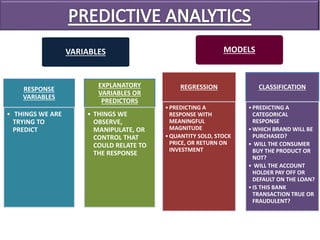
RESPONSE
VARIABLES
• THINGS WE ARE
TRYING TO
PREDICT
EXPLANATORY
VARIABLES OR
PREDICTORS
• THINGS WE
OBSERVE,
MANIPULATE, OR
CONTROL THAT
COULD RELATE TO
THE RESPONSE
VARIABLES MODELS
REGRESSION
•PREDICTING A
RESPONSE WITH
MEANINGFUL
MAGNITUDE
•QUANTITY SOLD, STOCK
PRICE, OR RETURN ON
INVESTMENT
CLASSIFICATION
•PREDICTING A
CATEGORICAL
RESPONSE
•WHICH BRAND WILL BE
PURCHASED?
• WILL THE CONSUMER
BUY THE PRODUCT OR
NOT?
• WILL THE ACCOUNT
HOLDER PAY OFF OR
DEFAULT ON THE LOAN?
•IS THIS BANK
TRANSACTION TRUE OR
FRAUDULENT?
FORECASTING SALES
FOR MARKET SHARE
FINDING A GOOD
RETAIL SITE OR
INVESTMENT
OPPORTUNITY
IDENTIFYING
CONSUMER SEGMENTS
AND TARGET MARKETS
ASSESSING THE
POTENTIAL OF NEW
PRODUCTS OR RISKS
ASSOCIATED WITH
EXISTING PRODUCTS
USES
MOST ORGS APPLY PA TO CORE
FUNCTIONS THAT PRODUCE
REVENUE USE PA TO INCREASE
PREDICTABILITY
USE PA TO CREATE NEW
REVENUE OPPORTUNITY
OF ORGS USE PA FOR CUSTOMER
SERVICES
TOP 5 SOURCES OF DATA TAPPED FOR PA
SALES
MARKETING
CUSTOMER
PRODUCT
FINANCIAL
COMPANIES USE
SOCIAL MEDIA
DATA
USE RESULTS OF PA FOR
PRODUCT
RECOMMENDATIONS AND
OFFERS
ASSERT THAT PA WILL HAVE MAJOR
POSITIVE IMPACT ON THEIR ORG
OF ORG WHO USE PA HAVE REALIZED A
COMPETITIVE ADVANTAGE
WITH REAL TIME PA YOU CAN MAKE SURE
YOUR COMPANY DOESN’T MISS IT’S
WINDOW OF OPPORTUNITY
CUSTOMER-RELATED ANALYTICS
SUCH AS RETENTION ANALYSIS
AND DIRECT MARKETING
• PREDICT TRENDS
• UNDERSTAND CUSTOMERS
• PREDICT BEHAVIOUR
• PROVIDE TARGETED PRODUCTS
• COMPETITIVE DIFFERENTIATOR
• REDUCE FRAUDS
BUSINESS PROCESS REASONS
• PREDICTIVE ANALYTICS TO
DRIVE BETTER BUSINESS
PERFORMANCE
• DRIVE STRATEGIC DECISION
MAKING
• DRIVE OPERATIONAL
EFFICIENCY
• IDENTIFY NEW BUSINESS
OPPORTUNITIES
• FASTER RESPONSE TO
BUSINESS CHANGE
Based on survey: TDWI 2012
LACK OF
UNDERSTANDING OF
PREDICTIVE
ANALYTICS
TECHNOLOGY
LACK OF SKILLED
PERSONNEL
INABILITY TO
ASSEMBLE
NECESSARY DATA—
INTEGRATION ISSUES
NOT ENOUGH
BUDGET
BUSINESS CASE NOT
STRONG ENOUGH
INABILITY TO
ASSEMBLE
NECESSARY DATA—
CULTURAL ISSUES
THE TECHNOLOGY IS
TOO HARD TO USE
DECISION
TREES
 Process of predicting a future
event based on historical data
 Educated Guessing
 Underlying basis of
all business decisions
 Production
 Inventory
 Personnel
 Facilities
FORECASTING
• Predict the next number
a) 3.7, 3.7, 3.7, 3.7, 3.7, ?
b) 2.5, 4.5, 6.5, 8.5, 10.5, ?
c) 5.0, 7.5, 6.0, 4.5, 7.0, 9.5, 8.0, 6.5, ?
Forecasting is the process of making statements about
events whose actual outcomes (typically) have not yet
been observed.
A commonplace example might be estimation of some
variable of interest at some specified future date.
• The term "forecasting" is used when it is a time series
and we are predicting the series into the future. Hence
"business forecasts" and "weather forecasts".
• Prediction is the act of predicting in a cross-sectional
setting, where the data are a snapshot in time (say, a
one-time sample from a customer database).
• Here you use information on a sample of records to
predict the value of other records (which can be a
value that will be observed in the future).
• Predictive analytics is something else entirely, going
beyond standard forecasting by producing a
predictive score for each customer or other
organizational element.
• In contrast, forecasting provides
overall aggregate estimates, such as the total
number of purchases next quarter.
• For example, forecasting might estimate the total
number of ice cream cones to be purchased in a
certain region, while predictive analytics tells
you which individual customers are likely to buy an
ice cream cone.
• Prediction is generally more about classification problems. In
sales, these could be at different stages of the customer
lifecycle.
– At acquisition stage - Predict whether you could be my
potential customer.
– At service stage - Predict whether you would buy my cross-
sell/up-sell offer.
– At the retention stage - Predict whether you would remain
my customer or not.
• Forecasting is more about understanding how my sales would
be given the historic trend, seasonal effects (if at all) etc etc.
Both are very different and different predictive techniques are
applied to solve each of the above problems.
Prediction is a generic term for gaining future knowledge on
diverse aspects using diverse predictive techniques and diverse
methods (e.g. numeric forecasting, predicting purchase patterns,
predicting attrition causes in sales decline)
Forecasting is jut one of multiple predictive methods, usually
referred to predicting the future state of a variable in a defined
future time (sales revenue for the next X months, cost structure
for the following year, etc.).
“Forecasting is about out-of-sample
observations while prediction is about in-
sample observations”
…process by which a model is created or chosen
to try to best predict the probability of an
outcome
Predictive modelling is a process used in predictive analytics to
create a statistical model of future behaviour
Fundamentals of Predictive Modelling
• Data Collection
• Data Extraction/transformation
• Predictive Model
• Business Understanding
Functionality Algorithm Applicability
Classification Logistic Regression
Decision Trees
Naïve Bayes
Support Vector Machine
Response Modeling
Recommending “Next likely
product”
Employee retention
Credit Default modelling
Clustering Hierarchical K-means Customer segmentation
Association rules Apriori Market Basket analysis
Regression analysis to predict the result of a categorical dependent variable based on one
or more predictors or independent variables
Useful to analyze and predict a discrete set of outcomes like
• success/failure of new product
• Likelihood of customer retention/loss
Logistic Regression, the connection between the categorical dependent variable and
the continuous independent variables is measured by changing the dependent
variable into probability scores
Y = b0 + b1x1 + b2x2 + ……………………….. + bkxk + E
Y = Dependent variable
b0 = Constant
b1 = Coefficient of variable X1
x1 = Independent Variable
E = Error Term
• Seven reasons you need predictive analytics today: Eric Segal, PhD
• Predictive Analytics for Business Advantage. Fern Halper
• www.predictionimpact.com
• Wikipedia
• www.slideshare.com
Predictive analysis and modelling

Predictive analysis and modelling

  • 1.
    • S –36 LALIT MOHAN THURIMELLA • S - 41 MANOJ KUMAR • S – 82 SUNIL KUMAR • S – 52 P SIVIAH • S - 94 SOMESH GILANI
  • 2.
    INTRODUCTION DEFINITION, DESCRIPTION & BUSINESSAPPLICATIONS DRIVERS FOR PREDICTIVE ANALYTICS PREDICITVE ANALYTICS VS FORECASTING PREDICTIVE MODELLING GAZING AT FUTURE FUTURE IN OUR HANDS
  • 4.
    IS A DATASCIENCE A MULTIDISCIPLINARY SKILL SET ESSENTIAL FOR SUCCESS IN BUSINESS, NONPROFIT ORGANIZATIONS & GOVERNMENT INVOLVES SEARCHING FOR MEANINGFUL RELATIONSHIPS AMONG VARIABLES & REPRESENTING THOSE RELATIONSHIPS IN MODELS
  • 5.
    RESPONSE VARIABLES • THINGS WEARE TRYING TO PREDICT EXPLANATORY VARIABLES OR PREDICTORS • THINGS WE OBSERVE, MANIPULATE, OR CONTROL THAT COULD RELATE TO THE RESPONSE VARIABLES MODELS REGRESSION •PREDICTING A RESPONSE WITH MEANINGFUL MAGNITUDE •QUANTITY SOLD, STOCK PRICE, OR RETURN ON INVESTMENT CLASSIFICATION •PREDICTING A CATEGORICAL RESPONSE •WHICH BRAND WILL BE PURCHASED? • WILL THE CONSUMER BUY THE PRODUCT OR NOT? • WILL THE ACCOUNT HOLDER PAY OFF OR DEFAULT ON THE LOAN? •IS THIS BANK TRANSACTION TRUE OR FRAUDULENT?
  • 13.
    FORECASTING SALES FOR MARKETSHARE FINDING A GOOD RETAIL SITE OR INVESTMENT OPPORTUNITY IDENTIFYING CONSUMER SEGMENTS AND TARGET MARKETS ASSESSING THE POTENTIAL OF NEW PRODUCTS OR RISKS ASSOCIATED WITH EXISTING PRODUCTS USES
  • 16.
    MOST ORGS APPLYPA TO CORE FUNCTIONS THAT PRODUCE REVENUE USE PA TO INCREASE PREDICTABILITY USE PA TO CREATE NEW REVENUE OPPORTUNITY OF ORGS USE PA FOR CUSTOMER SERVICES TOP 5 SOURCES OF DATA TAPPED FOR PA SALES MARKETING CUSTOMER PRODUCT FINANCIAL COMPANIES USE SOCIAL MEDIA DATA USE RESULTS OF PA FOR PRODUCT RECOMMENDATIONS AND OFFERS ASSERT THAT PA WILL HAVE MAJOR POSITIVE IMPACT ON THEIR ORG OF ORG WHO USE PA HAVE REALIZED A COMPETITIVE ADVANTAGE WITH REAL TIME PA YOU CAN MAKE SURE YOUR COMPANY DOESN’T MISS IT’S WINDOW OF OPPORTUNITY
  • 19.
    CUSTOMER-RELATED ANALYTICS SUCH ASRETENTION ANALYSIS AND DIRECT MARKETING • PREDICT TRENDS • UNDERSTAND CUSTOMERS • PREDICT BEHAVIOUR • PROVIDE TARGETED PRODUCTS • COMPETITIVE DIFFERENTIATOR • REDUCE FRAUDS BUSINESS PROCESS REASONS • PREDICTIVE ANALYTICS TO DRIVE BETTER BUSINESS PERFORMANCE • DRIVE STRATEGIC DECISION MAKING • DRIVE OPERATIONAL EFFICIENCY • IDENTIFY NEW BUSINESS OPPORTUNITIES • FASTER RESPONSE TO BUSINESS CHANGE
  • 20.
  • 21.
  • 22.
    LACK OF UNDERSTANDING OF PREDICTIVE ANALYTICS TECHNOLOGY LACKOF SKILLED PERSONNEL INABILITY TO ASSEMBLE NECESSARY DATA— INTEGRATION ISSUES NOT ENOUGH BUDGET BUSINESS CASE NOT STRONG ENOUGH INABILITY TO ASSEMBLE NECESSARY DATA— CULTURAL ISSUES THE TECHNOLOGY IS TOO HARD TO USE
  • 23.
  • 25.
     Process ofpredicting a future event based on historical data  Educated Guessing  Underlying basis of all business decisions  Production  Inventory  Personnel  Facilities
  • 26.
    FORECASTING • Predict thenext number a) 3.7, 3.7, 3.7, 3.7, 3.7, ? b) 2.5, 4.5, 6.5, 8.5, 10.5, ? c) 5.0, 7.5, 6.0, 4.5, 7.0, 9.5, 8.0, 6.5, ? Forecasting is the process of making statements about events whose actual outcomes (typically) have not yet been observed. A commonplace example might be estimation of some variable of interest at some specified future date.
  • 27.
    • The term"forecasting" is used when it is a time series and we are predicting the series into the future. Hence "business forecasts" and "weather forecasts". • Prediction is the act of predicting in a cross-sectional setting, where the data are a snapshot in time (say, a one-time sample from a customer database). • Here you use information on a sample of records to predict the value of other records (which can be a value that will be observed in the future).
  • 28.
    • Predictive analyticsis something else entirely, going beyond standard forecasting by producing a predictive score for each customer or other organizational element. • In contrast, forecasting provides overall aggregate estimates, such as the total number of purchases next quarter. • For example, forecasting might estimate the total number of ice cream cones to be purchased in a certain region, while predictive analytics tells you which individual customers are likely to buy an ice cream cone.
  • 30.
    • Prediction isgenerally more about classification problems. In sales, these could be at different stages of the customer lifecycle. – At acquisition stage - Predict whether you could be my potential customer. – At service stage - Predict whether you would buy my cross- sell/up-sell offer. – At the retention stage - Predict whether you would remain my customer or not. • Forecasting is more about understanding how my sales would be given the historic trend, seasonal effects (if at all) etc etc. Both are very different and different predictive techniques are applied to solve each of the above problems.
  • 31.
    Prediction is ageneric term for gaining future knowledge on diverse aspects using diverse predictive techniques and diverse methods (e.g. numeric forecasting, predicting purchase patterns, predicting attrition causes in sales decline) Forecasting is jut one of multiple predictive methods, usually referred to predicting the future state of a variable in a defined future time (sales revenue for the next X months, cost structure for the following year, etc.).
  • 32.
    “Forecasting is aboutout-of-sample observations while prediction is about in- sample observations”
  • 33.
    …process by whicha model is created or chosen to try to best predict the probability of an outcome
  • 34.
    Predictive modelling isa process used in predictive analytics to create a statistical model of future behaviour Fundamentals of Predictive Modelling • Data Collection • Data Extraction/transformation • Predictive Model • Business Understanding
  • 35.
    Functionality Algorithm Applicability ClassificationLogistic Regression Decision Trees Naïve Bayes Support Vector Machine Response Modeling Recommending “Next likely product” Employee retention Credit Default modelling Clustering Hierarchical K-means Customer segmentation Association rules Apriori Market Basket analysis
  • 36.
    Regression analysis topredict the result of a categorical dependent variable based on one or more predictors or independent variables Useful to analyze and predict a discrete set of outcomes like • success/failure of new product • Likelihood of customer retention/loss Logistic Regression, the connection between the categorical dependent variable and the continuous independent variables is measured by changing the dependent variable into probability scores Y = b0 + b1x1 + b2x2 + ……………………….. + bkxk + E Y = Dependent variable b0 = Constant b1 = Coefficient of variable X1 x1 = Independent Variable E = Error Term
  • 37.
    • Seven reasonsyou need predictive analytics today: Eric Segal, PhD • Predictive Analytics for Business Advantage. Fern Halper • www.predictionimpact.com • Wikipedia • www.slideshare.com