Building a Fast and Flexible Consumer-Driven Supply Chain
Wilfred Eijpen – Director, Supply Chain
Johanne Tsui – Manager, Supply Planning
 Company Overview
 Strategic Roadmap
 Consumer Driven Supply Chain – Benefits
 Sales & Operations Planning (S&OP)
 Production & Sales Inventory (PSI)
 Sales & Demand Management (SDM)
 Next Steps
Agenda
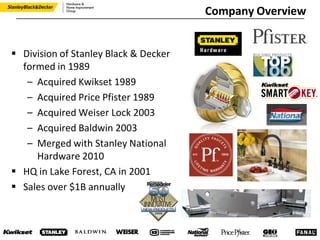
 Division of Stanley Black & Decker
formed in 1989
– Acquired Kwikset 1989
– Acquired Price Pfister 1989
– Acquired Weiser Lock 2003
– Acquired Baldwin 2003
– Merged with Stanley National
Hardware 2010
 HQ in Lake Forest, CA in 2001
 Sales over $1B annually
Company Overview
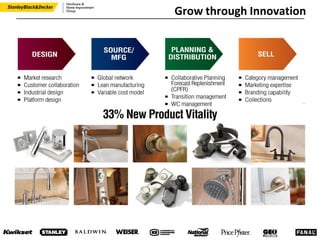
Grow through Innovation
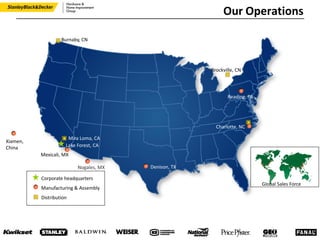
Denison, TX
Reading, PA
Charlotte, NC
Mira Loma, CA
Mexicali, MX
Nogales, MX
Lake Forest, CA
Burnaby, CN
Brockville, CN
Xiamen,
China
Corporate headquarters
Manufacturing & Assembly
Distribution
Global Sales Force
Our Operations
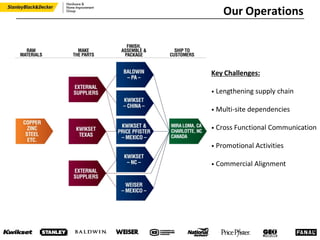
Our Operations
Key Challenges:
• Lengthening supply chain
• Multi-site dependencies
• Cross Functional Communication
• Promotional Activities
• Commercial Alignment
Fast & Flexible
Consumer Driven
Supply Chain
Our Objective
Our Strategic Roadmap
People
Process
Systems
2007
Revised 9/25/08
2008 2009 2010
Customer Service Integration
Channel Focused Teams
Establish CPFR presence
Supply Planning Collaboration Teams
CPFR with Retail Customers
SDM for Non-Retail
S&OP Revamp
Demand Planning for all accounts
Master Planning for Major Manufacturing Plants
Fulfillment for Supply Planning
S&OP Reporting
Production Sales & Inventory Planning
 Customer Order Prioritization
 Constrain demand at multiple levels in the Supply Chain
 Full visibility throughout the Supply Chain (Order to
Production)
 Connectivity of Supply Chain Systems
 Manage by Exception
 Improved Productivity
 Reduction in workload
Our Soft Benefits
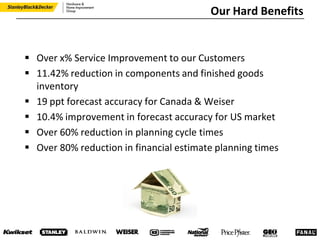
 Over x% Service Improvement to our Customers
 11.42% reduction in components and finished goods
inventory
 19 ppt forecast accuracy for Canada & Weiser
 10.4% improvement in forecast accuracy for US market
 Over 60% reduction in planning cycle times
 Over 80% reduction in financial estimate planning times
Our Hard Benefits
Fast & Flexible
Consumer Driven
Supply Chain
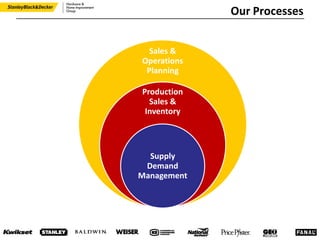
Strategic
Tactical
Operational
Sales &
Operations
Planning
Production
Sales &
Inventory
Supply
Demand
Management
Our Processes
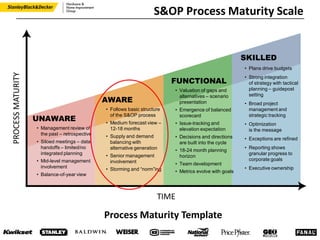
UNAWARE
• Management review of
the past – retrospective
• Siloed meetings – data
handoffs – limited/no
integrated planning
• Mid-level management
involvement
• Balance-of-year view
AWARE
• Follows basic structure
of the S&OP process
• Medium forecast view –
12-18 months
• Supply and demand
balancing with
alternative generation
• Senior management
involvement
• Storming and “norm”ing
FUNCTIONAL
• Valuation of gaps and
alternatives – scenario
presentation
• Emergence of balanced
scorecard
• Issue-tracking and
elevation expectation
• Decisions and directions
are built into the cycle
• 18-24 month planning
horizon
• Team development
• Metrics evolve with goals
SKILLED
• Plans drive budgets
• Strong integration
of strategy with tactical
planning – guidepost
setting
• Broad project
management and
strategic tracking
• Optimization
is the message
• Exceptions are refined
• Reporting shows
granular progress to
corporate goals
• Executive ownership
TIME
Process Maturity Template
PROCESSMATURITY S&OP Process Maturity Scale
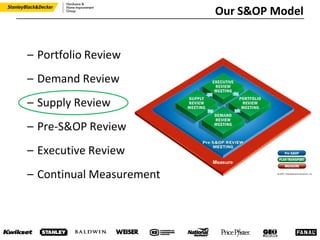
– Portfolio Review
– Demand Review
– Supply Review
– Pre-S&OP Review
– Executive Review
– Continual Measurement
Our S&OP Model
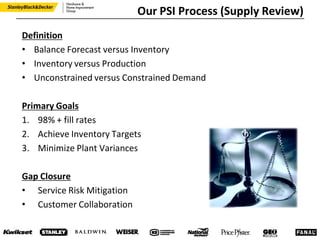
Definition
• Balance Forecast versus Inventory
• Inventory versus Production
• Unconstrained versus Constrained Demand
Primary Goals
1. 98% + fill rates
2. Achieve Inventory Targets
3. Minimize Plant Variances
Gap Closure
• Service Risk Mitigation
• Customer Collaboration
Our PSI Process (Supply Review)
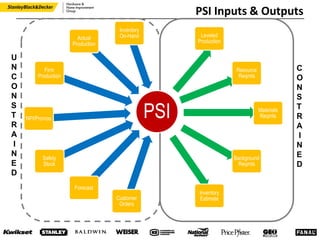
PSI
Customer
Orders
Forecast
Safety
Stock
NPI/Promos
Firm
Production
Actual
Production
Inventory
On-Hand Leveled
Production
Resource
Reqmts
Materials
Reqmts
Background
Reqmts
Inventory
Estimate
PSI Inputs & Outputs
U
N
C
O
N
S
T
R
A
I
N
E
D
C
O
N
S
T
R
A
I
N
E
D
Consumer Driven Supply Chain
Handshake
Meetings
Constrained
Demand
Review
Unconstrained
Demand
Review
PSI Process Overview
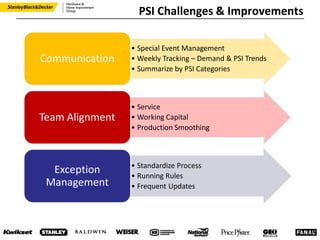
PSI Challenges & Improvements
• Special Event Management
• Weekly Tracking – Demand & PSI Trends
• Summarize by PSI Categories
Communication
• Service
• Working Capital
• Production Smoothing
Team Alignment
• Standardize Process
• Running Rules
• Frequent Updates
Exception
Management
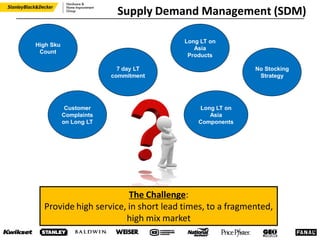
Supply Demand Management (SDM)
7 day LT
commitment
High Sku
Count
Long LT on
Asia
Products
Customer
Complaints
on Long LT
Long LT on
Asia
Components
No Stocking
Strategy
The Challenge:
Provide high service, in short lead times, to a fragmented,
high mix market
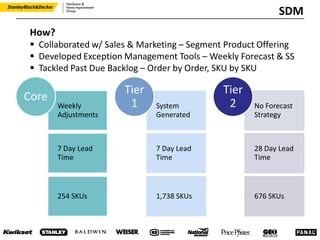
SDM
Weekly
Adjustments
7 Day Lead
Time
254 SKUs
Core
System
Generated
7 Day Lead
Time
1,738 SKUs
Tier
1 No Forecast
Strategy
28 Day Lead
Time
676 SKUs
Tier
2
How?
 Collaborated w/ Sales & Marketing – Segment Product Offering
 Developed Exception Management Tools – Weekly Forecast & SS
 Tackled Past Due Backlog – Order by Order, SKU by SKU
 Frequent review & measure  Smaller changes
 Use visual tools
 Highlight big deviations fast
 Highlight trends over time
 Review category assignment over time
 New SKUs start in Tier 1 and earn Core status over time
SDM Principles
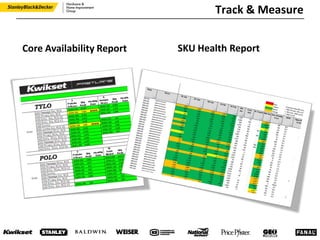
Track & Measure
Core Availability Report SKU Health Report
Next Steps
 S&OP Revamp for Entire Business
 Dedicated Product Life Cycle Management Resource
 Weekly Forecasting
 Weekly PSI report
 Inventory Balancing (Raw/WIP versus FG)
 Billing Debrief Meeting
 Standardize Reporting
Thank you!
Questions?

Building a Fast and Flexible Consumer-Driven Supply Chain, Stanley Black & Decker

  • 1.
    Building a Fastand Flexible Consumer-Driven Supply Chain Wilfred Eijpen – Director, Supply Chain Johanne Tsui – Manager, Supply Planning
  • 2.
     Company Overview Strategic Roadmap  Consumer Driven Supply Chain – Benefits  Sales & Operations Planning (S&OP)  Production & Sales Inventory (PSI)  Sales & Demand Management (SDM)  Next Steps Agenda
  • 3.
     Division ofStanley Black & Decker formed in 1989 – Acquired Kwikset 1989 – Acquired Price Pfister 1989 – Acquired Weiser Lock 2003 – Acquired Baldwin 2003 – Merged with Stanley National Hardware 2010  HQ in Lake Forest, CA in 2001  Sales over $1B annually Company Overview
  • 4.
  • 5.
    Denison, TX Reading, PA Charlotte,NC Mira Loma, CA Mexicali, MX Nogales, MX Lake Forest, CA Burnaby, CN Brockville, CN Xiamen, China Corporate headquarters Manufacturing & Assembly Distribution Global Sales Force Our Operations
  • 6.
    Our Operations Key Challenges: •Lengthening supply chain • Multi-site dependencies • Cross Functional Communication • Promotional Activities • Commercial Alignment
  • 7.
    Fast & Flexible ConsumerDriven Supply Chain Our Objective
  • 8.
    Our Strategic Roadmap People Process Systems 2007 Revised9/25/08 2008 2009 2010 Customer Service Integration Channel Focused Teams Establish CPFR presence Supply Planning Collaboration Teams CPFR with Retail Customers SDM for Non-Retail S&OP Revamp Demand Planning for all accounts Master Planning for Major Manufacturing Plants Fulfillment for Supply Planning S&OP Reporting Production Sales & Inventory Planning
  • 9.
     Customer OrderPrioritization  Constrain demand at multiple levels in the Supply Chain  Full visibility throughout the Supply Chain (Order to Production)  Connectivity of Supply Chain Systems  Manage by Exception  Improved Productivity  Reduction in workload Our Soft Benefits
  • 10.
     Over x%Service Improvement to our Customers  11.42% reduction in components and finished goods inventory  19 ppt forecast accuracy for Canada & Weiser  10.4% improvement in forecast accuracy for US market  Over 60% reduction in planning cycle times  Over 80% reduction in financial estimate planning times Our Hard Benefits
  • 11.
    Fast & Flexible ConsumerDriven Supply Chain Strategic Tactical Operational Sales & Operations Planning Production Sales & Inventory Supply Demand Management Our Processes
  • 12.
    UNAWARE • Management reviewof the past – retrospective • Siloed meetings – data handoffs – limited/no integrated planning • Mid-level management involvement • Balance-of-year view AWARE • Follows basic structure of the S&OP process • Medium forecast view – 12-18 months • Supply and demand balancing with alternative generation • Senior management involvement • Storming and “norm”ing FUNCTIONAL • Valuation of gaps and alternatives – scenario presentation • Emergence of balanced scorecard • Issue-tracking and elevation expectation • Decisions and directions are built into the cycle • 18-24 month planning horizon • Team development • Metrics evolve with goals SKILLED • Plans drive budgets • Strong integration of strategy with tactical planning – guidepost setting • Broad project management and strategic tracking • Optimization is the message • Exceptions are refined • Reporting shows granular progress to corporate goals • Executive ownership TIME Process Maturity Template PROCESSMATURITY S&OP Process Maturity Scale
  • 13.
    – Portfolio Review –Demand Review – Supply Review – Pre-S&OP Review – Executive Review – Continual Measurement Our S&OP Model
  • 14.
    Definition • Balance Forecastversus Inventory • Inventory versus Production • Unconstrained versus Constrained Demand Primary Goals 1. 98% + fill rates 2. Achieve Inventory Targets 3. Minimize Plant Variances Gap Closure • Service Risk Mitigation • Customer Collaboration Our PSI Process (Supply Review)
  • 15.
  • 16.
    Consumer Driven SupplyChain Handshake Meetings Constrained Demand Review Unconstrained Demand Review PSI Process Overview
  • 17.
    PSI Challenges &Improvements • Special Event Management • Weekly Tracking – Demand & PSI Trends • Summarize by PSI Categories Communication • Service • Working Capital • Production Smoothing Team Alignment • Standardize Process • Running Rules • Frequent Updates Exception Management
  • 18.
    Supply Demand Management(SDM) 7 day LT commitment High Sku Count Long LT on Asia Products Customer Complaints on Long LT Long LT on Asia Components No Stocking Strategy The Challenge: Provide high service, in short lead times, to a fragmented, high mix market
  • 19.
    SDM Weekly Adjustments 7 Day Lead Time 254SKUs Core System Generated 7 Day Lead Time 1,738 SKUs Tier 1 No Forecast Strategy 28 Day Lead Time 676 SKUs Tier 2 How?  Collaborated w/ Sales & Marketing – Segment Product Offering  Developed Exception Management Tools – Weekly Forecast & SS  Tackled Past Due Backlog – Order by Order, SKU by SKU
  • 20.
     Frequent review& measure  Smaller changes  Use visual tools  Highlight big deviations fast  Highlight trends over time  Review category assignment over time  New SKUs start in Tier 1 and earn Core status over time SDM Principles
  • 21.
    Track & Measure CoreAvailability Report SKU Health Report
  • 22.
    Next Steps  S&OPRevamp for Entire Business  Dedicated Product Life Cycle Management Resource  Weekly Forecasting  Weekly PSI report  Inventory Balancing (Raw/WIP versus FG)  Billing Debrief Meeting  Standardize Reporting
  • 23.