S&OP –Strengthen the Processes to
reach another level of excellence
Satish Sandhir
27-28 Jan 2011
2AGENDA
 Introduction
 Sales & Operations Planning
 PDCA – to improve S&OP Process
 New Processes
 Scenario Analysis
 Demand Shaping
 Process playbooks
 Data Compilation
3Introduction
 Satish Sandhir, CPIM
 20+ years experience in defense, shipbuilding, aviation industries
 14 years in setting up Supply Chain Systems for top Fortune
companies, Hi Tech, CPG, Industrials
 Presently Consultant at PepsiCo
4APICS – definition of Executive S&OP
“It is a decision-making activity involving the
leader of the business, his or her staff, and a
number of middle managers and specialists.
Its mission is to balance demand and supply
at the aggregate level, to align operational
planning with financial planning, and to link
strategic planning with day to day sales and
operational activities”
5Sales & Operations Planning
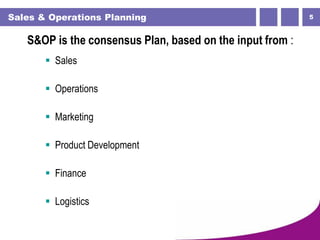
S&OP is the consensus Plan, based on the input from :
 Sales
 Operations
 Marketing
 Product Development
 Finance
 Logistics
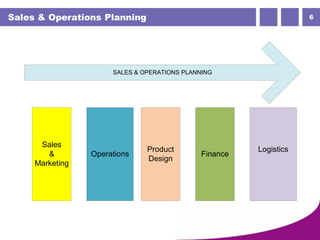
6Sales & Operations Planning
Sales
&
Marketing
Operations
Product
Design
Finance
Logistics
SALES & OPERATIONS PLANNING
7Sales & Operations Planning
Sales & Operations Process is a challenging process
 Identifies issues of Sales, Demand, Competition
 Collect prior month Sales, Production and Period ending
Inventory Information. Calculate Inventory based on Supply and
Demand and compare it to the Actual and reconcile differences.
Also collect Sales Forecast and Inventory Plan Information.
Modify S&OP spreadsheet to reflect updated Actuals, Forecast
and Plans.
 Upgrade Performance Measures for each department.
 Analyze and identify Trends
 Review Assumptions ( Marketplace; Economic conditions,
competitive situation, company structure, IT systems
 Compare performance to goals
 Distribute and review meeting material.
8Executive Sales & Operations Planning – Meeting
 S &OP decisions are taken at the highest level (VP’s) to come out
with a consensus Plan that Operations can implement and Sales
execute.
 Any deviations to the plan are clearly shown in the Financial
impact to the company.
 The complexities of the plan are so vigorous that a strong
Technology footprint is a pre-requisite to have a timely Plan that
has been diligently supported by the data.
 Any changes to the Plan are included in the monthly S& OP cycle
that takes place every month or Period.
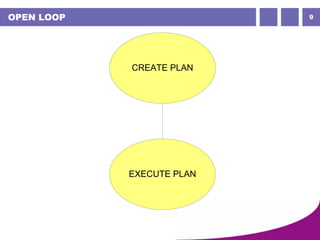
9OPEN LOOP
CREATE PLAN
EXECUTE PLAN
10Open Loop
Plan is called open Loop as:
 There is no process to constantly measure the deviation to the
Plan.
 By the time action is taken, the SUPPLY and DEMAND situation
has changed.
 Too much latency built in the execution.
11Variability of Demand & Supply
 Technology advances have made Customer the King, so the
variability of Demand has been increasing rapidly.
 Agile companies can not afford to be bowed down by such
changes.
 S& OP processes have been augmented by additional processes
that cater to the Plan deviations, immediately and react
accordingly. Many of these processes have been implemented
based on the renowned Quality Guru Dr. W. Edwards Deming.
 P-D-C-A is the mantra that is being recreated by these companies
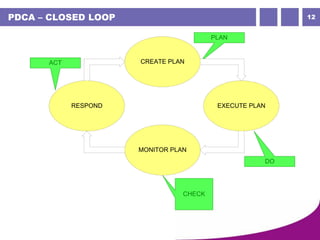
12PDCA – CLOSED LOOP
CREATE PLAN
MONITOR PLAN
EXECUTE PLANRESPOND
PLAN
ACT
DO
CHECK
13Closed Loop - P-D-C-A
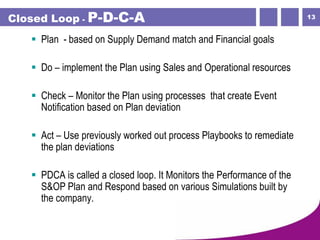
 Plan - based on Supply Demand match and Financial goals
 Do – implement the Plan using Sales and Operational resources
 Check – Monitor the Plan using processes that create Event
Notification based on Plan deviation
 Act – Use previously worked out process Playbooks to remediate
the plan deviations
 PDCA is called a closed loop. It Monitors the Performance of the
S&OP Plan and Respond based on various Simulations built by
the company.
14Check & Act
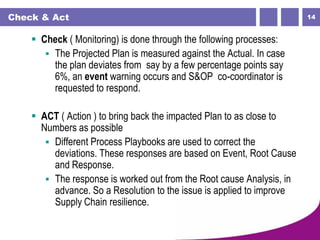
 Check ( Monitoring) is done through the following processes:
 The Projected Plan is measured against the Actual. In case
the plan deviates from say by a few percentage points say
6%, an event warning occurs and S&OP co-coordinator is
requested to respond.
 ACT ( Action ) to bring back the impacted Plan to as close to
Numbers as possible
 Different Process Playbooks are used to correct the
deviations. These responses are based on Event, Root Cause
and Response.
 The response is worked out from the Root cause Analysis, in
advance. So a Resolution to the issue is applied to improve
Supply Chain resilience.
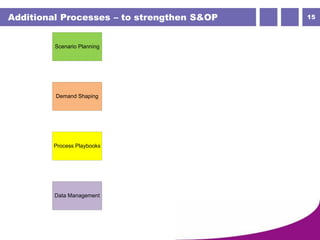
15Additional Processes – to strengthen S&OP
Scenario Planning
Process Playbooks
Demand Shaping
Data Management
16Scenario Analysis
 In this Planner run scenarios with different Demand and SUPPLY
profiles. They create WHAT IF scenarios depending on shortages
of Supply, alternate supply or/ Demand variability by region, or by
Product family and number of other situations.
 The impact of these Scenarios on Companies financials is noted. A
number of alternatives are evaluated and a PLAN is chosen.
 Based on optimistic, pessimistic scenarios for the demand and
Supply plans, one can consensually come out with a Plan that is
acceptable to all. Agile Companies are carrying out a number of
simulations. Based on these simulations responses are worked out
and kept in a Knowledge base.
17Demand Shaping
 Demand Shaping provides a mechanism for introducing action
that change demand to match available Supply. Demand Shaping
can be used for
 price changes,
 promotions and
 incentives to buy different products when Supply is low.
 By running different Scenarios, Planners can evaluate the impact
of Demand Shaping on the company’s financials.
18Process Playbook
 Many companies are doing simulations and have a knowledge
base of solutions for similar events. This makes for a well defined
response to ensure that Plan does not deviate. These responses
are called Process playbooks. The Process playbooks may be
applied for a trend such as negative direction or even for strategic
events such as natural disasters.
 Catalog of various unexpected events, and the responses would
make a quick response in a process playbook.
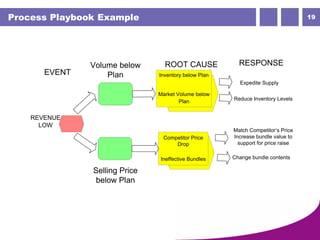
19Process Playbook Example
Volume below
Plan
Selling Price
below Plan
REVENUE
LOW
ROOT CAUSE
Inventory below Plan
Market Volume below
Plan
Competitor Price
Drop
Ineffective Bundles
Expedite Supply
Reduce Inventory Levels
Match Competitor’s Price
Increase bundle value to
support for price raise
Change bundle contents
RESPONSE
EVENT
20Data Management
 Critical data for decision making is held in different formats in
different systems. We need to:
 Integrate data and synchronize it, within various regions.
 Keep a database of competitors and own monitoring needs for
Event Management.
 Keep a record of Root Cause Analysis for different Events.
 Collaboration and Visibility of critical data between different
groups, particularly in global environments.
21Q & A

Strengthen the Processes to reach another level of excellence, Satish Sandhir

  • 1.
    S&OP –Strengthen theProcesses to reach another level of excellence Satish Sandhir 27-28 Jan 2011
  • 2.
    2AGENDA  Introduction  Sales& Operations Planning  PDCA – to improve S&OP Process  New Processes  Scenario Analysis  Demand Shaping  Process playbooks  Data Compilation
  • 3.
    3Introduction  Satish Sandhir,CPIM  20+ years experience in defense, shipbuilding, aviation industries  14 years in setting up Supply Chain Systems for top Fortune companies, Hi Tech, CPG, Industrials  Presently Consultant at PepsiCo
  • 4.
    4APICS – definitionof Executive S&OP “It is a decision-making activity involving the leader of the business, his or her staff, and a number of middle managers and specialists. Its mission is to balance demand and supply at the aggregate level, to align operational planning with financial planning, and to link strategic planning with day to day sales and operational activities”
  • 5.
    5Sales & OperationsPlanning S&OP is the consensus Plan, based on the input from :  Sales  Operations  Marketing  Product Development  Finance  Logistics
  • 6.
    6Sales & OperationsPlanning Sales & Marketing Operations Product Design Finance Logistics SALES & OPERATIONS PLANNING
  • 7.
    7Sales & OperationsPlanning Sales & Operations Process is a challenging process  Identifies issues of Sales, Demand, Competition  Collect prior month Sales, Production and Period ending Inventory Information. Calculate Inventory based on Supply and Demand and compare it to the Actual and reconcile differences. Also collect Sales Forecast and Inventory Plan Information. Modify S&OP spreadsheet to reflect updated Actuals, Forecast and Plans.  Upgrade Performance Measures for each department.  Analyze and identify Trends  Review Assumptions ( Marketplace; Economic conditions, competitive situation, company structure, IT systems  Compare performance to goals  Distribute and review meeting material.
  • 8.
    8Executive Sales &Operations Planning – Meeting  S &OP decisions are taken at the highest level (VP’s) to come out with a consensus Plan that Operations can implement and Sales execute.  Any deviations to the plan are clearly shown in the Financial impact to the company.  The complexities of the plan are so vigorous that a strong Technology footprint is a pre-requisite to have a timely Plan that has been diligently supported by the data.  Any changes to the Plan are included in the monthly S& OP cycle that takes place every month or Period.
  • 9.
  • 10.
    10Open Loop Plan iscalled open Loop as:  There is no process to constantly measure the deviation to the Plan.  By the time action is taken, the SUPPLY and DEMAND situation has changed.  Too much latency built in the execution.
  • 11.
    11Variability of Demand& Supply  Technology advances have made Customer the King, so the variability of Demand has been increasing rapidly.  Agile companies can not afford to be bowed down by such changes.  S& OP processes have been augmented by additional processes that cater to the Plan deviations, immediately and react accordingly. Many of these processes have been implemented based on the renowned Quality Guru Dr. W. Edwards Deming.  P-D-C-A is the mantra that is being recreated by these companies
  • 12.
    12PDCA – CLOSEDLOOP CREATE PLAN MONITOR PLAN EXECUTE PLANRESPOND PLAN ACT DO CHECK
  • 13.
    13Closed Loop -P-D-C-A  Plan - based on Supply Demand match and Financial goals  Do – implement the Plan using Sales and Operational resources  Check – Monitor the Plan using processes that create Event Notification based on Plan deviation  Act – Use previously worked out process Playbooks to remediate the plan deviations  PDCA is called a closed loop. It Monitors the Performance of the S&OP Plan and Respond based on various Simulations built by the company.
  • 14.
    14Check & Act Check ( Monitoring) is done through the following processes:  The Projected Plan is measured against the Actual. In case the plan deviates from say by a few percentage points say 6%, an event warning occurs and S&OP co-coordinator is requested to respond.  ACT ( Action ) to bring back the impacted Plan to as close to Numbers as possible  Different Process Playbooks are used to correct the deviations. These responses are based on Event, Root Cause and Response.  The response is worked out from the Root cause Analysis, in advance. So a Resolution to the issue is applied to improve Supply Chain resilience.
  • 15.
    15Additional Processes –to strengthen S&OP Scenario Planning Process Playbooks Demand Shaping Data Management
  • 16.
    16Scenario Analysis  Inthis Planner run scenarios with different Demand and SUPPLY profiles. They create WHAT IF scenarios depending on shortages of Supply, alternate supply or/ Demand variability by region, or by Product family and number of other situations.  The impact of these Scenarios on Companies financials is noted. A number of alternatives are evaluated and a PLAN is chosen.  Based on optimistic, pessimistic scenarios for the demand and Supply plans, one can consensually come out with a Plan that is acceptable to all. Agile Companies are carrying out a number of simulations. Based on these simulations responses are worked out and kept in a Knowledge base.
  • 17.
    17Demand Shaping  DemandShaping provides a mechanism for introducing action that change demand to match available Supply. Demand Shaping can be used for  price changes,  promotions and  incentives to buy different products when Supply is low.  By running different Scenarios, Planners can evaluate the impact of Demand Shaping on the company’s financials.
  • 18.
    18Process Playbook  Manycompanies are doing simulations and have a knowledge base of solutions for similar events. This makes for a well defined response to ensure that Plan does not deviate. These responses are called Process playbooks. The Process playbooks may be applied for a trend such as negative direction or even for strategic events such as natural disasters.  Catalog of various unexpected events, and the responses would make a quick response in a process playbook.
  • 19.
    19Process Playbook Example Volumebelow Plan Selling Price below Plan REVENUE LOW ROOT CAUSE Inventory below Plan Market Volume below Plan Competitor Price Drop Ineffective Bundles Expedite Supply Reduce Inventory Levels Match Competitor’s Price Increase bundle value to support for price raise Change bundle contents RESPONSE EVENT
  • 20.
    20Data Management  Criticaldata for decision making is held in different formats in different systems. We need to:  Integrate data and synchronize it, within various regions.  Keep a database of competitors and own monitoring needs for Event Management.  Keep a record of Root Cause Analysis for different Events.  Collaboration and Visibility of critical data between different groups, particularly in global environments.
  • 21.