Predictive analytics of
demand
for optimization of
Procurement Process
By :Prashant Bhatmule
VP-SCM
Bajaj Electricals Ltd
Points to cover
• Understanding the models, simulations and variables
• selection for better use of predictive analytics.
• How to reduce the volatility in decision making process using
• predictive analysis in procurement process
• How to overcome challenges in the procurement process ,
• inventory management understanding the future cost,
• demand, supply of resources using predictive analytics?
• Understanding multiple uses of predictive analytics
• in terms of suppliers and vendors
• Understand ways to address the challenges with managing
• Big Data and approaches for improving your supplier risk.
3
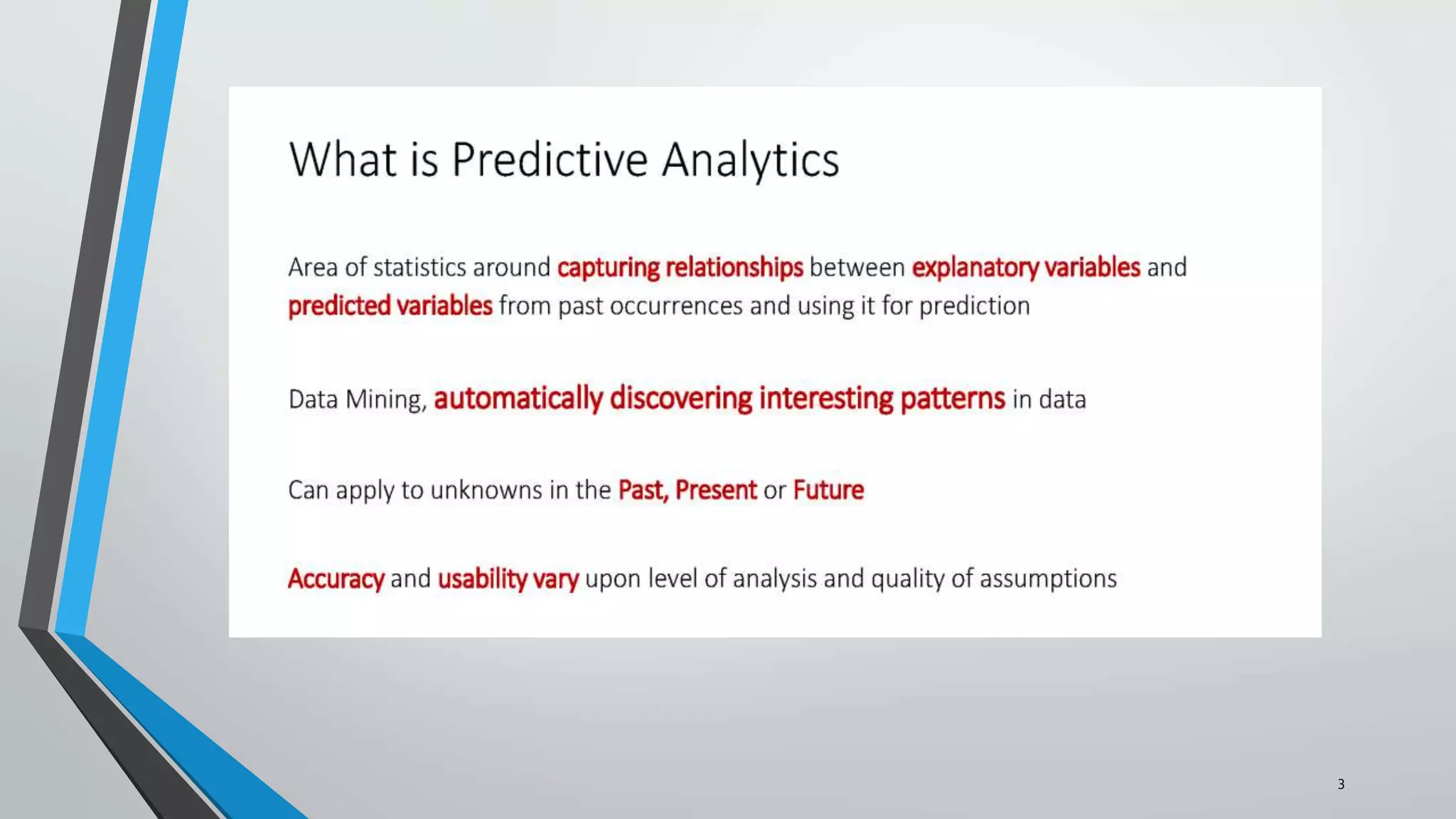
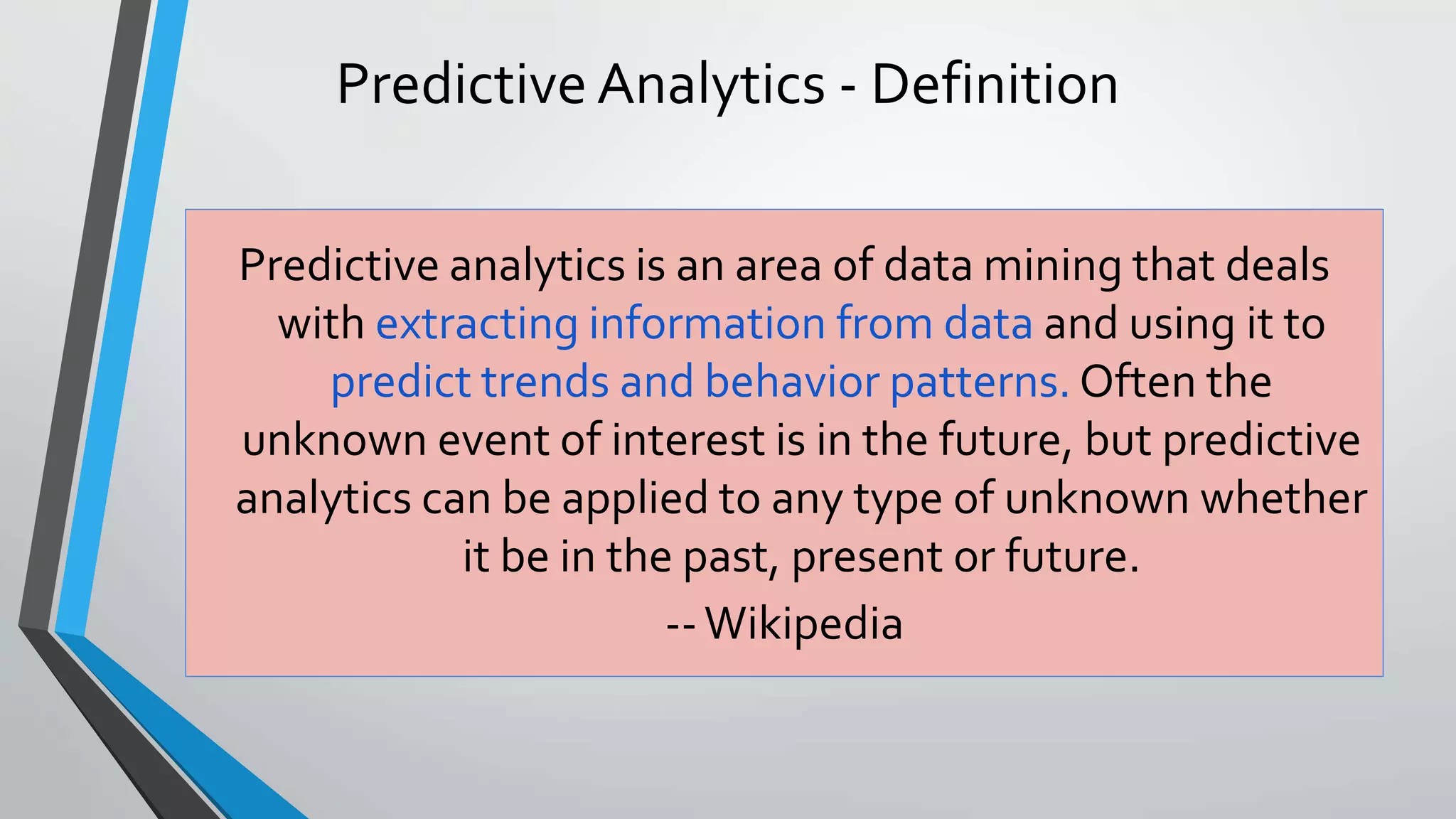
Predictive Analytics - Definition
Predictive analytics is an area of data mining that deals
with extracting information from data and using it to
predict trends and behavior patterns. Often the
unknown event of interest is in the future, but predictive
analytics can be applied to any type of unknown whether
it be in the past, present or future.
--Wikipedia
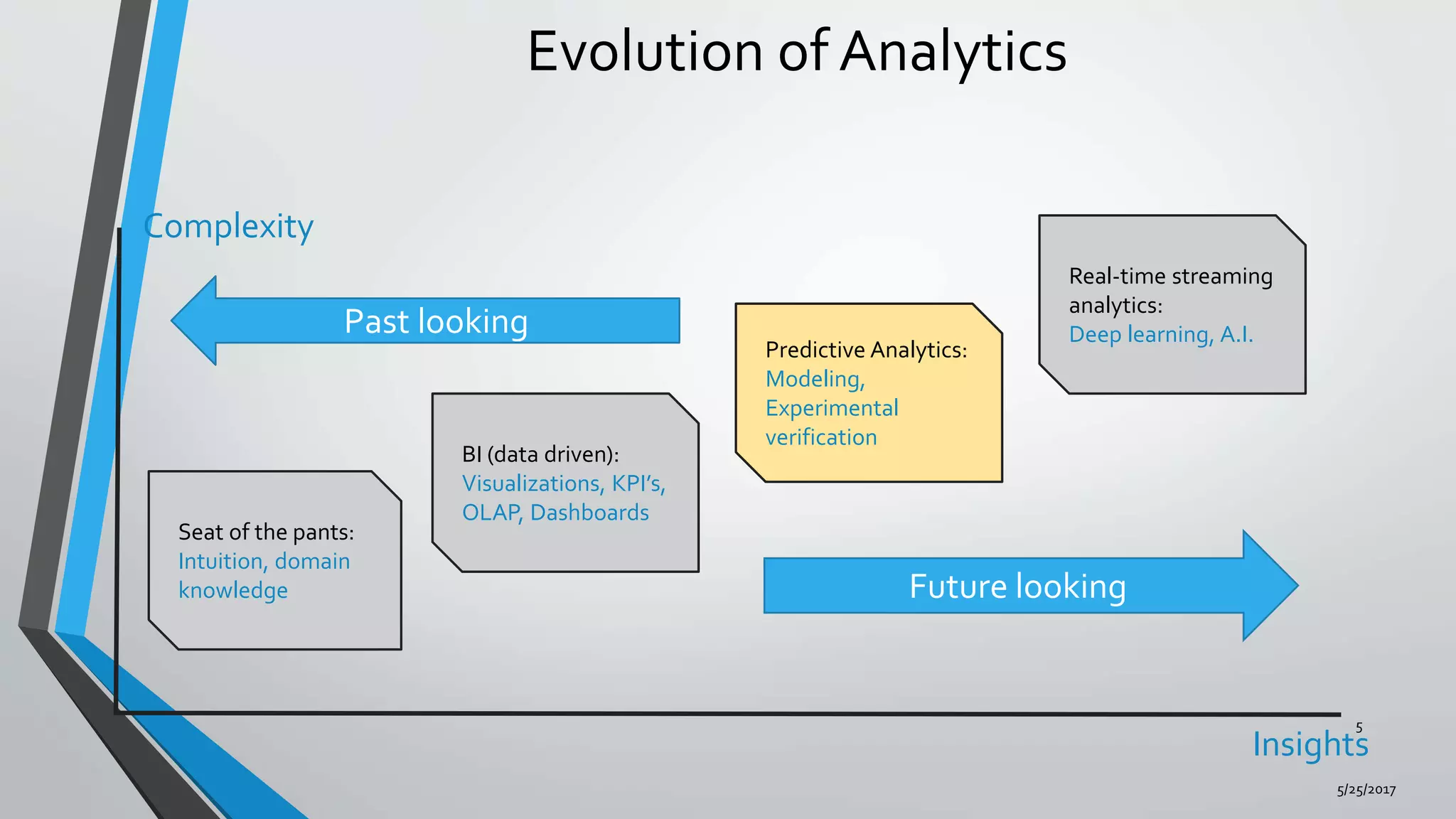
Evolution of Analytics
5/25/2017
5
Seat of the pants:
Intuition, domain
knowledge
BI (data driven):
Visualizations, KPI’s,
OLAP, Dashboards
Predictive Analytics:
Modeling,
Experimental
verification
Real-time streaming
analytics:
Deep learning, A.I.
Complexity
Insights
Future looking
Past looking
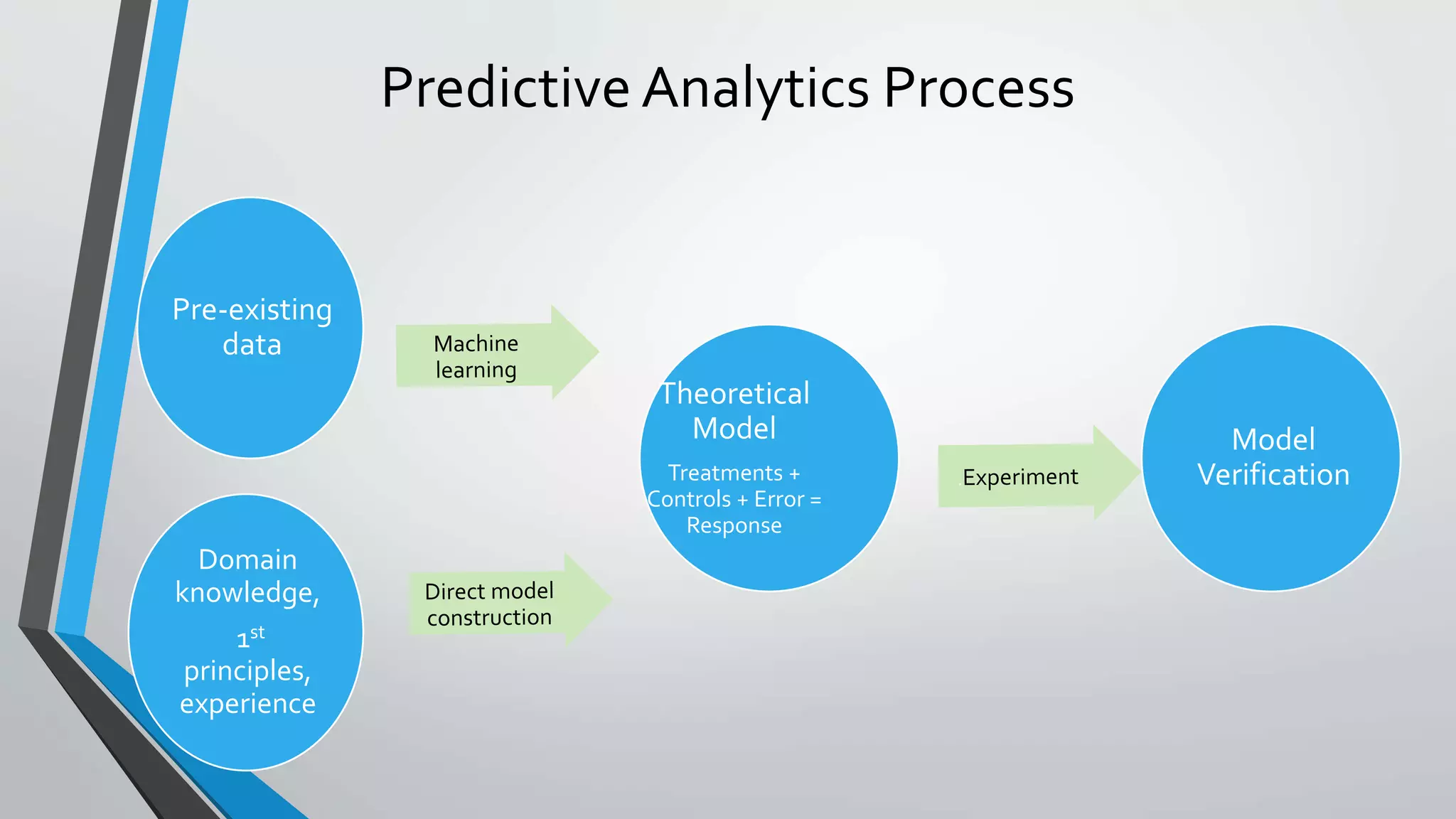
Predictive Analytics Process
Model
Verification
Theoretical
Model
Treatments +
Controls + Error =
Response
Domain
knowledge,
1st
principles,
experience
Pre-existing
data
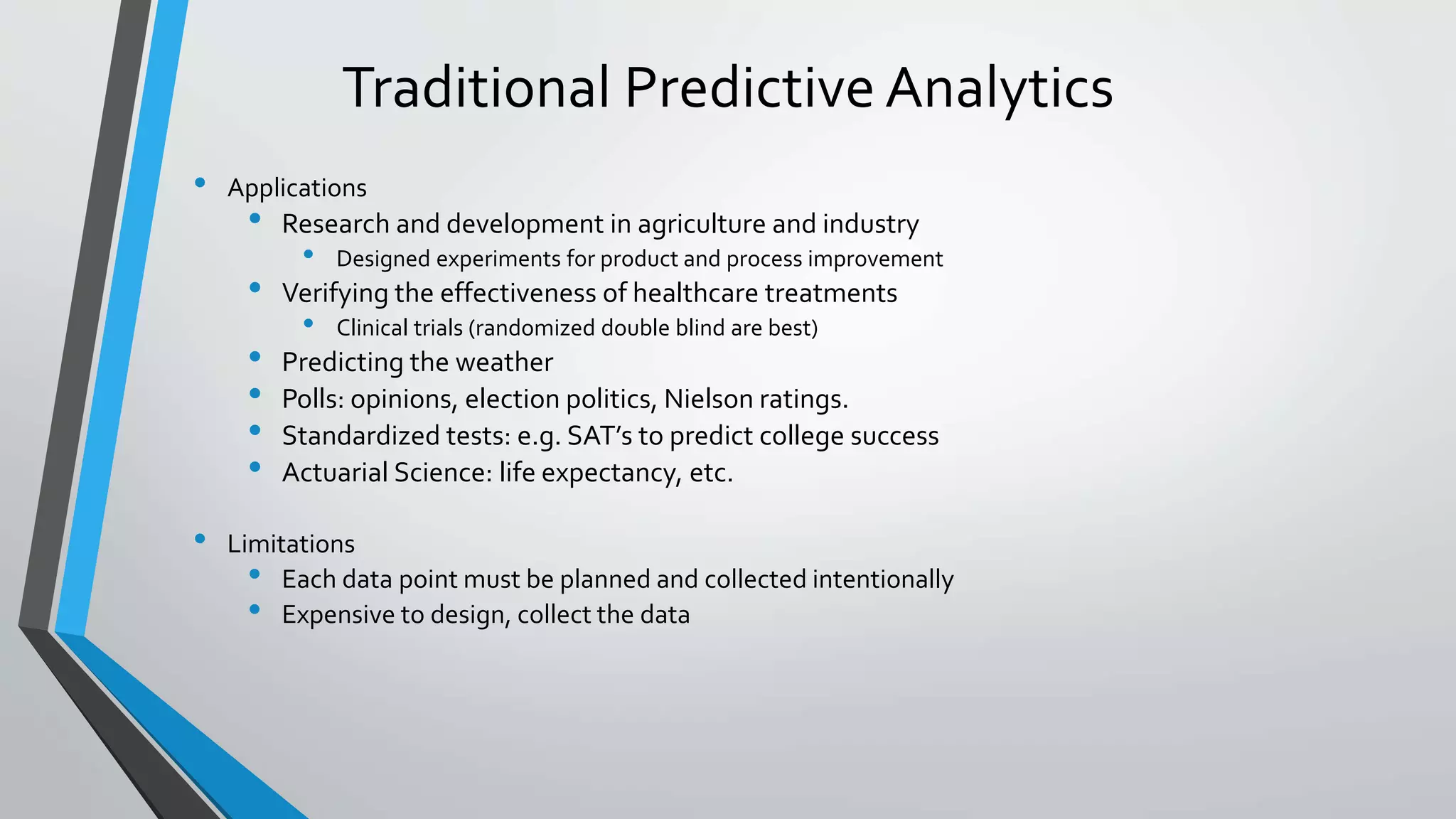
Traditional Predictive Analytics
• Applications
• Research and development in agriculture and industry
• Designed experiments for product and process improvement
• Verifying the effectiveness of healthcare treatments
• Clinical trials (randomized double blind are best)
• Predicting the weather
• Polls: opinions, election politics, Nielson ratings.
• Standardized tests: e.g. SAT’s to predict college success
• Actuarial Science: life expectancy, etc.
• Limitations
• Each data point must be planned and collected intentionally
• Expensive to design, collect the data
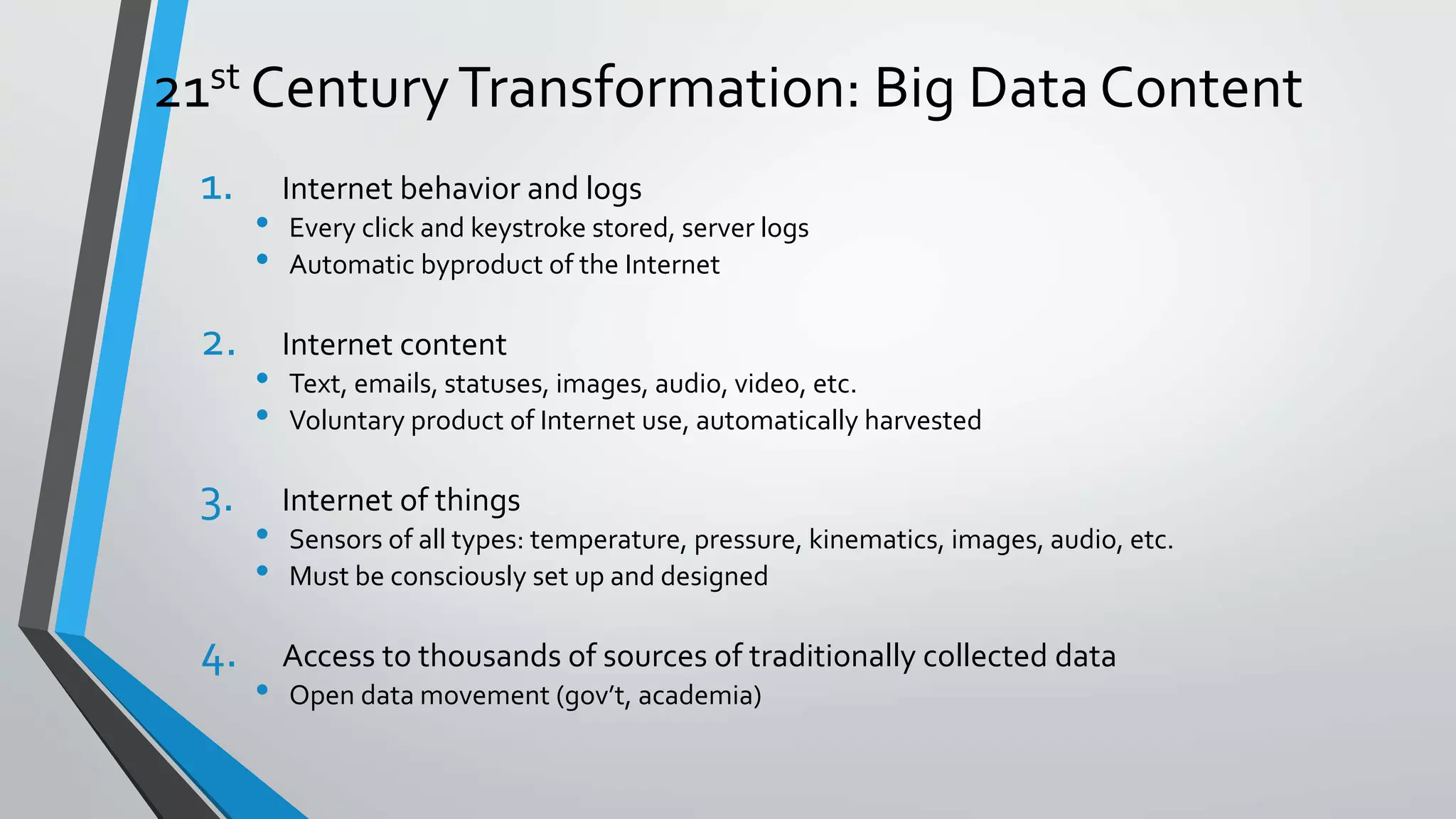
21st CenturyTransformation: Big Data Content
1. Internet behavior and logs
• Every click and keystroke stored, server logs
• Automatic byproduct of the Internet
2. Internet content
• Text, emails, statuses, images, audio, video, etc.
• Voluntary product of Internet use, automatically harvested
3. Internet of things
• Sensors of all types: temperature, pressure, kinematics, images, audio, etc.
• Must be consciously set up and designed
4. Access to thousands of sources of traditionally collected data
• Open data movement (gov’t, academia)
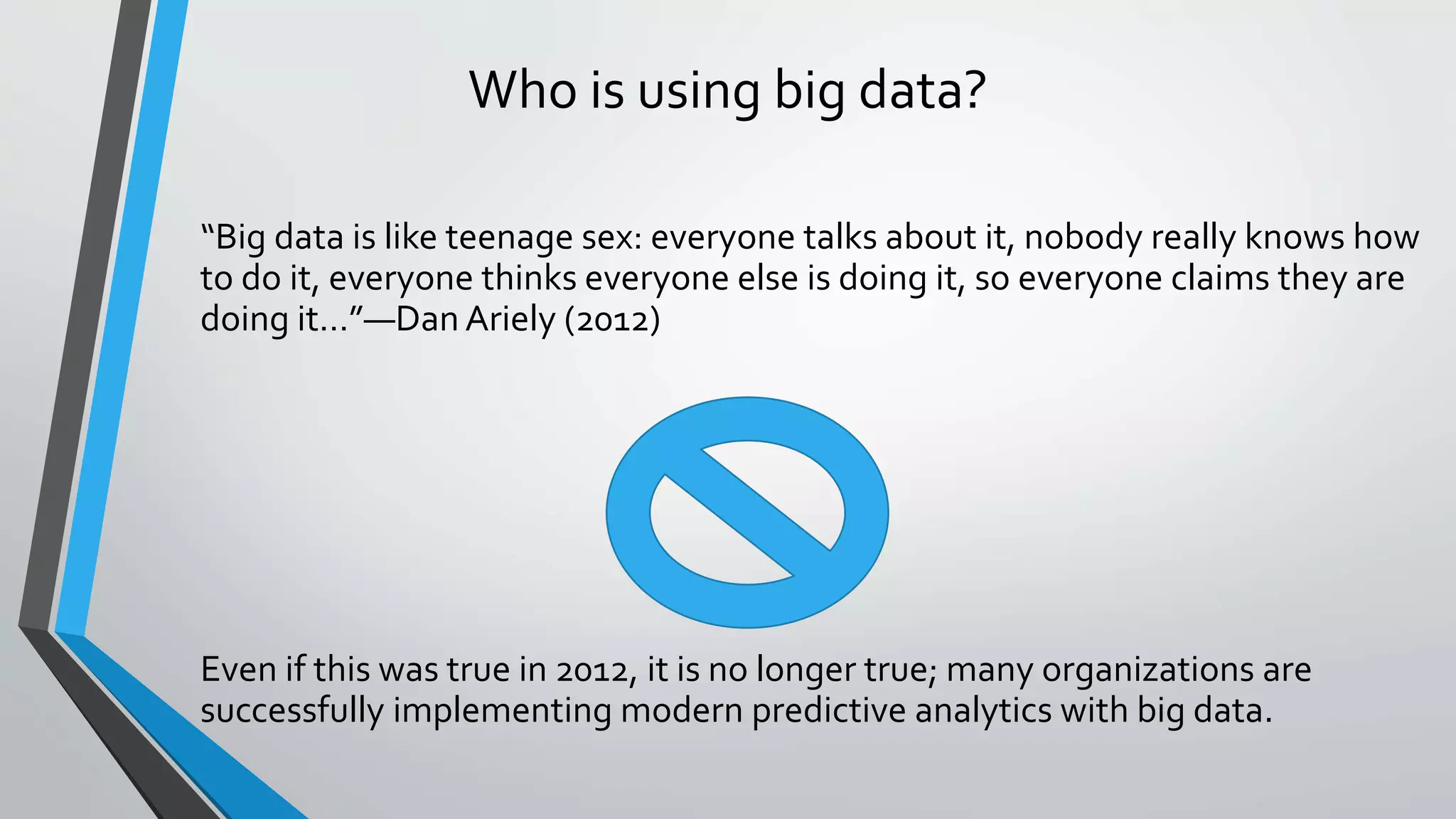
Who is using big data?
“Big data is like teenage sex: everyone talks about it, nobody really knows how
to do it, everyone thinks everyone else is doing it, so everyone claims they are
doing it…”—Dan Ariely (2012)
Even if this was true in 2012, it is no longer true; many organizations are
successfully implementing modern predictive analytics with big data.
Analytic process changes
• Huge quantity and variety of data available with little effort/cost
• Substantial extra effort needed to extract and process data that have been collected without a
specific end use in mind (ETL)
• Unstructured data images, videos, audio, etc.
• Combination of a variety of data sources
• Some creativity required to compose relevant metrics
• Data availability leads to increased data mining, exploratory data analysis and data visualization
requirements
• Hundreds or even thousands of variables are “thrown in” to analyses
• More “statistically significant” relationships found
• Some new insights that are real
• Some mistakes due to over-fitting, random clusters (some algorithms exist to help filter out false “hits”)
• Domain knowledge / insights still crucial to distinguish real effects from random chance or allied effects
TraditionalTools andTechniques
• TraditionalTools
• Mostly commercial – SAS, SPSS, STATA, Minitab, Excel
• Open Source – R, Python
• TraditionalTechniques
• Various flavors of regression analyses
• Linear, multinomial, logistic, general linear models, regression discontinuity, instrumental variables,
panel models, time series, etc.
• Designed experiments,ANOVA
• Controls built in for known covariates
• Randomization to accommodate unknown covariates
• Sometimes designed to extract maximum possible info from fewest observations
11
Big DataTools
• Big Data Predictive AnalyticsTools
• Open Source
• Apache Spark / MLlib
• Python scripts interfaced to Hadoop or other distributed data source
• Sometimes R or other traditional tools if data can be extracted and reduced to a size to fit on a single processor.
• Mondrian (OLAP – more BI than predictive analytics)
• Commercial / Proprietary
• RapidMiner (Radoop for Hadoop analytics)
• Pentaho – compare effectiveness of various models: operates against many data sources (being acquired by Hitachi)
• HPVertica Distributed R – ML algorithms pre-loaded
• BeyondCore - 1st through 4th order interactions automatically calculated
• SAS Enterprise Miner
• SPSS adding big data analytics modules
• IBM Predictive Maintenance and Quality
• Homegrown solutions internal to companies (hand-coded Python or Java algorithms)
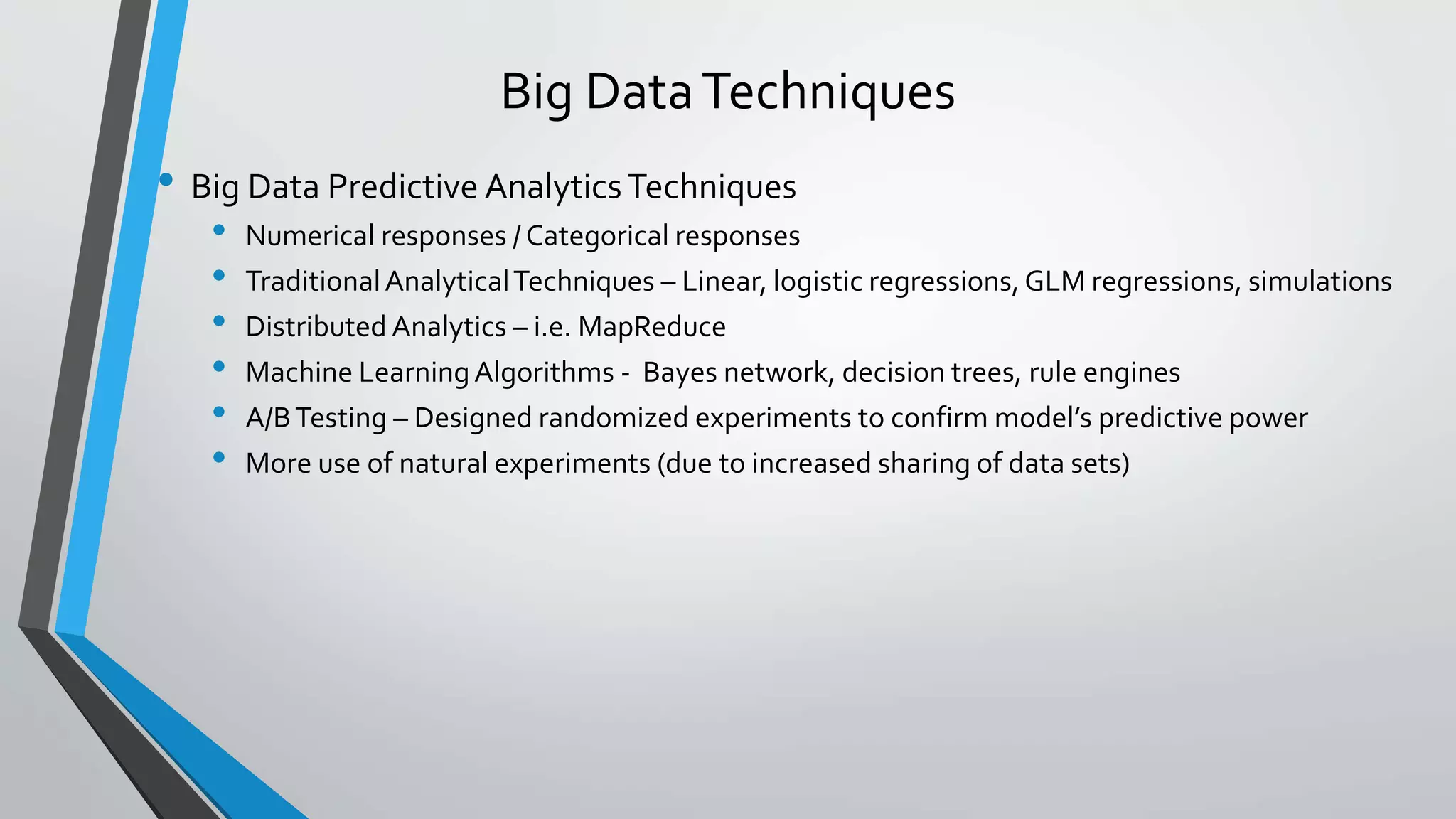
Big DataTechniques
• Big Data Predictive AnalyticsTechniques
• Numerical responses / Categorical responses
• TraditionalAnalyticalTechniques – Linear, logistic regressions,GLM regressions, simulations
• Distributed Analytics – i.e. MapReduce
• Machine LearningAlgorithms - Bayes network, decision trees, rule engines
• A/BTesting – Designed randomized experiments to confirm model’s predictive power
• More use of natural experiments (due to increased sharing of data sets)
Predictive Analytics:
Current Use Cases
Directly related to the sponsoring organization’s goals
14
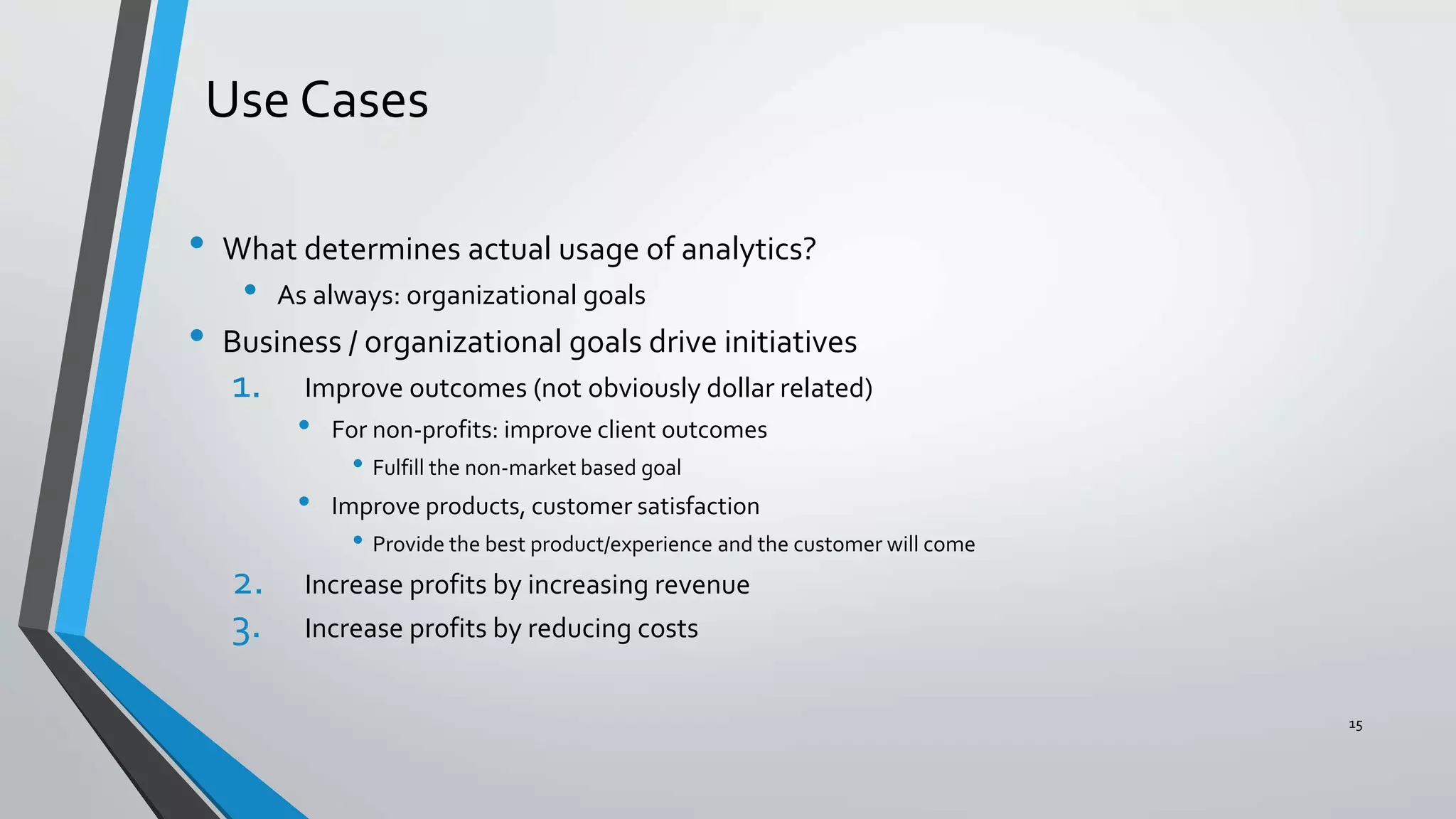
Use Cases
• What determines actual usage of analytics?
• As always: organizational goals
• Business / organizational goals drive initiatives
1. Improve outcomes (not obviously dollar related)
• For non-profits: improve client outcomes
• Fulfill the non-market based goal
• Improve products, customer satisfaction
• Provide the best product/experience and the customer will come
2. Increase profits by increasing revenue
3. Increase profits by reducing costs
15
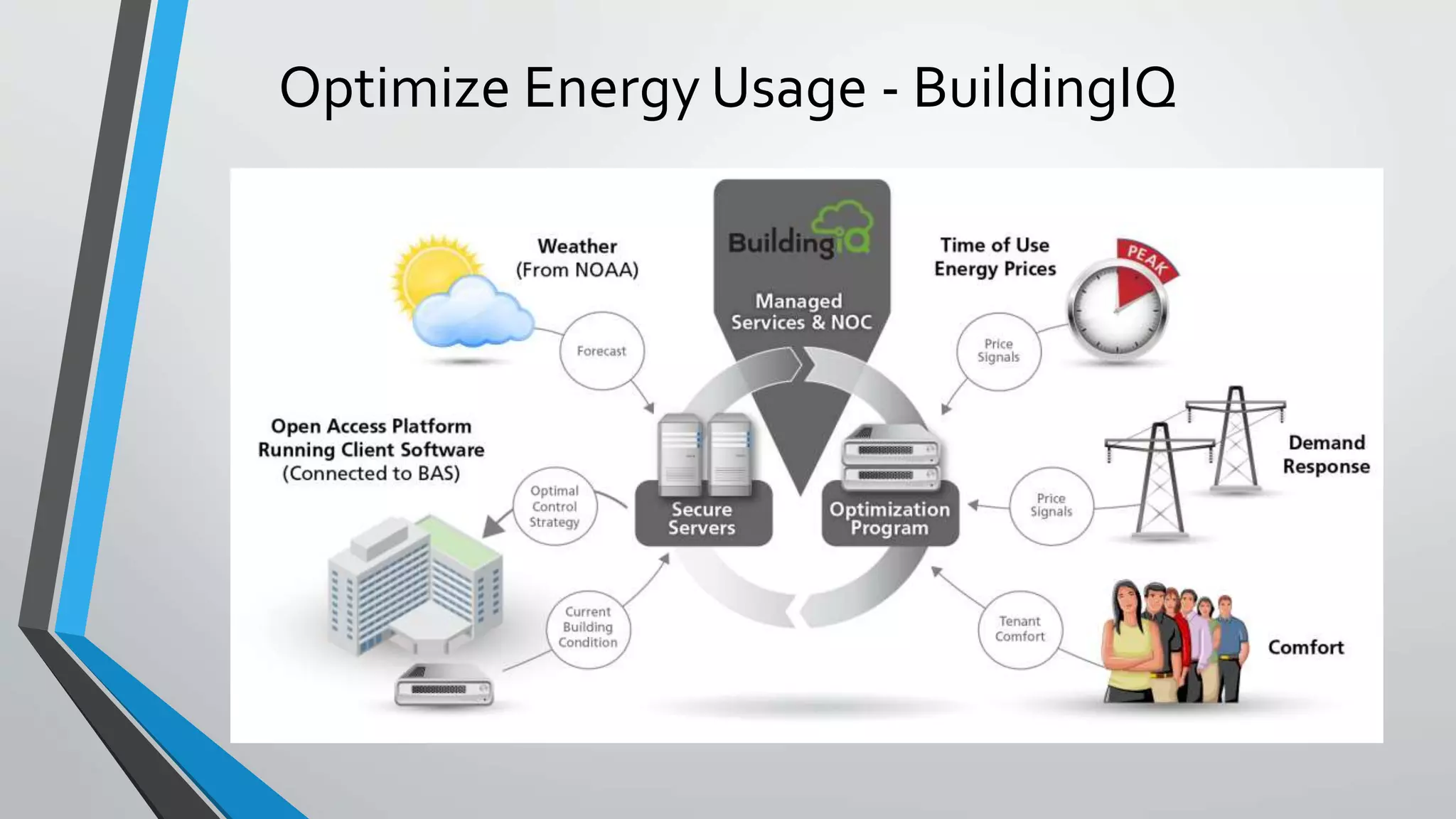
Optimize Energy Usage - BuildingIQ
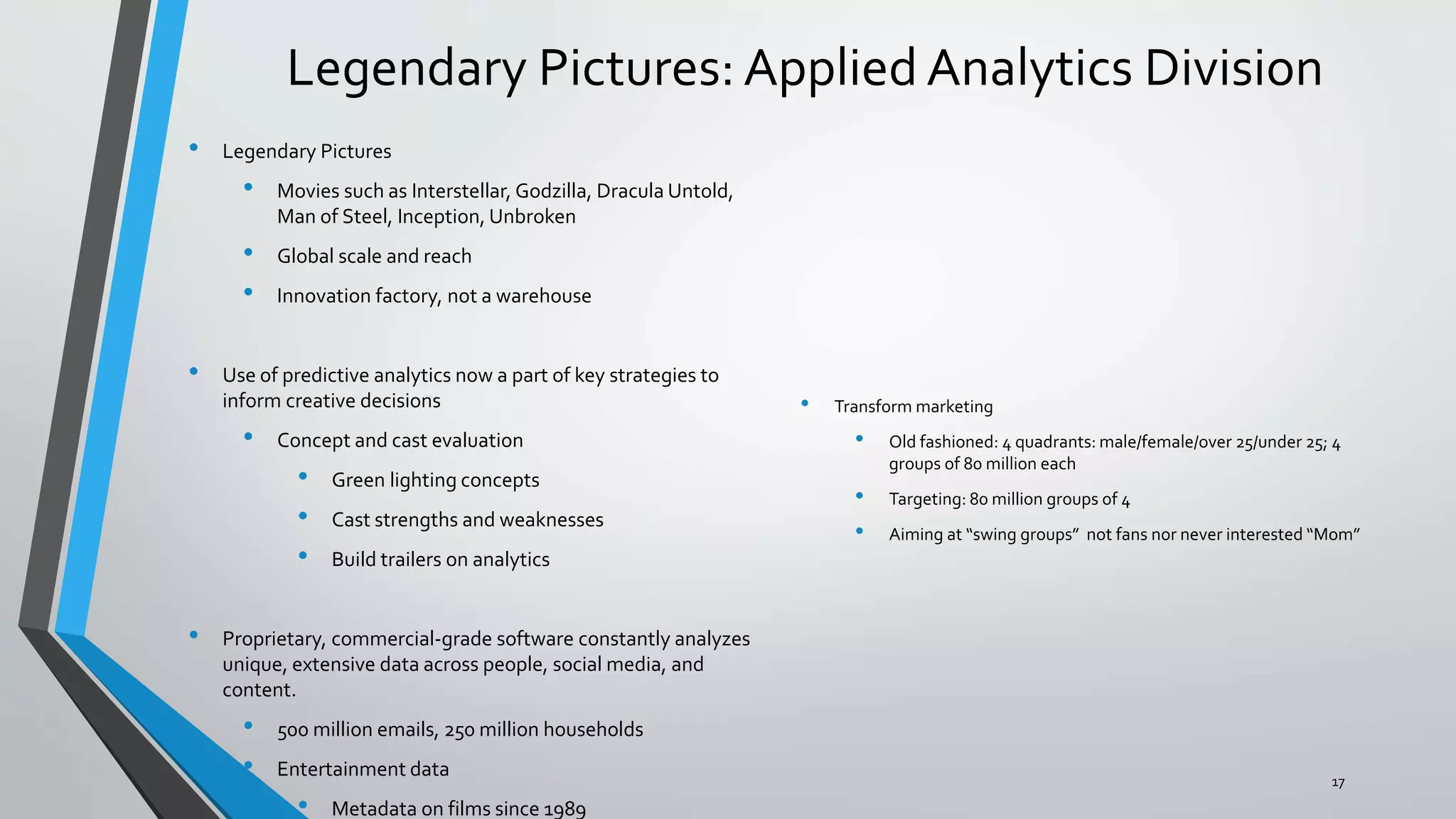
Legendary Pictures: Applied Analytics Division
• Legendary Pictures
• Movies such as Interstellar, Godzilla, Dracula Untold,
Man of Steel, Inception, Unbroken
• Global scale and reach
• Innovation factory, not a warehouse
• Use of predictive analytics now a part of key strategies to
inform creative decisions
• Concept and cast evaluation
• Green lighting concepts
• Cast strengths and weaknesses
• Build trailers on analytics
• Proprietary, commercial-grade software constantly analyzes
unique, extensive data across people, social media, and
content.
• 500 million emails, 250 million households
• Entertainment data
• Metadata on films since 1989
• Transform marketing
• Old fashioned: 4 quadrants: male/female/over 25/under 25; 4
groups of 80 million each
• Targeting: 80 million groups of 4
• Aiming at “swing groups” not fans nor never interested “Mom”
17
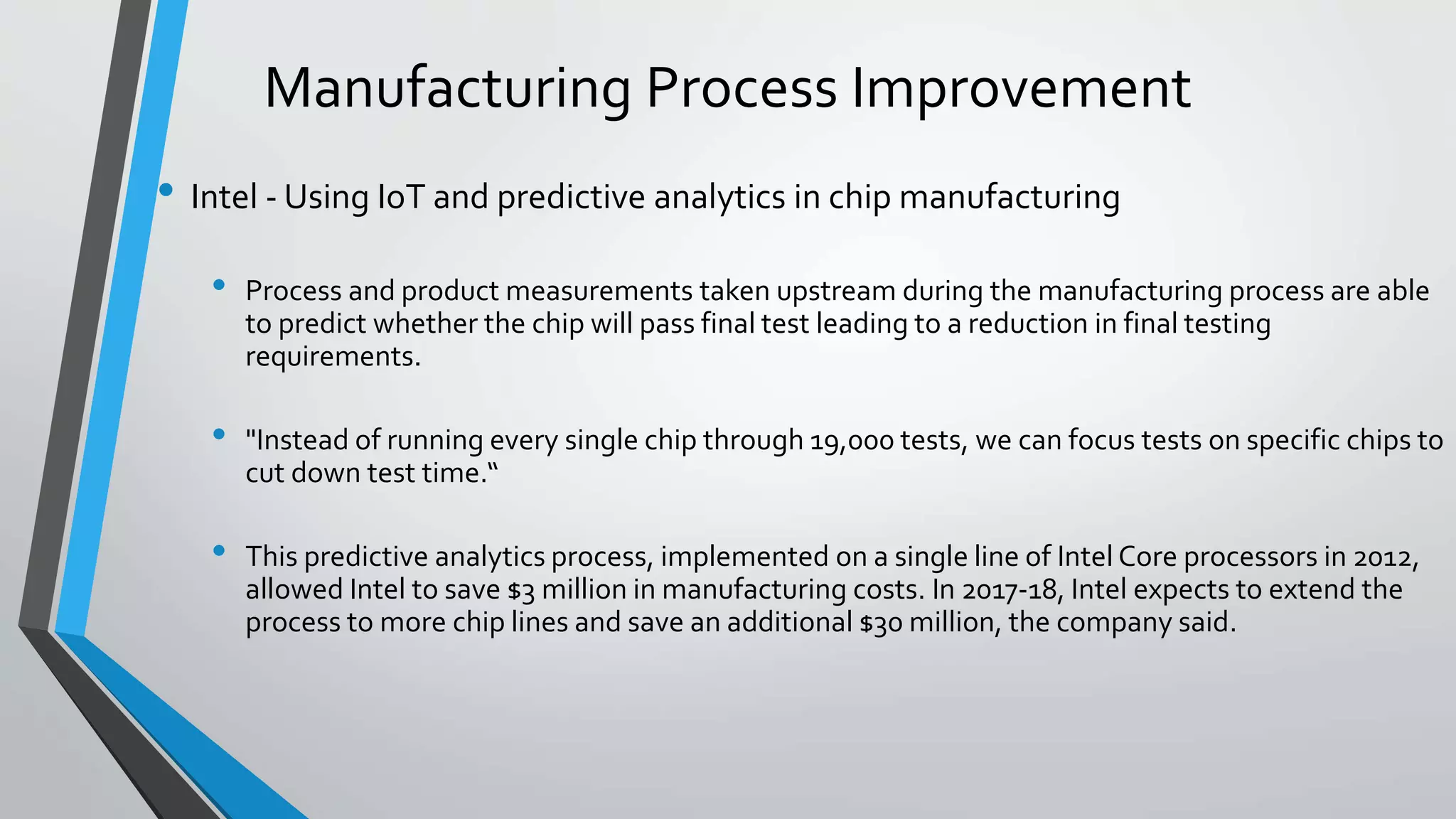
Manufacturing Process Improvement
• Intel - Using IoT and predictive analytics in chip manufacturing
• Process and product measurements taken upstream during the manufacturing process are able
to predict whether the chip will pass final test leading to a reduction in final testing
requirements.
• "Instead of running every single chip through 19,000 tests, we can focus tests on specific chips to
cut down test time.“
• This predictive analytics process, implemented on a single line of Intel Core processors in 2012,
allowed Intel to save $3 million in manufacturing costs. In 2017-18, Intel expects to extend the
process to more chip lines and save an additional $30 million, the company said.
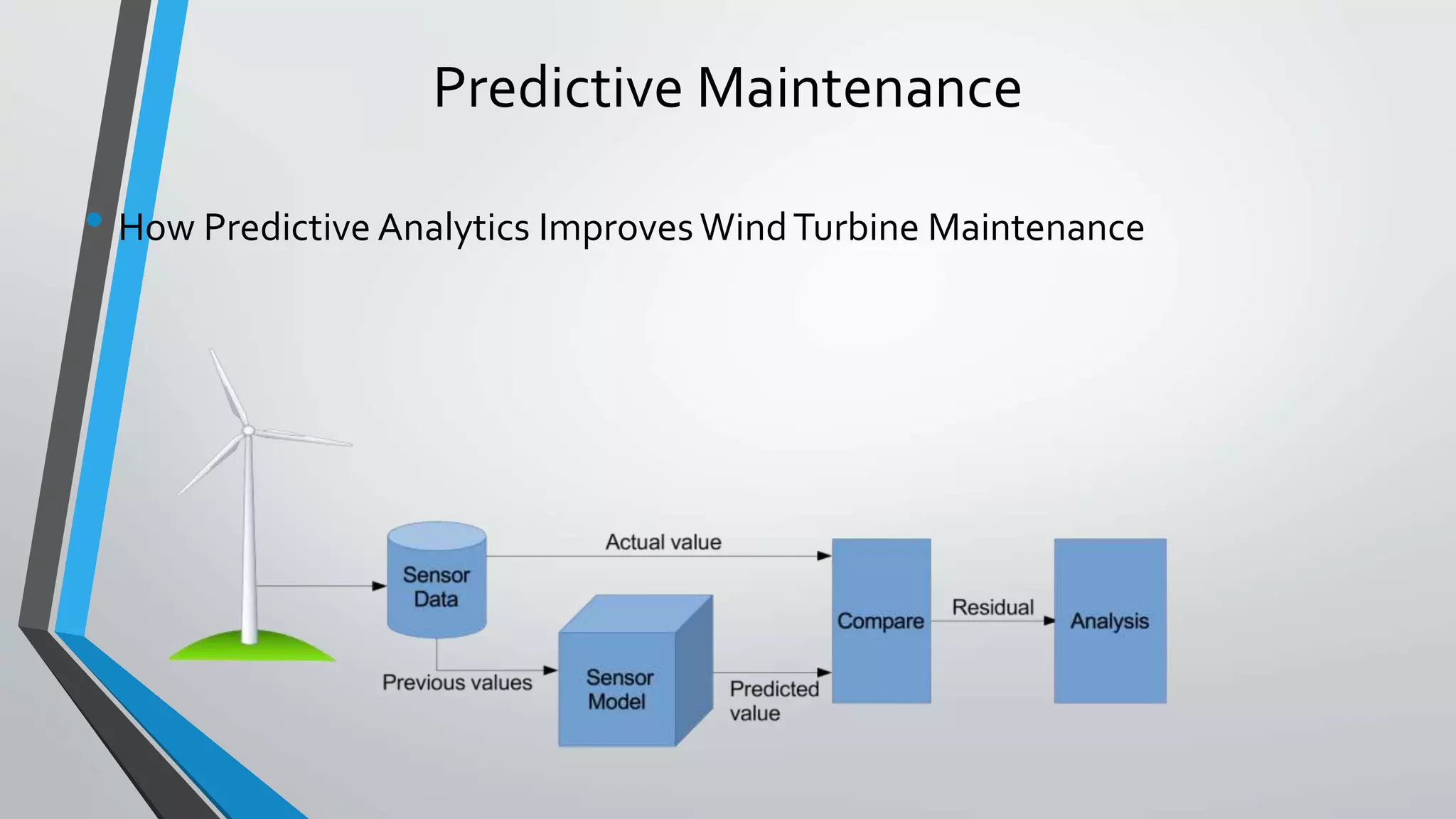
Predictive Maintenance
• How Predictive Analytics ImprovesWindTurbine Maintenance
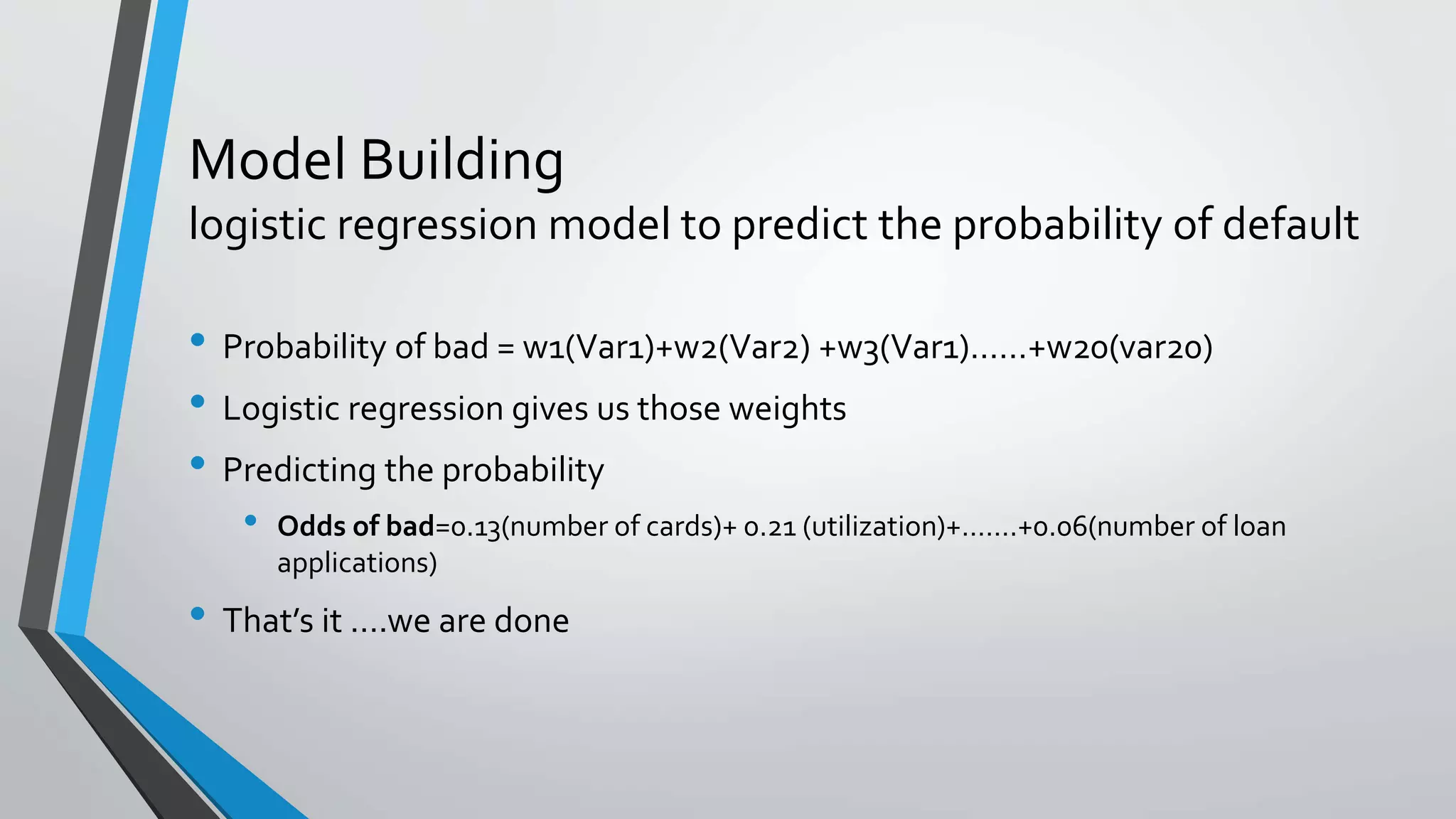
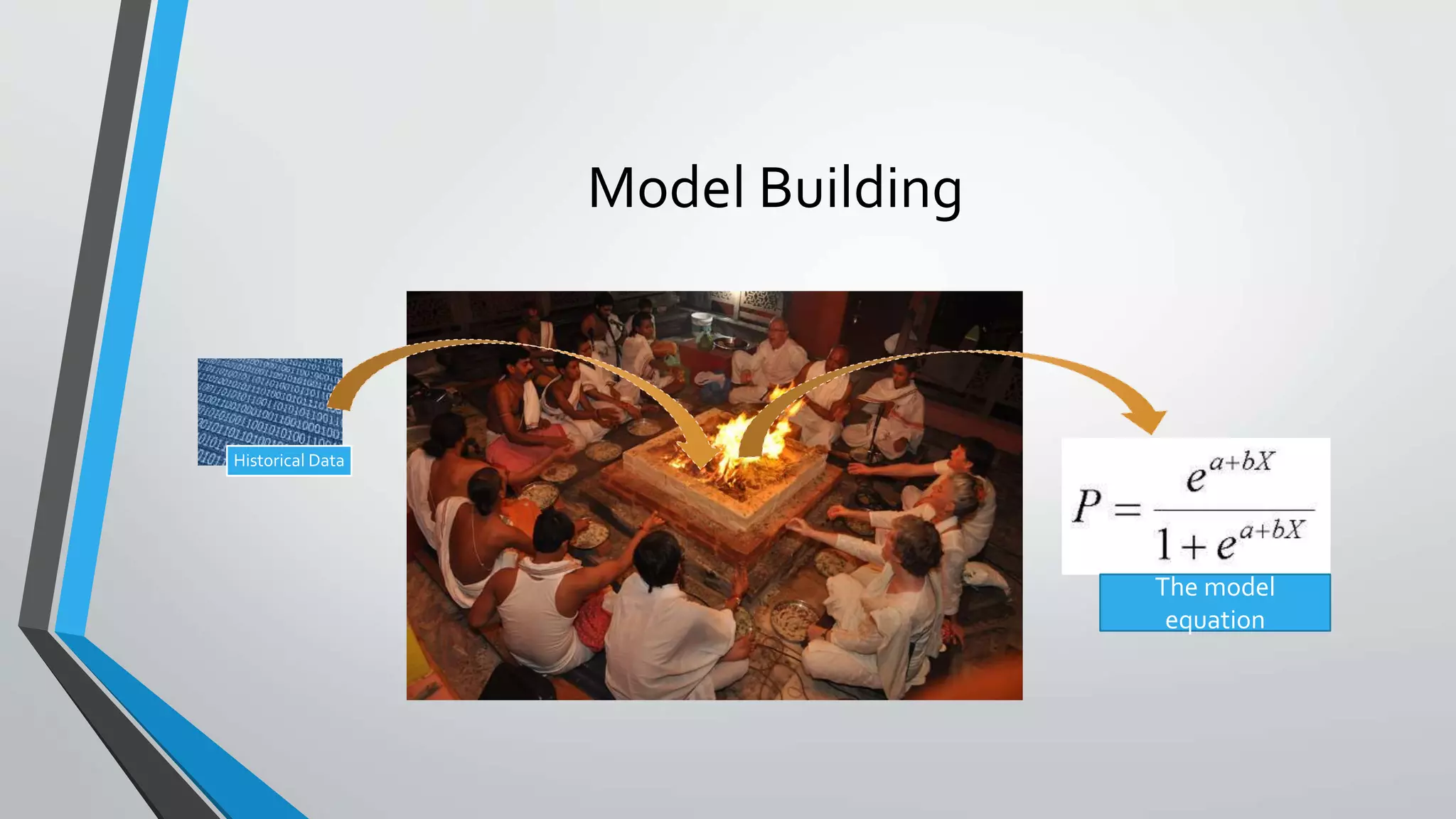
Model Building
logistic regression model to predict the probability of default
• Probability of bad = w1(Var1)+w2(Var2) +w3(Var1)……+w20(var20)
• Logistic regression gives us those weights
• Predicting the probability
• Odds of bad=0.13(number of cards)+ 0.21 (utilization)+…….+0.06(number of loan
applications)
• That’s it ….we are done
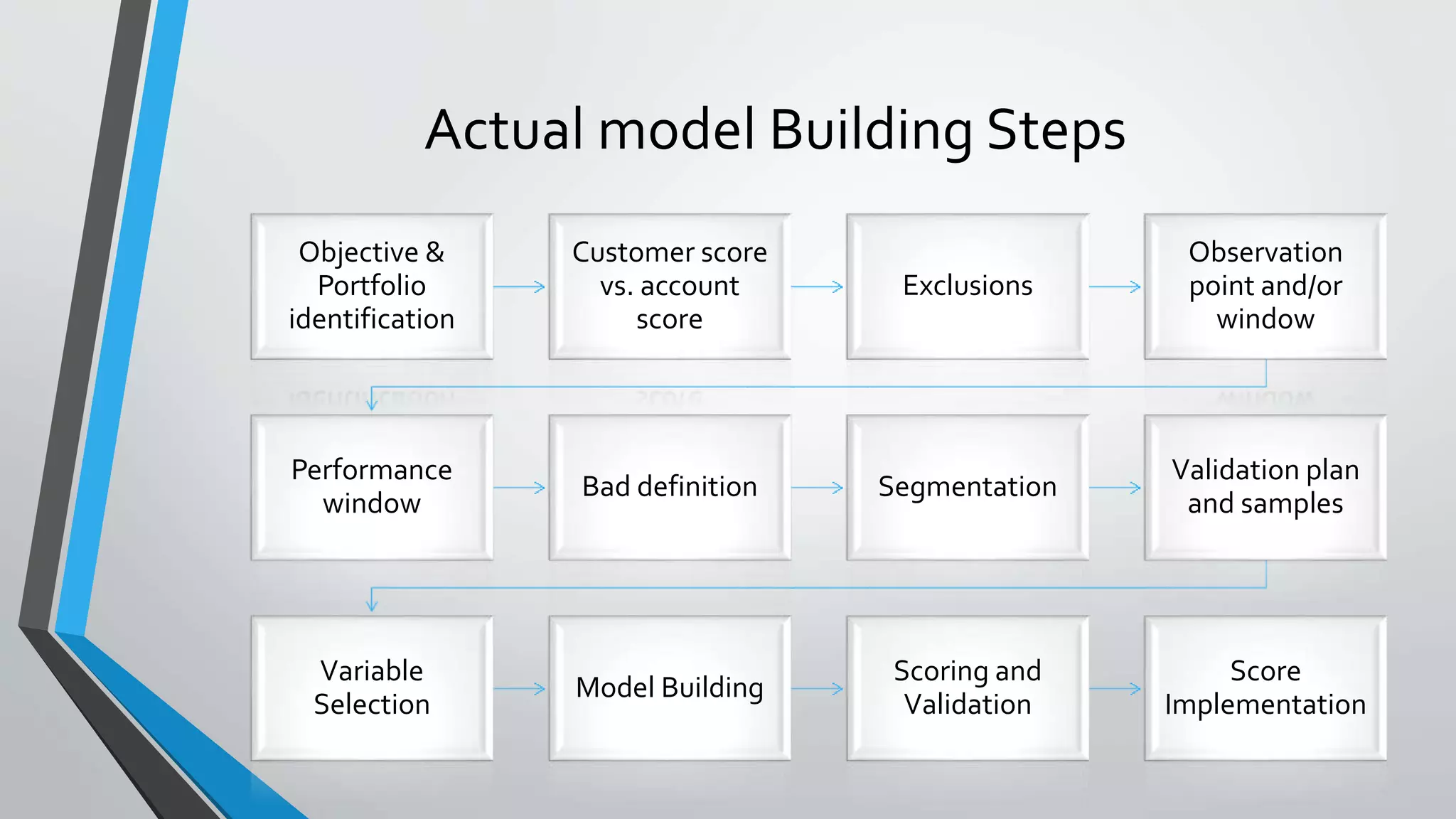
Actual model Building Steps
Objective &
Portfolio
identification
Customer score
vs. account
score
Exclusions
Observation
point and/or
window
Performance
window
Bad definition Segmentation
Validation plan
and samples
Variable
Selection
Model Building
Scoring and
Validation
Score
Implementation
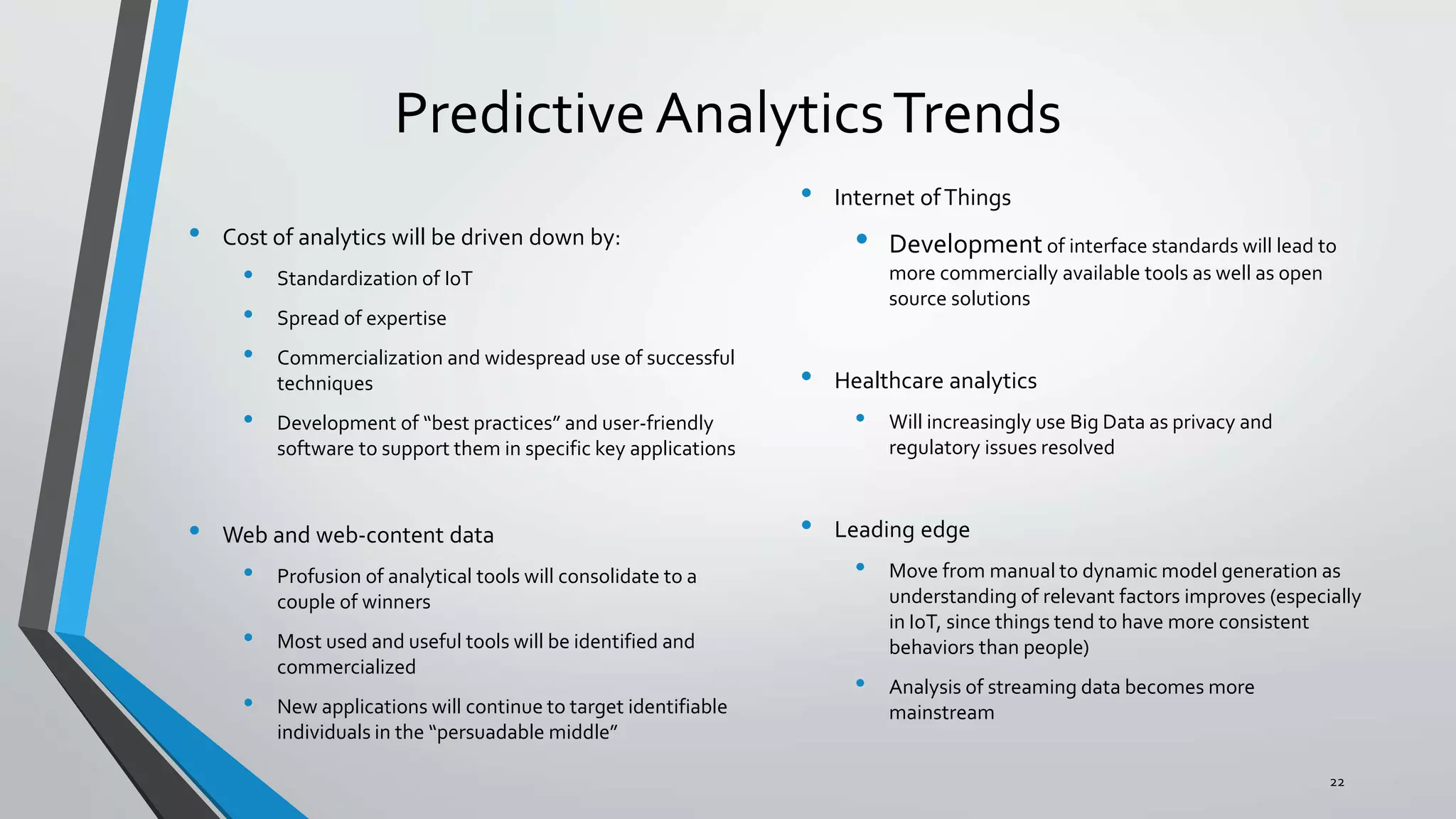
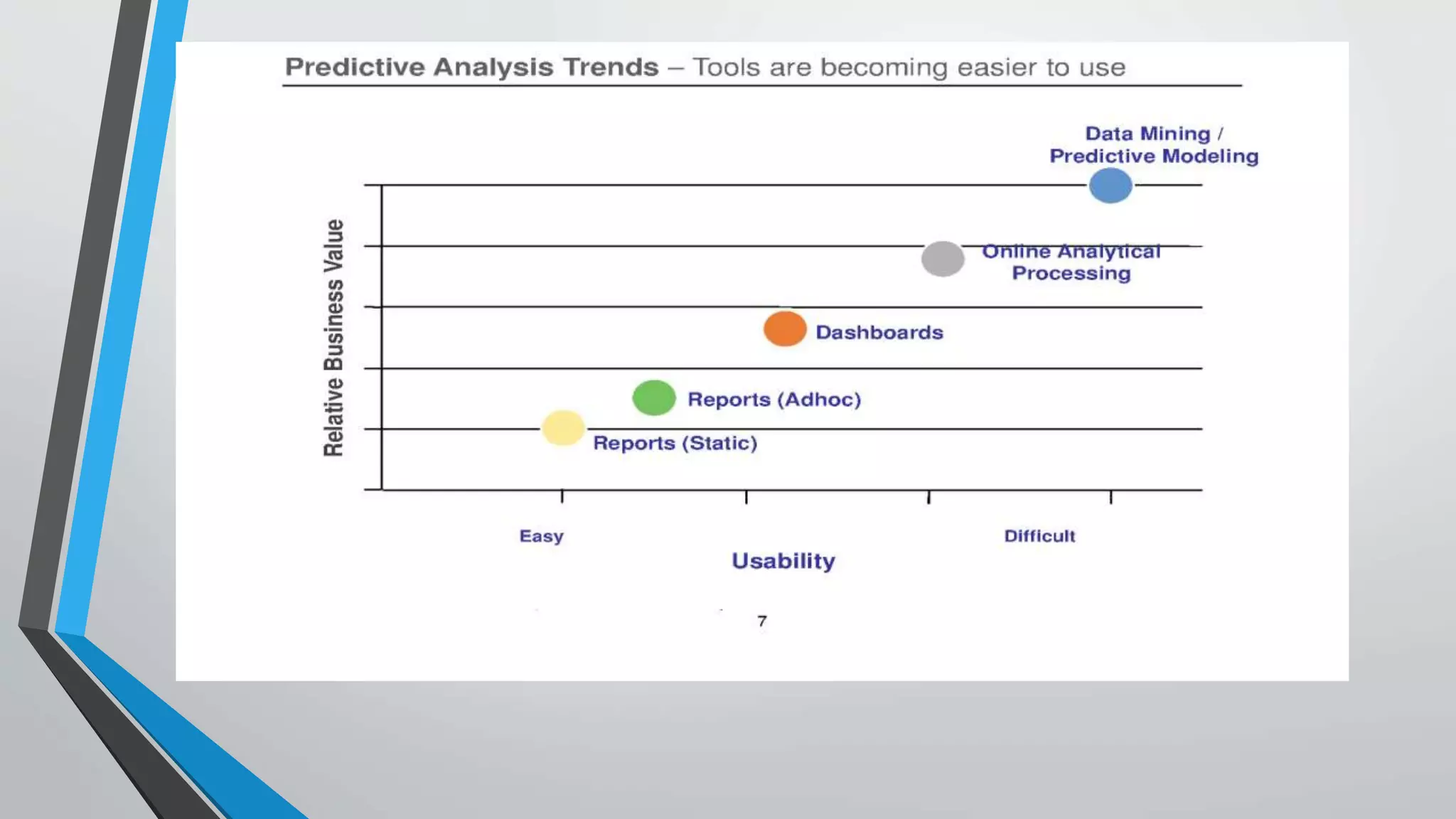
Predictive AnalyticsTrends
• Cost of analytics will be driven down by:
• Standardization of IoT
• Spread of expertise
• Commercialization and widespread use of successful
techniques
• Development of “best practices” and user-friendly
software to support them in specific key applications
• Web and web-content data
• Profusion of analytical tools will consolidate to a
couple of winners
• Most used and useful tools will be identified and
commercialized
• New applications will continue to target identifiable
individuals in the “persuadable middle”
• Internet ofThings
• Development of interface standards will lead to
more commercially available tools as well as open
source solutions
• Healthcare analytics
• Will increasingly use Big Data as privacy and
regulatory issues resolved
• Leading edge
• Move from manual to dynamic model generation as
understanding of relevant factors improves (especially
in IoT, since things tend to have more consistent
behaviors than people)
• Analysis of streaming data becomes more
mainstream
22
23
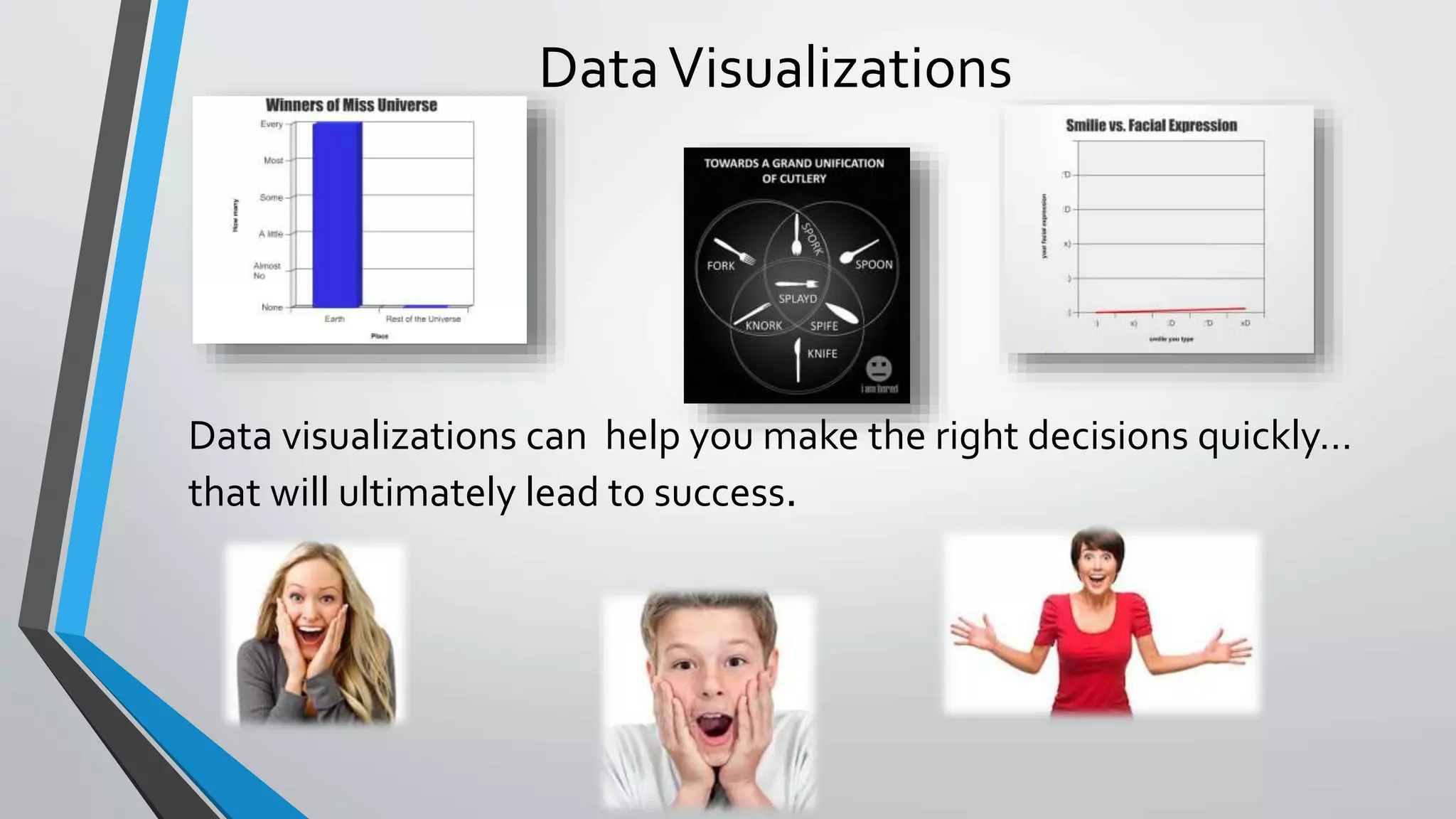
DataVisualizations
Data visualizations can help you make the right decisions quickly…
that will ultimately lead to success.
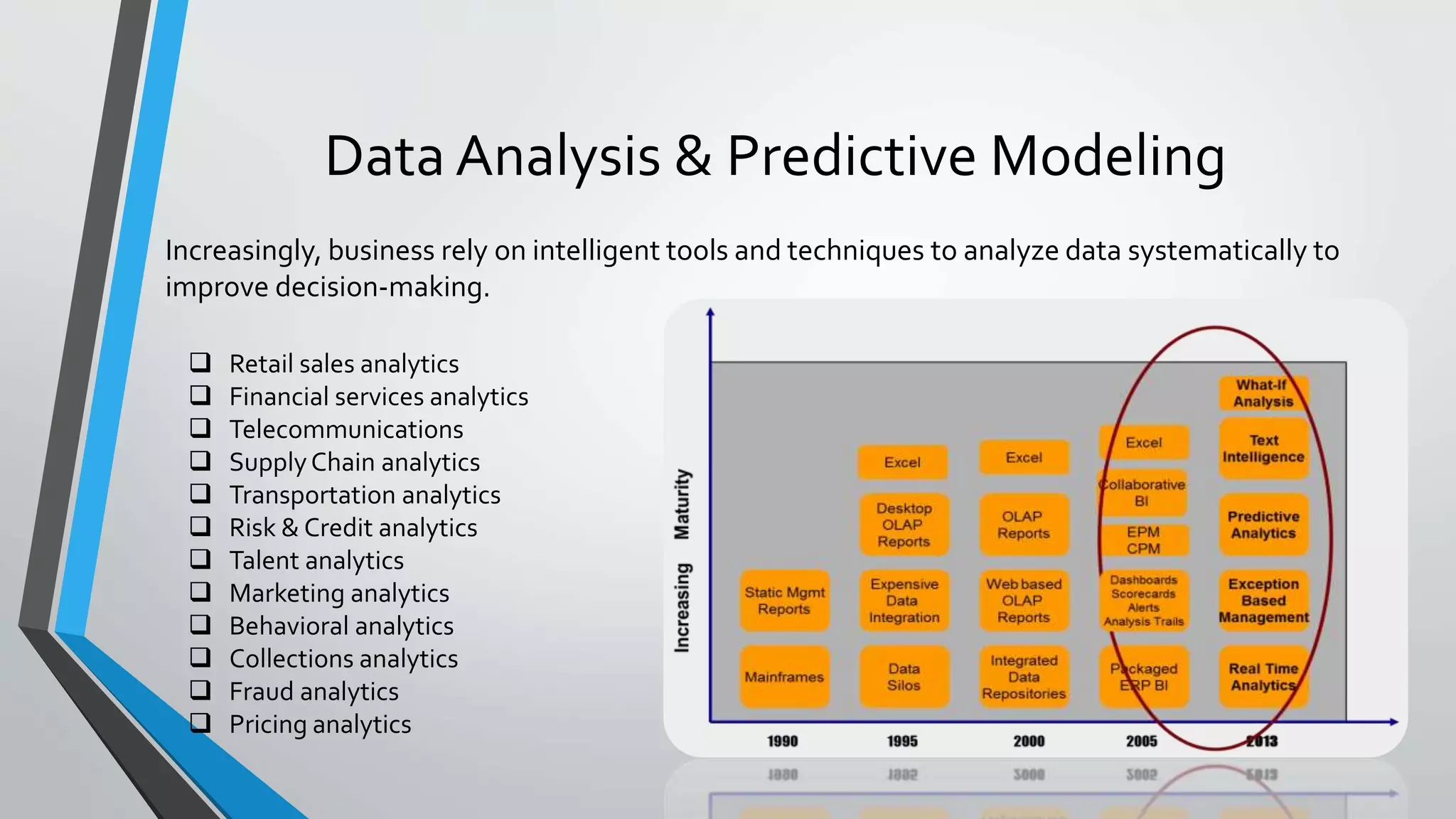
Data Analysis & Predictive Modeling
Increasingly, business rely on intelligent tools and techniques to analyze data systematically to
improve decision-making.
 Retail sales analytics
 Financial services analytics
 Telecommunications
 SupplyChain analytics
 Transportation analytics
 Risk & Credit analytics
 Talent analytics
 Marketing analytics
 Behavioral analytics
 Collections analytics
 Fraud analytics
 Pricing analytics
Dude we all know that
Data analytics rocks &
Predictive modeling is
going to rule!!!
How to
use
Data
>
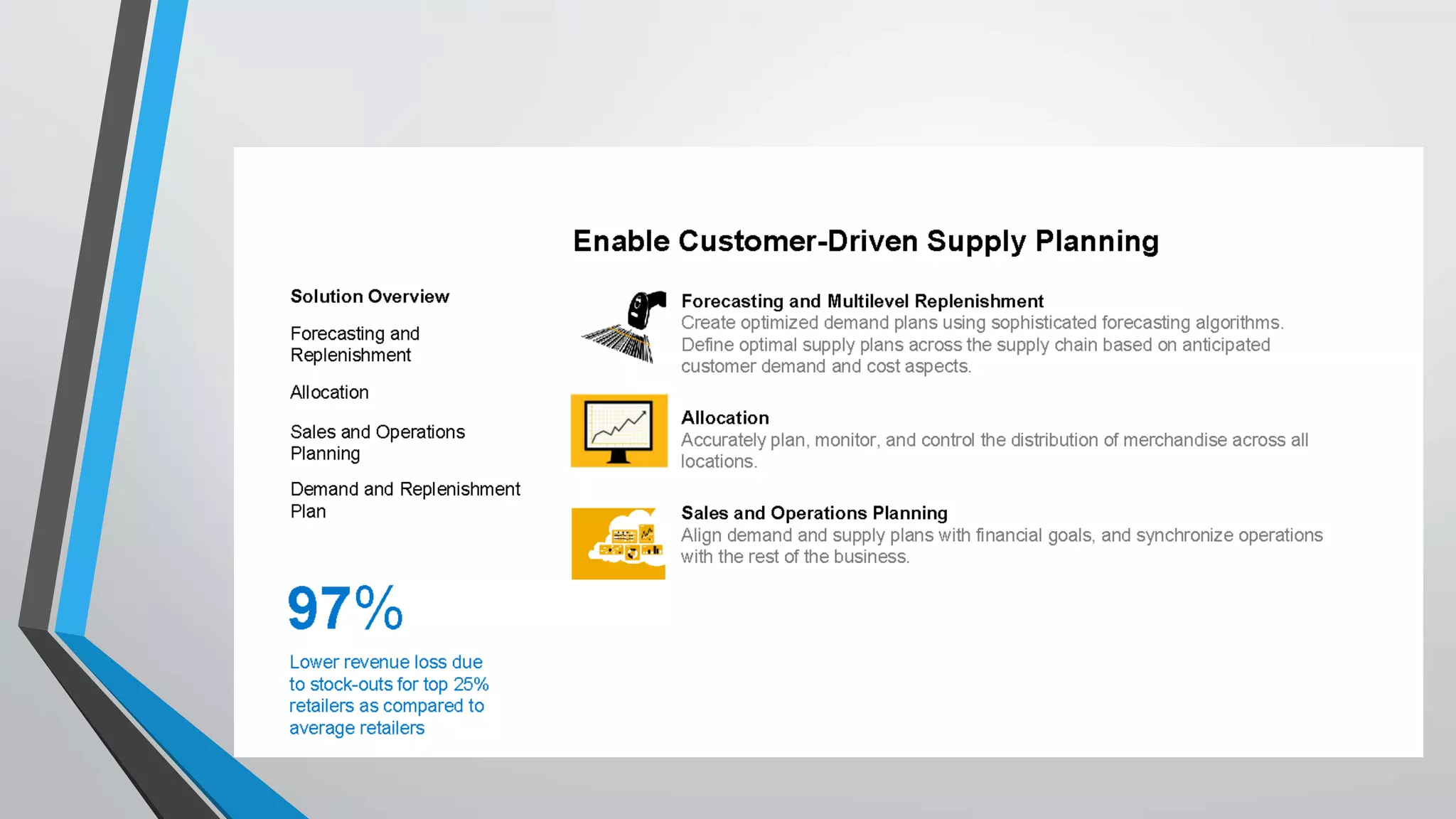
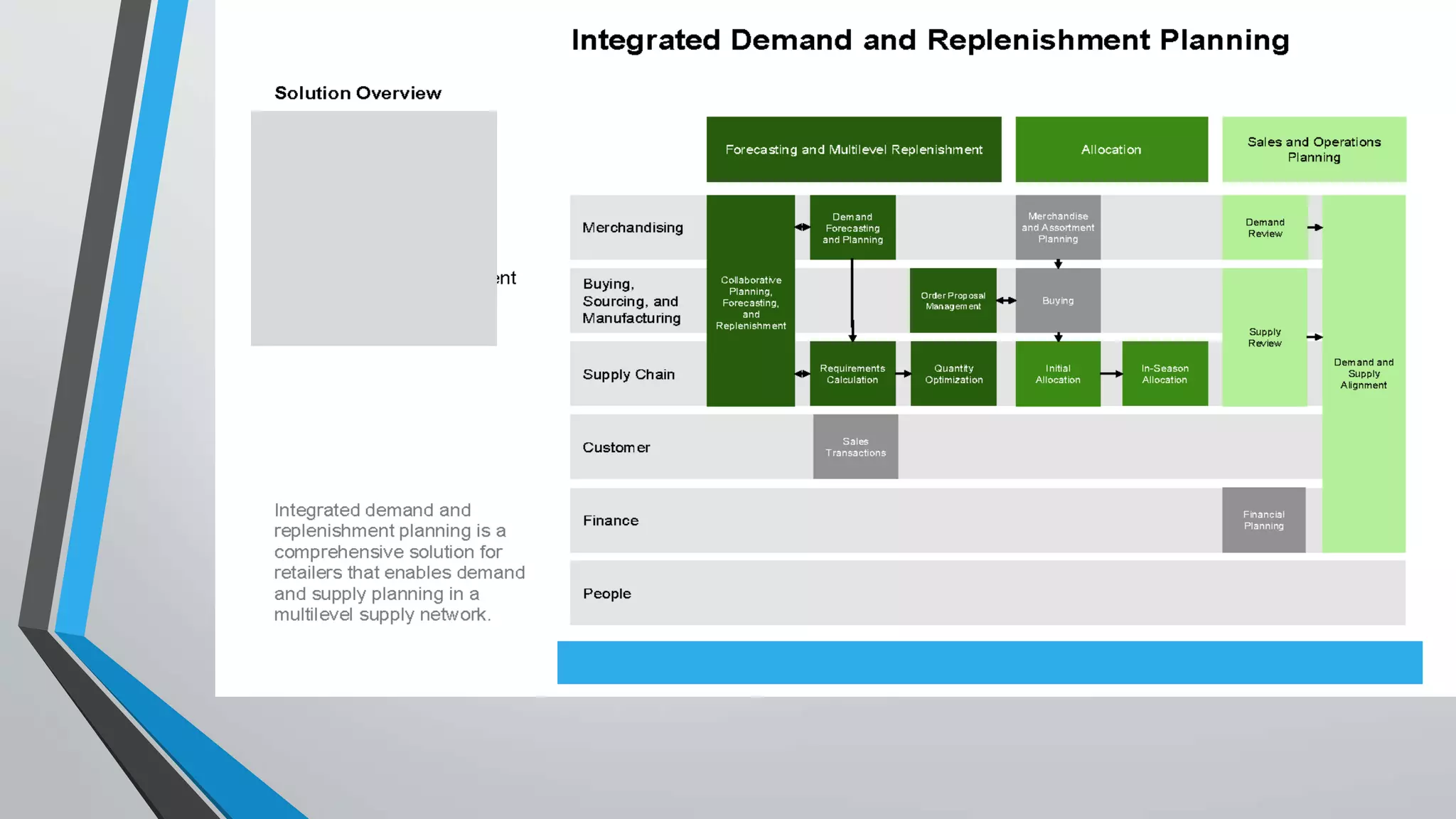
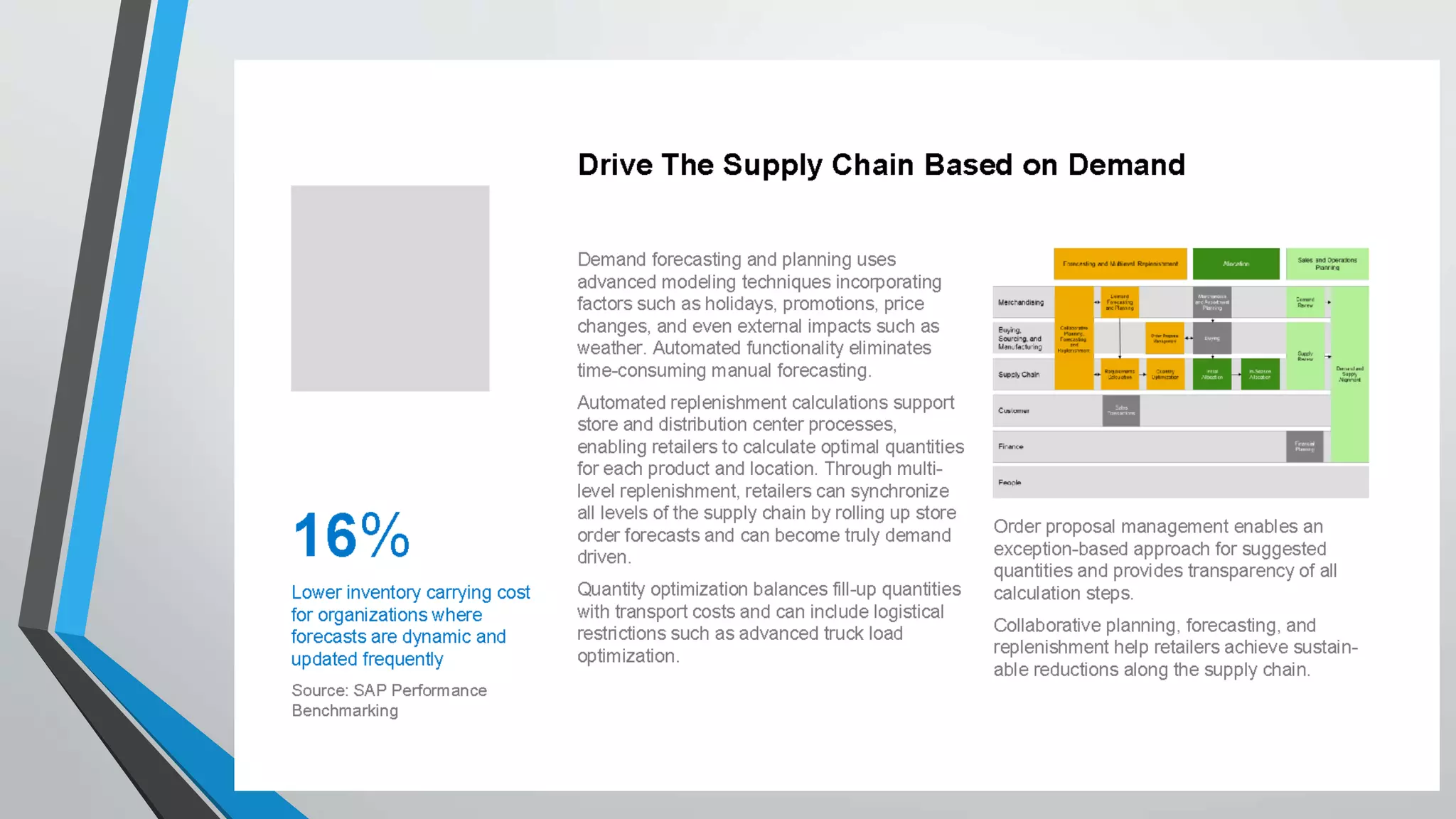
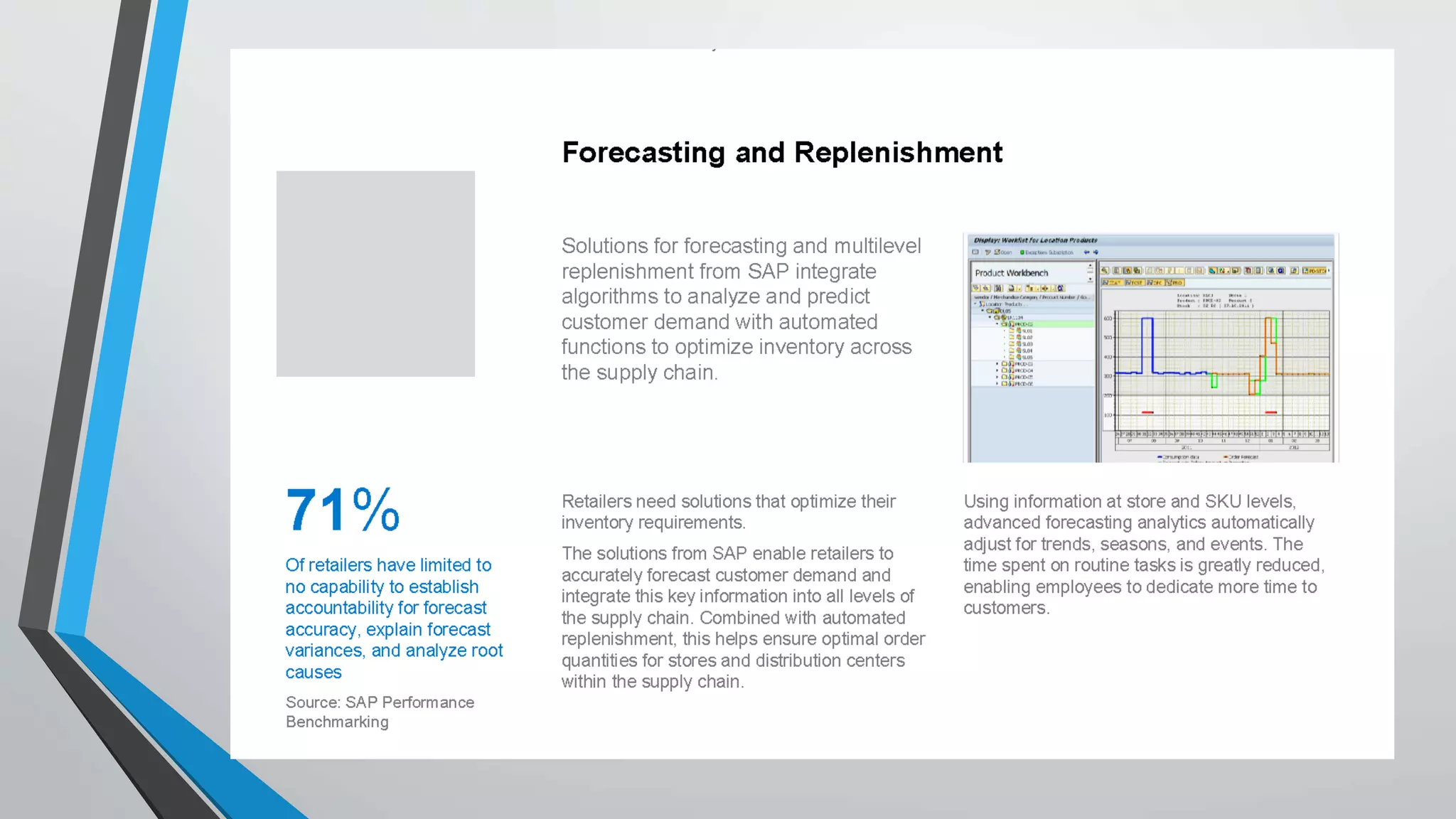
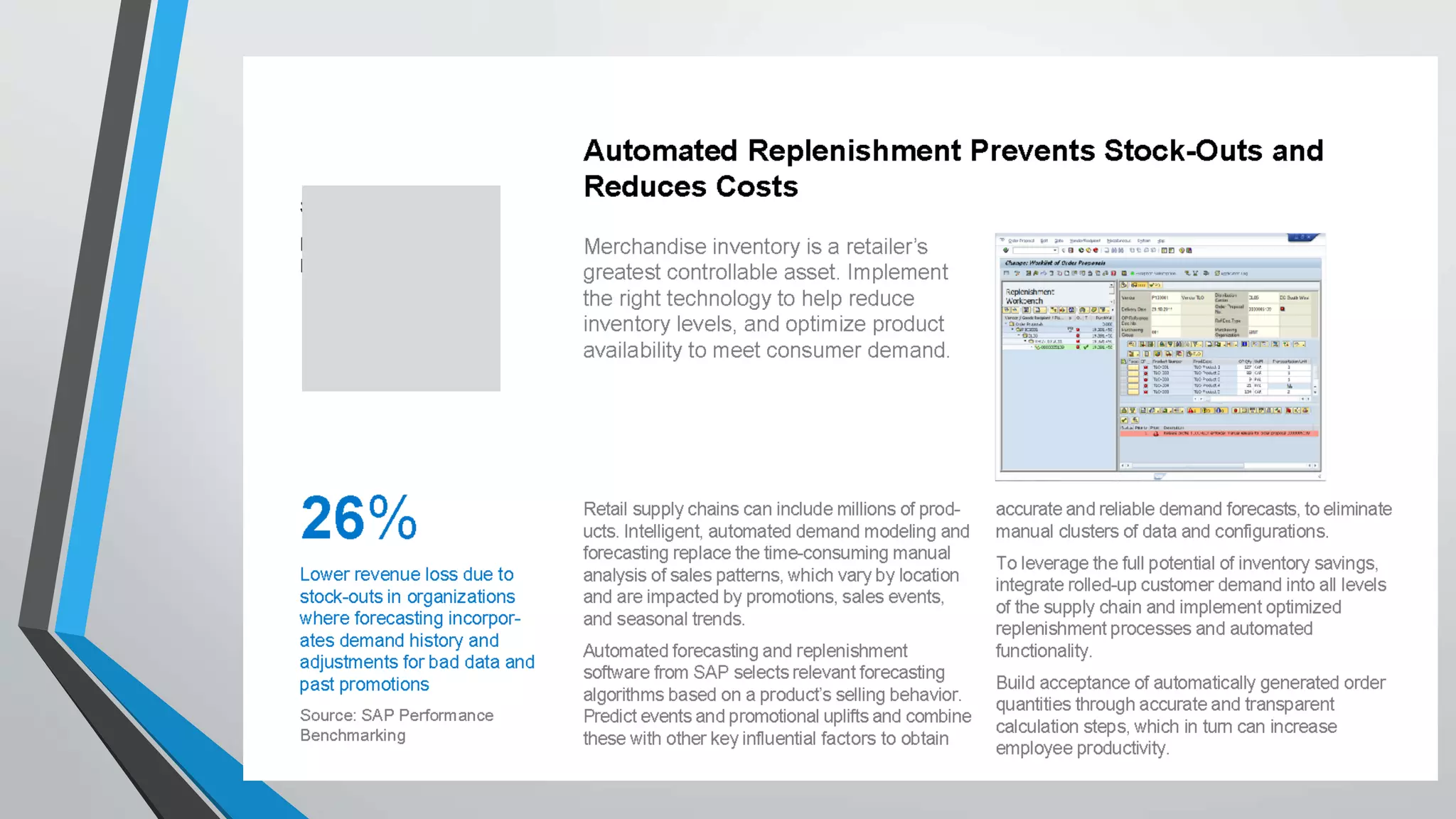
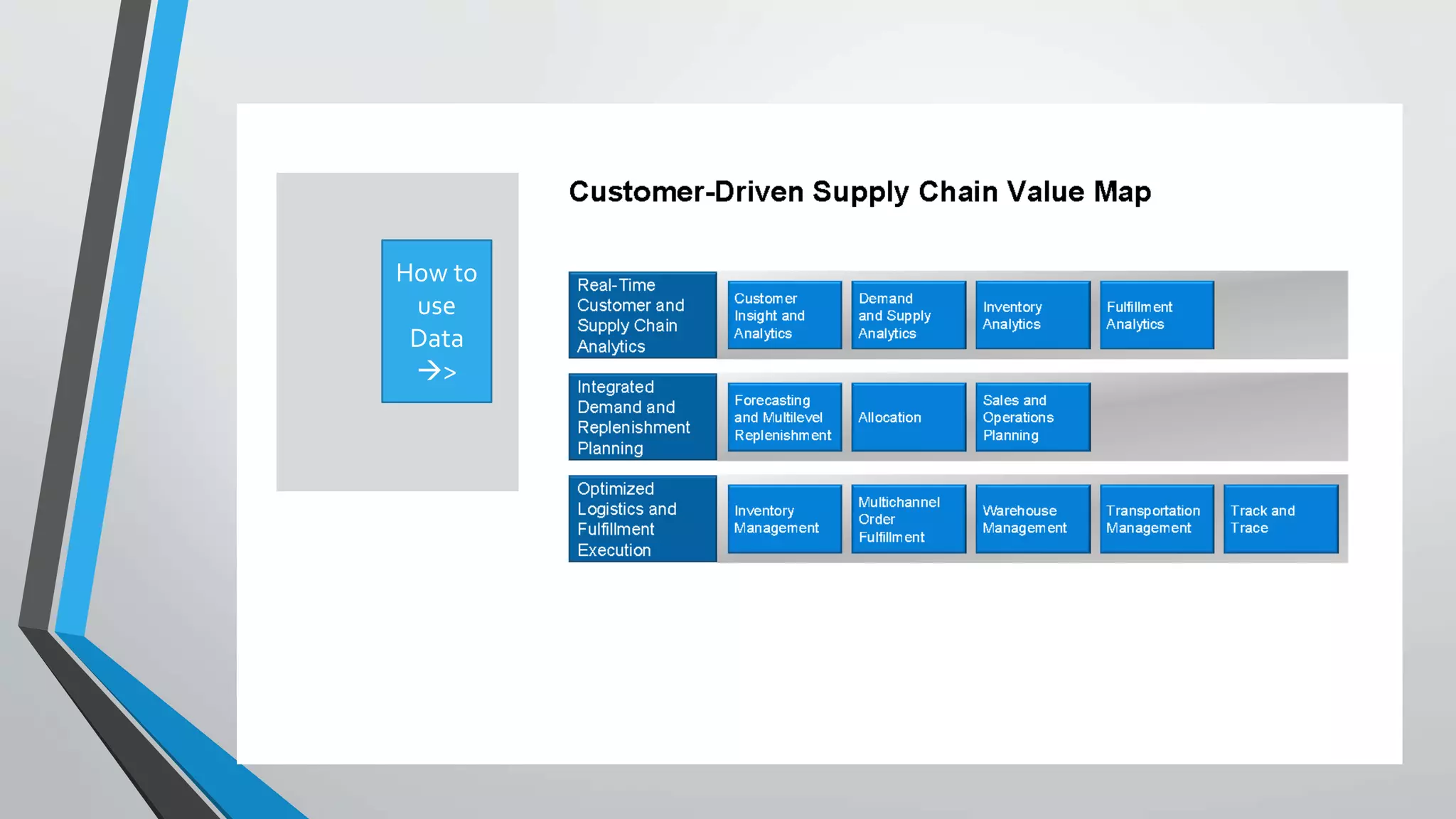
• Automated Replenishments prevent stock outs and reduce cost
• Enable Flexible allocation scenario
• Can use integrated plans and automate allocation
• Helps in Sales and operations planning
• Allows to implement Consensus Demand planning
• Aligns the organisation
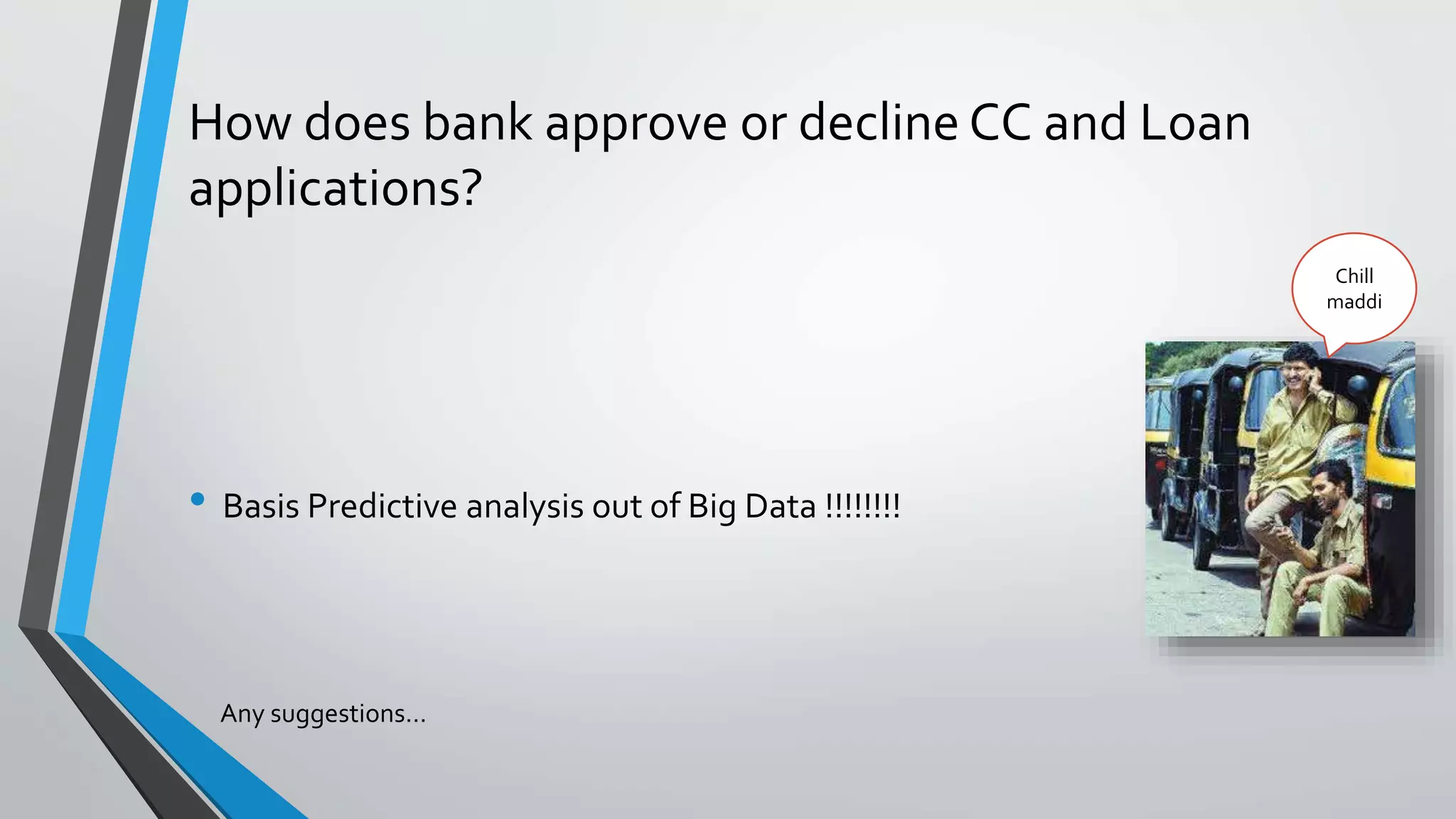
How does bank approve or decline CC and Loan
applications?
Any suggestions…
Chill
maddi
• Basis Predictive analysis out of Big Data !!!!!!!!
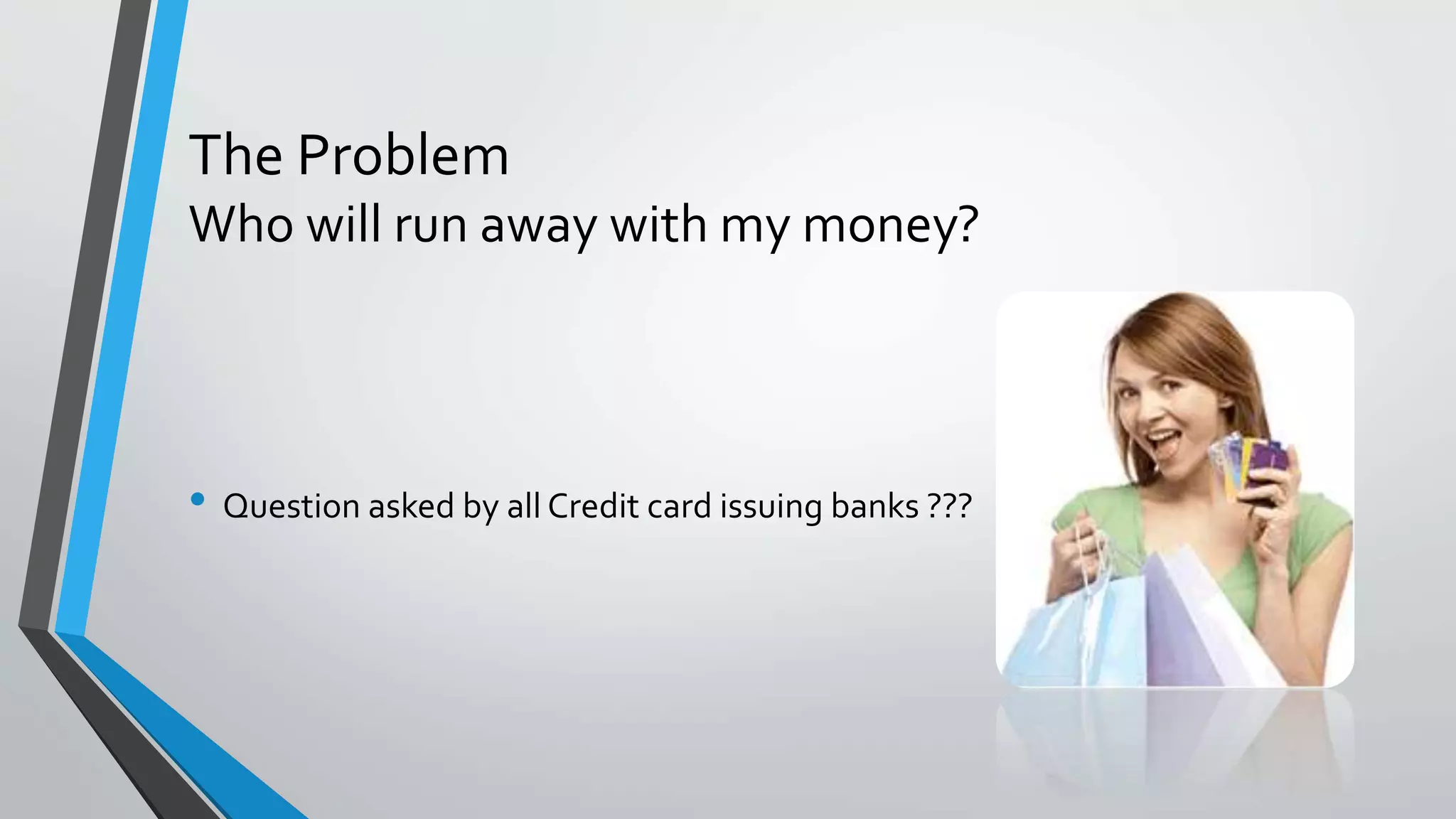
The Problem
Who will run away with my money?
• Question asked by all Credit card issuing banks ???
Citi has a similar problem?
Who is going to run away with my money?
• Given Historical of the customers we want to predict the probability of bad
• We have the data of each customer on
• Customer previous loans, customer previous payments, length of account credit
history, other credit cards and loans, job type, income band etc.,
• We want to predict the probability of default
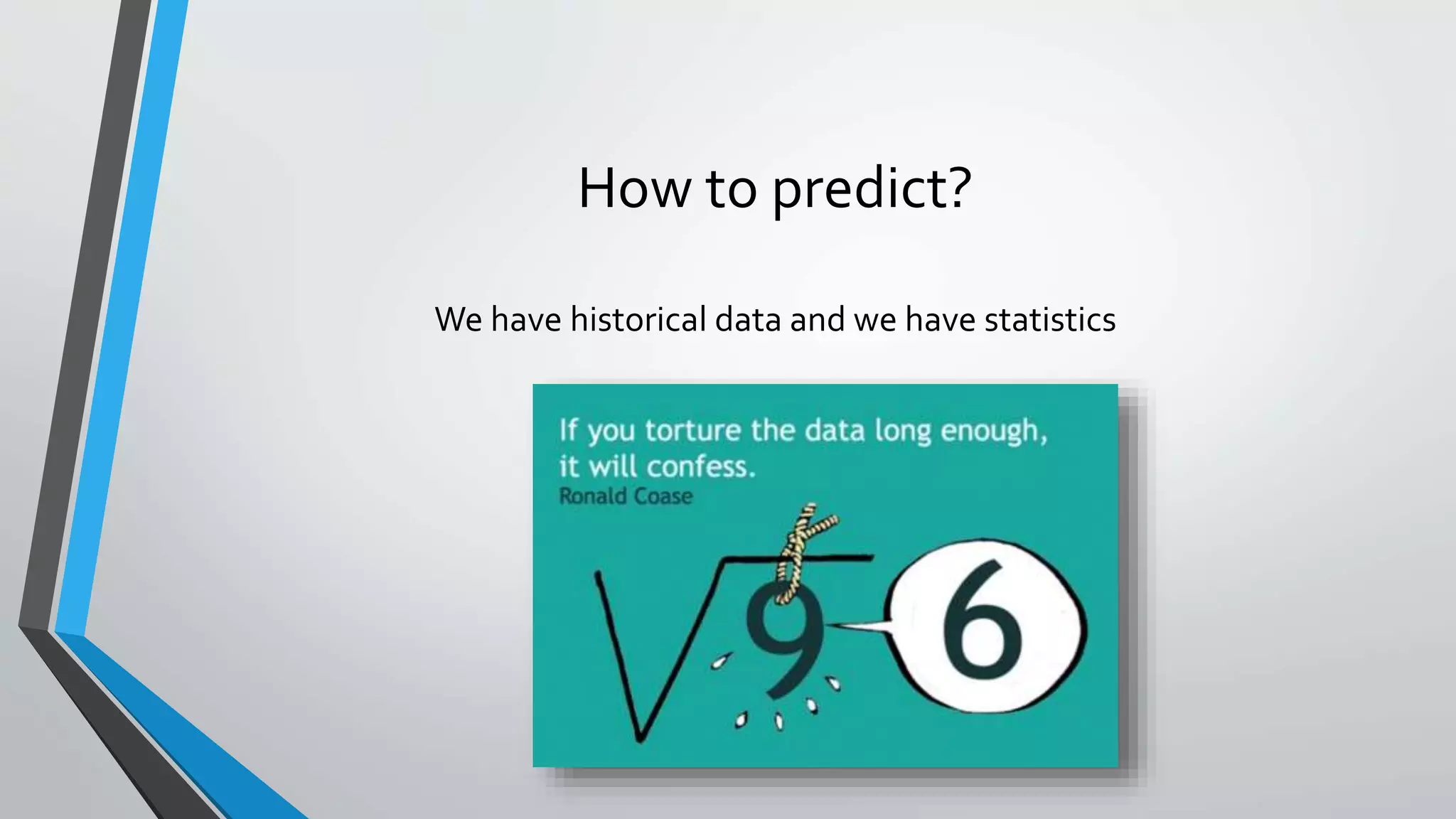
How to predict?
We have historical data and we have statistics
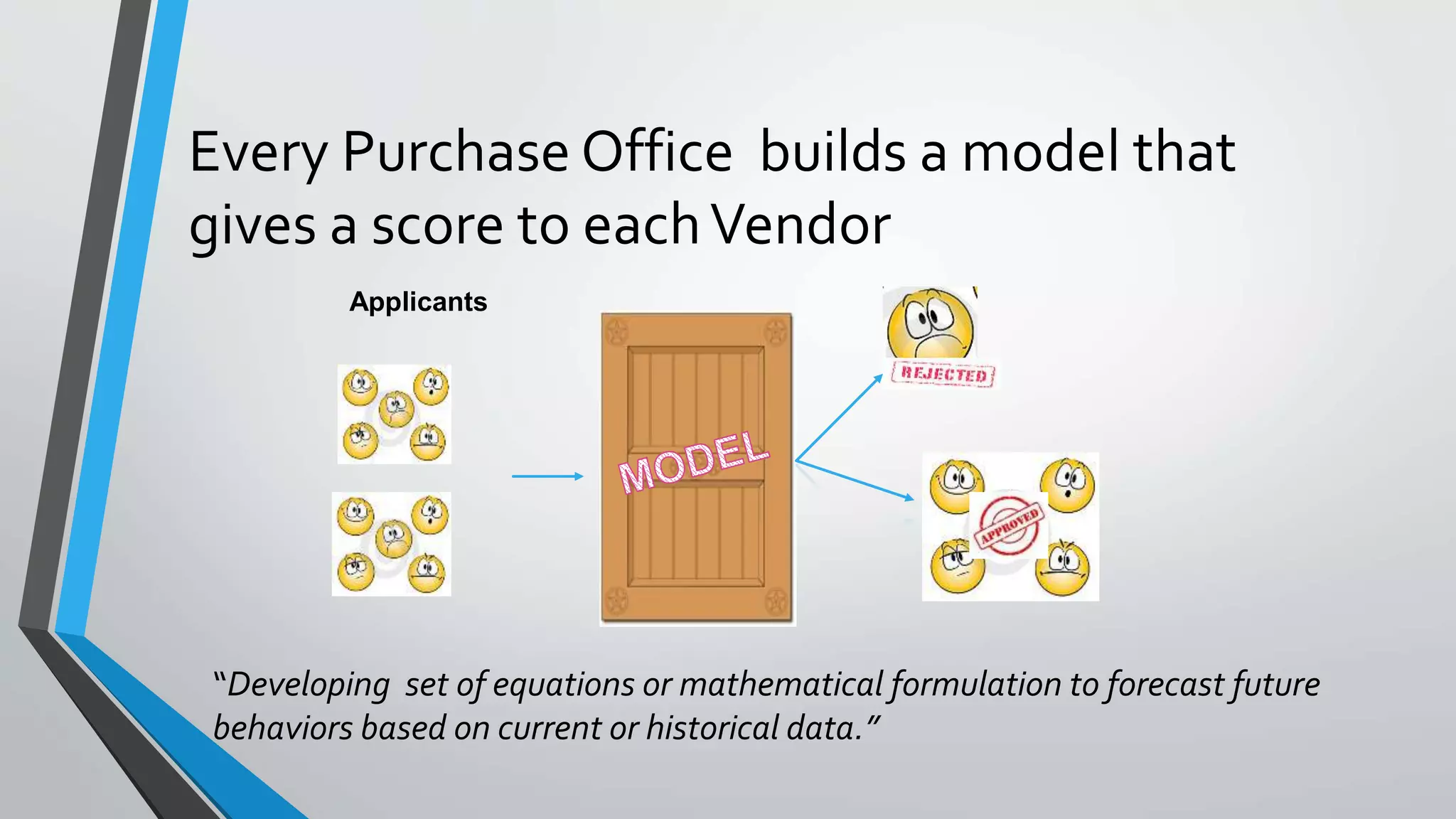
Every Purchase Office builds a model that
gives a score to eachVendor
“Developing set of equations or mathematical formulation to forecast future
behaviors based on current or historical data.”
Applicants
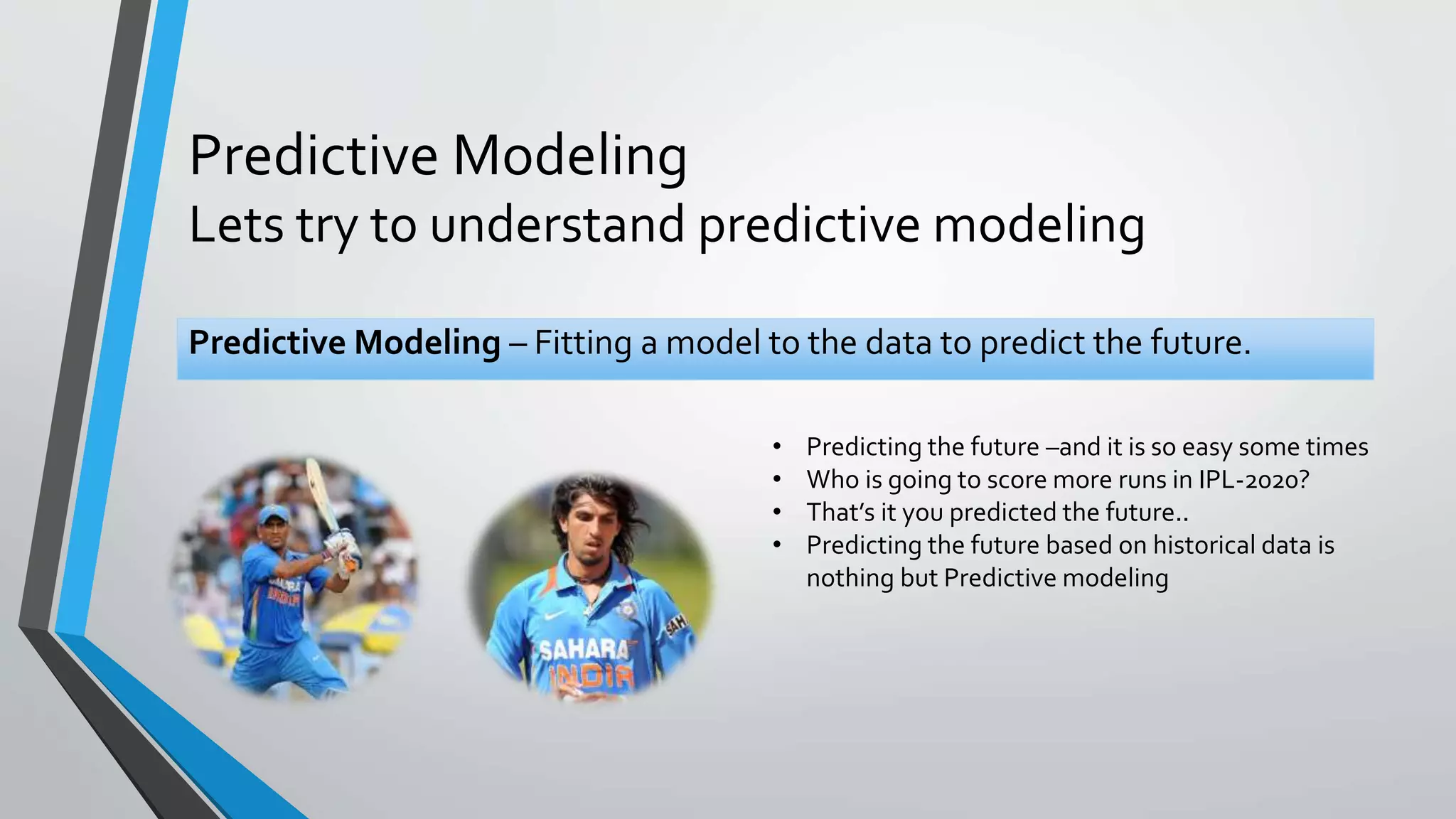
Predictive Modeling
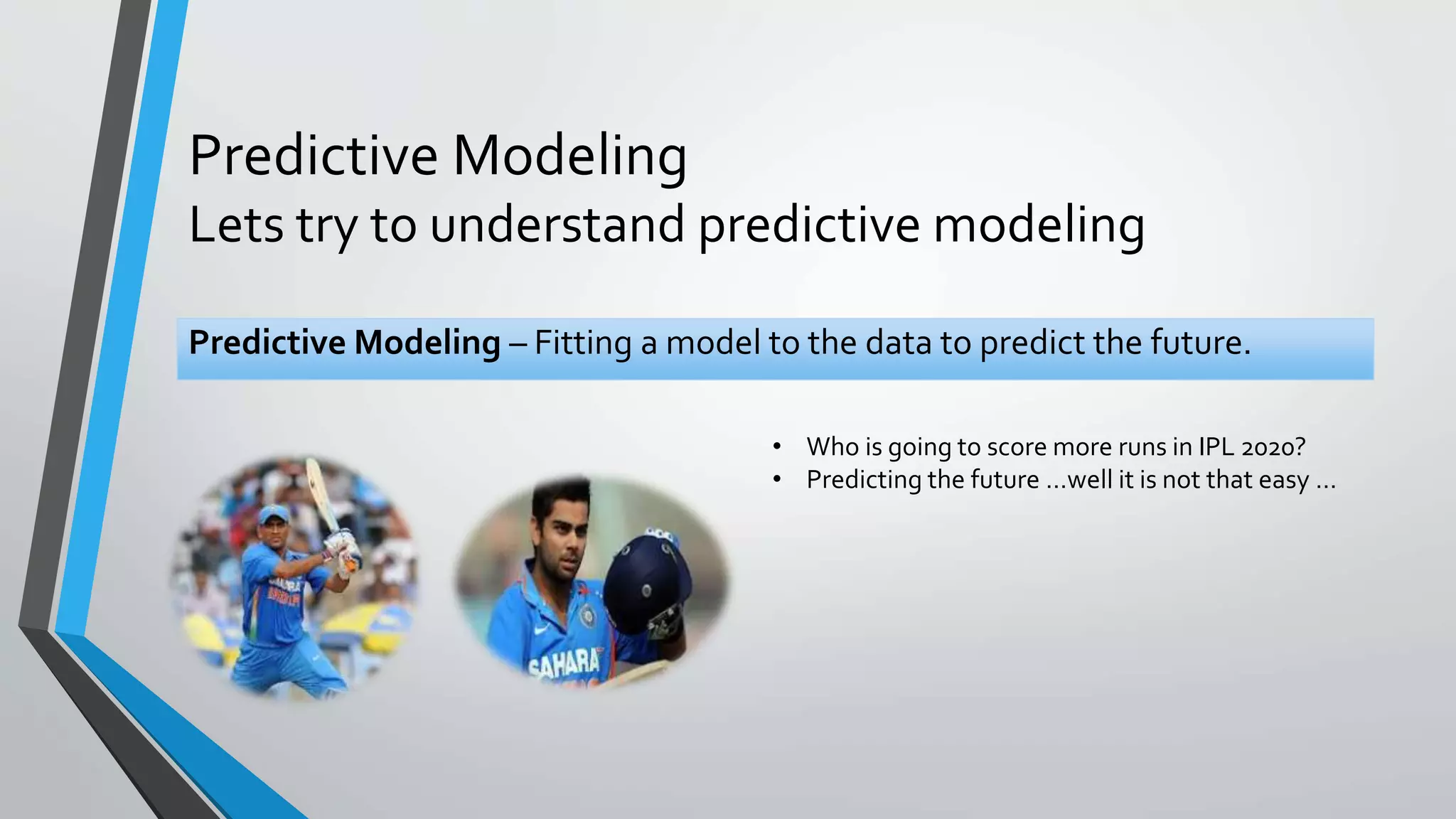
Lets try to understand predictive modeling
Predictive Modeling – Fitting a model to the data to predict the future.
• Predicting the future –and it is so easy some times
• Who is going to score more runs in IPL-2020?
• That’s it you predicted the future..
• Predicting the future based on historical data is
nothing but Predictive modeling
Predictive Modeling
Lets try to understand predictive modeling
Predictive Modeling – Fitting a model to the data to predict the future.
• Who is going to score more runs in IPL 2020?
• Predicting the future …well it is not that easy …
Predictive Modeling
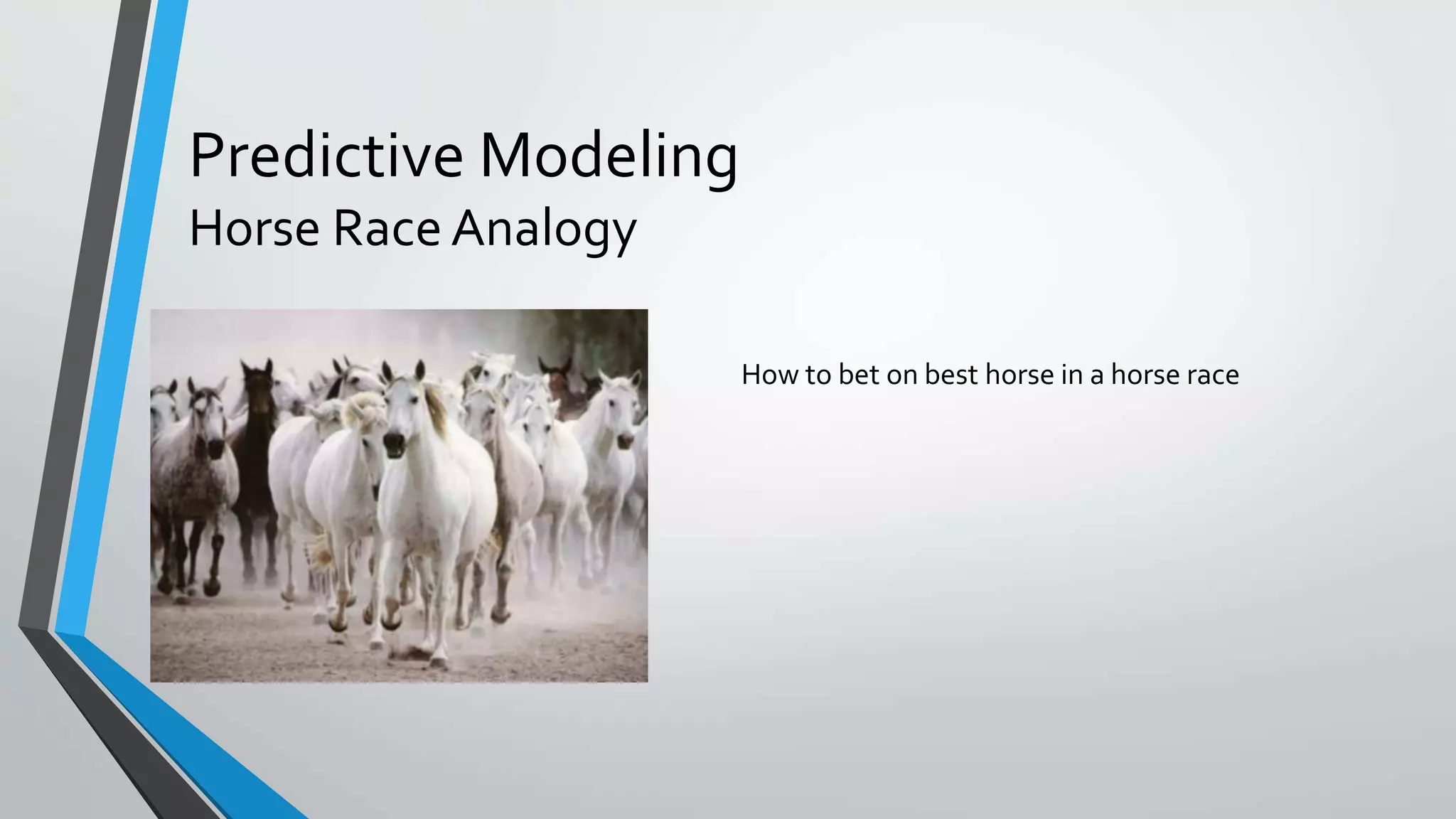
Horse Race Analogy
How to bet on best horse in a horse race
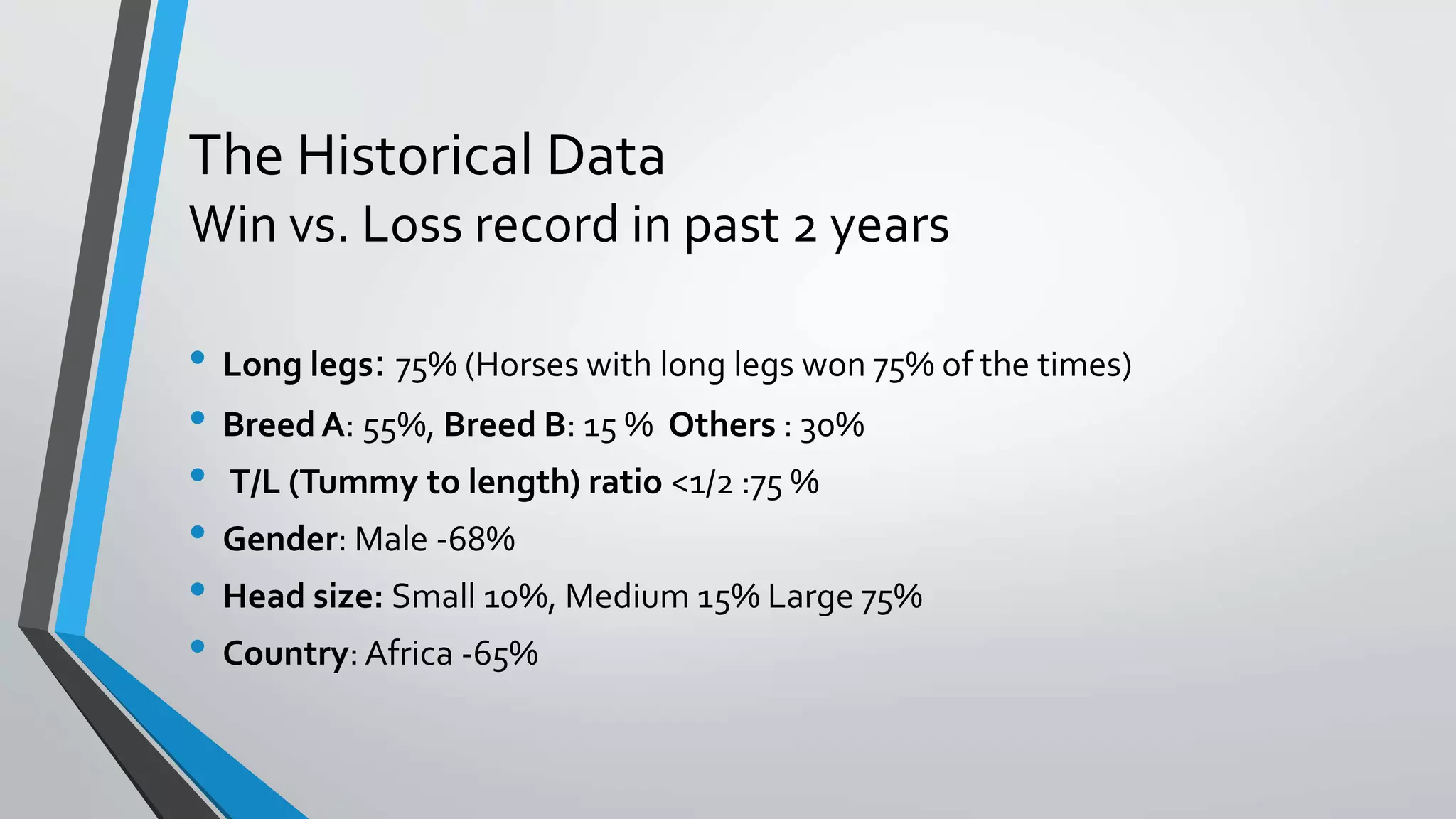
The Historical Data
Win vs. Loss record in past 2 years
• Long legs: 75% (Horses with long legs won 75% of the times)
• Breed A: 55%, Breed B: 15 % Others : 30%
• T/L (Tummy to length) ratio <1/2 :75 %
• Gender: Male -68%
• Head size: Small 10%, Medium 15% Large 75%
• Country: Africa -65%
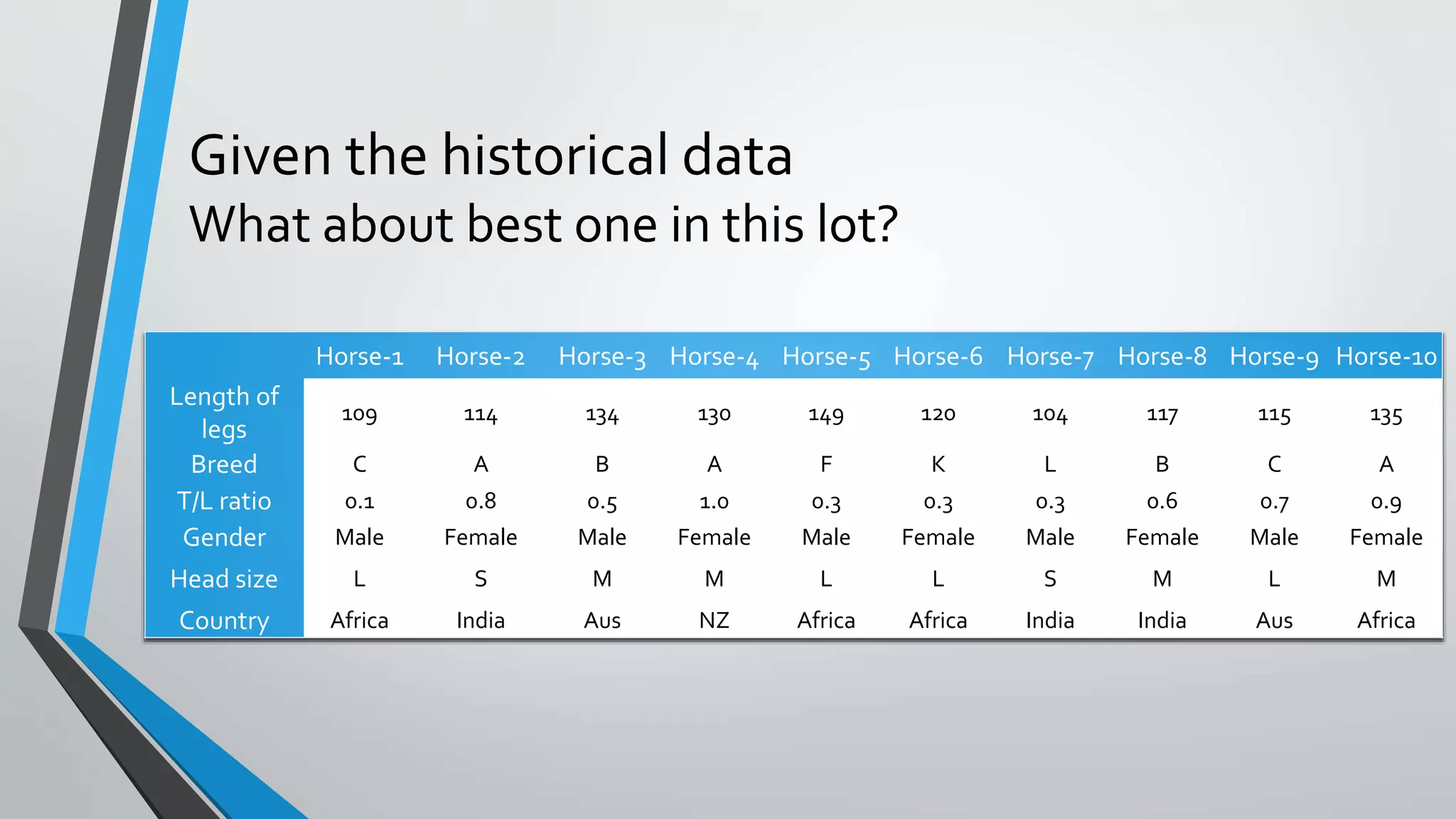
Given the historical data
What about best one in this lot?
Horse-1 Horse-2 Horse-3 Horse-4 Horse-5 Horse-6 Horse-7 Horse-8 Horse-9 Horse-10
Length of
legs
109 114 134 130 149 120 104 117 115 135
Breed C A B A F K L B C A
T/L ratio 0.1 0.8 0.5 1.0 0.3 0.3 0.3 0.6 0.7 0.9
Gender Male Female Male Female Male Female Male Female Male Female
Head size L S M M L L S M L M
Country Africa India Aus NZ Africa Africa India India Aus Africa
Even more variables
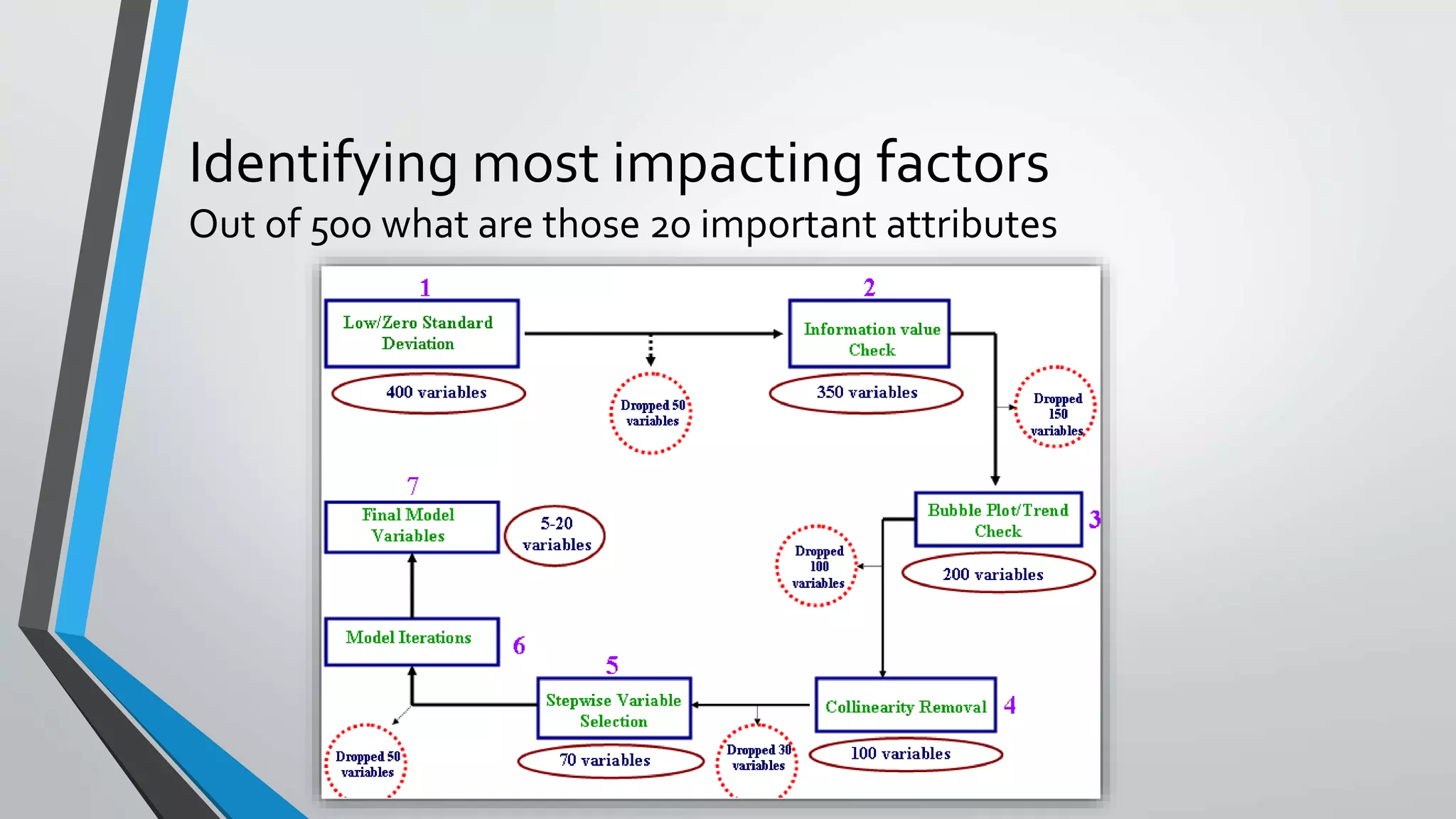
Identifying most impacting factors
Out of 500 what are those 20 important attributes
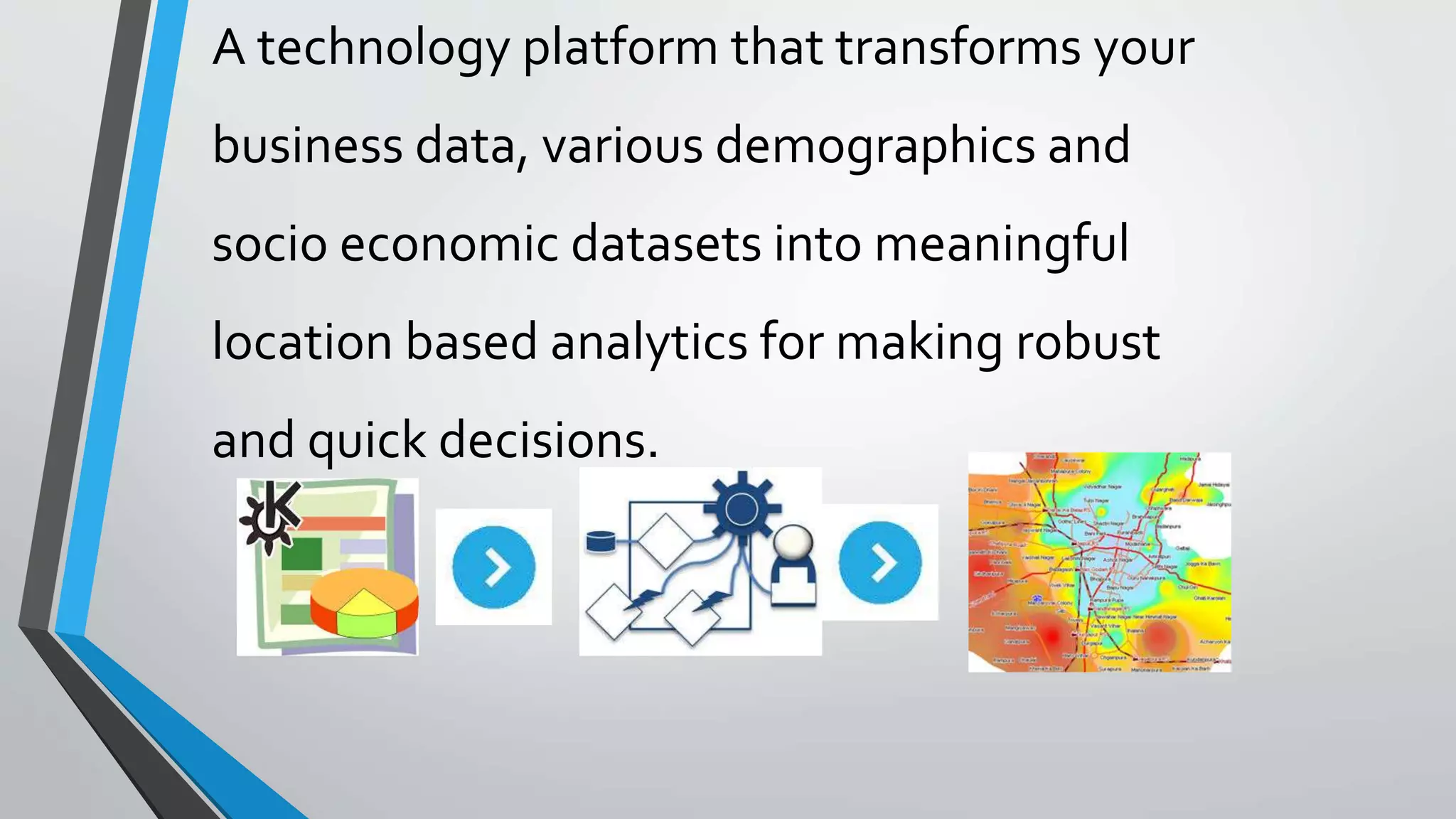
A technology platform that transforms your
business data, various demographics and
socio economic datasets into meaningful
location based analytics for making robust
and quick decisions.
Challenges/Key Requirements
1.Saturated markets? Any untapped markets still there.
2.What is the potential within the catchment of ‘X’ km around store.
3.How to organize/ re-define the territories for optimum distribution and sales?
4.Should I open new distribution point or cannibalize my existing non-performing
distribution points? But Where to open andWhat to cannibalize?
5.How to reach to the potential markets? Accessibility?
6.How a particular outlet/ distributor/ area is performing w.r.t. to the other
around it.
Model Building
Historical Data
The model
equation
Questions?
Prediction is very difficult, especially if it’s about the
future.
-- Niels Bohr
Thank You
Prashant Bhatmule

predictive analysis and usage in procurement ppt 2017

  • 1.
    Predictive analytics of demand foroptimization of Procurement Process By :Prashant Bhatmule VP-SCM Bajaj Electricals Ltd
  • 2.
    Points to cover •Understanding the models, simulations and variables • selection for better use of predictive analytics. • How to reduce the volatility in decision making process using • predictive analysis in procurement process • How to overcome challenges in the procurement process , • inventory management understanding the future cost, • demand, supply of resources using predictive analytics? • Understanding multiple uses of predictive analytics • in terms of suppliers and vendors • Understand ways to address the challenges with managing • Big Data and approaches for improving your supplier risk.
  • 3.
  • 4.
    Predictive Analytics -Definition Predictive analytics is an area of data mining that deals with extracting information from data and using it to predict trends and behavior patterns. Often the unknown event of interest is in the future, but predictive analytics can be applied to any type of unknown whether it be in the past, present or future. --Wikipedia
  • 5.
    Evolution of Analytics 5/25/2017 5 Seatof the pants: Intuition, domain knowledge BI (data driven): Visualizations, KPI’s, OLAP, Dashboards Predictive Analytics: Modeling, Experimental verification Real-time streaming analytics: Deep learning, A.I. Complexity Insights Future looking Past looking
  • 6.
    Predictive Analytics Process Model Verification Theoretical Model Treatments+ Controls + Error = Response Domain knowledge, 1st principles, experience Pre-existing data
  • 7.
    Traditional Predictive Analytics •Applications • Research and development in agriculture and industry • Designed experiments for product and process improvement • Verifying the effectiveness of healthcare treatments • Clinical trials (randomized double blind are best) • Predicting the weather • Polls: opinions, election politics, Nielson ratings. • Standardized tests: e.g. SAT’s to predict college success • Actuarial Science: life expectancy, etc. • Limitations • Each data point must be planned and collected intentionally • Expensive to design, collect the data
  • 8.
    21st CenturyTransformation: BigData Content 1. Internet behavior and logs • Every click and keystroke stored, server logs • Automatic byproduct of the Internet 2. Internet content • Text, emails, statuses, images, audio, video, etc. • Voluntary product of Internet use, automatically harvested 3. Internet of things • Sensors of all types: temperature, pressure, kinematics, images, audio, etc. • Must be consciously set up and designed 4. Access to thousands of sources of traditionally collected data • Open data movement (gov’t, academia)
  • 9.
    Who is usingbig data? “Big data is like teenage sex: everyone talks about it, nobody really knows how to do it, everyone thinks everyone else is doing it, so everyone claims they are doing it…”—Dan Ariely (2012) Even if this was true in 2012, it is no longer true; many organizations are successfully implementing modern predictive analytics with big data.
  • 10.
    Analytic process changes •Huge quantity and variety of data available with little effort/cost • Substantial extra effort needed to extract and process data that have been collected without a specific end use in mind (ETL) • Unstructured data images, videos, audio, etc. • Combination of a variety of data sources • Some creativity required to compose relevant metrics • Data availability leads to increased data mining, exploratory data analysis and data visualization requirements • Hundreds or even thousands of variables are “thrown in” to analyses • More “statistically significant” relationships found • Some new insights that are real • Some mistakes due to over-fitting, random clusters (some algorithms exist to help filter out false “hits”) • Domain knowledge / insights still crucial to distinguish real effects from random chance or allied effects
  • 11.
    TraditionalTools andTechniques • TraditionalTools •Mostly commercial – SAS, SPSS, STATA, Minitab, Excel • Open Source – R, Python • TraditionalTechniques • Various flavors of regression analyses • Linear, multinomial, logistic, general linear models, regression discontinuity, instrumental variables, panel models, time series, etc. • Designed experiments,ANOVA • Controls built in for known covariates • Randomization to accommodate unknown covariates • Sometimes designed to extract maximum possible info from fewest observations 11
  • 12.
    Big DataTools • BigData Predictive AnalyticsTools • Open Source • Apache Spark / MLlib • Python scripts interfaced to Hadoop or other distributed data source • Sometimes R or other traditional tools if data can be extracted and reduced to a size to fit on a single processor. • Mondrian (OLAP – more BI than predictive analytics) • Commercial / Proprietary • RapidMiner (Radoop for Hadoop analytics) • Pentaho – compare effectiveness of various models: operates against many data sources (being acquired by Hitachi) • HPVertica Distributed R – ML algorithms pre-loaded • BeyondCore - 1st through 4th order interactions automatically calculated • SAS Enterprise Miner • SPSS adding big data analytics modules • IBM Predictive Maintenance and Quality • Homegrown solutions internal to companies (hand-coded Python or Java algorithms)
  • 13.
    Big DataTechniques • BigData Predictive AnalyticsTechniques • Numerical responses / Categorical responses • TraditionalAnalyticalTechniques – Linear, logistic regressions,GLM regressions, simulations • Distributed Analytics – i.e. MapReduce • Machine LearningAlgorithms - Bayes network, decision trees, rule engines • A/BTesting – Designed randomized experiments to confirm model’s predictive power • More use of natural experiments (due to increased sharing of data sets)
  • 14.
    Predictive Analytics: Current UseCases Directly related to the sponsoring organization’s goals 14
  • 15.
    Use Cases • Whatdetermines actual usage of analytics? • As always: organizational goals • Business / organizational goals drive initiatives 1. Improve outcomes (not obviously dollar related) • For non-profits: improve client outcomes • Fulfill the non-market based goal • Improve products, customer satisfaction • Provide the best product/experience and the customer will come 2. Increase profits by increasing revenue 3. Increase profits by reducing costs 15
  • 16.
  • 17.
    Legendary Pictures: AppliedAnalytics Division • Legendary Pictures • Movies such as Interstellar, Godzilla, Dracula Untold, Man of Steel, Inception, Unbroken • Global scale and reach • Innovation factory, not a warehouse • Use of predictive analytics now a part of key strategies to inform creative decisions • Concept and cast evaluation • Green lighting concepts • Cast strengths and weaknesses • Build trailers on analytics • Proprietary, commercial-grade software constantly analyzes unique, extensive data across people, social media, and content. • 500 million emails, 250 million households • Entertainment data • Metadata on films since 1989 • Transform marketing • Old fashioned: 4 quadrants: male/female/over 25/under 25; 4 groups of 80 million each • Targeting: 80 million groups of 4 • Aiming at “swing groups” not fans nor never interested “Mom” 17
  • 18.
    Manufacturing Process Improvement •Intel - Using IoT and predictive analytics in chip manufacturing • Process and product measurements taken upstream during the manufacturing process are able to predict whether the chip will pass final test leading to a reduction in final testing requirements. • "Instead of running every single chip through 19,000 tests, we can focus tests on specific chips to cut down test time.“ • This predictive analytics process, implemented on a single line of Intel Core processors in 2012, allowed Intel to save $3 million in manufacturing costs. In 2017-18, Intel expects to extend the process to more chip lines and save an additional $30 million, the company said.
  • 19.
    Predictive Maintenance • HowPredictive Analytics ImprovesWindTurbine Maintenance
  • 20.
    Model Building logistic regressionmodel to predict the probability of default • Probability of bad = w1(Var1)+w2(Var2) +w3(Var1)……+w20(var20) • Logistic regression gives us those weights • Predicting the probability • Odds of bad=0.13(number of cards)+ 0.21 (utilization)+…….+0.06(number of loan applications) • That’s it ….we are done
  • 21.
    Actual model BuildingSteps Objective & Portfolio identification Customer score vs. account score Exclusions Observation point and/or window Performance window Bad definition Segmentation Validation plan and samples Variable Selection Model Building Scoring and Validation Score Implementation
  • 22.
    Predictive AnalyticsTrends • Costof analytics will be driven down by: • Standardization of IoT • Spread of expertise • Commercialization and widespread use of successful techniques • Development of “best practices” and user-friendly software to support them in specific key applications • Web and web-content data • Profusion of analytical tools will consolidate to a couple of winners • Most used and useful tools will be identified and commercialized • New applications will continue to target identifiable individuals in the “persuadable middle” • Internet ofThings • Development of interface standards will lead to more commercially available tools as well as open source solutions • Healthcare analytics • Will increasingly use Big Data as privacy and regulatory issues resolved • Leading edge • Move from manual to dynamic model generation as understanding of relevant factors improves (especially in IoT, since things tend to have more consistent behaviors than people) • Analysis of streaming data becomes more mainstream 22
  • 23.
  • 24.
    DataVisualizations Data visualizations canhelp you make the right decisions quickly… that will ultimately lead to success.
  • 25.
    Data Analysis &Predictive Modeling Increasingly, business rely on intelligent tools and techniques to analyze data systematically to improve decision-making.  Retail sales analytics  Financial services analytics  Telecommunications  SupplyChain analytics  Transportation analytics  Risk & Credit analytics  Talent analytics  Marketing analytics  Behavioral analytics  Collections analytics  Fraud analytics  Pricing analytics
  • 26.
    Dude we allknow that Data analytics rocks & Predictive modeling is going to rule!!!
  • 32.
  • 34.
    • Automated Replenishmentsprevent stock outs and reduce cost • Enable Flexible allocation scenario • Can use integrated plans and automate allocation • Helps in Sales and operations planning • Allows to implement Consensus Demand planning • Aligns the organisation
  • 35.
    How does bankapprove or decline CC and Loan applications? Any suggestions… Chill maddi • Basis Predictive analysis out of Big Data !!!!!!!!
  • 36.
    The Problem Who willrun away with my money? • Question asked by all Credit card issuing banks ???
  • 37.
    Citi has asimilar problem? Who is going to run away with my money? • Given Historical of the customers we want to predict the probability of bad • We have the data of each customer on • Customer previous loans, customer previous payments, length of account credit history, other credit cards and loans, job type, income band etc., • We want to predict the probability of default
  • 38.
    How to predict? Wehave historical data and we have statistics
  • 39.
    Every Purchase Officebuilds a model that gives a score to eachVendor “Developing set of equations or mathematical formulation to forecast future behaviors based on current or historical data.” Applicants
  • 40.
    Predictive Modeling Lets tryto understand predictive modeling Predictive Modeling – Fitting a model to the data to predict the future. • Predicting the future –and it is so easy some times • Who is going to score more runs in IPL-2020? • That’s it you predicted the future.. • Predicting the future based on historical data is nothing but Predictive modeling
  • 41.
    Predictive Modeling Lets tryto understand predictive modeling Predictive Modeling – Fitting a model to the data to predict the future. • Who is going to score more runs in IPL 2020? • Predicting the future …well it is not that easy …
  • 42.
    Predictive Modeling Horse RaceAnalogy How to bet on best horse in a horse race
  • 43.
    The Historical Data Winvs. Loss record in past 2 years • Long legs: 75% (Horses with long legs won 75% of the times) • Breed A: 55%, Breed B: 15 % Others : 30% • T/L (Tummy to length) ratio <1/2 :75 % • Gender: Male -68% • Head size: Small 10%, Medium 15% Large 75% • Country: Africa -65%
  • 44.
    Given the historicaldata What about best one in this lot? Horse-1 Horse-2 Horse-3 Horse-4 Horse-5 Horse-6 Horse-7 Horse-8 Horse-9 Horse-10 Length of legs 109 114 134 130 149 120 104 117 115 135 Breed C A B A F K L B C A T/L ratio 0.1 0.8 0.5 1.0 0.3 0.3 0.3 0.6 0.7 0.9 Gender Male Female Male Female Male Female Male Female Male Female Head size L S M M L L S M L M Country Africa India Aus NZ Africa Africa India India Aus Africa
  • 45.
  • 46.
    Identifying most impactingfactors Out of 500 what are those 20 important attributes
  • 47.
    A technology platformthat transforms your business data, various demographics and socio economic datasets into meaningful location based analytics for making robust and quick decisions.
  • 49.
    Challenges/Key Requirements 1.Saturated markets?Any untapped markets still there. 2.What is the potential within the catchment of ‘X’ km around store. 3.How to organize/ re-define the territories for optimum distribution and sales? 4.Should I open new distribution point or cannibalize my existing non-performing distribution points? But Where to open andWhat to cannibalize? 5.How to reach to the potential markets? Accessibility? 6.How a particular outlet/ distributor/ area is performing w.r.t. to the other around it.
  • 51.
  • 52.
    Questions? Prediction is verydifficult, especially if it’s about the future. -- Niels Bohr
  • 53.