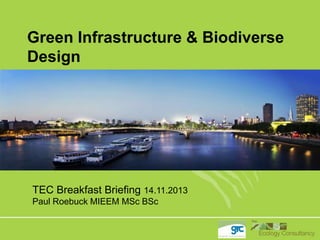
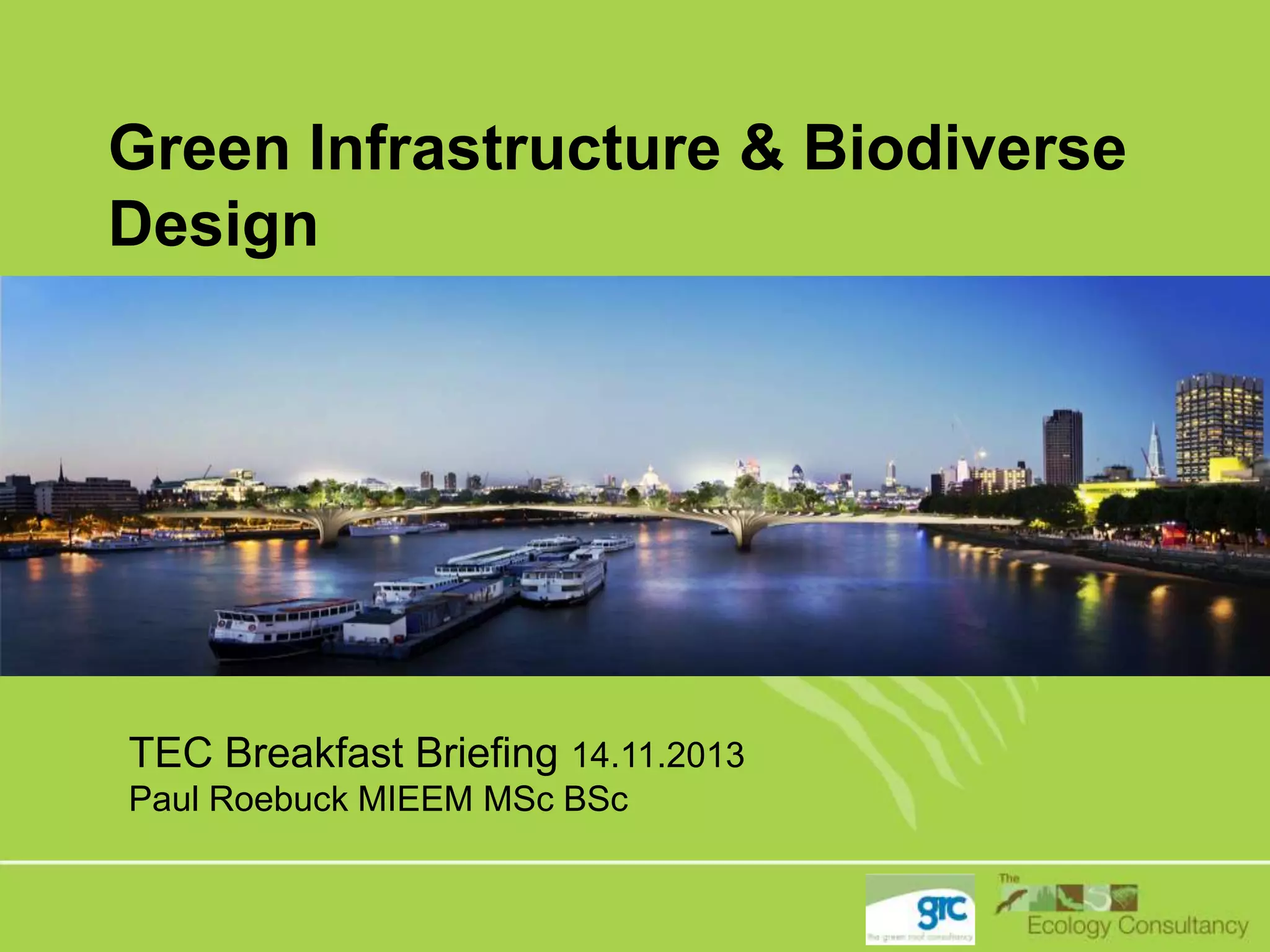
Green Infrastructure & Biodiverse
Design

TEC Breakfast Briefing 14.11.2013
Paul Roebuck MIEEM MSc BSc
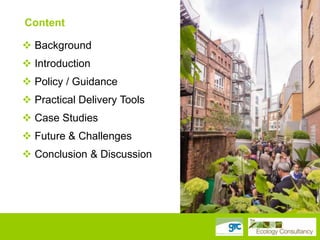
Content
 Background
 Introduction

 Policy / Guidance
 Practical Delivery Tools
 Case Studies

 Future & Challenges
 Conclusion & Discussion
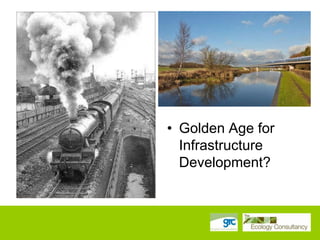
• Golden Age for
Infrastructure
Development?
What is Green Infrastructure?

“GI represents an approach to land use
that has a critical role in meeting many of
the challenges we face [social,
environmental and economic].
It achieves this through its multifunctional
and connected nature and is underpinned
by the concept of ecosystem services, an
approach which recognises the many
benefits that are generated by natural
ecosystems”
Landscape Institute
What is Green Infrastructure?

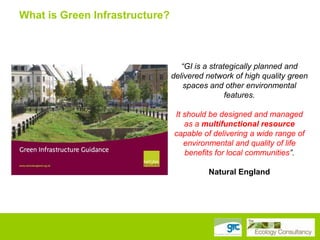
“GI is a strategically planned and
delivered network of high quality green
spaces and other environmental
features.
It should be designed and managed
as a multifunctional resource
capable of delivering a wide range of
environmental and quality of life
benefits for local communities”.
Natural England
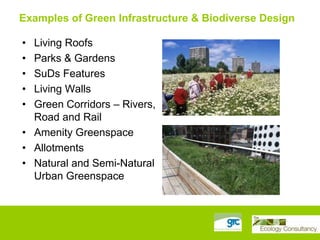
Examples of Green Infrastructure & Biodiverse Design
•
•
•
•
•

Living Roofs
Parks & Gardens
SuDs Features
Living Walls
Green Corridors – Rivers,
Road and Rail
• Amenity Greenspace
• Allotments
• Natural and Semi-Natural
Urban Greenspace
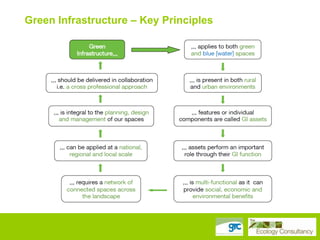
Green Infrastructure – Key Principles
Who is involved?
Policy & Legislation
• Historical planning policy and legislation relating to
ecology and biodiversity has been largely led by the
principles of conservation and protection
• Wildlife & Countryside Act (1981) & Habitat
Regulations (1994) as examples
• 20th Century approach?
• Future planning policy and legislation - Creation, Conservation &
Protection
• Natural Environment & Rural Communities Act (NERC) (2006),
the Localism Act (2011) & National Planning Policy Framework
(NPPF) (2012)
• LPAs must have „a due regard to biodiversity‟ (NERC Act) and
will expect a „net gain‟ from the development (NPPF)
• Green Infrastructure essential part of Local Plans
• 21st Century approach?
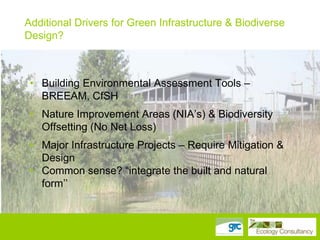
Additional Drivers for Green Infrastructure & Biodiverse
Design?
• Biodiversity Action Plan Targets – species and habitats

• • Building Environmental Assessment Tools – –
Building Environmental Assessment Tools BREEAM,
CfSH
BREEAM, CfSH
• • Nature Improvement Areas (NIA‟s) && Biodiversity
Nature Improvement Areas (NIA‟s) Biodiversity Offsetting
(No Net Loss) Net Loss)
Offsetting (No
• • Major Infrastructure Projects – – Require Mitigation &
Major Infrastructure Projects Require Mitigation & Design
• Common sense? “integrate the built and natural form
Design
• together” sense? “integrate the built and natural
Common
form‟‟
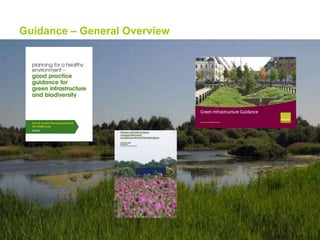
Guidance – General Overview
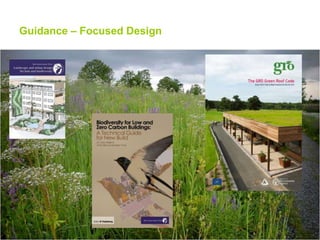
Guidance – Focused Design
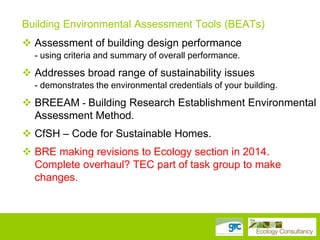
Building Environmental Assessment Tools (BEATs)
 Assessment of building design performance
- using criteria and summary of overall performance.

 Addresses broad range of sustainability issues
- demonstrates the environmental credentials of your building.

 BREEAM - Building Research Establishment Environmental
Assessment Method.
 CfSH – Code for Sustainable Homes.
 BRE making revisions to Ecology section in 2014.
Complete overhaul? TEC part of task group to make
changes.
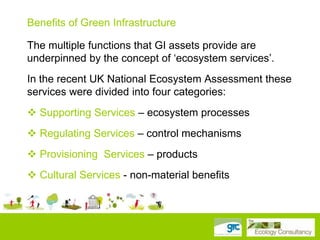
Benefits of Green Infrastructure
The multiple functions that GI assets provide are
underpinned by the concept of „ecosystem services‟.

In the recent UK National Ecosystem Assessment these
services were divided into four categories:
 Supporting Services – ecosystem processes

 Regulating Services – control mechanisms
 Provisioning Services – products
 Cultural Services - non-material benefits
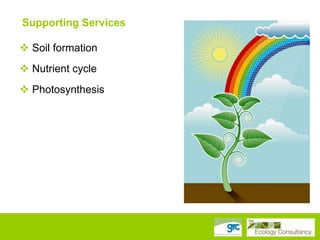
Supporting Services
 Soil formation
 Nutrient cycle
 Photosynthesis
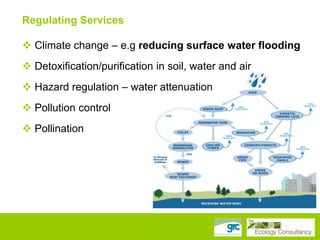
Regulating Services
Provisioning
 Climate
Services change – e.g reducing surface water flooding
 Detoxification/purification in soil, water and air

 Hazard regulation – water attenuation
 Pollution control
 Pollination
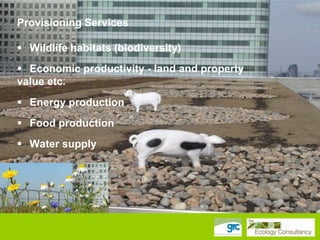
Provisioning Services
 Wildlife habitats (biodiversity)
 Economic productivity - land and property
value etc.

 Energy production
 Food production
 Water supply
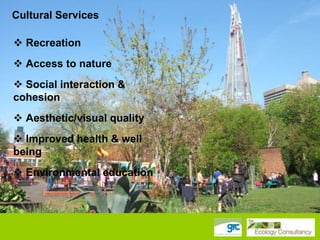
Cultural Services

 Recreation
 Access to nature
 Social interaction &
cohesion
 Aesthetic/visual quality
 Improved health & well
being
 Environmental education
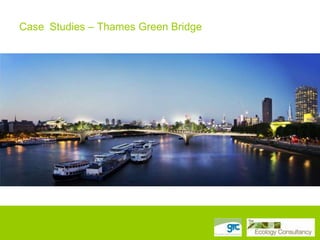
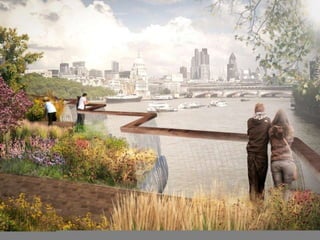
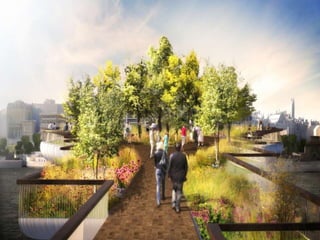
Case Studies – Thames Green Bridge
Landscape Planting – Design

 Selection – „right plant in the right place‟
 Sustainable horticulture – planting medium, water, nutrients
 Species of known wildlife value - native vs. non-native?
 Provenance of native stock – Pests & diseases (ash dieback
etc.)

 Planting density / diversity – do we need to take our leads from
nature?

 Long-term management is key – Management Plan (BEATs),
funding/costs, grounds maintenance/contractual issues, fostering
ownership etc.
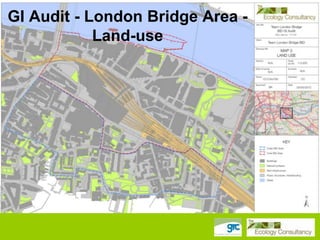
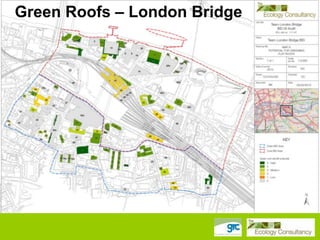
GI Audit - London Bridge Area Land-use
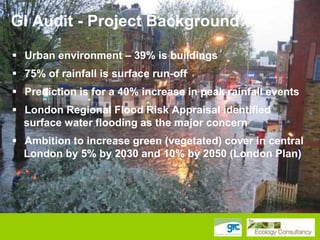
GI Audit - Project Background
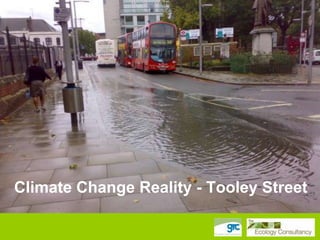
 Urban environment – 39% is buildings
 75% of rainfall is surface run-off
 Prediction is for a 40% increase in peak rainfall events
 London Regional Flood Risk Appraisal identified
surface water flooding as the major concern

 Ambition to increase green (vegetated) cover in central
London by 5% by 2030 and 10% by 2050 (London Plan)
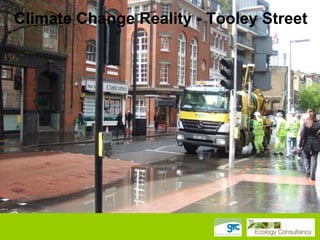
Climate Change Reality - Tooley Street
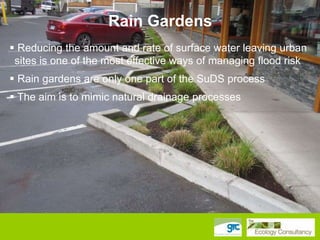
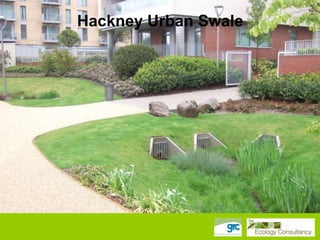
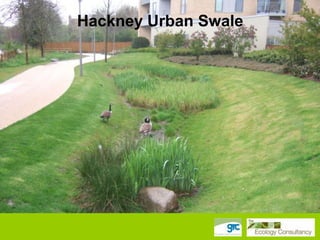
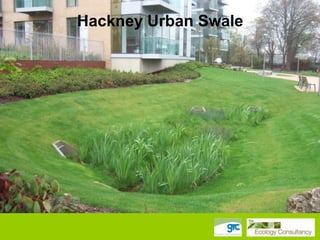
Rain Gardens
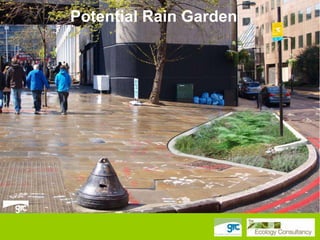
 Reducing the amount and rate of surface water leaving urban
sites is one of the most effective ways of managing flood risk

 Rain gardens are only one part of the SuDS process
 The aim is to mimic natural drainage processes
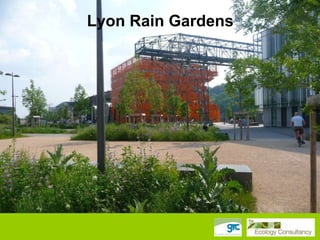
Lyon Rain Gardens
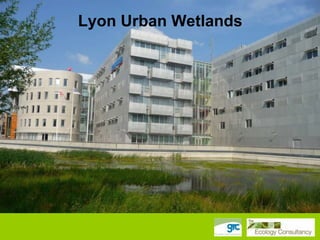
Lyon Urban Wetlands
Hackney Urban Swale
Hackney Urban Swale
Hackney Urban Swale
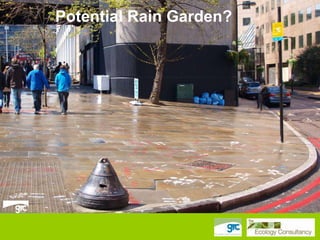
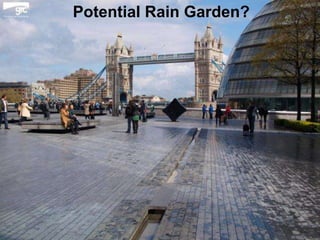
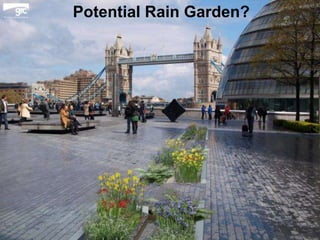
Potential Rain Garden?
Potential Rain Garden
Potential Rain Garden?
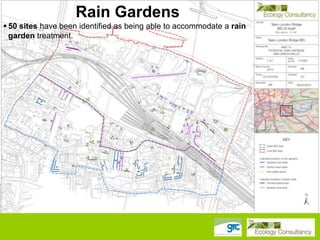
Rain Gardens
 50 sites have been identified as being able to accommodate a rain
garden treatment.
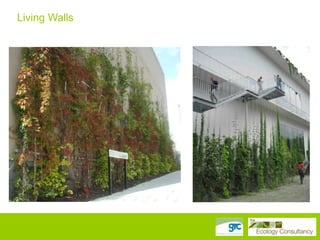
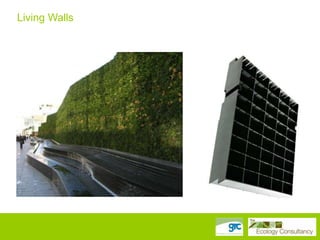
Living Walls
Living Walls
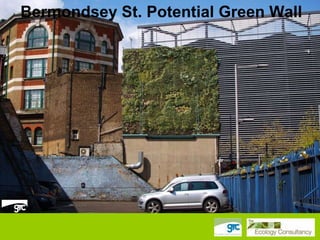
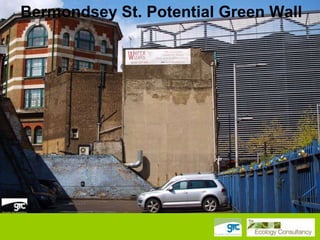
Bermondsey St. Potential Green Wall
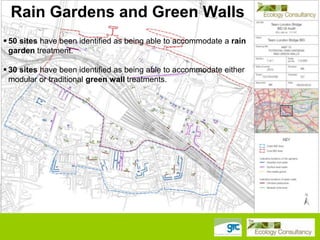
Rain Gardens and Green Walls
 50 sites have been identified as being able to accommodate a rain
garden treatment.
 30 sites have been identified as being able to accommodate either
modular or traditional green wall treatments.
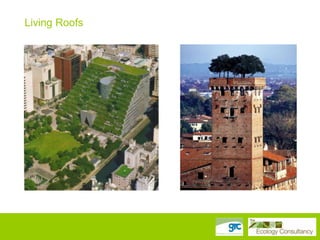
Living Roofs
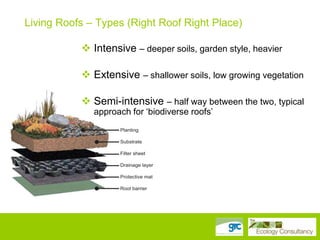
Living Roofs – Types (Right Roof Right Place)

hitworth Art Gallery

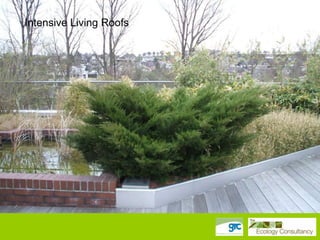
 Intensive – deeper soils, garden style, heavier
April 2010

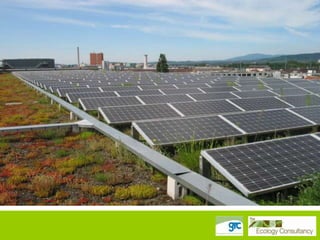
 Extensive – shallower soils, low growing vegetation
 Semi-intensive – half way between the two, typical
approach for „biodiverse roofs‟
Planting
Substrate
Filter sheet
Drainage layer
Protective mat
Root barrier
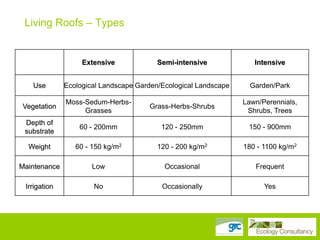
Living Roofs – Types

Extensive

Use

Semi-intensive

Ecological Landscape Garden/Ecological Landscape

Intensive

Garden/Park

Vegetation

Moss-Sedum-HerbsGrasses

Grass-Herbs-Shrubs

Lawn/Perennials,
Shrubs, Trees

Depth of
substrate

60 - 200mm

120 - 250mm

150 - 900mm

Weight

60 - 150 kg/m2

120 - 200 kg/m2

180 - 1100 kg/m2

Maintenance

Low

Occasional

Frequent

Irrigation

No

Occasionally

Yes
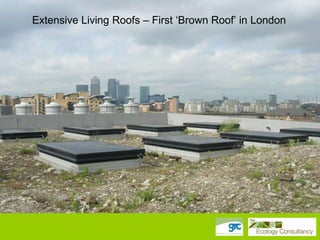
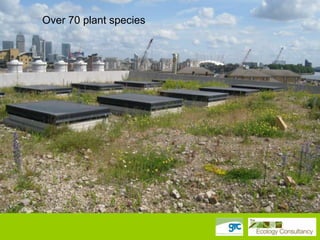
Extensive Living Roofs – First „Brown Roof‟ in London
Over 70 – Case Study
Living Roofsplant species 2
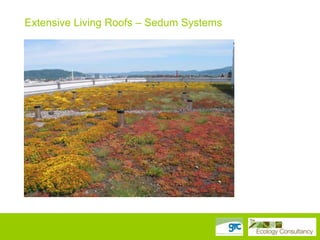
Extensive Living Roofs – Sedum Systems
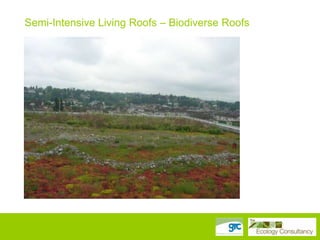
Semi-Intensive Living Roofs – Biodiverse Roofs
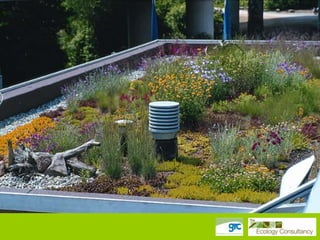
Intensive Living Roofs
Green Roofs – London Bridge
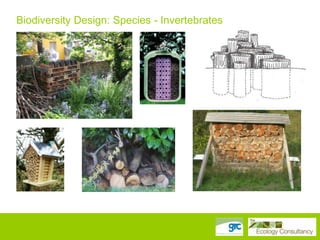
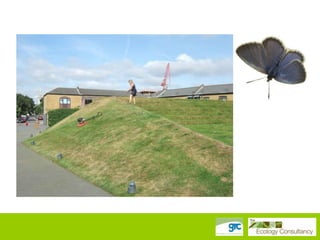
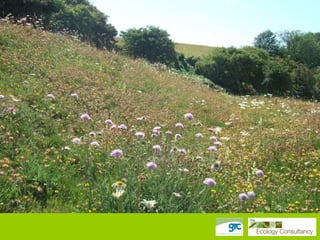
Biodiversity Design: Species - Invertebrates
Invertebrates
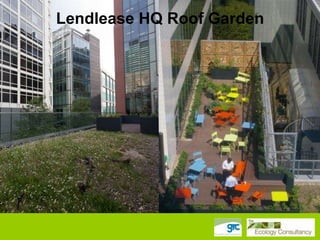
Lendlease HQ Roof Garden
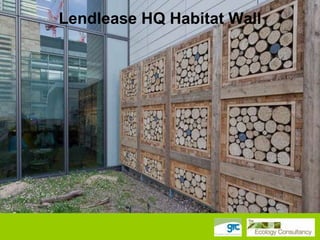
Lendlease HQ Habitat Wall
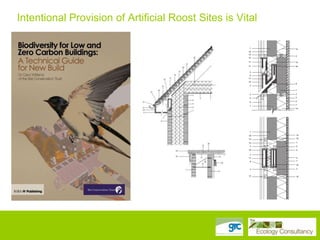
Intentional Provision of Artificial Roost Sites is Vital
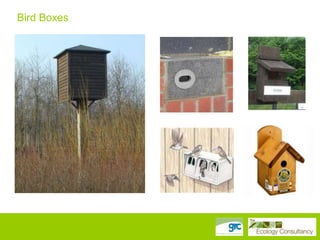
Bird Boxes
Bird Boxes – What to consider?
 Open fronted – black redstart, grey wagtail
 Hole fronted – blue-tit, robin
 Communal – house sparrow
 Nest bowl – house martin, swallow
 Bespoke – swift, peregrine falcon, owls
 Presence of bird / collect baseline data / BAP targets
 Attachment / orientation – away from direct midday sun
 Foraging habitat
 Size of hole / predation
 Maintenance
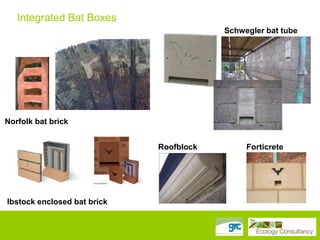
Integrated Bat Boxes
Schwegler bat tube

Norfolk bat brick
Roofblock

Ibstock enclosed bat brick

Forticrete
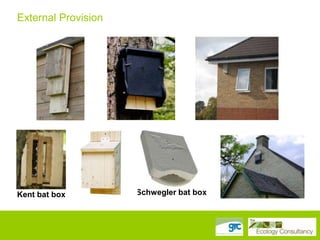
External Provision

Kent bat box

Schwegler bat box
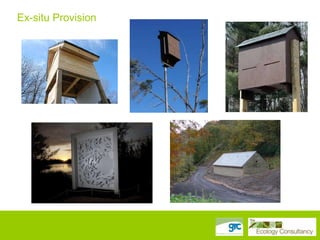
Ex-situ Provision
Bat Boxes - Design Considerations

Temperature requirements (opposite to birds!):
• Summer - warm for rearing young (30ºC to 40ºC)
• Winter - cool for hibernation (0ºC to 6ºC)
Positioning
• Place where the roost will receive at least 6-10 hours of direct
sunlight a day
• Aspect and orientation - S, SW, SE (W, E, N)
• 2-7m in height
Access / Clearance
• Clear path to flight-line
• Vegetation close by for cover and foraging
Ex-situ provision – What works?
Wildlife needs breakfast as well as a bed!
• Individual species requirements
• Sun exposure
• Bigger is better
• Height is important
• Size of crevice width: 1.5 cm to 2.5 cm
• Ventilation slots – provide wider temperature ranges
• Multiple bat houses – group three or more together
• Mitigation close to where roost was lost
• Proximity to landscape features: For example wildflower
meadows/pasture and water – Wildlife (not just bats!)
needs breakfast as well as a bed.
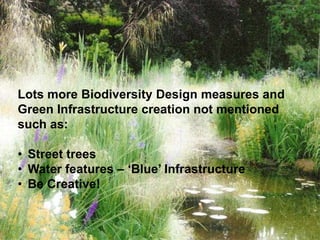
Lots more Biodiversity Design measures and
Green Infrastructure creation not mentioned
such as:
• Street trees
• Water features – ‘Blue’ Infrastructure
• Be Creative!
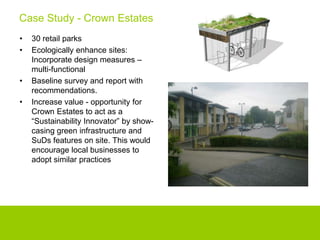
Case Study - Crown Estates
•
•

•
•

30 retail parks
Ecologically enhance sites:
Incorporate design measures –
multi-functional
Baseline survey and report with
recommendations.
Increase value - opportunity for
Crown Estates to act as a
“Sustainability Innovator” by showcasing green infrastructure and
SuDs features on site. This would
encourage local businesses to
adopt similar practices
Future & Challenges
• Lots of stakeholders – Need to work together
• New systems and mechanisms for delivery – Biodiversity
Offsetting
• Policy – Localism still early days
• Problems with delivery tools – BREEAM/CfSH etc.
• Incorporating „Biodiversity Design‟ measures for sake of
it. i.e. bird box in wrong place
• Playing it safe? Not taking risks due to costs/concerns of
implementation.
• Be inspired – be brave and take opportunities!
Thank You
Any Questions?

paul@ecologyconsultancy.co.uk

Green Infrastructure

  • 1.
    Green Infrastructure &Biodiverse Design TEC Breakfast Briefing 14.11.2013 Paul Roebuck MIEEM MSc BSc
  • 2.
    Content  Background  Introduction Policy / Guidance  Practical Delivery Tools  Case Studies  Future & Challenges  Conclusion & Discussion
  • 3.
    • Golden Agefor Infrastructure Development?
  • 4.
    What is GreenInfrastructure? “GI represents an approach to land use that has a critical role in meeting many of the challenges we face [social, environmental and economic]. It achieves this through its multifunctional and connected nature and is underpinned by the concept of ecosystem services, an approach which recognises the many benefits that are generated by natural ecosystems” Landscape Institute
  • 5.
    What is GreenInfrastructure? “GI is a strategically planned and delivered network of high quality green spaces and other environmental features. It should be designed and managed as a multifunctional resource capable of delivering a wide range of environmental and quality of life benefits for local communities”. Natural England
  • 6.
    Examples of GreenInfrastructure & Biodiverse Design • • • • • Living Roofs Parks & Gardens SuDs Features Living Walls Green Corridors – Rivers, Road and Rail • Amenity Greenspace • Allotments • Natural and Semi-Natural Urban Greenspace
  • 7.
  • 8.
  • 9.
    Policy & Legislation •Historical planning policy and legislation relating to ecology and biodiversity has been largely led by the principles of conservation and protection • Wildlife & Countryside Act (1981) & Habitat Regulations (1994) as examples • 20th Century approach?
  • 10.
    • Future planningpolicy and legislation - Creation, Conservation & Protection • Natural Environment & Rural Communities Act (NERC) (2006), the Localism Act (2011) & National Planning Policy Framework (NPPF) (2012) • LPAs must have „a due regard to biodiversity‟ (NERC Act) and will expect a „net gain‟ from the development (NPPF) • Green Infrastructure essential part of Local Plans • 21st Century approach?
  • 11.
    Additional Drivers forGreen Infrastructure & Biodiverse Design? • Biodiversity Action Plan Targets – species and habitats • • Building Environmental Assessment Tools – – Building Environmental Assessment Tools BREEAM, CfSH BREEAM, CfSH • • Nature Improvement Areas (NIA‟s) && Biodiversity Nature Improvement Areas (NIA‟s) Biodiversity Offsetting (No Net Loss) Net Loss) Offsetting (No • • Major Infrastructure Projects – – Require Mitigation & Major Infrastructure Projects Require Mitigation & Design • Common sense? “integrate the built and natural form Design • together” sense? “integrate the built and natural Common form‟‟
  • 12.
  • 13.
  • 14.
    Building Environmental AssessmentTools (BEATs)  Assessment of building design performance - using criteria and summary of overall performance.  Addresses broad range of sustainability issues - demonstrates the environmental credentials of your building.  BREEAM - Building Research Establishment Environmental Assessment Method.  CfSH – Code for Sustainable Homes.  BRE making revisions to Ecology section in 2014. Complete overhaul? TEC part of task group to make changes.
  • 15.
    Benefits of GreenInfrastructure The multiple functions that GI assets provide are underpinned by the concept of „ecosystem services‟. In the recent UK National Ecosystem Assessment these services were divided into four categories:  Supporting Services – ecosystem processes  Regulating Services – control mechanisms  Provisioning Services – products  Cultural Services - non-material benefits
  • 16.
    Supporting Services  Soilformation  Nutrient cycle  Photosynthesis
  • 17.
    Regulating Services Provisioning  Climate Serviceschange – e.g reducing surface water flooding  Detoxification/purification in soil, water and air  Hazard regulation – water attenuation  Pollution control  Pollination
  • 18.
    Provisioning Services  Wildlifehabitats (biodiversity)  Economic productivity - land and property value etc.  Energy production  Food production  Water supply
  • 19.
    Cultural Services  Recreation Access to nature  Social interaction & cohesion  Aesthetic/visual quality  Improved health & well being  Environmental education
  • 20.
    Case Studies –Thames Green Bridge
  • 25.
    Landscape Planting –Design  Selection – „right plant in the right place‟  Sustainable horticulture – planting medium, water, nutrients  Species of known wildlife value - native vs. non-native?  Provenance of native stock – Pests & diseases (ash dieback etc.)  Planting density / diversity – do we need to take our leads from nature?  Long-term management is key – Management Plan (BEATs), funding/costs, grounds maintenance/contractual issues, fostering ownership etc.
  • 26.
    GI Audit -London Bridge Area Land-use
  • 27.
    GI Audit -Project Background  Urban environment – 39% is buildings  75% of rainfall is surface run-off  Prediction is for a 40% increase in peak rainfall events  London Regional Flood Risk Appraisal identified surface water flooding as the major concern  Ambition to increase green (vegetated) cover in central London by 5% by 2030 and 10% by 2050 (London Plan)
  • 28.
    Climate Change Reality- Tooley Street
  • 29.
    Climate Change Reality- Tooley Street
  • 30.
    Rain Gardens  Reducingthe amount and rate of surface water leaving urban sites is one of the most effective ways of managing flood risk  Rain gardens are only one part of the SuDS process  The aim is to mimic natural drainage processes
  • 31.
  • 32.
  • 33.
  • 34.
  • 35.
  • 36.
  • 37.
  • 38.
  • 39.
  • 40.
    Rain Gardens  50sites have been identified as being able to accommodate a rain garden treatment.
  • 41.
  • 42.
  • 43.
  • 44.
  • 45.
    Rain Gardens andGreen Walls  50 sites have been identified as being able to accommodate a rain garden treatment.  30 sites have been identified as being able to accommodate either modular or traditional green wall treatments.
  • 46.
  • 47.
    Living Roofs –Types (Right Roof Right Place) hitworth Art Gallery  Intensive – deeper soils, garden style, heavier April 2010  Extensive – shallower soils, low growing vegetation  Semi-intensive – half way between the two, typical approach for „biodiverse roofs‟ Planting Substrate Filter sheet Drainage layer Protective mat Root barrier
  • 48.
    Living Roofs –Types Extensive Use Semi-intensive Ecological Landscape Garden/Ecological Landscape Intensive Garden/Park Vegetation Moss-Sedum-HerbsGrasses Grass-Herbs-Shrubs Lawn/Perennials, Shrubs, Trees Depth of substrate 60 - 200mm 120 - 250mm 150 - 900mm Weight 60 - 150 kg/m2 120 - 200 kg/m2 180 - 1100 kg/m2 Maintenance Low Occasional Frequent Irrigation No Occasionally Yes
  • 49.
    Extensive Living Roofs– First „Brown Roof‟ in London
  • 50.
    Over 70 –Case Study Living Roofsplant species 2
  • 51.
    Extensive Living Roofs– Sedum Systems
  • 52.
    Semi-Intensive Living Roofs– Biodiverse Roofs
  • 54.
  • 56.
    Green Roofs –London Bridge
  • 57.
  • 59.
  • 60.
  • 61.
  • 62.
    Intentional Provision ofArtificial Roost Sites is Vital
  • 63.
  • 64.
    Bird Boxes –What to consider?  Open fronted – black redstart, grey wagtail  Hole fronted – blue-tit, robin  Communal – house sparrow  Nest bowl – house martin, swallow  Bespoke – swift, peregrine falcon, owls  Presence of bird / collect baseline data / BAP targets  Attachment / orientation – away from direct midday sun  Foraging habitat  Size of hole / predation  Maintenance
  • 65.
    Integrated Bat Boxes Schweglerbat tube Norfolk bat brick Roofblock Ibstock enclosed bat brick Forticrete
  • 66.
    External Provision Kent batbox Schwegler bat box
  • 67.
  • 68.
    Bat Boxes -Design Considerations Temperature requirements (opposite to birds!): • Summer - warm for rearing young (30ºC to 40ºC) • Winter - cool for hibernation (0ºC to 6ºC) Positioning • Place where the roost will receive at least 6-10 hours of direct sunlight a day • Aspect and orientation - S, SW, SE (W, E, N) • 2-7m in height Access / Clearance • Clear path to flight-line • Vegetation close by for cover and foraging
  • 69.
    Ex-situ provision –What works? Wildlife needs breakfast as well as a bed! • Individual species requirements • Sun exposure • Bigger is better • Height is important • Size of crevice width: 1.5 cm to 2.5 cm • Ventilation slots – provide wider temperature ranges • Multiple bat houses – group three or more together • Mitigation close to where roost was lost • Proximity to landscape features: For example wildflower meadows/pasture and water – Wildlife (not just bats!) needs breakfast as well as a bed.
  • 70.
    Lots more BiodiversityDesign measures and Green Infrastructure creation not mentioned such as: • Street trees • Water features – ‘Blue’ Infrastructure • Be Creative!
  • 71.
    Case Study -Crown Estates • • • • 30 retail parks Ecologically enhance sites: Incorporate design measures – multi-functional Baseline survey and report with recommendations. Increase value - opportunity for Crown Estates to act as a “Sustainability Innovator” by showcasing green infrastructure and SuDs features on site. This would encourage local businesses to adopt similar practices
  • 72.
    Future & Challenges •Lots of stakeholders – Need to work together • New systems and mechanisms for delivery – Biodiversity Offsetting • Policy – Localism still early days • Problems with delivery tools – BREEAM/CfSH etc. • Incorporating „Biodiversity Design‟ measures for sake of it. i.e. bird box in wrong place • Playing it safe? Not taking risks due to costs/concerns of implementation. • Be inspired – be brave and take opportunities!
  • 73.

Editor's Notes

  • #47 BAP Targets – chalk grassland (UK BAP). Vegetated shingle (Sussex BAP) - conditions on a roof mimic the field conditions on the South Downs in many ways – light/pH/moisture etc. Brownfield sites etc. (UK BAP)Global issues – Urban Heat Island Effect, storm water amelioration, energy balance–reduces temp. fluctuations+insulation and cooling/air conditioning
  • #48 BAP Targets – chalk grassland (UK BAP). Vegetated shingle (Sussex BAP) - conditions on a roof mimic the field conditions on the South Downs in many ways – light/pH/moisture etc. Brownfield sites etc. (UK BAP)Global issues – Urban Heat Island Effect, storm water amelioration, energy balance–reduces temp. fluctuations+insulation and cooling/air conditioning
  • #49 BAP Targets – chalk grassland (UK BAP). Vegetated shingle (Sussex BAP) - conditions on a roof mimic the field conditions on the South Downs in many ways – light/pH/moisture etc. Brownfield sites etc. (UK BAP)Global issues – Urban Heat Island Effect, storm water amelioration, energy balance–reduces temp. fluctuations+insulation and cooling/air conditioning