1750 BC – 133 BC
Crete
• Home of the Minoans, an early Greek
civilization
• The Minoans were named after Mino, a
legendary king of Crete
• Was a dominant Greek civilization
between 1600 BC and 1500 BC
• Was known for being successful traders
The Minoans
• The Minoans emerged as a trading empire
• Set up trading outposts throughout
Mesopotamia and the Middle East
• Rulers of the empire lived in a palace at
Knossos
• By 1400 BC the Minoans had vanished
• Natural disaster and invasion ended the
Minoans
The Mycenaeans
• The first Greek-speaking people of whom
we have written record
• Conquered the Greek mainland and Crete
• Were sea traders like the Minoans
• Consisted of separate city-states, each
was ruled by a warrior-king and was built
like a fortress
The Trojan War
• The Mycenaeans are known for their role
in the Trojan War (1250 BC)
• Troy vs. the Mycenaeans
• What may have happened: war due to
economic competition
• Greek legend: Helen, the wife of the Greek
king is kidnapped by the prince of Troy
• Result= 10 year war, Troy is burnt to the
ground
Trojans vs. the Greeks
• Homer’s The Iliad
– Epic about the Trojan War
• Was regarded as a legend, now evidence
proves that Troy existed and was
destroyed by fire
Greek Origins
• The Mycenaeans were eventually
conquered by the Dorians
• Greek civilization diminished as a result
• Centuries later, the Greeks would make
stories of the Mycenaeans and the
Minoans as a part of their heritage
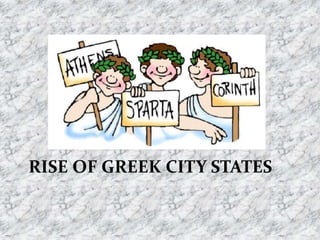
RISE OF GREEK CITY STATES
Geography
• Greece is a part of the Balkan peninsula,
surrounded by the Mediterranean sea
• Mountains divide the peninsula into
isolated valleys
– Consisted of small city-states separated from
one another
• The coast provided for safe harbors,
allowing the Greeks to become skilled
sailors
The Greek Polis
• Greeks created their own version of a city-
state, called a polis
– Included a major city and surrounding
countryside
• A Greek polis consisted of two levels
– The acropolis on the top (“high city”)
– Lower level (market, theater, public buildings,
homes)
Gov’t
• Originally, Greek city-states were run by
kings (monarchy)
• Eventually power shifted to the noble
landowners
– Aristocracy- rule by landholding elite
– Extension of trade leads to an oligarchy
Sparta
• A warrior society, centered around warfare
– Daily life ruled by discipline
• Spartan boys prepare for military life
– Strict discipline results in excellent soldiers
• Women were required to exercise and
maintain physical fitness
– Spartan logic: strong women make strong
babies
– Run the household while husband was at war
A Spartan Life
• Birth- the child is examined, if he or she is
sick or deformed then they are left to die
• 7 years old: the child is taken for military
training
• 7-17 years old: learned reading, writing, and
physical training
• 18-19: learned army tactics and survival
techniques
• 20-29: rigorous military training
• 30+: became full citizens
Athens
• Athens evolved from a
monarchy to an
aristocracy
– Landowners held power
• Wealthy Athenians
controlled society,
making the ordinary
unhappy
• Eventually Athens
became a democracy
– “Gov’t by the people, for
the people”
A Limited Democracy
• Only citizens can participate in gov’t, and
citizens are landholding men
• Athens still gives more people a say in
gov’t than any other ancient civilization
Athenian women
• Manage the
household in wealthy
homes, rarely go out
in public
– Cook, clean, raise
children
– Was not educated
• Poor women worked
outside of the home
Education
• Boys went to school if
they could afford it
• Learned to read,
write, study music
• Receive military
training and
participate in athletics
CONFLICT!
Persian and
Peloponnesian
Wars
The Persian Wars
• The Persian Empire was the largest
empire at that time
• In 499 BC, Ionian Greeks rebelled against
Persia with the help of Athens
• Darius I was furious at the role Athens
played in the rebellion
• Persia crushed the rebel cities, and sent a
huge force to punish Athens
Battle of Marathon
• The Persian army
landed at Marathon,
north of Athens
• The Greeks were
greatly outnumbered
by the Persians
• The Greeks beat the
Persians using hand
to hand combat
• Major upset
The 300
• Darius I died before he could attacked
Greece again
• His son Xerxes sent a larger force to conquer
Greece
• The Persians and the Spartans meet at the
narrow pass at Thermopylae
• King Leonidas and 300 Spartans fight the
Persian force
• The Spartans are defeated, but are
successful in uniting Greece to fight a
common enemy
Battle of Salamis
• The Athenians and
Themistocles build a fleet
of ships to fight the
Persian navy at the strait
of Salamis
• Athenian warships could
damage Persian ships with
underwater battering rams
• Xerxes navy is defeated,
soon after the Greeks
defeat the Persians on
land in Asia Minor
Bragging Rights and the Golden Age
• Following the victory, Athens emerged as the
most powerful city-state
• Allied with other city-states
– Delian League
• Pericles created a more democratic gov’t
– Direct democracy- the citizens=gov’t
• Used a jury in the legal system
• Could banish a public official
– Ostracism
Peloponnesian War
• Sparta formed the
Peloponnesian League
• Due to rivalries between the
two leagues, Sparta and
Athens engaged in a 27 year
war
• Athenians were forced to
crowd inside the city, creating
a plague
• Sparta sided with Persia for
their navy
• Both civilizations are nearly
eliminated, however Sparta is

Ancient_Greece_.pptx

  • 1.
  • 7.
    Crete • Home ofthe Minoans, an early Greek civilization • The Minoans were named after Mino, a legendary king of Crete • Was a dominant Greek civilization between 1600 BC and 1500 BC • Was known for being successful traders
  • 8.
    The Minoans • TheMinoans emerged as a trading empire • Set up trading outposts throughout Mesopotamia and the Middle East • Rulers of the empire lived in a palace at Knossos • By 1400 BC the Minoans had vanished • Natural disaster and invasion ended the Minoans
  • 9.
    The Mycenaeans • Thefirst Greek-speaking people of whom we have written record • Conquered the Greek mainland and Crete • Were sea traders like the Minoans • Consisted of separate city-states, each was ruled by a warrior-king and was built like a fortress
  • 10.
    The Trojan War •The Mycenaeans are known for their role in the Trojan War (1250 BC) • Troy vs. the Mycenaeans • What may have happened: war due to economic competition • Greek legend: Helen, the wife of the Greek king is kidnapped by the prince of Troy • Result= 10 year war, Troy is burnt to the ground
  • 11.
    Trojans vs. theGreeks • Homer’s The Iliad – Epic about the Trojan War • Was regarded as a legend, now evidence proves that Troy existed and was destroyed by fire
  • 12.
    Greek Origins • TheMycenaeans were eventually conquered by the Dorians • Greek civilization diminished as a result • Centuries later, the Greeks would make stories of the Mycenaeans and the Minoans as a part of their heritage
  • 13.
    RISE OF GREEKCITY STATES
  • 14.
    Geography • Greece isa part of the Balkan peninsula, surrounded by the Mediterranean sea • Mountains divide the peninsula into isolated valleys – Consisted of small city-states separated from one another • The coast provided for safe harbors, allowing the Greeks to become skilled sailors
  • 15.
    The Greek Polis •Greeks created their own version of a city- state, called a polis – Included a major city and surrounding countryside • A Greek polis consisted of two levels – The acropolis on the top (“high city”) – Lower level (market, theater, public buildings, homes)
  • 16.
    Gov’t • Originally, Greekcity-states were run by kings (monarchy) • Eventually power shifted to the noble landowners – Aristocracy- rule by landholding elite – Extension of trade leads to an oligarchy
  • 17.
    Sparta • A warriorsociety, centered around warfare – Daily life ruled by discipline • Spartan boys prepare for military life – Strict discipline results in excellent soldiers • Women were required to exercise and maintain physical fitness – Spartan logic: strong women make strong babies – Run the household while husband was at war
  • 19.
    A Spartan Life •Birth- the child is examined, if he or she is sick or deformed then they are left to die • 7 years old: the child is taken for military training • 7-17 years old: learned reading, writing, and physical training • 18-19: learned army tactics and survival techniques • 20-29: rigorous military training • 30+: became full citizens
  • 21.
    Athens • Athens evolvedfrom a monarchy to an aristocracy – Landowners held power • Wealthy Athenians controlled society, making the ordinary unhappy • Eventually Athens became a democracy – “Gov’t by the people, for the people”
  • 22.
    A Limited Democracy •Only citizens can participate in gov’t, and citizens are landholding men • Athens still gives more people a say in gov’t than any other ancient civilization
  • 23.
    Athenian women • Managethe household in wealthy homes, rarely go out in public – Cook, clean, raise children – Was not educated • Poor women worked outside of the home
  • 24.
    Education • Boys wentto school if they could afford it • Learned to read, write, study music • Receive military training and participate in athletics
  • 25.
  • 26.
    The Persian Wars •The Persian Empire was the largest empire at that time • In 499 BC, Ionian Greeks rebelled against Persia with the help of Athens • Darius I was furious at the role Athens played in the rebellion • Persia crushed the rebel cities, and sent a huge force to punish Athens
  • 27.
    Battle of Marathon •The Persian army landed at Marathon, north of Athens • The Greeks were greatly outnumbered by the Persians • The Greeks beat the Persians using hand to hand combat • Major upset
  • 28.
    The 300 • DariusI died before he could attacked Greece again • His son Xerxes sent a larger force to conquer Greece • The Persians and the Spartans meet at the narrow pass at Thermopylae • King Leonidas and 300 Spartans fight the Persian force • The Spartans are defeated, but are successful in uniting Greece to fight a common enemy
  • 32.
    Battle of Salamis •The Athenians and Themistocles build a fleet of ships to fight the Persian navy at the strait of Salamis • Athenian warships could damage Persian ships with underwater battering rams • Xerxes navy is defeated, soon after the Greeks defeat the Persians on land in Asia Minor
  • 34.
    Bragging Rights andthe Golden Age • Following the victory, Athens emerged as the most powerful city-state • Allied with other city-states – Delian League • Pericles created a more democratic gov’t – Direct democracy- the citizens=gov’t • Used a jury in the legal system • Could banish a public official – Ostracism
  • 35.
    Peloponnesian War • Spartaformed the Peloponnesian League • Due to rivalries between the two leagues, Sparta and Athens engaged in a 27 year war • Athenians were forced to crowd inside the city, creating a plague • Sparta sided with Persia for their navy • Both civilizations are nearly eliminated, however Sparta is