The Great Depression
A Picture is Worth a Thousand Words
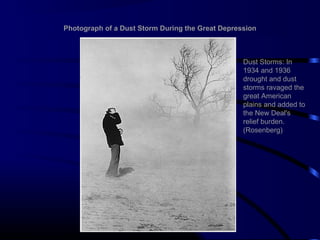
Photograph of a Dust Storm During the Great Depression
Dust Storms: In
1934 and 1936
drought and dust
storms ravaged the
great American
plains and added to
the New Deal's
relief burden.
(Rosenberg)
Migrant Workers
Farms in the mid-western states were destroyed by drought. This land
became known as “the dust bowl.” Families were forced to sell their
homes for very little. In these desperate times, many families traveled
west in hopes of better land or to the city in hopes of factory work.
Migrant families moved from place to place, living in tents, and taking
any jobs that were available.
As John Steinbeck wrote in his 1939 novel The
Grapes of Wrath:
"And then the dispossessed were drawn west-
from Kansas, Oklahoma, Texas, New Mexico;
from Nevada and Arkansas, families, tribes,
dusted out, tractored out. Car-loads, caravans,
homeless and hungry; twenty thousand and fifty
thousand and a hundred thousand and two
hundred thousand. They streamed over the
mountains, hungry and restless - restless as ants,
scurrying to find work to do - to lift, to push, to
pull, to pick, to cut - anything, any burden to
bear, for food. The kids are hungry. We got no
place to live. Like ants scurrying for work, for
food, and most of all for land.“ (Rosenberg)
The Dust Bowl
(Rosenberg)
(Rosenberg)
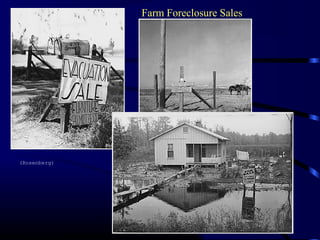
Farm Foreclosure Sales
Searching for a Job
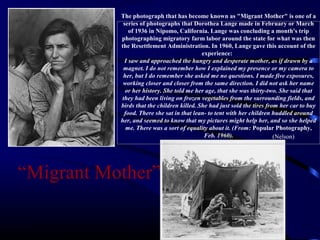
The photograph that has become known as "Migrant Mother" is one of a
series of photographs that Dorothea Lange made in February or March
of 1936 in Nipomo, California. Lange was concluding a month's trip
photographing migratory farm labor around the state for what was then
the Resettlement Administration. In 1960, Lange gave this account of the
experience:
I saw and approached the hungry and desperate mother, as if drawn by a
magnet. I do not remember how I explained my presence or my camera to
her, but I do remember she asked me no questions. I made five exposures,
working closer and closer from the same direction. I did not ask her name
or her history. She told me her age, that she was thirty-two. She said that
they had been living on frozen vegetables from the surrounding fields, and
birds that the children killed. She had just sold the tires from her car to buy
food. There she sat in that lean- to tent with her children huddled around
her, and seemed to know that my pictures might help her, and so she helped
me. There was a sort of equality about it. (From: Popular Photography,
Feb. 1960). (Nelson)
“Migrant Mother”
A Photograph of Christmas Dinner
During The Great Depression
(Roseberg)
The Big Cities
(google images)
Unemployed men vying for jobs at the American Legion
Employment Bureau in Los Angeles during the Great Depression.
(Nelson)
Vying for Jobs
The trading floor of the New York
Stock Exchange just after the crash
of 1929. On Black Tuesday, October
twenty-ninth, the market collapsed.
In a single day, sixteen million shares
were traded--a record--and thirty
billion dollars vanished into thin air.
Westinghouse lost two thirds of its
September value. DuPont dropped
seventy points. The "Era of Get Rich
Quick" was over. Jack Dempsey,
America's first millionaire athlete,
lost $3 million. Cynical New York
hotel clerks asked incoming guests,
"You want a room for sleeping or
jumping?"
(Nelson)
The Stock Market Crash
(Pearl)
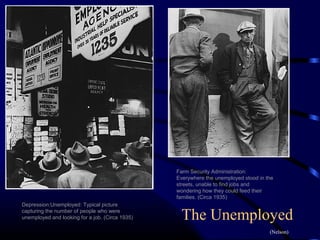
Farm Security Administration:
Everywhere the unemployed stood in the
streets, unable to find jobs and
wondering how they could feed their
families. (Circa 1935)
Depression:Unemployed: Typical picture
capturing the number of people who were
unemployed and looking for a job. (Circa 1935) The Unemployed
(Nelson)
Depression: Unemployed: The Unemployed Union: marchers south on Broadway: Camden New
Jersey typical scene reflecting large population of unemployed in desperate need of work and
looking for jobs. (Circa 1935)
Unemployed Union March
(Nelson)
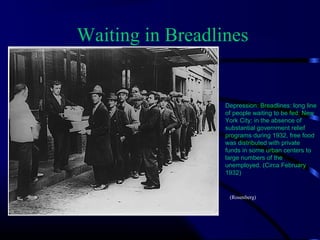
Depression: Breadlines: long line
of people waiting to be fed: New
York City: in the absence of
substantial government relief
programs during 1932, free food
was distributed with private
funds in some urban centers to
large numbers of the
unemployed. (Circa February
1932)
Waiting in Breadlines
(Rosenberg)
Segregation
(Nelson)
Most of the images we have of the tragedy of the
Depression portray strong, determined, dignified,
hopeful Americans -- fighters, survivors, the salt of
the earth. The photographs of Margaret Bourke-
White are not so cheerful. Reinforced by the text of
Eskine Caldwell, her images are often bleak, grim,
despairing. "Unlike other documentary
photographers, Bourke-White did not approach her
subjects with the assumption that they were noble,
and though her people were victims of circumstance,
she did not celebrate their ways of coping with their
plights. Instead, she pitied the cultural forms they
took" (Peeler 104). Even images of smiling children
have a pitying, patronizing undertone. These are
children who only go to school part-time, who will
never know better than to want to be just like their
daddies. They are the sharecropper's children. They
too would become "slaves of sharecropping." ).
Photographs by Margaret Bourke-White:
“White Folks” and “Black Folks”
(Bourke-White)
“White Folk”
(Bourke-White)
(Bourke-White)
“Black Folk”
(Bourke-White)
(Bourke-White)
(Bourke-
White)
(Bourke-White)
(Bourke-White)
Works Cited
Nelson, Cary. "Modern American Poetry." A Photo Essay on The Great Depression. 01 Dec.
2004 <http://www.english.uiuc.edu/maps/depression/depression.htm>.
Bourke-White, Margaret. Photographing the Representative American. 01 Dec. 2004
<http://xroads.virginia.edu/~CLASS/am485_98/coe/photofrnt.html>.
"Pearl Harbor: 1929 The Great Depression." Scholastic Teachers. 2004. Scholastic.
01 Dec. 2004
<http://teacher.scholastic.com/pearl/timeline/time4.htm>.
Rosenberg, Jennifer. “20th
Century History: Photographs of the Great Depression."
20th
Century History. 2004. About, Inc. 01 Dec. 2004
<http://history1900s.about.com/library/photos/blyindexdepression.htm>.

Great Depression PowerPoint

  • 1.
    The Great Depression APicture is Worth a Thousand Words
  • 2.
    Photograph of aDust Storm During the Great Depression Dust Storms: In 1934 and 1936 drought and dust storms ravaged the great American plains and added to the New Deal's relief burden. (Rosenberg)
  • 3.
    Migrant Workers Farms inthe mid-western states were destroyed by drought. This land became known as “the dust bowl.” Families were forced to sell their homes for very little. In these desperate times, many families traveled west in hopes of better land or to the city in hopes of factory work. Migrant families moved from place to place, living in tents, and taking any jobs that were available. As John Steinbeck wrote in his 1939 novel The Grapes of Wrath: "And then the dispossessed were drawn west- from Kansas, Oklahoma, Texas, New Mexico; from Nevada and Arkansas, families, tribes, dusted out, tractored out. Car-loads, caravans, homeless and hungry; twenty thousand and fifty thousand and a hundred thousand and two hundred thousand. They streamed over the mountains, hungry and restless - restless as ants, scurrying to find work to do - to lift, to push, to pull, to pick, to cut - anything, any burden to bear, for food. The kids are hungry. We got no place to live. Like ants scurrying for work, for food, and most of all for land.“ (Rosenberg)
  • 4.
  • 5.
  • 6.
  • 7.
    The photograph thathas become known as "Migrant Mother" is one of a series of photographs that Dorothea Lange made in February or March of 1936 in Nipomo, California. Lange was concluding a month's trip photographing migratory farm labor around the state for what was then the Resettlement Administration. In 1960, Lange gave this account of the experience: I saw and approached the hungry and desperate mother, as if drawn by a magnet. I do not remember how I explained my presence or my camera to her, but I do remember she asked me no questions. I made five exposures, working closer and closer from the same direction. I did not ask her name or her history. She told me her age, that she was thirty-two. She said that they had been living on frozen vegetables from the surrounding fields, and birds that the children killed. She had just sold the tires from her car to buy food. There she sat in that lean- to tent with her children huddled around her, and seemed to know that my pictures might help her, and so she helped me. There was a sort of equality about it. (From: Popular Photography, Feb. 1960). (Nelson) “Migrant Mother”
  • 8.
    A Photograph ofChristmas Dinner During The Great Depression (Roseberg)
  • 9.
  • 10.
    Unemployed men vyingfor jobs at the American Legion Employment Bureau in Los Angeles during the Great Depression. (Nelson) Vying for Jobs
  • 11.
    The trading floorof the New York Stock Exchange just after the crash of 1929. On Black Tuesday, October twenty-ninth, the market collapsed. In a single day, sixteen million shares were traded--a record--and thirty billion dollars vanished into thin air. Westinghouse lost two thirds of its September value. DuPont dropped seventy points. The "Era of Get Rich Quick" was over. Jack Dempsey, America's first millionaire athlete, lost $3 million. Cynical New York hotel clerks asked incoming guests, "You want a room for sleeping or jumping?" (Nelson) The Stock Market Crash
  • 12.
  • 13.
    Farm Security Administration: Everywherethe unemployed stood in the streets, unable to find jobs and wondering how they could feed their families. (Circa 1935) Depression:Unemployed: Typical picture capturing the number of people who were unemployed and looking for a job. (Circa 1935) The Unemployed (Nelson)
  • 14.
    Depression: Unemployed: TheUnemployed Union: marchers south on Broadway: Camden New Jersey typical scene reflecting large population of unemployed in desperate need of work and looking for jobs. (Circa 1935) Unemployed Union March (Nelson)
  • 15.
    Depression: Breadlines: longline of people waiting to be fed: New York City: in the absence of substantial government relief programs during 1932, free food was distributed with private funds in some urban centers to large numbers of the unemployed. (Circa February 1932) Waiting in Breadlines (Rosenberg)
  • 16.
  • 18.
    Most of theimages we have of the tragedy of the Depression portray strong, determined, dignified, hopeful Americans -- fighters, survivors, the salt of the earth. The photographs of Margaret Bourke- White are not so cheerful. Reinforced by the text of Eskine Caldwell, her images are often bleak, grim, despairing. "Unlike other documentary photographers, Bourke-White did not approach her subjects with the assumption that they were noble, and though her people were victims of circumstance, she did not celebrate their ways of coping with their plights. Instead, she pitied the cultural forms they took" (Peeler 104). Even images of smiling children have a pitying, patronizing undertone. These are children who only go to school part-time, who will never know better than to want to be just like their daddies. They are the sharecropper's children. They too would become "slaves of sharecropping." ). Photographs by Margaret Bourke-White: “White Folks” and “Black Folks” (Bourke-White)
  • 19.
  • 21.
  • 22.
  • 23.
  • 24.
  • 25.
  • 26.
  • 27.
    Works Cited Nelson, Cary."Modern American Poetry." A Photo Essay on The Great Depression. 01 Dec. 2004 <http://www.english.uiuc.edu/maps/depression/depression.htm>. Bourke-White, Margaret. Photographing the Representative American. 01 Dec. 2004 <http://xroads.virginia.edu/~CLASS/am485_98/coe/photofrnt.html>. "Pearl Harbor: 1929 The Great Depression." Scholastic Teachers. 2004. Scholastic. 01 Dec. 2004 <http://teacher.scholastic.com/pearl/timeline/time4.htm>. Rosenberg, Jennifer. “20th Century History: Photographs of the Great Depression." 20th Century History. 2004. About, Inc. 01 Dec. 2004 <http://history1900s.about.com/library/photos/blyindexdepression.htm>.