
 What did Stalin do after he took control?
 What was Stalin’s Soviet Union like?
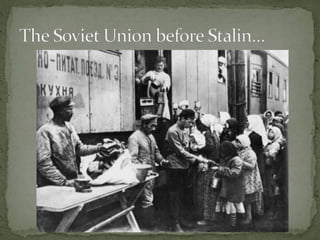
 Lack of food
 Lack of industry (i.e. backward farming country)
 Isolated by the rest of the world because of its
Communist government
An extract from an official Soviet document in the
1920s
The revolution’s goal is to make men brothers. The
revolution wants to build big houses where the kitchen,
dining room, laundry and nursery would be built
according to the latest scientific methods and serve
all the residents of the house-commune, who would
live in comfortable, clean rooms with running water
and electricity.
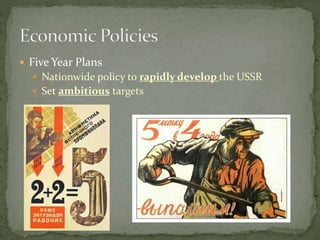
 Five Year Plans
 Nationwide policy to rapidly develop the USSR
 Set ambitious targets
Collectivisation
&
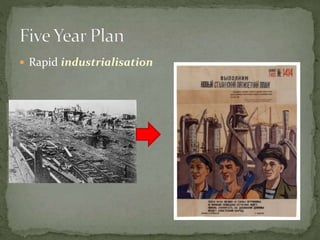
Rapid industrialisation
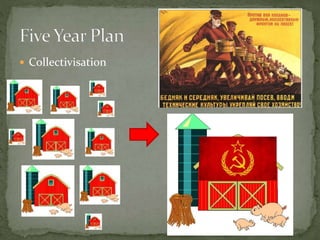
 Collectivisation
 Collectivisation
 Merger of small farms owned by individuals
INTO
 A single large farm owned by the state (called a
kolkhoz)
 Collectivised farms owned by the State
 State provided machinery (e.g. tractors) for farming
 State set high targets for crops produced
 Working hours & wages were also fixed by the state
 Harsh punishments were given out to those who were
absent or could not meet targets
Impact?
 Wealthy farmers (called kulaks) strongly opposed
collectivisation
 Many of them preferred to burn their crops and kill
their animals rather than hand them over
 Grain harvest fell significantly  Great Famine
(1932-3) where millions of peasants died
however…
 Increased manpower for industrialisation as
peasants moved to the cities
 Rapid industrialisation
Rapid industrialisation
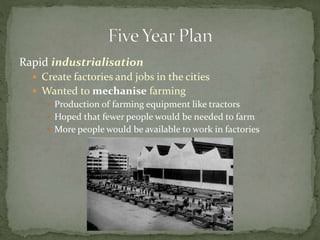
 Create factories and jobs in the cities
 Wanted to mechanise farming
 Production of farming equipment like tractors
 Hoped that fewer people would be needed to farm
 More people would be available to work in factories
Rapid industrialisation
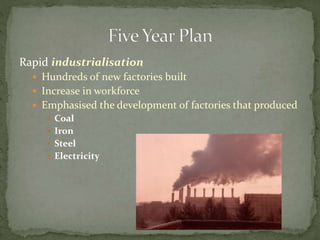
 Hundreds of new factories built
 Increase in workforce
 Emphasised the development of factories that produced
 Coal
 Iron
 Steel
 Electricity
Stalin’s Soviet Union - Economic Impact

Stalin’s Soviet Union - Economic Impact

  • 3.
     What didStalin do after he took control?  What was Stalin’s Soviet Union like?
  • 5.
     Lack offood  Lack of industry (i.e. backward farming country)  Isolated by the rest of the world because of its Communist government
  • 6.
    An extract froman official Soviet document in the 1920s The revolution’s goal is to make men brothers. The revolution wants to build big houses where the kitchen, dining room, laundry and nursery would be built according to the latest scientific methods and serve all the residents of the house-commune, who would live in comfortable, clean rooms with running water and electricity.
  • 8.
     Five YearPlans  Nationwide policy to rapidly develop the USSR  Set ambitious targets
  • 9.
  • 10.
  • 11.
     Collectivisation  Mergerof small farms owned by individuals INTO  A single large farm owned by the state (called a kolkhoz)  Collectivised farms owned by the State  State provided machinery (e.g. tractors) for farming  State set high targets for crops produced  Working hours & wages were also fixed by the state  Harsh punishments were given out to those who were absent or could not meet targets
  • 12.
    Impact?  Wealthy farmers(called kulaks) strongly opposed collectivisation  Many of them preferred to burn their crops and kill their animals rather than hand them over  Grain harvest fell significantly  Great Famine (1932-3) where millions of peasants died however…  Increased manpower for industrialisation as peasants moved to the cities
  • 13.
  • 14.
    Rapid industrialisation  Createfactories and jobs in the cities  Wanted to mechanise farming  Production of farming equipment like tractors  Hoped that fewer people would be needed to farm  More people would be available to work in factories
  • 15.
    Rapid industrialisation  Hundredsof new factories built  Increase in workforce  Emphasised the development of factories that produced  Coal  Iron  Steel  Electricity