The photograph that
has become known as
"Migrant Mother" is
one of a series of
photographs that
Dorothea Lange made
of Florence Owens
Thompson and her
children in February or
March of 1936 in
Nipomo, California. In
1960, Lange gave this
account of the
experience:
“I saw and approached
the hungry and
desperate mother, as if
drawn by a magnet. I do
not remember how I
explained my presence
or my camera to her, but
I do remember she
asked me no
questions…I did not ask
her name or her history.
She told me her age,
that she was thirty-two.
She said that they had
been living on frozen
vegetables from the..
.. surrounding fields,
and birds that the
children killed.
She had just sold the
tires from her car to
buy food. There she sat
in that lean- to tent with
her children huddled
around her, and seemed
to know that my
pictures might help her,
and so she helped me.
There was a sort of
equality about it.”
(From: Popular
Photography, Feb. 1960).
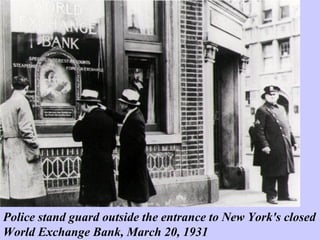
Police stand guard outside the entrance to New York's closed
World Exchange Bank, March 20, 1931
Unemployed men vying for jobs at the American Legion
Employment Bureau in Los Angeles during the Great
Depression.
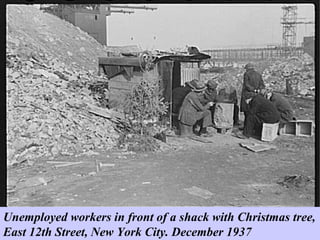
Unemployed workers in front of a shack with Christmas tree,
East 12th Street, New York City. December 1937
Man in hobo jungle killing
turtle to make soup,
Minneapolis, Minnesota.
Sept. 1939.
Hard Times
Unemployment
· By the early 1930’s,
approximately 25% of the
nation was unemployed.
· Fathers
and some
children
left home
to find
work.
Families
in Crisis
· Marriage
and birth
rates
dropped.
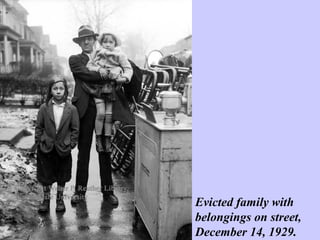
Evicted family with
belongings on street,
December 14, 1929.
· These shacks were
known as Hoovervilles.
Seattle, Washington
Homelessness
· Homeless families built
shacks out of wooden
crates and scrap metal.
Central Park,
New York City
“Hooverville,"
New York City,
December 8
1930
[Sign on shack
reads:
"House of
Unemployed"]
Brother, Can You Spare a Dime? (1932)
They used to tell me I was
building a dream
And so I followed the mob.
When there was earth to plow
or guns to bear,
I was always there, right on
the job.
They used to tell me I was
building a dream
With peace and glory ahead --
Why should I be standing in
line, just waiting for bread?
Once I built a railroad, I
made it run,
Made it race against time.
Once I built a railroad, now
it's done --
Brother, can you spare a
dime?
Once I built a tower, up to
the sun,
brick and rivet and lime.
Once I built a tower, now it's
done --
Brother, can you spare a
dime?
Once in khaki suits, gee, we looked swell
Full of that Yankee Doodle-de-dum.
Half a million boots went slogging through hell,
And I was the kid with the drum.
Say, don't you remember they called me Al,
It was Al all the time.
Why don't you remember, I'm your pal --
Say, buddy, can you spare a dime?
Hoover Takes Action • At first,
President
Hoover was
against
offering
direct
government
relief.
• Instead, he
asked private
charities,
such as the
YMCA, to
help.
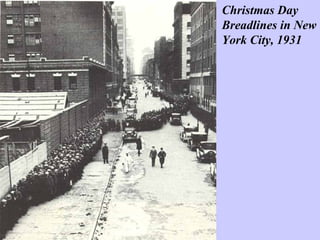
Christmas Day
Breadlines in New
York City, 1931
• Hoover eventually set up public works programs, where the
government hired people to construct schools, dams and
highways. Ex.) Hoover Dam
The Hoover Dam
Des Moines Register,
April 5, 1930
• Hoover also approved the
Reconstruction Finance
Corporation (RFC), which
loaned money to railroads,
banks, and insurance
companies.
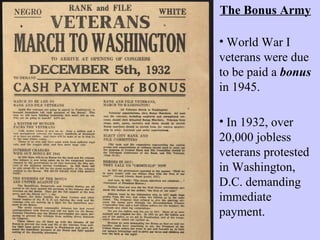
• In 1932, over
20,000 jobless
veterans protested
in Washington,
D.C. demanding
immediate
payment.
• World War I
veterans were due
to be paid a bonus
in 1945.
The Bonus Army
Handpainted sign on Bonus Army truck states: "We Done a
Good Job in France, Now You Do a Good Job in America"
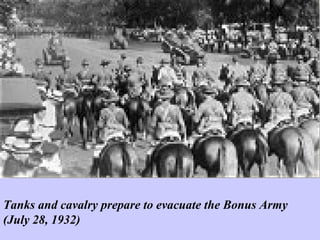
Tanks and cavalry prepare to evacuate the Bonus Army
(July 28, 1932)
The United States Army burned this and similar camps to the
ground after routing the many thousands of protestors that
were camped out in the national capital with tanks, tear gas,
and troops of armed soldiers. (July 28, 1932)
• In clashes with police, four veterans were killed.
* The brutal treatment of the Bonus Army lowered Hoover’s
popularity even further. The nation was poised for a new
leader to lead them out of the depression.
• Hoover ordered General Douglas MacArthur to clear out the
veterans using cavalry, tanks, tear gas and machine guns.

Great Depression

  • 1.
    The photograph that hasbecome known as "Migrant Mother" is one of a series of photographs that Dorothea Lange made of Florence Owens Thompson and her children in February or March of 1936 in Nipomo, California. In 1960, Lange gave this account of the experience:
  • 2.
    “I saw andapproached the hungry and desperate mother, as if drawn by a magnet. I do not remember how I explained my presence or my camera to her, but I do remember she asked me no questions…I did not ask her name or her history. She told me her age, that she was thirty-two. She said that they had been living on frozen vegetables from the..
  • 3.
    .. surrounding fields, andbirds that the children killed. She had just sold the tires from her car to buy food. There she sat in that lean- to tent with her children huddled around her, and seemed to know that my pictures might help her, and so she helped me. There was a sort of equality about it.” (From: Popular Photography, Feb. 1960).
  • 4.
    Police stand guardoutside the entrance to New York's closed World Exchange Bank, March 20, 1931
  • 5.
    Unemployed men vyingfor jobs at the American Legion Employment Bureau in Los Angeles during the Great Depression.
  • 6.
    Unemployed workers infront of a shack with Christmas tree, East 12th Street, New York City. December 1937
  • 8.
    Man in hobojungle killing turtle to make soup, Minneapolis, Minnesota. Sept. 1939. Hard Times Unemployment · By the early 1930’s, approximately 25% of the nation was unemployed.
  • 9.
    · Fathers and some children lefthome to find work. Families in Crisis · Marriage and birth rates dropped.
  • 10.
    Evicted family with belongingson street, December 14, 1929.
  • 11.
    · These shackswere known as Hoovervilles. Seattle, Washington Homelessness · Homeless families built shacks out of wooden crates and scrap metal.
  • 12.
  • 14.
    “Hooverville," New York City, December8 1930 [Sign on shack reads: "House of Unemployed"]
  • 15.
    Brother, Can YouSpare a Dime? (1932) They used to tell me I was building a dream And so I followed the mob. When there was earth to plow or guns to bear, I was always there, right on the job. They used to tell me I was building a dream With peace and glory ahead -- Why should I be standing in line, just waiting for bread? Once I built a railroad, I made it run, Made it race against time. Once I built a railroad, now it's done -- Brother, can you spare a dime? Once I built a tower, up to the sun, brick and rivet and lime. Once I built a tower, now it's done -- Brother, can you spare a dime?
  • 16.
    Once in khakisuits, gee, we looked swell Full of that Yankee Doodle-de-dum. Half a million boots went slogging through hell, And I was the kid with the drum. Say, don't you remember they called me Al, It was Al all the time. Why don't you remember, I'm your pal -- Say, buddy, can you spare a dime?
  • 17.
    Hoover Takes Action• At first, President Hoover was against offering direct government relief. • Instead, he asked private charities, such as the YMCA, to help.
  • 18.
    Christmas Day Breadlines inNew York City, 1931
  • 20.
    • Hoover eventuallyset up public works programs, where the government hired people to construct schools, dams and highways. Ex.) Hoover Dam
  • 21.
  • 22.
    Des Moines Register, April5, 1930 • Hoover also approved the Reconstruction Finance Corporation (RFC), which loaned money to railroads, banks, and insurance companies.
  • 24.
    • In 1932,over 20,000 jobless veterans protested in Washington, D.C. demanding immediate payment. • World War I veterans were due to be paid a bonus in 1945. The Bonus Army
  • 27.
    Handpainted sign onBonus Army truck states: "We Done a Good Job in France, Now You Do a Good Job in America"
  • 29.
    Tanks and cavalryprepare to evacuate the Bonus Army (July 28, 1932)
  • 30.
    The United StatesArmy burned this and similar camps to the ground after routing the many thousands of protestors that were camped out in the national capital with tanks, tear gas, and troops of armed soldiers. (July 28, 1932)
  • 31.
    • In clasheswith police, four veterans were killed. * The brutal treatment of the Bonus Army lowered Hoover’s popularity even further. The nation was poised for a new leader to lead them out of the depression. • Hoover ordered General Douglas MacArthur to clear out the veterans using cavalry, tanks, tear gas and machine guns.