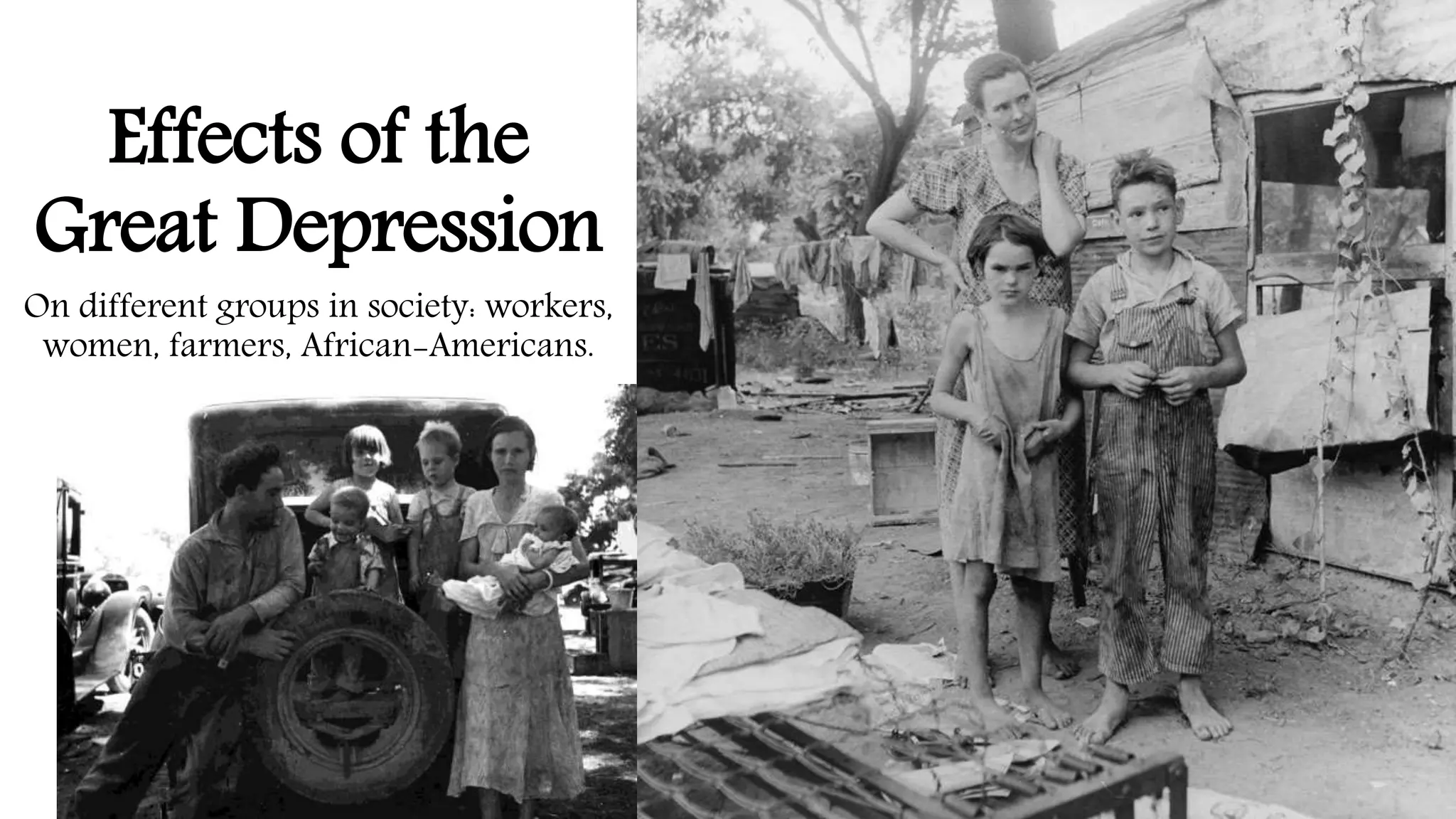
Effects of the
Great Depression
On different groups in society: workers,
women, farmers, African-Americans.
Workers
• 1931 - The unemployment rate rose to
15.9%
• 1932 - Hoover signed the Revenue Act. It
increased the top income tax rate to
63%. Higher taxes worsened the
Depression.
• Many people were out of work and lost
savings.
• Many middle-aged people no longer had
jobs and younger people were favoured.
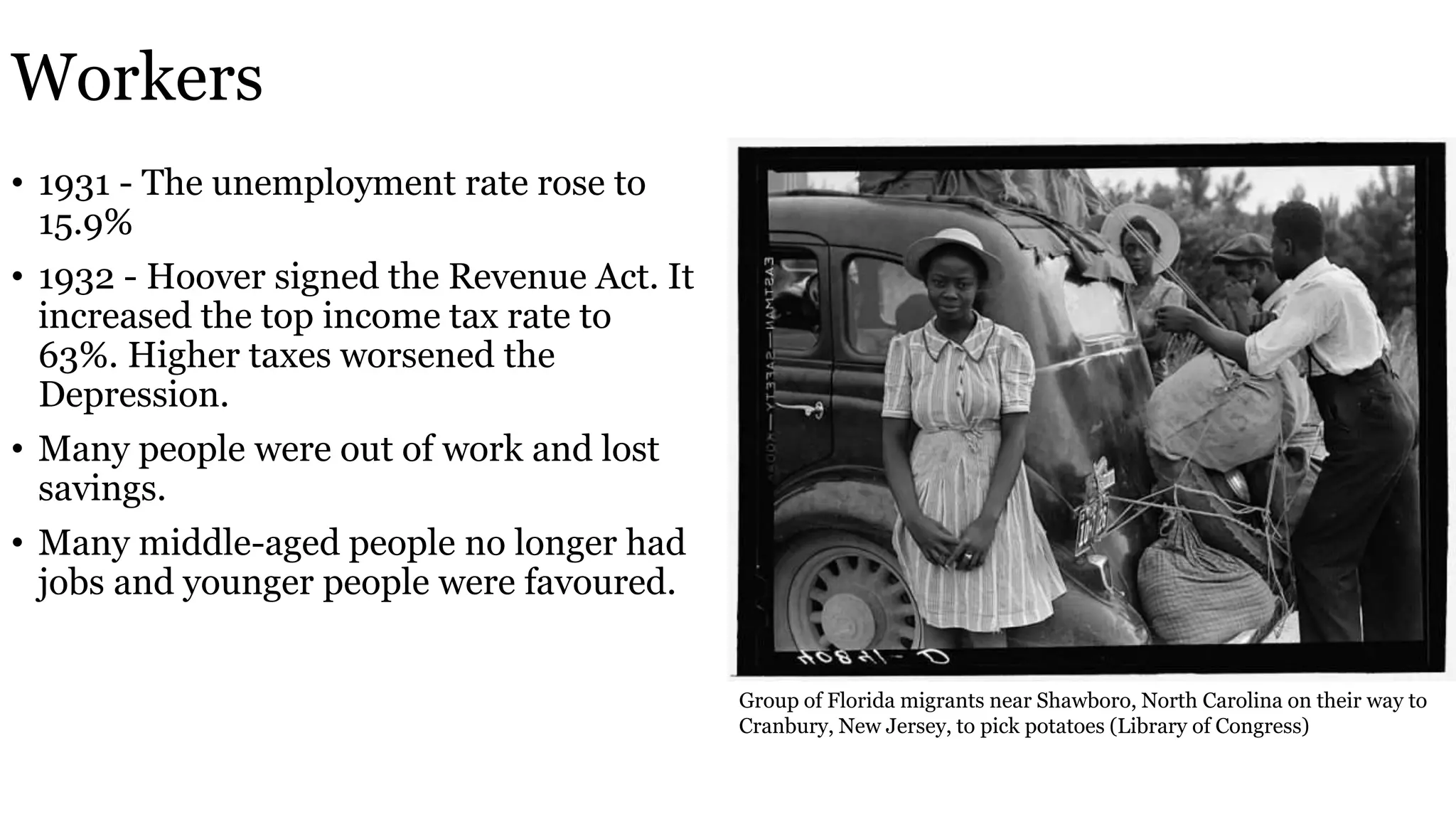
Group of Florida migrants near Shawboro, North Carolina on their way to
Cranbury, New Jersey, to pick potatoes (Library of Congress)
• 1933 - FDR launched the New Deal with
the Emergency Banking Act. It closed all U.S.
U.S. banks to stop devastating failures.
• The Civil Works Administration created 4
million construction jobs.
• 1935 - The Supreme Court declared
the National Industrial Recovery Act
unconstitutional. FDR launched
more programs focused on the poor, the
unemployed, and farmers.
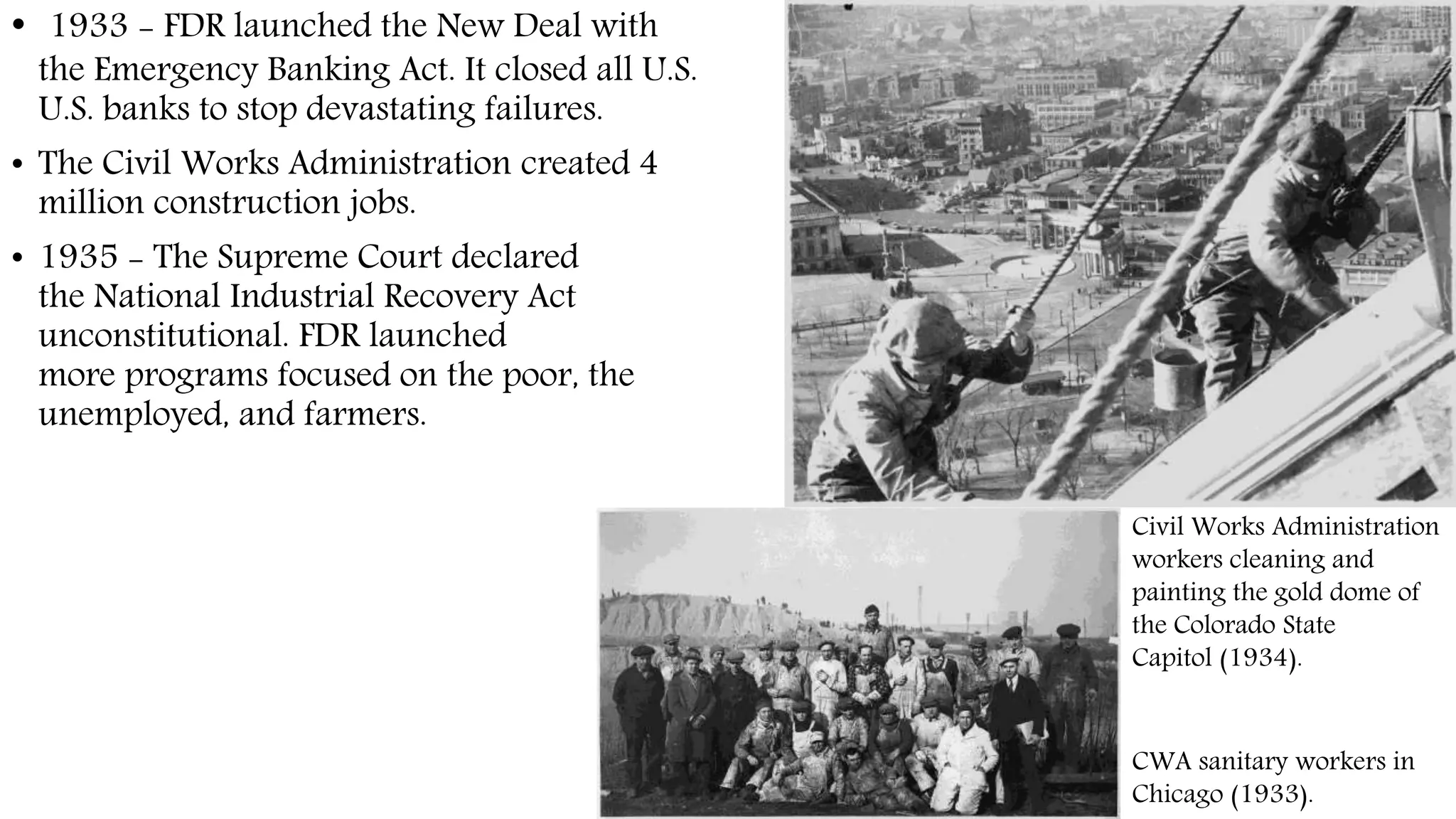
Civil Works Administration
workers cleaning and
painting the gold dome of
the Colorado State
Capitol (1934).
CWA sanitary workers in
Chicago (1933).
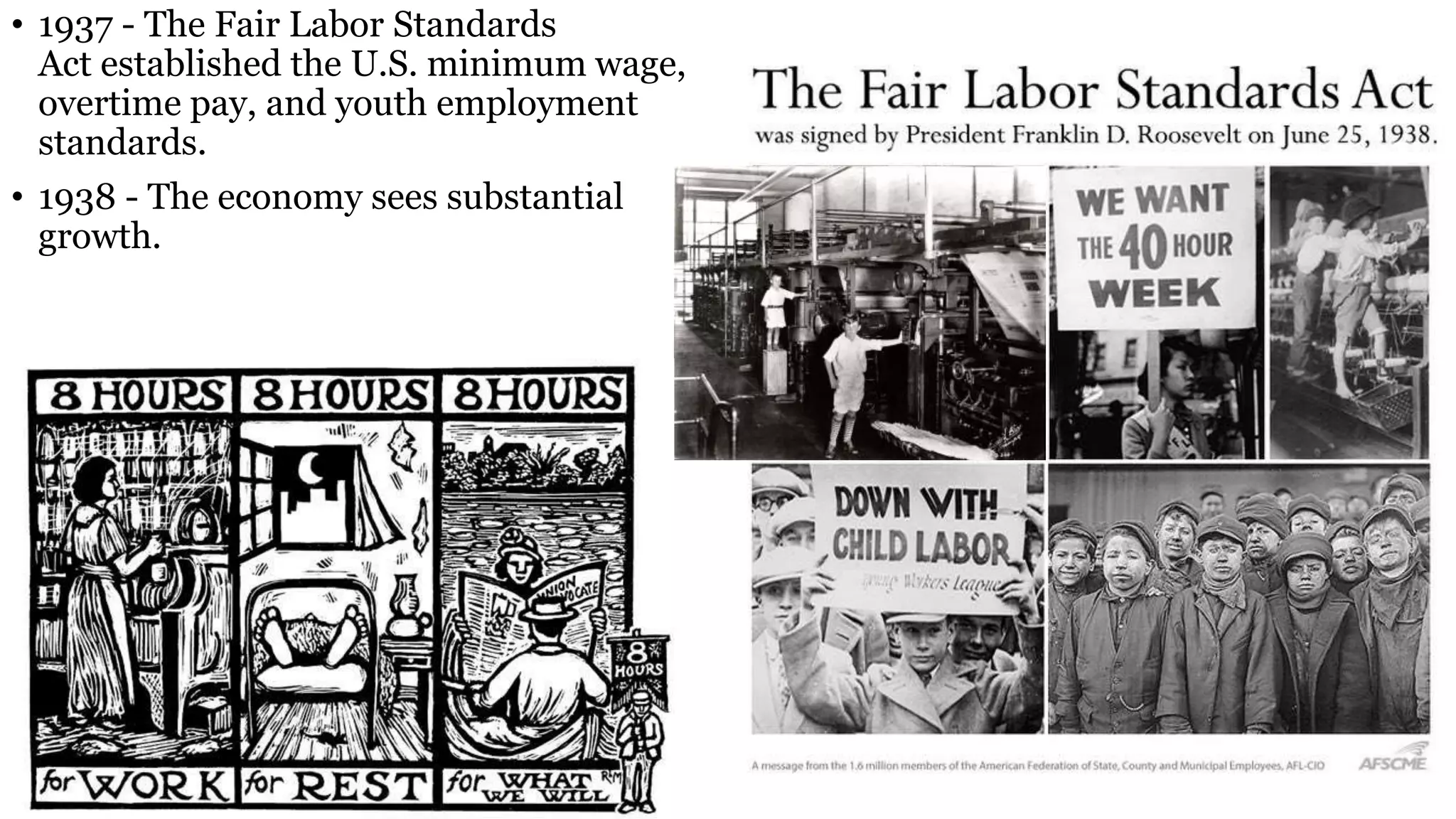
• 1937 - The Fair Labor Standards
Act established the U.S. minimum wage,
overtime pay, and youth employment
standards.
• 1938 - The economy sees substantial
growth.
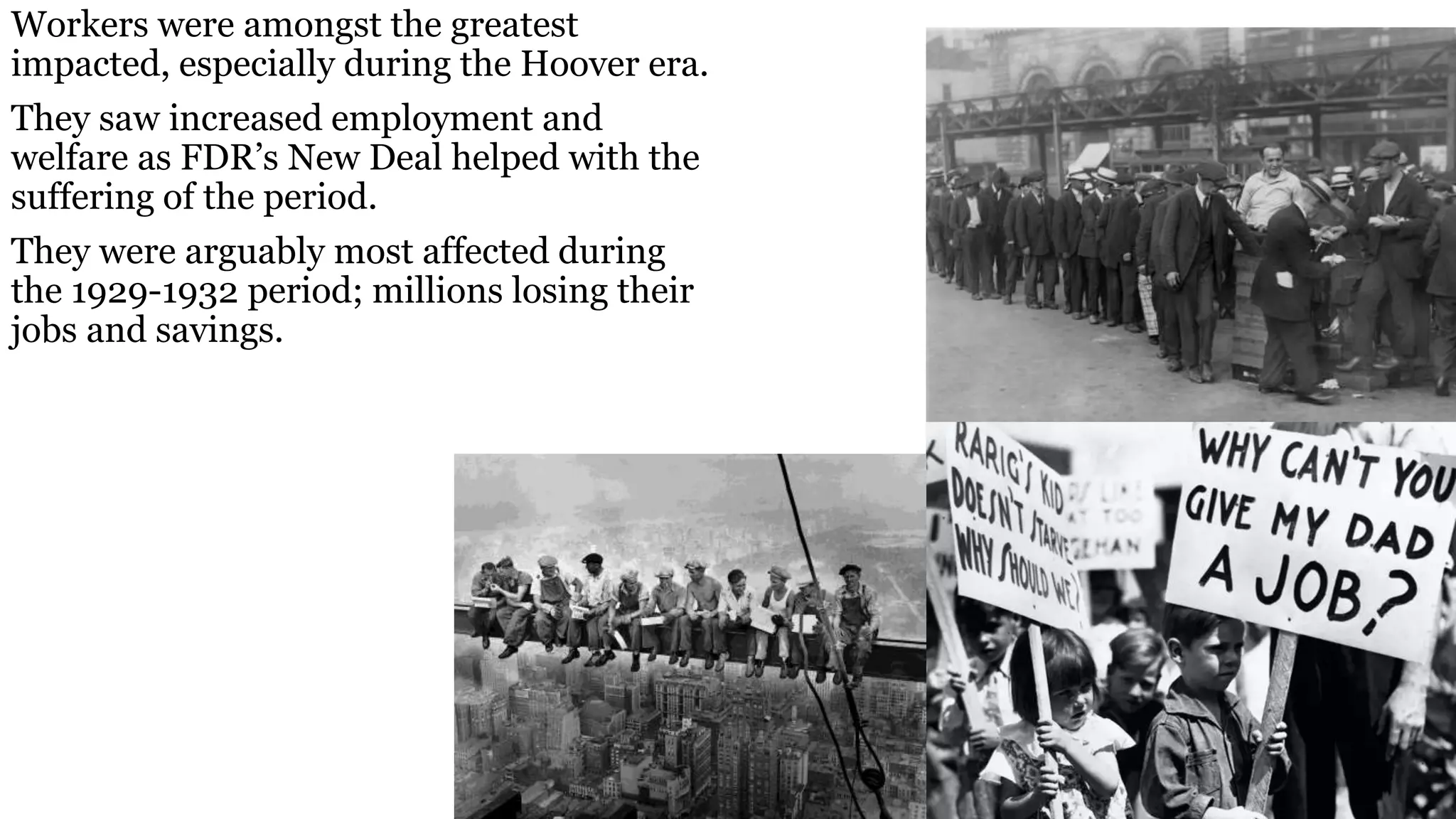
Workers were amongst the greatest
impacted, especially during the Hoover era.
They saw increased employment and
welfare as FDR’s New Deal helped with the
suffering of the period.
They were arguably most affected during
the 1929-1932 period; millions losing their
jobs and savings.
Women
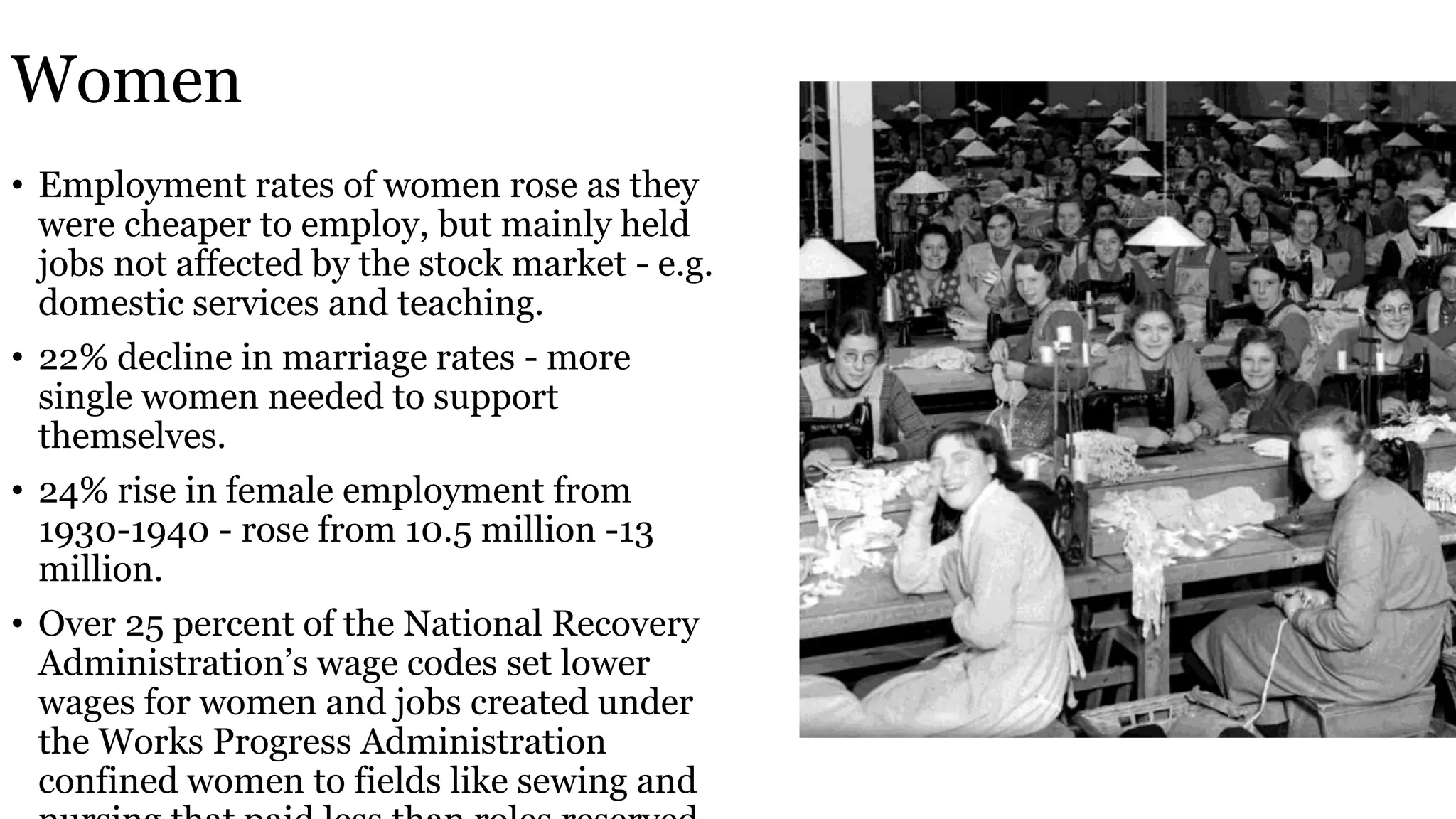
• Employment rates of women rose as they
were cheaper to employ, but mainly held
jobs not affected by the stock market - e.g.
domestic services and teaching.
• 22% decline in marriage rates - more
single women needed to support
themselves.
• 24% rise in female employment from
1930-1940 - rose from 10.5 million -13
million.
• Over 25 percent of the National Recovery
Administration’s wage codes set lower
wages for women and jobs created under
the Works Progress Administration
confined women to fields like sewing and
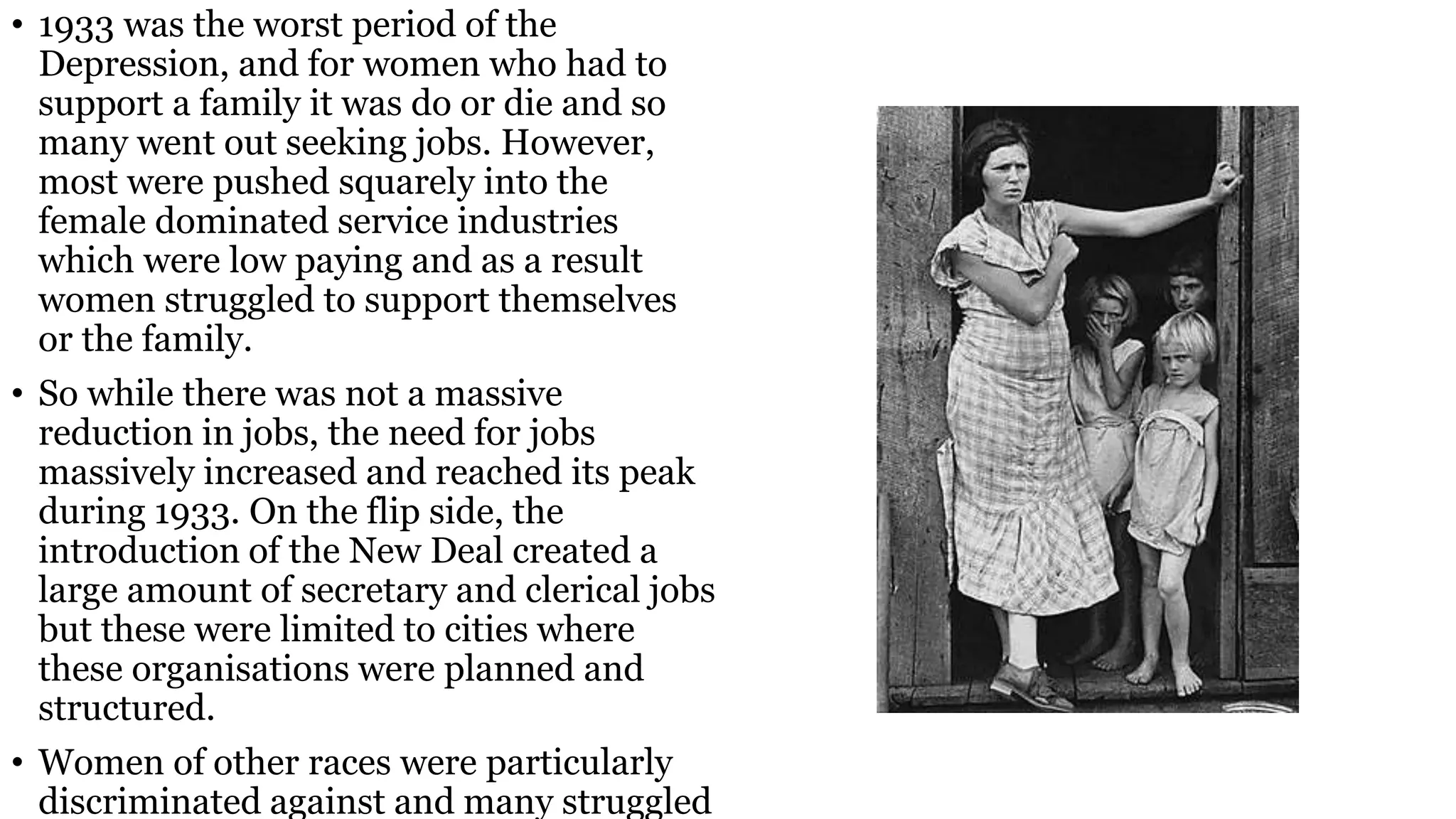
• 1933 was the worst period of the
Depression, and for women who had to
support a family it was do or die and so
many went out seeking jobs. However,
most were pushed squarely into the
female dominated service industries
which were low paying and as a result
women struggled to support themselves
or the family.
• So while there was not a massive
reduction in jobs, the need for jobs
massively increased and reached its peak
during 1933. On the flip side, the
introduction of the New Deal created a
large amount of secretary and clerical jobs
but these were limited to cities where
these organisations were planned and
structured.
• Women of other races were particularly
discriminated against and many struggled
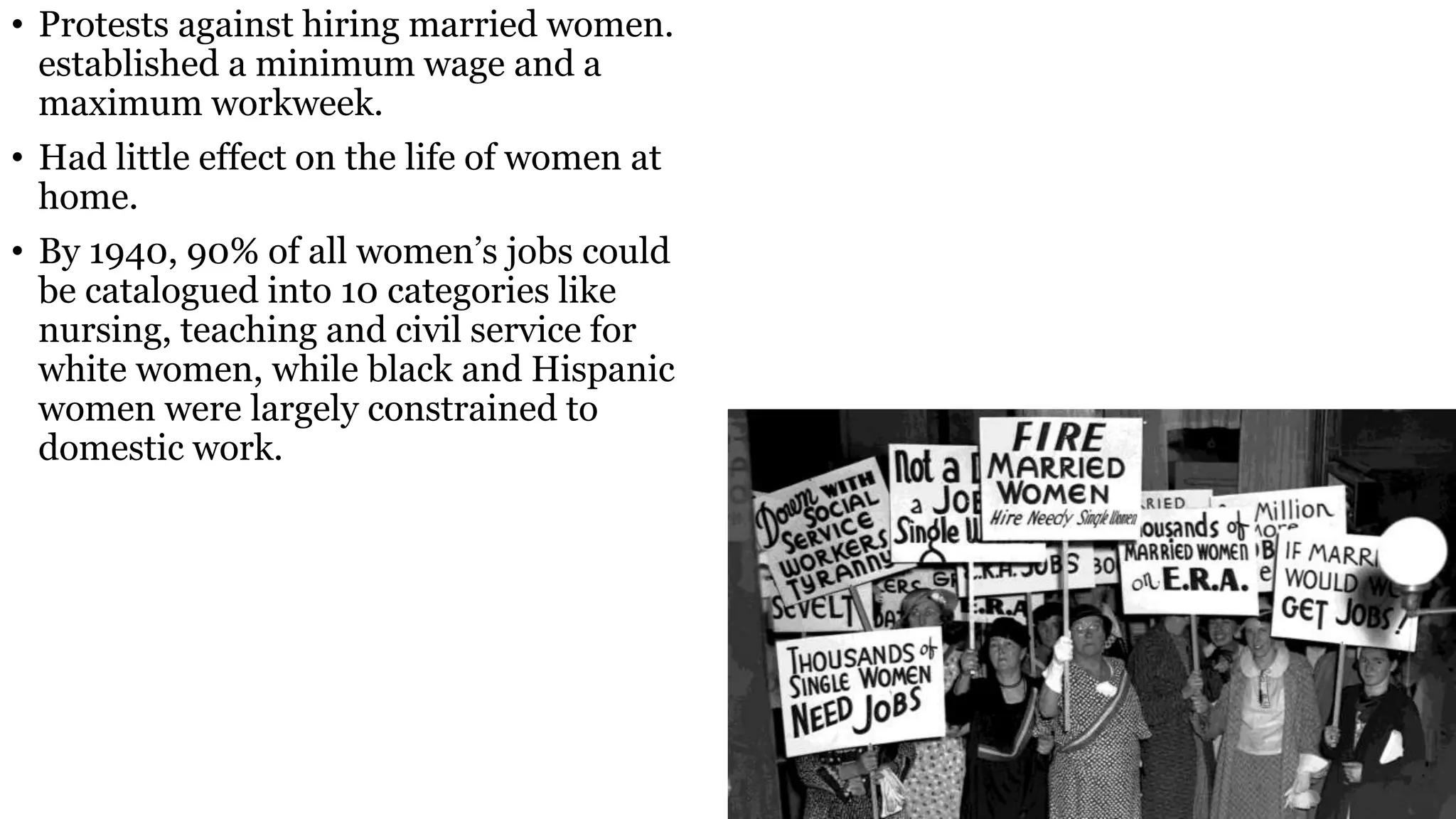
• Protests against hiring married women.
established a minimum wage and a
maximum workweek.
• Had little effect on the life of women at
home.
• By 1940, 90% of all women’s jobs could
be catalogued into 10 categories like
nursing, teaching and civil service for
white women, while black and Hispanic
women were largely constrained to
domestic work.
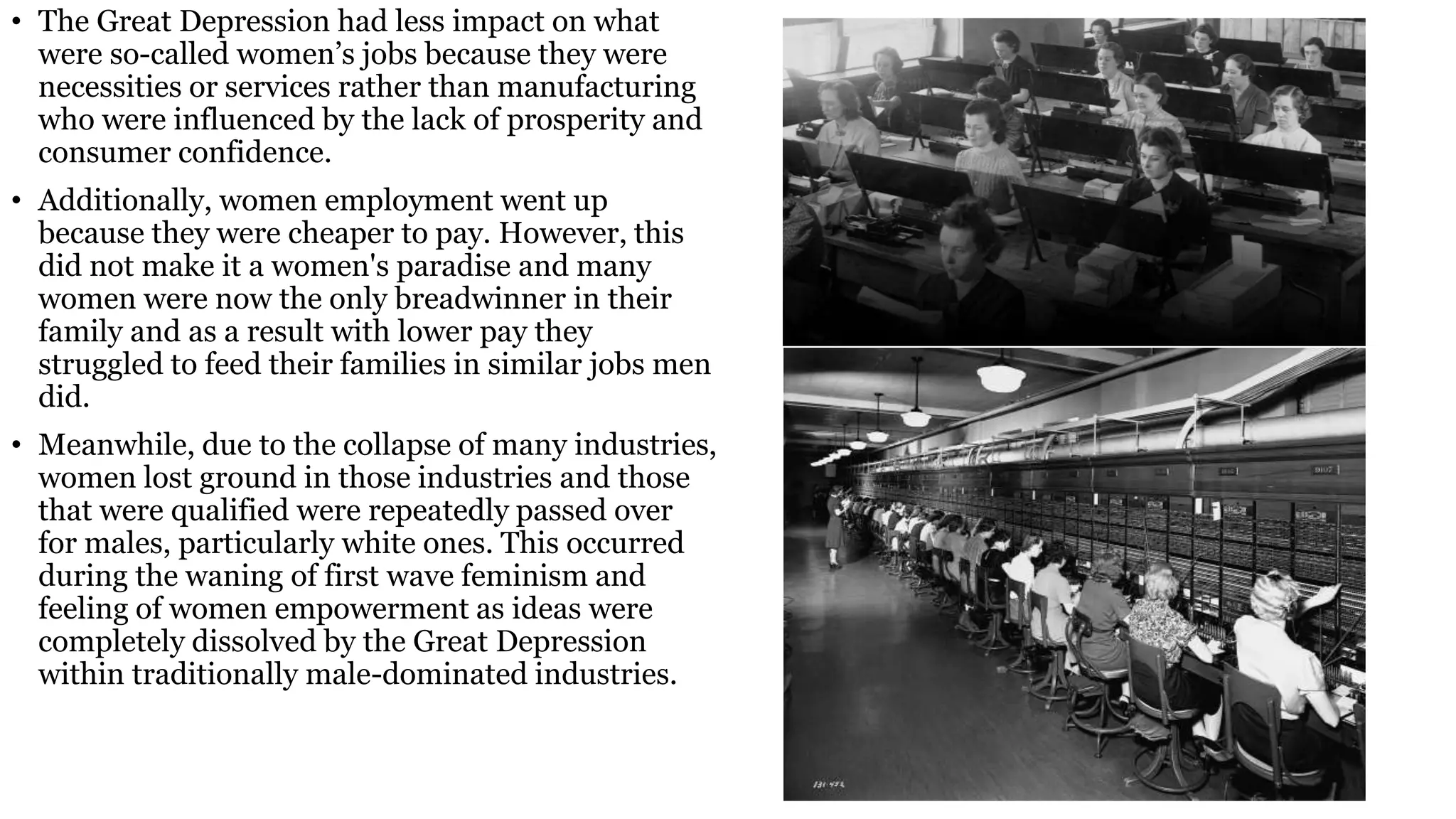
• The Great Depression had less impact on what
were so-called women’s jobs because they were
necessities or services rather than manufacturing
who were influenced by the lack of prosperity and
consumer confidence.
• Additionally, women employment went up
because they were cheaper to pay. However, this
did not make it a women's paradise and many
women were now the only breadwinner in their
family and as a result with lower pay they
struggled to feed their families in similar jobs men
did.
• Meanwhile, due to the collapse of many industries,
women lost ground in those industries and those
that were qualified were repeatedly passed over
for males, particularly white ones. This occurred
during the waning of first wave feminism and
feeling of women empowerment as ideas were
completely dissolved by the Great Depression
within traditionally male-dominated industries.
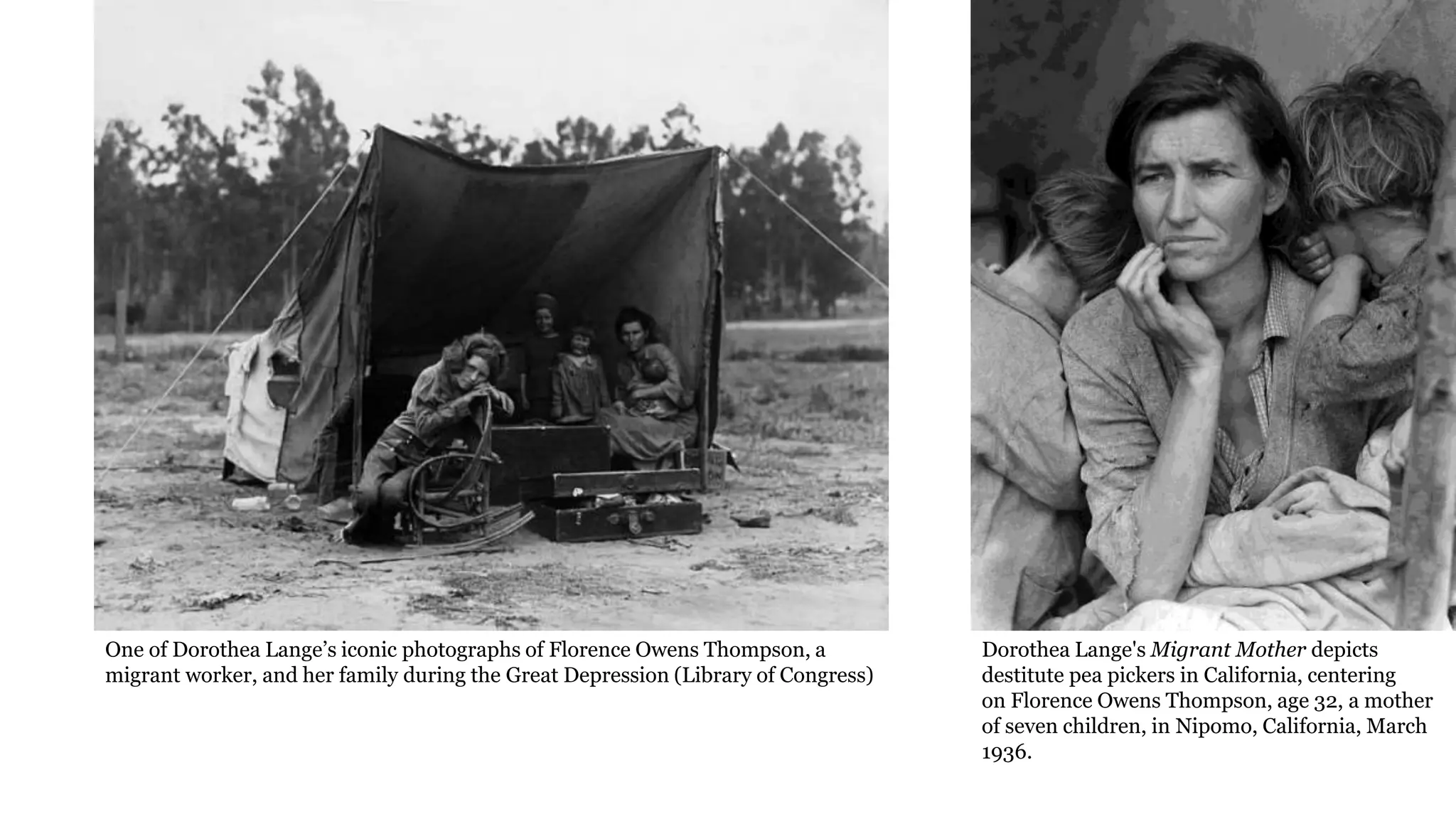
One of Dorothea Lange’s iconic photographs of Florence Owens Thompson, a
migrant worker, and her family during the Great Depression (Library of Congress)
Dorothea Lange's Migrant Mother depicts
destitute pea pickers in California, centering
on Florence Owens Thompson, age 32, a mother
of seven children, in Nipomo, California, March
1936.
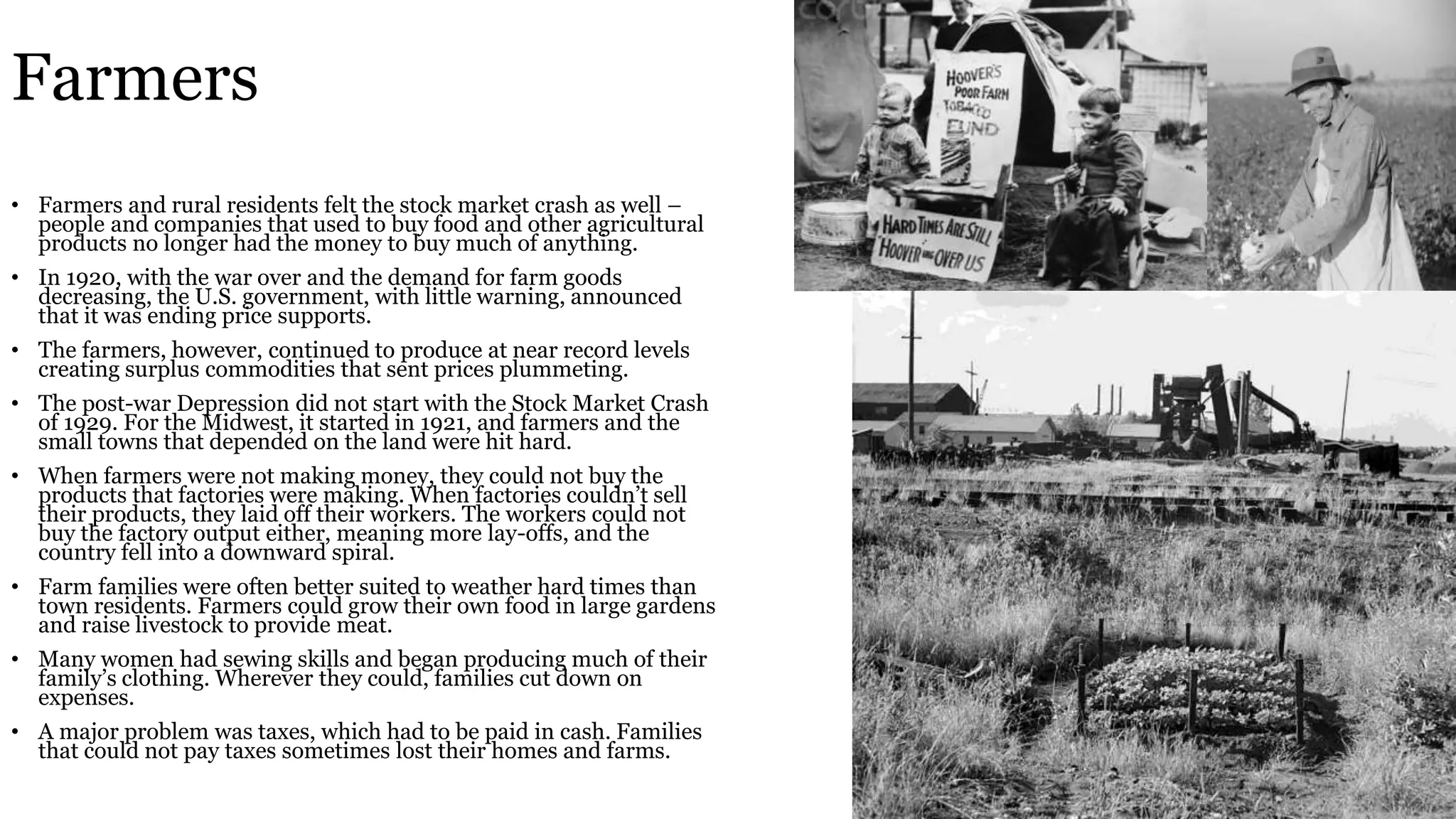
Farmers
• Farmers and rural residents felt the stock market crash as well –
people and companies that used to buy food and other agricultural
products no longer had the money to buy much of anything.
• In 1920, with the war over and the demand for farm goods
decreasing, the U.S. government, with little warning, announced
that it was ending price supports.
• The farmers, however, continued to produce at near record levels
creating surplus commodities that sent prices plummeting.
• The post-war Depression did not start with the Stock Market Crash
of 1929. For the Midwest, it started in 1921, and farmers and the
small towns that depended on the land were hit hard.
• When farmers were not making money, they could not buy the
products that factories were making. When factories couldn’t sell
their products, they laid off their workers. The workers could not
buy the factory output either, meaning more lay-offs, and the
country fell into a downward spiral.
• Farm families were often better suited to weather hard times than
town residents. Farmers could grow their own food in large gardens
and raise livestock to provide meat.
• Many women had sewing skills and began producing much of their
family’s clothing. Wherever they could, families cut down on
expenses.
• A major problem was taxes, which had to be paid in cash. Families
that could not pay taxes sometimes lost their homes and farms.
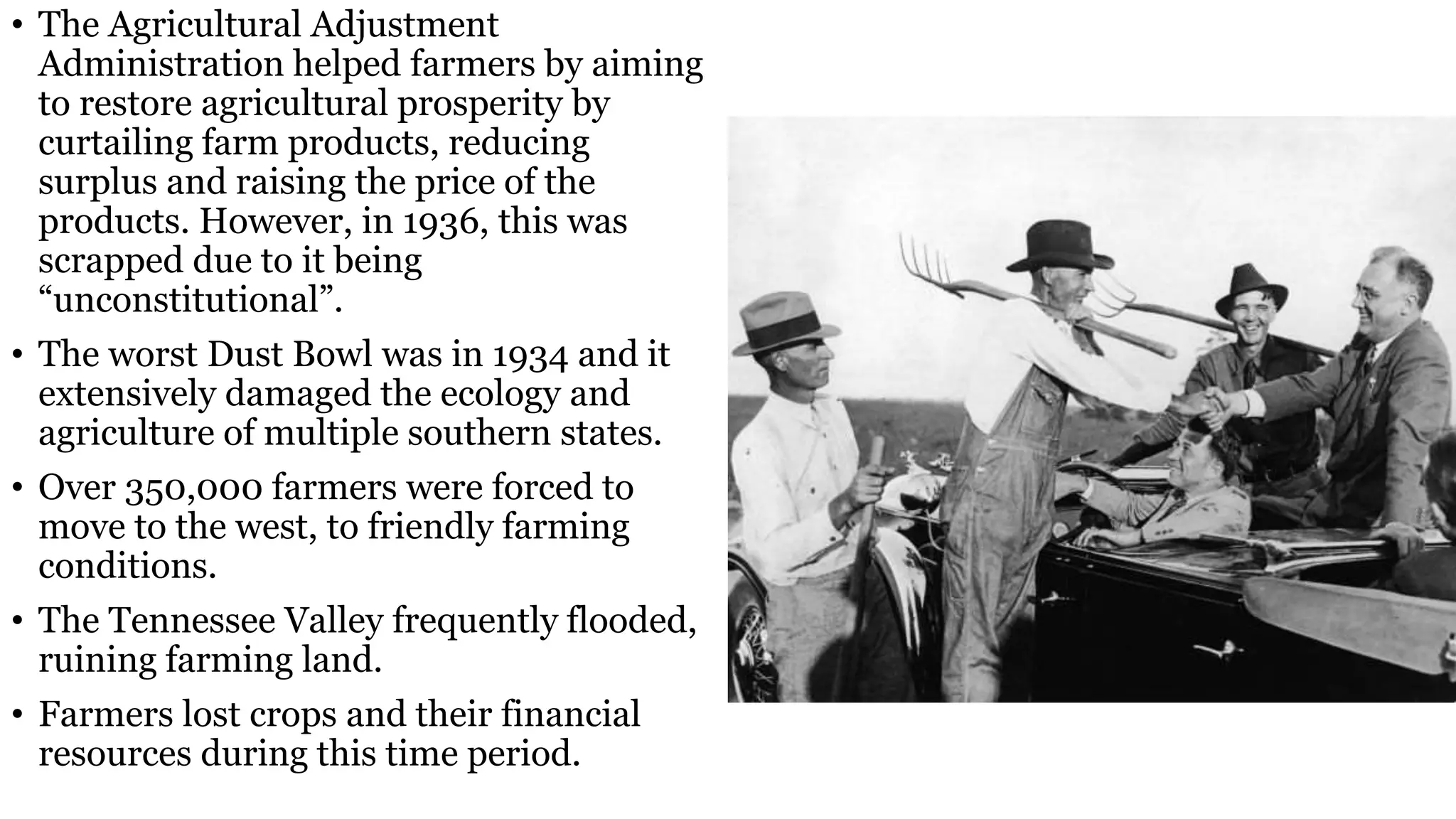
• The Agricultural Adjustment
Administration helped farmers by aiming
to restore agricultural prosperity by
curtailing farm products, reducing
surplus and raising the price of the
products. However, in 1936, this was
scrapped due to it being
“unconstitutional”.
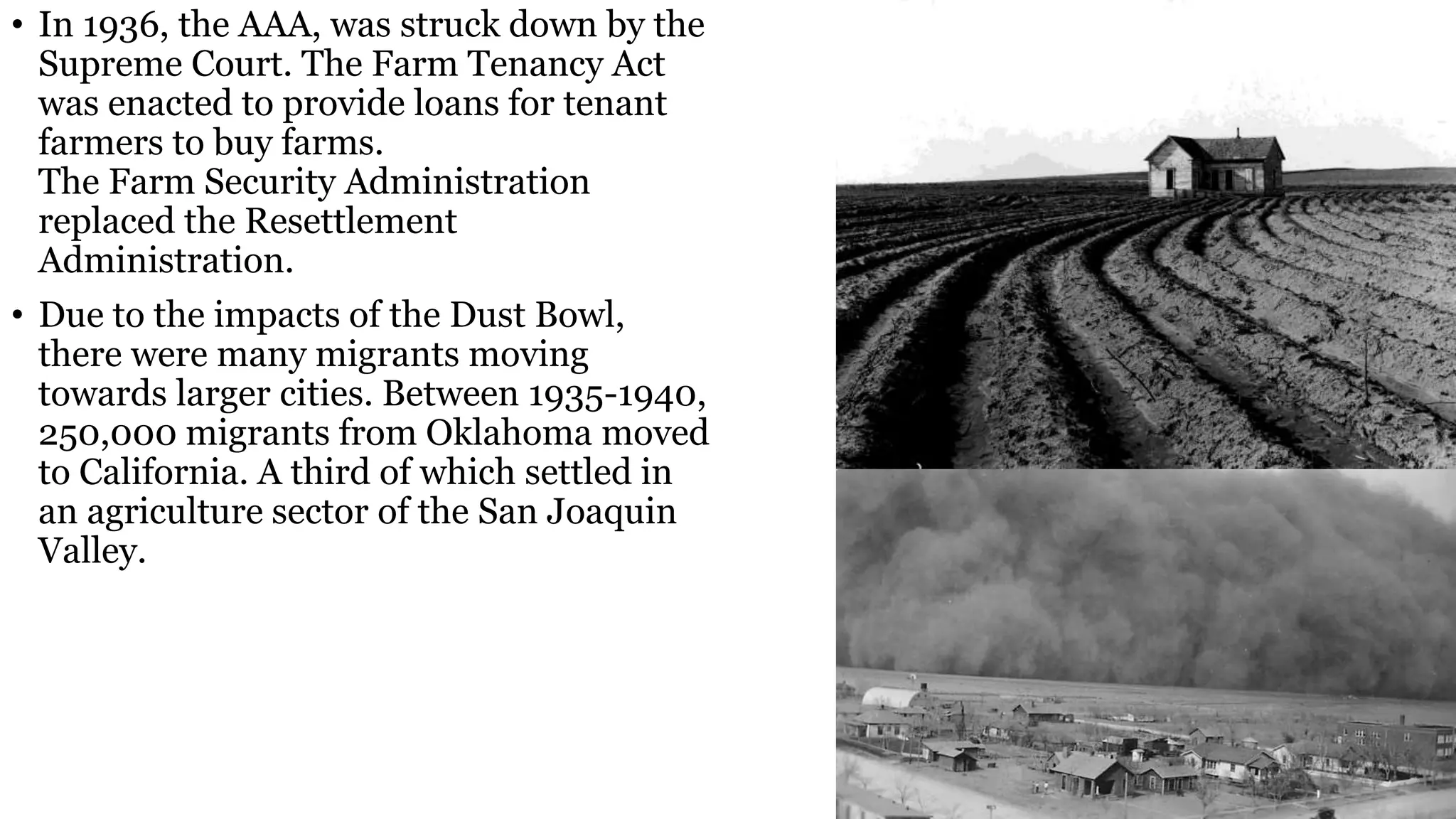
• The worst Dust Bowl was in 1934 and it
extensively damaged the ecology and
agriculture of multiple southern states.
• Over 350,000 farmers were forced to
move to the west, to friendly farming
conditions.
• The Tennessee Valley frequently flooded,
ruining farming land.
• Farmers lost crops and their financial
resources during this time period.
• In 1936, the AAA, was struck down by the
Supreme Court. The Farm Tenancy Act
was enacted to provide loans for tenant
farmers to buy farms.
The Farm Security Administration
replaced the Resettlement
Administration.
• Due to the impacts of the Dust Bowl,
there were many migrants moving
towards larger cities. Between 1935-1940,
250,000 migrants from Oklahoma moved
to California. A third of which settled in
an agriculture sector of the San Joaquin
Valley.
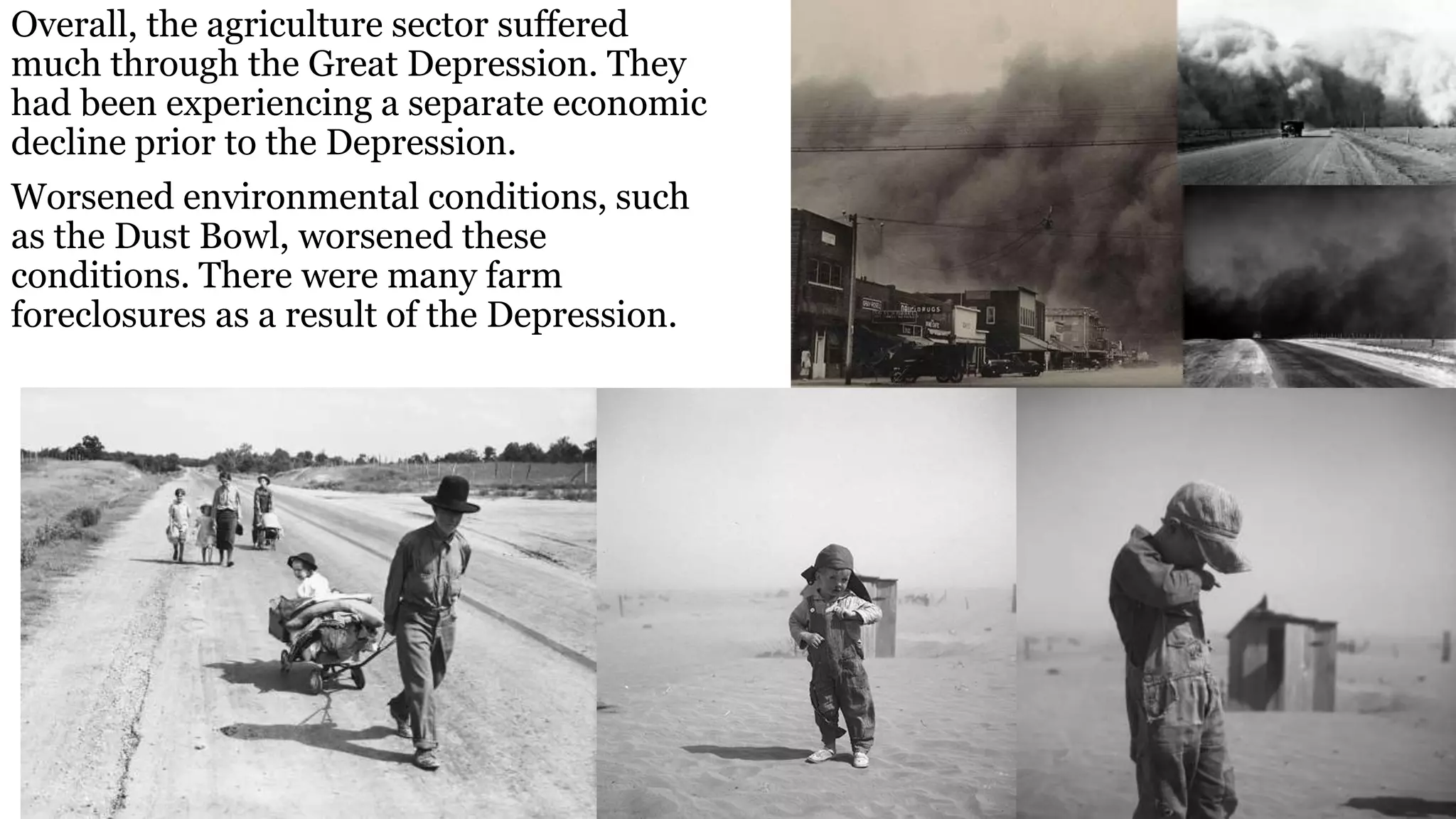
Overall, the agriculture sector suffered
much through the Great Depression. They
had been experiencing a separate economic
decline prior to the Depression.
Worsened environmental conditions, such
as the Dust Bowl, worsened these
conditions. There were many farm
foreclosures as a result of the Depression.
African-Americans
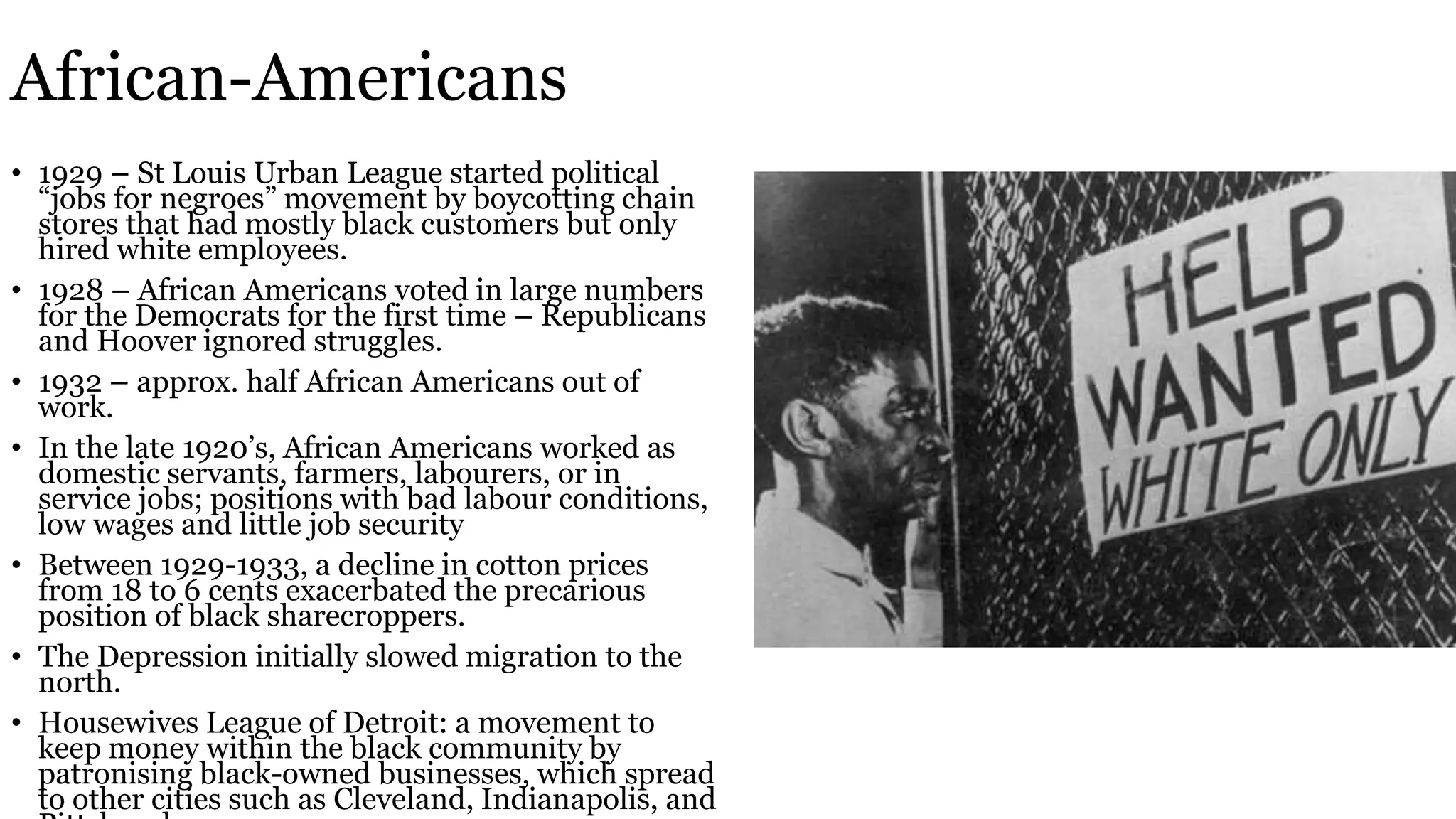
• 1929 – St Louis Urban League started political
“jobs for negroes” movement by boycotting chain
stores that had mostly black customers but only
hired white employees.
• 1928 – African Americans voted in large numbers
for the Democrats for the first time – Republicans
and Hoover ignored struggles.
• 1932 – approx. half African Americans out of
work.
• In the late 1920’s, African Americans worked as
domestic servants, farmers, labourers, or in
service jobs; positions with bad labour conditions,
low wages and little job security
• Between 1929-1933, a decline in cotton prices
from 18 to 6 cents exacerbated the precarious
position of black sharecroppers.
• The Depression initially slowed migration to the
north.
• Housewives League of Detroit: a movement to
keep money within the black community by
patronising black-owned businesses, which spread
to other cities such as Cleveland, Indianapolis, and
• Acceleration of racial conflict - Lynchings
increased from 8 in 1932 to 28 in 1933.
• Throughout the 1930’s, migration
recovered and African Americans
continued to stream north.
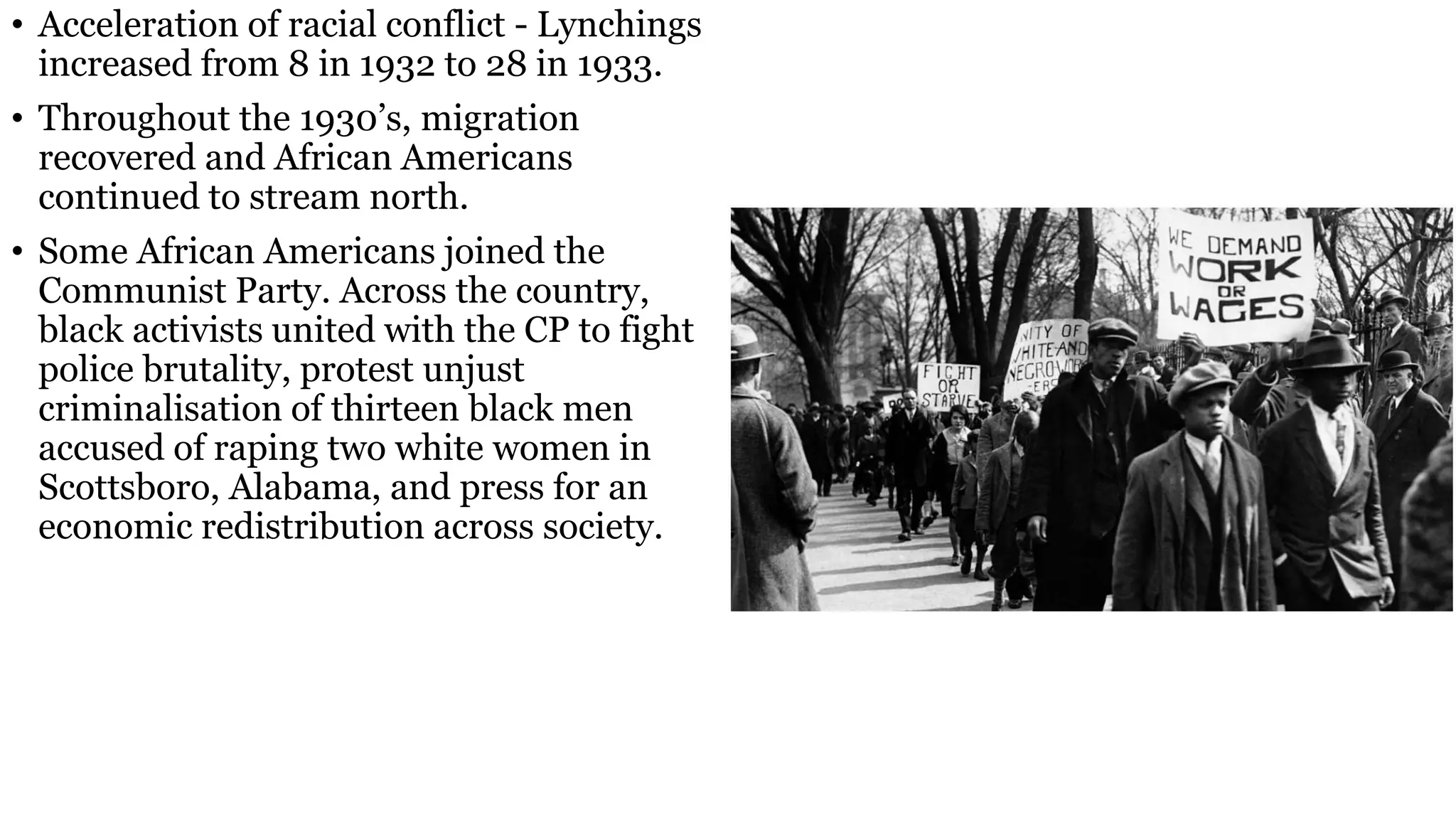
• Some African Americans joined the
Communist Party. Across the country,
black activists united with the CP to fight
police brutality, protest unjust
criminalisation of thirteen black men
accused of raping two white women in
Scottsboro, Alabama, and press for an
economic redistribution across society.
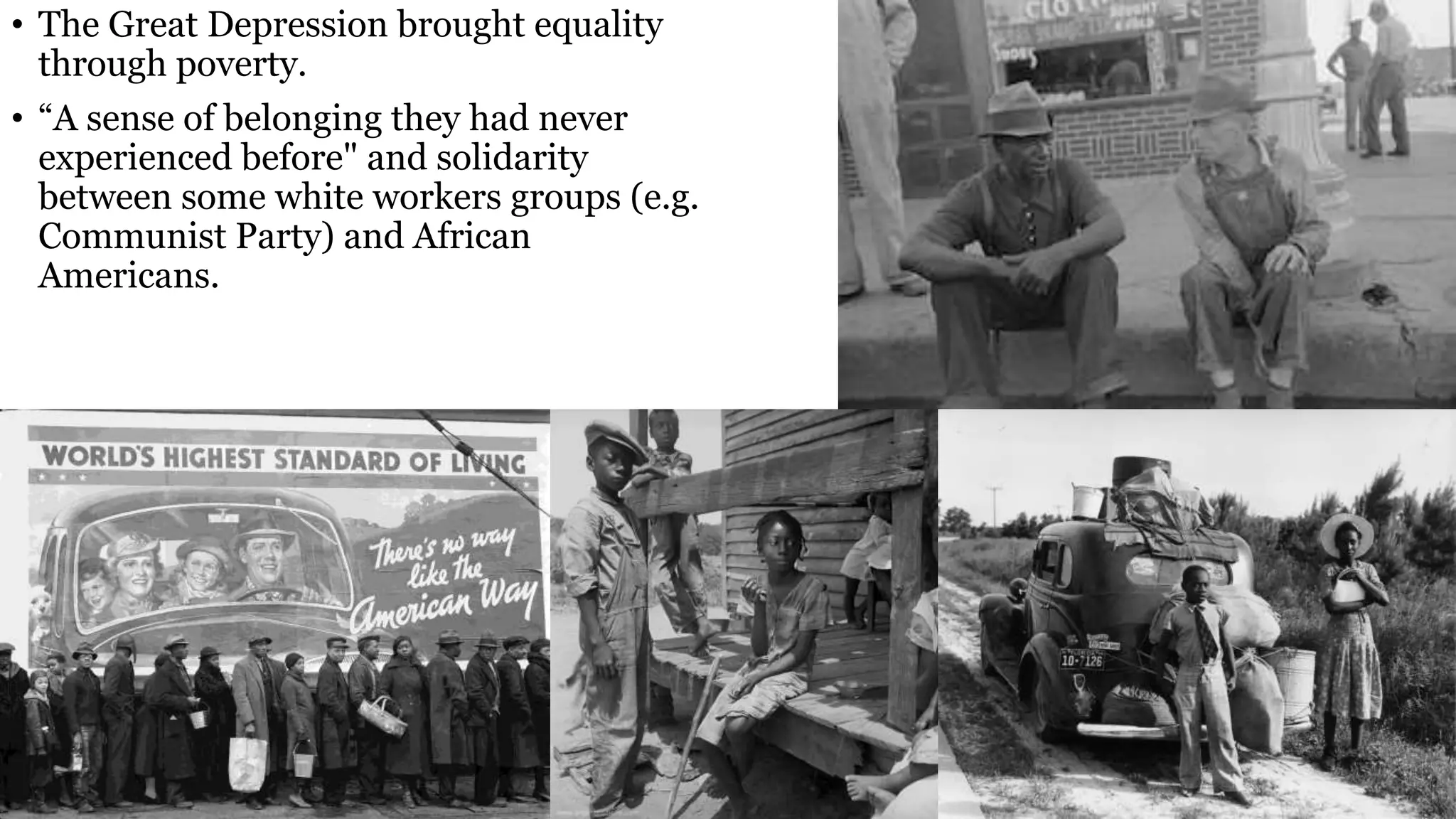
• The Great Depression brought equality
through poverty.
• “A sense of belonging they had never
experienced before" and solidarity
between some white workers groups (e.g.
Communist Party) and African
Americans.
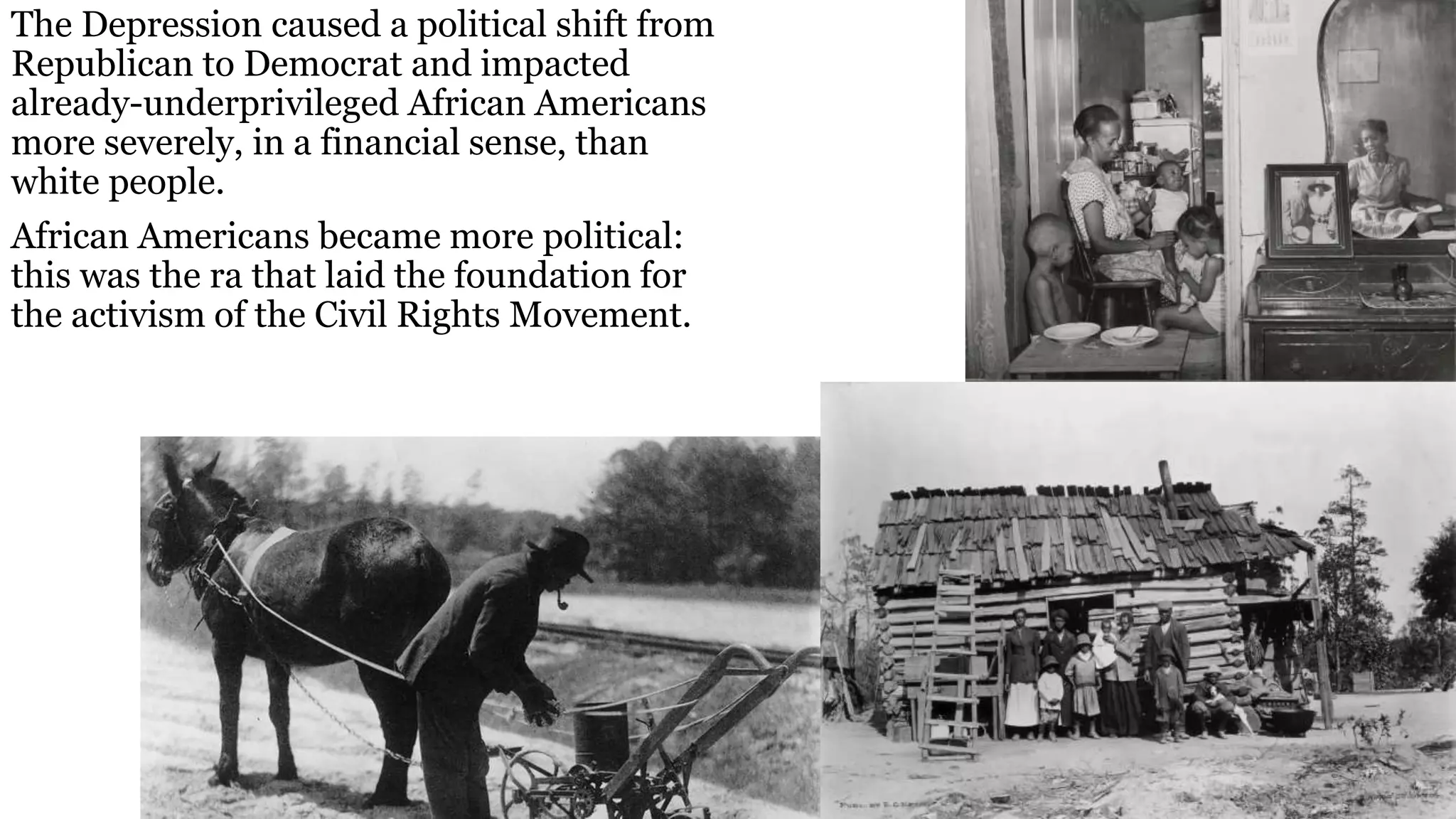
The Depression caused a political shift from
Republican to Democrat and impacted
already-underprivileged African Americans
more severely, in a financial sense, than
white people.
African Americans became more political:
this was the ra that laid the foundation for
the activism of the Civil Rights Movement.
Effects of the Depression on Different Groups in USA.

Effects of the Depression on Different Groups in USA.

  • 1.
    Effects of the GreatDepression On different groups in society: workers, women, farmers, African-Americans.
  • 3.
    Workers • 1931 -The unemployment rate rose to 15.9% • 1932 - Hoover signed the Revenue Act. It increased the top income tax rate to 63%. Higher taxes worsened the Depression. • Many people were out of work and lost savings. • Many middle-aged people no longer had jobs and younger people were favoured. Group of Florida migrants near Shawboro, North Carolina on their way to Cranbury, New Jersey, to pick potatoes (Library of Congress)
  • 4.
    • 1933 -FDR launched the New Deal with the Emergency Banking Act. It closed all U.S. U.S. banks to stop devastating failures. • The Civil Works Administration created 4 million construction jobs. • 1935 - The Supreme Court declared the National Industrial Recovery Act unconstitutional. FDR launched more programs focused on the poor, the unemployed, and farmers. Civil Works Administration workers cleaning and painting the gold dome of the Colorado State Capitol (1934). CWA sanitary workers in Chicago (1933).
  • 5.
    • 1937 -The Fair Labor Standards Act established the U.S. minimum wage, overtime pay, and youth employment standards. • 1938 - The economy sees substantial growth.
  • 6.
    Workers were amongstthe greatest impacted, especially during the Hoover era. They saw increased employment and welfare as FDR’s New Deal helped with the suffering of the period. They were arguably most affected during the 1929-1932 period; millions losing their jobs and savings.
  • 7.
    Women • Employment ratesof women rose as they were cheaper to employ, but mainly held jobs not affected by the stock market - e.g. domestic services and teaching. • 22% decline in marriage rates - more single women needed to support themselves. • 24% rise in female employment from 1930-1940 - rose from 10.5 million -13 million. • Over 25 percent of the National Recovery Administration’s wage codes set lower wages for women and jobs created under the Works Progress Administration confined women to fields like sewing and
  • 8.
    • 1933 wasthe worst period of the Depression, and for women who had to support a family it was do or die and so many went out seeking jobs. However, most were pushed squarely into the female dominated service industries which were low paying and as a result women struggled to support themselves or the family. • So while there was not a massive reduction in jobs, the need for jobs massively increased and reached its peak during 1933. On the flip side, the introduction of the New Deal created a large amount of secretary and clerical jobs but these were limited to cities where these organisations were planned and structured. • Women of other races were particularly discriminated against and many struggled
  • 9.
    • Protests againsthiring married women. established a minimum wage and a maximum workweek. • Had little effect on the life of women at home. • By 1940, 90% of all women’s jobs could be catalogued into 10 categories like nursing, teaching and civil service for white women, while black and Hispanic women were largely constrained to domestic work.
  • 10.
    • The GreatDepression had less impact on what were so-called women’s jobs because they were necessities or services rather than manufacturing who were influenced by the lack of prosperity and consumer confidence. • Additionally, women employment went up because they were cheaper to pay. However, this did not make it a women's paradise and many women were now the only breadwinner in their family and as a result with lower pay they struggled to feed their families in similar jobs men did. • Meanwhile, due to the collapse of many industries, women lost ground in those industries and those that were qualified were repeatedly passed over for males, particularly white ones. This occurred during the waning of first wave feminism and feeling of women empowerment as ideas were completely dissolved by the Great Depression within traditionally male-dominated industries.
  • 11.
    One of DorotheaLange’s iconic photographs of Florence Owens Thompson, a migrant worker, and her family during the Great Depression (Library of Congress) Dorothea Lange's Migrant Mother depicts destitute pea pickers in California, centering on Florence Owens Thompson, age 32, a mother of seven children, in Nipomo, California, March 1936.
  • 12.
    Farmers • Farmers andrural residents felt the stock market crash as well – people and companies that used to buy food and other agricultural products no longer had the money to buy much of anything. • In 1920, with the war over and the demand for farm goods decreasing, the U.S. government, with little warning, announced that it was ending price supports. • The farmers, however, continued to produce at near record levels creating surplus commodities that sent prices plummeting. • The post-war Depression did not start with the Stock Market Crash of 1929. For the Midwest, it started in 1921, and farmers and the small towns that depended on the land were hit hard. • When farmers were not making money, they could not buy the products that factories were making. When factories couldn’t sell their products, they laid off their workers. The workers could not buy the factory output either, meaning more lay-offs, and the country fell into a downward spiral. • Farm families were often better suited to weather hard times than town residents. Farmers could grow their own food in large gardens and raise livestock to provide meat. • Many women had sewing skills and began producing much of their family’s clothing. Wherever they could, families cut down on expenses. • A major problem was taxes, which had to be paid in cash. Families that could not pay taxes sometimes lost their homes and farms.
  • 13.
    • The AgriculturalAdjustment Administration helped farmers by aiming to restore agricultural prosperity by curtailing farm products, reducing surplus and raising the price of the products. However, in 1936, this was scrapped due to it being “unconstitutional”. • The worst Dust Bowl was in 1934 and it extensively damaged the ecology and agriculture of multiple southern states. • Over 350,000 farmers were forced to move to the west, to friendly farming conditions. • The Tennessee Valley frequently flooded, ruining farming land. • Farmers lost crops and their financial resources during this time period.
  • 14.
    • In 1936,the AAA, was struck down by the Supreme Court. The Farm Tenancy Act was enacted to provide loans for tenant farmers to buy farms. The Farm Security Administration replaced the Resettlement Administration. • Due to the impacts of the Dust Bowl, there were many migrants moving towards larger cities. Between 1935-1940, 250,000 migrants from Oklahoma moved to California. A third of which settled in an agriculture sector of the San Joaquin Valley.
  • 15.
    Overall, the agriculturesector suffered much through the Great Depression. They had been experiencing a separate economic decline prior to the Depression. Worsened environmental conditions, such as the Dust Bowl, worsened these conditions. There were many farm foreclosures as a result of the Depression.
  • 16.
    African-Americans • 1929 –St Louis Urban League started political “jobs for negroes” movement by boycotting chain stores that had mostly black customers but only hired white employees. • 1928 – African Americans voted in large numbers for the Democrats for the first time – Republicans and Hoover ignored struggles. • 1932 – approx. half African Americans out of work. • In the late 1920’s, African Americans worked as domestic servants, farmers, labourers, or in service jobs; positions with bad labour conditions, low wages and little job security • Between 1929-1933, a decline in cotton prices from 18 to 6 cents exacerbated the precarious position of black sharecroppers. • The Depression initially slowed migration to the north. • Housewives League of Detroit: a movement to keep money within the black community by patronising black-owned businesses, which spread to other cities such as Cleveland, Indianapolis, and
  • 17.
    • Acceleration ofracial conflict - Lynchings increased from 8 in 1932 to 28 in 1933. • Throughout the 1930’s, migration recovered and African Americans continued to stream north. • Some African Americans joined the Communist Party. Across the country, black activists united with the CP to fight police brutality, protest unjust criminalisation of thirteen black men accused of raping two white women in Scottsboro, Alabama, and press for an economic redistribution across society.
  • 18.
    • The GreatDepression brought equality through poverty. • “A sense of belonging they had never experienced before" and solidarity between some white workers groups (e.g. Communist Party) and African Americans.
  • 19.
    The Depression causeda political shift from Republican to Democrat and impacted already-underprivileged African Americans more severely, in a financial sense, than white people. African Americans became more political: this was the ra that laid the foundation for the activism of the Civil Rights Movement.