Total War, Propaganda and the
Cultural Consequences of WWI
Total War
• Mobilizing resources, production &
populations for war effort
– War economy
– War expanding the size of the state
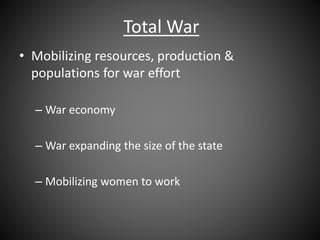
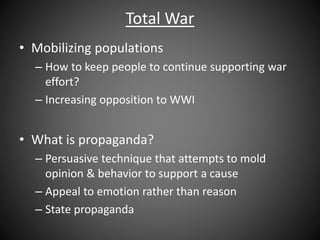
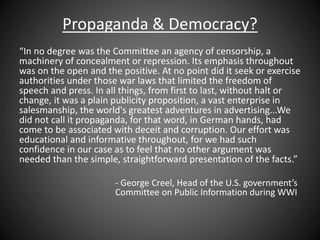
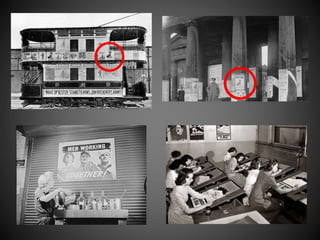
– Mobilizing women to work
Total War
• Mobilizing populations
– How to keep people to continue supporting war
effort?
– Increasing opposition to WWI
• What is propaganda?
– Persuasive technique that attempts to mold
opinion & behavior to support a cause
– Appeal to emotion rather than reason
– State propaganda
Propaganda & Democracy?
“In no degree was the Committee an agency of censorship, a
machinery of concealment or repression. Its emphasis throughout
was on the open and the positive. At no point did it seek or exercise
authorities under those war laws that limited the freedom of
speech and press. In all things, from first to last, without halt or
change, it was a plain publicity proposition, a vast enterprise in
salesmanship, the world's greatest adventures in advertising...We
did not call it propaganda, for that word, in German hands, had
come to be associated with deceit and corruption. Our effort was
educational and informative throughout, for we had such
confidence in our case as to feel that no other argument was
needed than the simple, straightforward presentation of the facts.”
- George Creel, Head of the U.S. government’s
Committee on Public Information during WWI
Propaganda & Democracy?
“The conscious and intelligent manipulation of the organized
habits and opinions of the masses is an important element in
democratic society. Those who manipulate this unseen
mechanism of society constitute an invisible government
which is the true ruling power of our country. We are
governed, our minds are molded, our tastes formed, our ideas
suggested, largely by men we have never heard of. This is a
logical result of the way in which our democratic society is
organized. Vast numbers of human beings must cooperate in
this manner if they are to live together as a smoothly
functioning society.”
- Edward Bernays, "Propaganda" (1928)
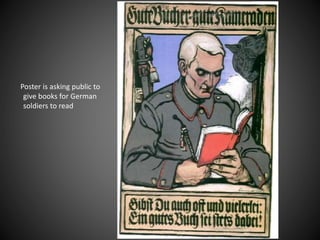
Poster is asking public to
give books for German
soldiers to read
Questions about posters:
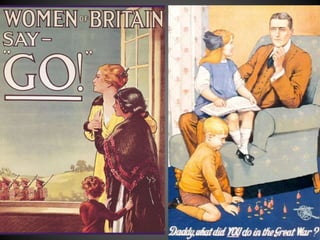
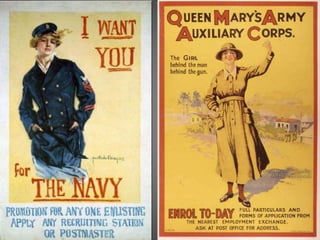
• Who is the intended audience?
• What is the main messages of the poster?
• Do the messages attempt to manipulate with
emotion, reason or both?
• Do you think the poster was a successful piece
of propaganda?
• How do the two posters in the set
compare/contrast with one another?
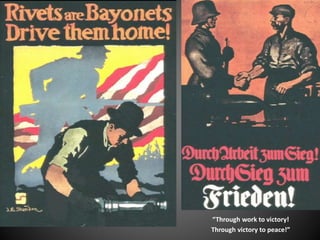
“Through work to victory!
Through victory to peace!”
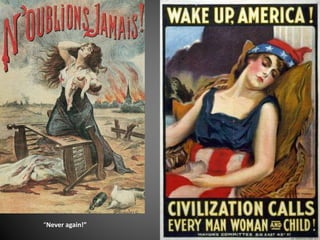
“Never again!”
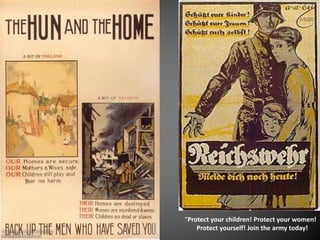
“Protect your children! Protect your women!
Protect yourself! Join the army today!
Modern propaganda
• What is propaganda today? How is it similar
and/or different to WWI propaganda
techniques?
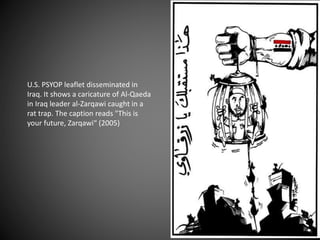
U.S. PSYOP leaflet disseminated in
Iraq. It shows a caricature of Al-Qaeda
in Iraq leader al-Zarqawi caught in a
rat trap. The caption reads "This is
your future, Zarqawi“ (2005)
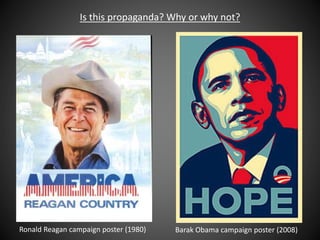
Is this propaganda? Why or why not?
U.S. Office of National Drug
Control Policy, 2000
British Petroleum
advertisement, 2010
Is this propaganda? Why or why not?
Ronald Reagan campaign poster (1980) Barak Obama campaign poster (2008)
Is this propaganda? Why or why not?
Review: some social and cultural
consequences of WWI
• Immense documentation of war
• New ways of memorializing war
• Total War
– Increased role of state in the economy
– Propaganda
• Impact on women & gender roles

WWI - Total War & Propaganda

  • 1.
    Total War, Propagandaand the Cultural Consequences of WWI
  • 2.
    Total War • Mobilizingresources, production & populations for war effort – War economy – War expanding the size of the state – Mobilizing women to work
  • 3.
    Total War • Mobilizingpopulations – How to keep people to continue supporting war effort? – Increasing opposition to WWI • What is propaganda? – Persuasive technique that attempts to mold opinion & behavior to support a cause – Appeal to emotion rather than reason – State propaganda
  • 4.
    Propaganda & Democracy? “Inno degree was the Committee an agency of censorship, a machinery of concealment or repression. Its emphasis throughout was on the open and the positive. At no point did it seek or exercise authorities under those war laws that limited the freedom of speech and press. In all things, from first to last, without halt or change, it was a plain publicity proposition, a vast enterprise in salesmanship, the world's greatest adventures in advertising...We did not call it propaganda, for that word, in German hands, had come to be associated with deceit and corruption. Our effort was educational and informative throughout, for we had such confidence in our case as to feel that no other argument was needed than the simple, straightforward presentation of the facts.” - George Creel, Head of the U.S. government’s Committee on Public Information during WWI
  • 5.
    Propaganda & Democracy? “Theconscious and intelligent manipulation of the organized habits and opinions of the masses is an important element in democratic society. Those who manipulate this unseen mechanism of society constitute an invisible government which is the true ruling power of our country. We are governed, our minds are molded, our tastes formed, our ideas suggested, largely by men we have never heard of. This is a logical result of the way in which our democratic society is organized. Vast numbers of human beings must cooperate in this manner if they are to live together as a smoothly functioning society.” - Edward Bernays, "Propaganda" (1928)
  • 10.
    Poster is askingpublic to give books for German soldiers to read
  • 11.
    Questions about posters: •Who is the intended audience? • What is the main messages of the poster? • Do the messages attempt to manipulate with emotion, reason or both? • Do you think the poster was a successful piece of propaganda? • How do the two posters in the set compare/contrast with one another?
  • 12.
    “Through work tovictory! Through victory to peace!”
  • 14.
  • 16.
    “Protect your children!Protect your women! Protect yourself! Join the army today!
  • 20.
    Modern propaganda • Whatis propaganda today? How is it similar and/or different to WWI propaganda techniques?
  • 21.
    U.S. PSYOP leafletdisseminated in Iraq. It shows a caricature of Al-Qaeda in Iraq leader al-Zarqawi caught in a rat trap. The caption reads "This is your future, Zarqawi“ (2005)
  • 22.
    Is this propaganda?Why or why not?
  • 23.
    U.S. Office ofNational Drug Control Policy, 2000 British Petroleum advertisement, 2010 Is this propaganda? Why or why not?
  • 24.
    Ronald Reagan campaignposter (1980) Barak Obama campaign poster (2008) Is this propaganda? Why or why not?
  • 25.
    Review: some socialand cultural consequences of WWI • Immense documentation of war • New ways of memorializing war • Total War – Increased role of state in the economy – Propaganda • Impact on women & gender roles

Editor's Notes

  • #8 US posters
  • #9 British recruitment poster
  • #10 U.S. and British anti-German posters; Germans as the “brutes” and “huns”
  • #11 The “civilized” Germans
  • #13 Workers & soldiers as both part of war effort, Left: British poster, Right: German poster
  • #14 Left: British recruitment poster, Right: American recruitment poster (Uncle Sam)
  • #15 Evoking themes of “civilization”
  • #16 Gendered British recruitment poster for men
  • #17 Saving women and children. Left: British poster, Right: German poster
  • #18 Socialization of children into the Total War
  • #19 Recruiting women into the military (British)
  • #20 British war propaganda, women factory workers