Professor Chee
Lecture on WWII
Questions to consider:
How did the war start?
What are the outcomes of this war?
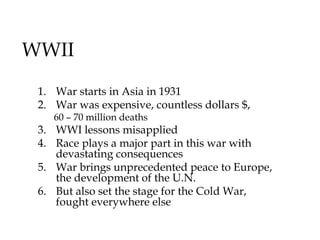
WWII
1. War starts in Asia in 1931
2. War was expensive, countless dollars $,
60 – 70 million deaths
3. WWI lessons misapplied
4. Race plays a major part in this war with
devastating consequences
5. War brings unprecedented peace to Europe,
the development of the U.N.
6. But also set the stage for the Cold War,
fought everywhere else
3
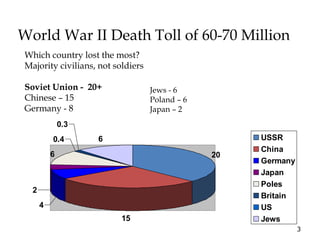
World War II Death Toll of 60-70 Million
20
15
4
2
6
0.4
0.3
6 USSR
China
Germany
Japan
Poles
Britain
US
Jews
Which country lost the most?
Majority civilians, not soldiers
Soviet Union - 20+
Chinese – 15
Germany - 8
Jews - 6
Poland – 6
Japan – 2
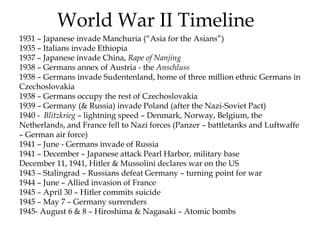
World War II Timeline
1931 – Japanese invade Manchuria (“Asia for the Asians”)
1935 – Italians invade Ethiopia
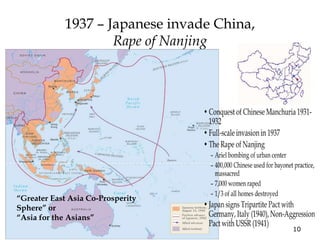
1937 – Japanese invade China, Rape of Nanjing
1938 – Germans annex of Austria - the Anschluss
1938 – Germans invade Sudentenland, home of three million ethnic Germans in
Czechoslovakia
1938 – Germans occupy the rest of Czechoslovakia
1939 – Germany (& Russia) invade Poland (after the Nazi-Soviet Pact)
1940 - Blitzkrieg – lightning speed – Denmark, Norway, Belgium, the
Netherlands, and France fell to Nazi forces (Panzer – battletanks and Luftwaffe
– German air force)
1941 – June - Germans invade of Russia
1941 – December – Japanese attack Pearl Harbor, military base
December 11, 1941, Hitler & Mussolini declares war on the US
1943 – Stalingrad – Russians defeat Germany – turning point for war
1944 – June – Allied invasion of France
1945 – April 30 – Hitler commits suicide
1945 – May 7 – Germany surrenders
1945- August 6 & 8 – Hiroshima & Nagasaki – Atomic bombs
5
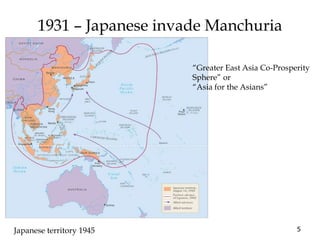
1931 – Japanese invade Manchuria
“Greater East Asia Co-Prosperity
Sphere” or
“Asia for the Asians”
Japanese territory 1945
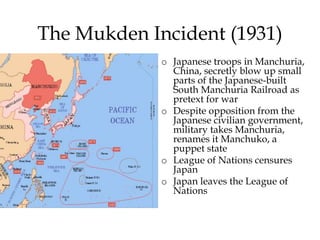
The Mukden Incident (1931)
o Japanese troops in Manchuria,
China, secretly blow up small
parts of the Japanese-built
South Manchuria Railroad as
pretext for war
o Despite opposition from the
Japanese civilian government,
military takes Manchuria,
renames it Manchuko, a
puppet state
o League of Nations censures
Japan
o Japan leaves the League of
Nations
6
7
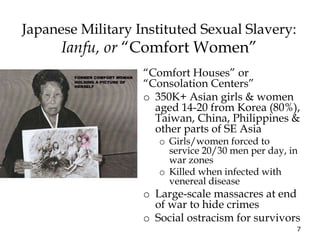
Japanese Military Instituted Sexual Slavery:
Ianfu, or “Comfort Women”
“Comfort Houses” or
“Consolation Centers”
o 350K+ Asian girls & women
aged 14-20 from Korea (80%),
Taiwan, China, Philippines &
other parts of SE Asia
o Girls/women forced to
service 20/30 men per day, in
war zones
o Killed when infected with
venereal disease
o Large-scale massacres at end
of war to hide crimes
o Social ostracism for survivors
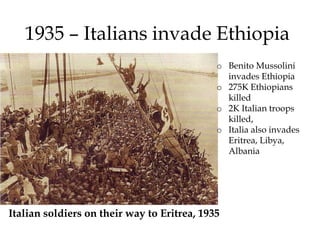
1935 – Italians invade Ethiopia
Italian soldiers on their way to Eritrea, 1935
o Benito Mussolini
invades Ethiopia
o 275K Ethiopians
killed
o 2K Italian troops
killed,
o Italia also invades
Eritrea, Libya,
Albania
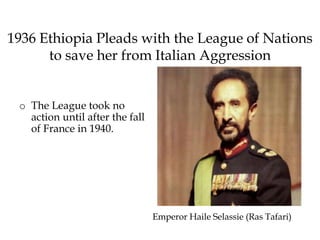
1936 Ethiopia Pleads with the League of Nations
to save her from Italian Aggression
o The League took no
action until after the fall
of France in 1940.
Emperor Haile Selassie (Ras Tafari)
10
1937 – Japanese invade China,
Rape of Nanjing
“Greater East Asia Co-Prosperity
Sphere” or
“Asia for the Asians”
11
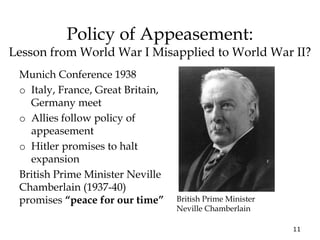
Policy of Appeasement:
Lesson from World War I Misapplied to World War II?
Munich Conference 1938
o Italy, France, Great Britain,
Germany meet
o Allies follow policy of
appeasement
o Hitler promises to halt
expansion
British Prime Minister Neville
Chamberlain (1937-40)
promises “peace for our time” British Prime Minister
Neville Chamberlain
12
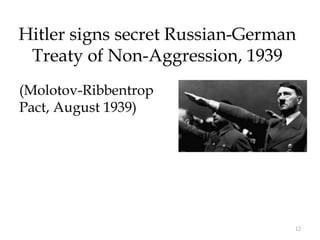
Hitler signs secret Russian-German
Treaty of Non-Aggression, 1939
(Molotov-Ribbentrop
Pact, August 1939)
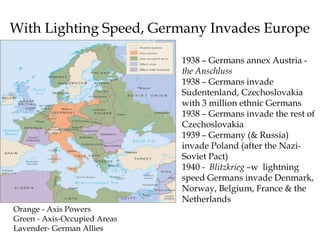
With Lighting Speed, Germany Invades Europe
1938 – Germans annex Austria -
the Anschluss
1938 – Germans invade
Sudentenland, Czechoslovakia
with 3 million ethnic Germans
1938 – Germans invade the rest of
Czechoslovakia
1939 – Germany (& Russia)
invade Poland (after the Nazi-
Soviet Pact)
1940 - Blitzkrieg –w lightning
speed Germans invade Denmark,
Norway, Belgium, France & the
Netherlands
Orange - Axis Powers
Green - Axis-Occupied Areas
Lavender- German Allies
14
1940 - Japan Signs Pact with Germany & Italy,
Non-Aggression Pact w USSR
15
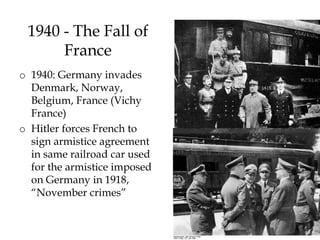
1940 - The Fall of
France
o 1940: Germany invades
Denmark, Norway,
Belgium, France (Vichy
France)
o Hitler forces French to
sign armistice agreement
in same railroad car used
for the armistice imposed
on Germany in 1918,
“November crimes”
16
Collaboration & Resistance
• Military forms of
resistance
• Intelligence gathering
• Protecting refugees
• Symbolic gestures
For some, opportunity for
social mobility under
conquerors
Sometimes considered a
lesser evil than military
administration
17
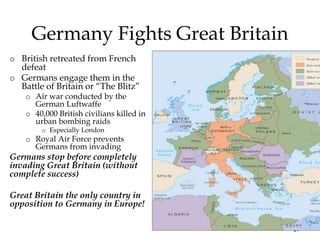
Germany Fights Great Britain
o British retreated from French
defeat
o Germans engage them in the
Battle of Britain or “The Blitz”
o Air war conducted by the
German Luftwaffe
o 40,000 British civilians killed in
urban bombing raids
o Especially London
o Royal Air Force prevents
Germans from invading
Germans stop before completely
invading Great Britain (without
complete success)
Great Britain the only country in
opposition to Germany in Europe!
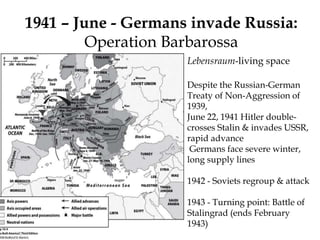
1941 – June - Germans invade Russia:
Operation Barbarossa
Lebensraum-living space
Despite the Russian-German
Treaty of Non-Aggression of
1939,
June 22, 1941 Hitler double-
crosses Stalin & invades USSR,
rapid advance
Germans face severe winter,
long supply lines
1942 - Soviets regroup & attack
1943 - Turning point: Battle of
Stalingrad (ends February
1943)
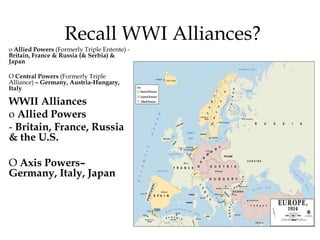
Recall WWI Alliances?
o Allied Powers (Formerly Triple Entente) -
Britain, France & Russia (& Serbia) &
Japan
O Central Powers (Formerly Triple
Alliance) – Germany, Austria-Hungary,
Italy
WWII Alliances
o Allied Powers
- Britain, France, Russia
& the U.S.
O Axis Powers–
Germany, Italy, Japan
20
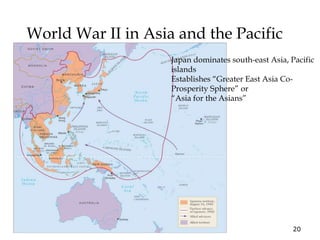
World War II in Asia and the Pacific
Japan dominates south-east Asia, Pacific
islands
Establishes “Greater East Asia Co-
Prosperity Sphere” or
“Asia for the Asians”
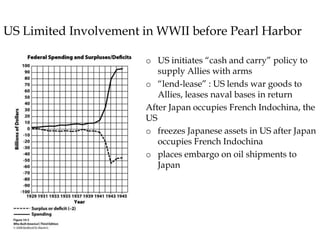
US Limited Involvement in WWII before Pearl Harbor
o US initiates “cash and carry” policy to
supply Allies with arms
o “lend-lease” : US lends war goods to
Allies, leases naval bases in return
After Japan occupies French Indochina, the
US
o freezes Japanese assets in US after Japan
occupies French Indochina
o places embargo on oil shipments to
Japan
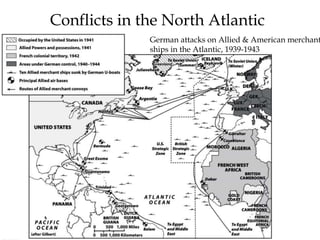
German attacks on Allied & American merchant
ships in the Atlantic, 1939-1943
Conflicts in the North Atlantic
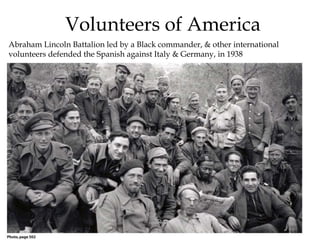
Abraham Lincoln Battalion led by a Black commander, & other international
volunteers defended the Spanish against Italy & Germany, in 1938
Volunteers of America
24
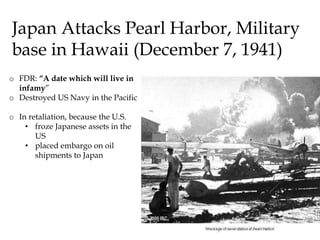
Japan Attacks Pearl Harbor, Military
base in Hawaii (December 7, 1941)
o FDR: “A date which will live in
infamy”
o Destroyed US Navy in the Pacific
o In retaliation, because the U.S.
• froze Japanese assets in the
US
• placed embargo on oil
shipments to Japan
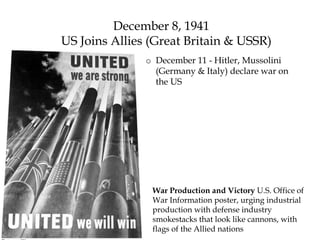
December 8, 1941
US Joins Allies (Great Britain & USSR)
o December 11 - Hitler, Mussolini
(Germany & Italy) declare war on
the US
War Production and Victory U.S. Office of
War Information poster, urging industrial
production with defense industry
smokestacks that look like cannons, with
flags of the Allied nations
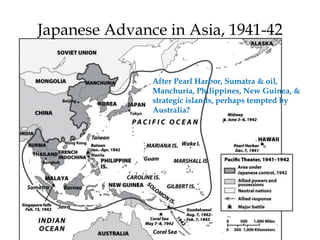
After Pearl Harbor, Sumatra & oil,
Manchuria, Philippines, New Guinea, &
strategic islands, perhaps tempted by
Australia?
Japanese Advance in Asia, 1941-42
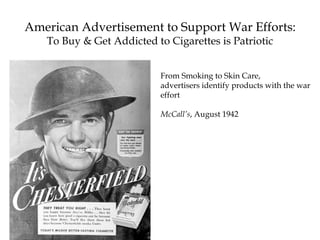
From Smoking to Skin Care,
advertisers identify products with the war
effort
McCall’s, August 1942
American Advertisement to Support War Efforts:
To Buy & Get Addicted to Cigarettes is Patriotic
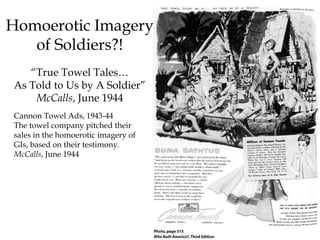
Cannon Towel Ads, 1943-44
The towel company pitched their
sales in the homoerotic imagery of
GIs, based on their testimony.
McCalls, June 1944
Homoerotic Imagery
of Soldiers?!
“True Towel Tales…
As Told to Us by A Soldier”
McCalls, June 1944
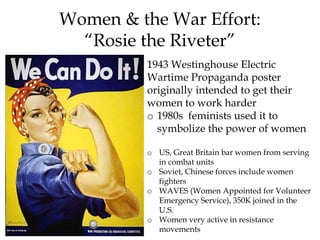
1943 Westinghouse Electric
Wartime Propaganda poster
originally intended to get their
women to work harder
o 1980s feminists used it to
symbolize the power of women
o US, Great Britain bar women from serving
in combat units
o Soviet, Chinese forces include women
fighters
o WAVES (Women Appointed for Volunteer
Emergency Service), 350K joined in the
U.S.
o Women very active in resistance
movements
Women & the War Effort:
“Rosie the Riveter”
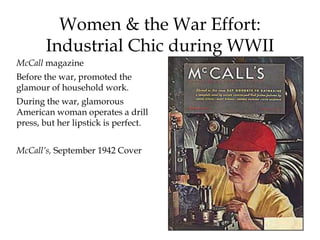
McCall magazine
Before the war, promoted the
glamour of household work.
During the war, glamorous
American woman operates a drill
press, but her lipstick is perfect.
McCall’s, September 1942 Cover
Women & the War Effort:
Industrial Chic during WWII
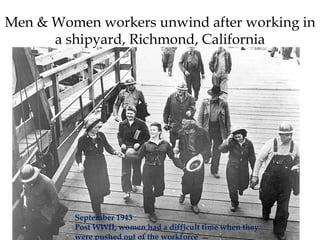
September 1943
Post WWII, women had a difficult time when they
were pushed out of the workforce
Men & Women workers unwind after working in
a shipyard, Richmond, California
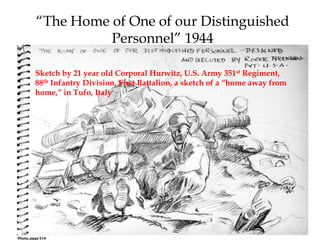
Sketch by 21 year old Corporal Hurwitz, U.S. Army 351st Regiment,
88th Infantry Division, First Battalion, a sketch of a “home away from
home,” in Tufo, Italy
“The Home of One of our Distinguished
Personnel” 1944
33
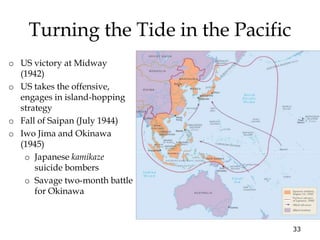
Turning the Tide in the Pacific
o US victory at Midway
(1942)
o US takes the offensive,
engages in island-hopping
strategy
o Fall of Saipan (July 1944)
o Iwo Jima and Okinawa
(1945)
o Japanese kamikaze
suicide bombers
o Savage two-month battle
for Okinawa
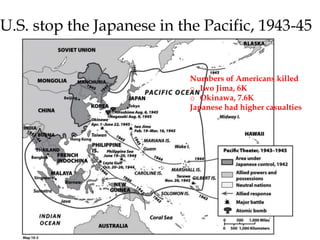
Numbers of Americans killed
o Iwo Jima, 6K
o Okinawa, 7.6K
Japanese had higher casualties
U.S. stop the Japanese in the Pacific, 1943-45
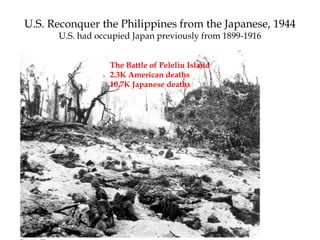
The Battle of Peleliu Island
2.3K American deaths
10.7K Japanese deaths
U.S. Reconquer the Philippines from the Japanese, 1944
U.S. had occupied Japan previously from 1899-1916
36
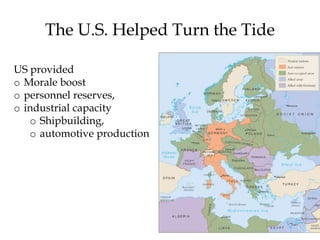
The U.S. Helped Turn the Tide
US provided
o Morale boost
o personnel reserves,
o industrial capacity
o Shipbuilding,
o automotive production
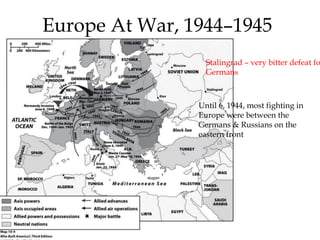
Stalingrad – very bitter defeat fo
Germans
Europe At War, 1944–1945
Until 6, 1944, most fighting in
Europe were between the
Germans & Russians on the
eastern front
38
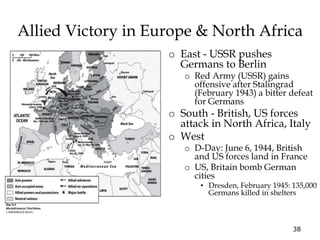
Allied Victory in Europe & North Africa
o East - USSR pushes
Germans to Berlin
o Red Army (USSR) gains
offensive after Stalingrad
(February 1943) a bitter defeat
for Germans
o South - British, US forces
attack in North Africa, Italy
o West
o D-Day: June 6, 1944, British
and US forces land in France
o US, Britain bomb German
cities
• Dresden, February 1945: 135,000
Germans killed in shelters
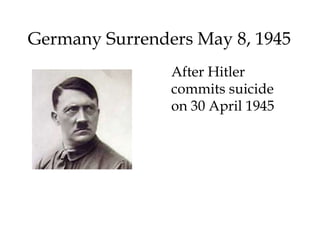
Germany Surrenders May 8, 1945
After Hitler
commits suicide
on 30 April 1945
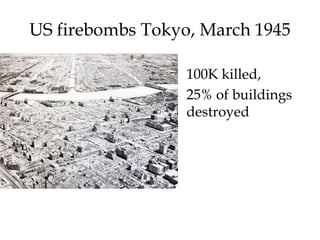
US firebombs Tokyo, March 1945
100K killed,
25% of buildings
destroyed
41
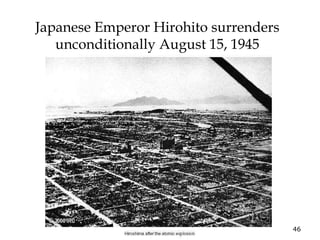
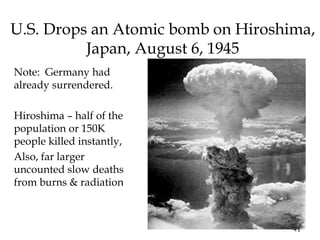
U.S. Drops an Atomic bomb on Hiroshima,
Japan, August 6, 1945
Note: Germany had
already surrendered.
Hiroshima – half of the
population or 150K
people killed instantly,
Also, far larger
uncounted slow deaths
from burns & radiation
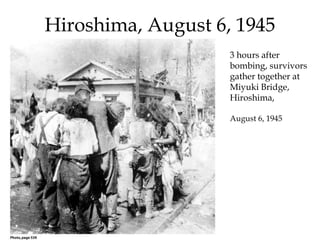
3 hours after
bombing, survivors
gather together at
Miyuki Bridge,
Hiroshima,
August 6, 1945
Hiroshima, August 6, 1945
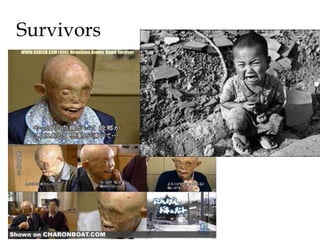
Survivors
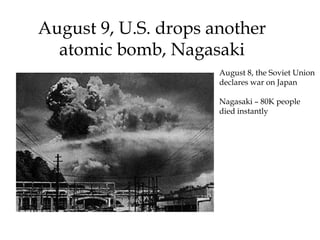
August 9, U.S. drops another
atomic bomb, Nagasaki
August 8, the Soviet Union
declares war on Japan
Nagasaki – 80K people
died instantly
“Why do you have to end the war twice?”
“To me, actually, the important event was not the first bomb, but the
second…[w]hen they announced the second bomb…, that came as a
shock to me. I said, ‘But the war is over.’ In fact, the headlines at
that time were ‘Japanese Surrender.’ and then bang, there was the
bomb in Nagasaki. And that hit me like a glass of cold water
thrown at you. I suddenly said, ‘Now, wait a second. What for?’ I
mean, great, we ended the war – but why do you have to end the
war twice?’…
Bernard Feld,
graduate student,
Manhattan Project, a U.S. Army Corps of Engineers Atomic Bomb
Research & Development
The Reminiscences of Bernard Feld, Columbia Oral History Research Office, Columbia University, 1980, 19-20
46
Japanese Emperor Hirohito surrenders
unconditionally August 15, 1945
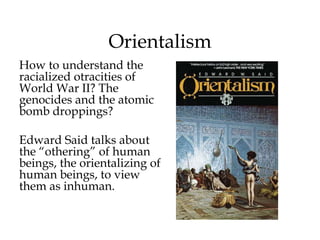
Orientalism
How to understand the
racialized otracities of
World War II? The
genocides and the atomic
bomb droppings?
Edward Said talks about
the “othering” of human
beings, the orientalizing of
human beings, to view
them as inhuman.
48
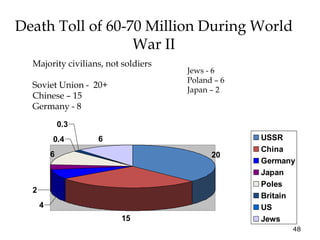
Death Toll of 60-70 Million During World
War II
20
15
4
2
6
0.4
0.3
6 USSR
China
Germany
Japan
Poles
Britain
US
Jews
Majority civilians, not soldiers
Soviet Union - 20+
Chinese – 15
Germany - 8
Jews - 6
Poland – 6
Japan – 2
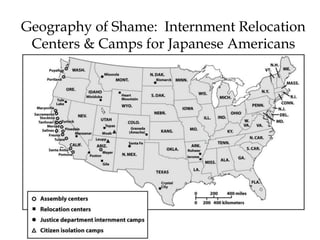
Geography of Shame: Internment Relocation
Centers & Camps for Japanese Americans
Prime Minister Hideki Tojo as
a vampire bat
U.S. propaganda portrayed
Japanese as subhuman apes,
insects, rats & reptiles (unlike
European enemies)
“Most Americans came to
hate the Japanese with a
passion that was not equally
directed at their German or
Italian enemies.”
Rosenzweig et al.
Japan as Enemy #1
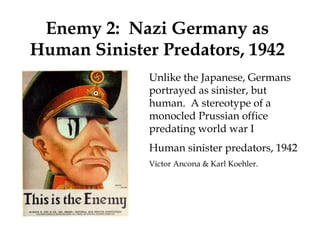
Unlike the Japanese, Germans
portrayed as sinister, but
human. A stereotype of a
monocled Prussian office
predating world war I
Human sinister predators, 1942
Victor Ancona & Karl Koehler.
Enemy 2: Nazi Germany as
Human Sinister Predators, 1942
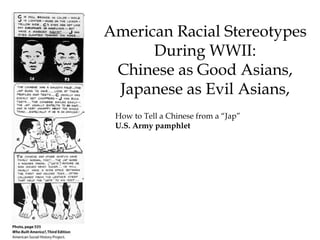
How to Tell a Chinese from a “Jap”
U.S. Army pamphlet
American Racial Stereotypes
During WWII:
Chinese as Good Asians,
Japanese as Evil Asians,
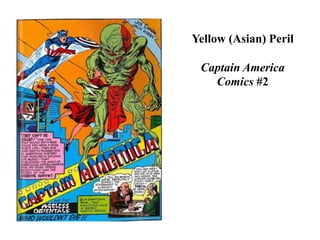
Yellow (Asian) Peril
Captain America
Comics #2
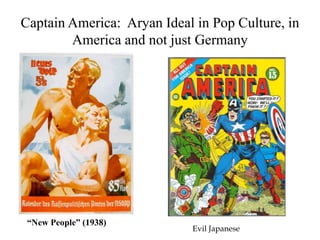
Captain America: Aryan Ideal in Pop Culture, in
America and not just Germany
“New People” (1938)
Evil Japanese
55
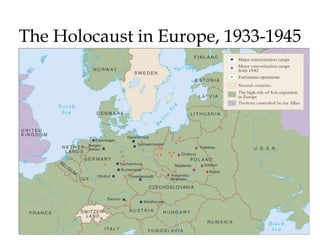
The Holocaust in Europe, 1933-1945
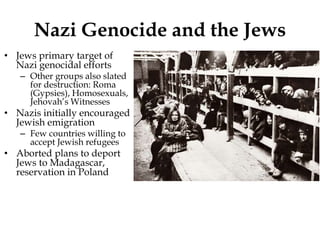
Nazi Genocide and the Jews
• Jews primary target of
Nazi genocidal efforts
– Other groups also slated
for destruction: Roma
(Gypsies), Homosexuals,
Jehovah’s Witnesses
• Nazis initially encouraged
Jewish emigration
– Few countries willing to
accept Jewish refugees
• Aborted plans to deport
Jews to Madagascar,
reservation in Poland
57
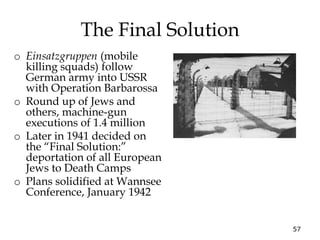
The Final Solution
o Einsatzgruppen (mobile
killing squads) follow
German army into USSR
with Operation Barbarossa
o Round up of Jews and
others, machine-gun
executions of 1.4 million
o Later in 1941 decided on
the “Final Solution:”
deportation of all European
Jews to Death Camps
o Plans solidified at Wannsee
Conference, January 1942
58
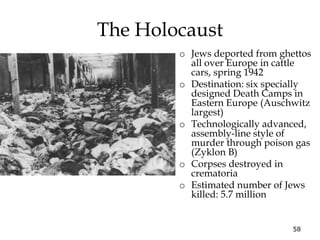
The Holocaust
o Jews deported from ghettos
all over Europe in cattle
cars, spring 1942
o Destination: six specially
designed Death Camps in
Eastern Europe (Auschwitz
largest)
o Technologically advanced,
assembly-line style of
murder through poison gas
(Zyklon B)
o Corpses destroyed in
crematoria
o Estimated number of Jews
killed: 5.7 million
59
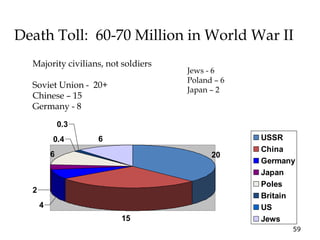
Death Toll: 60-70 Million in World War II
20
15
4
2
6
0.4
0.3
6 USSR
China
Germany
Japan
Poles
Britain
US
Jews
Majority civilians, not soldiers
Soviet Union - 20+
Chinese – 15
Germany - 8
Jews - 6
Poland – 6
Japan – 2
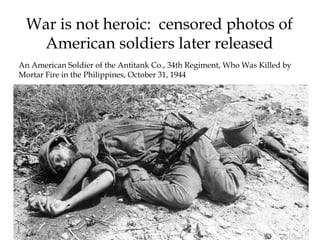
An American Soldier of the Antitank Co., 34th Regiment, Who Was Killed by
Mortar Fire in the Philippines, October 31, 1944
War is not heroic: censored photos of
American soldiers later released
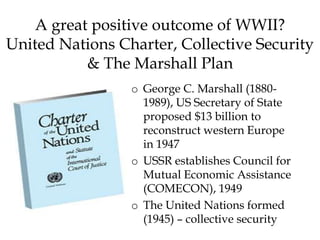
A great positive outcome of WWII?
United Nations Charter, Collective Security
& The Marshall Plan
o George C. Marshall (1880-
1989), US Secretary of State
proposed $13 billion to
reconstruct western Europe
in 1947
o USSR establishes Council for
Mutual Economic Assistance
(COMECON), 1949
o The United Nations formed
(1945) – collective security
Copyright © Chee, 2017
Message to students:
Professor Chee does not endorse other slideshare
presentations, unless it says, Professor Chee.
You may want to read your primary sources, textbook,
and other readings/videos as assigned

Lecture 8 - World War II, Captain America, and the Final Solution

  • 1.
    Professor Chee Lecture onWWII Questions to consider: How did the war start? What are the outcomes of this war?
  • 2.
    WWII 1. War startsin Asia in 1931 2. War was expensive, countless dollars $, 60 – 70 million deaths 3. WWI lessons misapplied 4. Race plays a major part in this war with devastating consequences 5. War brings unprecedented peace to Europe, the development of the U.N. 6. But also set the stage for the Cold War, fought everywhere else
  • 3.
    3 World War IIDeath Toll of 60-70 Million 20 15 4 2 6 0.4 0.3 6 USSR China Germany Japan Poles Britain US Jews Which country lost the most? Majority civilians, not soldiers Soviet Union - 20+ Chinese – 15 Germany - 8 Jews - 6 Poland – 6 Japan – 2
  • 4.
    World War IITimeline 1931 – Japanese invade Manchuria (“Asia for the Asians”) 1935 – Italians invade Ethiopia 1937 – Japanese invade China, Rape of Nanjing 1938 – Germans annex of Austria - the Anschluss 1938 – Germans invade Sudentenland, home of three million ethnic Germans in Czechoslovakia 1938 – Germans occupy the rest of Czechoslovakia 1939 – Germany (& Russia) invade Poland (after the Nazi-Soviet Pact) 1940 - Blitzkrieg – lightning speed – Denmark, Norway, Belgium, the Netherlands, and France fell to Nazi forces (Panzer – battletanks and Luftwaffe – German air force) 1941 – June - Germans invade of Russia 1941 – December – Japanese attack Pearl Harbor, military base December 11, 1941, Hitler & Mussolini declares war on the US 1943 – Stalingrad – Russians defeat Germany – turning point for war 1944 – June – Allied invasion of France 1945 – April 30 – Hitler commits suicide 1945 – May 7 – Germany surrenders 1945- August 6 & 8 – Hiroshima & Nagasaki – Atomic bombs
  • 5.
    5 1931 – Japaneseinvade Manchuria “Greater East Asia Co-Prosperity Sphere” or “Asia for the Asians” Japanese territory 1945
  • 6.
    The Mukden Incident(1931) o Japanese troops in Manchuria, China, secretly blow up small parts of the Japanese-built South Manchuria Railroad as pretext for war o Despite opposition from the Japanese civilian government, military takes Manchuria, renames it Manchuko, a puppet state o League of Nations censures Japan o Japan leaves the League of Nations 6
  • 7.
    7 Japanese Military InstitutedSexual Slavery: Ianfu, or “Comfort Women” “Comfort Houses” or “Consolation Centers” o 350K+ Asian girls & women aged 14-20 from Korea (80%), Taiwan, China, Philippines & other parts of SE Asia o Girls/women forced to service 20/30 men per day, in war zones o Killed when infected with venereal disease o Large-scale massacres at end of war to hide crimes o Social ostracism for survivors
  • 8.
    1935 – Italiansinvade Ethiopia Italian soldiers on their way to Eritrea, 1935 o Benito Mussolini invades Ethiopia o 275K Ethiopians killed o 2K Italian troops killed, o Italia also invades Eritrea, Libya, Albania
  • 9.
    1936 Ethiopia Pleadswith the League of Nations to save her from Italian Aggression o The League took no action until after the fall of France in 1940. Emperor Haile Selassie (Ras Tafari)
  • 10.
    10 1937 – Japaneseinvade China, Rape of Nanjing “Greater East Asia Co-Prosperity Sphere” or “Asia for the Asians”
  • 11.
    11 Policy of Appeasement: Lessonfrom World War I Misapplied to World War II? Munich Conference 1938 o Italy, France, Great Britain, Germany meet o Allies follow policy of appeasement o Hitler promises to halt expansion British Prime Minister Neville Chamberlain (1937-40) promises “peace for our time” British Prime Minister Neville Chamberlain
  • 12.
    12 Hitler signs secretRussian-German Treaty of Non-Aggression, 1939 (Molotov-Ribbentrop Pact, August 1939)
  • 13.
    With Lighting Speed,Germany Invades Europe 1938 – Germans annex Austria - the Anschluss 1938 – Germans invade Sudentenland, Czechoslovakia with 3 million ethnic Germans 1938 – Germans invade the rest of Czechoslovakia 1939 – Germany (& Russia) invade Poland (after the Nazi- Soviet Pact) 1940 - Blitzkrieg –w lightning speed Germans invade Denmark, Norway, Belgium, France & the Netherlands Orange - Axis Powers Green - Axis-Occupied Areas Lavender- German Allies
  • 14.
    14 1940 - JapanSigns Pact with Germany & Italy, Non-Aggression Pact w USSR
  • 15.
    15 1940 - TheFall of France o 1940: Germany invades Denmark, Norway, Belgium, France (Vichy France) o Hitler forces French to sign armistice agreement in same railroad car used for the armistice imposed on Germany in 1918, “November crimes”
  • 16.
    16 Collaboration & Resistance •Military forms of resistance • Intelligence gathering • Protecting refugees • Symbolic gestures For some, opportunity for social mobility under conquerors Sometimes considered a lesser evil than military administration
  • 17.
    17 Germany Fights GreatBritain o British retreated from French defeat o Germans engage them in the Battle of Britain or “The Blitz” o Air war conducted by the German Luftwaffe o 40,000 British civilians killed in urban bombing raids o Especially London o Royal Air Force prevents Germans from invading Germans stop before completely invading Great Britain (without complete success) Great Britain the only country in opposition to Germany in Europe!
  • 18.
    1941 – June- Germans invade Russia: Operation Barbarossa Lebensraum-living space Despite the Russian-German Treaty of Non-Aggression of 1939, June 22, 1941 Hitler double- crosses Stalin & invades USSR, rapid advance Germans face severe winter, long supply lines 1942 - Soviets regroup & attack 1943 - Turning point: Battle of Stalingrad (ends February 1943)
  • 19.
    Recall WWI Alliances? oAllied Powers (Formerly Triple Entente) - Britain, France & Russia (& Serbia) & Japan O Central Powers (Formerly Triple Alliance) – Germany, Austria-Hungary, Italy WWII Alliances o Allied Powers - Britain, France, Russia & the U.S. O Axis Powers– Germany, Italy, Japan
  • 20.
    20 World War IIin Asia and the Pacific Japan dominates south-east Asia, Pacific islands Establishes “Greater East Asia Co- Prosperity Sphere” or “Asia for the Asians”
  • 21.
    US Limited Involvementin WWII before Pearl Harbor o US initiates “cash and carry” policy to supply Allies with arms o “lend-lease” : US lends war goods to Allies, leases naval bases in return After Japan occupies French Indochina, the US o freezes Japanese assets in US after Japan occupies French Indochina o places embargo on oil shipments to Japan
  • 22.
    German attacks onAllied & American merchant ships in the Atlantic, 1939-1943 Conflicts in the North Atlantic
  • 23.
    Abraham Lincoln Battalionled by a Black commander, & other international volunteers defended the Spanish against Italy & Germany, in 1938 Volunteers of America
  • 24.
    24 Japan Attacks PearlHarbor, Military base in Hawaii (December 7, 1941) o FDR: “A date which will live in infamy” o Destroyed US Navy in the Pacific o In retaliation, because the U.S. • froze Japanese assets in the US • placed embargo on oil shipments to Japan
  • 25.
    December 8, 1941 USJoins Allies (Great Britain & USSR) o December 11 - Hitler, Mussolini (Germany & Italy) declare war on the US War Production and Victory U.S. Office of War Information poster, urging industrial production with defense industry smokestacks that look like cannons, with flags of the Allied nations
  • 26.
    After Pearl Harbor,Sumatra & oil, Manchuria, Philippines, New Guinea, & strategic islands, perhaps tempted by Australia? Japanese Advance in Asia, 1941-42
  • 27.
    From Smoking toSkin Care, advertisers identify products with the war effort McCall’s, August 1942 American Advertisement to Support War Efforts: To Buy & Get Addicted to Cigarettes is Patriotic
  • 28.
    Cannon Towel Ads,1943-44 The towel company pitched their sales in the homoerotic imagery of GIs, based on their testimony. McCalls, June 1944 Homoerotic Imagery of Soldiers?! “True Towel Tales… As Told to Us by A Soldier” McCalls, June 1944
  • 29.
    1943 Westinghouse Electric WartimePropaganda poster originally intended to get their women to work harder o 1980s feminists used it to symbolize the power of women o US, Great Britain bar women from serving in combat units o Soviet, Chinese forces include women fighters o WAVES (Women Appointed for Volunteer Emergency Service), 350K joined in the U.S. o Women very active in resistance movements Women & the War Effort: “Rosie the Riveter”
  • 30.
    McCall magazine Before thewar, promoted the glamour of household work. During the war, glamorous American woman operates a drill press, but her lipstick is perfect. McCall’s, September 1942 Cover Women & the War Effort: Industrial Chic during WWII
  • 31.
    September 1943 Post WWII,women had a difficult time when they were pushed out of the workforce Men & Women workers unwind after working in a shipyard, Richmond, California
  • 32.
    Sketch by 21year old Corporal Hurwitz, U.S. Army 351st Regiment, 88th Infantry Division, First Battalion, a sketch of a “home away from home,” in Tufo, Italy “The Home of One of our Distinguished Personnel” 1944
  • 33.
    33 Turning the Tidein the Pacific o US victory at Midway (1942) o US takes the offensive, engages in island-hopping strategy o Fall of Saipan (July 1944) o Iwo Jima and Okinawa (1945) o Japanese kamikaze suicide bombers o Savage two-month battle for Okinawa
  • 34.
    Numbers of Americanskilled o Iwo Jima, 6K o Okinawa, 7.6K Japanese had higher casualties U.S. stop the Japanese in the Pacific, 1943-45
  • 35.
    The Battle ofPeleliu Island 2.3K American deaths 10.7K Japanese deaths U.S. Reconquer the Philippines from the Japanese, 1944 U.S. had occupied Japan previously from 1899-1916
  • 36.
    36 The U.S. HelpedTurn the Tide US provided o Morale boost o personnel reserves, o industrial capacity o Shipbuilding, o automotive production
  • 37.
    Stalingrad – verybitter defeat fo Germans Europe At War, 1944–1945 Until 6, 1944, most fighting in Europe were between the Germans & Russians on the eastern front
  • 38.
    38 Allied Victory inEurope & North Africa o East - USSR pushes Germans to Berlin o Red Army (USSR) gains offensive after Stalingrad (February 1943) a bitter defeat for Germans o South - British, US forces attack in North Africa, Italy o West o D-Day: June 6, 1944, British and US forces land in France o US, Britain bomb German cities • Dresden, February 1945: 135,000 Germans killed in shelters
  • 39.
    Germany Surrenders May8, 1945 After Hitler commits suicide on 30 April 1945
  • 40.
    US firebombs Tokyo,March 1945 100K killed, 25% of buildings destroyed
  • 41.
    41 U.S. Drops anAtomic bomb on Hiroshima, Japan, August 6, 1945 Note: Germany had already surrendered. Hiroshima – half of the population or 150K people killed instantly, Also, far larger uncounted slow deaths from burns & radiation
  • 42.
    3 hours after bombing,survivors gather together at Miyuki Bridge, Hiroshima, August 6, 1945 Hiroshima, August 6, 1945
  • 43.
  • 44.
    August 9, U.S.drops another atomic bomb, Nagasaki August 8, the Soviet Union declares war on Japan Nagasaki – 80K people died instantly
  • 45.
    “Why do youhave to end the war twice?” “To me, actually, the important event was not the first bomb, but the second…[w]hen they announced the second bomb…, that came as a shock to me. I said, ‘But the war is over.’ In fact, the headlines at that time were ‘Japanese Surrender.’ and then bang, there was the bomb in Nagasaki. And that hit me like a glass of cold water thrown at you. I suddenly said, ‘Now, wait a second. What for?’ I mean, great, we ended the war – but why do you have to end the war twice?’… Bernard Feld, graduate student, Manhattan Project, a U.S. Army Corps of Engineers Atomic Bomb Research & Development The Reminiscences of Bernard Feld, Columbia Oral History Research Office, Columbia University, 1980, 19-20
  • 46.
    46 Japanese Emperor Hirohitosurrenders unconditionally August 15, 1945
  • 47.
    Orientalism How to understandthe racialized otracities of World War II? The genocides and the atomic bomb droppings? Edward Said talks about the “othering” of human beings, the orientalizing of human beings, to view them as inhuman.
  • 48.
    48 Death Toll of60-70 Million During World War II 20 15 4 2 6 0.4 0.3 6 USSR China Germany Japan Poles Britain US Jews Majority civilians, not soldiers Soviet Union - 20+ Chinese – 15 Germany - 8 Jews - 6 Poland – 6 Japan – 2
  • 49.
    Geography of Shame:Internment Relocation Centers & Camps for Japanese Americans
  • 50.
    Prime Minister HidekiTojo as a vampire bat U.S. propaganda portrayed Japanese as subhuman apes, insects, rats & reptiles (unlike European enemies) “Most Americans came to hate the Japanese with a passion that was not equally directed at their German or Italian enemies.” Rosenzweig et al. Japan as Enemy #1
  • 51.
    Unlike the Japanese,Germans portrayed as sinister, but human. A stereotype of a monocled Prussian office predating world war I Human sinister predators, 1942 Victor Ancona & Karl Koehler. Enemy 2: Nazi Germany as Human Sinister Predators, 1942
  • 52.
    How to Tella Chinese from a “Jap” U.S. Army pamphlet American Racial Stereotypes During WWII: Chinese as Good Asians, Japanese as Evil Asians,
  • 53.
  • 54.
    Captain America: AryanIdeal in Pop Culture, in America and not just Germany “New People” (1938) Evil Japanese
  • 55.
    55 The Holocaust inEurope, 1933-1945
  • 56.
    Nazi Genocide andthe Jews • Jews primary target of Nazi genocidal efforts – Other groups also slated for destruction: Roma (Gypsies), Homosexuals, Jehovah’s Witnesses • Nazis initially encouraged Jewish emigration – Few countries willing to accept Jewish refugees • Aborted plans to deport Jews to Madagascar, reservation in Poland
  • 57.
    57 The Final Solution oEinsatzgruppen (mobile killing squads) follow German army into USSR with Operation Barbarossa o Round up of Jews and others, machine-gun executions of 1.4 million o Later in 1941 decided on the “Final Solution:” deportation of all European Jews to Death Camps o Plans solidified at Wannsee Conference, January 1942
  • 58.
    58 The Holocaust o Jewsdeported from ghettos all over Europe in cattle cars, spring 1942 o Destination: six specially designed Death Camps in Eastern Europe (Auschwitz largest) o Technologically advanced, assembly-line style of murder through poison gas (Zyklon B) o Corpses destroyed in crematoria o Estimated number of Jews killed: 5.7 million
  • 59.
    59 Death Toll: 60-70Million in World War II 20 15 4 2 6 0.4 0.3 6 USSR China Germany Japan Poles Britain US Jews Majority civilians, not soldiers Soviet Union - 20+ Chinese – 15 Germany - 8 Jews - 6 Poland – 6 Japan – 2
  • 60.
    An American Soldierof the Antitank Co., 34th Regiment, Who Was Killed by Mortar Fire in the Philippines, October 31, 1944 War is not heroic: censored photos of American soldiers later released
  • 61.
    A great positiveoutcome of WWII? United Nations Charter, Collective Security & The Marshall Plan o George C. Marshall (1880- 1989), US Secretary of State proposed $13 billion to reconstruct western Europe in 1947 o USSR establishes Council for Mutual Economic Assistance (COMECON), 1949 o The United Nations formed (1945) – collective security
  • 62.
    Copyright © Chee,2017 Message to students: Professor Chee does not endorse other slideshare presentations, unless it says, Professor Chee. You may want to read your primary sources, textbook, and other readings/videos as assigned