Depth First Search Algorithm in 🧠 DFS in Artificial Intelligence (AI)
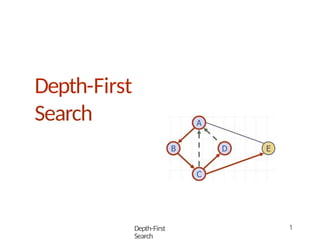
DFS is a classic algorithm used to traverse or search through graphs and tree structures. It dives deep into each branch before backtracking, which makes it especially useful for exploring complex structures.
Outline and Reading
Depth-First
Search
2
4Definitions (§6.1)
■ Subgraph
■ Connectivity
■ Spanning trees and forests
4 Depth-first search (§6.3.1)
■ Algorithm
■ Example
• Properties
• Analysis
4 Applications of DFS (§6.5)
■ Path finding
• Cycle finding
3.
Subgraphs
Depth-First
Search
3
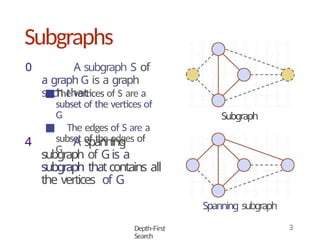
0 A subgraphS of
a graph G is a graph
such that
■The vertices of S are a
subset of the vertices of
G
■ The edges of S are a
subset of the edges of
G
4 A spanning
subgraph of Gis a
subgraph thatcontains all
the vertices of G
Spanning subgraph
Subgraph
4.
Connectivi@
Depth-First
Search
4
¥A graph is
connectedif there
is
a path between
every pair of
vertices
¥A
connected
component
of a graph G is a
maximal connected
subgraph of G
Connected
graph
Non connected graph with
two connected
component
5.
Trees and Forests
Depth-First
Search
5
4A (free) tree is an
undirected graph T
such
that
• T is connected
• T has no cycles
This definition of tree is
different from the one
of a rooted tree
4 A forest is an
undirected
graph without cycles
4 The connected
components of a forest
are trees
Tree
Forest
6.
Spanning Trees andForests
Depth-First
Search
6
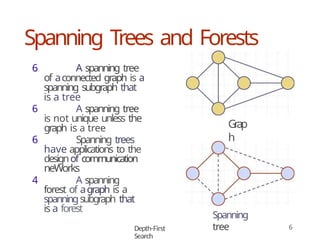
6 A spanning tree
of aconnected graph is a
spanning subgraph that
is a tree
6 A spanning tree
is not unique unless the
graph is a tree
6 Spanning trees
have applications to the
designof communication
neWorks
4 A spanning
forest of agraph is a
spanningsubgraph that
is a forest
Grap
h
Spanning
tree
7.
Depth-First Search
Depth-First
Search
7
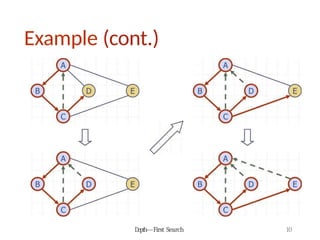
4 Depth-firstsearch
(DFS) is a general
technique for traversing
a graph
4 A DFS traversal of
a graph G
■Visits all the
vertices and
edges of G
• Determines whether G
is connected
• Computes the
connected
components of G
■Computes a
spanning
0 DFS on a
graph with n velices
and m edges takes
O(n +m ) time
4 DFS can be further
extended to solve
other graph problems
• Find and report a
path between two
given vertices
■ Find a cycle in the
graph
0 Depth-first search is to
graphs what Euler tour
is to binary trees
8.
DFS Algorithm
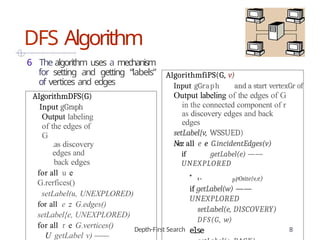
6 Thealgorithm uses a mechanism
for setting and getting “labels”
of vertices and edges
AIgorithmDFS(G)
Input gGraph
Output labeling
of the edges of
G
.as discovery
edges and
back edges
for all u e
G.rerfices()
setLabel(u, UNEXPLORED)
for all e z G.edges()
setLabel{e, UNEXPLORED)
for all r e G.vertices()
U getLabel v) ——
AlgorithmfiPS(G, v)
Input gGraph and a start vertexGr of
Output labeling of the edges of G
in the connected component of r
as discovery edges and back
edges
setLabel{v, WSSUED)
Nez all e e G.incidentEdges(v)
if getLabel(e) ——
UNEXPLORED
• ‹- pPOsite{v,e)
if getLabel(w) ——
UNEXPLORED
setLabel(e, DISCOVERY)
DFS(G, w)
else
Depth-First Search
DFS and NazeTraversal
Depth-First
Search
11
4 The DFS
algorithm is similar
to a classic strategy
for exploring a maze
■ We mark
each intersection,
corner and dead end
(velex) visited
• We mark each
corridor (edge )
traversed
■ We keep track
of the path back to
the entrance (start
vertex) by means of a
rope (recursion stack)
12.
Prope%ies
DFS
Depth-First
Search
12
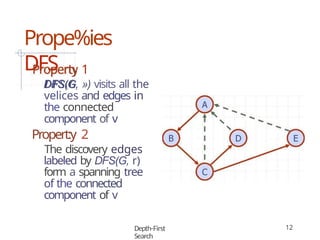
Property 1
DFS(G, »)visits all the
velices and edges in
the connected
component of v
Propert:y 2
The discovery edges
labeled by DFS(G, r)
form a spanning tree
of the connected
component of v
13.
Analysis
DFS
Depth-First
Search
13
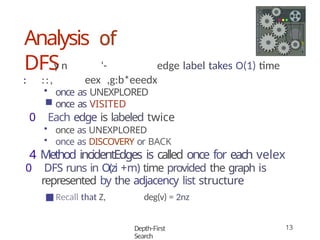
y n '-edge label takes O(1) time
: ::, eex ,g:b*eeedx
• once as UNEXPLORED
■ once as VISITED
0 Each edge is labeled twice
• once as UNEXPLORED
• once as DISCOVERY or BACK
4 Method incidentEdges is called once for each velex
0 DFS runs in O(zi +m) time provided the graph is
represented by the adjacency list structure
■ Recall that Z, deg(v) = 2nz
14.
Path Finding
Depth-First
Search
14
We canspecialize the DFS
algorithm to find a path
between two given
velices u and z using the
template method pattern
We call DFS(C, u) with u
as the start vertex
We use a stack S to
keep track of the path
between the start vertex
and the current vertex
As soon as destination
velex z is encountered,
we return the path as
the contents of the stack
Algorithmpa@DNS(G, r, z)
setLabel(v, VISITED)
S.puch(v)
if r
return S.elements{)
for all e z
G.incidentEdges(v)
iI getLabel(e) ——UNF
XPLORED
W
*Rp' $ite(v,e)
if getLabel(w)
UNEXPLORED setLabel(e,
DISCOVER ) S.push(e)
pathDFS(G, w, z)
S.R•p{e)
else
setLabel(e, BACK)
S.p*R(•)
15.
Cycle Finding
Depth-First
Search
15
We canspecialize the
DFS algorithm to find a
simple cycle using the
template method
pahern
We use a stack S to
keeptrack of the path
between the stal
vertex and the current
velex
+ As soon as a back edge
(v, w) is encountered,
we return the cycle as
the portion of the stack
from the top to vertex
›r
Algorithm cycleDFS{G, v, z)
setLabel‹v, VISITED
for all e e G.incidentEdges(v)
if getLabelie) -- UNEXPLORED
w ‹- opposite[v,e)
S.push(e)
if getLabel(w j -- UNEXPLORE.D
setLabel(e, DISCOVERY)
patliDFS(G, w, z)
S.pop{e)
else
fi ‹- new empty
stack
repeat
o +- S.pop )
-R ffsh{O)
until o -- w
return T.elements()