Graphing PolynomialsBy: Logan Jones
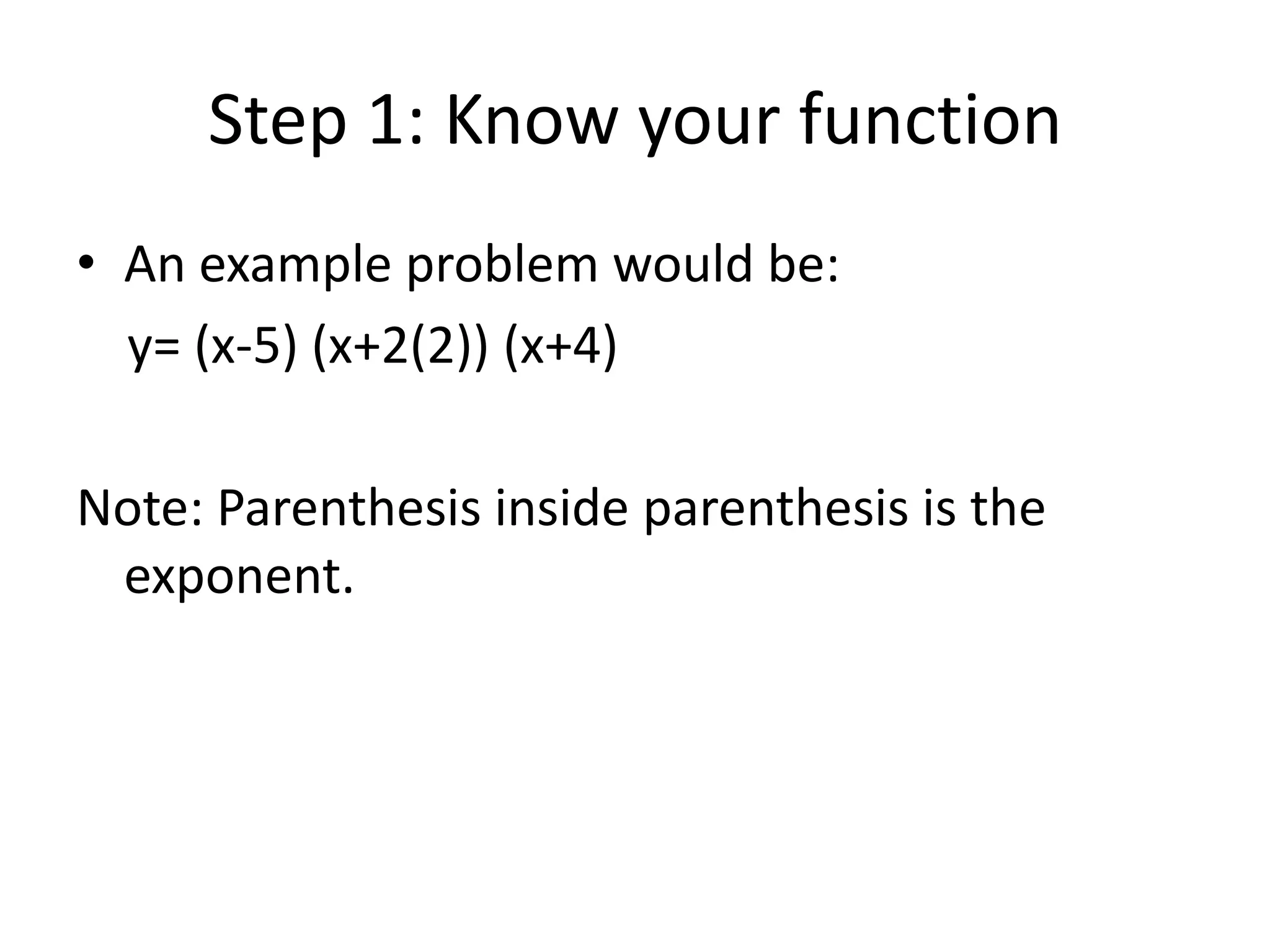
Step 1: Know your functionAn example problem would be:    y= (x-5) (x+2(2)) (x+4)Note: Parenthesis inside parenthesis is the exponent.
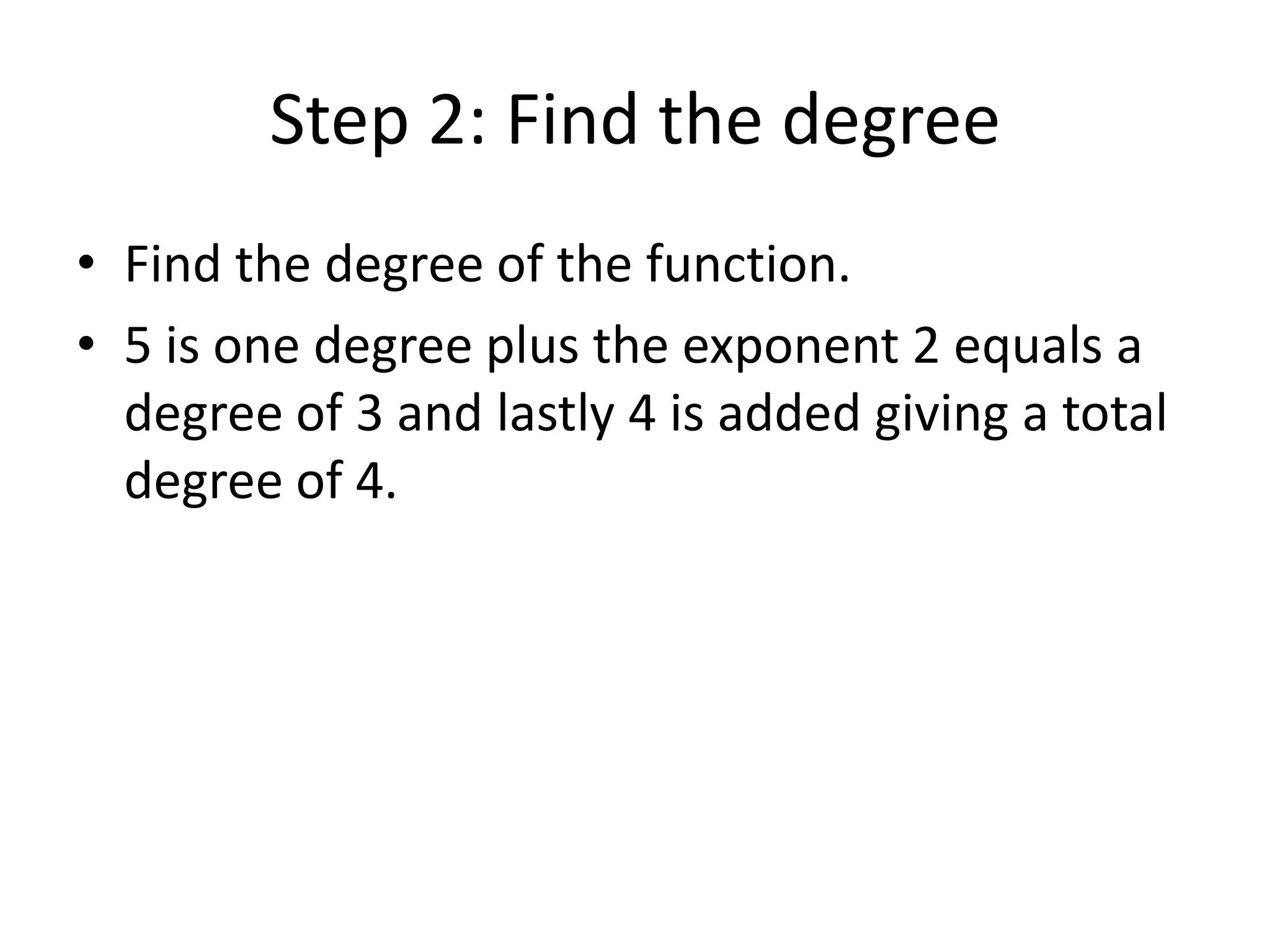
Step 2: Find the degreeFind the degree of the function.5 is one degree plus the exponent 2 equals a degree of 3 and lastly 4 is added giving a total degree of 4.
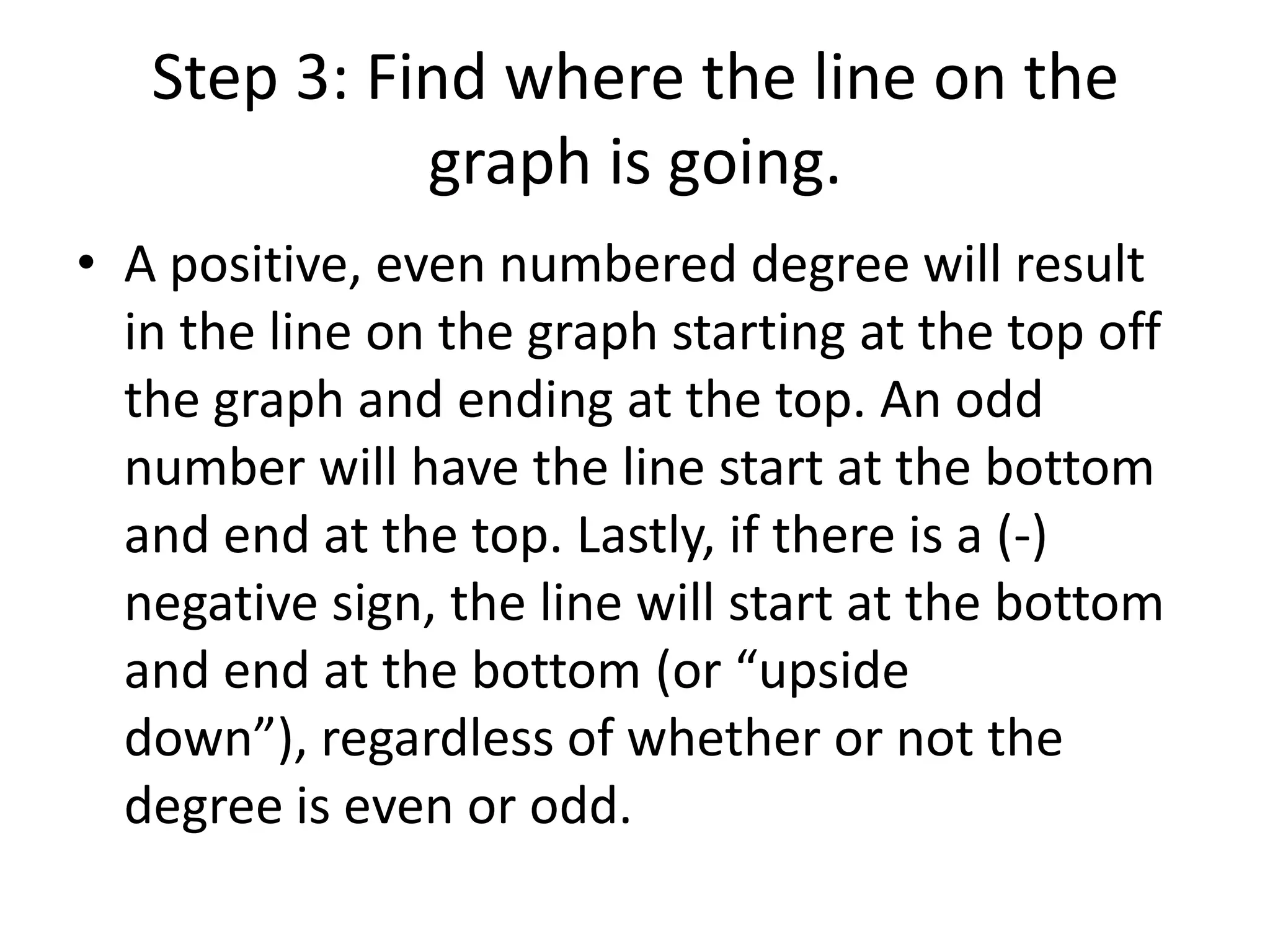
Step 3: Find where the line on the graph is going.A positive, even numbered degree will result in the line on the graph starting at the top off the graph and ending at the top. An odd number will have the line start at the bottom and end at the top. Lastly, if there is a (-) negative sign, the line will start at the bottom and end at the bottom (or “upside down”), regardless of whether or not the degree is even or odd.
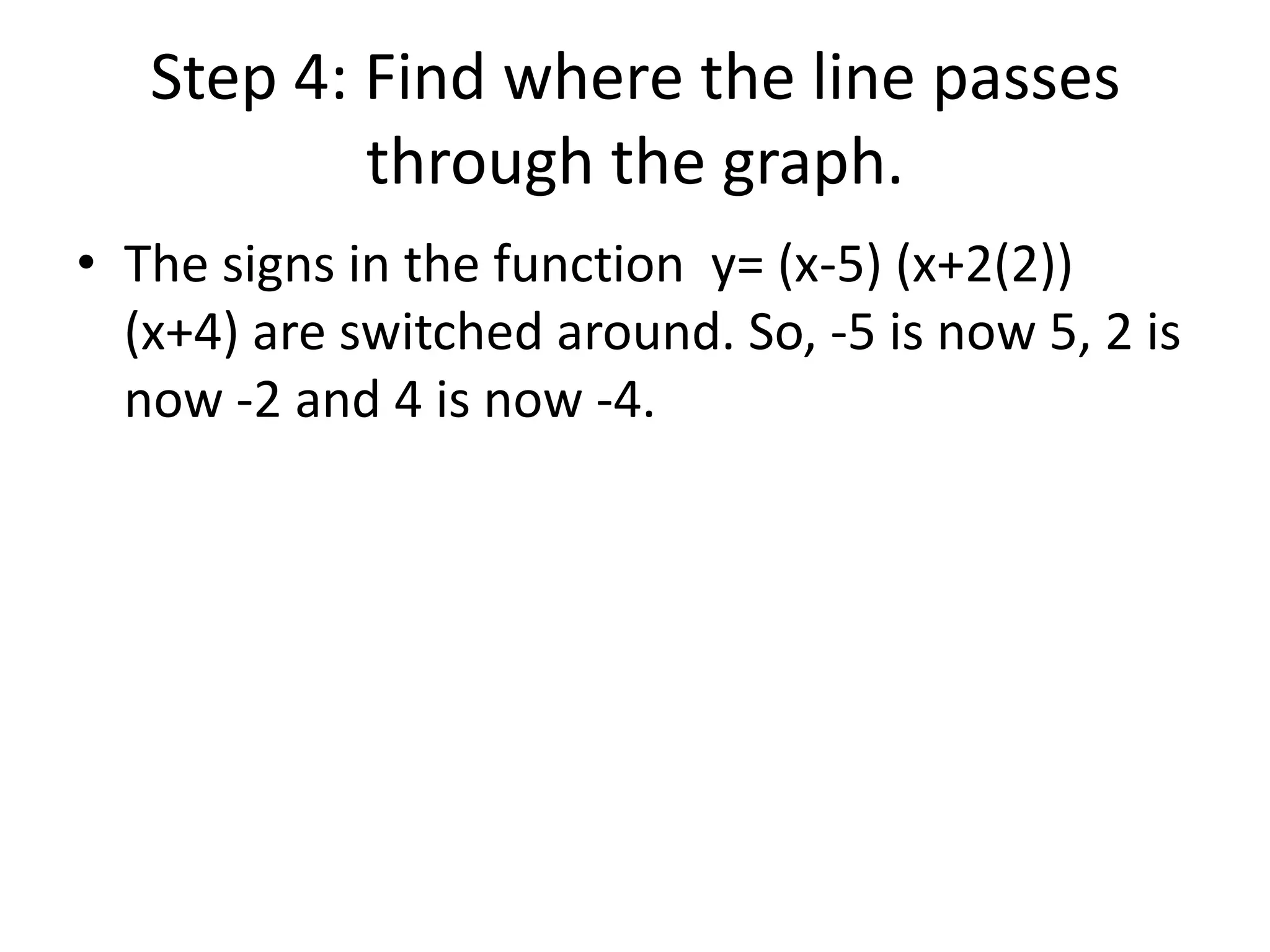
Step 4: Find where the line passes through the graph.The signs in the function  y= (x-5) (x+2(2)) (x+4) are switched around. So, -5 is now 5, 2 is now -2 and 4 is now -4.
Step 5: Find out if the line passes through, bounces, or “squiggles” through the pointIf the number in the function has no exponent to speak of, the line simply passes through the point.If the number has any even exponent, it “bounces” off of the line, not passing through it.Finally, if the number has any odd exponent, the line will “squiggle” through the point, not simply passing through nor bouncing off.
Step 6: Graph the polynomial!

Graphing Polynomials

  • 1.
  • 2.
    Step 1: Knowyour functionAn example problem would be: y= (x-5) (x+2(2)) (x+4)Note: Parenthesis inside parenthesis is the exponent.
  • 3.
    Step 2: Findthe degreeFind the degree of the function.5 is one degree plus the exponent 2 equals a degree of 3 and lastly 4 is added giving a total degree of 4.
  • 4.
    Step 3: Findwhere the line on the graph is going.A positive, even numbered degree will result in the line on the graph starting at the top off the graph and ending at the top. An odd number will have the line start at the bottom and end at the top. Lastly, if there is a (-) negative sign, the line will start at the bottom and end at the bottom (or “upside down”), regardless of whether or not the degree is even or odd.
  • 5.
    Step 4: Findwhere the line passes through the graph.The signs in the function y= (x-5) (x+2(2)) (x+4) are switched around. So, -5 is now 5, 2 is now -2 and 4 is now -4.
  • 6.
    Step 5: Findout if the line passes through, bounces, or “squiggles” through the pointIf the number in the function has no exponent to speak of, the line simply passes through the point.If the number has any even exponent, it “bounces” off of the line, not passing through it.Finally, if the number has any odd exponent, the line will “squiggle” through the point, not simply passing through nor bouncing off.
  • 7.
    Step 6: Graphthe polynomial!