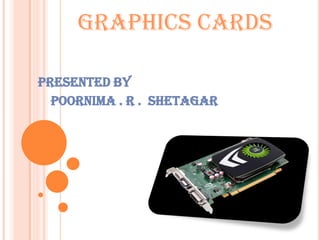
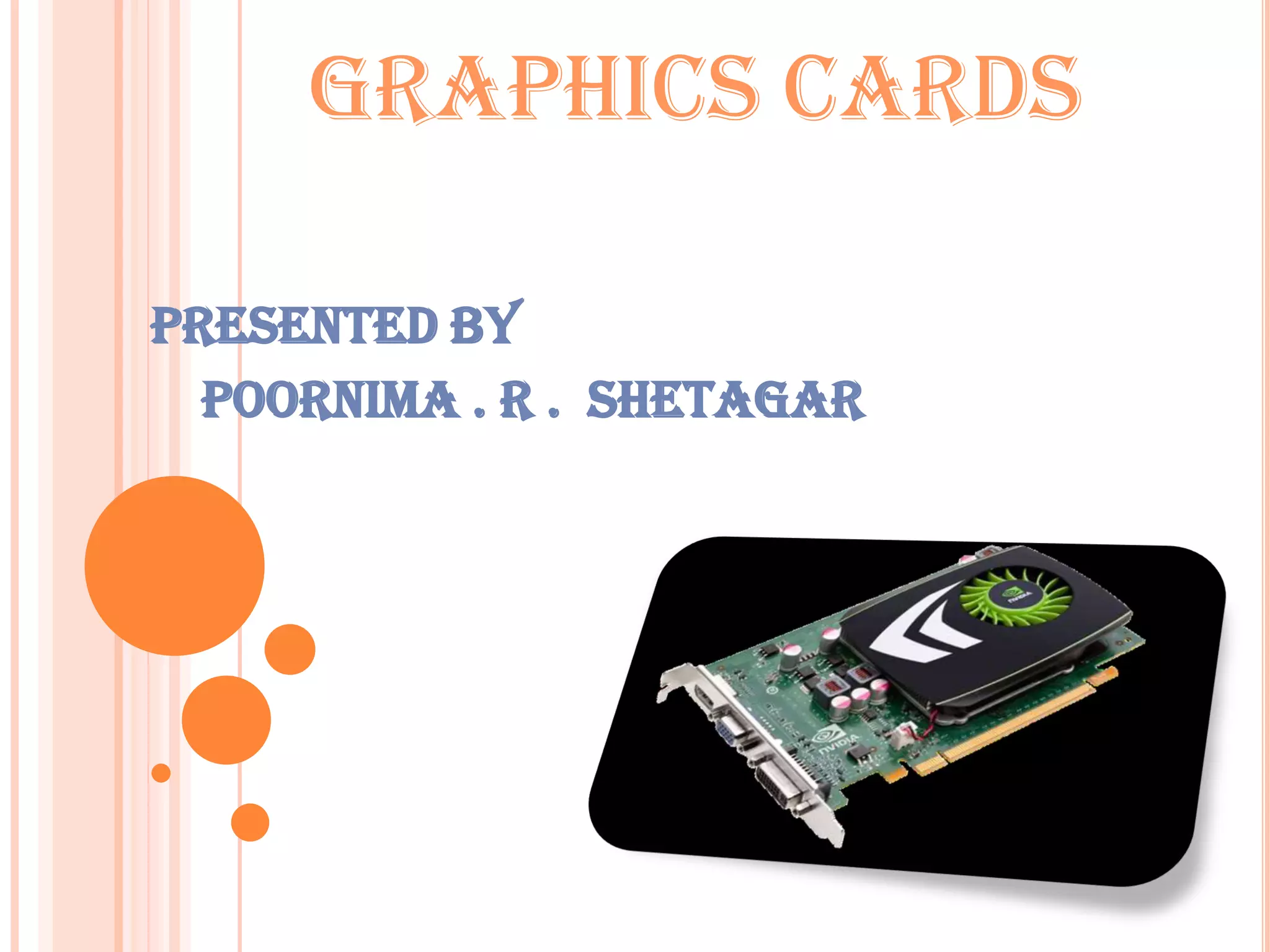
Graphics Cards
Presented by
Poornima . R . shetagar
WHAT ARE GRAPHICS CARDS?
A Graphics Card is a piece of
computer hardware that produces
the image you see on a monitor.
TheGraphics Card is responsible
for rendering an image to your
monitor, it does this by converting
data into a signal your monitor can
understand.
WHAT ARE GRAPHICS
CARDS USED FOR?
• Animation
• Gaming – both PC and console
• Design/Drafting
• Special effects creation/editing
• Medical Instruments
• And other purposes where fast rendering
and high resolutions are needed
HISTORY
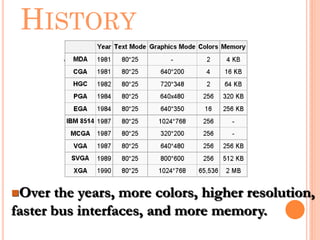
Over the years, more colors, higher resolution,
faster bus interfaces, and more memory.
HISTORY
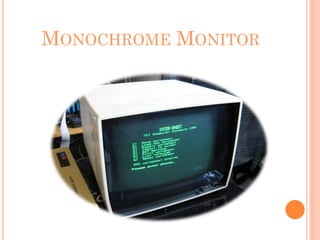
Monochrome Display Adapter (MDA) was the
first video card created in 1981 – displays green
text on black screen
Video Graphics Array (VGA) = very popular and
was the standard in almost every PC up until
recently
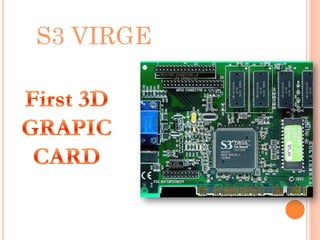
First 3d video cards were released in 1995 and
they used SVGA; learned to create 3d effects
HISTORY
 In 1983 Intel made the iSBX 275 Video Graphics
Controller Multimodule Board for industrial
systems based on the Multibus standard.
 Released in 1985, the Commodore Amiga was
of first personal computers to come standard
with a GPU
 Nvidia was first to produce a chip capable of
programmable shading, GeForce 3(code
named NV20) .
MONOCHROME MONITOR
S3 VIRGE
What is GPU??
• A GRAPHICS PROCESSING UNIT or GPU
is a
specialized microprocessor that discharge and
accelerates 3D or 2D graphics.
• Used in embedded systems, mobile
phones, personal computers, workstations
and game consoles.
COMPONENTS
 Graphics Processing Unit (GPU): perform
calculations for rendering and figure out
what to do with each pixel
 Video Memory: storing images and
information about each pixel
 Output: Common outputs include Video
Graphics Array (VGA) for CRT monitors,
Digital Visual Interface (DVI) for flat panel
displays, and Video-in-video-out (ViVo) for
television and video cameras
COMPONENTS
 Heat sink and Fan: used to cool the
GPU, just like the CPU of a computer
having the same cooling instruments
 Motherboards: PCI before AGP
 Motherboards: Accelerated Graphics
Port (AGP) compatible popular decade
ago; Peripheral Component Interconnect
Express (PCI-E) gaining popularity
 BIOS chip that stores settings,
information about each component of the
graphics cards, and can be altered for
over-clocking
HOW GRAPHICS CARDS
WORK?
Take data from CPU and figure out what to
do with each pixel to create image
Create wire frame using vectors
Fill remaining pixels with color, lighting,
and texture
The filling will consider viewpoint
For games and video, the graphics cards
has to do the above steps for 30 frames per
second
HOW GRAPHICS CARDS
WORK?
In greater detail:
• GPU creates image, stores image with
location and color of each pixel in memory
• Memory also holds completed images until
it’s time to display them (frame buffer)
• Digital-to-analog converter (DAC) is
connected to memory and translates image
into analog signals that is sent through
monitor cable and the image is displayed on
monitor
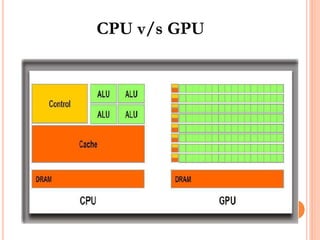
CPU v/s GPU
WIRE IMAGE
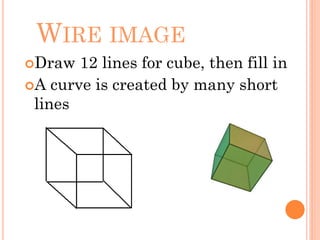
Draw 12 lines for cube, then fill in
A curve is created by many short
lines
Sample image
3D IMAGE DEVELOPMENT
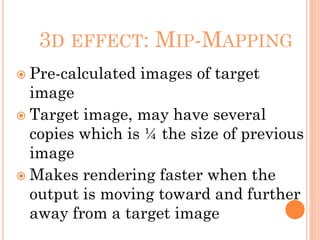
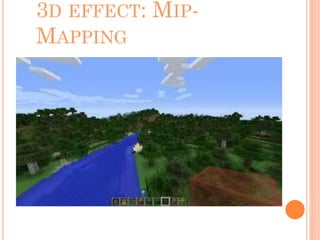
3D EFFECT: MIP-MAPPING
 Pre-calculated images of target
image
 Target image, may have several
copies which is ¼ the size of previous
image
 Makes rendering faster when the
output is moving toward and further
away from a target image
3D EFFECT: MIP-
MAPPING
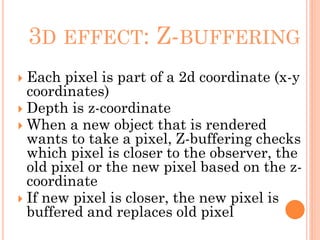
3D EFFECT: Z-BUFFERING
 Each pixel is part of a 2d coordinate (x-y
coordinates)
 Depth is z-coordinate
 When a new object that is rendered
wants to take a pixel, Z-buffering checks
which pixel is closer to the observer, the
old pixel or the new pixel based on the z-
coordinate
 If new pixel is closer, the new pixel is
buffered and replaces old pixel
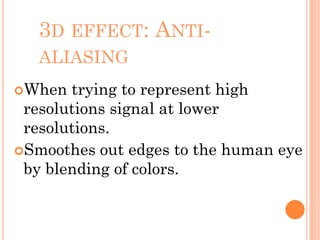
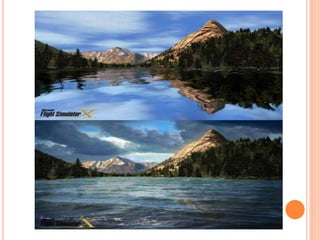
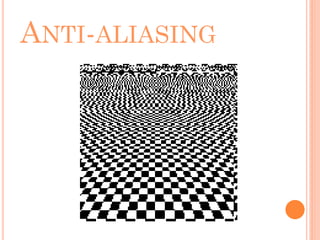
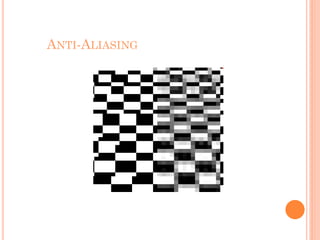
3D EFFECT: ANTI-
ALIASING
When trying to represent high
resolutions signal at lower
resolutions.
Smoothes out edges to the human eye
by blending of colors.
ANTI-ALIASING
ANTI-ALIASING
ANTI-ALIASING
ANTI-ALIASING
EXTRA FEATURES
 ATI and nVidia added enhancements to
their GPUs including:
› Anti-aliasing which makes smoother
edges for 3d objects
› Anisotropic filtering: creating crisper
images
 Dual-monitor support which can
increase productivity
 TV-tuner
DO YOU NEED A GRAPHICS
CARD?
 If you only surf the web, watch
streaming videos, chat, or word
processing, the integrated graphics
processor on your motherboard is
enough.
 If you play games or work with 3d
graphics, then a graphics card is
recommended.
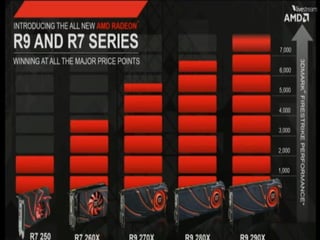
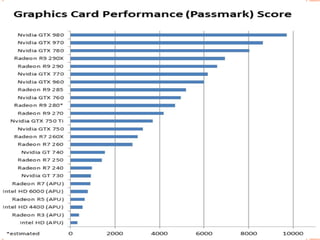
HOW TO JUDGE QUALITY OF GRAPHICS CARD?
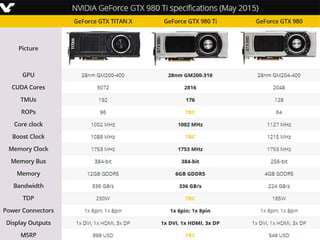
 Most of the time, you can judge the
quality of a graphics card by the processor
speed and how much memory the card
has.
 There are some sites that do benchmark
tests (www.tomshardware.com) for
comparable cards by running graphics
intensive games or environments and
measuring the frame rate (frames per
second)
 Higher the frames per second, the
smoother the transitions for frames in
MANUFACTURERS
 Intel: develop IGPs (integrated graphics
processors)
 AMD (acquired ATI) develop GPUs
 Nvidia also develop GPUs
 Different manufacturers take GPUs and
other components to assemble video cards;
thus creating slight variations of video
cards with same GPUs
 Video cards are marketed with GPU
manufacturer’s brand name
 Most popular video brands are the Radeon
of ATI and GeForce of Nvidia
IGPS VS GRAPHIC CARDS
 About 90% of computers use IGPs
 IGPs use the memory in the system
instead of having dedicated video memory
like Graphics Cards
 IGPs are way cheaper than Graphics
Cards
 Performance always favors Graphics
Cards
 Almost impossible to play high end games
on IGPs
HOW MUCH VIDEO MEMORY YOU
NEED?
Depends on resolution and bits per pixel
(how many colors possible for pixel)
32bpp = 2^32 = 4,294,967,296 colors
Minimum memory = Resolution x bpp
Example: 1024 x 768 x 32 bits per pixel
 25,165,824 bits / (8 bits per byte)
 3,145,728 bytes
 So need a little bit more than 3 MB of
memory
FUTURE
 Because of growing processor speeds, there may
be a need to develop a faster way for the CPU to
transfer bits to the GPU (like how AGP was
needed a decade ago, and PCI-E few years ago)
 With greater GPU speeds, comes greater
demand for power (a simple PCI-E connection is
not enough to power a high quality graphics
cards these days, most likely needs additional
sockets to be connected for power)
 The growth in processor speed and memory will
create higher fps at greater resolutions.
SOURCES
Howstuffworks.com
Wikipedia.org
Encarta.msn.com
Brighthub.com
Pcwize.com
https://mygaming.co.za
THANK
YOU

Graphic card information search pp

  • 1.
  • 2.
    WHAT ARE GRAPHICSCARDS? A Graphics Card is a piece of computer hardware that produces the image you see on a monitor. TheGraphics Card is responsible for rendering an image to your monitor, it does this by converting data into a signal your monitor can understand.
  • 3.
    WHAT ARE GRAPHICS CARDSUSED FOR? • Animation • Gaming – both PC and console • Design/Drafting • Special effects creation/editing • Medical Instruments • And other purposes where fast rendering and high resolutions are needed
  • 4.
    HISTORY Over the years,more colors, higher resolution, faster bus interfaces, and more memory.
  • 5.
    HISTORY Monochrome Display Adapter(MDA) was the first video card created in 1981 – displays green text on black screen Video Graphics Array (VGA) = very popular and was the standard in almost every PC up until recently First 3d video cards were released in 1995 and they used SVGA; learned to create 3d effects
  • 6.
    HISTORY  In 1983Intel made the iSBX 275 Video Graphics Controller Multimodule Board for industrial systems based on the Multibus standard.  Released in 1985, the Commodore Amiga was of first personal computers to come standard with a GPU  Nvidia was first to produce a chip capable of programmable shading, GeForce 3(code named NV20) .
  • 7.
  • 8.
  • 9.
    What is GPU?? •A GRAPHICS PROCESSING UNIT or GPU is a specialized microprocessor that discharge and accelerates 3D or 2D graphics. • Used in embedded systems, mobile phones, personal computers, workstations and game consoles.
  • 10.
    COMPONENTS  Graphics ProcessingUnit (GPU): perform calculations for rendering and figure out what to do with each pixel  Video Memory: storing images and information about each pixel  Output: Common outputs include Video Graphics Array (VGA) for CRT monitors, Digital Visual Interface (DVI) for flat panel displays, and Video-in-video-out (ViVo) for television and video cameras
  • 11.
    COMPONENTS  Heat sinkand Fan: used to cool the GPU, just like the CPU of a computer having the same cooling instruments  Motherboards: PCI before AGP  Motherboards: Accelerated Graphics Port (AGP) compatible popular decade ago; Peripheral Component Interconnect Express (PCI-E) gaining popularity  BIOS chip that stores settings, information about each component of the graphics cards, and can be altered for over-clocking
  • 12.
    HOW GRAPHICS CARDS WORK? Takedata from CPU and figure out what to do with each pixel to create image Create wire frame using vectors Fill remaining pixels with color, lighting, and texture The filling will consider viewpoint For games and video, the graphics cards has to do the above steps for 30 frames per second
  • 13.
    HOW GRAPHICS CARDS WORK? Ingreater detail: • GPU creates image, stores image with location and color of each pixel in memory • Memory also holds completed images until it’s time to display them (frame buffer) • Digital-to-analog converter (DAC) is connected to memory and translates image into analog signals that is sent through monitor cable and the image is displayed on monitor
  • 14.
  • 15.
    WIRE IMAGE Draw 12lines for cube, then fill in A curve is created by many short lines
  • 16.
  • 17.
  • 18.
    3D EFFECT: MIP-MAPPING Pre-calculated images of target image  Target image, may have several copies which is ¼ the size of previous image  Makes rendering faster when the output is moving toward and further away from a target image
  • 19.
  • 20.
    3D EFFECT: Z-BUFFERING Each pixel is part of a 2d coordinate (x-y coordinates)  Depth is z-coordinate  When a new object that is rendered wants to take a pixel, Z-buffering checks which pixel is closer to the observer, the old pixel or the new pixel based on the z- coordinate  If new pixel is closer, the new pixel is buffered and replaces old pixel
  • 21.
    3D EFFECT: ANTI- ALIASING Whentrying to represent high resolutions signal at lower resolutions. Smoothes out edges to the human eye by blending of colors.
  • 23.
  • 24.
  • 25.
  • 26.
  • 27.
    EXTRA FEATURES  ATIand nVidia added enhancements to their GPUs including: › Anti-aliasing which makes smoother edges for 3d objects › Anisotropic filtering: creating crisper images  Dual-monitor support which can increase productivity  TV-tuner
  • 28.
    DO YOU NEEDA GRAPHICS CARD?  If you only surf the web, watch streaming videos, chat, or word processing, the integrated graphics processor on your motherboard is enough.  If you play games or work with 3d graphics, then a graphics card is recommended.
  • 29.
    HOW TO JUDGEQUALITY OF GRAPHICS CARD?  Most of the time, you can judge the quality of a graphics card by the processor speed and how much memory the card has.  There are some sites that do benchmark tests (www.tomshardware.com) for comparable cards by running graphics intensive games or environments and measuring the frame rate (frames per second)  Higher the frames per second, the smoother the transitions for frames in
  • 30.
    MANUFACTURERS  Intel: developIGPs (integrated graphics processors)  AMD (acquired ATI) develop GPUs  Nvidia also develop GPUs  Different manufacturers take GPUs and other components to assemble video cards; thus creating slight variations of video cards with same GPUs  Video cards are marketed with GPU manufacturer’s brand name  Most popular video brands are the Radeon of ATI and GeForce of Nvidia
  • 36.
    IGPS VS GRAPHICCARDS  About 90% of computers use IGPs  IGPs use the memory in the system instead of having dedicated video memory like Graphics Cards  IGPs are way cheaper than Graphics Cards  Performance always favors Graphics Cards  Almost impossible to play high end games on IGPs
  • 37.
    HOW MUCH VIDEOMEMORY YOU NEED? Depends on resolution and bits per pixel (how many colors possible for pixel) 32bpp = 2^32 = 4,294,967,296 colors Minimum memory = Resolution x bpp Example: 1024 x 768 x 32 bits per pixel  25,165,824 bits / (8 bits per byte)  3,145,728 bytes  So need a little bit more than 3 MB of memory
  • 38.
    FUTURE  Because ofgrowing processor speeds, there may be a need to develop a faster way for the CPU to transfer bits to the GPU (like how AGP was needed a decade ago, and PCI-E few years ago)  With greater GPU speeds, comes greater demand for power (a simple PCI-E connection is not enough to power a high quality graphics cards these days, most likely needs additional sockets to be connected for power)  The growth in processor speed and memory will create higher fps at greater resolutions.
  • 39.
  • 40.