GPU – Graphic Processing Unit
Hao Yu
Computer Architecture and Design
Content
• Instruction
• History
• Different types of GPUs
• Recent Development
Instruction
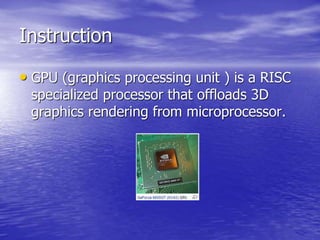
• GPU (graphics processing unit ) is a RISC
specialized processor that offloads 3D
graphics rendering from microprocessor.
Instruction
• GPUs are mainly used in embedded
systems, mobile phones, personal
computers, workstations and game
consoles.
History of graphics cards
• The first graphics card was developed
by IBM in 1981. The first cards had just
2, 4 or 16 colors. In 1987, the first
graphics card with 256 colors was
released, and in 1990, the first card
with memory over a MB was released by
IBM. All these cards are very low
quality compared to today’s cards
• 1970s:
ANTIC and CTIA chips provided for hardware control of mixed
graphics and text modes, sprite positioning and display, and other
operations based on Atari 8-bit computers.
• 1980s:
IBM Professional Graphics Controller was one of the very first 2D/3D
graphics accelerators available for the IBM PC, released in 1984. But
it was expensive, slow and lack of compatibility.
History
• 1990s:
S3 Graphics introduced the first single-chip 2D accelerator (S3
86C911); in mid-1990s, PlayStation and Nintendo 64 developed
hardware-accelerated 3D graphics for the requirement of game
market.
• 2000s:
NVIDIA was first to produce a chip capable of programmable
shading, GeForce 3 (NV20); Oct. 2002, ATI Radeon 9700 (R300),
was introduced as the world’s first Direct3D 9.0 accelerator.
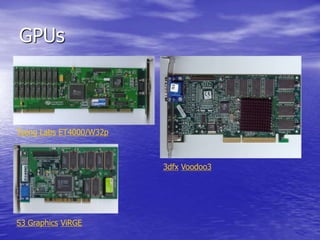
GPUs
Tseng Labs ET4000/W32p
S3 Graphics ViRGE
3dfx Voodoo3
Different types of GPUs
• Dedicated Graphics Card
• Integrated Graphics
• Hybrid Graphics
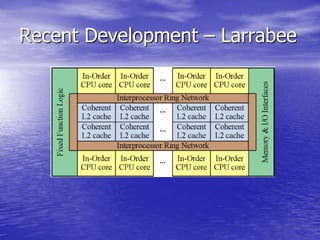
Recent Development – Larrabee
• Differences from other GPUs
1. Larrabee will use the x86 instruction set with
Larrabee-specific extensions;
2. Larrabee will feature cache coherency across all
its cores;
3. Larrabee will include little specialized graphics
hardware, by using a tile-based rendering way.
• More flexible
How does it work?
• When your PC wants to display
something on your monitor, the CPU
sends information to the graphics card,
which decides how to use the pixels, and
sends the data to the monitor.
• The graphics cards can be connected in
many different outputs. The most basic
ones are VGA made in the 1980s. Now
mostly DVI connection is used, and it
has the ability to connect to LCDs.
Graphics card outputs
Thanks!

Presentation Graphic cards - History

  • 1.
    GPU – GraphicProcessing Unit Hao Yu Computer Architecture and Design
  • 2.
    Content • Instruction • History •Different types of GPUs • Recent Development
  • 3.
    Instruction • GPU (graphicsprocessing unit ) is a RISC specialized processor that offloads 3D graphics rendering from microprocessor.
  • 4.
    Instruction • GPUs aremainly used in embedded systems, mobile phones, personal computers, workstations and game consoles.
  • 5.
    History of graphicscards • The first graphics card was developed by IBM in 1981. The first cards had just 2, 4 or 16 colors. In 1987, the first graphics card with 256 colors was released, and in 1990, the first card with memory over a MB was released by IBM. All these cards are very low quality compared to today’s cards
  • 6.
    • 1970s: ANTIC andCTIA chips provided for hardware control of mixed graphics and text modes, sprite positioning and display, and other operations based on Atari 8-bit computers. • 1980s: IBM Professional Graphics Controller was one of the very first 2D/3D graphics accelerators available for the IBM PC, released in 1984. But it was expensive, slow and lack of compatibility.
  • 7.
    History • 1990s: S3 Graphicsintroduced the first single-chip 2D accelerator (S3 86C911); in mid-1990s, PlayStation and Nintendo 64 developed hardware-accelerated 3D graphics for the requirement of game market. • 2000s: NVIDIA was first to produce a chip capable of programmable shading, GeForce 3 (NV20); Oct. 2002, ATI Radeon 9700 (R300), was introduced as the world’s first Direct3D 9.0 accelerator.
  • 8.
    GPUs Tseng Labs ET4000/W32p S3Graphics ViRGE 3dfx Voodoo3
  • 9.
    Different types ofGPUs • Dedicated Graphics Card • Integrated Graphics • Hybrid Graphics
  • 10.
  • 11.
    Recent Development –Larrabee • Differences from other GPUs 1. Larrabee will use the x86 instruction set with Larrabee-specific extensions; 2. Larrabee will feature cache coherency across all its cores; 3. Larrabee will include little specialized graphics hardware, by using a tile-based rendering way. • More flexible
  • 12.
    How does itwork? • When your PC wants to display something on your monitor, the CPU sends information to the graphics card, which decides how to use the pixels, and sends the data to the monitor.
  • 13.
    • The graphicscards can be connected in many different outputs. The most basic ones are VGA made in the 1980s. Now mostly DVI connection is used, and it has the ability to connect to LCDs. Graphics card outputs
  • 14.