Graphene field effect transistor simulation with tcad on top-gate dielectric influence
1) The document presents a simulation of a graphene field-effect transistor (GFET) using technology computer-aided design (TCAD) software to analyze the influence of different top-gate dielectric materials.
2) The simulation shows that using high-k dielectric materials like hafnium oxide and aluminum oxide improves the electrical properties of the GFET, increasing saturation drain current and the on/off current ratio compared to silicon-based dielectric materials.
3) Varying the thickness of the dielectric materials, the simulation found that a very thin layer of high-k dielectric is needed to maximize the critical electrical parameters of the GFET.
ISSN: 1693-6930
TELKOMNIKAVol. 17, No. 4, August 2019: 1845-1852
1846
On the other hand, top-gate dielectric material is also identified as one of the main
parameters which have also contributed to the overall GFET characteristics and
performances [16]. There are several dielectric materials available in the semiconductor
industry, ranging from classical silicon-based material such as silicon dioxide (SiO2) and silicon
nitride (Si3N4), to refined high-k dielectric material such as aluminum oxide (Al2O3) and hafnium
oxide (HfO2) [17]. Although there are different literatures reported for different type of dielectric
materials used in their GFET structures, there is no thorough analysis provided on
the influences of dielectric material based on the same device structure [18, 19].
Considering the importance of critical electrical parameters such as saturation drain
current, Ion and Ioff to the different device applications, this paper is focusing on the effect of
several top-gate dielectric materials used in GFET structure for electrical parameter’s
improvements. This work takes the advantages of TCAD simulation to circumvent the laborious,
lengthy and costly experiments of real wafer in view of early in-house technology development.
The influences of high-k dielectric used as a top-gate material on transfer and output
characteristic curves are investigated. Electrical characteristics for different top-gate oxide
thicknesses are also studied. The outcome would impart a satisfactory guidance to the process
engineer in selecting suitable dielectric material and thickness accordingly.
2. GFET Simulation with Sentaurus TCAD
Similar to other transistor’s behaviors, GFET is also identified by its transfer and output
characteristic curves. But compared to the normal CMOS transistor, GFET is unique because its
transfer characteristic or drain current versus gate voltage (Id-Vg) plot shows an ambipolar
behavior where single device is represented by both hole and electron conductions, depending
on voltage applied to the gate terminal. The inflection point between these hole and electron
conductions is marked by the Dirac voltage (VDirac) which also represents the maximum
resistance and minimum current. As a zero bandgap material, the graphene layer in
the transistor’s channel cannot be turned off as the leakage current is just too high. For output
characteristic curves or drain current versus drain voltage (Id-Vd) plot, some literatures reported
that no saturation current could be generated due to high contact resistances while some
observed a mild saturation region [8, 19]. Either with or without mild saturation current value, it
is actually another major drawback to GFET as it cannot be used for the high speed applications
of digital and analog designs.
In mimicking the complete GFET fabrication flow, Sentaurus TCAD software from
Synopsys was utilized in this work as it contains both process and device simulations [20]. For
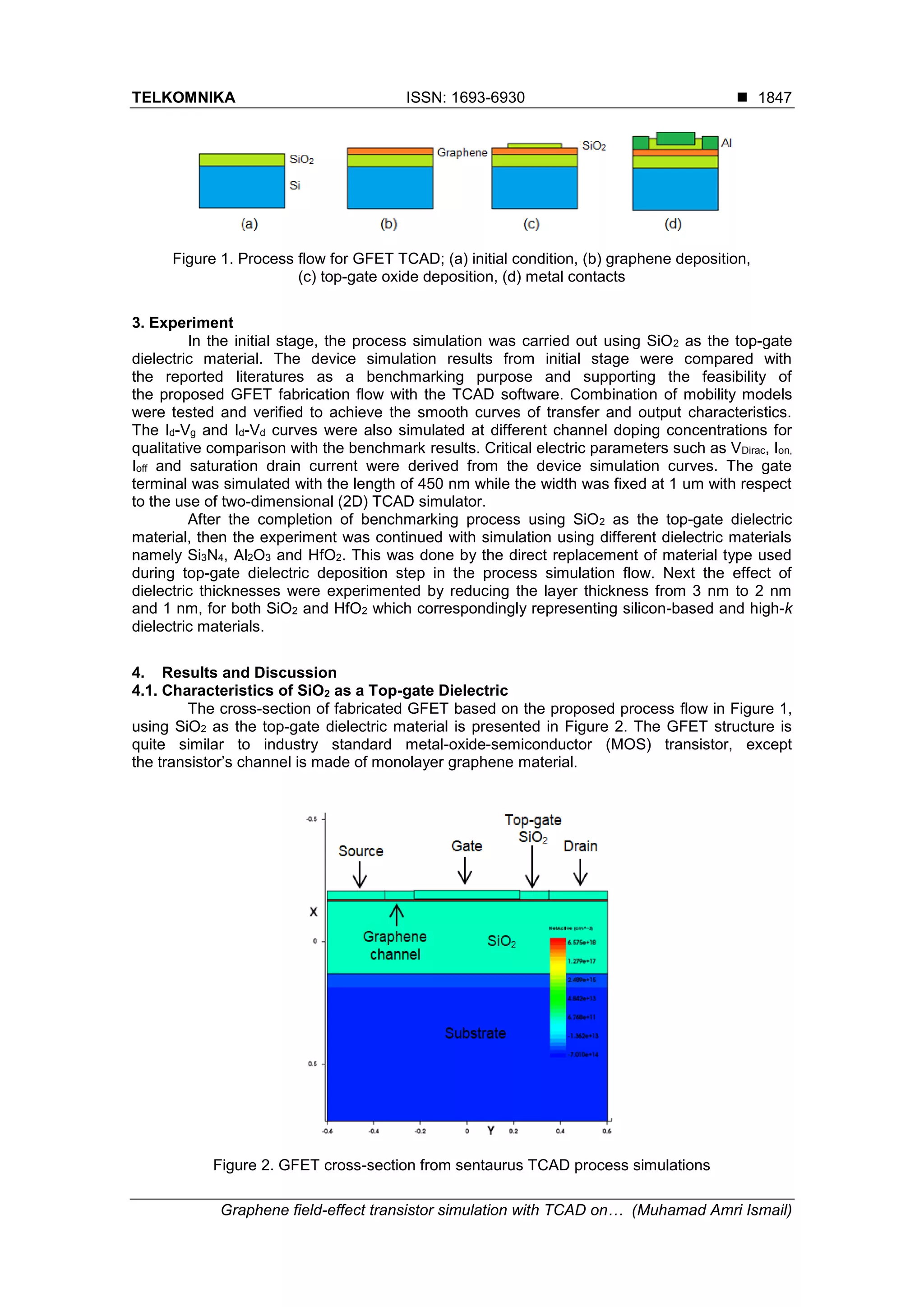
process simulation, there are several fabrication steps involved as simplified in Figure 1.
The initial condition is a p-type boron-doped silicon at 1x1015 cm-3 concentration. Next, silicon
dioxide at 300 nm thickness was deposited using diffusion process with dry oxygen at 1000 ˚C
for 880 minutes. After that, graphene layer was deposited at 5 nm thickness. From typical
process simulation point of view, graphene is not a standard material offered by any TCAD
software hence polysilicon was chosen as transistor’s channel region for this work. As
polysilicon is not a self-doping layer while graphene layer is, arsenic at 5x1015 cm-3
concentration was doped to the polysilicon layer to represent such effect. Then, 3 nm thickness
of silicon dioxide was diffused and aligned accordingly to gate structure on top of the graphene
layer to represent the GFET’s top-gate dielectric layer. For the contact formation, 35 nm
thickness of aluminum (Al) was deposited and aligned to the contact mask.
Modification of standard polysilicon material properties is mandatory to really represent
the actual monolayer graphene properties to the transistor’s channel. For this purpose,
particularly with the use of Sentaurus TCAD process platform, several material parameters are
involved namely bandgap, carrier mobility, permittivity ratio of graphene and vacuum as well
constant mobility, as proposed by Ciarrocchi [21]. For the device time-dependent simulation,
the selection of suitable transport models is crucial in order to find the right combination for both
recombination and carrier mobility models. In Sentaurus TCAD device simulation, recombination
phenomenon is modelled with standard Shockley Read Hall (SRH) model while there are
several carrier mobility models available such as Philips unified mobility (PhuMob), high field
saturation and normal electric field (Enormal) [22]. Good model combinations are required to get
the smooth transfer characteristic curves especially at the VDirac region which is the transition
from hole to electron conductions.
3.
TELKOMNIKA ISSN: 1693-6930
Graphene field-effect transistor simulation with TCAD on… (Muhamad Amri Ismail)
1847
Figure 1. Process flow for GFET TCAD; (a) initial condition, (b) graphene deposition,
(c) top-gate oxide deposition, (d) metal contacts
3. Experiment
In the initial stage, the process simulation was carried out using SiO2 as the top-gate
dielectric material. The device simulation results from initial stage were compared with
the reported literatures as a benchmarking purpose and supporting the feasibility of
the proposed GFET fabrication flow with the TCAD software. Combination of mobility models
were tested and verified to achieve the smooth curves of transfer and output characteristics.
The Id-Vg and Id-Vd curves were also simulated at different channel doping concentrations for
qualitative comparison with the benchmark results. Critical electric parameters such as VDirac, Ion,
Ioff and saturation drain current were derived from the device simulation curves. The gate
terminal was simulated with the length of 450 nm while the width was fixed at 1 um with respect
to the use of two-dimensional (2D) TCAD simulator.
After the completion of benchmarking process using SiO2 as the top-gate dielectric
material, then the experiment was continued with simulation using different dielectric materials
namely Si3N4, Al2O3 and HfO2. This was done by the direct replacement of material type used
during top-gate dielectric deposition step in the process simulation flow. Next the effect of
dielectric thicknesses were experimented by reducing the layer thickness from 3 nm to 2 nm
and 1 nm, for both SiO2 and HfO2 which correspondingly representing silicon-based and high-k
dielectric materials.
4. Results and Discussion
4.1. Characteristics of SiO2 as a Top-gate Dielectric
The cross-section of fabricated GFET based on the proposed process flow in Figure 1,
using SiO2 as the top-gate dielectric material is presented in Figure 2. The GFET structure is
quite similar to industry standard metal-oxide-semiconductor (MOS) transistor, except
the transistor’s channel is made of monolayer graphene material.
Figure 2. GFET cross-section from sentaurus TCAD process simulations
4.
ISSN: 1693-6930
TELKOMNIKAVol. 17, No. 4, August 2019: 1845-1852
1848
The simulated transfer characteristic using different combination of mobility models are
presented in Figure 3. The results show that the combination of Philips unified (PhuMob) and
high field saturation models provide the smoothest curves as compared to other combinations.
The inclusion of Enormal mobility model generally contributed to the unnecessary kink effect at
the VDirac point. Therefore only PhuMob and high field saturation models are selected for mobility
models while SRH is used for recombination model for the rest of this work.
Figure 4 shows the ambipolar characteristics of Id-Vg curves for GFET with SiO2 as a
top-gate dielectric material, biased at different drain voltage (Vd). Based on this TCAD
simulation works, the most significant graphene properties are the bandgap and carrier mobility
where the former is particularly producing the ambipolar curves valid from negative to positive
gate voltage (Vg) while the latter is imperative for symmetrical shape of the transfer
characteristic curves. It is observed that both Ion and Ioff increase with the increased of Vd while
both VDirac and Ion/Ioff values remain unchanged.
Besides that, Ion is decreases with the increased of doping concentration of channel’s
region as shown in Figure 5 for Vd = 0.2 V. There is a shift of the VDirac, from -0.72 V to -0.60 V
respectively for the doping concentration of 1x1015 cm-3 and 1x1019 cm-3, which is supporting
the idea of tuning the GFET polarity by amending graphene concentration level at certain
values [23]. Both outcome of Figure 4 and 5 are critical as benchmarking purposes which are
consistent with the results obtained by Johirul et al [9]. The sensitivities of graphene material to
voltage and doping concentration variations further promoted its suitability to be well qualified
for sensor applications [11].
Figure 3. Transfer characteristic curves from
different combinations of mobility models
Figure 4. Transfer characteristic curves at
different drain voltages (Vd)
Figure 5. Transfer characteristic curves at different channel doping concentrations
5.
TELKOMNIKA ISSN: 1693-6930
Graphene field-effect transistor simulation with TCAD on… (Muhamad Amri Ismail)
1849
The drain current as a function of drain voltage with different channel doping
concentrations and gate voltages is presented in Figure 6. The simulated results show that
saturation drain current decreases with increasing channel doping concentration. On
the contrary, the saturation drain current increases with increasing biased gate voltage.
These results are also qualitatively comparable with the reported data by Johirul and Thingujam
et al [14, 15]. It is worth noting that hydrodynamic model is included during the simulation of
output characteristic curves in order to increase the accuracies. It slightly increased
the simulation time but necessary for normal Id-Vd curves, or else the fast and simple model
simulations end up with unnecessary resistor characteristics.
Figure 6. Output characteristic curves at different channel doping concentrations
4.2. GFET Simulations at Various Top-gate Dielectric Materials
The transfer characteristic curves of SiO2, Si3N4, Al2O3 and HfO2 as the top-gate
dielectric material at film thickness of 3 nm are illustrated in Figure 7 (a). The maximum Ion is
about 121 uA by using HfO2 followed by Al2O3 and Si3N4 as the experimental materials
respectively at 118 uA and 117 uA. The lowest Ion produced from initial benchmark material of
SiO2 at about 114 uA, which is 6% lower compared to the highest Ion value. The results show
that the Ion value increases with the use of high-k top-gate dielectric material where both HfO2
and Al2O3 are superior as compared to silicon-based dielectric of Si3N4 and SiO2. Besides that
the use of high-k dielectric material also leads to the positive shift of VDirac from -0.72 V using
SiO2 to -0.48 V using HfO2. Both Si3N4 and Al2O3 though shared same VDirac at -0.54 V.
Interestingly all of the top-gate dielectric materials generated about the same value of Ioff at
99 uA to make the ratio of Ion/Ioff increased from 1.15 of SiO2 to 1.18, 1.19 and 1.22
correspondingly to Si3N4, Al2O3 and HfO2. These results exhibit that the use of HfO2 is the best
option for the overall improvement to the critical electrical parameters such as Ion and ratio
of Ion/Ioff.
The output characteristic curves of various top-gate dielectric materials used during
device simulation experimentations are depicted in Figure 7 (b). Consistent with transfer
characteristic curves of Figure 7 (a), the Id-Vd plot also shows that HfO2 yielded the highest
saturation drain current while SiO2 produced the lowest saturation drain current. Based on these
simulated curves, about 12% improvement of saturation drain current can be observed by
replacing the top-gate dielectric material from SiO2 to HfO2. These results agree well with
current graphene-based transistor’s engineering towards the use of high-k dielectric material for
better device performance [24]. With respect to this distinguished comparison between SiO2 and
HfO2, the rest of comparisons are done based on these two dielectric materials.
6.
ISSN: 1693-6930
TELKOMNIKAVol. 17, No. 4, August 2019: 1845-1852
1850
(a) (b)
Figure 7. Simulation curves at various top-gate dielectric materials:
(a) transfer characteristic and (b) output characteristics
4.3. GFET Simulations at Different Top-gate Dielectric Thicknesses
Figure 8 (a) and 8 (b) show the result of device simulations using SiO2 respectively for
transfer and output characteristic curves at different top-gate dielectric thicknesses. For Id-Vg
plot, there is a consistent increase of Ion when the dielectric thickness reduced from 3 nm to
2 nm and 1 nm. The results show that Ion improves by 6% to 121 uA, as the thickness is
reduced to 1 nm. There is also a shift of VDirac observed from -0.72 V to -0.6 V and -0.48 V when
the thickness reduced from 3 nm to 2 nm and 1 nm accordingly. Furthermore, the ratio of Ion/Ioff
increases about 6% with reduction of top-gate dielectric thickness from the minimum of 1.15 to
the maximum of 1.22 as constant Ioff value extracted even at different dielectric thicknesses
applied. For Id-Vd plot, the results show that the saturation drain current increases with reduction
of dielectric thickness, which is consistent with Id-Vg plot.
Figure 9 (a) and 9 (b) illustrate correspondingly the Id-Vg and Id-Vd characteristics with
HfO2 as the top-gate dielectric material at different dielectric thicknesses. It is seen that Ion is
slightly increases with the reduction of dielectric thickness for Id-Vg curves while the saturation
drain current rises by 5% to 4.85 mA as the thickness is decreased from 3 nm to 1 nm for Id-Vd
curves. The overall results of HfO2 simulations are harmonious with previous SiO2 results which
exhibit both silicon-based and high-k dielectric materials produce better electrical parameters
with the decreasing of dielectric thickness. These attainments also match well with
contemporary GFET development in the vicinity of an ultra-thin dielectric material [25].
(a) (b)
Figure 8. Simulation curves at different top-gate dielectric thicknesses for SiO2:
(a) transfer characteristics and (b) output characteristics
7.
TELKOMNIKA ISSN: 1693-6930
Graphene field-effect transistor simulation with TCAD on… (Muhamad Amri Ismail)
1851
(a) (b)
Figure 9. Simulation curves at different top-gate dielectric thicknesses for HfO2:
(a) transfer characteristics and (b) output characteristics
5. Conclusion
The improvement to the saturation drain current and ratio of Ion/Ioff for GFET
characteristics were successfully evaluated using TCAD simulations under varying top-gate
dielectric materials and thicknesses. The high-k dielectric material has been investigated where
the replacement of SiO2 to HfO2 shows an improvement in saturation drain current about 12%.
The outcomes also reveal that the replacement to HfO2 improves the ratio of Ion/Ioff about 6%
compared to SiO2. For the variations of dielectric thickness, the ratio of Ion/Ioff increased by about
6% when dielectric thickness was reduced from 3 nm to 1 nm for SiO2 material, which provides
option for silicon-based dielectric refinement. These consequences are precious for the process
engineers in determining the suitable top-gate dielectric material with related thickness for
actual process fabrications with respect to the available optimized recipes and equipment.
References
[1] Geim AK, Novoselov KS. The Rise of Graphene. Nature Materials. 2007; 6(3): 183-191.
[2] Geim AK. Graphene: Status and Prospects. Science. 2009; 324(5934): 1530-1534.
[3] Hancock Y. The 2010 Nobel Prize in Physics-Ground-breaking Experiments on Graphene. Physics
D: Applied Physics. 2011; 44(47): 1-12.
[4] Choi W, Lahiri I, Seelaboyina R, Kang YS. Synthesis of Graphene and Its Applications: A Review.
Critical Reviews in Solid State and Material Sciences. 2010; 35(1): 52-71.
[5] Kuila T, Bose S, Mishra AK, Khanra P, Kim NH, Lee JH. Chemical Functionalization of Graphene
and Its Applications. Progress in Materials Science. 2012; 57(7): 1061-1105.
[6] Reddy D, Register LF, Carpenter D, Banerjee SK. Graphene Field-Effect Transistor. Physics D:
Applied Physics. 2011; 44(31): 1-12.
[7] Anteroinen J. Structure and Electrical Characteristics of Graphene Field Effect Transistors. Master
Thesis. Espoo: Aalto University; 2011.
[8] Schwierz F. Graphene Transistors. Nature Nanotechnology. 2010; 5(10): 487-496.
[9] Vaziri S, Lupina G, Henkel C, Smith AD, Ostling M, Dabrowski J, Lippert G, Mehr W, Lemme MC. A
Graphene-based Hot Electron Transistor. Nano Lett. 2013; 13(4): 1435-1439.
[10] Petrone N, Meric I, Hone J, Shepard KL. Graphene Field-Effect Transistors with Gigahertz-frequency
Power Gain on Flexible Substrate. Nano Lett. 2013; 13(1): 121-125.
[11] Zhan B, Li C, Yang J, Jenkins G, Huang W, Dong X. Graphene Field-Effect Transistor and Its
Application for Electronic Sensing. Small. 2014; 10(20): 1-24.
[12] Blom A, Stokbro K. Towards Realistic Atomic-Scale Modeling of Nanoscale Devices. IEEE
International Conference on Nanotechnology. Portland. 2011; 1487-1492.
[13] Hafsi B, Boubaker A, Ismail N, Kalboussi A, Lmimouni K. TCAD Simulations of Graphene Field-Effect
Transistors Based on Quantum Capacitance Effect. Korean Physical Society. 2015; 67(7):
1201-1207.
[14] Johirul M, Sami R, Islam MS, Chowdhury MIB. Study of Characteristics Curves Top-Gated Graphene
FET Using Silvaco TCAD. Electronic Design Engineering. 2017; 3(3): 1-9.
8.
ISSN: 1693-6930
TELKOMNIKAVol. 17, No. 4, August 2019: 1845-1852
1852
[15] Thingujam T, Jolson K, Kumar M, Sarkar SK. TCAD Based Modeling and Simulation of Graphene
Nanostructured FET (GFET) for High Frequency Performance. Engineering Technology. 2017;
6(1): 1-5.
[16] Shostachenko SA, Zakharchenko RV, Zebrev GI, Stanishevkiy YM, Kargin NI. Dielectric Influence on
IV curve of Graphene Field Effect Transistor. International Conference on Micro-and
Nano-Electronics. Zvenigorod. 2016: 1-5.
[17] Kundu P, Yadav R. Effect of High-K Dielectric Materials on Leakage Current. Electronics and
Computer Science Engineering. 2009; 1(3): 1454-1458.
[18] Lemme MC, Echtermeyer TJ, Baus M, Kurz H. A Graphene Field Effect Device. IEEE Electron
Device Letters. 2007; 28(4): 282-284.
[19] Meric I, Han MY, Young AF, Ozyilmaz B, Kim P, Shepard KL. Current Saturation in Zero-bandgap,
Top-Gated Graphene Field-Effect Transistors. Nature Nanotechnology. 2008; 3(11): 654-659.
[20] Pandit S. Study of Deep Sub-Micron VLSI MOSFET through TCAD. In: Sarkar CK. Editors.
Technology Computer Aided Design: Simulation for VLSI MOSFET. 1st ed. Boca Raton: CRC Press;
2013: 237-266.
[21] Ciarrocchi A. Graphene and 2D Materials for Radiation Detection Devices. Master Thesis. Pisa:
University of Pisa; 2016.
[22] Nier O. Development of TCAD Modeling for Low Field Electronics Transport and Strain Engineering
in Advanced Fully Depleted Silicon on Insulator (FDSOI) CMOS Transistors. PhD Thesis. Grenoble:
Universite Grenoble Alpes; 2015.
[23] Li H, Zhang Q, Liu C, Xu S, Gao P. Ambipolar to Unipolar Conversion in Graphene Field-Effect
Transistors. ACS Nano. 2011; 5(4): 3198-3203.
[24] Zou X, Huang CW, Wang L, Yin LJ, Li W, Wang J, Wu B, Liu Y, Yao Q, Jiang C, Wu WW, He L,
Chen S, Ho Jc, Liao L. Dielectric Engineering of a Boron Nitride/Hafnium Oxide Heterostructure for
High-Performance 2D Field Effect Transistor. Advanced Materials. 2016; 28(10): 2062-2069.
[25] Xiao M, Qiu C, Zhang Z, Peng LM. Atomic-Layer-Deposition Growth of Ultra-Thin HfO2 Film on
Graphene. ACS Appl. Mater. Interfaces. 2017; 9(39): 34050-34056.
![TELKOMNIKA, Vol.17, No.4, August 2019, pp.1845~1852
ISSN: 1693-6930, accredited First Grade by Kemenristekdikti, Decree No: 21/E/KPT/2018
DOI: 10.12928/TELKOMNIKA.v17i4.12760 1845
Received October 12, 2018; Revised January 28, 2019; Accepted March 1, 2019
Graphene field-effect transistor simulation with TCAD
on top-gate dielectric influences
Muhamad Amri Ismail*, Khairil Mazwan Mohd Zaini, Mohd Ismahadi Syono
Advanced Device Lab, MIMOS Semiconductor (M) Sdn. Bhd., Malaysia
tel/fax: +603 8995 5000
*Corresponding author, e-mail: amris@mimos.my
Abstract
This paper presents the influence of top-gate dielectric material for graphene field-effect
transistor (GFET) using TCAD simulation. Apart from silicon-based dielectric that is typically used for
top-gate structure, other high-dielectric constant (high-k) dielectric materials namely aluminum oxide and
hafnium oxide are also involved in the analysis deliberately to improve the electrical properties of the
GFET. The unique GFET current-voltage characteristics against several top-gate dielectric thicknesses are
also investigated to guide the wafer fabrication engineers during the process optimization stage.
The improvement to critical electrical parameters of GFET in terms of higher saturation drain current and
greater on/off current ratio shows that the use of high-k dielectric material with very thin oxide layer is
absolutely necessary.
Keywords: ambipolar characteristics, graphene FET (GFET), high-k dielectric, monolayer graphene,
TCAD simulations
Copyright © 2019 Universitas Ahmad Dahlan. All rights reserved.
1. Introduction
Technology scaling of CMOS transistor is approaching its physical limit and GFET is
promoted to be one of the worthy candidates with respect to its advanced material properties.
This is started with the breakthrough work by Geim and Novoselov in GFET fabrication and
characterization using mechanical exfoliation method, which later managed to win the Nobel
Prize in Physics 2010 [1-3]. Besides mechanical exfoliation, other methods typically used for
graphene synthetization are thermal chemical vapor deposition (CVD) and sublimation of silicon
carbide (SiC) where each of these methods contains its own advantages and disadvantages.
Different synthesis methods will produce different graphene properties which are suitable for
certain device and design applications [4, 5].
Large-area GFET is desirable with respect to its real manufacturability prospect,
compared to another graphene-based transistor namely graphene nanoribbons (GNR) [6, 7].
However large-area GFET actually suffer a significance disadvantage with regards to its zero
bandgap material properties which contributed to high leakage current and very low ratio of
highest on-current (Ion) over lowest off-current (Ioff) [8, 9]. This is also the main reason that has
hindered GFET advancement in the forefront digital and analog design applications.
Nevertheless manufacturable GFET is still applicable and desired in radio frequency (RF),
sensors and detector applications where the ratio of Ion/Ioff is not necessarily significant [10, 11].
Technology Computer-Aided Design (TCAD) is well-known in semiconductor industry
as tool for process and device simulations useful for pre-silicon characterizations and
optimizations. Although TCAD is loaded with advantages required in technology development
phase, there are just minimal reports to be found in literatures linking TCAD with GFET. This is
understandably due to the missing graphene material properties in the software and accurate
quantum models which require another expensive simulation tool to be integrated to the overall
flow for accurate device analysis [12]. In overcoming these obstacles, GFET is simulated with
TCAD in the consideration of quantum capacitance effects as reported by Hafsi et al [13].
Besides that, there are works that described the feasibility of GFET simulation with TCAD, by
modifying the default material properties, such as bandgap, effective density of states,
permittivity and the mobility of the carriers [14, 15].](https://image.slidesharecdn.com/graphenefield-effecttransistorsimulationwithtcadontop-gatedielectricinfluence-211202061732/75/Graphene-field-effect-transistor-simulation-with-tcad-on-top-gate-dielectric-influence-1-2048.jpg)
![ ISSN: 1693-6930
TELKOMNIKA Vol. 17, No. 4, August 2019: 1845-1852
1846
On the other hand, top-gate dielectric material is also identified as one of the main
parameters which have also contributed to the overall GFET characteristics and
performances [16]. There are several dielectric materials available in the semiconductor
industry, ranging from classical silicon-based material such as silicon dioxide (SiO2) and silicon
nitride (Si3N4), to refined high-k dielectric material such as aluminum oxide (Al2O3) and hafnium
oxide (HfO2) [17]. Although there are different literatures reported for different type of dielectric
materials used in their GFET structures, there is no thorough analysis provided on
the influences of dielectric material based on the same device structure [18, 19].
Considering the importance of critical electrical parameters such as saturation drain
current, Ion and Ioff to the different device applications, this paper is focusing on the effect of
several top-gate dielectric materials used in GFET structure for electrical parameter’s
improvements. This work takes the advantages of TCAD simulation to circumvent the laborious,
lengthy and costly experiments of real wafer in view of early in-house technology development.
The influences of high-k dielectric used as a top-gate material on transfer and output
characteristic curves are investigated. Electrical characteristics for different top-gate oxide
thicknesses are also studied. The outcome would impart a satisfactory guidance to the process
engineer in selecting suitable dielectric material and thickness accordingly.
2. GFET Simulation with Sentaurus TCAD
Similar to other transistor’s behaviors, GFET is also identified by its transfer and output
characteristic curves. But compared to the normal CMOS transistor, GFET is unique because its
transfer characteristic or drain current versus gate voltage (Id-Vg) plot shows an ambipolar
behavior where single device is represented by both hole and electron conductions, depending
on voltage applied to the gate terminal. The inflection point between these hole and electron
conductions is marked by the Dirac voltage (VDirac) which also represents the maximum
resistance and minimum current. As a zero bandgap material, the graphene layer in
the transistor’s channel cannot be turned off as the leakage current is just too high. For output
characteristic curves or drain current versus drain voltage (Id-Vd) plot, some literatures reported
that no saturation current could be generated due to high contact resistances while some
observed a mild saturation region [8, 19]. Either with or without mild saturation current value, it
is actually another major drawback to GFET as it cannot be used for the high speed applications
of digital and analog designs.
In mimicking the complete GFET fabrication flow, Sentaurus TCAD software from
Synopsys was utilized in this work as it contains both process and device simulations [20]. For
process simulation, there are several fabrication steps involved as simplified in Figure 1.
The initial condition is a p-type boron-doped silicon at 1x1015 cm-3 concentration. Next, silicon
dioxide at 300 nm thickness was deposited using diffusion process with dry oxygen at 1000 ˚C
for 880 minutes. After that, graphene layer was deposited at 5 nm thickness. From typical
process simulation point of view, graphene is not a standard material offered by any TCAD
software hence polysilicon was chosen as transistor’s channel region for this work. As
polysilicon is not a self-doping layer while graphene layer is, arsenic at 5x1015 cm-3
concentration was doped to the polysilicon layer to represent such effect. Then, 3 nm thickness
of silicon dioxide was diffused and aligned accordingly to gate structure on top of the graphene
layer to represent the GFET’s top-gate dielectric layer. For the contact formation, 35 nm
thickness of aluminum (Al) was deposited and aligned to the contact mask.
Modification of standard polysilicon material properties is mandatory to really represent
the actual monolayer graphene properties to the transistor’s channel. For this purpose,
particularly with the use of Sentaurus TCAD process platform, several material parameters are
involved namely bandgap, carrier mobility, permittivity ratio of graphene and vacuum as well
constant mobility, as proposed by Ciarrocchi [21]. For the device time-dependent simulation,
the selection of suitable transport models is crucial in order to find the right combination for both
recombination and carrier mobility models. In Sentaurus TCAD device simulation, recombination
phenomenon is modelled with standard Shockley Read Hall (SRH) model while there are
several carrier mobility models available such as Philips unified mobility (PhuMob), high field
saturation and normal electric field (Enormal) [22]. Good model combinations are required to get
the smooth transfer characteristic curves especially at the VDirac region which is the transition
from hole to electron conductions.](https://image.slidesharecdn.com/graphenefield-effecttransistorsimulationwithtcadontop-gatedielectricinfluence-211202061732/75/Graphene-field-effect-transistor-simulation-with-tcad-on-top-gate-dielectric-influence-2-2048.jpg)
![ ISSN: 1693-6930
TELKOMNIKA Vol. 17, No. 4, August 2019: 1845-1852
1848
The simulated transfer characteristic using different combination of mobility models are
presented in Figure 3. The results show that the combination of Philips unified (PhuMob) and
high field saturation models provide the smoothest curves as compared to other combinations.
The inclusion of Enormal mobility model generally contributed to the unnecessary kink effect at
the VDirac point. Therefore only PhuMob and high field saturation models are selected for mobility
models while SRH is used for recombination model for the rest of this work.
Figure 4 shows the ambipolar characteristics of Id-Vg curves for GFET with SiO2 as a
top-gate dielectric material, biased at different drain voltage (Vd). Based on this TCAD
simulation works, the most significant graphene properties are the bandgap and carrier mobility
where the former is particularly producing the ambipolar curves valid from negative to positive
gate voltage (Vg) while the latter is imperative for symmetrical shape of the transfer
characteristic curves. It is observed that both Ion and Ioff increase with the increased of Vd while
both VDirac and Ion/Ioff values remain unchanged.
Besides that, Ion is decreases with the increased of doping concentration of channel’s
region as shown in Figure 5 for Vd = 0.2 V. There is a shift of the VDirac, from -0.72 V to -0.60 V
respectively for the doping concentration of 1x1015 cm-3 and 1x1019 cm-3, which is supporting
the idea of tuning the GFET polarity by amending graphene concentration level at certain
values [23]. Both outcome of Figure 4 and 5 are critical as benchmarking purposes which are
consistent with the results obtained by Johirul et al [9]. The sensitivities of graphene material to
voltage and doping concentration variations further promoted its suitability to be well qualified
for sensor applications [11].
Figure 3. Transfer characteristic curves from
different combinations of mobility models
Figure 4. Transfer characteristic curves at
different drain voltages (Vd)
Figure 5. Transfer characteristic curves at different channel doping concentrations](https://image.slidesharecdn.com/graphenefield-effecttransistorsimulationwithtcadontop-gatedielectricinfluence-211202061732/75/Graphene-field-effect-transistor-simulation-with-tcad-on-top-gate-dielectric-influence-4-2048.jpg)
![TELKOMNIKA ISSN: 1693-6930
Graphene field-effect transistor simulation with TCAD on… (Muhamad Amri Ismail)
1849
The drain current as a function of drain voltage with different channel doping
concentrations and gate voltages is presented in Figure 6. The simulated results show that
saturation drain current decreases with increasing channel doping concentration. On
the contrary, the saturation drain current increases with increasing biased gate voltage.
These results are also qualitatively comparable with the reported data by Johirul and Thingujam
et al [14, 15]. It is worth noting that hydrodynamic model is included during the simulation of
output characteristic curves in order to increase the accuracies. It slightly increased
the simulation time but necessary for normal Id-Vd curves, or else the fast and simple model
simulations end up with unnecessary resistor characteristics.
Figure 6. Output characteristic curves at different channel doping concentrations
4.2. GFET Simulations at Various Top-gate Dielectric Materials
The transfer characteristic curves of SiO2, Si3N4, Al2O3 and HfO2 as the top-gate
dielectric material at film thickness of 3 nm are illustrated in Figure 7 (a). The maximum Ion is
about 121 uA by using HfO2 followed by Al2O3 and Si3N4 as the experimental materials
respectively at 118 uA and 117 uA. The lowest Ion produced from initial benchmark material of
SiO2 at about 114 uA, which is 6% lower compared to the highest Ion value. The results show
that the Ion value increases with the use of high-k top-gate dielectric material where both HfO2
and Al2O3 are superior as compared to silicon-based dielectric of Si3N4 and SiO2. Besides that
the use of high-k dielectric material also leads to the positive shift of VDirac from -0.72 V using
SiO2 to -0.48 V using HfO2. Both Si3N4 and Al2O3 though shared same VDirac at -0.54 V.
Interestingly all of the top-gate dielectric materials generated about the same value of Ioff at
99 uA to make the ratio of Ion/Ioff increased from 1.15 of SiO2 to 1.18, 1.19 and 1.22
correspondingly to Si3N4, Al2O3 and HfO2. These results exhibit that the use of HfO2 is the best
option for the overall improvement to the critical electrical parameters such as Ion and ratio
of Ion/Ioff.
The output characteristic curves of various top-gate dielectric materials used during
device simulation experimentations are depicted in Figure 7 (b). Consistent with transfer
characteristic curves of Figure 7 (a), the Id-Vd plot also shows that HfO2 yielded the highest
saturation drain current while SiO2 produced the lowest saturation drain current. Based on these
simulated curves, about 12% improvement of saturation drain current can be observed by
replacing the top-gate dielectric material from SiO2 to HfO2. These results agree well with
current graphene-based transistor’s engineering towards the use of high-k dielectric material for
better device performance [24]. With respect to this distinguished comparison between SiO2 and
HfO2, the rest of comparisons are done based on these two dielectric materials.](https://image.slidesharecdn.com/graphenefield-effecttransistorsimulationwithtcadontop-gatedielectricinfluence-211202061732/75/Graphene-field-effect-transistor-simulation-with-tcad-on-top-gate-dielectric-influence-5-2048.jpg)
![ ISSN: 1693-6930
TELKOMNIKA Vol. 17, No. 4, August 2019: 1845-1852
1850
(a) (b)
Figure 7. Simulation curves at various top-gate dielectric materials:
(a) transfer characteristic and (b) output characteristics
4.3. GFET Simulations at Different Top-gate Dielectric Thicknesses
Figure 8 (a) and 8 (b) show the result of device simulations using SiO2 respectively for
transfer and output characteristic curves at different top-gate dielectric thicknesses. For Id-Vg
plot, there is a consistent increase of Ion when the dielectric thickness reduced from 3 nm to
2 nm and 1 nm. The results show that Ion improves by 6% to 121 uA, as the thickness is
reduced to 1 nm. There is also a shift of VDirac observed from -0.72 V to -0.6 V and -0.48 V when
the thickness reduced from 3 nm to 2 nm and 1 nm accordingly. Furthermore, the ratio of Ion/Ioff
increases about 6% with reduction of top-gate dielectric thickness from the minimum of 1.15 to
the maximum of 1.22 as constant Ioff value extracted even at different dielectric thicknesses
applied. For Id-Vd plot, the results show that the saturation drain current increases with reduction
of dielectric thickness, which is consistent with Id-Vg plot.
Figure 9 (a) and 9 (b) illustrate correspondingly the Id-Vg and Id-Vd characteristics with
HfO2 as the top-gate dielectric material at different dielectric thicknesses. It is seen that Ion is
slightly increases with the reduction of dielectric thickness for Id-Vg curves while the saturation
drain current rises by 5% to 4.85 mA as the thickness is decreased from 3 nm to 1 nm for Id-Vd
curves. The overall results of HfO2 simulations are harmonious with previous SiO2 results which
exhibit both silicon-based and high-k dielectric materials produce better electrical parameters
with the decreasing of dielectric thickness. These attainments also match well with
contemporary GFET development in the vicinity of an ultra-thin dielectric material [25].
(a) (b)
Figure 8. Simulation curves at different top-gate dielectric thicknesses for SiO2:
(a) transfer characteristics and (b) output characteristics](https://image.slidesharecdn.com/graphenefield-effecttransistorsimulationwithtcadontop-gatedielectricinfluence-211202061732/75/Graphene-field-effect-transistor-simulation-with-tcad-on-top-gate-dielectric-influence-6-2048.jpg)
![TELKOMNIKA ISSN: 1693-6930
Graphene field-effect transistor simulation with TCAD on… (Muhamad Amri Ismail)
1851
(a) (b)
Figure 9. Simulation curves at different top-gate dielectric thicknesses for HfO2:
(a) transfer characteristics and (b) output characteristics
5. Conclusion
The improvement to the saturation drain current and ratio of Ion/Ioff for GFET
characteristics were successfully evaluated using TCAD simulations under varying top-gate
dielectric materials and thicknesses. The high-k dielectric material has been investigated where
the replacement of SiO2 to HfO2 shows an improvement in saturation drain current about 12%.
The outcomes also reveal that the replacement to HfO2 improves the ratio of Ion/Ioff about 6%
compared to SiO2. For the variations of dielectric thickness, the ratio of Ion/Ioff increased by about
6% when dielectric thickness was reduced from 3 nm to 1 nm for SiO2 material, which provides
option for silicon-based dielectric refinement. These consequences are precious for the process
engineers in determining the suitable top-gate dielectric material with related thickness for
actual process fabrications with respect to the available optimized recipes and equipment.
References
[1] Geim AK, Novoselov KS. The Rise of Graphene. Nature Materials. 2007; 6(3): 183-191.
[2] Geim AK. Graphene: Status and Prospects. Science. 2009; 324(5934): 1530-1534.
[3] Hancock Y. The 2010 Nobel Prize in Physics-Ground-breaking Experiments on Graphene. Physics
D: Applied Physics. 2011; 44(47): 1-12.
[4] Choi W, Lahiri I, Seelaboyina R, Kang YS. Synthesis of Graphene and Its Applications: A Review.
Critical Reviews in Solid State and Material Sciences. 2010; 35(1): 52-71.
[5] Kuila T, Bose S, Mishra AK, Khanra P, Kim NH, Lee JH. Chemical Functionalization of Graphene
and Its Applications. Progress in Materials Science. 2012; 57(7): 1061-1105.
[6] Reddy D, Register LF, Carpenter D, Banerjee SK. Graphene Field-Effect Transistor. Physics D:
Applied Physics. 2011; 44(31): 1-12.
[7] Anteroinen J. Structure and Electrical Characteristics of Graphene Field Effect Transistors. Master
Thesis. Espoo: Aalto University; 2011.
[8] Schwierz F. Graphene Transistors. Nature Nanotechnology. 2010; 5(10): 487-496.
[9] Vaziri S, Lupina G, Henkel C, Smith AD, Ostling M, Dabrowski J, Lippert G, Mehr W, Lemme MC. A
Graphene-based Hot Electron Transistor. Nano Lett. 2013; 13(4): 1435-1439.
[10] Petrone N, Meric I, Hone J, Shepard KL. Graphene Field-Effect Transistors with Gigahertz-frequency
Power Gain on Flexible Substrate. Nano Lett. 2013; 13(1): 121-125.
[11] Zhan B, Li C, Yang J, Jenkins G, Huang W, Dong X. Graphene Field-Effect Transistor and Its
Application for Electronic Sensing. Small. 2014; 10(20): 1-24.
[12] Blom A, Stokbro K. Towards Realistic Atomic-Scale Modeling of Nanoscale Devices. IEEE
International Conference on Nanotechnology. Portland. 2011; 1487-1492.
[13] Hafsi B, Boubaker A, Ismail N, Kalboussi A, Lmimouni K. TCAD Simulations of Graphene Field-Effect
Transistors Based on Quantum Capacitance Effect. Korean Physical Society. 2015; 67(7):
1201-1207.
[14] Johirul M, Sami R, Islam MS, Chowdhury MIB. Study of Characteristics Curves Top-Gated Graphene
FET Using Silvaco TCAD. Electronic Design Engineering. 2017; 3(3): 1-9.](https://image.slidesharecdn.com/graphenefield-effecttransistorsimulationwithtcadontop-gatedielectricinfluence-211202061732/75/Graphene-field-effect-transistor-simulation-with-tcad-on-top-gate-dielectric-influence-7-2048.jpg)
![ ISSN: 1693-6930
TELKOMNIKA Vol. 17, No. 4, August 2019: 1845-1852
1852
[15] Thingujam T, Jolson K, Kumar M, Sarkar SK. TCAD Based Modeling and Simulation of Graphene
Nanostructured FET (GFET) for High Frequency Performance. Engineering Technology. 2017;
6(1): 1-5.
[16] Shostachenko SA, Zakharchenko RV, Zebrev GI, Stanishevkiy YM, Kargin NI. Dielectric Influence on
IV curve of Graphene Field Effect Transistor. International Conference on Micro-and
Nano-Electronics. Zvenigorod. 2016: 1-5.
[17] Kundu P, Yadav R. Effect of High-K Dielectric Materials on Leakage Current. Electronics and
Computer Science Engineering. 2009; 1(3): 1454-1458.
[18] Lemme MC, Echtermeyer TJ, Baus M, Kurz H. A Graphene Field Effect Device. IEEE Electron
Device Letters. 2007; 28(4): 282-284.
[19] Meric I, Han MY, Young AF, Ozyilmaz B, Kim P, Shepard KL. Current Saturation in Zero-bandgap,
Top-Gated Graphene Field-Effect Transistors. Nature Nanotechnology. 2008; 3(11): 654-659.
[20] Pandit S. Study of Deep Sub-Micron VLSI MOSFET through TCAD. In: Sarkar CK. Editors.
Technology Computer Aided Design: Simulation for VLSI MOSFET. 1st ed. Boca Raton: CRC Press;
2013: 237-266.
[21] Ciarrocchi A. Graphene and 2D Materials for Radiation Detection Devices. Master Thesis. Pisa:
University of Pisa; 2016.
[22] Nier O. Development of TCAD Modeling for Low Field Electronics Transport and Strain Engineering
in Advanced Fully Depleted Silicon on Insulator (FDSOI) CMOS Transistors. PhD Thesis. Grenoble:
Universite Grenoble Alpes; 2015.
[23] Li H, Zhang Q, Liu C, Xu S, Gao P. Ambipolar to Unipolar Conversion in Graphene Field-Effect
Transistors. ACS Nano. 2011; 5(4): 3198-3203.
[24] Zou X, Huang CW, Wang L, Yin LJ, Li W, Wang J, Wu B, Liu Y, Yao Q, Jiang C, Wu WW, He L,
Chen S, Ho Jc, Liao L. Dielectric Engineering of a Boron Nitride/Hafnium Oxide Heterostructure for
High-Performance 2D Field Effect Transistor. Advanced Materials. 2016; 28(10): 2062-2069.
[25] Xiao M, Qiu C, Zhang Z, Peng LM. Atomic-Layer-Deposition Growth of Ultra-Thin HfO2 Film on
Graphene. ACS Appl. Mater. Interfaces. 2017; 9(39): 34050-34056.](https://image.slidesharecdn.com/graphenefield-effecttransistorsimulationwithtcadontop-gatedielectricinfluence-211202061732/75/Graphene-field-effect-transistor-simulation-with-tcad-on-top-gate-dielectric-influence-8-2048.jpg)


![RF Circuit Design - [Ch4-1] Microwave Transistor Amplifier](https://cdn.slidesharecdn.com/ss_thumbnails/ch4-1-150613064409-lva1-app6892-thumbnail.jpg?width=640&height=640&fit=bounds)


![RF Module Design - [Chapter 5] Low Noise Amplifier](https://cdn.slidesharecdn.com/ss_thumbnails/rfch5-150613070346-lva1-app6891-thumbnail.jpg?width=640&height=640&fit=bounds)


![Vibe Coding vs. Spec-Driven Development [Free Meetup]](https://cdn.slidesharecdn.com/ss_thumbnails/vibecodingvsspecdrivendevelopment-251209105622-43f455e7-thumbnail.jpg?width=640&height=640&fit=bounds)


