GRAPH THEORY
MRS.D.ARIVUSELVI
,M.SC. ,B.Ed. ,M.Phil
BASIC DEFINITIONS
GRAPH:
A graph G = (V (G),E(G)) consists of a non-empty finite set V (G) of
elements called vertices, and a finite set E(G) of unordered pairs of
elements of V (G) called edges. We call V (G) the vertex set and E(G) the
edge set of G. An edge {v, w} is said to join the vertices v and w, and is
usually abbreviated to vw.
For example,
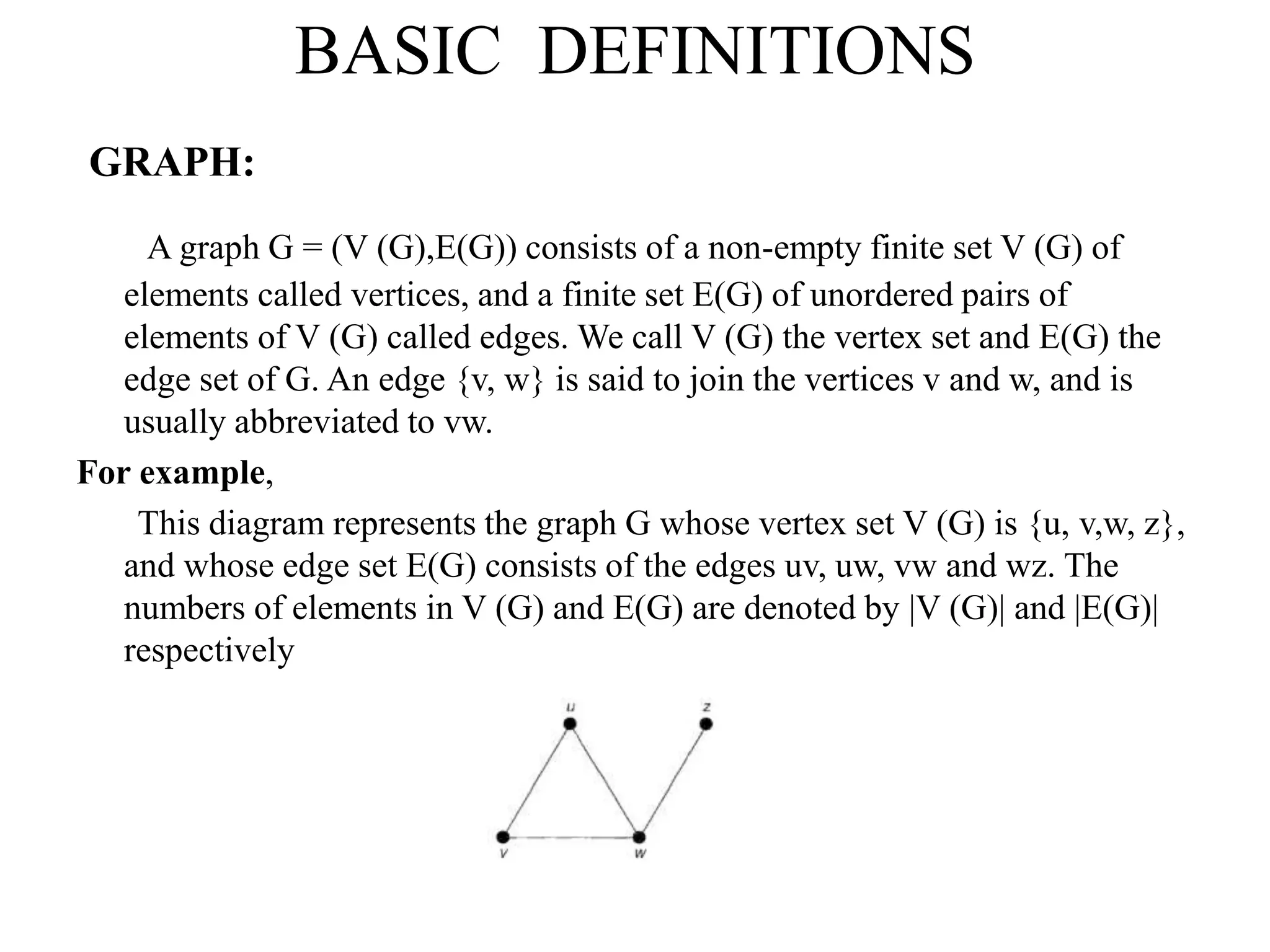
This diagram represents the graph G whose vertex set V (G) is {u, v,w, z},
and whose edge set E(G) consists of the edges uv, uw, vw and wz. The
numbers of elements in V (G) and E(G) are denoted by |V (G)| and |E(G)|
respectively
ADJACENCY AND INCIDENCE MATRIX:
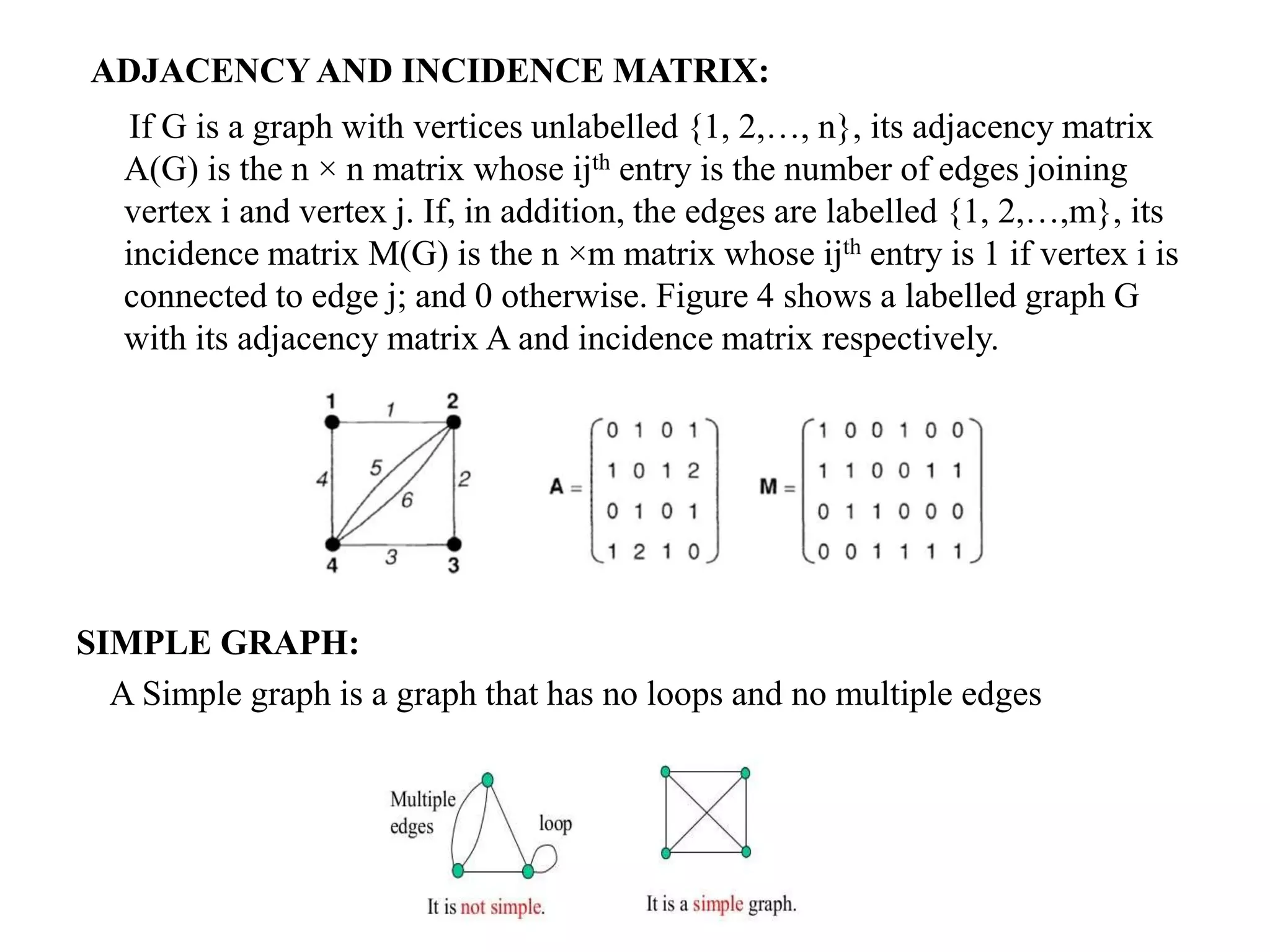
If G is a graph with vertices unlabelled {1, 2,…, n}, its adjacency matrix
A(G) is the n × n matrix whose ijth entry is the number of edges joining
vertex i and vertex j. If, in addition, the edges are labelled {1, 2,…,m}, its
incidence matrix M(G) is the n ×m matrix whose ijth entry is 1 if vertex i is
connected to edge j; and 0 otherwise. Figure 4 shows a labelled graph G
with its adjacency matrix A and incidence matrix respectively.
SIMPLE GRAPH:
A Simple graph is a graph that has no loops and no multiple edges
COMPLETE GRAPH
A simple graph in which each pair of distinct vertices are adjacent is a
complete graph. We denote the complete graph on n vertices by Kn. K3 and
K4
K3 K4
ISOMORPHIC:
Let two graphs G1 and G2 are isomorphic (written as G1 ≃ G2) if there is a
one-one correspondence between the vertices of G1 and those of G2 such
that the number of edges joining any two vertices of G1 is equal to the
number of edges joining the corresponding vertices of G2. Let θ : V (G1) →
V (G2) be the isomorphism, then x1 x2 E (G1) if and only if θ(x1)θ(x2)
E(G2).
Multigraph
If more than one line joining two vertices are allowed
,the resulting object is called a multigraph
Pseudo Graph
If further loops are allowed ,the resulting object is
called a Pseudo graph.
Null Graph
A Graph whose edge set is empty is called a Null
Graph
Degree
The degree of a point vi in a graph G is the
number of lines incident with vi .The degree
of vi is denoted by degvi.
Isolated Point
A point v of degree 0 is called an
isolated Point.
End point
A point v of degree 1 is called an end point.
Acyclic Graph
A Graph that contains no cycles is called
an Acyclic graph.
Tree
A connected acyclic graph is called a tree.
Thank you

Graph theory

  • 1.
  • 2.
    BASIC DEFINITIONS GRAPH: A graphG = (V (G),E(G)) consists of a non-empty finite set V (G) of elements called vertices, and a finite set E(G) of unordered pairs of elements of V (G) called edges. We call V (G) the vertex set and E(G) the edge set of G. An edge {v, w} is said to join the vertices v and w, and is usually abbreviated to vw. For example, This diagram represents the graph G whose vertex set V (G) is {u, v,w, z}, and whose edge set E(G) consists of the edges uv, uw, vw and wz. The numbers of elements in V (G) and E(G) are denoted by |V (G)| and |E(G)| respectively
  • 3.
    ADJACENCY AND INCIDENCEMATRIX: If G is a graph with vertices unlabelled {1, 2,…, n}, its adjacency matrix A(G) is the n × n matrix whose ijth entry is the number of edges joining vertex i and vertex j. If, in addition, the edges are labelled {1, 2,…,m}, its incidence matrix M(G) is the n ×m matrix whose ijth entry is 1 if vertex i is connected to edge j; and 0 otherwise. Figure 4 shows a labelled graph G with its adjacency matrix A and incidence matrix respectively. SIMPLE GRAPH: A Simple graph is a graph that has no loops and no multiple edges
  • 4.
    COMPLETE GRAPH A simplegraph in which each pair of distinct vertices are adjacent is a complete graph. We denote the complete graph on n vertices by Kn. K3 and K4 K3 K4 ISOMORPHIC: Let two graphs G1 and G2 are isomorphic (written as G1 ≃ G2) if there is a one-one correspondence between the vertices of G1 and those of G2 such that the number of edges joining any two vertices of G1 is equal to the number of edges joining the corresponding vertices of G2. Let θ : V (G1) → V (G2) be the isomorphism, then x1 x2 E (G1) if and only if θ(x1)θ(x2) E(G2).
  • 5.
    Multigraph If more thanone line joining two vertices are allowed ,the resulting object is called a multigraph Pseudo Graph If further loops are allowed ,the resulting object is called a Pseudo graph. Null Graph A Graph whose edge set is empty is called a Null Graph
  • 6.
    Degree The degree ofa point vi in a graph G is the number of lines incident with vi .The degree of vi is denoted by degvi. Isolated Point A point v of degree 0 is called an isolated Point. End point A point v of degree 1 is called an end point.
  • 7.
    Acyclic Graph A Graphthat contains no cycles is called an Acyclic graph. Tree A connected acyclic graph is called a tree.
  • 9.