GRAPH THEORY
Introduction
Walk
PathPath
Circuit
Dr Manish T I
Associate Professor,
Dept of CSE
ASIET, Kalady
Definition
• A graph G = ( V , E ) consists of a set of
objects V = { v1 , v2 , v3 ,….., vn} called vertices
and another set E = = { e1 , e2 , e3 ,….., em}
whose elements are called edges, such thatwhose elements are called edges, such that
each edge ek is identified with an unordered
pair ( vi, vj) of vertices.
• Here discussion is based on undirected graph.
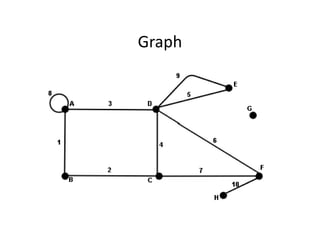
Graph
Properties of Graph
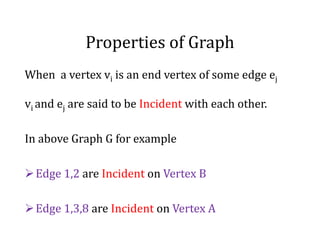
When a vertex vi is an end vertex of some edge ej
vi and ej are said to be Incident with each other.
In above Graph G for example
Edge 1,2 are Incident on Vertex B
Edge 1,3,8 are Incident on Vertex A
• An edge having the same vertex as both its end
vertices is called a self-loop.
• More than one edge associated with a given pair of
vertices. Such edges are referred as parallel edges
In above Graph G for exampleIn above Graph G for example
 Edge 8 has vertex A has its end vertices. Hence
Edge 8 is a self-loop
 Edge 5, 9 are associated with vertex D,E. Hence
Edge 5, 9 are parallel edges.
A vertex having no incident edge is called an
isolated vertex.
The number of edges incident on a vertex vi ,
with self-loops counted twice is called the
degree d(vi), of vertex vi . Degree is also known
as the Valency.as the Valency.
A vertex of degree one is called a pendant
vertex or an end vertex.
A Graph has edge set empty then it called null
graph
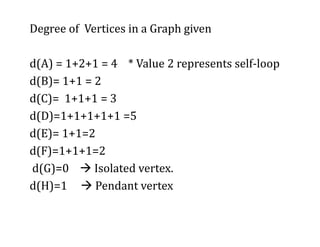
Degree of Vertices in a Graph given
d(A) = 1+2+1 = 4 * Value 2 represents self-loop
d(B)= 1+1 = 2
d(C)= 1+1+1 = 3
d(D)=1+1+1+1+1 =5
d(E)= 1+1=2
d(F)=1+1+1=2
d(G)=0  Isolated vertex.
d(H)=1  Pendant vertex
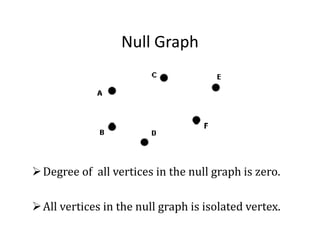
Null Graph
Degree of all vertices in the null graph is zero.
All vertices in the null graph is isolated vertex.
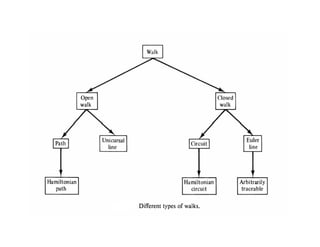
WALKS
• A Walk is defined as a finite alternating sequence
of vertices and edges beginning and ending with
vertices, such that each edge is incident with the
vertices preceding and following it.
 No edge appears more than once in a walk
 A vertex may appear more than once.
• Walk is also known as Edge train or a Chain.
• The set of vertices and edges constituting a given
walk in a graph G is clearly a sub graph of G.
• A vertices with which a walk begins and ends are
known as Terminal vertices.known as Terminal vertices.
• A walk to begin and end at the same vertex is
known as Closed walk. Otherwise walk is known
as Open walk.
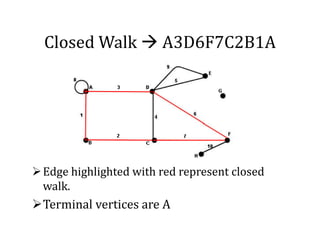
Closed Walk  A3D6F7C2B1A
Edge highlighted with red represent closed
walk.
Terminal vertices are A
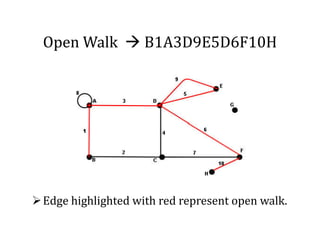
Open Walk  B1A3D9E5D6F10H
Edge highlighted with red represent open walk.
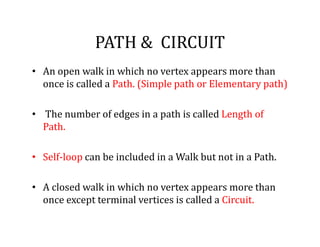
• An open walk in which no vertex appears more than
once is called a Path. (Simple path or Elementary path)
• The number of edges in a path is called Length of
Path.
PATH & CIRCUIT
Path.
• Self-loop can be included in a Walk but not in a Path.
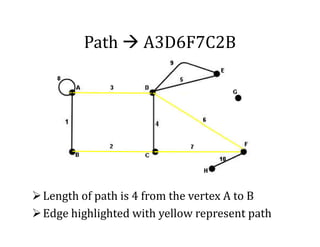
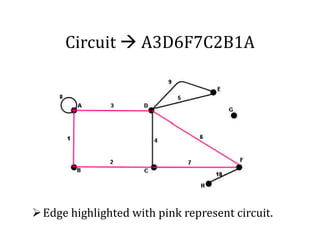
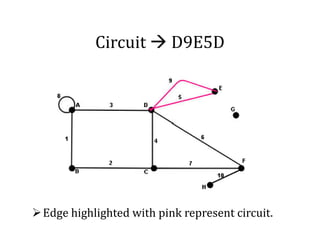
• A closed walk in which no vertex appears more than
once except terminal vertices is called a Circuit.
Path  A3D6F7C2B
Length of path is 4 from the vertex A to B
Edge highlighted with yellow represent path
Circuit  A3D6F7C2B1A
Edge highlighted with pink represent circuit.
Circuit  D9E5D
Edge highlighted with pink represent circuit.
References
• Narasingh Deo, “Graph theory with
applications to engineering and
computer science”, PHI.
• Graph drawings www.draw.io• Graph drawings www.draw.io
Any comments, corrections and feedback send to
manishti2004@gmail.com
manish.cs@adishankara.ac.in

Graph Theory Introduction

  • 1.
    GRAPH THEORY Introduction Walk PathPath Circuit Dr ManishT I Associate Professor, Dept of CSE ASIET, Kalady
  • 2.
    Definition • A graphG = ( V , E ) consists of a set of objects V = { v1 , v2 , v3 ,….., vn} called vertices and another set E = = { e1 , e2 , e3 ,….., em} whose elements are called edges, such thatwhose elements are called edges, such that each edge ek is identified with an unordered pair ( vi, vj) of vertices. • Here discussion is based on undirected graph.
  • 3.
  • 4.
    Properties of Graph Whena vertex vi is an end vertex of some edge ej vi and ej are said to be Incident with each other. In above Graph G for example Edge 1,2 are Incident on Vertex B Edge 1,3,8 are Incident on Vertex A
  • 5.
    • An edgehaving the same vertex as both its end vertices is called a self-loop. • More than one edge associated with a given pair of vertices. Such edges are referred as parallel edges In above Graph G for exampleIn above Graph G for example  Edge 8 has vertex A has its end vertices. Hence Edge 8 is a self-loop  Edge 5, 9 are associated with vertex D,E. Hence Edge 5, 9 are parallel edges.
  • 6.
    A vertex havingno incident edge is called an isolated vertex. The number of edges incident on a vertex vi , with self-loops counted twice is called the degree d(vi), of vertex vi . Degree is also known as the Valency.as the Valency. A vertex of degree one is called a pendant vertex or an end vertex. A Graph has edge set empty then it called null graph
  • 7.
    Degree of Verticesin a Graph given d(A) = 1+2+1 = 4 * Value 2 represents self-loop d(B)= 1+1 = 2 d(C)= 1+1+1 = 3 d(D)=1+1+1+1+1 =5 d(E)= 1+1=2 d(F)=1+1+1=2 d(G)=0  Isolated vertex. d(H)=1  Pendant vertex
  • 8.
    Null Graph Degree ofall vertices in the null graph is zero. All vertices in the null graph is isolated vertex.
  • 9.
    WALKS • A Walkis defined as a finite alternating sequence of vertices and edges beginning and ending with vertices, such that each edge is incident with the vertices preceding and following it.  No edge appears more than once in a walk  A vertex may appear more than once.
  • 10.
    • Walk isalso known as Edge train or a Chain. • The set of vertices and edges constituting a given walk in a graph G is clearly a sub graph of G. • A vertices with which a walk begins and ends are known as Terminal vertices.known as Terminal vertices. • A walk to begin and end at the same vertex is known as Closed walk. Otherwise walk is known as Open walk.
  • 11.
    Closed Walk A3D6F7C2B1A Edge highlighted with red represent closed walk. Terminal vertices are A
  • 12.
    Open Walk B1A3D9E5D6F10H Edge highlighted with red represent open walk.
  • 13.
    • An openwalk in which no vertex appears more than once is called a Path. (Simple path or Elementary path) • The number of edges in a path is called Length of Path. PATH & CIRCUIT Path. • Self-loop can be included in a Walk but not in a Path. • A closed walk in which no vertex appears more than once except terminal vertices is called a Circuit.
  • 14.
    Path  A3D6F7C2B Lengthof path is 4 from the vertex A to B Edge highlighted with yellow represent path
  • 15.
    Circuit  A3D6F7C2B1A Edgehighlighted with pink represent circuit.
  • 16.
    Circuit  D9E5D Edgehighlighted with pink represent circuit.
  • 18.
    References • Narasingh Deo,“Graph theory with applications to engineering and computer science”, PHI. • Graph drawings www.draw.io• Graph drawings www.draw.io Any comments, corrections and feedback send to manishti2004@gmail.com manish.cs@adishankara.ac.in