ACUTE AND CHRONICACUTE AND CHRONIC
INFLAMMATIONS OFINFLAMMATIONS OF
LARYNXLARYNX
DEPT OF
OTORHINOLARYNGOLOGY
J J M M C
DAVANAGERE
ACUTE LARYNGITIS (SIMPLE)
• AETIOLOGY: Secondary to inflammation of
nose, throat, paranasal sinuses
• Air born infection by adenovirus, influenza
leads to secondary bacterial infection by
damaging mucosa
• Most common organisms are moraxella
catarrhalis, streptococcus pneumoniae,
haemophilus influenzae
• Unfavorable climate, physical, psychological
strain are predisposing factors
ACUTE LARYNGITIS (SIMPLE)-
PATHOLOGY
• Mucosal inflammation extravasation of
fluid
• Infiltration of neutrophils/ lymphocytes/
plasma cells
• Muscles, joints, perichondrium affected
• Epithelial exfoliation, necrosis occurs
• In some instance fibrosis results with
mucosal loss leading to chronic laryngitis
ACUTE LARYNGITIS (SIMPLE)-
SYMPTOMS
• Hoarseness of voice
• Discomfort
• Pain
• Instant paroxysmal cough
• General cold
• Dryness of throat
• Malaise
• fever
ACUTE LARYNGITIS (SIMPLE)-
SIGNS
• Erythema and edema of epiglottis, aryepiglottic
folds, arytenoids and ventricular bands
• Vocal cords appear normal in early stages
• In later stages congestion and swelling increases,
vocal cords become red and swollen
• Sticky secretions are seen between cords and
interarytenoid region
• Submucosal hemorrhages may be seen in the
vocal cords
ACUTE LARYNGITIS (SIMPLE)
ACUTE LARYNGITIS (SIMPLE)-
TREATMENT
• Vocal rest
• Avoid smoking and alcohol
• Steam inhalation with tincture benzoin
• Cough sedatives (codeine)
• Antibiotics (broad spectrum penicillin)
• Analgesics
• steroids
ACUTE FIBRINOUS
LARYNGITIS
• Laryngotrachoebronchitis involving the
entire respiratory system
• Age: 6 months-7 years
• Super infections following influenza by
hemolytic streptococcus
ACUTE FIBRINOUS
LARYNGITIS- PATHOLOGY
• Affects entire respiratory tract
• The loose areolar tissue in the subglottic
region swells up and causes respiratory
obstruction and stridor
• This coupled with thick tenacious
secretions and crusts may completely
occlude the airway
ACUTE FIBRINOUS
LARYNGITIS- SIGNS AND
SYMPTOMS
• Hoarseness
• Croupy cough
• 39- 40 degree temperature
• Common cold
• Difficulty to breath
• Inspiratory stridor
• Increased muscular energy consumption
• Increased CO2 retention leads to metabolic
respiratory acidosis, paralysis of respiratory
regulation centers
• CYNOSIS may be present
ACUTE FIBRINOUS
LARYNGITIS- INVESTIGATIONS
• Blood gas analysis
• 3mm flexible endoscopic examination
• Chest X-ray
ACUTE FIBRINOUS
LARYNGITIS- TREATMENT
• Hospitalization: isolated room
• Treatment with moist air
• Antibiotics-Broad spectrum penicillins amoxicillin
50mg/kg
• Mucolytics: oral or aerosol
• Nasogastric feeding
• Hydration
• Steroids ?
• Intubation / tracheostomy
• Ventilator support may be required
SUBGLOTTIC LARYNGITIS
(PSEUDOCROUP)
• Common in young children- 3 years of age
• Caused by influenza virus
• Signs and symptoms: subglottic edema (+)
croup, stridor, no fever
• Treatment : voice rest, steroids, tracheostomy
may be needed
ACUTE EPIGLOTTITIS
(SUPRAGLOTTITIS)
• Etiology :
1. Common in children between 2-7 years
2. Incidence 1:17000
3. In adult 1:100000
4. Caused by h. influenza type B
ACUTE EPIGLOTTITIS-
CLINICAL FEATURES
• Onset : abrupt / rapid progressive
• Sore throat
• Dysphagia in adults
• Dyspnoea and stridor in children
• Tripod sign
• Drooling of saliva
• Fever 40 degree Celsius
ACUTE EPIGLOTTITIS-
CLINICAL FEATURES
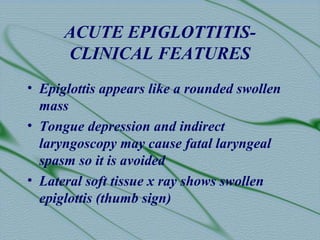
• Epiglottis appears like a rounded swollen
mass
• Tongue depression and indirect
laryngoscopy may cause fatal laryngeal
spasm so it is avoided
• Lateral soft tissue x ray shows swollen
epiglottis (thumb sign)
ACUTE EPIGLOTTITIS-
TREATMENT
• Hospitalization
• Antibiotics
• Fluids
• Steroids
• Humidification
• Intubation / tracheostomy
• Assisted respiration
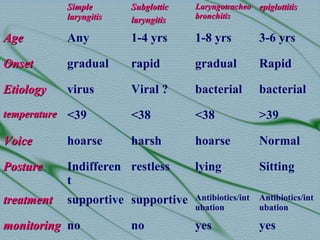
SimpleSimple
laryngitislaryngitis
SubglotticSubglottic
laryngitislaryngitis
LaryngotracheoLaryngotracheo
bronchitisbronchitis
epiglottitisepiglottitis
AgeAge Any 1-4 yrs 1-8 yrs 3-6 yrs
OnsetOnset gradual rapid gradual Rapid
EtiologyEtiology virus Viral ? bacterial bacterial
temperaturetemperature <39 <38 <38 >39
VoiceVoice hoarse harsh hoarse Normal
PosturePosture Indifferen
t
restless lying Sitting
treatmenttreatment supportive supportive Antibiotics/int
ubation
Antibiotics/int
ubation
monitoringmonitoring no no yes yes
OEDEMA OF THE LARYNX
• Oedema of mucosa can accompany any
inflammatory reaction therefore not a
specific disease but rather a sign
• Solitary reaction to different types of
stimuli like exogenous or unknown /
trauma, infection, tobacco, radiation
OEDEMA OF THE LARYNX-
ETIOLOGY
• Infection: acute epiglottitis, croup, tuberculosis,
syphilis
• From neighboring structures: quinsy, retro and
parapharyngeal abscess, Ludwig's angina
• Trauma: tongue, larynx, floor of mouth burns
(physical, chemical), Foreign bodies, post
endoscopy
• Neoplasms: larynx, tongue, pharynx
• Allergy
• Angioneurotic oedema
• Radiation
• Systemic diseases: nephritis, cardiac failure,
myxedema
REINKE’S OEDEMA
• Named after German anatomist
• Reinke’s space bound between superior
and inferior arcuate lines which is filled
with loose areolar tissue
REINKE’S OEDEMA
Etiology
• Precisely not known
• Allergy, infection, local irritants like
tobacco
• Common in men age 30-60 yrs
Clinical features
• On IDL examination : vocal cord red
swollen, slightly translucent, mucosa
shows polypoidal changes
• Hoarseness stridor cough present
REINKE’S OEDEMA
REINKE’S OEDEMA-
TREATMENT
• Rehabilitation
• Microlaryngeal stripping: mucosa on both
sides incised sagittally not up to anterior
commissure
• Voice rest and speech therapy
ANGIONEUROTIC OEDEMA
• May be allergic, non allergic OR
hereditary and non hereditary
• Recurrent attacks of local swelling in
various parts of the body: face, larynx,
limbs, buttocks
• Death occurs because of the edema of the
larynx
• Colic, nausea, vomiting
ANGIONEUROTIC OEDEMA
• Allergic: food, medicines, inhaled
allergens (ACE inhibitors used in
treatment of essential hypertension)
• Hereditary Angioneurotic edema:
described by Sir William Osler (1888)
Serum deficiency of C1 esterase inhibitor
protein thus inhibiting compliment
activation, kinin formation and fibrinolysis
Triad of symptoms: abdominal pain,
peripheral non pitting oedema, laryngeal
oedema
ANGIONEUROTIC OEDEMA-
TREATMENT
• 36000 units of C1 INH
• Recurrent attacks : use fibrinolytic
inhibitors like epsilon amino caprioc acid,
tranexamic acid or methyl testosterone
derivative ( danazol) these drugs
stimulate C1 INH production
LARYNGEAL PERICHONDRITIS
• Inflammation of perichondrium covering
laryngeal cartilages
• Etiology: blood borne infections, typhus,
typhoid and radiotherapy
RELAPSING POLYCHONDRITIS
• Autoimmune disease- collagen vascular
disease
• Rheumatoid arthritis, SLE, ankylosing
spondylitis
• Can effect recurrently pinna, nasal
cartilages, larynx and trachea
• Treatment: corticosteroids
CHRONIC LARYNGITIS
• Diffuse inflammatory condition symmetrically
involving whole larynx
• Aetiology
1. Incomplete resolution of acute laryngitis and its
recurrent attacks
2. Chronic infection in paranasal sinuses, teeth,
tonsils and chest
3. Occupational factors miners, gold/ironsmiths,
chemical industries
4. Smoking, alcohol
5. Chronic lung disease
6. Vocal abuse
CHRONIC LARYNGITIS-
CLINICAL FEATURES
• Hoarseness of voice easily tired becoming
aphonic
• Constant hawking, dryness, compelled to clear
throat
• Discomfort in throat
• Dry irritating cough
Signs
• Hyperemia of vocal cords : dull, red and round
• Viscid mucosa in vocal cord and interarytenoid
region
CHRONIC LARYNGITIS
CHRONIC LARYNGITIS-
TREATMENT
• Elimination of upper and lower respiratory
infections
• Avoid irritating factors
• Voice rest
• Speech therapy
• Steam inhalation
• Supportive measures
CHRONIC HYPERTROPHIC(HYPERPLASTIC)
LARYNGITIS
• May be symmetrical diffuse process or localized
• Dysphonia plica ventricularis, vocal cord nodules, vocal cord
polyps, Reinke's oedema, contact ulcers
Pathology
• Starts in Glottic region, later extends to supra and subglottic
region
• Mucosa, submucosa, mucosal glands, intrinsic muscles and
joints affected
• Initially hyperemia, oedema, cellular infiltration to submucosa
• Epithelium changes to squamous type (from pseudostratified
ciliated )
• Vocal cord epithelium becomes hyperplasic
• Mucosal gland hypertrophy later may atrophy
• dryness
CHRONIC
HYPERTROPHIC(HYPERPLASTIC)
LARYNGITIS
VOCAL CORD POLYPS
VOCAL NODULE

acute and chronic laryngeal inflammation

  • 1.
    ACUTE AND CHRONICACUTEAND CHRONIC INFLAMMATIONS OFINFLAMMATIONS OF LARYNXLARYNX DEPT OF OTORHINOLARYNGOLOGY J J M M C DAVANAGERE
  • 2.
    ACUTE LARYNGITIS (SIMPLE) •AETIOLOGY: Secondary to inflammation of nose, throat, paranasal sinuses • Air born infection by adenovirus, influenza leads to secondary bacterial infection by damaging mucosa • Most common organisms are moraxella catarrhalis, streptococcus pneumoniae, haemophilus influenzae • Unfavorable climate, physical, psychological strain are predisposing factors
  • 3.
    ACUTE LARYNGITIS (SIMPLE)- PATHOLOGY •Mucosal inflammation extravasation of fluid • Infiltration of neutrophils/ lymphocytes/ plasma cells • Muscles, joints, perichondrium affected • Epithelial exfoliation, necrosis occurs • In some instance fibrosis results with mucosal loss leading to chronic laryngitis
  • 4.
    ACUTE LARYNGITIS (SIMPLE)- SYMPTOMS •Hoarseness of voice • Discomfort • Pain • Instant paroxysmal cough • General cold • Dryness of throat • Malaise • fever
  • 5.
    ACUTE LARYNGITIS (SIMPLE)- SIGNS •Erythema and edema of epiglottis, aryepiglottic folds, arytenoids and ventricular bands • Vocal cords appear normal in early stages • In later stages congestion and swelling increases, vocal cords become red and swollen • Sticky secretions are seen between cords and interarytenoid region • Submucosal hemorrhages may be seen in the vocal cords
  • 6.
  • 7.
    ACUTE LARYNGITIS (SIMPLE)- TREATMENT •Vocal rest • Avoid smoking and alcohol • Steam inhalation with tincture benzoin • Cough sedatives (codeine) • Antibiotics (broad spectrum penicillin) • Analgesics • steroids
  • 8.
    ACUTE FIBRINOUS LARYNGITIS • Laryngotrachoebronchitisinvolving the entire respiratory system • Age: 6 months-7 years • Super infections following influenza by hemolytic streptococcus
  • 9.
    ACUTE FIBRINOUS LARYNGITIS- PATHOLOGY •Affects entire respiratory tract • The loose areolar tissue in the subglottic region swells up and causes respiratory obstruction and stridor • This coupled with thick tenacious secretions and crusts may completely occlude the airway
  • 10.
    ACUTE FIBRINOUS LARYNGITIS- SIGNSAND SYMPTOMS • Hoarseness • Croupy cough • 39- 40 degree temperature • Common cold • Difficulty to breath • Inspiratory stridor • Increased muscular energy consumption • Increased CO2 retention leads to metabolic respiratory acidosis, paralysis of respiratory regulation centers • CYNOSIS may be present
  • 11.
    ACUTE FIBRINOUS LARYNGITIS- INVESTIGATIONS •Blood gas analysis • 3mm flexible endoscopic examination • Chest X-ray
  • 12.
    ACUTE FIBRINOUS LARYNGITIS- TREATMENT •Hospitalization: isolated room • Treatment with moist air • Antibiotics-Broad spectrum penicillins amoxicillin 50mg/kg • Mucolytics: oral or aerosol • Nasogastric feeding • Hydration • Steroids ? • Intubation / tracheostomy • Ventilator support may be required
  • 13.
    SUBGLOTTIC LARYNGITIS (PSEUDOCROUP) • Commonin young children- 3 years of age • Caused by influenza virus • Signs and symptoms: subglottic edema (+) croup, stridor, no fever • Treatment : voice rest, steroids, tracheostomy may be needed
  • 14.
    ACUTE EPIGLOTTITIS (SUPRAGLOTTITIS) • Etiology: 1. Common in children between 2-7 years 2. Incidence 1:17000 3. In adult 1:100000 4. Caused by h. influenza type B
  • 15.
    ACUTE EPIGLOTTITIS- CLINICAL FEATURES •Onset : abrupt / rapid progressive • Sore throat • Dysphagia in adults • Dyspnoea and stridor in children • Tripod sign • Drooling of saliva • Fever 40 degree Celsius
  • 16.
    ACUTE EPIGLOTTITIS- CLINICAL FEATURES •Epiglottis appears like a rounded swollen mass • Tongue depression and indirect laryngoscopy may cause fatal laryngeal spasm so it is avoided • Lateral soft tissue x ray shows swollen epiglottis (thumb sign)
  • 18.
    ACUTE EPIGLOTTITIS- TREATMENT • Hospitalization •Antibiotics • Fluids • Steroids • Humidification • Intubation / tracheostomy • Assisted respiration
  • 19.
    SimpleSimple laryngitislaryngitis SubglotticSubglottic laryngitislaryngitis LaryngotracheoLaryngotracheo bronchitisbronchitis epiglottitisepiglottitis AgeAge Any 1-4yrs 1-8 yrs 3-6 yrs OnsetOnset gradual rapid gradual Rapid EtiologyEtiology virus Viral ? bacterial bacterial temperaturetemperature <39 <38 <38 >39 VoiceVoice hoarse harsh hoarse Normal PosturePosture Indifferen t restless lying Sitting treatmenttreatment supportive supportive Antibiotics/int ubation Antibiotics/int ubation monitoringmonitoring no no yes yes
  • 20.
    OEDEMA OF THELARYNX • Oedema of mucosa can accompany any inflammatory reaction therefore not a specific disease but rather a sign • Solitary reaction to different types of stimuli like exogenous or unknown / trauma, infection, tobacco, radiation
  • 21.
    OEDEMA OF THELARYNX- ETIOLOGY • Infection: acute epiglottitis, croup, tuberculosis, syphilis • From neighboring structures: quinsy, retro and parapharyngeal abscess, Ludwig's angina • Trauma: tongue, larynx, floor of mouth burns (physical, chemical), Foreign bodies, post endoscopy • Neoplasms: larynx, tongue, pharynx • Allergy • Angioneurotic oedema • Radiation • Systemic diseases: nephritis, cardiac failure, myxedema
  • 22.
    REINKE’S OEDEMA • Namedafter German anatomist • Reinke’s space bound between superior and inferior arcuate lines which is filled with loose areolar tissue
  • 23.
    REINKE’S OEDEMA Etiology • Preciselynot known • Allergy, infection, local irritants like tobacco • Common in men age 30-60 yrs Clinical features • On IDL examination : vocal cord red swollen, slightly translucent, mucosa shows polypoidal changes • Hoarseness stridor cough present
  • 24.
  • 25.
    REINKE’S OEDEMA- TREATMENT • Rehabilitation •Microlaryngeal stripping: mucosa on both sides incised sagittally not up to anterior commissure • Voice rest and speech therapy
  • 26.
    ANGIONEUROTIC OEDEMA • Maybe allergic, non allergic OR hereditary and non hereditary • Recurrent attacks of local swelling in various parts of the body: face, larynx, limbs, buttocks • Death occurs because of the edema of the larynx • Colic, nausea, vomiting
  • 27.
    ANGIONEUROTIC OEDEMA • Allergic:food, medicines, inhaled allergens (ACE inhibitors used in treatment of essential hypertension) • Hereditary Angioneurotic edema: described by Sir William Osler (1888) Serum deficiency of C1 esterase inhibitor protein thus inhibiting compliment activation, kinin formation and fibrinolysis Triad of symptoms: abdominal pain, peripheral non pitting oedema, laryngeal oedema
  • 28.
    ANGIONEUROTIC OEDEMA- TREATMENT • 36000units of C1 INH • Recurrent attacks : use fibrinolytic inhibitors like epsilon amino caprioc acid, tranexamic acid or methyl testosterone derivative ( danazol) these drugs stimulate C1 INH production
  • 29.
    LARYNGEAL PERICHONDRITIS • Inflammationof perichondrium covering laryngeal cartilages • Etiology: blood borne infections, typhus, typhoid and radiotherapy
  • 30.
    RELAPSING POLYCHONDRITIS • Autoimmunedisease- collagen vascular disease • Rheumatoid arthritis, SLE, ankylosing spondylitis • Can effect recurrently pinna, nasal cartilages, larynx and trachea • Treatment: corticosteroids
  • 31.
    CHRONIC LARYNGITIS • Diffuseinflammatory condition symmetrically involving whole larynx • Aetiology 1. Incomplete resolution of acute laryngitis and its recurrent attacks 2. Chronic infection in paranasal sinuses, teeth, tonsils and chest 3. Occupational factors miners, gold/ironsmiths, chemical industries 4. Smoking, alcohol 5. Chronic lung disease 6. Vocal abuse
  • 32.
    CHRONIC LARYNGITIS- CLINICAL FEATURES •Hoarseness of voice easily tired becoming aphonic • Constant hawking, dryness, compelled to clear throat • Discomfort in throat • Dry irritating cough Signs • Hyperemia of vocal cords : dull, red and round • Viscid mucosa in vocal cord and interarytenoid region
  • 33.
  • 34.
    CHRONIC LARYNGITIS- TREATMENT • Eliminationof upper and lower respiratory infections • Avoid irritating factors • Voice rest • Speech therapy • Steam inhalation • Supportive measures
  • 35.
    CHRONIC HYPERTROPHIC(HYPERPLASTIC) LARYNGITIS • Maybe symmetrical diffuse process or localized • Dysphonia plica ventricularis, vocal cord nodules, vocal cord polyps, Reinke's oedema, contact ulcers Pathology • Starts in Glottic region, later extends to supra and subglottic region • Mucosa, submucosa, mucosal glands, intrinsic muscles and joints affected • Initially hyperemia, oedema, cellular infiltration to submucosa • Epithelium changes to squamous type (from pseudostratified ciliated ) • Vocal cord epithelium becomes hyperplasic • Mucosal gland hypertrophy later may atrophy • dryness
  • 36.
  • 37.
  • 38.