


Introduction Gradient Descent Adaptation and Preconditioning Natural Gradient Thoughts
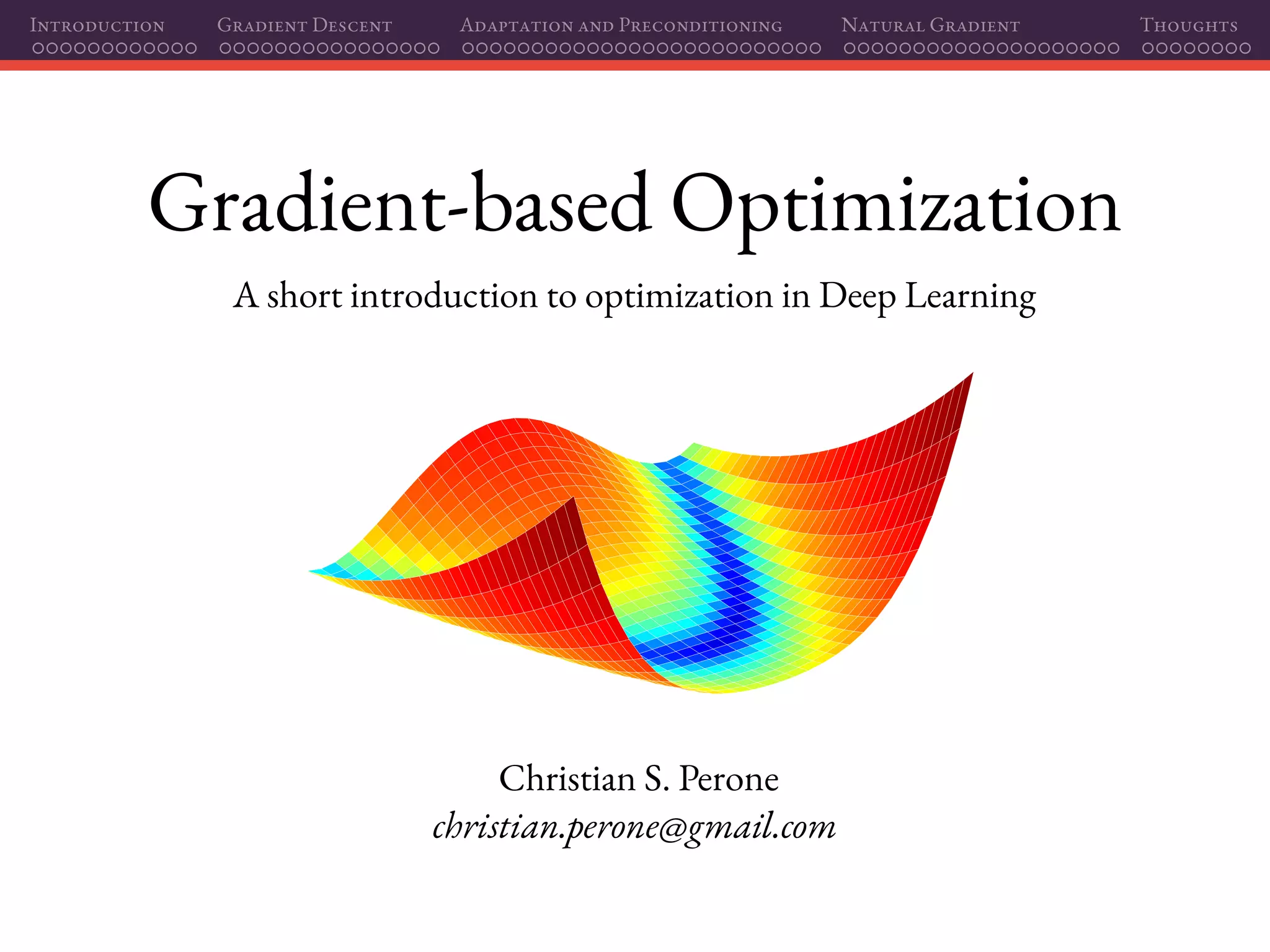
Gradient-based Optimization
A short introduction to optimization in Deep Learning
Christian S. Perone
christian.perone@gmail.com
Introduction Gradient Descent Adaptation and Preconditioning Natural Gradient Thoughts
Agenda
Introduction
Motivation
Probability framework
Taylor approximation
Gradient Descent
Gradient Descent
Momentum
Stochastic Gradient Descent
Adaptation and Preconditioning
Adam
Hessian
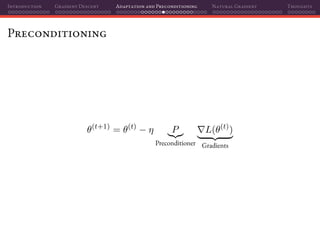
Preconditioning
Fisher Information Matrix
Natural Gradient
Natural Gradient
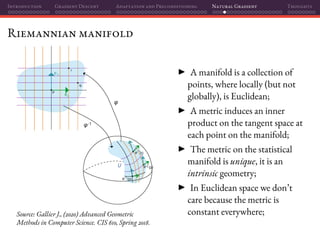
Riemannian manifold
Empirical Fisher
K-FAC
Thoughts
Introduction Gradient Descent Adaptation and Preconditioning Natural Gradient Thoughts
Who Am I
Christian S. Perone
Machine Learning Engineer / Research
BSc Computer Science
(Brazil/Universidade de Passo Fundo)
MSc Deep Learning Biomed. Eng.
(Canada/Polytechnique Montreal/UdeM)
Blog
http://blog.christianperone.com
Open-source projects
https://github.com/perone
Twitter @tarantulae
Introduction Gradient Descent Adaptation and Preconditioning Natural Gradient Thoughts
Section I
Introduction
Introduction Gradient Descent Adaptation and Preconditioning Natural Gradient Thoughts
Motivation
Mathematical optimization is the core of Machine Learning, without it we
wouldn’t be able to find the needle in the haystack of the parameter space.
Introduction Gradient Descent Adaptation and Preconditioning Natural Gradient Thoughts
Motivation
Mathematical optimization is the core of Machine Learning, without it we
wouldn’t be able to find the needle in the haystack of the parameter space.
It materializes in Machine Learning by minimizing an
objective function such as a divergence or any function that
penalizes for mistakes of the model;
Introduction Gradient Descent Adaptation and Preconditioning Natural Gradient Thoughts
Motivation
Mathematical optimization is the core of Machine Learning, without it we
wouldn’t be able to find the needle in the haystack of the parameter space.
It materializes in Machine Learning by minimizing an
objective function such as a divergence or any function that
penalizes for mistakes of the model;
We will talk here about local methods that are characterized by the
search of an optimal value within a neighboring set of parameter space;
Introduction Gradient Descent Adaptation and Preconditioning Natural Gradient Thoughts
Motivation
Mathematical optimization is the core of Machine Learning, without it we
wouldn’t be able to find the needle in the haystack of the parameter space.
It materializes in Machine Learning by minimizing an
objective function such as a divergence or any function that
penalizes for mistakes of the model;
We will talk here about local methods that are characterized by the
search of an optimal value within a neighboring set of parameter space;
We have a huge variety of methods that were recently developed,
therefore this talk is by far from being a comprehensive
collection. I will focus on intuition and understanding, instead of
throwing algorithms.
Introduction Gradient Descent Adaptation and Preconditioning Natural Gradient Thoughts
Empirical Risk Minimization (ERM)
On a supervised setting, we want to find a function or a model fθ(·)
that describes the relationship between a random feature vector x and
the label target vector y. We assume a joint distribution pdata(x, y);
Introduction Gradient Descent Adaptation and Preconditioning Natural Gradient Thoughts
Empirical Risk Minimization (ERM)
On a supervised setting, we want to find a function or a model fθ(·)
that describes the relationship between a random feature vector x and
the label target vector y. We assume a joint distribution pdata(x, y);
We start by defining a loss function L, evaluated as L(fθ(x), y) that
gives us a penalization for the difference between predictions fθ(x)
and the true label y;
Introduction Gradient Descent Adaptation and Preconditioning Natural Gradient Thoughts
Empirical Risk Minimization (ERM)
On a supervised setting, we want to find a function or a model fθ(·)
that describes the relationship between a random feature vector x and
the label target vector y. We assume a joint distribution pdata(x, y);
We start by defining a loss function L, evaluated as L(fθ(x), y) that
gives us a penalization for the difference between predictions fθ(x)
and the true label y;
Now, taking the expectation of the loss we have our risk R:
Definition: Risk
R(f) = Ex,y∼pdata
[L(fθ(x), y)
Loss
] = L(fθ(x), y) dpdata(x, y),
that we want to minimize.
Introduction Gradient Descent Adaptation and Preconditioning Natural Gradient Thoughts
Empirical Risk Minimization (ERM)
However, we don’t know pdata(x, y), we only have access to a sample
training set D = (xi, yi) ∼ pdata;
Introduction Gradient Descent Adaptation and Preconditioning Natural Gradient Thoughts
Empirical Risk Minimization (ERM)
However, we don’t know pdata(x, y), we only have access to a sample
training set D = (xi, yi) ∼ pdata;
Therefore, we can approximate the risk with the empirical risk:
Definition: Empirical Risk
Remp(f) =
1
n
n
i=1
L(fθ(xi), yi)
Introduction Gradient Descent Adaptation and Preconditioning Natural Gradient Thoughts
Empirical Risk Minimization (ERM)
However, we don’t know pdata(x, y), we only have access to a sample
training set D = (xi, yi) ∼ pdata;
Therefore, we can approximate the risk with the empirical risk:
Definition: Empirical Risk
Remp(f) =
1
n
n
i=1
L(fθ(xi), yi)
The Empirical Risk Minimization (ERM) principle says that our
learning algorithm should minimize the empirical risk;
Introduction Gradient Descent Adaptation and Preconditioning Natural Gradient Thoughts
Empirical Risk Minimization (ERM)
However, we don’t know pdata(x, y), we only have access to a sample
training set D = (xi, yi) ∼ pdata;
Therefore, we can approximate the risk with the empirical risk:
Definition: Empirical Risk
Remp(f) =
1
n
n
i=1
L(fθ(xi), yi)
The Empirical Risk Minimization (ERM) principle says that our
learning algorithm should minimize the empirical risk;
The MLE (Maximum Likelihood Estimation) can be posed as a
special case of ERM where the loss function is the negative
log-likelihood.
Introduction Gradient Descent Adaptation and Preconditioning Natural Gradient Thoughts
Maximum Likelihood Estimation (MLE)
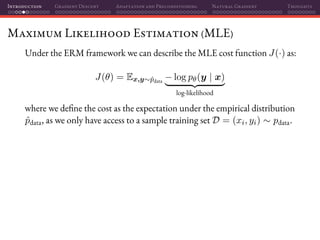
Under the ERM framework we can describe the MLE cost function J(·) as:
J(θ) = Ex,y∼ˆpdata
− log pθ(y | x)
log-likelihood
where we define the cost as the expectation under the empirical distribution
ˆpdata, as we only have access to a sample training set D = (xi, yi) ∼ pdata.
Introduction Gradient Descent Adaptation and Preconditioning Natural Gradient Thoughts
Maximum Likelihood Estimation (MLE)
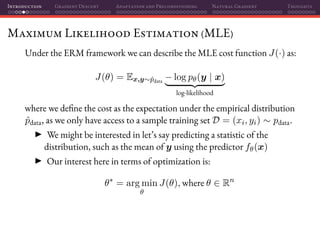
Under the ERM framework we can describe the MLE cost function J(·) as:
J(θ) = Ex,y∼ˆpdata
− log pθ(y | x)
log-likelihood
where we define the cost as the expectation under the empirical distribution
ˆpdata, as we only have access to a sample training set D = (xi, yi) ∼ pdata.
We might be interested in let’s say predicting a statistic of the
distribution, such as the mean of y using the predictor fθ(x)
Our interest here in terms of optimization is:
θ∗
= arg min
θ
J(θ), where θ ∈ Rn
Introduction Gradient Descent Adaptation and Preconditioning Natural Gradient Thoughts
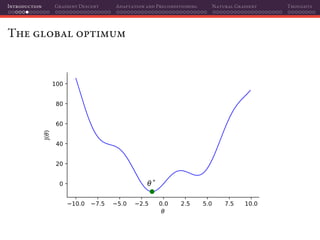
The global optimum
10.0 7.5 5.0 2.5 0.0 2.5 5.0 7.5 10.0
0
20
40
60
80
100
J()
*
Introduction Gradient Descent Adaptation and Preconditioning Natural Gradient Thoughts
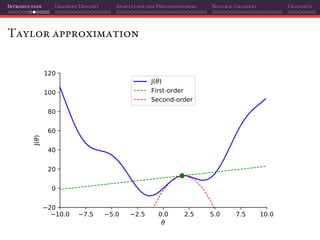
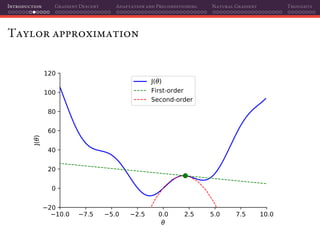
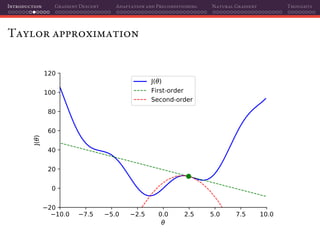
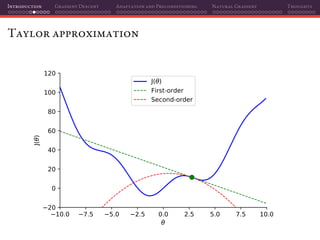
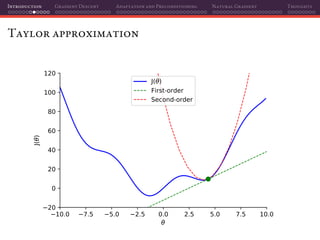
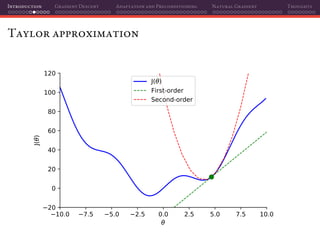
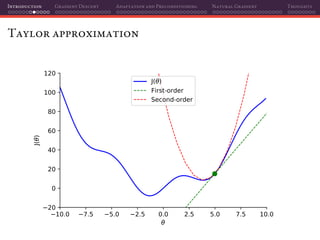
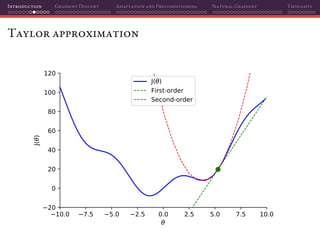
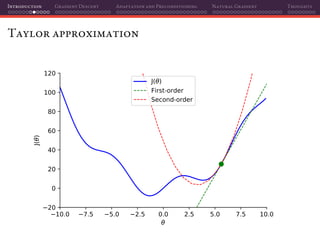
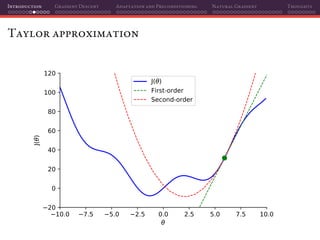
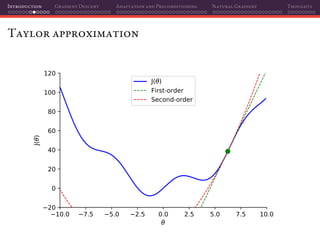
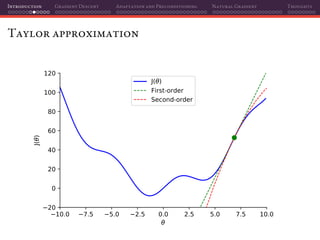
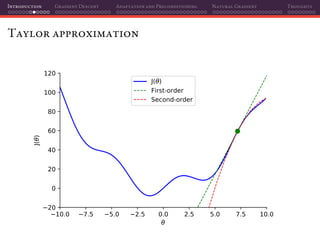
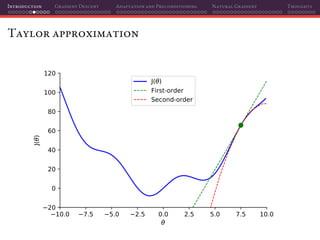
Taylor approximation
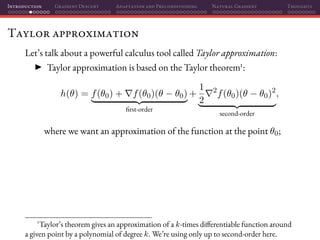
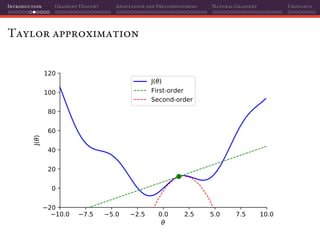
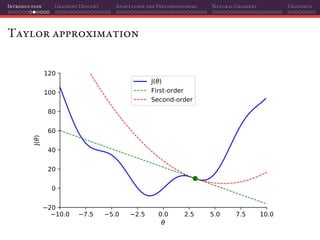
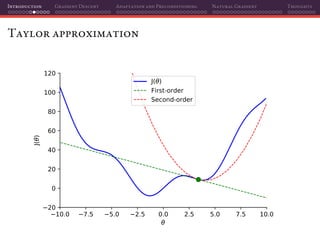
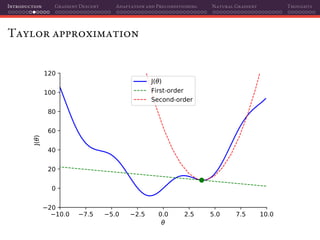
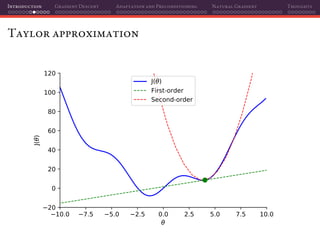
Let’s talk about a powerful calculus tool called Taylor approximation:
Taylor approximation is based on the Taylor theorem1:
h(θ) = f(θ0) + f(θ0)(θ − θ0)
first-order
+
1
2
2
f(θ0)(θ − θ0)2
second-order
,
where we want an approximation of the function at the point θ0;
1
Taylor’s theorem gives an approximation of a k-times differentiable function around
a given point by a polynomial of degree k. We’re using only up to second-order here.
Introduction Gradient Descent Adaptation and Preconditioning Natural Gradient Thoughts
Taylor approximation
Let’s talk about a powerful calculus tool called Taylor approximation:
Taylor approximation is based on the Taylor theorem1:
h(θ) = f(θ0) + f(θ0)(θ − θ0)
first-order
+
1
2
2
f(θ0)(θ − θ0)2
second-order
,
where we want an approximation of the function at the point θ0;
This theorem is very powerful as it allows us to approximate any
differentiable (and twice differentiable) function;
1
Taylor’s theorem gives an approximation of a k-times differentiable function around
a given point by a polynomial of degree k. We’re using only up to second-order here.
Introduction Gradient Descent Adaptation and Preconditioning Natural Gradient Thoughts
Taylor approximation
Let’s talk about a powerful calculus tool called Taylor approximation:
Taylor approximation is based on the Taylor theorem1:
h(θ) = f(θ0) + f(θ0)(θ − θ0)
first-order
+
1
2
2
f(θ0)(θ − θ0)2
second-order
,
where we want an approximation of the function at the point θ0;
This theorem is very powerful as it allows us to approximate any
differentiable (and twice differentiable) function;
The 2f(·) is also called the Hessian, or Hf . We will talk more
about it later;
1
Taylor’s theorem gives an approximation of a k-times differentiable function around
a given point by a polynomial of degree k. We’re using only up to second-order here.
Introduction Gradient Descent Adaptation and Preconditioning Natural Gradient Thoughts
Taylor approximation
Let’s talk about a powerful calculus tool called Taylor approximation:
Taylor approximation is based on the Taylor theorem1:
h(θ) = f(θ0) + f(θ0)(θ − θ0)
first-order
+
1
2
2
f(θ0)(θ − θ0)2
second-order
,
where we want an approximation of the function at the point θ0;
This theorem is very powerful as it allows us to approximate any
differentiable (and twice differentiable) function;
The 2f(·) is also called the Hessian, or Hf . We will talk more
about it later;
We will understand the deep connection of this approximation with
Gradient Descent.
1
Taylor’s theorem gives an approximation of a k-times differentiable function around
a given point by a polynomial of degree k. We’re using only up to second-order here.
Introduction Gradient Descent Adaptation and Preconditioning Natural Gradient Thoughts
Taylor approximation
10.0 7.5 5.0 2.5 0.0 2.5 5.0 7.5 10.0
20
0
20
40
60
80
100
120
J()
J( )
First-order
Second-order
Introduction Gradient Descent Adaptation and Preconditioning Natural Gradient Thoughts
Taylor approximation
10.0 7.5 5.0 2.5 0.0 2.5 5.0 7.5 10.0
20
0
20
40
60
80
100
120
J()
J( )
First-order
Second-order
Introduction Gradient Descent Adaptation and Preconditioning Natural Gradient Thoughts
Taylor approximation
10.0 7.5 5.0 2.5 0.0 2.5 5.0 7.5 10.0
20
0
20
40
60
80
100
120
J()
J( )
First-order
Second-order
Introduction Gradient Descent Adaptation and Preconditioning Natural Gradient Thoughts
Taylor approximation
10.0 7.5 5.0 2.5 0.0 2.5 5.0 7.5 10.0
20
0
20
40
60
80
100
120
J()
J( )
First-order
Second-order
Introduction Gradient Descent Adaptation and Preconditioning Natural Gradient Thoughts
Taylor approximation
10.0 7.5 5.0 2.5 0.0 2.5 5.0 7.5 10.0
20
0
20
40
60
80
100
120
J()
J( )
First-order
Second-order
Introduction Gradient Descent Adaptation and Preconditioning Natural Gradient Thoughts
Taylor approximation
10.0 7.5 5.0 2.5 0.0 2.5 5.0 7.5 10.0
20
0
20
40
60
80
100
120
J()
J( )
First-order
Second-order
Introduction Gradient Descent Adaptation and Preconditioning Natural Gradient Thoughts
Taylor approximation
10.0 7.5 5.0 2.5 0.0 2.5 5.0 7.5 10.0
20
0
20
40
60
80
100
120
J()
J( )
First-order
Second-order
Introduction Gradient Descent Adaptation and Preconditioning Natural Gradient Thoughts
Taylor approximation
10.0 7.5 5.0 2.5 0.0 2.5 5.0 7.5 10.0
20
0
20
40
60
80
100
120
J()
J( )
First-order
Second-order
Introduction Gradient Descent Adaptation and Preconditioning Natural Gradient Thoughts
Taylor approximation
10.0 7.5 5.0 2.5 0.0 2.5 5.0 7.5 10.0
20
0
20
40
60
80
100
120
J()
J( )
First-order
Second-order
Introduction Gradient Descent Adaptation and Preconditioning Natural Gradient Thoughts
Taylor approximation
10.0 7.5 5.0 2.5 0.0 2.5 5.0 7.5 10.0
20
0
20
40
60
80
100
120
J()
J( )
First-order
Second-order
Introduction Gradient Descent Adaptation and Preconditioning Natural Gradient Thoughts
Taylor approximation
10.0 7.5 5.0 2.5 0.0 2.5 5.0 7.5 10.0
20
0
20
40
60
80
100
120
J()
J( )
First-order
Second-order
Introduction Gradient Descent Adaptation and Preconditioning Natural Gradient Thoughts
Taylor approximation
10.0 7.5 5.0 2.5 0.0 2.5 5.0 7.5 10.0
20
0
20
40
60
80
100
120
J()
J( )
First-order
Second-order
Introduction Gradient Descent Adaptation and Preconditioning Natural Gradient Thoughts
Taylor approximation
10.0 7.5 5.0 2.5 0.0 2.5 5.0 7.5 10.0
20
0
20
40
60
80
100
120
J()
J( )
First-order
Second-order
Introduction Gradient Descent Adaptation and Preconditioning Natural Gradient Thoughts
Taylor approximation
10.0 7.5 5.0 2.5 0.0 2.5 5.0 7.5 10.0
20
0
20
40
60
80
100
120
J()
J( )
First-order
Second-order
Introduction Gradient Descent Adaptation and Preconditioning Natural Gradient Thoughts
Taylor approximation
10.0 7.5 5.0 2.5 0.0 2.5 5.0 7.5 10.0
20
0
20
40
60
80
100
120
J()
J( )
First-order
Second-order
Introduction Gradient Descent Adaptation and Preconditioning Natural Gradient Thoughts
Taylor approximation
10.0 7.5 5.0 2.5 0.0 2.5 5.0 7.5 10.0
20
0
20
40
60
80
100
120
J()
J( )
First-order
Second-order
Introduction Gradient Descent Adaptation and Preconditioning Natural Gradient Thoughts
Taylor approximation
10.0 7.5 5.0 2.5 0.0 2.5 5.0 7.5 10.0
20
0
20
40
60
80
100
120
J()
J( )
First-order
Second-order
Introduction Gradient Descent Adaptation and Preconditioning Natural Gradient Thoughts
Taylor approximation
10.0 7.5 5.0 2.5 0.0 2.5 5.0 7.5 10.0
20
0
20
40
60
80
100
120
J()
J( )
First-order
Second-order
Introduction Gradient Descent Adaptation and Preconditioning Natural Gradient Thoughts
Taylor approximation
10.0 7.5 5.0 2.5 0.0 2.5 5.0 7.5 10.0
20
0
20
40
60
80
100
120
J()
J( )
First-order
Second-order
Introduction Gradient Descent Adaptation and Preconditioning Natural Gradient Thoughts
Taylor approximation
10.0 7.5 5.0 2.5 0.0 2.5 5.0 7.5 10.0
20
0
20
40
60
80
100
120
J()
J( )
First-order
Second-order
Introduction Gradient Descent Adaptation and Preconditioning Natural Gradient Thoughts
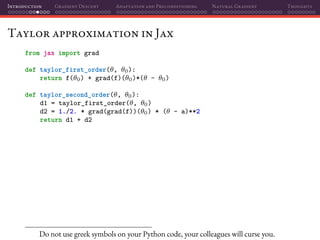
Taylor approximation in Jax
from jax import grad
def taylor_first_order(θ, θ0):
return f(θ0) + grad(f)(θ0)*(θ - θ0)
def taylor_second_order(θ, θ0):
d1 = taylor_first_order(θ, θ0)
d2 = 1./2. * grad(grad(f))(θ0) * (θ - a)**2
return d1 + d2
Do not use greek symbols on your Python code, your colleagues will curse you.
Introduction Gradient Descent Adaptation and Preconditioning Natural Gradient Thoughts
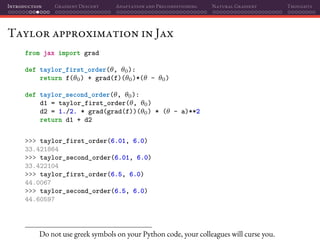
Taylor approximation in Jax
from jax import grad
def taylor_first_order(θ, θ0):
return f(θ0) + grad(f)(θ0)*(θ - θ0)
def taylor_second_order(θ, θ0):
d1 = taylor_first_order(θ, θ0)
d2 = 1./2. * grad(grad(f))(θ0) * (θ - a)**2
return d1 + d2
>>> taylor_first_order(6.01, 6.0)
33.421864
>>> taylor_second_order(6.01, 6.0)
33.422104
>>> taylor_first_order(6.5, 6.0)
44.0067
>>> taylor_second_order(6.5, 6.0)
44.60597
Do not use greek symbols on your Python code, your colleagues will curse you.
Introduction Gradient Descent Adaptation and Preconditioning Natural Gradient Thoughts
Linear approximation plane
Source: Tangent Planes and Linear Approximations. Calculus Volume 3.
Rice University. 2020. Creative Commons Attribution 4.0 International License.
Introduction Gradient Descent Adaptation and Preconditioning Natural Gradient Thoughts
Local approximation and second-order
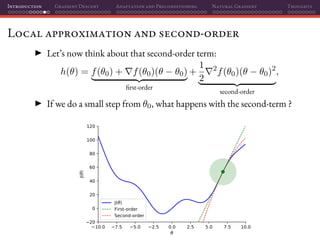
Let’s now think about that second-order term:
h(θ) = f(θ0) + f(θ0)(θ − θ0)
first-order
+
1
2
2
f(θ0)(θ − θ0)2
second-order
,
If we do a small step from θ0, what happens with the second-term ?
Introduction Gradient Descent Adaptation and Preconditioning Natural Gradient Thoughts
Local approximation and second-order
Let’s now think about that second-order term:
h(θ) = f(θ0) + f(θ0)(θ − θ0)
first-order
+
1
2
2
f(θ0)(θ − θ0)2
second-order
,
If we do a small step from θ0, what happens with the second-term ?
10.0 7.5 5.0 2.5 0.0 2.5 5.0 7.5 10.0
20
0
20
40
60
80
100
120
J()
J( )
First-order
Second-order
Introduction Gradient Descent Adaptation and Preconditioning Natural Gradient Thoughts
The steepest descent
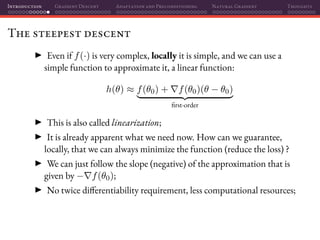
Even if f(·) is very complex, locally it is simple, and we can use a
simple function to approximate it, a linear function:
h(θ) ≈ f(θ0) + f(θ0)(θ − θ0)
first-order
This is also called linearization;
Introduction Gradient Descent Adaptation and Preconditioning Natural Gradient Thoughts
The steepest descent
Even if f(·) is very complex, locally it is simple, and we can use a
simple function to approximate it, a linear function:
h(θ) ≈ f(θ0) + f(θ0)(θ − θ0)
first-order
This is also called linearization;
It is already apparent what we need now. How can we guarantee,
locally, that we can always minimize the function (reduce the loss) ?
Introduction Gradient Descent Adaptation and Preconditioning Natural Gradient Thoughts
The steepest descent
Even if f(·) is very complex, locally it is simple, and we can use a
simple function to approximate it, a linear function:
h(θ) ≈ f(θ0) + f(θ0)(θ − θ0)
first-order
This is also called linearization;
It is already apparent what we need now. How can we guarantee,
locally, that we can always minimize the function (reduce the loss) ?
We can just follow the slope (negative) of the approximation that is
given by − f(θ0);
Introduction Gradient Descent Adaptation and Preconditioning Natural Gradient Thoughts
The steepest descent
Even if f(·) is very complex, locally it is simple, and we can use a
simple function to approximate it, a linear function:
h(θ) ≈ f(θ0) + f(θ0)(θ − θ0)
first-order
This is also called linearization;
It is already apparent what we need now. How can we guarantee,
locally, that we can always minimize the function (reduce the loss) ?
We can just follow the slope (negative) of the approximation that is
given by − f(θ0);
No twice differentiability requirement, less computational resources;
Introduction Gradient Descent Adaptation and Preconditioning Natural Gradient Thoughts
Section II
Gradient Descent
Introduction Gradient Descent Adaptation and Preconditioning Natural Gradient Thoughts
Gradient Descent
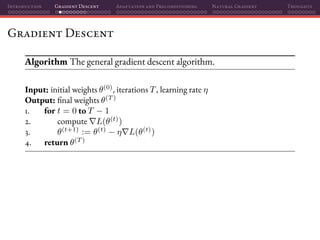
Algorithm The general gradient descent algorithm.
Input: initial weights θ(0)
, iterations T, learning rate η
Output: final weights θ(T )
1. for t = 0 to T − 1
2. compute L(θ(t)
)
3. θ(t+1)
:= θ(t)
− η L(θ(t)
)
4. return θ(T )
Introduction Gradient Descent Adaptation and Preconditioning Natural Gradient Thoughts
Gradient Descent
Algorithm The general gradient descent algorithm.
Input: initial weights θ(0)
, iterations T, learning rate η
Output: final weights θ(T )
1. for t = 0 to T − 1
2. compute L(θ(t)
)
3. θ(t+1)
:= θ(t)
− η L(θ(t)
)
4. return θ(T )
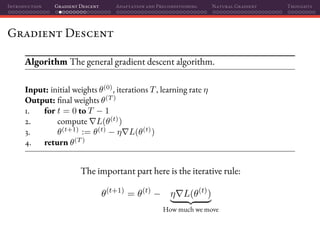
The important part here is the iterative rule:
θ(t+1)
= θ(t)
− η L(θ(t)
)
How much we move
Introduction Gradient Descent Adaptation and Preconditioning Natural Gradient Thoughts
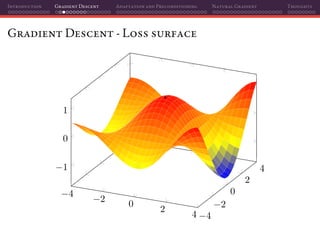
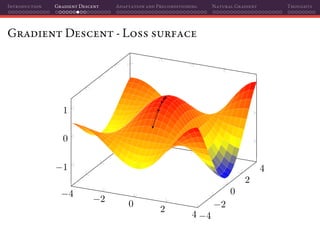
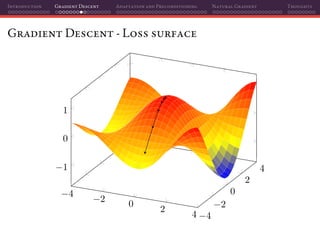
Gradient Descent - Loss surface
−4
−2 0
2
4 −4
−2
0
2
4−1
0
1
Introduction Gradient Descent Adaptation and Preconditioning Natural Gradient Thoughts
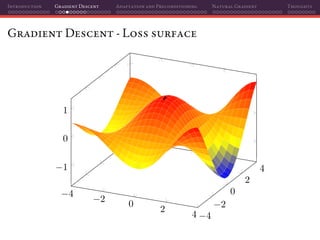
Gradient Descent - Loss surface
−4
−2 0
2
4 −4
−2
0
2
4−1
0
1
Introduction Gradient Descent Adaptation and Preconditioning Natural Gradient Thoughts
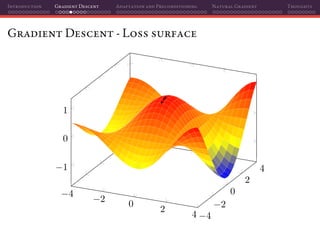
Gradient Descent - Loss surface
−4
−2 0
2
4 −4
−2
0
2
4−1
0
1
Introduction Gradient Descent Adaptation and Preconditioning Natural Gradient Thoughts
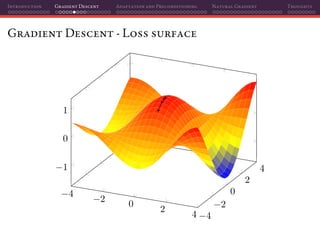
Gradient Descent - Loss surface
−4
−2 0
2
4 −4
−2
0
2
4−1
0
1
Introduction Gradient Descent Adaptation and Preconditioning Natural Gradient Thoughts
Gradient Descent - Loss surface
−4
−2 0
2
4 −4
−2
0
2
4−1
0
1
Introduction Gradient Descent Adaptation and Preconditioning Natural Gradient Thoughts
Gradient Descent - Loss surface
−4
−2 0
2
4 −4
−2
0
2
4−1
0
1
Introduction Gradient Descent Adaptation and Preconditioning Natural Gradient Thoughts
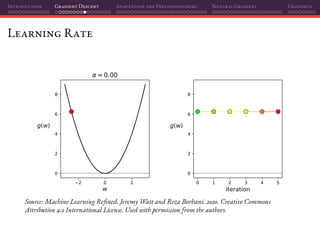
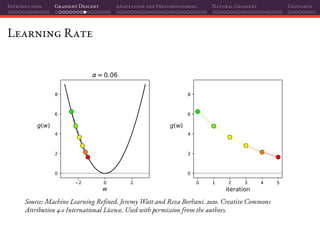
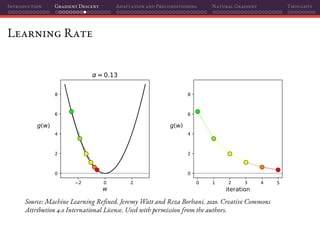
Learning Rate
2 0 2
w
0
2
4
6
8
g(w)
=0.00
0 1 2 3 4 5
iteration
0
2
4
6
8
g(w)
Source: Machine Learning Refined. Jeremy Watt and Reza Borhani. 2020. Creative Commons
Attribution 4.0 International License. Used with permission from the authors.
Introduction Gradient Descent Adaptation and Preconditioning Natural Gradient Thoughts
Learning Rate
2 0 2
w
0
2
4
6
8
g(w)
=0.06
0 1 2 3 4 5
iteration
0
2
4
6
8
g(w)
Source: Machine Learning Refined. Jeremy Watt and Reza Borhani. 2020. Creative Commons
Attribution 4.0 International License. Used with permission from the authors.
Introduction Gradient Descent Adaptation and Preconditioning Natural Gradient Thoughts
Learning Rate
2 0 2
w
0
2
4
6
8
g(w)
=0.13
0 1 2 3 4 5
iteration
0
2
4
6
8
g(w)
Source: Machine Learning Refined. Jeremy Watt and Reza Borhani. 2020. Creative Commons
Attribution 4.0 International License. Used with permission from the authors.
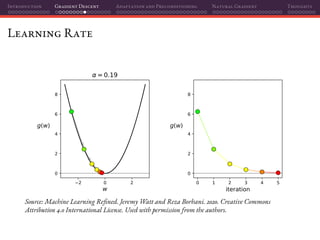
Introduction Gradient Descent Adaptation and Preconditioning Natural Gradient Thoughts
Learning Rate
2 0 2
w
0
2
4
6
8
g(w)
=0.19
0 1 2 3 4 5
iteration
0
2
4
6
8
g(w)
Source: Machine Learning Refined. Jeremy Watt and Reza Borhani. 2020. Creative Commons
Attribution 4.0 International License. Used with permission from the authors.
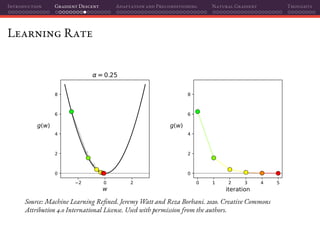
Introduction Gradient Descent Adaptation and Preconditioning Natural Gradient Thoughts
Learning Rate
2 0 2
w
0
2
4
6
8
g(w)
=0.25
0 1 2 3 4 5
iteration
0
2
4
6
8
g(w)
Source: Machine Learning Refined. Jeremy Watt and Reza Borhani. 2020. Creative Commons
Attribution 4.0 International License. Used with permission from the authors.
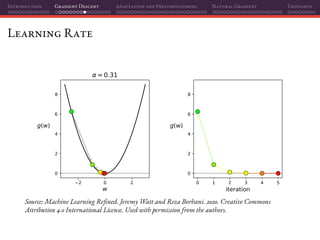
Introduction Gradient Descent Adaptation and Preconditioning Natural Gradient Thoughts
Learning Rate
2 0 2
w
0
2
4
6
8
g(w)
=0.31
0 1 2 3 4 5
iteration
0
2
4
6
8
g(w)
Source: Machine Learning Refined. Jeremy Watt and Reza Borhani. 2020. Creative Commons
Attribution 4.0 International License. Used with permission from the authors.
Introduction Gradient Descent Adaptation and Preconditioning Natural Gradient Thoughts
Learning Rate
2 0 2
w
0
2
4
6
8
g(w)
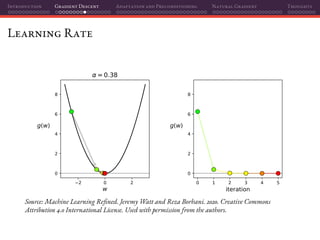
=0.38
0 1 2 3 4 5
iteration
0
2
4
6
8
g(w)
Source: Machine Learning Refined. Jeremy Watt and Reza Borhani. 2020. Creative Commons
Attribution 4.0 International License. Used with permission from the authors.
Introduction Gradient Descent Adaptation and Preconditioning Natural Gradient Thoughts
Learning Rate
2 0 2
w
0
2
4
6
8
g(w)
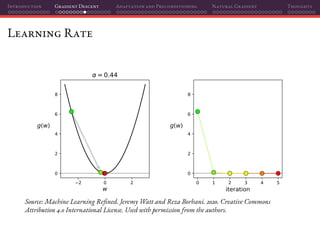
=0.44
0 1 2 3 4 5
iteration
0
2
4
6
8
g(w)
Source: Machine Learning Refined. Jeremy Watt and Reza Borhani. 2020. Creative Commons
Attribution 4.0 International License. Used with permission from the authors.
Introduction Gradient Descent Adaptation and Preconditioning Natural Gradient Thoughts
Learning Rate
2 0 2
w
0
2
4
6
8
g(w)
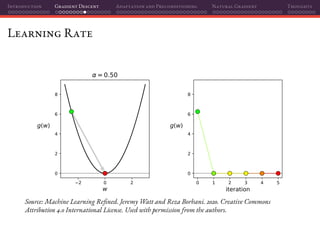
=0.50
0 1 2 3 4 5
iteration
0
2
4
6
8
g(w)
Source: Machine Learning Refined. Jeremy Watt and Reza Borhani. 2020. Creative Commons
Attribution 4.0 International License. Used with permission from the authors.
Introduction Gradient Descent Adaptation and Preconditioning Natural Gradient Thoughts
Learning Rate
2 0 2
w
0
2
4
6
8
g(w)
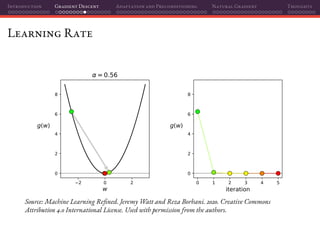
=0.56
0 1 2 3 4 5
iteration
0
2
4
6
8
g(w)
Source: Machine Learning Refined. Jeremy Watt and Reza Borhani. 2020. Creative Commons
Attribution 4.0 International License. Used with permission from the authors.
Introduction Gradient Descent Adaptation and Preconditioning Natural Gradient Thoughts
Learning Rate
2 0 2
w
0
2
4
6
8
g(w)
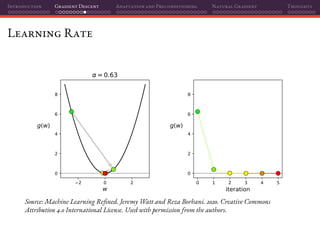
=0.63
0 1 2 3 4 5
iteration
0
2
4
6
8
g(w)
Source: Machine Learning Refined. Jeremy Watt and Reza Borhani. 2020. Creative Commons
Attribution 4.0 International License. Used with permission from the authors.
Introduction Gradient Descent Adaptation and Preconditioning Natural Gradient Thoughts
Learning Rate
2 0 2
w
0
2
4
6
8
g(w)
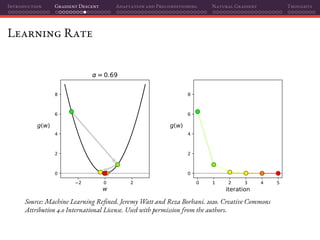
=0.69
0 1 2 3 4 5
iteration
0
2
4
6
8
g(w)
Source: Machine Learning Refined. Jeremy Watt and Reza Borhani. 2020. Creative Commons
Attribution 4.0 International License. Used with permission from the authors.
Introduction Gradient Descent Adaptation and Preconditioning Natural Gradient Thoughts
Learning Rate
2 0 2
w
0
2
4
6
8
g(w)
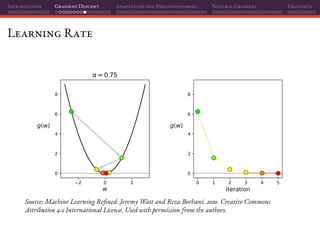
=0.75
0 1 2 3 4 5
iteration
0
2
4
6
8
g(w)
Source: Machine Learning Refined. Jeremy Watt and Reza Borhani. 2020. Creative Commons
Attribution 4.0 International License. Used with permission from the authors.
Introduction Gradient Descent Adaptation and Preconditioning Natural Gradient Thoughts
Learning Rate
2 0 2
w
0
2
4
6
8
g(w)
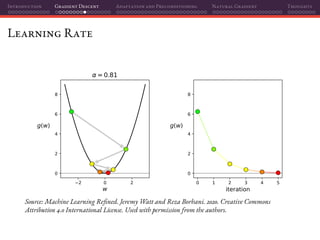
=0.81
0 1 2 3 4 5
iteration
0
2
4
6
8
g(w)
Source: Machine Learning Refined. Jeremy Watt and Reza Borhani. 2020. Creative Commons
Attribution 4.0 International License. Used with permission from the authors.
Introduction Gradient Descent Adaptation and Preconditioning Natural Gradient Thoughts
Learning Rate
2 0 2
w
0
2
4
6
8
g(w)
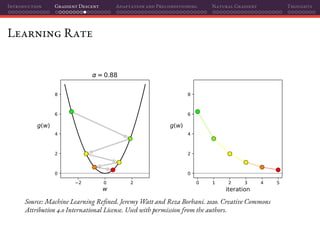
=0.88
0 1 2 3 4 5
iteration
0
2
4
6
8
g(w)
Source: Machine Learning Refined. Jeremy Watt and Reza Borhani. 2020. Creative Commons
Attribution 4.0 International License. Used with permission from the authors.
Introduction Gradient Descent Adaptation and Preconditioning Natural Gradient Thoughts
Learning Rate
2 0 2
w
0
2
4
6
8
g(w)
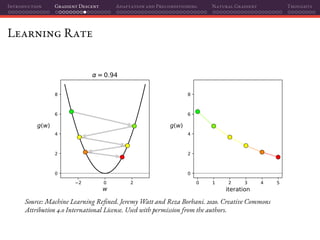
=0.94
0 1 2 3 4 5
iteration
0
2
4
6
8
g(w)
Source: Machine Learning Refined. Jeremy Watt and Reza Borhani. 2020. Creative Commons
Attribution 4.0 International License. Used with permission from the authors.
Introduction Gradient Descent Adaptation and Preconditioning Natural Gradient Thoughts
Learning Rate
2 0 2
w
0
2
4
6
8
g(w)
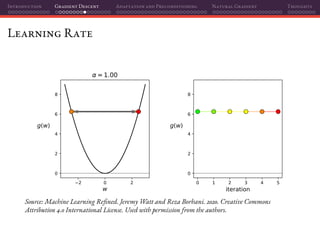
=1.00
0 1 2 3 4 5
iteration
0
2
4
6
8
g(w)
Source: Machine Learning Refined. Jeremy Watt and Reza Borhani. 2020. Creative Commons
Attribution 4.0 International License. Used with permission from the authors.
Introduction Gradient Descent Adaptation and Preconditioning Natural Gradient Thoughts
Learning Rate
4 2 0 2 4
w
0.0
2.5
5.0
7.5
10.0
12.5
15.0
17.5
20.0
g(w)
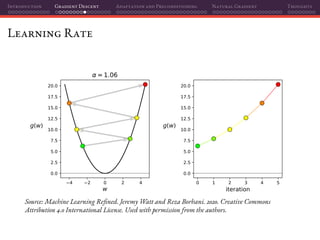
=1.06
0 1 2 3 4 5
iteration
0.0
2.5
5.0
7.5
10.0
12.5
15.0
17.5
20.0
g(w)
Source: Machine Learning Refined. Jeremy Watt and Reza Borhani. 2020. Creative Commons
Attribution 4.0 International License. Used with permission from the authors.
Introduction Gradient Descent Adaptation and Preconditioning Natural Gradient Thoughts
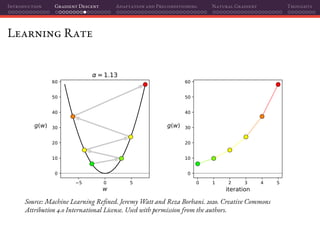
Learning Rate
5 0 5
w
0
10
20
30
40
50
60
g(w)
=1.13
0 1 2 3 4 5
iteration
0
10
20
30
40
50
60
g(w)
Source: Machine Learning Refined. Jeremy Watt and Reza Borhani. 2020. Creative Commons
Attribution 4.0 International License. Used with permission from the authors.
Introduction Gradient Descent Adaptation and Preconditioning Natural Gradient Thoughts
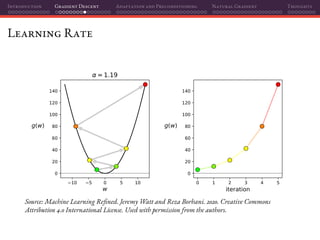
Learning Rate
10 5 0 5 10
w
0
20
40
60
80
100
120
140
g(w)
=1.19
0 1 2 3 4 5
iteration
0
20
40
60
80
100
120
140
g(w)
Source: Machine Learning Refined. Jeremy Watt and Reza Borhani. 2020. Creative Commons
Attribution 4.0 International License. Used with permission from the authors.
Introduction Gradient Descent Adaptation and Preconditioning Natural Gradient Thoughts
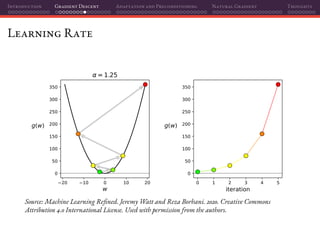
Learning Rate
20 10 0 10 20
w
0
50
100
150
200
250
300
350
g(w)
=1.25
0 1 2 3 4 5
iteration
0
50
100
150
200
250
300
350
g(w)
Source: Machine Learning Refined. Jeremy Watt and Reza Borhani. 2020. Creative Commons
Attribution 4.0 International License. Used with permission from the authors.
Introduction Gradient Descent Adaptation and Preconditioning Natural Gradient Thoughts
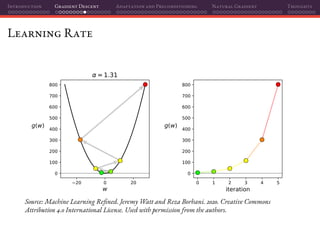
Learning Rate
20 0 20
w
0
100
200
300
400
500
600
700
800
g(w)
=1.31
0 1 2 3 4 5
iteration
0
100
200
300
400
500
600
700
800
g(w)
Source: Machine Learning Refined. Jeremy Watt and Reza Borhani. 2020. Creative Commons
Attribution 4.0 International License. Used with permission from the authors.
Introduction Gradient Descent Adaptation and Preconditioning Natural Gradient Thoughts
Learning Rate
40 20 0 20 40
w
0
250
500
750
1000
1250
1500
1750
g(w)
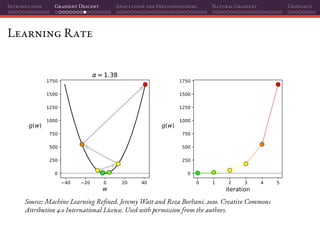
=1.38
0 1 2 3 4 5
iteration
0
250
500
750
1000
1250
1500
1750
g(w)
Source: Machine Learning Refined. Jeremy Watt and Reza Borhani. 2020. Creative Commons
Attribution 4.0 International License. Used with permission from the authors.
Introduction Gradient Descent Adaptation and Preconditioning Natural Gradient Thoughts
Learning Rate
50 25 0 25 50
w
0
500
1000
1500
2000
2500
3000
3500
g(w)
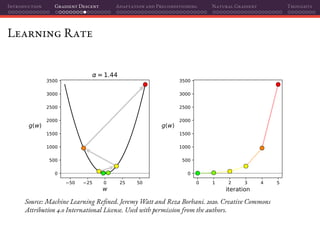
=1.44
0 1 2 3 4 5
iteration
0
500
1000
1500
2000
2500
3000
3500
g(w)
Source: Machine Learning Refined. Jeremy Watt and Reza Borhani. 2020. Creative Commons
Attribution 4.0 International License. Used with permission from the authors.
Introduction Gradient Descent Adaptation and Preconditioning Natural Gradient Thoughts
Learning Rate
50 0 50
w
0
1000
2000
3000
4000
5000
6000
g(w)
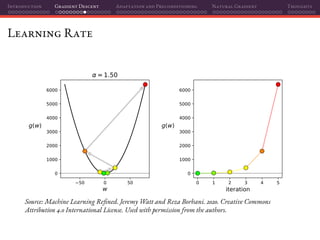
=1.50
0 1 2 3 4 5
iteration
0
1000
2000
3000
4000
5000
6000
g(w)
Source: Machine Learning Refined. Jeremy Watt and Reza Borhani. 2020. Creative Commons
Attribution 4.0 International License. Used with permission from the authors.
Introduction Gradient Descent Adaptation and Preconditioning Natural Gradient Thoughts
High curvatures
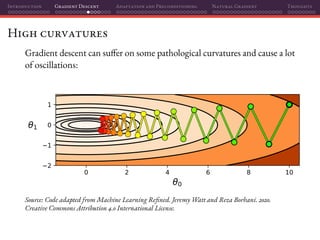
Gradient descent can suffer on some pathological curvatures and cause a lot
of oscillations:
0 2 4 6 8 10
0
2
1
0
1
1
0
1
1
Source: Code adapted from Machine Learning Refined. Jeremy Watt and Reza Borhani. 2020.
Creative Commons Attribution 4.0 International License.
Introduction Gradient Descent Adaptation and Preconditioning Natural Gradient Thoughts
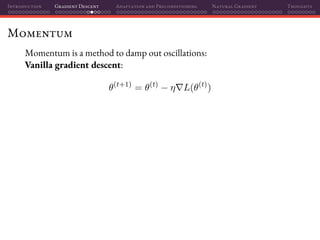
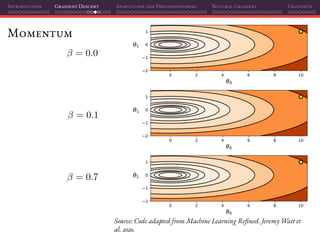
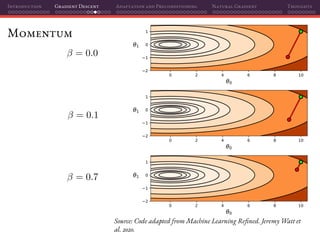
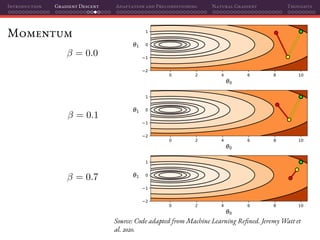
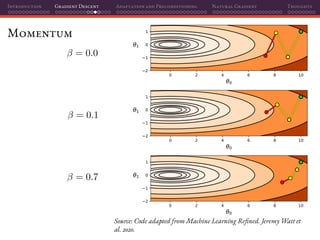
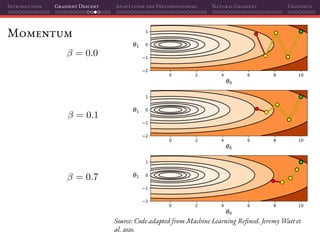
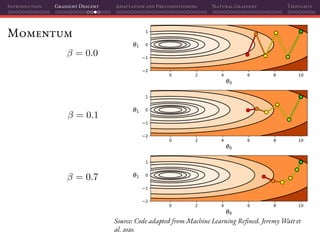
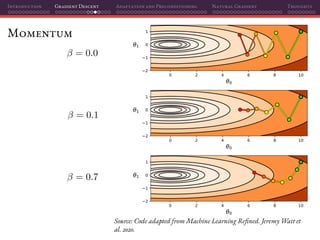
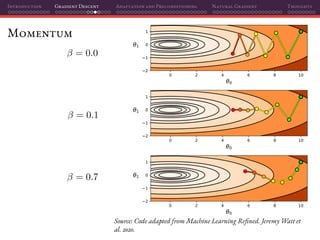
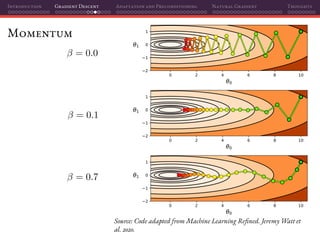
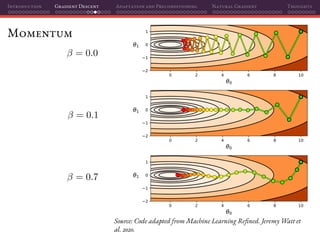
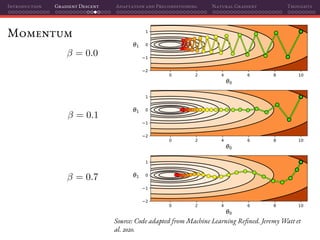
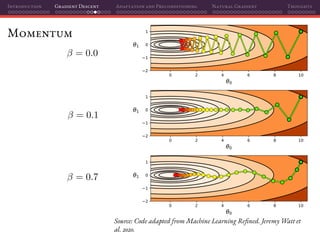
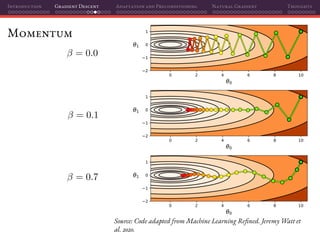
Momentum
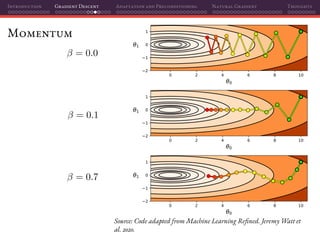
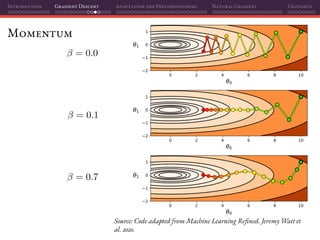
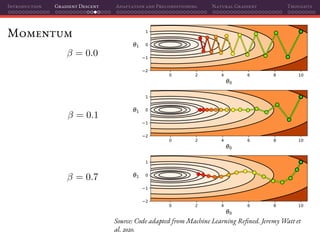
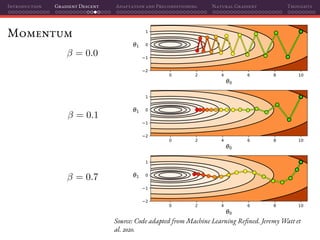
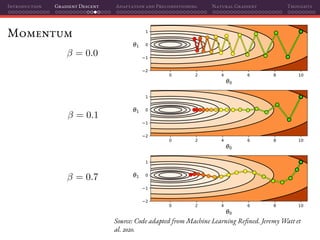
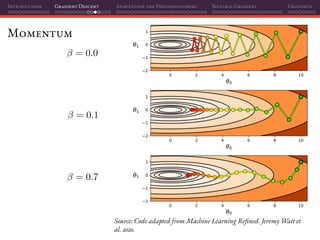
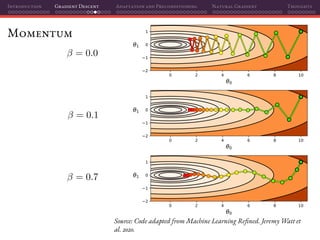
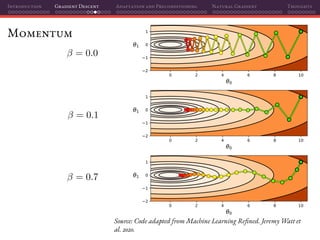
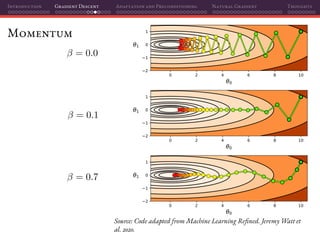
Momentum is a method to damp out oscillations:
Vanilla gradient descent:
θ(t+1)
= θ(t)
− η L(θ(t)
)
Introduction Gradient Descent Adaptation and Preconditioning Natural Gradient Thoughts
Momentum
Momentum is a method to damp out oscillations:
Vanilla gradient descent:
θ(t+1)
= θ(t)
− η L(θ(t)
)
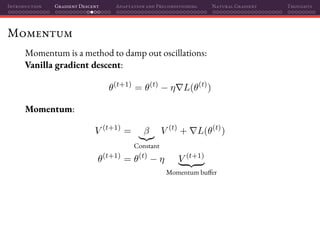
Momentum:
V (t+1)
= β
Constant
V (t)
+ L(θ(t)
)
θ(t+1)
= θ(t)
− η V (t+1)
Momentum buffer
Introduction Gradient Descent Adaptation and Preconditioning Natural Gradient Thoughts
Momentum
Momentum is a method to damp out oscillations:
Vanilla gradient descent:
θ(t+1)
= θ(t)
− η L(θ(t)
)
Momentum:
V (t+1)
= β
Constant
V (t)
+ L(θ(t)
)
θ(t+1)
= θ(t)
− η V (t+1)
Momentum buffer
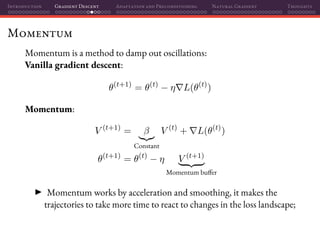
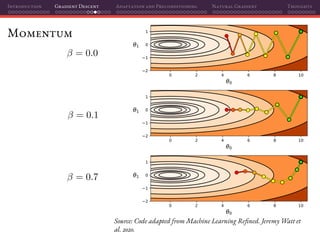
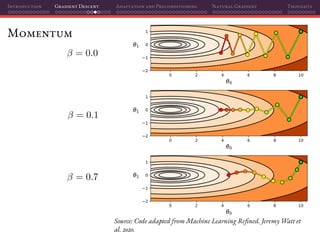
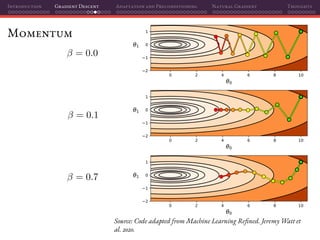
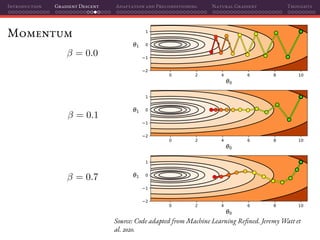
Momentum works by acceleration and smoothing, it makes the
trajectories to take more time to react to changes in the loss landscape;
Introduction Gradient Descent Adaptation and Preconditioning Natural Gradient Thoughts
Momentum
Momentum is a method to damp out oscillations:
Vanilla gradient descent:
θ(t+1)
= θ(t)
− η L(θ(t)
)
Momentum:
V (t+1)
= β
Constant
V (t)
+ L(θ(t)
)
θ(t+1)
= θ(t)
− η V (t+1)
Momentum buffer
Momentum works by acceleration and smoothing, it makes the
trajectories to take more time to react to changes in the loss landscape;
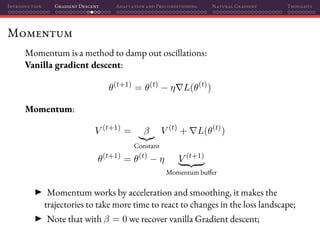
Note that with β = 0 we recover vanilla Gradient descent;
Introduction Gradient Descent Adaptation and Preconditioning Natural Gradient Thoughts
Momentum
β = 0.0
β = 0.1
β = 0.7
0 2 4 6 8 10
0
2
1
0
1
1
0 2 4 6 8 10
0
2
1
0
1
1
0 2 4 6 8 10
0
2
1
0
1
1
Source: Code adapted from Machine Learning Refined. Jeremy Watt et
al. 2020.
Introduction Gradient Descent Adaptation and Preconditioning Natural Gradient Thoughts
Momentum
β = 0.0
β = 0.1
β = 0.7
0 2 4 6 8 10
0
2
1
0
1
1
0 2 4 6 8 10
0
2
1
0
1
1
0 2 4 6 8 10
0
2
1
0
1
1
Source: Code adapted from Machine Learning Refined. Jeremy Watt et
al. 2020.
Introduction Gradient Descent Adaptation and Preconditioning Natural Gradient Thoughts
Momentum
β = 0.0
β = 0.1
β = 0.7
0 2 4 6 8 10
0
2
1
0
1
1
0 2 4 6 8 10
0
2
1
0
1
1
0 2 4 6 8 10
0
2
1
0
1
1
Source: Code adapted from Machine Learning Refined. Jeremy Watt et
al. 2020.
Introduction Gradient Descent Adaptation and Preconditioning Natural Gradient Thoughts
Momentum
β = 0.0
β = 0.1
β = 0.7
0 2 4 6 8 10
0
2
1
0
1
1
0 2 4 6 8 10
0
2
1
0
1
1
0 2 4 6 8 10
0
2
1
0
1
1
Source: Code adapted from Machine Learning Refined. Jeremy Watt et
al. 2020.
Introduction Gradient Descent Adaptation and Preconditioning Natural Gradient Thoughts
Momentum
β = 0.0
β = 0.1
β = 0.7
0 2 4 6 8 10
0
2
1
0
1
1
0 2 4 6 8 10
0
2
1
0
1
1
0 2 4 6 8 10
0
2
1
0
1
1
Source: Code adapted from Machine Learning Refined. Jeremy Watt et
al. 2020.
Introduction Gradient Descent Adaptation and Preconditioning Natural Gradient Thoughts
Momentum
β = 0.0
β = 0.1
β = 0.7
0 2 4 6 8 10
0
2
1
0
1
1
0 2 4 6 8 10
0
2
1
0
1
1
0 2 4 6 8 10
0
2
1
0
1
1
Source: Code adapted from Machine Learning Refined. Jeremy Watt et
al. 2020.
Introduction Gradient Descent Adaptation and Preconditioning Natural Gradient Thoughts
Momentum
β = 0.0
β = 0.1
β = 0.7
0 2 4 6 8 10
0
2
1
0
1
1
0 2 4 6 8 10
0
2
1
0
1
1
0 2 4 6 8 10
0
2
1
0
1
1
Source: Code adapted from Machine Learning Refined. Jeremy Watt et
al. 2020.
Introduction Gradient Descent Adaptation and Preconditioning Natural Gradient Thoughts
Momentum
β = 0.0
β = 0.1
β = 0.7
0 2 4 6 8 10
0
2
1
0
1
1
0 2 4 6 8 10
0
2
1
0
1
1
0 2 4 6 8 10
0
2
1
0
1
1
Source: Code adapted from Machine Learning Refined. Jeremy Watt et
al. 2020.
Introduction Gradient Descent Adaptation and Preconditioning Natural Gradient Thoughts
Momentum
β = 0.0
β = 0.1
β = 0.7
0 2 4 6 8 10
0
2
1
0
1
1
0 2 4 6 8 10
0
2
1
0
1
1
0 2 4 6 8 10
0
2
1
0
1
1
Source: Code adapted from Machine Learning Refined. Jeremy Watt et
al. 2020.
Introduction Gradient Descent Adaptation and Preconditioning Natural Gradient Thoughts
Momentum
β = 0.0
β = 0.1
β = 0.7
0 2 4 6 8 10
0
2
1
0
1
1
0 2 4 6 8 10
0
2
1
0
1
1
0 2 4 6 8 10
0
2
1
0
1
1
Source: Code adapted from Machine Learning Refined. Jeremy Watt et
al. 2020.
Introduction Gradient Descent Adaptation and Preconditioning Natural Gradient Thoughts
Momentum
β = 0.0
β = 0.1
β = 0.7
0 2 4 6 8 10
0
2
1
0
1
1
0 2 4 6 8 10
0
2
1
0
1
1
0 2 4 6 8 10
0
2
1
0
1
1
Source: Code adapted from Machine Learning Refined. Jeremy Watt et
al. 2020.
Introduction Gradient Descent Adaptation and Preconditioning Natural Gradient Thoughts
Momentum
β = 0.0
β = 0.1
β = 0.7
0 2 4 6 8 10
0
2
1
0
1
1
0 2 4 6 8 10
0
2
1
0
1
1
0 2 4 6 8 10
0
2
1
0
1
1
Source: Code adapted from Machine Learning Refined. Jeremy Watt et
al. 2020.
Introduction Gradient Descent Adaptation and Preconditioning Natural Gradient Thoughts
Momentum
β = 0.0
β = 0.1
β = 0.7
0 2 4 6 8 10
0
2
1
0
1
1
0 2 4 6 8 10
0
2
1
0
1
1
0 2 4 6 8 10
0
2
1
0
1
1
Source: Code adapted from Machine Learning Refined. Jeremy Watt et
al. 2020.
Introduction Gradient Descent Adaptation and Preconditioning Natural Gradient Thoughts
Momentum
β = 0.0
β = 0.1
β = 0.7
0 2 4 6 8 10
0
2
1
0
1
1
0 2 4 6 8 10
0
2
1
0
1
1
0 2 4 6 8 10
0
2
1
0
1
1
Source: Code adapted from Machine Learning Refined. Jeremy Watt et
al. 2020.
Introduction Gradient Descent Adaptation and Preconditioning Natural Gradient Thoughts
Momentum
β = 0.0
β = 0.1
β = 0.7
0 2 4 6 8 10
0
2
1
0
1
1
0 2 4 6 8 10
0
2
1
0
1
1
0 2 4 6 8 10
0
2
1
0
1
1
Source: Code adapted from Machine Learning Refined. Jeremy Watt et
al. 2020.
Introduction Gradient Descent Adaptation and Preconditioning Natural Gradient Thoughts
Momentum
β = 0.0
β = 0.1
β = 0.7
0 2 4 6 8 10
0
2
1
0
1
1
0 2 4 6 8 10
0
2
1
0
1
1
0 2 4 6 8 10
0
2
1
0
1
1
Source: Code adapted from Machine Learning Refined. Jeremy Watt et
al. 2020.
Introduction Gradient Descent Adaptation and Preconditioning Natural Gradient Thoughts
Momentum
β = 0.0
β = 0.1
β = 0.7
0 2 4 6 8 10
0
2
1
0
1
1
0 2 4 6 8 10
0
2
1
0
1
1
0 2 4 6 8 10
0
2
1
0
1
1
Source: Code adapted from Machine Learning Refined. Jeremy Watt et
al. 2020.
Introduction Gradient Descent Adaptation and Preconditioning Natural Gradient Thoughts
Momentum
β = 0.0
β = 0.1
β = 0.7
0 2 4 6 8 10
0
2
1
0
1
1
0 2 4 6 8 10
0
2
1
0
1
1
0 2 4 6 8 10
0
2
1
0
1
1
Source: Code adapted from Machine Learning Refined. Jeremy Watt et
al. 2020.
Introduction Gradient Descent Adaptation and Preconditioning Natural Gradient Thoughts
Momentum
β = 0.0
β = 0.1
β = 0.7
0 2 4 6 8 10
0
2
1
0
1
1
0 2 4 6 8 10
0
2
1
0
1
1
0 2 4 6 8 10
0
2
1
0
1
1
Source: Code adapted from Machine Learning Refined. Jeremy Watt et
al. 2020.
Introduction Gradient Descent Adaptation and Preconditioning Natural Gradient Thoughts
Momentum
β = 0.0
β = 0.1
β = 0.7
0 2 4 6 8 10
0
2
1
0
1
1
0 2 4 6 8 10
0
2
1
0
1
1
0 2 4 6 8 10
0
2
1
0
1
1
Source: Code adapted from Machine Learning Refined. Jeremy Watt et
al. 2020.
Introduction Gradient Descent Adaptation and Preconditioning Natural Gradient Thoughts
Momentum
β = 0.0
β = 0.1
β = 0.7
0 2 4 6 8 10
0
2
1
0
1
1
0 2 4 6 8 10
0
2
1
0
1
1
0 2 4 6 8 10
0
2
1
0
1
1
Source: Code adapted from Machine Learning Refined. Jeremy Watt et
al. 2020.
Introduction Gradient Descent Adaptation and Preconditioning Natural Gradient Thoughts
Momentum
β = 0.0
β = 0.1
β = 0.7
0 2 4 6 8 10
0
2
1
0
1
1
0 2 4 6 8 10
0
2
1
0
1
1
0 2 4 6 8 10
0
2
1
0
1
1
Source: Code adapted from Machine Learning Refined. Jeremy Watt et
al. 2020.
Introduction Gradient Descent Adaptation and Preconditioning Natural Gradient Thoughts
Momentum
β = 0.0
β = 0.1
β = 0.7
0 2 4 6 8 10
0
2
1
0
1
1
0 2 4 6 8 10
0
2
1
0
1
1
0 2 4 6 8 10
0
2
1
0
1
1
Source: Code adapted from Machine Learning Refined. Jeremy Watt et
al. 2020.
Introduction Gradient Descent Adaptation and Preconditioning Natural Gradient Thoughts
Momentum
β = 0.0
β = 0.1
β = 0.7
0 2 4 6 8 10
0
2
1
0
1
1
0 2 4 6 8 10
0
2
1
0
1
1
0 2 4 6 8 10
0
2
1
0
1
1
Source: Code adapted from Machine Learning Refined. Jeremy Watt et
al. 2020.
Introduction Gradient Descent Adaptation and Preconditioning Natural Gradient Thoughts
Momentum
β = 0.0
β = 0.1
β = 0.7
0 2 4 6 8 10
0
2
1
0
1
1
0 2 4 6 8 10
0
2
1
0
1
1
0 2 4 6 8 10
0
2
1
0
1
1
Source: Code adapted from Machine Learning Refined. Jeremy Watt et
al. 2020.
Introduction Gradient Descent Adaptation and Preconditioning Natural Gradient Thoughts
Momentum
β = 0.0
β = 0.1
β = 0.7
0 2 4 6 8 10
0
2
1
0
1
1
0 2 4 6 8 10
0
2
1
0
1
1
0 2 4 6 8 10
0
2
1
0
1
1
Source: Code adapted from Machine Learning Refined. Jeremy Watt et
al. 2020.
Introduction Gradient Descent Adaptation and Preconditioning Natural Gradient Thoughts
Momentum
Pause for a quick demo from Lili Jiang, from:
https://github.com/lilipads/gradient_descent_viz
Introduction Gradient Descent Adaptation and Preconditioning Natural Gradient Thoughts
Stochastic Gradient Descent (SGD)
It turns out that we don’t quite need to compute the gradients L(θ) over
the whole dataset at every iteration of Gradient descent:
θ(t+1)
= θ(t)
− η Li(θ(t)
)
Individual samples
where we do random sampling (or not, we can stratify too, in practice it can
lead to better results) of individual samples i at every step.
3
Robbins and Monro, “A Stochastic Approximation Method”, 1951
Introduction Gradient Descent Adaptation and Preconditioning Natural Gradient Thoughts
Stochastic Gradient Descent (SGD)
It turns out that we don’t quite need to compute the gradients L(θ) over
the whole dataset at every iteration of Gradient descent:
θ(t+1)
= θ(t)
− η Li(θ(t)
)
Individual samples
where we do random sampling (or not, we can stratify too, in practice it can
lead to better results) of individual samples i at every step.
Much more efficient (don’t have to compute gradient for entire
dataset);
Noise (can be beneficial);
Lots of redundancy on real datasets;
Highly correlation at early steps (similar gradients SGD vs GD);
SGD can be traced back to 1950s work on the Robbins–Monro algorithm 3.
3
Robbins and Monro, “A Stochastic Approximation Method”, 1951
Introduction Gradient Descent Adaptation and Preconditioning Natural Gradient Thoughts
Graphics Processing Unit (GPUs)
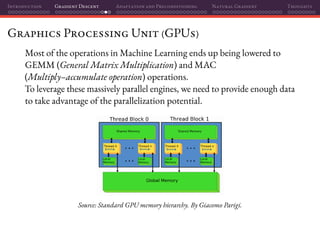
Most of the operations in Machine Learning ends up being lowered to
GEMM (General Matrix Multiplication) and MAC
(Multiply–accumulate operation) operations.
To leverage these massively parallel engines, we need to provide enough data
to take advantage of the parallelization potential.
Source: Standard GPU memory hierarchy. By Giacomo Parigi.
Introduction Gradient Descent Adaptation and Preconditioning Natural Gradient Thoughts
Mini-batch SGD
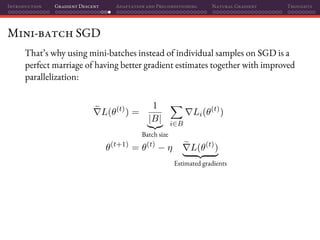
That’s why using mini-batches instead of individual samples on SGD is a
perfect marriage of having better gradient estimates together with improved
parallelization:
L(θ(t)
) =
1
|B|
Batch size
i∈B
Li(θ(t)
)
θ(t+1)
= θ(t)
− η L(θ(t)
)
Estimated gradients
Introduction Gradient Descent Adaptation and Preconditioning Natural Gradient Thoughts
Mini-batch SGD
That’s why using mini-batches instead of individual samples on SGD is a
perfect marriage of having better gradient estimates together with improved
parallelization:
L(θ(t)
) =
1
|B|
Batch size
i∈B
Li(θ(t)
)
θ(t+1)
= θ(t)
− η L(θ(t)
)
Estimated gradients
If we do random sampling, then:
E[ L(θ(t)
)] = L(θ)
Unbiased estimate
Introduction Gradient Descent Adaptation and Preconditioning Natural Gradient Thoughts
Section III
Adaptation and
Preconditioning
Introduction Gradient Descent Adaptation and Preconditioning Natural Gradient Thoughts
Adaptive Moment Estimation (Adam)
There are many adaptive methods, we will focus on one of the most
frequently used in Deep Learning, the Adaptive Moment Estimation 4, also
called Adam.
4
Kingma and Ba, “Adam: a Method for Stochastic Optimization”, 2015
Introduction Gradient Descent Adaptation and Preconditioning Natural Gradient Thoughts
Adaptive Moment Estimation (Adam)
There are many adaptive methods, we will focus on one of the most
frequently used in Deep Learning, the Adaptive Moment Estimation 4, also
called Adam.
Single learning rate for all parameters of the network doesn’t seem to
be enough to cope with the growing complexity of Deep Learning
architectures;
4
Kingma and Ba, “Adam: a Method for Stochastic Optimization”, 2015
Introduction Gradient Descent Adaptation and Preconditioning Natural Gradient Thoughts
Adaptive Moment Estimation (Adam)
There are many adaptive methods, we will focus on one of the most
frequently used in Deep Learning, the Adaptive Moment Estimation 4, also
called Adam.
Single learning rate for all parameters of the network doesn’t seem to
be enough to cope with the growing complexity of Deep Learning
architectures;
What we can do is often bounded by what we can optimize, therefore
better optimization techniques that explores structure are paramount;
4
Kingma and Ba, “Adam: a Method for Stochastic Optimization”, 2015
Introduction Gradient Descent Adaptation and Preconditioning Natural Gradient Thoughts
Adaptive Moment Estimation (Adam)
There are many adaptive methods, we will focus on one of the most
frequently used in Deep Learning, the Adaptive Moment Estimation 4, also
called Adam.
Single learning rate for all parameters of the network doesn’t seem to
be enough to cope with the growing complexity of Deep Learning
architectures;
What we can do is often bounded by what we can optimize, therefore
better optimization techniques that explores structure are paramount;
Most of the adaptive methods adapt to some kind of structure or
curvature of the optimization landscape;
4
Kingma and Ba, “Adam: a Method for Stochastic Optimization”, 2015
Introduction Gradient Descent Adaptation and Preconditioning Natural Gradient Thoughts
Adaptive Moment Estimation (Adam)
There are many adaptive methods, we will focus on one of the most
frequently used in Deep Learning, the Adaptive Moment Estimation 4, also
called Adam.
Single learning rate for all parameters of the network doesn’t seem to
be enough to cope with the growing complexity of Deep Learning
architectures;
What we can do is often bounded by what we can optimize, therefore
better optimization techniques that explores structure are paramount;
Most of the adaptive methods adapt to some kind of structure or
curvature of the optimization landscape;
Many of these algorithms are still not well understood, lots of folklore
in the field;
4
Kingma and Ba, “Adam: a Method for Stochastic Optimization”, 2015
Introduction Gradient Descent Adaptation and Preconditioning Natural Gradient Thoughts
Adaptive Moment Estimation (Adam)
There are many adaptive methods, we will focus on one of the most
frequently used in Deep Learning, the Adaptive Moment Estimation 4, also
called Adam.
Single learning rate for all parameters of the network doesn’t seem to
be enough to cope with the growing complexity of Deep Learning
architectures;
What we can do is often bounded by what we can optimize, therefore
better optimization techniques that explores structure are paramount;
Most of the adaptive methods adapt to some kind of structure or
curvature of the optimization landscape;
Many of these algorithms are still not well understood, lots of folklore
in the field;
Will try to focus on building intuition from the original algorithm.
4
Kingma and Ba, “Adam: a Method for Stochastic Optimization”, 2015
Introduction Gradient Descent Adaptation and Preconditioning Natural Gradient Thoughts
Adaptive Moment Estimation (Adam)
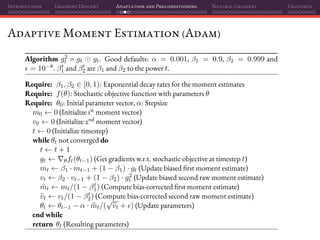
Algorithm g2
t = gt gt. Good defaults: α = 0.001, β1 = 0.9, β2 = 0.999 and
= 10−8. βt
1 and βt
2 are β1 and β2 to the power t.
Require: β1, β2 ∈ [0, 1): Exponential decay rates for the moment estimates
Require: f(θ): Stochastic objective function with parameters θ
Require: θ0: Initial parameter vector, α: Stepsize
m0 ← 0 (Initialize 1st moment vector)
v0 ← 0 (Initialize 2nd moment vector)
t ← 0 (Initialize timestep)
while θt not converged do
t ← t + 1
gt ← θft(θt−1) (Get gradients w.r.t. stochastic objective at timestep t)
mt ← β1 · mt−1 + (1 − β1) · gt (Update biased first moment estimate)
vt ← β2 · vt−1 + (1 − β2) · g2
t (Update biased second raw moment estimate)
mt ← mt/(1 − βt
1) (Compute bias-corrected first moment estimate)
vt ← vt/(1 − βt
2) (Compute bias-corrected second raw moment estimate)
θt ← θt−1 − α · mt/(
√
vt + ) (Update parameters)
end while
return θt (Resulting parameters)
Introduction Gradient Descent Adaptation and Preconditioning Natural Gradient Thoughts
Adaptive Moment Estimation (Adam)
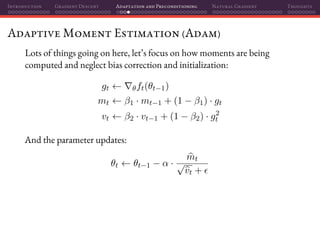
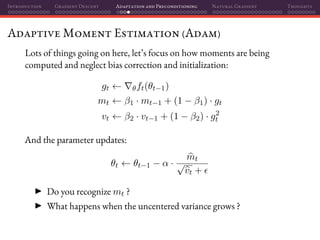
Lots of things going on here, let’s focus on how moments are being
computed and neglect bias correction and initialization:
gt ← θft(θt−1)
mt ← β1 · mt−1 + (1 − β1) · gt
vt ← β2 · vt−1 + (1 − β2) · g2
t
And the parameter updates:
θt ← θt−1 − α ·
mt
√
vt +
Introduction Gradient Descent Adaptation and Preconditioning Natural Gradient Thoughts
Adaptive Moment Estimation (Adam)
Lots of things going on here, let’s focus on how moments are being
computed and neglect bias correction and initialization:
gt ← θft(θt−1)
mt ← β1 · mt−1 + (1 − β1) · gt
vt ← β2 · vt−1 + (1 − β2) · g2
t
And the parameter updates:
θt ← θt−1 − α ·
mt
√
vt +
Do you recognize mt ?
What happens when the uncentered variance grows ?
Introduction Gradient Descent Adaptation and Preconditioning Natural Gradient Thoughts
The good, the bad, and the Hessian
The convergence rate of Gradient descent is deeply connected to the
curvature of the landscape it is trying to optimize;
Introduction Gradient Descent Adaptation and Preconditioning Natural Gradient Thoughts
The good, the bad, and the Hessian
The convergence rate of Gradient descent is deeply connected to the
curvature of the landscape it is trying to optimize;
The Hessian matrix Hf carries information about the curvature,
therefore we usually use it understand problems or even make them
better conditioned;
Introduction Gradient Descent Adaptation and Preconditioning Natural Gradient Thoughts
The good, the bad, and the Hessian
The convergence rate of Gradient descent is deeply connected to the
curvature of the landscape it is trying to optimize;
The Hessian matrix Hf carries information about the curvature,
therefore we usually use it understand problems or even make them
better conditioned;
The Hf is often very costly to compute for real-life problems,
therefore much of the work rely on approximating it or computing
information about it without having to materialize the entire matrix;
Introduction Gradient Descent Adaptation and Preconditioning Natural Gradient Thoughts
Hessian
The Hf is a square matrix of 2nd-order partial derivatives. Let’s compute
the Hf of f(x, y) = x2y + xy3, starting with first-order:
∂f
∂x
= 2xy + y3
,
∂f
∂y
= x2
+ 3xy2
Note that the Hf can be constant and not depend on variables or depend only on
some of them. We will see this case later.
Introduction Gradient Descent Adaptation and Preconditioning Natural Gradient Thoughts
Hessian
The Hf is a square matrix of 2nd-order partial derivatives. Let’s compute
the Hf of f(x, y) = x2y + xy3, starting with first-order:
∂f
∂x
= 2xy + y3
,
∂f
∂y
= x2
+ 3xy2
Second order
∂2
f
∂x2
= 2y ,
∂2
f
∂y∂x
2x + 3y2
,
∂2
f
∂x∂y
= 2x + 3y2
,
∂2
f
∂y2
= 6xy
Note that the Hf can be constant and not depend on variables or depend only on
some of them. We will see this case later.
Introduction Gradient Descent Adaptation and Preconditioning Natural Gradient Thoughts
Hessian
The Hf is a square matrix of 2nd-order partial derivatives. Let’s compute
the Hf of f(x, y) = x2y + xy3, starting with first-order:
∂f
∂x
= 2xy + y3
,
∂f
∂y
= x2
+ 3xy2
Second order
∂2
f
∂x2
= 2y ,
∂2
f
∂y∂x
2x + 3y2
,
∂2
f
∂x∂y
= 2x + 3y2
,
∂2
f
∂y2
= 6xy
Hessian
Hf =


∂2f
∂x2
∂2f
∂y∂x
∂2f
∂x∂y
∂2f
∂y2

 =
2y 2x + 3y2
2x + 3y2 6xy
Note that the Hf can be constant and not depend on variables or depend only on
some of them. We will see this case later.
Introduction Gradient Descent Adaptation and Preconditioning Natural Gradient Thoughts
Hessian Eigenvalues
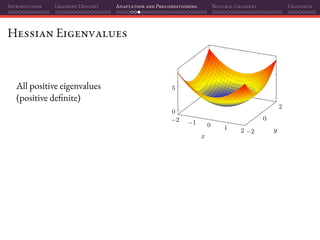
All positive eigenvalues
(positive definite)
−2 −1 0 1 2 −2
0
2
0
5
x
y
Introduction Gradient Descent Adaptation and Preconditioning Natural Gradient Thoughts
Hessian Eigenvalues
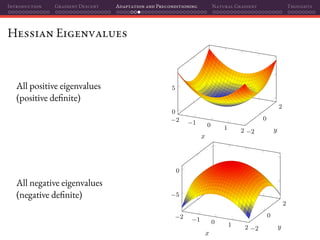
All positive eigenvalues
(positive definite)
−2 −1 0 1 2 −2
0
2
0
5
x
y
All negative eigenvalues
(negative definite)
−2 −1 0 1 2 −2
0
2
−5
0
x
y
Introduction Gradient Descent Adaptation and Preconditioning Natural Gradient Thoughts
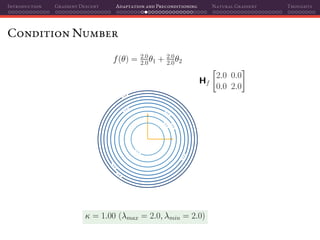
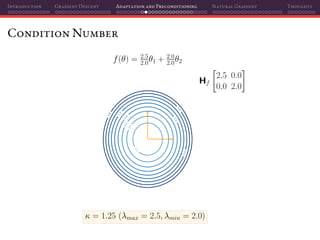
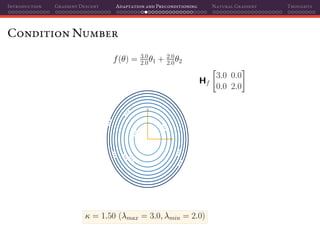
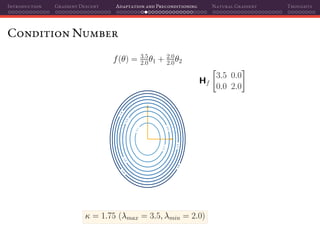
Condition Number
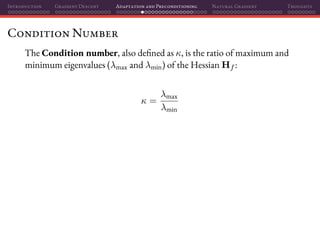
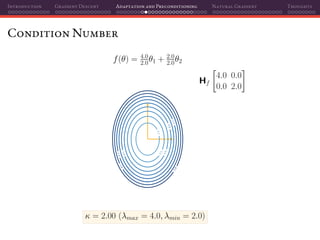
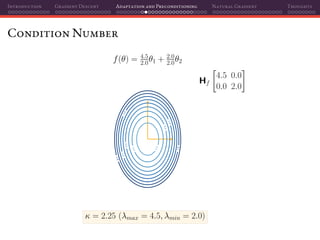
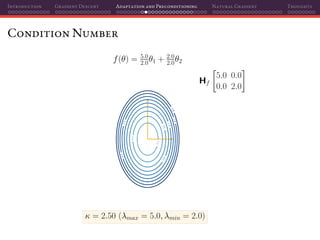
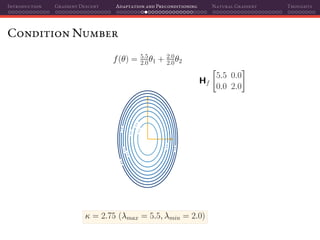
The Condition number, also defined as κ, is the ratio of maximum and
minimum eigenvalues (λmax and λmin) of the Hessian Hf :
κ =
λmax
λmin
Introduction Gradient Descent Adaptation and Preconditioning Natural Gradient Thoughts
Condition Number
The Condition number, also defined as κ, is the ratio of maximum and
minimum eigenvalues (λmax and λmin) of the Hessian Hf :
κ =
λmax
λmin
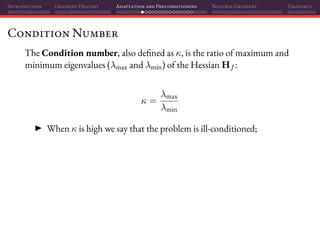
When κ is high we say that the problem is ill-conditioned;
Introduction Gradient Descent Adaptation and Preconditioning Natural Gradient Thoughts
Condition Number
The Condition number, also defined as κ, is the ratio of maximum and
minimum eigenvalues (λmax and λmin) of the Hessian Hf :
κ =
λmax
λmin
When κ is high we say that the problem is ill-conditioned;
Steepest descent convergence rate is slow for ill-conditioned problems;
Introduction Gradient Descent Adaptation and Preconditioning Natural Gradient Thoughts
Condition Number
The Condition number, also defined as κ, is the ratio of maximum and
minimum eigenvalues (λmax and λmin) of the Hessian Hf :
κ =
λmax
λmin
When κ is high we say that the problem is ill-conditioned;
Steepest descent convergence rate is slow for ill-conditioned problems;
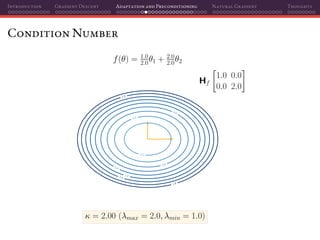
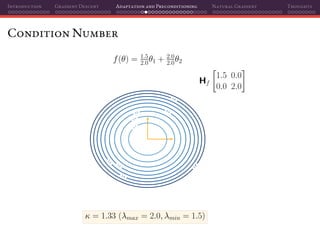
Let’s understand it on a quadratic problem to gain intuition.
Introduction Gradient Descent Adaptation and Preconditioning Natural Gradient Thoughts
Condition Number
Hf
1.0 0.0
0.0 2.0
0.2
0.4
0.6
0.8
1.0
1.21.4
1.6
1.8
f(θ) = 1.0
2.0θ1 + 2.0
2.0θ2
κ = 2.00 (λmax = 2.0, λmin = 1.0)
Introduction Gradient Descent Adaptation and Preconditioning Natural Gradient Thoughts
Condition Number
Hf
1.5 0.0
0.0 2.0
0.2
0.4
0.6
0.8
1.0
1.2
1.4
1.6
1.8
f(θ) = 1.5
2.0θ1 + 2.0
2.0θ2
κ = 1.33 (λmax = 2.0, λmin = 1.5)
Introduction Gradient Descent Adaptation and Preconditioning Natural Gradient Thoughts
Condition Number
Hf
2.0 0.0
0.0 2.0
0.2
0.4
0.6
0.8
1.0
1.2
1.4
1.6
1.8
f(θ) = 2.0
2.0θ1 + 2.0
2.0θ2
κ = 1.00 (λmax = 2.0, λmin = 2.0)
Introduction Gradient Descent Adaptation and Preconditioning Natural Gradient Thoughts
Condition Number
Hf
2.5 0.0
0.0 2.0
0.2
0.4
0.60.8
1.0
1.2
1.4
1.6
1.8
f(θ) = 2.5
2.0θ1 + 2.0
2.0θ2
κ = 1.25 (λmax = 2.5, λmin = 2.0)
Introduction Gradient Descent Adaptation and Preconditioning Natural Gradient Thoughts
Condition Number
Hf
3.0 0.0
0.0 2.0
0.2
0.4
0.6
0.8
1.0
1.2
1.4
1.6
1.8
f(θ) = 3.0
2.0θ1 + 2.0
2.0θ2
κ = 1.50 (λmax = 3.0, λmin = 2.0)
Introduction Gradient Descent Adaptation and Preconditioning Natural Gradient Thoughts
Condition Number
Hf
3.5 0.0
0.0 2.0
0.2
0.4
0.6
0.8
1.0
1.2
1.41.6
1.8
f(θ) = 3.5
2.0θ1 + 2.0
2.0θ2
κ = 1.75 (λmax = 3.5, λmin = 2.0)
Introduction Gradient Descent Adaptation and Preconditioning Natural Gradient Thoughts
Condition Number
Hf
4.0 0.0
0.0 2.0
0.2
0.4
0.6
0.8
1.0
1.2
1.4
1.6
1.8
f(θ) = 4.0
2.0θ1 + 2.0
2.0θ2
κ = 2.00 (λmax = 4.0, λmin = 2.0)
Introduction Gradient Descent Adaptation and Preconditioning Natural Gradient Thoughts
Condition Number
Hf
4.5 0.0
0.0 2.0
0.2
0.4
0.6
0.8
1.0
1.2
1.4
1.6
1.8
f(θ) = 4.5
2.0θ1 + 2.0
2.0θ2
κ = 2.25 (λmax = 4.5, λmin = 2.0)
Introduction Gradient Descent Adaptation and Preconditioning Natural Gradient Thoughts
Condition Number
Hf
5.0 0.0
0.0 2.0
0.2
0.4
0.60.8
1.0
1.2
1.4
1.6
1.8
f(θ) = 5.0
2.0θ1 + 2.0
2.0θ2
κ = 2.50 (λmax = 5.0, λmin = 2.0)
Introduction Gradient Descent Adaptation and Preconditioning Natural Gradient Thoughts
Condition Number
Hf
5.5 0.0
0.0 2.0
0.2
0.4
0.6
0.8
1.0
1.21.4
1.6
1.8
f(θ) = 5.5
2.0θ1 + 2.0
2.0θ2
κ = 2.75 (λmax = 5.5, λmin = 2.0)
Introduction Gradient Descent Adaptation and Preconditioning Natural Gradient Thoughts
Hessian eigenvalue spectral density (ESD)
1 25 50 75 100 125 150 175
Epoch
0
200
400
600
800
1000
1200
Eigenvalue
Cifar-10 ResNet20
1 25 50 75 100 125 150 175
Epoch
0
200
400
600
800
1000
1200
Eigenvalue
Cifar-10 ResNet BN20
1 25 50 75 100 125 150 175
Epoch
0
200
400
600
800
1000
1200
Eigenvalue
Cifar-10 ResNet Res20
Source: Yao, Z., Gholami, A., Keutzer, K., & Mahoney, M. W. (2019, December 15). PYHESSIAN:
Neural networks through the lens of the hessian.
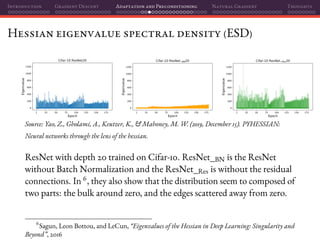
ResNet with depth 20 trained on Cifar-10. ResNet_BN is the ResNet
without Batch Normalization and the ResNet_Res is without the residual
connections. In 6, they also show that the distribution seem to composed of
two parts: the bulk around zero, and the edges scattered away from zero.
6
Sagun, Leon Bottou, and LeCun, “Eigenvalues of the Hessian in Deep Learning: Singularity and
Beyond”, 2016
Introduction Gradient Descent Adaptation and Preconditioning Natural Gradient Thoughts
Preconditioning
From Adam’s original paper:
(...) Like natural gradient descent (NGD) 7
, Adam employs a preconditioner
that adapts to the geometry of the data, since vt is an approximation to the
diagonal of the Fisher information matrix 8
; (...)
Preconditioning can be viewed as a change in the geometry;
7
Amari, “Natural Gradient Works Efficiently in Learning”, 1998
8
Pascanu and Bengio, “Revisiting Natural Gradient for Deep Networks”, 2013
Introduction Gradient Descent Adaptation and Preconditioning Natural Gradient Thoughts
Preconditioning
From Adam’s original paper:
(...) Like natural gradient descent (NGD) 7
, Adam employs a preconditioner
that adapts to the geometry of the data, since vt is an approximation to the
diagonal of the Fisher information matrix 8
; (...)
Preconditioning can be viewed as a change in the geometry;
It can help with poorly conditioned problems;
7
Amari, “Natural Gradient Works Efficiently in Learning”, 1998
8
Pascanu and Bengio, “Revisiting Natural Gradient for Deep Networks”, 2013
Introduction Gradient Descent Adaptation and Preconditioning Natural Gradient Thoughts
Preconditioning
From Adam’s original paper:
(...) Like natural gradient descent (NGD) 7
, Adam employs a preconditioner
that adapts to the geometry of the data, since vt is an approximation to the
diagonal of the Fisher information matrix 8
; (...)
Preconditioning can be viewed as a change in the geometry;
It can help with poorly conditioned problems;
We will talk about the Fisher Information Matrix (FIM) later;
7
Amari, “Natural Gradient Works Efficiently in Learning”, 1998
8
Pascanu and Bengio, “Revisiting Natural Gradient for Deep Networks”, 2013
Introduction Gradient Descent Adaptation and Preconditioning Natural Gradient Thoughts
Preconditioning
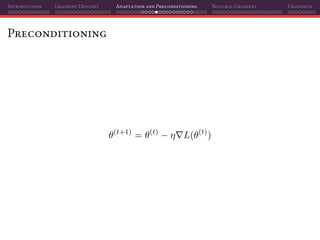
θ(t+1)
= θ(t)
− η L(θ(t)
)
Introduction Gradient Descent Adaptation and Preconditioning Natural Gradient Thoughts
Preconditioning
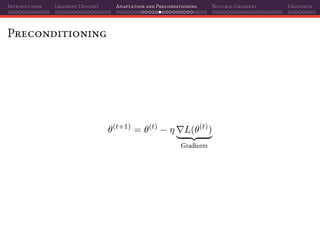
θ(t+1)
= θ(t)
− η L(θ(t)
)
Gradients
Introduction Gradient Descent Adaptation and Preconditioning Natural Gradient Thoughts
Preconditioning
θ(t+1)
= θ(t)
− η P
Preconditioner
L(θ(t)
)
Gradients
Introduction Gradient Descent Adaptation and Preconditioning Natural Gradient Thoughts
Preconditioning
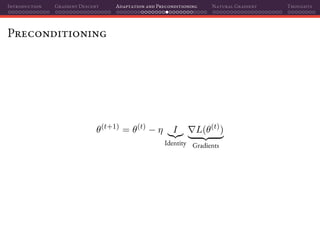
θ(t+1)
= θ(t)
− η I
Identity
L(θ(t)
)
Gradients
Introduction Gradient Descent Adaptation and Preconditioning Natural Gradient Thoughts
Preconditioning
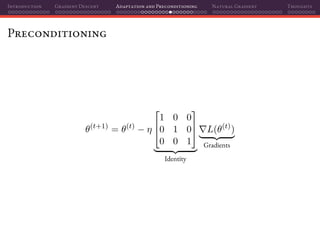
θ(t+1)
= θ(t)
− η



1 0 0
0 1 0
0 0 1



Identity
L(θ(t)
)
Gradients
Introduction Gradient Descent Adaptation and Preconditioning Natural Gradient Thoughts
Preconditioning
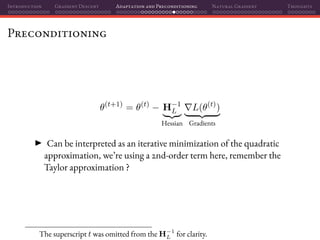
θ(t+1)
= θ(t)
− H−1
L
Hessian
L(θ(t)
)
Gradients
Can be interpreted as an iterative minimization of the quadratic
approximation, we’re using a 2nd-order term here, remember the
Taylor approximation ?
The superscript t was omitted from the H−1
L for clarity.
Introduction Gradient Descent Adaptation and Preconditioning Natural Gradient Thoughts
Preconditioning
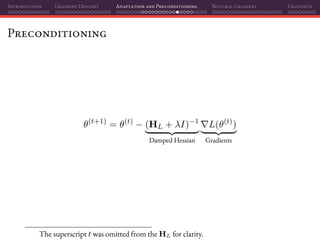
θ(t+1)
= θ(t)
− (HL + λI)−1
Damped Hessian
L(θ(t)
)
Gradients
The superscript t was omitted from the HL for clarity.
Introduction Gradient Descent Adaptation and Preconditioning Natural Gradient Thoughts
Preconditioning
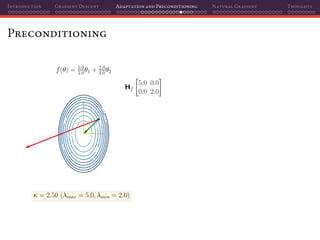
Hf
5.0 0.0
0.0 2.00.2
0.4
0.60.8
1.0
1.2
1.4
1.6
1.8
f(θ) = 5.0
2.0θ1 + 2.0
2.0θ2
κ = 2.50 (λmax = 5.0, λmin = 2.0)
Introduction Gradient Descent Adaptation and Preconditioning Natural Gradient Thoughts
Preconditioning
Hf
5.0 0.0
0.0 2.00.2
0.4
0.60.8
1.0
1.2
1.4
1.6
1.8
f(θ) = 5.0
2.0θ1 + 2.0
2.0θ2
κ = 2.50 (λmax = 5.0, λmin = 2.0)
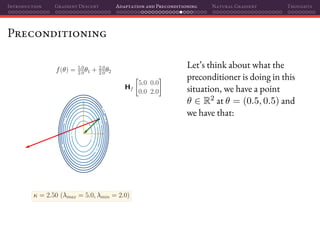
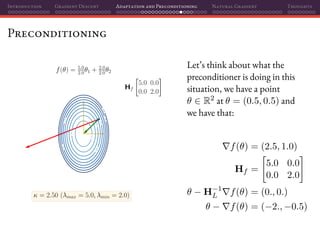
Let’s think about what the
preconditioner is doing in this
situation, we have a point
θ ∈ R2 at θ = (0.5, 0.5) and
we have that:
Introduction Gradient Descent Adaptation and Preconditioning Natural Gradient Thoughts
Preconditioning
Hf
5.0 0.0
0.0 2.00.2
0.4
0.60.8
1.0
1.2
1.4
1.6
1.8
f(θ) = 5.0
2.0θ1 + 2.0
2.0θ2
κ = 2.50 (λmax = 5.0, λmin = 2.0)
Let’s think about what the
preconditioner is doing in this
situation, we have a point
θ ∈ R2 at θ = (0.5, 0.5) and
we have that:
f(θ) = (2.5, 1.0)
Hf =
5.0 0.0
0.0 2.0
θ − H−1
L f(θ) = (0., 0.)
θ − f(θ) = (−2., −0.5)
Introduction Gradient Descent Adaptation and Preconditioning Natural Gradient Thoughts
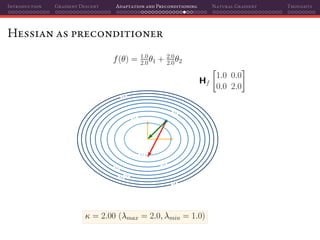
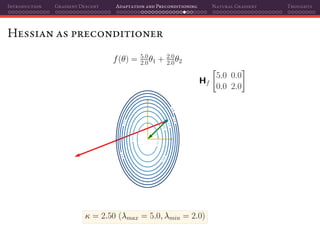
Hessian as preconditioner
Hf
1.0 0.0
0.0 2.0
0.2
0.4
0.6
0.8
1.0
1.21.4
1.6
1.8
f(θ) = 1.0
2.0θ1 + 2.0
2.0θ2
κ = 2.00 (λmax = 2.0, λmin = 1.0)
Introduction Gradient Descent Adaptation and Preconditioning Natural Gradient Thoughts
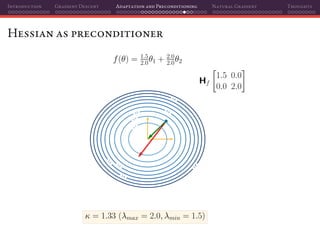
Hessian as preconditioner
Hf
1.5 0.0
0.0 2.0
0.2
0.4
0.6
0.8
1.0
1.2
1.4
1.6
1.8
f(θ) = 1.5
2.0θ1 + 2.0
2.0θ2
κ = 1.33 (λmax = 2.0, λmin = 1.5)
Introduction Gradient Descent Adaptation and Preconditioning Natural Gradient Thoughts
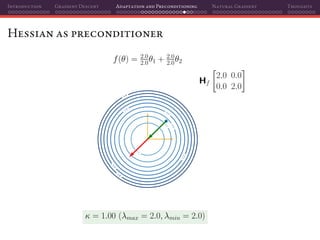
Hessian as preconditioner
Hf
2.0 0.0
0.0 2.0
0.2
0.4
0.6
0.8
1.0
1.2
1.4
1.6
1.8
f(θ) = 2.0
2.0θ1 + 2.0
2.0θ2
κ = 1.00 (λmax = 2.0, λmin = 2.0)
Introduction Gradient Descent Adaptation and Preconditioning Natural Gradient Thoughts
Hessian as preconditioner
Hf
2.5 0.0
0.0 2.0
0.2
0.4
0.60.8
1.0
1.2
1.4
1.6
1.8
f(θ) = 2.5
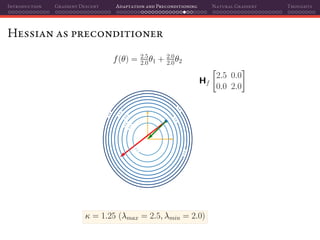
2.0θ1 + 2.0
2.0θ2
κ = 1.25 (λmax = 2.5, λmin = 2.0)
Introduction Gradient Descent Adaptation and Preconditioning Natural Gradient Thoughts
Hessian as preconditioner
Hf
3.0 0.0
0.0 2.0
0.2
0.4
0.6
0.8
1.0
1.2
1.4
1.6
1.8
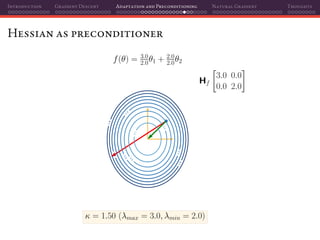
f(θ) = 3.0
2.0θ1 + 2.0
2.0θ2
κ = 1.50 (λmax = 3.0, λmin = 2.0)
Introduction Gradient Descent Adaptation and Preconditioning Natural Gradient Thoughts
Hessian as preconditioner
Hf
3.5 0.0
0.0 2.0
0.2
0.4
0.6
0.8
1.0
1.2
1.41.6
1.8
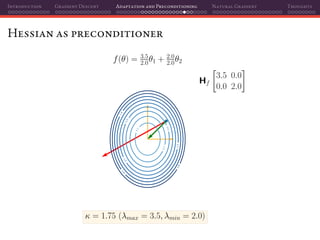
f(θ) = 3.5
2.0θ1 + 2.0
2.0θ2
κ = 1.75 (λmax = 3.5, λmin = 2.0)
Introduction Gradient Descent Adaptation and Preconditioning Natural Gradient Thoughts
Hessian as preconditioner
Hf
4.0 0.0
0.0 2.0
0.2
0.4
0.6
0.8
1.0
1.2
1.4
1.6
1.8
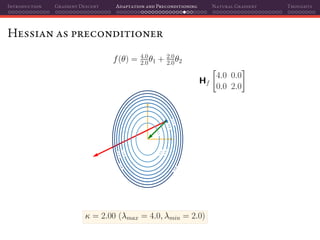
f(θ) = 4.0
2.0θ1 + 2.0
2.0θ2
κ = 2.00 (λmax = 4.0, λmin = 2.0)
Introduction Gradient Descent Adaptation and Preconditioning Natural Gradient Thoughts
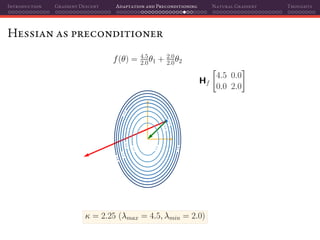
Hessian as preconditioner
Hf
4.5 0.0
0.0 2.0
0.2
0.4
0.6
0.8
1.0
1.2
1.4
1.6
1.8
f(θ) = 4.5
2.0θ1 + 2.0
2.0θ2
κ = 2.25 (λmax = 4.5, λmin = 2.0)
Introduction Gradient Descent Adaptation and Preconditioning Natural Gradient Thoughts
Hessian as preconditioner
Hf
5.0 0.0
0.0 2.0
0.2
0.4
0.60.8
1.0
1.2
1.4
1.6
1.8
f(θ) = 5.0
2.0θ1 + 2.0
2.0θ2
κ = 2.50 (λmax = 5.0, λmin = 2.0)
Introduction Gradient Descent Adaptation and Preconditioning Natural Gradient Thoughts
Difficulties of the Hessian preconditioning
Using the Hessian as preconditioner is the basis of the Newton’s
method;
11
Dauphin et al., “Identifying and attacking the saddle point problem in high-dimensional
non-convex optimization”, 2014
12
Yao et al., PYHESSIAN: Neural networks through the lens of the hessian, 2019
13
Martens, Deep learning via Hessian-free optimization, 2010
Introduction Gradient Descent Adaptation and Preconditioning Natural Gradient Thoughts
Difficulties of the Hessian preconditioning
Using the Hessian as preconditioner is the basis of the Newton’s
method;
Invariant to affine transformations;
11
Dauphin et al., “Identifying and attacking the saddle point problem in high-dimensional
non-convex optimization”, 2014
12
Yao et al., PYHESSIAN: Neural networks through the lens of the hessian, 2019
13
Martens, Deep learning via Hessian-free optimization, 2010
Introduction Gradient Descent Adaptation and Preconditioning Natural Gradient Thoughts
Difficulties of the Hessian preconditioning
Using the Hessian as preconditioner is the basis of the Newton’s
method;
Invariant to affine transformations;
However, a model with 23 million parameters (i.e. ResNet-50), what
is the space complexity to store the Hf and the computational
complexity to invert it ?
11
Dauphin et al., “Identifying and attacking the saddle point problem in high-dimensional
non-convex optimization”, 2014
12
Yao et al., PYHESSIAN: Neural networks through the lens of the hessian, 2019
13
Martens, Deep learning via Hessian-free optimization, 2010
Introduction Gradient Descent Adaptation and Preconditioning Natural Gradient Thoughts
Difficulties of the Hessian preconditioning
Using the Hessian as preconditioner is the basis of the Newton’s
method;
Invariant to affine transformations;
However, a model with 23 million parameters (i.e. ResNet-50), what
is the space complexity to store the Hf and the computational
complexity to invert it ?
Difficult on non-convex problems, not always invertible, attracted by
saddle points 11;
11
Dauphin et al., “Identifying and attacking the saddle point problem in high-dimensional
non-convex optimization”, 2014
12
Yao et al., PYHESSIAN: Neural networks through the lens of the hessian, 2019
13
Martens, Deep learning via Hessian-free optimization, 2010
Introduction Gradient Descent Adaptation and Preconditioning Natural Gradient Thoughts
Difficulties of the Hessian preconditioning
Using the Hessian as preconditioner is the basis of the Newton’s
method;
Invariant to affine transformations;
However, a model with 23 million parameters (i.e. ResNet-50), what
is the space complexity to store the Hf and the computational
complexity to invert it ?
Difficult on non-convex problems, not always invertible, attracted by
saddle points 11;
Among other reasons, you now understand all the efforts into
Hessian approximations 12, alternative curvature matrices and
hessian-free optimization 13.
11
Dauphin et al., “Identifying and attacking the saddle point problem in high-dimensional
non-convex optimization”, 2014
12
Yao et al., PYHESSIAN: Neural networks through the lens of the hessian, 2019
13
Martens, Deep learning via Hessian-free optimization, 2010
Introduction Gradient Descent Adaptation and Preconditioning Natural Gradient Thoughts
Saddle points
−4
−2 0
2
4 −4
−2
0
2
4−10
0
10
Introduction Gradient Descent Adaptation and Preconditioning Natural Gradient Thoughts
Fisher Information Matrix (FIM)
Going back to the Adam’s article:
From Adam’s original paper:
(...) Like natural gradient descent (NGD) 14
, Adam employs a preconditioner
that adapts to the geometry of the data, since vt is an approximation to the
diagonal of the Fisher information matrix 15
; (...)
We now know what a preconditioner means;
The missing ingredient now is the Fisher Information Matrix (also
known as FIM).
14
Amari, “Natural Gradient Works Efficiently in Learning”, 1998
15
Pascanu and Bengio, “Revisiting Natural Gradient for Deep Networks”, 2013
Introduction Gradient Descent Adaptation and Preconditioning Natural Gradient Thoughts
Fisher Information Matrix (FIM)
The Fisher Information Matrix is the covariance of the score function
(gradients of the log-likelihood function) with expectation over the model’s
predictive distribution (pay attention to this detail).
Definition: Fisher Information Matrix
Fθ = E
y∼pθ(y|x)
x∼pdata
[ θ log pθ(y|x) θ log pθ(y|x) ]
Where Fθ ∈ Rn×n.
Introduction Gradient Descent Adaptation and Preconditioning Natural Gradient Thoughts
Fisher Information Matrix (FIM)
The Fisher Information Matrix is the covariance of the score function
(gradients of the log-likelihood function) with expectation over the model’s
predictive distribution (pay attention to this detail).
Definition: Fisher Information Matrix
Fθ = E
y∼pθ(y|x)
x∼pdata
[ θ log pθ(y|x) θ log pθ(y|x) ]
Where Fθ ∈ Rn×n. We often approximate it using input samples (y is still
from model’s predictive distribution), as we don’t have access to pdata:
Fθ =
1
N
N
i=1
θ log pθ(y|xi) θ log pθ(y|xi)
Introduction Gradient Descent Adaptation and Preconditioning Natural Gradient Thoughts
Kullback-Leibler divergence
−20 −15 −10 −5 0 5 10 15 20
KL[P Q] = 5683.243
P
Q
Introduction Gradient Descent Adaptation and Preconditioning Natural Gradient Thoughts
Kullback-Leibler divergence
−20 −15 −10 −5 0 5 10 15 20
KL[P Q] = 3488.456
P
Q
Introduction Gradient Descent Adaptation and Preconditioning Natural Gradient Thoughts
Kullback-Leibler divergence
−20 −15 −10 −5 0 5 10 15 20
KL[P Q] = 1842.365
P
Q
Introduction Gradient Descent Adaptation and Preconditioning Natural Gradient Thoughts
Kullback-Leibler divergence
−20 −15 −10 −5 0 5 10 15 20
KL[P Q] = 744.971
P
Q
Introduction Gradient Descent Adaptation and Preconditioning Natural Gradient Thoughts
Kullback-Leibler divergence
−20 −15 −10 −5 0 5 10 15 20
KL[P Q] = 196.274
P
Q
Introduction Gradient Descent Adaptation and Preconditioning Natural Gradient Thoughts
Kullback-Leibler divergence
−20 −15 −10 −5 0 5 10 15 20
KL[P Q] = 196.274
P
Q
Introduction Gradient Descent Adaptation and Preconditioning Natural Gradient Thoughts
Kullback-Leibler divergence
−20 −15 −10 −5 0 5 10 15 20
KL[P Q] = 744.971
P
Q
Introduction Gradient Descent Adaptation and Preconditioning Natural Gradient Thoughts
Kullback-Leibler divergence
−20 −15 −10 −5 0 5 10 15 20
KL[P Q] = 1842.365
P
Q
Introduction Gradient Descent Adaptation and Preconditioning Natural Gradient Thoughts
Kullback-Leibler divergence
−20 −15 −10 −5 0 5 10 15 20
KL[P Q] = 3488.456
P
Q
Introduction Gradient Descent Adaptation and Preconditioning Natural Gradient Thoughts
Kullback-Leibler divergence
−20 −15 −10 −5 0 5 10 15 20
KL[P Q] = 5683.243
P
Q
Introduction Gradient Descent Adaptation and Preconditioning Natural Gradient Thoughts
Fisher Information Matrix (FIM)
We can parametrize the same distribution family on many different
ways;
Moving in the parameter space using the Euclidean distance as a
metric makes us tied to the particular parametrization;
16
For a full derivation please refer to: Ratliff, N. (2013). Information Geometry and
Natural Gradients.
17
Martens, “New insights and perspectives on the natural gradient method”, 2014
Introduction Gradient Descent Adaptation and Preconditioning Natural Gradient Thoughts
Fisher Information Matrix (FIM)
We can parametrize the same distribution family on many different
ways;
Moving in the parameter space using the Euclidean distance as a
metric makes us tied to the particular parametrization;
One interesting way is to move on the distribution space, to which
the KL divergence makes more sense;
16
For a full derivation please refer to: Ratliff, N. (2013). Information Geometry and
Natural Gradients.
17
Martens, “New insights and perspectives on the natural gradient method”, 2014
Introduction Gradient Descent Adaptation and Preconditioning Natural Gradient Thoughts
Fisher Information Matrix (FIM)
We can parametrize the same distribution family on many different
ways;
Moving in the parameter space using the Euclidean distance as a
metric makes us tied to the particular parametrization;
One interesting way is to move on the distribution space, to which
the KL divergence makes more sense;
It turns out that the second-order Taylor approximation to the KL
divergence is the Fisher Information Matrix16;
16
For a full derivation please refer to: Ratliff, N. (2013). Information Geometry and
Natural Gradients.
17
Martens, “New insights and perspectives on the natural gradient method”, 2014
Introduction Gradient Descent Adaptation and Preconditioning Natural Gradient Thoughts
Fisher Information Matrix (FIM)
We can parametrize the same distribution family on many different
ways;
Moving in the parameter space using the Euclidean distance as a
metric makes us tied to the particular parametrization;
One interesting way is to move on the distribution space, to which
the KL divergence makes more sense;
It turns out that the second-order Taylor approximation to the KL
divergence is the Fisher Information Matrix16;
We won’t be talking here, but the Fisher has a strong connection to
the Hessian and the Generalized Gauss-Newton (GGN), please refer
to 17 if you are interested.
16
For a full derivation please refer to: Ratliff, N. (2013). Information Geometry and
Natural Gradients.
17
Martens, “New insights and perspectives on the natural gradient method”, 2014
Introduction Gradient Descent Adaptation and Preconditioning Natural Gradient Thoughts
Section IV
Natural Gradient
Introduction Gradient Descent Adaptation and Preconditioning Natural Gradient Thoughts
Natural Gradient
When we do a preconditioning on Gradient descent using the Fisher, we
have the Natural Gradient Descent 18:
θ(t+1)
= θ(t)
− η F−1
θ
FIM
L(θ(t)
)
Gradients
18
Amari, “Natural Gradient Works Efficiently in Learning”, 1998
19
Léon Bottou, Curtis, and Nocedal, Optimization methods for large-scale machine learning, 2018
Introduction Gradient Descent Adaptation and Preconditioning Natural Gradient Thoughts
Natural Gradient
When we do a preconditioning on Gradient descent using the Fisher, we
have the Natural Gradient Descent 18:
θ(t+1)
= θ(t)
− η F−1
θ
FIM
L(θ(t)
)
Gradients
It converges much faster than ordinary Gradient descent;
18
Amari, “Natural Gradient Works Efficiently in Learning”, 1998
19
Léon Bottou, Curtis, and Nocedal, Optimization methods for large-scale machine learning, 2018
Introduction Gradient Descent Adaptation and Preconditioning Natural Gradient Thoughts
Natural Gradient
When we do a preconditioning on Gradient descent using the Fisher, we
have the Natural Gradient Descent 18:
θ(t+1)
= θ(t)
− η F−1
θ
FIM
L(θ(t)
)
Gradients
It converges much faster than ordinary Gradient descent;
It moves on the distribution space manifold, invariant with respect to
all differentiable and invertible transformations 19;
18
Amari, “Natural Gradient Works Efficiently in Learning”, 1998
19
Léon Bottou, Curtis, and Nocedal, Optimization methods for large-scale machine learning, 2018
Introduction Gradient Descent Adaptation and Preconditioning Natural Gradient Thoughts
Natural Gradient
When we do a preconditioning on Gradient descent using the Fisher, we
have the Natural Gradient Descent 18:
θ(t+1)
= θ(t)
− η F−1
θ
FIM
L(θ(t)
)
Gradients
It converges much faster than ordinary Gradient descent;
It moves on the distribution space manifold, invariant with respect to
all differentiable and invertible transformations 19;
Given that the FIM is the result of an outer-product, it is always PSD
(positive semidefinite matrix);
18
Amari, “Natural Gradient Works Efficiently in Learning”, 1998
19
Léon Bottou, Curtis, and Nocedal, Optimization methods for large-scale machine learning, 2018
Introduction Gradient Descent Adaptation and Preconditioning Natural Gradient Thoughts
Natural Gradient
When we do a preconditioning on Gradient descent using the Fisher, we
have the Natural Gradient Descent 18:
θ(t+1)
= θ(t)
− η F−1
θ
FIM
L(θ(t)
)
Gradients
It converges much faster than ordinary Gradient descent;
It moves on the distribution space manifold, invariant with respect to
all differentiable and invertible transformations 19;
Given that the FIM is the result of an outer-product, it is always PSD
(positive semidefinite matrix);
It is still a n × n matrix, that needs to be inverted;
18
Amari, “Natural Gradient Works Efficiently in Learning”, 1998
19
Léon Bottou, Curtis, and Nocedal, Optimization methods for large-scale machine learning, 2018
Introduction Gradient Descent Adaptation and Preconditioning Natural Gradient Thoughts
Natural Gradient
The natural gradient is connected to information geometry 20.
In a Euclidean space, the shortest path between two points is always
the straight line;
20
Amari, “Information geometry and its applications”, 2016
21
Léon Bottou, Curtis, and Nocedal, Optimization methods for large-scale machine learning, 2018
Introduction Gradient Descent Adaptation and Preconditioning Natural Gradient Thoughts
Natural Gradient
The natural gradient is connected to information geometry 20.
In a Euclidean space, the shortest path between two points is always
the straight line;
In a Riemannian space, the shortest path between two points
(minimal geodesic) can have a curvature and sometimes there is more
than one between two points;
20
Amari, “Information geometry and its applications”, 2016
21
Léon Bottou, Curtis, and Nocedal, Optimization methods for large-scale machine learning, 2018
Introduction Gradient Descent Adaptation and Preconditioning Natural Gradient Thoughts
Natural Gradient
The natural gradient is connected to information geometry 20.
In a Euclidean space, the shortest path between two points is always
the straight line;
In a Riemannian space, the shortest path between two points
(minimal geodesic) can have a curvature and sometimes there is more
than one between two points;
The metric tensor represents this curvature and can be different at
different points;
20
Amari, “Information geometry and its applications”, 2016
21
Léon Bottou, Curtis, and Nocedal, Optimization methods for large-scale machine learning, 2018
Introduction Gradient Descent Adaptation and Preconditioning Natural Gradient Thoughts
Natural Gradient
The natural gradient is connected to information geometry 20.
In a Euclidean space, the shortest path between two points is always
the straight line;
In a Riemannian space, the shortest path between two points
(minimal geodesic) can have a curvature and sometimes there is more
than one between two points;
The metric tensor represents this curvature and can be different at
different points;
With the natural gradient, we are moving in this Riemannian
manifold using the Fisher as the metric tensor;
20
Amari, “Information geometry and its applications”, 2016
21
Léon Bottou, Curtis, and Nocedal, Optimization methods for large-scale machine learning, 2018
Introduction Gradient Descent Adaptation and Preconditioning Natural Gradient Thoughts
Natural Gradient
The natural gradient is connected to information geometry 20.
In a Euclidean space, the shortest path between two points is always
the straight line;
In a Riemannian space, the shortest path between two points
(minimal geodesic) can have a curvature and sometimes there is more
than one between two points;
The metric tensor represents this curvature and can be different at
different points;
With the natural gradient, we are moving in this Riemannian
manifold using the Fisher as the metric tensor;
Parameters move more quickly along directions that have a small
impact on the decision function, and more cautiously along directions
that have a large impact 21;
20
Amari, “Information geometry and its applications”, 2016
21
Léon Bottou, Curtis, and Nocedal, Optimization methods for large-scale machine learning, 2018
Introduction Gradient Descent Adaptation and Preconditioning Natural Gradient Thoughts
Riemannian manifold
Source: Gallier J., (2020) Advanced Geometric
Methods in Computer Science. CIS 610, Spring 2018.
A manifold is a collection of
points, where locally (but not
globally), is Euclidean;
Introduction Gradient Descent Adaptation and Preconditioning Natural Gradient Thoughts
Riemannian manifold
Source: Gallier J., (2020) Advanced Geometric
Methods in Computer Science. CIS 610, Spring 2018.
A manifold is a collection of
points, where locally (but not
globally), is Euclidean;
A metric induces an inner
product on the tangent space at
each point on the manifold;
Introduction Gradient Descent Adaptation and Preconditioning Natural Gradient Thoughts
Riemannian manifold
Source: Gallier J., (2020) Advanced Geometric
Methods in Computer Science. CIS 610, Spring 2018.
A manifold is a collection of
points, where locally (but not
globally), is Euclidean;
A metric induces an inner
product on the tangent space at
each point on the manifold;
The metric on the statistical
manifold is unique, it is an
intrinsic geometry;
Introduction Gradient Descent Adaptation and Preconditioning Natural Gradient Thoughts
Riemannian manifold
Source: Gallier J., (2020) Advanced Geometric
Methods in Computer Science. CIS 610, Spring 2018.
A manifold is a collection of
points, where locally (but not
globally), is Euclidean;
A metric induces an inner
product on the tangent space at
each point on the manifold;
The metric on the statistical
manifold is unique, it is an
intrinsic geometry;
In Euclidean space we don’t
care because the metric is
constant everywhere;
Introduction Gradient Descent Adaptation and Preconditioning Natural Gradient Thoughts
Empirical Fisher
There is a lot of confusion22 about the Fisher Information Matrix 23.
In some scenarios you will see people sampling y ∼ pdata too instead
of sampling from the model’s predictive distribution y ∼ pθ(y|x);
22
I blame evil people who omit expectation qualifiers about where y is coming from.
23
Kunstner, Balles, and Hennig, “Limitations of the empirical fisher approximation for natural
gradient descent”, 2019
Introduction Gradient Descent Adaptation and Preconditioning Natural Gradient Thoughts
Empirical Fisher
There is a lot of confusion22 about the Fisher Information Matrix 23.
In some scenarios you will see people sampling y ∼ pdata too instead
of sampling from the model’s predictive distribution y ∼ pθ(y|x);
This is called the Empirical Fisher, Empirical FIM or just EF:
Fθ =
1
N
N
i=1
θ log pθ(yi|xi) θ log pθ(yi|xi)
22
I blame evil people who omit expectation qualifiers about where y is coming from.
23
Kunstner, Balles, and Hennig, “Limitations of the empirical fisher approximation for natural
gradient descent”, 2019
Introduction Gradient Descent Adaptation and Preconditioning Natural Gradient Thoughts
Empirical Fisher
There is a lot of confusion22 about the Fisher Information Matrix 23.
In some scenarios you will see people sampling y ∼ pdata too instead
of sampling from the model’s predictive distribution y ∼ pθ(y|x);
This is called the Empirical Fisher, Empirical FIM or just EF:
Fθ =
1
N
N
i=1
θ log pθ(yi|xi) θ log pθ(yi|xi)
It turns out that Adam is using the Empirical Fisher, and to make
things more confusing it is using the square root of it.
22
I blame evil people who omit expectation qualifiers about where y is coming from.
23
Kunstner, Balles, and Hennig, “Limitations of the empirical fisher approximation for natural
gradient descent”, 2019
Introduction Gradient Descent Adaptation and Preconditioning Natural Gradient Thoughts
Adam and the Natural Gradient Descent
Original Adam paper 24 claims that Adam is an approximation to the
natural gradient descent (diagonal of the FIM):
gt ← θft(θt−1)
mt ← β1 · mt−1 + (1 − β1) · gt
vt ← β2 · vt−1 + (1 − β2) · g2
t
θt ← θt−1 − α ·
mt
vt +
24
Kingma and Ba, “Adam: a Method for Stochastic Optimization”, 2015
25
Staib et al., “Escaping saddle points with adaptive gradient methods”, 2019
Introduction Gradient Descent Adaptation and Preconditioning Natural Gradient Thoughts
Adam and the Natural Gradient Descent
Original Adam paper 24 claims that Adam is an approximation to the
natural gradient descent (diagonal of the FIM):
gt ← θft(θt−1)
mt ← β1 · mt−1 + (1 − β1) · gt
vt ← β2 · vt−1 + (1 − β2) · g2
t
θt ← θt−1 − α ·
mt
vt +
However, the approximation is only valid near optimality (why ?). The
exponent is also different, since Adam is taking square root, it doesn’t
change direction of the descent (only stepsize) 25.
24
Kingma and Ba, “Adam: a Method for Stochastic Optimization”, 2015
25
Staib et al., “Escaping saddle points with adaptive gradient methods”, 2019
Introduction Gradient Descent Adaptation and Preconditioning Natural Gradient Thoughts
Empirical Fisher
Dataset
y = θx + b
GD NGD EF
Source: Kunstner, F., Balles, L., & Hennig, P. Limitations of the Empirical Fisher Approximation for
Natural Gradient Descent. 2019. https://arxiv.org/abs/1905.12558.
Vector fields of the gradients conditioned using the FIM vs using the
EF are very different;
Are they close to each other close to the minima ?
Introduction Gradient Descent Adaptation and Preconditioning Natural Gradient Thoughts
Empirical FisherDataset
Correct Misspecified (A) Misspecified (B)
Quadratic
approximation
Loss contour Fisher emp. Fisher Minimum
Source: Kunstner, F., Balles, L., & Hennig, P. Limitations of the Empirical Fisher Approximation for
Natural Gradient Descent. 2019. https://arxiv.org/abs/1905.12558.
EF is a good approximation of the Fisher at the minimum if model is
well-specified. Otherwise, even at the minimum and with a large amount of
samples, it can be a very poor approximation 26
;
Is EF just the non-central gradient covariance matrix, working as variance
reduction instead of curvature adaptation ?
26
Kunstner, Balles, and Hennig, “Limitations of the empirical fisher approximation for natural
gradient descent”, 2019
Introduction Gradient Descent Adaptation and Preconditioning Natural Gradient Thoughts
The epsilon that might not be an epsilon
Many implementations use the epsilon to avoid division by zero:
gt ← θft(θt−1)
mt ← β1 · mt−1 + (1 − β1) · gt
vt ← β2 · vt−1 + (1 − β2) · g2
t
θt ← θt−1 − α ·
mt
√
vt +
27
Choi et al., On empirical comparisons of optimizers for deep learning, 2019
Introduction Gradient Descent Adaptation and Preconditioning Natural Gradient Thoughts
The epsilon that might not be an epsilon
Many implementations use the epsilon to avoid division by zero:
gt ← θft(θt−1)
mt ← β1 · mt−1 + (1 − β1) · gt
vt ← β2 · vt−1 + (1 − β2) · g2
t
θt ← θt−1 − α ·
mt
√
vt +
However, remember about the damping mechanism ? The can be seen as
setting a trust region radius 27.
27
Choi et al., On empirical comparisons of optimizers for deep learning, 2019
Introduction Gradient Descent Adaptation and Preconditioning Natural Gradient Thoughts
Fisher is a big Fisher
Computing the inverse of the diagonal Fisher is easy, but computing the
inverse of the “full” Fisher F−1 and the natural gradient F−1
θ L(θ(t)), on
networks with millions of parameters, is just intractable.
28
Martens and Grosse, “Optimizing neural networks with Kronecker-factored approximate
curvature”, 2015
Introduction Gradient Descent Adaptation and Preconditioning Natural Gradient Thoughts
Fisher is a big Fisher
Computing the inverse of the diagonal Fisher is easy, but computing the
inverse of the “full” Fisher F−1 and the natural gradient F−1
θ L(θ(t)), on
networks with millions of parameters, is just intractable.
What about other structural approximations ? We don’t want to lose
all of the off-diagonal structure;
28
Martens and Grosse, “Optimizing neural networks with Kronecker-factored approximate
curvature”, 2015
Introduction Gradient Descent Adaptation and Preconditioning Natural Gradient Thoughts
Fisher is a big Fisher
Computing the inverse of the diagonal Fisher is easy, but computing the
inverse of the “full” Fisher F−1 and the natural gradient F−1
θ L(θ(t)), on
networks with millions of parameters, is just intractable.
What about other structural approximations ? We don’t want to lose
all of the off-diagonal structure;
However, there are certain goals that we should be ideally try to
achieve: memory (remember we have F ∈ Rn×n) and computation
(we want to have an efficient F−1);
28
Martens and Grosse, “Optimizing neural networks with Kronecker-factored approximate
curvature”, 2015
Introduction Gradient Descent Adaptation and Preconditioning Natural Gradient Thoughts
Fisher is a big Fisher
Computing the inverse of the diagonal Fisher is easy, but computing the
inverse of the “full” Fisher F−1 and the natural gradient F−1
θ L(θ(t)), on
networks with millions of parameters, is just intractable.
What about other structural approximations ? We don’t want to lose
all of the off-diagonal structure;
However, there are certain goals that we should be ideally try to
achieve: memory (remember we have F ∈ Rn×n) and computation
(we want to have an efficient F−1);
That is what Kronecker-Factored Approximate Curvature
(K-FAC) 28 proposes, an structured approximation to natural gradient
descent;
28
Martens and Grosse, “Optimizing neural networks with Kronecker-factored approximate
curvature”, 2015
Introduction Gradient Descent Adaptation and Preconditioning Natural Gradient Thoughts
Kronecker product
Source: Kazuki Osawa. Introducing k-fac: A second-order optimization method for large-scale deep
learning, 2018.
Introduction Gradient Descent Adaptation and Preconditioning Natural Gradient Thoughts
Kronecker product
Source: Kazuki Osawa. Introducing k-fac: A second-order optimization method for large-scale deep
learning, 2018.
Introduction Gradient Descent Adaptation and Preconditioning Natural Gradient Thoughts
Kronecker product
Source: Kazuki Osawa. Introducing k-fac: A second-order optimization method for large-scale deep
learning, 2018.
Introduction Gradient Descent Adaptation and Preconditioning Natural Gradient Thoughts
Fisher approximation
Source: Kazuki Osawa. Introducing k-fac: A second-order optimization method for large-scale deep
learning, 2018.
Introduction Gradient Descent Adaptation and Preconditioning Natural Gradient Thoughts
Fisher approximation
Source: Kazuki Osawa. Introducing k-fac: A second-order optimization method for large-scale deep
learning, 2018.
Introduction Gradient Descent Adaptation and Preconditioning Natural Gradient Thoughts
Fisher approximation
Source: Osawa, K. et al. Understanding Approximate Fisher Information for Fast Convergence of
Natural Gradient Descent in Wide Neural Networks, 2020.
Introduction Gradient Descent Adaptation and Preconditioning Natural Gradient Thoughts
Kronecker Inversion
Kronecker product has a very interesting and critical property:
(A ⊗ B)−1
= A−1
⊗ B−1
This means that the inverse of the product is the same as the product of the
inverse of the operands. And this gives us a critical performance speed-up
because we just need to invert small factor matrices.
Introduction Gradient Descent Adaptation and Preconditioning Natural Gradient Thoughts
Backpack in PyTorch
If you want to play with K-FAC on PyTorch, you can try using Backpack 29:
from torch import nn
from backpack import backpack, extend
from backpack.extensions import KFAC
from backpack.utils.examples import load_one_batch_mnist
from backpack.utils import kroneckers
X, y = load_one_batch_mnist(batch_size=512)
model = nn.Sequential(
nn.Flatten(),
nn.Linear(784, 10)
)
lossfunc = nn.CrossEntropyLoss()
model = extend(model)
lossfunc = extend(lossfunc)
loss = lossfunc(model(X), y)
with backpack(KFAC(mc_samples=1)):
loss.backward()
named_params = dict(model.named_parameters())
layer_weights = named_params["1.weight"]
# layer_weights.grad = [10, 784]
kfac_f1, kfac_f2 = layer_weights.kfac
# kfac_f1 = [10, 10]
# kfac_f2 = [784, 784]
mat = kroneckers.two_kfacs_to_mat(kfac_f1,
kfac_f2)
# mat = [7840, 7840]
29
Dangel, Kunstner, and Hennig, “BackPACK: Packing more into backprop”, 2019
Introduction Gradient Descent Adaptation and Preconditioning Natural Gradient Thoughts
Kronecker Matrices
0 2 4 6 8
0
2
4
6
8
⊗
0 100 200 300 400 500 600 700
0
100
200
300
400
500
600
700
=
0 1000 2000 3000 4000 5000 6000 7000
0
1000
2000
3000
4000
5000
6000
7000
A ∈ R10×10
B ∈ R784×784
G(θ) ∈ R7840×7840
Note that the colormap of the G(θ) was changed for visualization
purposes.
Introduction Gradient Descent Adaptation and Preconditioning Natural Gradient Thoughts
Some empirical results
Source: Johnson, M. et al. K-FAC and Natural Gradients, 2017.
https://supercomputersfordl2017.github.io/Presentations/K-FAC.pdf .
Introduction Gradient Descent Adaptation and Preconditioning Natural Gradient Thoughts
Section V
Thoughts
Introduction Gradient Descent Adaptation and Preconditioning Natural Gradient Thoughts
Benchmarking optimizers
oneshot
const.
oneshot
cosine wr
oneshot
cosine
oneshot
trapez.
small
budget
const.
small
budget
cosine wr
small
budget
cosine
small
budget
trapez.
large
budget
const.
large
budget
cosine wr
large
budget
cosine
large
budget
trapez.
Tuning:
Schedule:
-2.0%
0.0%
2.0%
4.0%
6.0%
8.0%
10.0%
Relativeimprovement
Source: Schmidt, R. M., Schneider, F., & Hennig, P. (2020). Descending through a Crowded Valley –
Benchmarking Deep Learning Optimizers.
Lines in gray (—, smoothed by cubic splines for visual guidance only) show the relative improvement
for a certain tuning and schedule (compared to the one-shot tuning without schedule) for all 14
optimizers on all eight test problems. The median over all lines is plotted in orange (—) with the
shaded area indicating the area between the 25th and 75th percentile. 30
30
Schmidt, Schneider, and Hennig, “Descending through a Crowded Valley – Benchmarking Deep
Learning Optimizers”, 2020
Introduction Gradient Descent Adaptation and Preconditioning Natural Gradient Thoughts
To think
Do we really need normalization techniques (i.e. Batch
Normalization) if we can come up with optimization methods that
embed invariant properties ?
Introduction Gradient Descent Adaptation and Preconditioning Natural Gradient Thoughts
To think
Do we really need normalization techniques (i.e. Batch
Normalization) if we can come up with optimization methods that
embed invariant properties ?
What are the other difficult problems we can optimize with better
optimization algorithms ?
Introduction Gradient Descent Adaptation and Preconditioning Natural Gradient Thoughts
To think
Do we really need normalization techniques (i.e. Batch
Normalization) if we can come up with optimization methods that
embed invariant properties ?
What are the other difficult problems we can optimize with better
optimization algorithms ?
What other approximations can we achieve ?
Introduction Gradient Descent Adaptation and Preconditioning Natural Gradient Thoughts
To think
Do we really need normalization techniques (i.e. Batch
Normalization) if we can come up with optimization methods that
embed invariant properties ?
What are the other difficult problems we can optimize with better
optimization algorithms ?
What other approximations can we achieve ?
What is empirical Fisher actually doing ?
Introduction Gradient Descent Adaptation and Preconditioning Natural Gradient Thoughts
To think
Do we really need normalization techniques (i.e. Batch
Normalization) if we can come up with optimization methods that
embed invariant properties ?
What are the other difficult problems we can optimize with better
optimization algorithms ?
What other approximations can we achieve ?
What is empirical Fisher actually doing ?
What are the barriers to the use of second-order or approximately
second-order methods ? Are we going to see more software support ?
Introduction Gradient Descent Adaptation and Preconditioning Natural Gradient Thoughts
To think
Do we really need normalization techniques (i.e. Batch
Normalization) if we can come up with optimization methods that
embed invariant properties ?
What are the other difficult problems we can optimize with better
optimization algorithms ?
What other approximations can we achieve ?
What is empirical Fisher actually doing ?
What are the barriers to the use of second-order or approximately
second-order methods ? Are we going to see more software support ?
Are we driving towards more hyper-parameters or more robust
methods ?
Introduction Gradient Descent Adaptation and Preconditioning Natural Gradient Thoughts
To think
Do we really need normalization techniques (i.e. Batch
Normalization) if we can come up with optimization methods that
embed invariant properties ?
What are the other difficult problems we can optimize with better
optimization algorithms ?
What other approximations can we achieve ?
What is empirical Fisher actually doing ?
What are the barriers to the use of second-order or approximately
second-order methods ? Are we going to see more software support ?
Are we driving towards more hyper-parameters or more robust
methods ?
What are properties of the different solutions that different
optimization methods can achieve ?
Introduction Gradient Descent Adaptation and Preconditioning Natural Gradient Thoughts
Q&A
Introduction Gradient Descent Adaptation and Preconditioning Natural Gradient Thoughts
References I
Amari, Shun Ichi (Feb. 1998). “Natural Gradient Works Efficiently in Learning”. In: Neural
Computation 10.2, pp. 251–276. issn: 08997667. doi: 10.1162/089976698300017746. url:
https://www.mitpressjournals.org/doi/abs/10.1162/089976698300017746.
— (2016). “Information geometry and its applications”. In: Applied Mathematical Sciences
(Switzerland). Vol. 194. Springer, pp. i–374. doi: 10.1007/978-4-431-55978-8.
Bengio, Yoshua (2012). “Practical recommendations for gradient-based training of deep
architectures”. In: Lecture Notes in Computer Science (including subseries Lecture Notes in
Artificial Intelligence and Lecture Notes in Bioinformatics) 7700 LECTU, pp. 437–478. issn:
03029743. doi: 10.1007/978-3-642-35289-8-26. arXiv: 1206.5533. url:
https://arxiv.org/pdf/1206.5533.pdf.
Bottou, Léon, Frank E Curtis, and Jorge Nocedal (2018). Optimization methods for large-scale
machine learning. doi: 10.1137/16M1080173. arXiv: 1606.04838.
Choi, Dami et al. (Oct. 2019). On empirical comparisons of optimizers for deep learning. arXiv:
1910.05446. url: http://arxiv.org/abs/1910.05446.
Dangel, Felix, Frederik Kunstner, and Philipp Hennig (2019). “BackPACK: Packing more into
backprop”. In: ICLR, pp. 1–22. arXiv: 1912.10985. url: http://arxiv.org/abs/1912.10985.
Introduction Gradient Descent Adaptation and Preconditioning Natural Gradient Thoughts
References II
Dauphin, Yann N et al. (2014). “Identifying and attacking the saddle point problem in
high-dimensional non-convex optimization”. In: Advances in Neural Information Processing
Systems. Vol. 4. January, pp. 2933–2941. arXiv: 1406.2572.
Johnson, Matt et al. (2017). “K-FAC and Natural Gradients”. In: url:
https://supercomputersfordl2017.github.io/Presentations/K-FAC.pdf.
Karakida, Ryo and Kazuki Osawa (Oct. 2020). “Understanding Approximate Fisher
Information for Fast Convergence of Natural Gradient Descent in Wide Neural Networks”. In:
arXiv: 2010.00879. url: http://arxiv.org/abs/2010.00879.
Kingma, Diederik P. and Jimmy Lei Ba (2015). “Adam: a Method for Stochastic Optimization”.
In: International Conference on Learning Representations 2015, pp. 1–15. issn: 09252312. doi:
http://doi.acm.org.ezproxy.lib.ucf.edu/10.1145/1830483.1830503. arXiv: 1412.6980v9.
Kunstner, Frederik, Lukas Balles, and Philipp Hennig (2019). “Limitations of the empirical
fisher approximation for natural gradient descent”. In: Advances in Neural Information
Processing Systems. Vol. 32. arXiv: 1905.12558.
Lê, Hông Vân (June 2017). “The uniqueness of the Fisher metric as information metric”. In:
Annals of the Institute of Statistical Mathematics 69.4, pp. 879–896. issn: 15729052. doi:
10.1007/s10463-016-0562-0. arXiv: 1306.1465. url: http://arxiv.org/abs/1306.1465.
Martens, James (2010). Deep learning via Hessian-free optimization. Tech. rep.
Introduction Gradient Descent Adaptation and Preconditioning Natural Gradient Thoughts
References III
Martens, James (2014). “New insights and perspectives on the natural gradient method”. In:
Journal of Machine Learning Research 21, pp. 1–76. issn: 15337928. arXiv: 1412.1193. url:
http://arxiv.org/abs/1412.1193.
Martens, James and Roger Grosse (2015). “Optimizing neural networks with
Kronecker-factored approximate curvature”. In: 32nd International Conference on Machine
Learning, ICML 2015. Vol. 3, pp. 2398–2407. isbn: 9781510810587. arXiv: 1503.05671.
Pascanu, Razvan and Yoshua Bengio (Jan. 2013). “Revisiting Natural Gradient for Deep
Networks”. In: 1st International Conference on Learning Representations, ICLR 2013 - Workshop
Track Proceedings. arXiv: 1301.3584. url: http://arxiv.org/abs/1301.3584.
Ratliff, Nathan (2013). “Information Geometry and Natural Gradients”. In: pp. 1–8. url:
http://www.nathanratliff.com/pedagogy/mathematics-for-intelligent-
systems/mathematics%7B%5C_%7Dfor%7B%5C_%7Dintelligent%7B%5C_%7Dsystems%7B%
5C_%7Dlecture12%7B%5C_%7Dnotes%7B%5C_%7DI.pdf?attredirects=0.
Robbins, Herbert and Sutton Monro (Sept. 1951). “A Stochastic Approximation Method”. In:
The Annals of Mathematical Statistics 22.3, pp. 400–407. issn: 0003-4851. doi:
10.1214/aoms/1177729586. url: https://projecteuclid.org/euclid.aoms/1177729586.
Sagun, Levent, Leon Bottou, and Yann LeCun (2016). “Eigenvalues of the Hessian in Deep
Learning: Singularity and Beyond”. In: arXiv: 1611.07476. url: http://arxiv.org/abs/1611.07476.
Introduction Gradient Descent Adaptation and Preconditioning Natural Gradient Thoughts
References IV
Schmidt, Robin M, Frank Schneider, and Philipp Hennig (2020). “Descending through a
Crowded Valley – Benchmarking Deep Learning Optimizers”. In: arXiv: 2007.01547. url: https:
//github.com/SirRob1997/Crowded-Valley---Results%20http://arxiv.org/abs/2007.01547.
Staib, Matthew et al. (2019). “Escaping saddle points with adaptive gradient methods”. In: 36th
International Conference on Machine Learning, ICML 2019. Vol. 2019-June, pp. 10420–10454.
isbn: 9781510886988. arXiv: 1901.09149.
Thomas, Valentin et al. (2019). “On the interplay between noise and curvature and its effect on
optimization and generalization”. In: arXiv: 1906.07774. url: http://arxiv.org/abs/1906.07774.
Truong, Tuyen Trung et al. (June 2020). “A modification of quasi-Newton’s methods helping
to avoid saddle points”. In: arXiv: 2006.01512. url: http://arxiv.org/abs/2006.01512.
Watt, Jeremy, Reza Borhani, and Aggelos Katsaggelos (Jan. 2020). Machine Learning Refined.
Cambridge University Press. isbn: 9781108690935. doi: 10.1017/9781108690935. url:
https://www.cambridge.org/core/product/identifier/9781108690935/type/book.
Yao, Zhewei et al. (Dec. 2019). PYHESSIAN: Neural networks through the lens of the hessian.
arXiv: 1912.07145. url: http://arxiv.org/abs/1912.07145.

Gradient-based optimization for Deep Learning: a short introduction

  • 1.
    Introduction Gradient DescentAdaptation and Preconditioning Natural Gradient Thoughts Gradient-based Optimization A short introduction to optimization in Deep Learning Christian S. Perone christian.perone@gmail.com
  • 2.
    Introduction Gradient DescentAdaptation and Preconditioning Natural Gradient Thoughts Agenda Introduction Motivation Probability framework Taylor approximation Gradient Descent Gradient Descent Momentum Stochastic Gradient Descent Adaptation and Preconditioning Adam Hessian Preconditioning Fisher Information Matrix Natural Gradient Natural Gradient Riemannian manifold Empirical Fisher K-FAC Thoughts
  • 3.
    Introduction Gradient DescentAdaptation and Preconditioning Natural Gradient Thoughts Who Am I Christian S. Perone Machine Learning Engineer / Research BSc Computer Science (Brazil/Universidade de Passo Fundo) MSc Deep Learning Biomed. Eng. (Canada/Polytechnique Montreal/UdeM) Blog http://blog.christianperone.com Open-source projects https://github.com/perone Twitter @tarantulae
  • 4.
    Introduction Gradient DescentAdaptation and Preconditioning Natural Gradient Thoughts Section I Introduction
  • 5.
    Introduction Gradient DescentAdaptation and Preconditioning Natural Gradient Thoughts Motivation Mathematical optimization is the core of Machine Learning, without it we wouldn’t be able to find the needle in the haystack of the parameter space.
  • 6.
    Introduction Gradient DescentAdaptation and Preconditioning Natural Gradient Thoughts Motivation Mathematical optimization is the core of Machine Learning, without it we wouldn’t be able to find the needle in the haystack of the parameter space. It materializes in Machine Learning by minimizing an objective function such as a divergence or any function that penalizes for mistakes of the model;
  • 7.
    Introduction Gradient DescentAdaptation and Preconditioning Natural Gradient Thoughts Motivation Mathematical optimization is the core of Machine Learning, without it we wouldn’t be able to find the needle in the haystack of the parameter space. It materializes in Machine Learning by minimizing an objective function such as a divergence or any function that penalizes for mistakes of the model; We will talk here about local methods that are characterized by the search of an optimal value within a neighboring set of parameter space;
  • 8.
    Introduction Gradient DescentAdaptation and Preconditioning Natural Gradient Thoughts Motivation Mathematical optimization is the core of Machine Learning, without it we wouldn’t be able to find the needle in the haystack of the parameter space. It materializes in Machine Learning by minimizing an objective function such as a divergence or any function that penalizes for mistakes of the model; We will talk here about local methods that are characterized by the search of an optimal value within a neighboring set of parameter space; We have a huge variety of methods that were recently developed, therefore this talk is by far from being a comprehensive collection. I will focus on intuition and understanding, instead of throwing algorithms.
  • 9.
    Introduction Gradient DescentAdaptation and Preconditioning Natural Gradient Thoughts Empirical Risk Minimization (ERM) On a supervised setting, we want to find a function or a model fθ(·) that describes the relationship between a random feature vector x and the label target vector y. We assume a joint distribution pdata(x, y);
  • 10.
    Introduction Gradient DescentAdaptation and Preconditioning Natural Gradient Thoughts Empirical Risk Minimization (ERM) On a supervised setting, we want to find a function or a model fθ(·) that describes the relationship between a random feature vector x and the label target vector y. We assume a joint distribution pdata(x, y); We start by defining a loss function L, evaluated as L(fθ(x), y) that gives us a penalization for the difference between predictions fθ(x) and the true label y;
  • 11.
    Introduction Gradient DescentAdaptation and Preconditioning Natural Gradient Thoughts Empirical Risk Minimization (ERM) On a supervised setting, we want to find a function or a model fθ(·) that describes the relationship between a random feature vector x and the label target vector y. We assume a joint distribution pdata(x, y); We start by defining a loss function L, evaluated as L(fθ(x), y) that gives us a penalization for the difference between predictions fθ(x) and the true label y; Now, taking the expectation of the loss we have our risk R: Definition: Risk R(f) = Ex,y∼pdata [L(fθ(x), y) Loss ] = L(fθ(x), y) dpdata(x, y), that we want to minimize.
  • 12.
    Introduction Gradient DescentAdaptation and Preconditioning Natural Gradient Thoughts Empirical Risk Minimization (ERM) However, we don’t know pdata(x, y), we only have access to a sample training set D = (xi, yi) ∼ pdata;
  • 13.
    Introduction Gradient DescentAdaptation and Preconditioning Natural Gradient Thoughts Empirical Risk Minimization (ERM) However, we don’t know pdata(x, y), we only have access to a sample training set D = (xi, yi) ∼ pdata; Therefore, we can approximate the risk with the empirical risk: Definition: Empirical Risk Remp(f) = 1 n n i=1 L(fθ(xi), yi)
  • 14.
    Introduction Gradient DescentAdaptation and Preconditioning Natural Gradient Thoughts Empirical Risk Minimization (ERM) However, we don’t know pdata(x, y), we only have access to a sample training set D = (xi, yi) ∼ pdata; Therefore, we can approximate the risk with the empirical risk: Definition: Empirical Risk Remp(f) = 1 n n i=1 L(fθ(xi), yi) The Empirical Risk Minimization (ERM) principle says that our learning algorithm should minimize the empirical risk;
  • 15.
    Introduction Gradient DescentAdaptation and Preconditioning Natural Gradient Thoughts Empirical Risk Minimization (ERM) However, we don’t know pdata(x, y), we only have access to a sample training set D = (xi, yi) ∼ pdata; Therefore, we can approximate the risk with the empirical risk: Definition: Empirical Risk Remp(f) = 1 n n i=1 L(fθ(xi), yi) The Empirical Risk Minimization (ERM) principle says that our learning algorithm should minimize the empirical risk; The MLE (Maximum Likelihood Estimation) can be posed as a special case of ERM where the loss function is the negative log-likelihood.
  • 16.
    Introduction Gradient DescentAdaptation and Preconditioning Natural Gradient Thoughts Maximum Likelihood Estimation (MLE) Under the ERM framework we can describe the MLE cost function J(·) as: J(θ) = Ex,y∼ˆpdata − log pθ(y | x) log-likelihood where we define the cost as the expectation under the empirical distribution ˆpdata, as we only have access to a sample training set D = (xi, yi) ∼ pdata.
  • 17.
    Introduction Gradient DescentAdaptation and Preconditioning Natural Gradient Thoughts Maximum Likelihood Estimation (MLE) Under the ERM framework we can describe the MLE cost function J(·) as: J(θ) = Ex,y∼ˆpdata − log pθ(y | x) log-likelihood where we define the cost as the expectation under the empirical distribution ˆpdata, as we only have access to a sample training set D = (xi, yi) ∼ pdata. We might be interested in let’s say predicting a statistic of the distribution, such as the mean of y using the predictor fθ(x) Our interest here in terms of optimization is: θ∗ = arg min θ J(θ), where θ ∈ Rn
  • 18.
    Introduction Gradient DescentAdaptation and Preconditioning Natural Gradient Thoughts The global optimum 10.0 7.5 5.0 2.5 0.0 2.5 5.0 7.5 10.0 0 20 40 60 80 100 J() *
  • 19.
    Introduction Gradient DescentAdaptation and Preconditioning Natural Gradient Thoughts Taylor approximation Let’s talk about a powerful calculus tool called Taylor approximation: Taylor approximation is based on the Taylor theorem1: h(θ) = f(θ0) + f(θ0)(θ − θ0) first-order + 1 2 2 f(θ0)(θ − θ0)2 second-order , where we want an approximation of the function at the point θ0; 1 Taylor’s theorem gives an approximation of a k-times differentiable function around a given point by a polynomial of degree k. We’re using only up to second-order here.
  • 20.
    Introduction Gradient DescentAdaptation and Preconditioning Natural Gradient Thoughts Taylor approximation Let’s talk about a powerful calculus tool called Taylor approximation: Taylor approximation is based on the Taylor theorem1: h(θ) = f(θ0) + f(θ0)(θ − θ0) first-order + 1 2 2 f(θ0)(θ − θ0)2 second-order , where we want an approximation of the function at the point θ0; This theorem is very powerful as it allows us to approximate any differentiable (and twice differentiable) function; 1 Taylor’s theorem gives an approximation of a k-times differentiable function around a given point by a polynomial of degree k. We’re using only up to second-order here.
  • 21.
    Introduction Gradient DescentAdaptation and Preconditioning Natural Gradient Thoughts Taylor approximation Let’s talk about a powerful calculus tool called Taylor approximation: Taylor approximation is based on the Taylor theorem1: h(θ) = f(θ0) + f(θ0)(θ − θ0) first-order + 1 2 2 f(θ0)(θ − θ0)2 second-order , where we want an approximation of the function at the point θ0; This theorem is very powerful as it allows us to approximate any differentiable (and twice differentiable) function; The 2f(·) is also called the Hessian, or Hf . We will talk more about it later; 1 Taylor’s theorem gives an approximation of a k-times differentiable function around a given point by a polynomial of degree k. We’re using only up to second-order here.
  • 22.
    Introduction Gradient DescentAdaptation and Preconditioning Natural Gradient Thoughts Taylor approximation Let’s talk about a powerful calculus tool called Taylor approximation: Taylor approximation is based on the Taylor theorem1: h(θ) = f(θ0) + f(θ0)(θ − θ0) first-order + 1 2 2 f(θ0)(θ − θ0)2 second-order , where we want an approximation of the function at the point θ0; This theorem is very powerful as it allows us to approximate any differentiable (and twice differentiable) function; The 2f(·) is also called the Hessian, or Hf . We will talk more about it later; We will understand the deep connection of this approximation with Gradient Descent. 1 Taylor’s theorem gives an approximation of a k-times differentiable function around a given point by a polynomial of degree k. We’re using only up to second-order here.
  • 23.
    Introduction Gradient DescentAdaptation and Preconditioning Natural Gradient Thoughts Taylor approximation 10.0 7.5 5.0 2.5 0.0 2.5 5.0 7.5 10.0 20 0 20 40 60 80 100 120 J() J( ) First-order Second-order
  • 24.
    Introduction Gradient DescentAdaptation and Preconditioning Natural Gradient Thoughts Taylor approximation 10.0 7.5 5.0 2.5 0.0 2.5 5.0 7.5 10.0 20 0 20 40 60 80 100 120 J() J( ) First-order Second-order
  • 25.
    Introduction Gradient DescentAdaptation and Preconditioning Natural Gradient Thoughts Taylor approximation 10.0 7.5 5.0 2.5 0.0 2.5 5.0 7.5 10.0 20 0 20 40 60 80 100 120 J() J( ) First-order Second-order
  • 26.
    Introduction Gradient DescentAdaptation and Preconditioning Natural Gradient Thoughts Taylor approximation 10.0 7.5 5.0 2.5 0.0 2.5 5.0 7.5 10.0 20 0 20 40 60 80 100 120 J() J( ) First-order Second-order
  • 27.
    Introduction Gradient DescentAdaptation and Preconditioning Natural Gradient Thoughts Taylor approximation 10.0 7.5 5.0 2.5 0.0 2.5 5.0 7.5 10.0 20 0 20 40 60 80 100 120 J() J( ) First-order Second-order
  • 28.
    Introduction Gradient DescentAdaptation and Preconditioning Natural Gradient Thoughts Taylor approximation 10.0 7.5 5.0 2.5 0.0 2.5 5.0 7.5 10.0 20 0 20 40 60 80 100 120 J() J( ) First-order Second-order
  • 29.
    Introduction Gradient DescentAdaptation and Preconditioning Natural Gradient Thoughts Taylor approximation 10.0 7.5 5.0 2.5 0.0 2.5 5.0 7.5 10.0 20 0 20 40 60 80 100 120 J() J( ) First-order Second-order
  • 30.
    Introduction Gradient DescentAdaptation and Preconditioning Natural Gradient Thoughts Taylor approximation 10.0 7.5 5.0 2.5 0.0 2.5 5.0 7.5 10.0 20 0 20 40 60 80 100 120 J() J( ) First-order Second-order
  • 31.
    Introduction Gradient DescentAdaptation and Preconditioning Natural Gradient Thoughts Taylor approximation 10.0 7.5 5.0 2.5 0.0 2.5 5.0 7.5 10.0 20 0 20 40 60 80 100 120 J() J( ) First-order Second-order
  • 32.
    Introduction Gradient DescentAdaptation and Preconditioning Natural Gradient Thoughts Taylor approximation 10.0 7.5 5.0 2.5 0.0 2.5 5.0 7.5 10.0 20 0 20 40 60 80 100 120 J() J( ) First-order Second-order
  • 33.
    Introduction Gradient DescentAdaptation and Preconditioning Natural Gradient Thoughts Taylor approximation 10.0 7.5 5.0 2.5 0.0 2.5 5.0 7.5 10.0 20 0 20 40 60 80 100 120 J() J( ) First-order Second-order
  • 34.
    Introduction Gradient DescentAdaptation and Preconditioning Natural Gradient Thoughts Taylor approximation 10.0 7.5 5.0 2.5 0.0 2.5 5.0 7.5 10.0 20 0 20 40 60 80 100 120 J() J( ) First-order Second-order
  • 35.
    Introduction Gradient DescentAdaptation and Preconditioning Natural Gradient Thoughts Taylor approximation 10.0 7.5 5.0 2.5 0.0 2.5 5.0 7.5 10.0 20 0 20 40 60 80 100 120 J() J( ) First-order Second-order
  • 36.
    Introduction Gradient DescentAdaptation and Preconditioning Natural Gradient Thoughts Taylor approximation 10.0 7.5 5.0 2.5 0.0 2.5 5.0 7.5 10.0 20 0 20 40 60 80 100 120 J() J( ) First-order Second-order
  • 37.
    Introduction Gradient DescentAdaptation and Preconditioning Natural Gradient Thoughts Taylor approximation 10.0 7.5 5.0 2.5 0.0 2.5 5.0 7.5 10.0 20 0 20 40 60 80 100 120 J() J( ) First-order Second-order
  • 38.
    Introduction Gradient DescentAdaptation and Preconditioning Natural Gradient Thoughts Taylor approximation 10.0 7.5 5.0 2.5 0.0 2.5 5.0 7.5 10.0 20 0 20 40 60 80 100 120 J() J( ) First-order Second-order
  • 39.
    Introduction Gradient DescentAdaptation and Preconditioning Natural Gradient Thoughts Taylor approximation 10.0 7.5 5.0 2.5 0.0 2.5 5.0 7.5 10.0 20 0 20 40 60 80 100 120 J() J( ) First-order Second-order
  • 40.
    Introduction Gradient DescentAdaptation and Preconditioning Natural Gradient Thoughts Taylor approximation 10.0 7.5 5.0 2.5 0.0 2.5 5.0 7.5 10.0 20 0 20 40 60 80 100 120 J() J( ) First-order Second-order
  • 41.
    Introduction Gradient DescentAdaptation and Preconditioning Natural Gradient Thoughts Taylor approximation 10.0 7.5 5.0 2.5 0.0 2.5 5.0 7.5 10.0 20 0 20 40 60 80 100 120 J() J( ) First-order Second-order
  • 42.
    Introduction Gradient DescentAdaptation and Preconditioning Natural Gradient Thoughts Taylor approximation 10.0 7.5 5.0 2.5 0.0 2.5 5.0 7.5 10.0 20 0 20 40 60 80 100 120 J() J( ) First-order Second-order
  • 43.
    Introduction Gradient DescentAdaptation and Preconditioning Natural Gradient Thoughts Taylor approximation in Jax from jax import grad def taylor_first_order(θ, θ0): return f(θ0) + grad(f)(θ0)*(θ - θ0) def taylor_second_order(θ, θ0): d1 = taylor_first_order(θ, θ0) d2 = 1./2. * grad(grad(f))(θ0) * (θ - a)**2 return d1 + d2 Do not use greek symbols on your Python code, your colleagues will curse you.
  • 44.
    Introduction Gradient DescentAdaptation and Preconditioning Natural Gradient Thoughts Taylor approximation in Jax from jax import grad def taylor_first_order(θ, θ0): return f(θ0) + grad(f)(θ0)*(θ - θ0) def taylor_second_order(θ, θ0): d1 = taylor_first_order(θ, θ0) d2 = 1./2. * grad(grad(f))(θ0) * (θ - a)**2 return d1 + d2 >>> taylor_first_order(6.01, 6.0) 33.421864 >>> taylor_second_order(6.01, 6.0) 33.422104 >>> taylor_first_order(6.5, 6.0) 44.0067 >>> taylor_second_order(6.5, 6.0) 44.60597 Do not use greek symbols on your Python code, your colleagues will curse you.
  • 45.
    Introduction Gradient DescentAdaptation and Preconditioning Natural Gradient Thoughts Linear approximation plane Source: Tangent Planes and Linear Approximations. Calculus Volume 3. Rice University. 2020. Creative Commons Attribution 4.0 International License.
  • 46.
    Introduction Gradient DescentAdaptation and Preconditioning Natural Gradient Thoughts Local approximation and second-order Let’s now think about that second-order term: h(θ) = f(θ0) + f(θ0)(θ − θ0) first-order + 1 2 2 f(θ0)(θ − θ0)2 second-order , If we do a small step from θ0, what happens with the second-term ?
  • 47.
    Introduction Gradient DescentAdaptation and Preconditioning Natural Gradient Thoughts Local approximation and second-order Let’s now think about that second-order term: h(θ) = f(θ0) + f(θ0)(θ − θ0) first-order + 1 2 2 f(θ0)(θ − θ0)2 second-order , If we do a small step from θ0, what happens with the second-term ? 10.0 7.5 5.0 2.5 0.0 2.5 5.0 7.5 10.0 20 0 20 40 60 80 100 120 J() J( ) First-order Second-order
  • 48.
    Introduction Gradient DescentAdaptation and Preconditioning Natural Gradient Thoughts The steepest descent Even if f(·) is very complex, locally it is simple, and we can use a simple function to approximate it, a linear function: h(θ) ≈ f(θ0) + f(θ0)(θ − θ0) first-order This is also called linearization;
  • 49.
    Introduction Gradient DescentAdaptation and Preconditioning Natural Gradient Thoughts The steepest descent Even if f(·) is very complex, locally it is simple, and we can use a simple function to approximate it, a linear function: h(θ) ≈ f(θ0) + f(θ0)(θ − θ0) first-order This is also called linearization; It is already apparent what we need now. How can we guarantee, locally, that we can always minimize the function (reduce the loss) ?
  • 50.
    Introduction Gradient DescentAdaptation and Preconditioning Natural Gradient Thoughts The steepest descent Even if f(·) is very complex, locally it is simple, and we can use a simple function to approximate it, a linear function: h(θ) ≈ f(θ0) + f(θ0)(θ − θ0) first-order This is also called linearization; It is already apparent what we need now. How can we guarantee, locally, that we can always minimize the function (reduce the loss) ? We can just follow the slope (negative) of the approximation that is given by − f(θ0);
  • 51.
    Introduction Gradient DescentAdaptation and Preconditioning Natural Gradient Thoughts The steepest descent Even if f(·) is very complex, locally it is simple, and we can use a simple function to approximate it, a linear function: h(θ) ≈ f(θ0) + f(θ0)(θ − θ0) first-order This is also called linearization; It is already apparent what we need now. How can we guarantee, locally, that we can always minimize the function (reduce the loss) ? We can just follow the slope (negative) of the approximation that is given by − f(θ0); No twice differentiability requirement, less computational resources;
  • 52.
    Introduction Gradient DescentAdaptation and Preconditioning Natural Gradient Thoughts Section II Gradient Descent
  • 53.
    Introduction Gradient DescentAdaptation and Preconditioning Natural Gradient Thoughts Gradient Descent Algorithm The general gradient descent algorithm. Input: initial weights θ(0) , iterations T, learning rate η Output: final weights θ(T ) 1. for t = 0 to T − 1 2. compute L(θ(t) ) 3. θ(t+1) := θ(t) − η L(θ(t) ) 4. return θ(T )
  • 54.
    Introduction Gradient DescentAdaptation and Preconditioning Natural Gradient Thoughts Gradient Descent Algorithm The general gradient descent algorithm. Input: initial weights θ(0) , iterations T, learning rate η Output: final weights θ(T ) 1. for t = 0 to T − 1 2. compute L(θ(t) ) 3. θ(t+1) := θ(t) − η L(θ(t) ) 4. return θ(T ) The important part here is the iterative rule: θ(t+1) = θ(t) − η L(θ(t) ) How much we move
  • 55.
    Introduction Gradient DescentAdaptation and Preconditioning Natural Gradient Thoughts Gradient Descent - Loss surface −4 −2 0 2 4 −4 −2 0 2 4−1 0 1
  • 56.
    Introduction Gradient DescentAdaptation and Preconditioning Natural Gradient Thoughts Gradient Descent - Loss surface −4 −2 0 2 4 −4 −2 0 2 4−1 0 1
  • 57.
    Introduction Gradient DescentAdaptation and Preconditioning Natural Gradient Thoughts Gradient Descent - Loss surface −4 −2 0 2 4 −4 −2 0 2 4−1 0 1
  • 58.
    Introduction Gradient DescentAdaptation and Preconditioning Natural Gradient Thoughts Gradient Descent - Loss surface −4 −2 0 2 4 −4 −2 0 2 4−1 0 1
  • 59.
    Introduction Gradient DescentAdaptation and Preconditioning Natural Gradient Thoughts Gradient Descent - Loss surface −4 −2 0 2 4 −4 −2 0 2 4−1 0 1
  • 60.
    Introduction Gradient DescentAdaptation and Preconditioning Natural Gradient Thoughts Gradient Descent - Loss surface −4 −2 0 2 4 −4 −2 0 2 4−1 0 1
  • 61.
    Introduction Gradient DescentAdaptation and Preconditioning Natural Gradient Thoughts Learning Rate 2 0 2 w 0 2 4 6 8 g(w) =0.00 0 1 2 3 4 5 iteration 0 2 4 6 8 g(w) Source: Machine Learning Refined. Jeremy Watt and Reza Borhani. 2020. Creative Commons Attribution 4.0 International License. Used with permission from the authors.
  • 62.
    Introduction Gradient DescentAdaptation and Preconditioning Natural Gradient Thoughts Learning Rate 2 0 2 w 0 2 4 6 8 g(w) =0.06 0 1 2 3 4 5 iteration 0 2 4 6 8 g(w) Source: Machine Learning Refined. Jeremy Watt and Reza Borhani. 2020. Creative Commons Attribution 4.0 International License. Used with permission from the authors.
  • 63.
    Introduction Gradient DescentAdaptation and Preconditioning Natural Gradient Thoughts Learning Rate 2 0 2 w 0 2 4 6 8 g(w) =0.13 0 1 2 3 4 5 iteration 0 2 4 6 8 g(w) Source: Machine Learning Refined. Jeremy Watt and Reza Borhani. 2020. Creative Commons Attribution 4.0 International License. Used with permission from the authors.
  • 64.
    Introduction Gradient DescentAdaptation and Preconditioning Natural Gradient Thoughts Learning Rate 2 0 2 w 0 2 4 6 8 g(w) =0.19 0 1 2 3 4 5 iteration 0 2 4 6 8 g(w) Source: Machine Learning Refined. Jeremy Watt and Reza Borhani. 2020. Creative Commons Attribution 4.0 International License. Used with permission from the authors.
  • 65.
    Introduction Gradient DescentAdaptation and Preconditioning Natural Gradient Thoughts Learning Rate 2 0 2 w 0 2 4 6 8 g(w) =0.25 0 1 2 3 4 5 iteration 0 2 4 6 8 g(w) Source: Machine Learning Refined. Jeremy Watt and Reza Borhani. 2020. Creative Commons Attribution 4.0 International License. Used with permission from the authors.
  • 66.
    Introduction Gradient DescentAdaptation and Preconditioning Natural Gradient Thoughts Learning Rate 2 0 2 w 0 2 4 6 8 g(w) =0.31 0 1 2 3 4 5 iteration 0 2 4 6 8 g(w) Source: Machine Learning Refined. Jeremy Watt and Reza Borhani. 2020. Creative Commons Attribution 4.0 International License. Used with permission from the authors.
  • 67.
    Introduction Gradient DescentAdaptation and Preconditioning Natural Gradient Thoughts Learning Rate 2 0 2 w 0 2 4 6 8 g(w) =0.38 0 1 2 3 4 5 iteration 0 2 4 6 8 g(w) Source: Machine Learning Refined. Jeremy Watt and Reza Borhani. 2020. Creative Commons Attribution 4.0 International License. Used with permission from the authors.
  • 68.
    Introduction Gradient DescentAdaptation and Preconditioning Natural Gradient Thoughts Learning Rate 2 0 2 w 0 2 4 6 8 g(w) =0.44 0 1 2 3 4 5 iteration 0 2 4 6 8 g(w) Source: Machine Learning Refined. Jeremy Watt and Reza Borhani. 2020. Creative Commons Attribution 4.0 International License. Used with permission from the authors.
  • 69.
    Introduction Gradient DescentAdaptation and Preconditioning Natural Gradient Thoughts Learning Rate 2 0 2 w 0 2 4 6 8 g(w) =0.50 0 1 2 3 4 5 iteration 0 2 4 6 8 g(w) Source: Machine Learning Refined. Jeremy Watt and Reza Borhani. 2020. Creative Commons Attribution 4.0 International License. Used with permission from the authors.
  • 70.
    Introduction Gradient DescentAdaptation and Preconditioning Natural Gradient Thoughts Learning Rate 2 0 2 w 0 2 4 6 8 g(w) =0.56 0 1 2 3 4 5 iteration 0 2 4 6 8 g(w) Source: Machine Learning Refined. Jeremy Watt and Reza Borhani. 2020. Creative Commons Attribution 4.0 International License. Used with permission from the authors.
  • 71.
    Introduction Gradient DescentAdaptation and Preconditioning Natural Gradient Thoughts Learning Rate 2 0 2 w 0 2 4 6 8 g(w) =0.63 0 1 2 3 4 5 iteration 0 2 4 6 8 g(w) Source: Machine Learning Refined. Jeremy Watt and Reza Borhani. 2020. Creative Commons Attribution 4.0 International License. Used with permission from the authors.
  • 72.
    Introduction Gradient DescentAdaptation and Preconditioning Natural Gradient Thoughts Learning Rate 2 0 2 w 0 2 4 6 8 g(w) =0.69 0 1 2 3 4 5 iteration 0 2 4 6 8 g(w) Source: Machine Learning Refined. Jeremy Watt and Reza Borhani. 2020. Creative Commons Attribution 4.0 International License. Used with permission from the authors.
  • 73.
    Introduction Gradient DescentAdaptation and Preconditioning Natural Gradient Thoughts Learning Rate 2 0 2 w 0 2 4 6 8 g(w) =0.75 0 1 2 3 4 5 iteration 0 2 4 6 8 g(w) Source: Machine Learning Refined. Jeremy Watt and Reza Borhani. 2020. Creative Commons Attribution 4.0 International License. Used with permission from the authors.
  • 74.
    Introduction Gradient DescentAdaptation and Preconditioning Natural Gradient Thoughts Learning Rate 2 0 2 w 0 2 4 6 8 g(w) =0.81 0 1 2 3 4 5 iteration 0 2 4 6 8 g(w) Source: Machine Learning Refined. Jeremy Watt and Reza Borhani. 2020. Creative Commons Attribution 4.0 International License. Used with permission from the authors.
  • 75.
    Introduction Gradient DescentAdaptation and Preconditioning Natural Gradient Thoughts Learning Rate 2 0 2 w 0 2 4 6 8 g(w) =0.88 0 1 2 3 4 5 iteration 0 2 4 6 8 g(w) Source: Machine Learning Refined. Jeremy Watt and Reza Borhani. 2020. Creative Commons Attribution 4.0 International License. Used with permission from the authors.
  • 76.
    Introduction Gradient DescentAdaptation and Preconditioning Natural Gradient Thoughts Learning Rate 2 0 2 w 0 2 4 6 8 g(w) =0.94 0 1 2 3 4 5 iteration 0 2 4 6 8 g(w) Source: Machine Learning Refined. Jeremy Watt and Reza Borhani. 2020. Creative Commons Attribution 4.0 International License. Used with permission from the authors.
  • 77.
    Introduction Gradient DescentAdaptation and Preconditioning Natural Gradient Thoughts Learning Rate 2 0 2 w 0 2 4 6 8 g(w) =1.00 0 1 2 3 4 5 iteration 0 2 4 6 8 g(w) Source: Machine Learning Refined. Jeremy Watt and Reza Borhani. 2020. Creative Commons Attribution 4.0 International License. Used with permission from the authors.
  • 78.
    Introduction Gradient DescentAdaptation and Preconditioning Natural Gradient Thoughts Learning Rate 4 2 0 2 4 w 0.0 2.5 5.0 7.5 10.0 12.5 15.0 17.5 20.0 g(w) =1.06 0 1 2 3 4 5 iteration 0.0 2.5 5.0 7.5 10.0 12.5 15.0 17.5 20.0 g(w) Source: Machine Learning Refined. Jeremy Watt and Reza Borhani. 2020. Creative Commons Attribution 4.0 International License. Used with permission from the authors.
  • 79.
    Introduction Gradient DescentAdaptation and Preconditioning Natural Gradient Thoughts Learning Rate 5 0 5 w 0 10 20 30 40 50 60 g(w) =1.13 0 1 2 3 4 5 iteration 0 10 20 30 40 50 60 g(w) Source: Machine Learning Refined. Jeremy Watt and Reza Borhani. 2020. Creative Commons Attribution 4.0 International License. Used with permission from the authors.
  • 80.
    Introduction Gradient DescentAdaptation and Preconditioning Natural Gradient Thoughts Learning Rate 10 5 0 5 10 w 0 20 40 60 80 100 120 140 g(w) =1.19 0 1 2 3 4 5 iteration 0 20 40 60 80 100 120 140 g(w) Source: Machine Learning Refined. Jeremy Watt and Reza Borhani. 2020. Creative Commons Attribution 4.0 International License. Used with permission from the authors.
  • 81.
    Introduction Gradient DescentAdaptation and Preconditioning Natural Gradient Thoughts Learning Rate 20 10 0 10 20 w 0 50 100 150 200 250 300 350 g(w) =1.25 0 1 2 3 4 5 iteration 0 50 100 150 200 250 300 350 g(w) Source: Machine Learning Refined. Jeremy Watt and Reza Borhani. 2020. Creative Commons Attribution 4.0 International License. Used with permission from the authors.
  • 82.
    Introduction Gradient DescentAdaptation and Preconditioning Natural Gradient Thoughts Learning Rate 20 0 20 w 0 100 200 300 400 500 600 700 800 g(w) =1.31 0 1 2 3 4 5 iteration 0 100 200 300 400 500 600 700 800 g(w) Source: Machine Learning Refined. Jeremy Watt and Reza Borhani. 2020. Creative Commons Attribution 4.0 International License. Used with permission from the authors.
  • 83.
    Introduction Gradient DescentAdaptation and Preconditioning Natural Gradient Thoughts Learning Rate 40 20 0 20 40 w 0 250 500 750 1000 1250 1500 1750 g(w) =1.38 0 1 2 3 4 5 iteration 0 250 500 750 1000 1250 1500 1750 g(w) Source: Machine Learning Refined. Jeremy Watt and Reza Borhani. 2020. Creative Commons Attribution 4.0 International License. Used with permission from the authors.
  • 84.
    Introduction Gradient DescentAdaptation and Preconditioning Natural Gradient Thoughts Learning Rate 50 25 0 25 50 w 0 500 1000 1500 2000 2500 3000 3500 g(w) =1.44 0 1 2 3 4 5 iteration 0 500 1000 1500 2000 2500 3000 3500 g(w) Source: Machine Learning Refined. Jeremy Watt and Reza Borhani. 2020. Creative Commons Attribution 4.0 International License. Used with permission from the authors.
  • 85.
    Introduction Gradient DescentAdaptation and Preconditioning Natural Gradient Thoughts Learning Rate 50 0 50 w 0 1000 2000 3000 4000 5000 6000 g(w) =1.50 0 1 2 3 4 5 iteration 0 1000 2000 3000 4000 5000 6000 g(w) Source: Machine Learning Refined. Jeremy Watt and Reza Borhani. 2020. Creative Commons Attribution 4.0 International License. Used with permission from the authors.
  • 86.
    Introduction Gradient DescentAdaptation and Preconditioning Natural Gradient Thoughts High curvatures Gradient descent can suffer on some pathological curvatures and cause a lot of oscillations: 0 2 4 6 8 10 0 2 1 0 1 1 0 1 1 Source: Code adapted from Machine Learning Refined. Jeremy Watt and Reza Borhani. 2020. Creative Commons Attribution 4.0 International License.
  • 87.
    Introduction Gradient DescentAdaptation and Preconditioning Natural Gradient Thoughts Momentum Momentum is a method to damp out oscillations: Vanilla gradient descent: θ(t+1) = θ(t) − η L(θ(t) )
  • 88.
    Introduction Gradient DescentAdaptation and Preconditioning Natural Gradient Thoughts Momentum Momentum is a method to damp out oscillations: Vanilla gradient descent: θ(t+1) = θ(t) − η L(θ(t) ) Momentum: V (t+1) = β Constant V (t) + L(θ(t) ) θ(t+1) = θ(t) − η V (t+1) Momentum buffer
  • 89.
    Introduction Gradient DescentAdaptation and Preconditioning Natural Gradient Thoughts Momentum Momentum is a method to damp out oscillations: Vanilla gradient descent: θ(t+1) = θ(t) − η L(θ(t) ) Momentum: V (t+1) = β Constant V (t) + L(θ(t) ) θ(t+1) = θ(t) − η V (t+1) Momentum buffer Momentum works by acceleration and smoothing, it makes the trajectories to take more time to react to changes in the loss landscape;
  • 90.
    Introduction Gradient DescentAdaptation and Preconditioning Natural Gradient Thoughts Momentum Momentum is a method to damp out oscillations: Vanilla gradient descent: θ(t+1) = θ(t) − η L(θ(t) ) Momentum: V (t+1) = β Constant V (t) + L(θ(t) ) θ(t+1) = θ(t) − η V (t+1) Momentum buffer Momentum works by acceleration and smoothing, it makes the trajectories to take more time to react to changes in the loss landscape; Note that with β = 0 we recover vanilla Gradient descent;
  • 91.
    Introduction Gradient DescentAdaptation and Preconditioning Natural Gradient Thoughts Momentum β = 0.0 β = 0.1 β = 0.7 0 2 4 6 8 10 0 2 1 0 1 1 0 2 4 6 8 10 0 2 1 0 1 1 0 2 4 6 8 10 0 2 1 0 1 1 Source: Code adapted from Machine Learning Refined. Jeremy Watt et al. 2020.
  • 92.
    Introduction Gradient DescentAdaptation and Preconditioning Natural Gradient Thoughts Momentum β = 0.0 β = 0.1 β = 0.7 0 2 4 6 8 10 0 2 1 0 1 1 0 2 4 6 8 10 0 2 1 0 1 1 0 2 4 6 8 10 0 2 1 0 1 1 Source: Code adapted from Machine Learning Refined. Jeremy Watt et al. 2020.
  • 93.
    Introduction Gradient DescentAdaptation and Preconditioning Natural Gradient Thoughts Momentum β = 0.0 β = 0.1 β = 0.7 0 2 4 6 8 10 0 2 1 0 1 1 0 2 4 6 8 10 0 2 1 0 1 1 0 2 4 6 8 10 0 2 1 0 1 1 Source: Code adapted from Machine Learning Refined. Jeremy Watt et al. 2020.
  • 94.
    Introduction Gradient DescentAdaptation and Preconditioning Natural Gradient Thoughts Momentum β = 0.0 β = 0.1 β = 0.7 0 2 4 6 8 10 0 2 1 0 1 1 0 2 4 6 8 10 0 2 1 0 1 1 0 2 4 6 8 10 0 2 1 0 1 1 Source: Code adapted from Machine Learning Refined. Jeremy Watt et al. 2020.
  • 95.
    Introduction Gradient DescentAdaptation and Preconditioning Natural Gradient Thoughts Momentum β = 0.0 β = 0.1 β = 0.7 0 2 4 6 8 10 0 2 1 0 1 1 0 2 4 6 8 10 0 2 1 0 1 1 0 2 4 6 8 10 0 2 1 0 1 1 Source: Code adapted from Machine Learning Refined. Jeremy Watt et al. 2020.
  • 96.
    Introduction Gradient DescentAdaptation and Preconditioning Natural Gradient Thoughts Momentum β = 0.0 β = 0.1 β = 0.7 0 2 4 6 8 10 0 2 1 0 1 1 0 2 4 6 8 10 0 2 1 0 1 1 0 2 4 6 8 10 0 2 1 0 1 1 Source: Code adapted from Machine Learning Refined. Jeremy Watt et al. 2020.
  • 97.
    Introduction Gradient DescentAdaptation and Preconditioning Natural Gradient Thoughts Momentum β = 0.0 β = 0.1 β = 0.7 0 2 4 6 8 10 0 2 1 0 1 1 0 2 4 6 8 10 0 2 1 0 1 1 0 2 4 6 8 10 0 2 1 0 1 1 Source: Code adapted from Machine Learning Refined. Jeremy Watt et al. 2020.
  • 98.
    Introduction Gradient DescentAdaptation and Preconditioning Natural Gradient Thoughts Momentum β = 0.0 β = 0.1 β = 0.7 0 2 4 6 8 10 0 2 1 0 1 1 0 2 4 6 8 10 0 2 1 0 1 1 0 2 4 6 8 10 0 2 1 0 1 1 Source: Code adapted from Machine Learning Refined. Jeremy Watt et al. 2020.
  • 99.
    Introduction Gradient DescentAdaptation and Preconditioning Natural Gradient Thoughts Momentum β = 0.0 β = 0.1 β = 0.7 0 2 4 6 8 10 0 2 1 0 1 1 0 2 4 6 8 10 0 2 1 0 1 1 0 2 4 6 8 10 0 2 1 0 1 1 Source: Code adapted from Machine Learning Refined. Jeremy Watt et al. 2020.
  • 100.
    Introduction Gradient DescentAdaptation and Preconditioning Natural Gradient Thoughts Momentum β = 0.0 β = 0.1 β = 0.7 0 2 4 6 8 10 0 2 1 0 1 1 0 2 4 6 8 10 0 2 1 0 1 1 0 2 4 6 8 10 0 2 1 0 1 1 Source: Code adapted from Machine Learning Refined. Jeremy Watt et al. 2020.
  • 101.
    Introduction Gradient DescentAdaptation and Preconditioning Natural Gradient Thoughts Momentum β = 0.0 β = 0.1 β = 0.7 0 2 4 6 8 10 0 2 1 0 1 1 0 2 4 6 8 10 0 2 1 0 1 1 0 2 4 6 8 10 0 2 1 0 1 1 Source: Code adapted from Machine Learning Refined. Jeremy Watt et al. 2020.
  • 102.
    Introduction Gradient DescentAdaptation and Preconditioning Natural Gradient Thoughts Momentum β = 0.0 β = 0.1 β = 0.7 0 2 4 6 8 10 0 2 1 0 1 1 0 2 4 6 8 10 0 2 1 0 1 1 0 2 4 6 8 10 0 2 1 0 1 1 Source: Code adapted from Machine Learning Refined. Jeremy Watt et al. 2020.
  • 103.
    Introduction Gradient DescentAdaptation and Preconditioning Natural Gradient Thoughts Momentum β = 0.0 β = 0.1 β = 0.7 0 2 4 6 8 10 0 2 1 0 1 1 0 2 4 6 8 10 0 2 1 0 1 1 0 2 4 6 8 10 0 2 1 0 1 1 Source: Code adapted from Machine Learning Refined. Jeremy Watt et al. 2020.
  • 104.
    Introduction Gradient DescentAdaptation and Preconditioning Natural Gradient Thoughts Momentum β = 0.0 β = 0.1 β = 0.7 0 2 4 6 8 10 0 2 1 0 1 1 0 2 4 6 8 10 0 2 1 0 1 1 0 2 4 6 8 10 0 2 1 0 1 1 Source: Code adapted from Machine Learning Refined. Jeremy Watt et al. 2020.
  • 105.
    Introduction Gradient DescentAdaptation and Preconditioning Natural Gradient Thoughts Momentum β = 0.0 β = 0.1 β = 0.7 0 2 4 6 8 10 0 2 1 0 1 1 0 2 4 6 8 10 0 2 1 0 1 1 0 2 4 6 8 10 0 2 1 0 1 1 Source: Code adapted from Machine Learning Refined. Jeremy Watt et al. 2020.
  • 106.
    Introduction Gradient DescentAdaptation and Preconditioning Natural Gradient Thoughts Momentum β = 0.0 β = 0.1 β = 0.7 0 2 4 6 8 10 0 2 1 0 1 1 0 2 4 6 8 10 0 2 1 0 1 1 0 2 4 6 8 10 0 2 1 0 1 1 Source: Code adapted from Machine Learning Refined. Jeremy Watt et al. 2020.
  • 107.
    Introduction Gradient DescentAdaptation and Preconditioning Natural Gradient Thoughts Momentum β = 0.0 β = 0.1 β = 0.7 0 2 4 6 8 10 0 2 1 0 1 1 0 2 4 6 8 10 0 2 1 0 1 1 0 2 4 6 8 10 0 2 1 0 1 1 Source: Code adapted from Machine Learning Refined. Jeremy Watt et al. 2020.
  • 108.
    Introduction Gradient DescentAdaptation and Preconditioning Natural Gradient Thoughts Momentum β = 0.0 β = 0.1 β = 0.7 0 2 4 6 8 10 0 2 1 0 1 1 0 2 4 6 8 10 0 2 1 0 1 1 0 2 4 6 8 10 0 2 1 0 1 1 Source: Code adapted from Machine Learning Refined. Jeremy Watt et al. 2020.
  • 109.
    Introduction Gradient DescentAdaptation and Preconditioning Natural Gradient Thoughts Momentum β = 0.0 β = 0.1 β = 0.7 0 2 4 6 8 10 0 2 1 0 1 1 0 2 4 6 8 10 0 2 1 0 1 1 0 2 4 6 8 10 0 2 1 0 1 1 Source: Code adapted from Machine Learning Refined. Jeremy Watt et al. 2020.
  • 110.
    Introduction Gradient DescentAdaptation and Preconditioning Natural Gradient Thoughts Momentum β = 0.0 β = 0.1 β = 0.7 0 2 4 6 8 10 0 2 1 0 1 1 0 2 4 6 8 10 0 2 1 0 1 1 0 2 4 6 8 10 0 2 1 0 1 1 Source: Code adapted from Machine Learning Refined. Jeremy Watt et al. 2020.
  • 111.
    Introduction Gradient DescentAdaptation and Preconditioning Natural Gradient Thoughts Momentum β = 0.0 β = 0.1 β = 0.7 0 2 4 6 8 10 0 2 1 0 1 1 0 2 4 6 8 10 0 2 1 0 1 1 0 2 4 6 8 10 0 2 1 0 1 1 Source: Code adapted from Machine Learning Refined. Jeremy Watt et al. 2020.
  • 112.
    Introduction Gradient DescentAdaptation and Preconditioning Natural Gradient Thoughts Momentum β = 0.0 β = 0.1 β = 0.7 0 2 4 6 8 10 0 2 1 0 1 1 0 2 4 6 8 10 0 2 1 0 1 1 0 2 4 6 8 10 0 2 1 0 1 1 Source: Code adapted from Machine Learning Refined. Jeremy Watt et al. 2020.
  • 113.
    Introduction Gradient DescentAdaptation and Preconditioning Natural Gradient Thoughts Momentum β = 0.0 β = 0.1 β = 0.7 0 2 4 6 8 10 0 2 1 0 1 1 0 2 4 6 8 10 0 2 1 0 1 1 0 2 4 6 8 10 0 2 1 0 1 1 Source: Code adapted from Machine Learning Refined. Jeremy Watt et al. 2020.
  • 114.
    Introduction Gradient DescentAdaptation and Preconditioning Natural Gradient Thoughts Momentum β = 0.0 β = 0.1 β = 0.7 0 2 4 6 8 10 0 2 1 0 1 1 0 2 4 6 8 10 0 2 1 0 1 1 0 2 4 6 8 10 0 2 1 0 1 1 Source: Code adapted from Machine Learning Refined. Jeremy Watt et al. 2020.
  • 115.
    Introduction Gradient DescentAdaptation and Preconditioning Natural Gradient Thoughts Momentum β = 0.0 β = 0.1 β = 0.7 0 2 4 6 8 10 0 2 1 0 1 1 0 2 4 6 8 10 0 2 1 0 1 1 0 2 4 6 8 10 0 2 1 0 1 1 Source: Code adapted from Machine Learning Refined. Jeremy Watt et al. 2020.
  • 116.
    Introduction Gradient DescentAdaptation and Preconditioning Natural Gradient Thoughts Momentum β = 0.0 β = 0.1 β = 0.7 0 2 4 6 8 10 0 2 1 0 1 1 0 2 4 6 8 10 0 2 1 0 1 1 0 2 4 6 8 10 0 2 1 0 1 1 Source: Code adapted from Machine Learning Refined. Jeremy Watt et al. 2020.
  • 117.
    Introduction Gradient DescentAdaptation and Preconditioning Natural Gradient Thoughts Momentum Pause for a quick demo from Lili Jiang, from: https://github.com/lilipads/gradient_descent_viz
  • 118.
    Introduction Gradient DescentAdaptation and Preconditioning Natural Gradient Thoughts Stochastic Gradient Descent (SGD) It turns out that we don’t quite need to compute the gradients L(θ) over the whole dataset at every iteration of Gradient descent: θ(t+1) = θ(t) − η Li(θ(t) ) Individual samples where we do random sampling (or not, we can stratify too, in practice it can lead to better results) of individual samples i at every step. 3 Robbins and Monro, “A Stochastic Approximation Method”, 1951
  • 119.
    Introduction Gradient DescentAdaptation and Preconditioning Natural Gradient Thoughts Stochastic Gradient Descent (SGD) It turns out that we don’t quite need to compute the gradients L(θ) over the whole dataset at every iteration of Gradient descent: θ(t+1) = θ(t) − η Li(θ(t) ) Individual samples where we do random sampling (or not, we can stratify too, in practice it can lead to better results) of individual samples i at every step. Much more efficient (don’t have to compute gradient for entire dataset); Noise (can be beneficial); Lots of redundancy on real datasets; Highly correlation at early steps (similar gradients SGD vs GD); SGD can be traced back to 1950s work on the Robbins–Monro algorithm 3. 3 Robbins and Monro, “A Stochastic Approximation Method”, 1951
  • 120.
    Introduction Gradient DescentAdaptation and Preconditioning Natural Gradient Thoughts Graphics Processing Unit (GPUs) Most of the operations in Machine Learning ends up being lowered to GEMM (General Matrix Multiplication) and MAC (Multiply–accumulate operation) operations. To leverage these massively parallel engines, we need to provide enough data to take advantage of the parallelization potential. Source: Standard GPU memory hierarchy. By Giacomo Parigi.
  • 121.
    Introduction Gradient DescentAdaptation and Preconditioning Natural Gradient Thoughts Mini-batch SGD That’s why using mini-batches instead of individual samples on SGD is a perfect marriage of having better gradient estimates together with improved parallelization: L(θ(t) ) = 1 |B| Batch size i∈B Li(θ(t) ) θ(t+1) = θ(t) − η L(θ(t) ) Estimated gradients
  • 122.
    Introduction Gradient DescentAdaptation and Preconditioning Natural Gradient Thoughts Mini-batch SGD That’s why using mini-batches instead of individual samples on SGD is a perfect marriage of having better gradient estimates together with improved parallelization: L(θ(t) ) = 1 |B| Batch size i∈B Li(θ(t) ) θ(t+1) = θ(t) − η L(θ(t) ) Estimated gradients If we do random sampling, then: E[ L(θ(t) )] = L(θ) Unbiased estimate
  • 123.
    Introduction Gradient DescentAdaptation and Preconditioning Natural Gradient Thoughts Section III Adaptation and Preconditioning
  • 124.
    Introduction Gradient DescentAdaptation and Preconditioning Natural Gradient Thoughts Adaptive Moment Estimation (Adam) There are many adaptive methods, we will focus on one of the most frequently used in Deep Learning, the Adaptive Moment Estimation 4, also called Adam. 4 Kingma and Ba, “Adam: a Method for Stochastic Optimization”, 2015
  • 125.
    Introduction Gradient DescentAdaptation and Preconditioning Natural Gradient Thoughts Adaptive Moment Estimation (Adam) There are many adaptive methods, we will focus on one of the most frequently used in Deep Learning, the Adaptive Moment Estimation 4, also called Adam. Single learning rate for all parameters of the network doesn’t seem to be enough to cope with the growing complexity of Deep Learning architectures; 4 Kingma and Ba, “Adam: a Method for Stochastic Optimization”, 2015
  • 126.
    Introduction Gradient DescentAdaptation and Preconditioning Natural Gradient Thoughts Adaptive Moment Estimation (Adam) There are many adaptive methods, we will focus on one of the most frequently used in Deep Learning, the Adaptive Moment Estimation 4, also called Adam. Single learning rate for all parameters of the network doesn’t seem to be enough to cope with the growing complexity of Deep Learning architectures; What we can do is often bounded by what we can optimize, therefore better optimization techniques that explores structure are paramount; 4 Kingma and Ba, “Adam: a Method for Stochastic Optimization”, 2015
  • 127.
    Introduction Gradient DescentAdaptation and Preconditioning Natural Gradient Thoughts Adaptive Moment Estimation (Adam) There are many adaptive methods, we will focus on one of the most frequently used in Deep Learning, the Adaptive Moment Estimation 4, also called Adam. Single learning rate for all parameters of the network doesn’t seem to be enough to cope with the growing complexity of Deep Learning architectures; What we can do is often bounded by what we can optimize, therefore better optimization techniques that explores structure are paramount; Most of the adaptive methods adapt to some kind of structure or curvature of the optimization landscape; 4 Kingma and Ba, “Adam: a Method for Stochastic Optimization”, 2015
  • 128.
    Introduction Gradient DescentAdaptation and Preconditioning Natural Gradient Thoughts Adaptive Moment Estimation (Adam) There are many adaptive methods, we will focus on one of the most frequently used in Deep Learning, the Adaptive Moment Estimation 4, also called Adam. Single learning rate for all parameters of the network doesn’t seem to be enough to cope with the growing complexity of Deep Learning architectures; What we can do is often bounded by what we can optimize, therefore better optimization techniques that explores structure are paramount; Most of the adaptive methods adapt to some kind of structure or curvature of the optimization landscape; Many of these algorithms are still not well understood, lots of folklore in the field; 4 Kingma and Ba, “Adam: a Method for Stochastic Optimization”, 2015
  • 129.
    Introduction Gradient DescentAdaptation and Preconditioning Natural Gradient Thoughts Adaptive Moment Estimation (Adam) There are many adaptive methods, we will focus on one of the most frequently used in Deep Learning, the Adaptive Moment Estimation 4, also called Adam. Single learning rate for all parameters of the network doesn’t seem to be enough to cope with the growing complexity of Deep Learning architectures; What we can do is often bounded by what we can optimize, therefore better optimization techniques that explores structure are paramount; Most of the adaptive methods adapt to some kind of structure or curvature of the optimization landscape; Many of these algorithms are still not well understood, lots of folklore in the field; Will try to focus on building intuition from the original algorithm. 4 Kingma and Ba, “Adam: a Method for Stochastic Optimization”, 2015
  • 130.
    Introduction Gradient DescentAdaptation and Preconditioning Natural Gradient Thoughts Adaptive Moment Estimation (Adam) Algorithm g2 t = gt gt. Good defaults: α = 0.001, β1 = 0.9, β2 = 0.999 and = 10−8. βt 1 and βt 2 are β1 and β2 to the power t. Require: β1, β2 ∈ [0, 1): Exponential decay rates for the moment estimates Require: f(θ): Stochastic objective function with parameters θ Require: θ0: Initial parameter vector, α: Stepsize m0 ← 0 (Initialize 1st moment vector) v0 ← 0 (Initialize 2nd moment vector) t ← 0 (Initialize timestep) while θt not converged do t ← t + 1 gt ← θft(θt−1) (Get gradients w.r.t. stochastic objective at timestep t) mt ← β1 · mt−1 + (1 − β1) · gt (Update biased first moment estimate) vt ← β2 · vt−1 + (1 − β2) · g2 t (Update biased second raw moment estimate) mt ← mt/(1 − βt 1) (Compute bias-corrected first moment estimate) vt ← vt/(1 − βt 2) (Compute bias-corrected second raw moment estimate) θt ← θt−1 − α · mt/( √ vt + ) (Update parameters) end while return θt (Resulting parameters)
  • 131.
    Introduction Gradient DescentAdaptation and Preconditioning Natural Gradient Thoughts Adaptive Moment Estimation (Adam) Lots of things going on here, let’s focus on how moments are being computed and neglect bias correction and initialization: gt ← θft(θt−1) mt ← β1 · mt−1 + (1 − β1) · gt vt ← β2 · vt−1 + (1 − β2) · g2 t And the parameter updates: θt ← θt−1 − α · mt √ vt +
  • 132.
    Introduction Gradient DescentAdaptation and Preconditioning Natural Gradient Thoughts Adaptive Moment Estimation (Adam) Lots of things going on here, let’s focus on how moments are being computed and neglect bias correction and initialization: gt ← θft(θt−1) mt ← β1 · mt−1 + (1 − β1) · gt vt ← β2 · vt−1 + (1 − β2) · g2 t And the parameter updates: θt ← θt−1 − α · mt √ vt + Do you recognize mt ? What happens when the uncentered variance grows ?
  • 133.
    Introduction Gradient DescentAdaptation and Preconditioning Natural Gradient Thoughts The good, the bad, and the Hessian The convergence rate of Gradient descent is deeply connected to the curvature of the landscape it is trying to optimize;
  • 134.
    Introduction Gradient DescentAdaptation and Preconditioning Natural Gradient Thoughts The good, the bad, and the Hessian The convergence rate of Gradient descent is deeply connected to the curvature of the landscape it is trying to optimize; The Hessian matrix Hf carries information about the curvature, therefore we usually use it understand problems or even make them better conditioned;
  • 135.
    Introduction Gradient DescentAdaptation and Preconditioning Natural Gradient Thoughts The good, the bad, and the Hessian The convergence rate of Gradient descent is deeply connected to the curvature of the landscape it is trying to optimize; The Hessian matrix Hf carries information about the curvature, therefore we usually use it understand problems or even make them better conditioned; The Hf is often very costly to compute for real-life problems, therefore much of the work rely on approximating it or computing information about it without having to materialize the entire matrix;
  • 136.
    Introduction Gradient DescentAdaptation and Preconditioning Natural Gradient Thoughts Hessian The Hf is a square matrix of 2nd-order partial derivatives. Let’s compute the Hf of f(x, y) = x2y + xy3, starting with first-order: ∂f ∂x = 2xy + y3 , ∂f ∂y = x2 + 3xy2 Note that the Hf can be constant and not depend on variables or depend only on some of them. We will see this case later.
  • 137.
    Introduction Gradient DescentAdaptation and Preconditioning Natural Gradient Thoughts Hessian The Hf is a square matrix of 2nd-order partial derivatives. Let’s compute the Hf of f(x, y) = x2y + xy3, starting with first-order: ∂f ∂x = 2xy + y3 , ∂f ∂y = x2 + 3xy2 Second order ∂2 f ∂x2 = 2y , ∂2 f ∂y∂x 2x + 3y2 , ∂2 f ∂x∂y = 2x + 3y2 , ∂2 f ∂y2 = 6xy Note that the Hf can be constant and not depend on variables or depend only on some of them. We will see this case later.
  • 138.
    Introduction Gradient DescentAdaptation and Preconditioning Natural Gradient Thoughts Hessian The Hf is a square matrix of 2nd-order partial derivatives. Let’s compute the Hf of f(x, y) = x2y + xy3, starting with first-order: ∂f ∂x = 2xy + y3 , ∂f ∂y = x2 + 3xy2 Second order ∂2 f ∂x2 = 2y , ∂2 f ∂y∂x 2x + 3y2 , ∂2 f ∂x∂y = 2x + 3y2 , ∂2 f ∂y2 = 6xy Hessian Hf =   ∂2f ∂x2 ∂2f ∂y∂x ∂2f ∂x∂y ∂2f ∂y2   = 2y 2x + 3y2 2x + 3y2 6xy Note that the Hf can be constant and not depend on variables or depend only on some of them. We will see this case later.
  • 139.
    Introduction Gradient DescentAdaptation and Preconditioning Natural Gradient Thoughts Hessian Eigenvalues All positive eigenvalues (positive definite) −2 −1 0 1 2 −2 0 2 0 5 x y
  • 140.
    Introduction Gradient DescentAdaptation and Preconditioning Natural Gradient Thoughts Hessian Eigenvalues All positive eigenvalues (positive definite) −2 −1 0 1 2 −2 0 2 0 5 x y All negative eigenvalues (negative definite) −2 −1 0 1 2 −2 0 2 −5 0 x y
  • 141.
    Introduction Gradient DescentAdaptation and Preconditioning Natural Gradient Thoughts Condition Number The Condition number, also defined as κ, is the ratio of maximum and minimum eigenvalues (λmax and λmin) of the Hessian Hf : κ = λmax λmin
  • 142.
    Introduction Gradient DescentAdaptation and Preconditioning Natural Gradient Thoughts Condition Number The Condition number, also defined as κ, is the ratio of maximum and minimum eigenvalues (λmax and λmin) of the Hessian Hf : κ = λmax λmin When κ is high we say that the problem is ill-conditioned;
  • 143.
    Introduction Gradient DescentAdaptation and Preconditioning Natural Gradient Thoughts Condition Number The Condition number, also defined as κ, is the ratio of maximum and minimum eigenvalues (λmax and λmin) of the Hessian Hf : κ = λmax λmin When κ is high we say that the problem is ill-conditioned; Steepest descent convergence rate is slow for ill-conditioned problems;
  • 144.
    Introduction Gradient DescentAdaptation and Preconditioning Natural Gradient Thoughts Condition Number The Condition number, also defined as κ, is the ratio of maximum and minimum eigenvalues (λmax and λmin) of the Hessian Hf : κ = λmax λmin When κ is high we say that the problem is ill-conditioned; Steepest descent convergence rate is slow for ill-conditioned problems; Let’s understand it on a quadratic problem to gain intuition.
  • 145.
    Introduction Gradient DescentAdaptation and Preconditioning Natural Gradient Thoughts Condition Number Hf 1.0 0.0 0.0 2.0 0.2 0.4 0.6 0.8 1.0 1.21.4 1.6 1.8 f(θ) = 1.0 2.0θ1 + 2.0 2.0θ2 κ = 2.00 (λmax = 2.0, λmin = 1.0)
  • 146.
    Introduction Gradient DescentAdaptation and Preconditioning Natural Gradient Thoughts Condition Number Hf 1.5 0.0 0.0 2.0 0.2 0.4 0.6 0.8 1.0 1.2 1.4 1.6 1.8 f(θ) = 1.5 2.0θ1 + 2.0 2.0θ2 κ = 1.33 (λmax = 2.0, λmin = 1.5)
  • 147.
    Introduction Gradient DescentAdaptation and Preconditioning Natural Gradient Thoughts Condition Number Hf 2.0 0.0 0.0 2.0 0.2 0.4 0.6 0.8 1.0 1.2 1.4 1.6 1.8 f(θ) = 2.0 2.0θ1 + 2.0 2.0θ2 κ = 1.00 (λmax = 2.0, λmin = 2.0)
  • 148.
    Introduction Gradient DescentAdaptation and Preconditioning Natural Gradient Thoughts Condition Number Hf 2.5 0.0 0.0 2.0 0.2 0.4 0.60.8 1.0 1.2 1.4 1.6 1.8 f(θ) = 2.5 2.0θ1 + 2.0 2.0θ2 κ = 1.25 (λmax = 2.5, λmin = 2.0)
  • 149.
    Introduction Gradient DescentAdaptation and Preconditioning Natural Gradient Thoughts Condition Number Hf 3.0 0.0 0.0 2.0 0.2 0.4 0.6 0.8 1.0 1.2 1.4 1.6 1.8 f(θ) = 3.0 2.0θ1 + 2.0 2.0θ2 κ = 1.50 (λmax = 3.0, λmin = 2.0)
  • 150.
    Introduction Gradient DescentAdaptation and Preconditioning Natural Gradient Thoughts Condition Number Hf 3.5 0.0 0.0 2.0 0.2 0.4 0.6 0.8 1.0 1.2 1.41.6 1.8 f(θ) = 3.5 2.0θ1 + 2.0 2.0θ2 κ = 1.75 (λmax = 3.5, λmin = 2.0)
  • 151.
    Introduction Gradient DescentAdaptation and Preconditioning Natural Gradient Thoughts Condition Number Hf 4.0 0.0 0.0 2.0 0.2 0.4 0.6 0.8 1.0 1.2 1.4 1.6 1.8 f(θ) = 4.0 2.0θ1 + 2.0 2.0θ2 κ = 2.00 (λmax = 4.0, λmin = 2.0)
  • 152.
    Introduction Gradient DescentAdaptation and Preconditioning Natural Gradient Thoughts Condition Number Hf 4.5 0.0 0.0 2.0 0.2 0.4 0.6 0.8 1.0 1.2 1.4 1.6 1.8 f(θ) = 4.5 2.0θ1 + 2.0 2.0θ2 κ = 2.25 (λmax = 4.5, λmin = 2.0)
  • 153.
    Introduction Gradient DescentAdaptation and Preconditioning Natural Gradient Thoughts Condition Number Hf 5.0 0.0 0.0 2.0 0.2 0.4 0.60.8 1.0 1.2 1.4 1.6 1.8 f(θ) = 5.0 2.0θ1 + 2.0 2.0θ2 κ = 2.50 (λmax = 5.0, λmin = 2.0)
  • 154.
    Introduction Gradient DescentAdaptation and Preconditioning Natural Gradient Thoughts Condition Number Hf 5.5 0.0 0.0 2.0 0.2 0.4 0.6 0.8 1.0 1.21.4 1.6 1.8 f(θ) = 5.5 2.0θ1 + 2.0 2.0θ2 κ = 2.75 (λmax = 5.5, λmin = 2.0)
  • 155.
    Introduction Gradient DescentAdaptation and Preconditioning Natural Gradient Thoughts Hessian eigenvalue spectral density (ESD) 1 25 50 75 100 125 150 175 Epoch 0 200 400 600 800 1000 1200 Eigenvalue Cifar-10 ResNet20 1 25 50 75 100 125 150 175 Epoch 0 200 400 600 800 1000 1200 Eigenvalue Cifar-10 ResNet BN20 1 25 50 75 100 125 150 175 Epoch 0 200 400 600 800 1000 1200 Eigenvalue Cifar-10 ResNet Res20 Source: Yao, Z., Gholami, A., Keutzer, K., & Mahoney, M. W. (2019, December 15). PYHESSIAN: Neural networks through the lens of the hessian. ResNet with depth 20 trained on Cifar-10. ResNet_BN is the ResNet without Batch Normalization and the ResNet_Res is without the residual connections. In 6, they also show that the distribution seem to composed of two parts: the bulk around zero, and the edges scattered away from zero. 6 Sagun, Leon Bottou, and LeCun, “Eigenvalues of the Hessian in Deep Learning: Singularity and Beyond”, 2016
  • 156.
    Introduction Gradient DescentAdaptation and Preconditioning Natural Gradient Thoughts Preconditioning From Adam’s original paper: (...) Like natural gradient descent (NGD) 7 , Adam employs a preconditioner that adapts to the geometry of the data, since vt is an approximation to the diagonal of the Fisher information matrix 8 ; (...) Preconditioning can be viewed as a change in the geometry; 7 Amari, “Natural Gradient Works Efficiently in Learning”, 1998 8 Pascanu and Bengio, “Revisiting Natural Gradient for Deep Networks”, 2013
  • 157.
    Introduction Gradient DescentAdaptation and Preconditioning Natural Gradient Thoughts Preconditioning From Adam’s original paper: (...) Like natural gradient descent (NGD) 7 , Adam employs a preconditioner that adapts to the geometry of the data, since vt is an approximation to the diagonal of the Fisher information matrix 8 ; (...) Preconditioning can be viewed as a change in the geometry; It can help with poorly conditioned problems; 7 Amari, “Natural Gradient Works Efficiently in Learning”, 1998 8 Pascanu and Bengio, “Revisiting Natural Gradient for Deep Networks”, 2013
  • 158.
    Introduction Gradient DescentAdaptation and Preconditioning Natural Gradient Thoughts Preconditioning From Adam’s original paper: (...) Like natural gradient descent (NGD) 7 , Adam employs a preconditioner that adapts to the geometry of the data, since vt is an approximation to the diagonal of the Fisher information matrix 8 ; (...) Preconditioning can be viewed as a change in the geometry; It can help with poorly conditioned problems; We will talk about the Fisher Information Matrix (FIM) later; 7 Amari, “Natural Gradient Works Efficiently in Learning”, 1998 8 Pascanu and Bengio, “Revisiting Natural Gradient for Deep Networks”, 2013
  • 159.
    Introduction Gradient DescentAdaptation and Preconditioning Natural Gradient Thoughts Preconditioning θ(t+1) = θ(t) − η L(θ(t) )
  • 160.
    Introduction Gradient DescentAdaptation and Preconditioning Natural Gradient Thoughts Preconditioning θ(t+1) = θ(t) − η L(θ(t) ) Gradients
  • 161.
    Introduction Gradient DescentAdaptation and Preconditioning Natural Gradient Thoughts Preconditioning θ(t+1) = θ(t) − η P Preconditioner L(θ(t) ) Gradients
  • 162.
    Introduction Gradient DescentAdaptation and Preconditioning Natural Gradient Thoughts Preconditioning θ(t+1) = θ(t) − η I Identity L(θ(t) ) Gradients
  • 163.
    Introduction Gradient DescentAdaptation and Preconditioning Natural Gradient Thoughts Preconditioning θ(t+1) = θ(t) − η    1 0 0 0 1 0 0 0 1    Identity L(θ(t) ) Gradients
  • 164.
    Introduction Gradient DescentAdaptation and Preconditioning Natural Gradient Thoughts Preconditioning θ(t+1) = θ(t) − H−1 L Hessian L(θ(t) ) Gradients Can be interpreted as an iterative minimization of the quadratic approximation, we’re using a 2nd-order term here, remember the Taylor approximation ? The superscript t was omitted from the H−1 L for clarity.
  • 165.
    Introduction Gradient DescentAdaptation and Preconditioning Natural Gradient Thoughts Preconditioning θ(t+1) = θ(t) − (HL + λI)−1 Damped Hessian L(θ(t) ) Gradients The superscript t was omitted from the HL for clarity.
  • 166.
    Introduction Gradient DescentAdaptation and Preconditioning Natural Gradient Thoughts Preconditioning Hf 5.0 0.0 0.0 2.00.2 0.4 0.60.8 1.0 1.2 1.4 1.6 1.8 f(θ) = 5.0 2.0θ1 + 2.0 2.0θ2 κ = 2.50 (λmax = 5.0, λmin = 2.0)
  • 167.
    Introduction Gradient DescentAdaptation and Preconditioning Natural Gradient Thoughts Preconditioning Hf 5.0 0.0 0.0 2.00.2 0.4 0.60.8 1.0 1.2 1.4 1.6 1.8 f(θ) = 5.0 2.0θ1 + 2.0 2.0θ2 κ = 2.50 (λmax = 5.0, λmin = 2.0) Let’s think about what the preconditioner is doing in this situation, we have a point θ ∈ R2 at θ = (0.5, 0.5) and we have that:
  • 168.
    Introduction Gradient DescentAdaptation and Preconditioning Natural Gradient Thoughts Preconditioning Hf 5.0 0.0 0.0 2.00.2 0.4 0.60.8 1.0 1.2 1.4 1.6 1.8 f(θ) = 5.0 2.0θ1 + 2.0 2.0θ2 κ = 2.50 (λmax = 5.0, λmin = 2.0) Let’s think about what the preconditioner is doing in this situation, we have a point θ ∈ R2 at θ = (0.5, 0.5) and we have that: f(θ) = (2.5, 1.0) Hf = 5.0 0.0 0.0 2.0 θ − H−1 L f(θ) = (0., 0.) θ − f(θ) = (−2., −0.5)
  • 169.
    Introduction Gradient DescentAdaptation and Preconditioning Natural Gradient Thoughts Hessian as preconditioner Hf 1.0 0.0 0.0 2.0 0.2 0.4 0.6 0.8 1.0 1.21.4 1.6 1.8 f(θ) = 1.0 2.0θ1 + 2.0 2.0θ2 κ = 2.00 (λmax = 2.0, λmin = 1.0)
  • 170.
    Introduction Gradient DescentAdaptation and Preconditioning Natural Gradient Thoughts Hessian as preconditioner Hf 1.5 0.0 0.0 2.0 0.2 0.4 0.6 0.8 1.0 1.2 1.4 1.6 1.8 f(θ) = 1.5 2.0θ1 + 2.0 2.0θ2 κ = 1.33 (λmax = 2.0, λmin = 1.5)
  • 171.
    Introduction Gradient DescentAdaptation and Preconditioning Natural Gradient Thoughts Hessian as preconditioner Hf 2.0 0.0 0.0 2.0 0.2 0.4 0.6 0.8 1.0 1.2 1.4 1.6 1.8 f(θ) = 2.0 2.0θ1 + 2.0 2.0θ2 κ = 1.00 (λmax = 2.0, λmin = 2.0)
  • 172.
    Introduction Gradient DescentAdaptation and Preconditioning Natural Gradient Thoughts Hessian as preconditioner Hf 2.5 0.0 0.0 2.0 0.2 0.4 0.60.8 1.0 1.2 1.4 1.6 1.8 f(θ) = 2.5 2.0θ1 + 2.0 2.0θ2 κ = 1.25 (λmax = 2.5, λmin = 2.0)
  • 173.
    Introduction Gradient DescentAdaptation and Preconditioning Natural Gradient Thoughts Hessian as preconditioner Hf 3.0 0.0 0.0 2.0 0.2 0.4 0.6 0.8 1.0 1.2 1.4 1.6 1.8 f(θ) = 3.0 2.0θ1 + 2.0 2.0θ2 κ = 1.50 (λmax = 3.0, λmin = 2.0)
  • 174.
    Introduction Gradient DescentAdaptation and Preconditioning Natural Gradient Thoughts Hessian as preconditioner Hf 3.5 0.0 0.0 2.0 0.2 0.4 0.6 0.8 1.0 1.2 1.41.6 1.8 f(θ) = 3.5 2.0θ1 + 2.0 2.0θ2 κ = 1.75 (λmax = 3.5, λmin = 2.0)
  • 175.
    Introduction Gradient DescentAdaptation and Preconditioning Natural Gradient Thoughts Hessian as preconditioner Hf 4.0 0.0 0.0 2.0 0.2 0.4 0.6 0.8 1.0 1.2 1.4 1.6 1.8 f(θ) = 4.0 2.0θ1 + 2.0 2.0θ2 κ = 2.00 (λmax = 4.0, λmin = 2.0)
  • 176.
    Introduction Gradient DescentAdaptation and Preconditioning Natural Gradient Thoughts Hessian as preconditioner Hf 4.5 0.0 0.0 2.0 0.2 0.4 0.6 0.8 1.0 1.2 1.4 1.6 1.8 f(θ) = 4.5 2.0θ1 + 2.0 2.0θ2 κ = 2.25 (λmax = 4.5, λmin = 2.0)
  • 177.
    Introduction Gradient DescentAdaptation and Preconditioning Natural Gradient Thoughts Hessian as preconditioner Hf 5.0 0.0 0.0 2.0 0.2 0.4 0.60.8 1.0 1.2 1.4 1.6 1.8 f(θ) = 5.0 2.0θ1 + 2.0 2.0θ2 κ = 2.50 (λmax = 5.0, λmin = 2.0)
  • 178.
    Introduction Gradient DescentAdaptation and Preconditioning Natural Gradient Thoughts Difficulties of the Hessian preconditioning Using the Hessian as preconditioner is the basis of the Newton’s method; 11 Dauphin et al., “Identifying and attacking the saddle point problem in high-dimensional non-convex optimization”, 2014 12 Yao et al., PYHESSIAN: Neural networks through the lens of the hessian, 2019 13 Martens, Deep learning via Hessian-free optimization, 2010
  • 179.
    Introduction Gradient DescentAdaptation and Preconditioning Natural Gradient Thoughts Difficulties of the Hessian preconditioning Using the Hessian as preconditioner is the basis of the Newton’s method; Invariant to affine transformations; 11 Dauphin et al., “Identifying and attacking the saddle point problem in high-dimensional non-convex optimization”, 2014 12 Yao et al., PYHESSIAN: Neural networks through the lens of the hessian, 2019 13 Martens, Deep learning via Hessian-free optimization, 2010
  • 180.
    Introduction Gradient DescentAdaptation and Preconditioning Natural Gradient Thoughts Difficulties of the Hessian preconditioning Using the Hessian as preconditioner is the basis of the Newton’s method; Invariant to affine transformations; However, a model with 23 million parameters (i.e. ResNet-50), what is the space complexity to store the Hf and the computational complexity to invert it ? 11 Dauphin et al., “Identifying and attacking the saddle point problem in high-dimensional non-convex optimization”, 2014 12 Yao et al., PYHESSIAN: Neural networks through the lens of the hessian, 2019 13 Martens, Deep learning via Hessian-free optimization, 2010
  • 181.
    Introduction Gradient DescentAdaptation and Preconditioning Natural Gradient Thoughts Difficulties of the Hessian preconditioning Using the Hessian as preconditioner is the basis of the Newton’s method; Invariant to affine transformations; However, a model with 23 million parameters (i.e. ResNet-50), what is the space complexity to store the Hf and the computational complexity to invert it ? Difficult on non-convex problems, not always invertible, attracted by saddle points 11; 11 Dauphin et al., “Identifying and attacking the saddle point problem in high-dimensional non-convex optimization”, 2014 12 Yao et al., PYHESSIAN: Neural networks through the lens of the hessian, 2019 13 Martens, Deep learning via Hessian-free optimization, 2010
  • 182.
    Introduction Gradient DescentAdaptation and Preconditioning Natural Gradient Thoughts Difficulties of the Hessian preconditioning Using the Hessian as preconditioner is the basis of the Newton’s method; Invariant to affine transformations; However, a model with 23 million parameters (i.e. ResNet-50), what is the space complexity to store the Hf and the computational complexity to invert it ? Difficult on non-convex problems, not always invertible, attracted by saddle points 11; Among other reasons, you now understand all the efforts into Hessian approximations 12, alternative curvature matrices and hessian-free optimization 13. 11 Dauphin et al., “Identifying and attacking the saddle point problem in high-dimensional non-convex optimization”, 2014 12 Yao et al., PYHESSIAN: Neural networks through the lens of the hessian, 2019 13 Martens, Deep learning via Hessian-free optimization, 2010
  • 183.
    Introduction Gradient DescentAdaptation and Preconditioning Natural Gradient Thoughts Saddle points −4 −2 0 2 4 −4 −2 0 2 4−10 0 10
  • 184.
    Introduction Gradient DescentAdaptation and Preconditioning Natural Gradient Thoughts Fisher Information Matrix (FIM) Going back to the Adam’s article: From Adam’s original paper: (...) Like natural gradient descent (NGD) 14 , Adam employs a preconditioner that adapts to the geometry of the data, since vt is an approximation to the diagonal of the Fisher information matrix 15 ; (...) We now know what a preconditioner means; The missing ingredient now is the Fisher Information Matrix (also known as FIM). 14 Amari, “Natural Gradient Works Efficiently in Learning”, 1998 15 Pascanu and Bengio, “Revisiting Natural Gradient for Deep Networks”, 2013
  • 185.
    Introduction Gradient DescentAdaptation and Preconditioning Natural Gradient Thoughts Fisher Information Matrix (FIM) The Fisher Information Matrix is the covariance of the score function (gradients of the log-likelihood function) with expectation over the model’s predictive distribution (pay attention to this detail). Definition: Fisher Information Matrix Fθ = E y∼pθ(y|x) x∼pdata [ θ log pθ(y|x) θ log pθ(y|x) ] Where Fθ ∈ Rn×n.
  • 186.
    Introduction Gradient DescentAdaptation and Preconditioning Natural Gradient Thoughts Fisher Information Matrix (FIM) The Fisher Information Matrix is the covariance of the score function (gradients of the log-likelihood function) with expectation over the model’s predictive distribution (pay attention to this detail). Definition: Fisher Information Matrix Fθ = E y∼pθ(y|x) x∼pdata [ θ log pθ(y|x) θ log pθ(y|x) ] Where Fθ ∈ Rn×n. We often approximate it using input samples (y is still from model’s predictive distribution), as we don’t have access to pdata: Fθ = 1 N N i=1 θ log pθ(y|xi) θ log pθ(y|xi)
  • 187.
    Introduction Gradient DescentAdaptation and Preconditioning Natural Gradient Thoughts Kullback-Leibler divergence −20 −15 −10 −5 0 5 10 15 20 KL[P Q] = 5683.243 P Q
  • 188.
    Introduction Gradient DescentAdaptation and Preconditioning Natural Gradient Thoughts Kullback-Leibler divergence −20 −15 −10 −5 0 5 10 15 20 KL[P Q] = 3488.456 P Q
  • 189.
    Introduction Gradient DescentAdaptation and Preconditioning Natural Gradient Thoughts Kullback-Leibler divergence −20 −15 −10 −5 0 5 10 15 20 KL[P Q] = 1842.365 P Q
  • 190.
    Introduction Gradient DescentAdaptation and Preconditioning Natural Gradient Thoughts Kullback-Leibler divergence −20 −15 −10 −5 0 5 10 15 20 KL[P Q] = 744.971 P Q
  • 191.
    Introduction Gradient DescentAdaptation and Preconditioning Natural Gradient Thoughts Kullback-Leibler divergence −20 −15 −10 −5 0 5 10 15 20 KL[P Q] = 196.274 P Q
  • 192.
    Introduction Gradient DescentAdaptation and Preconditioning Natural Gradient Thoughts Kullback-Leibler divergence −20 −15 −10 −5 0 5 10 15 20 KL[P Q] = 196.274 P Q
  • 193.
    Introduction Gradient DescentAdaptation and Preconditioning Natural Gradient Thoughts Kullback-Leibler divergence −20 −15 −10 −5 0 5 10 15 20 KL[P Q] = 744.971 P Q
  • 194.
    Introduction Gradient DescentAdaptation and Preconditioning Natural Gradient Thoughts Kullback-Leibler divergence −20 −15 −10 −5 0 5 10 15 20 KL[P Q] = 1842.365 P Q
  • 195.
    Introduction Gradient DescentAdaptation and Preconditioning Natural Gradient Thoughts Kullback-Leibler divergence −20 −15 −10 −5 0 5 10 15 20 KL[P Q] = 3488.456 P Q
  • 196.
    Introduction Gradient DescentAdaptation and Preconditioning Natural Gradient Thoughts Kullback-Leibler divergence −20 −15 −10 −5 0 5 10 15 20 KL[P Q] = 5683.243 P Q
  • 197.
    Introduction Gradient DescentAdaptation and Preconditioning Natural Gradient Thoughts Fisher Information Matrix (FIM) We can parametrize the same distribution family on many different ways; Moving in the parameter space using the Euclidean distance as a metric makes us tied to the particular parametrization; 16 For a full derivation please refer to: Ratliff, N. (2013). Information Geometry and Natural Gradients. 17 Martens, “New insights and perspectives on the natural gradient method”, 2014
  • 198.
    Introduction Gradient DescentAdaptation and Preconditioning Natural Gradient Thoughts Fisher Information Matrix (FIM) We can parametrize the same distribution family on many different ways; Moving in the parameter space using the Euclidean distance as a metric makes us tied to the particular parametrization; One interesting way is to move on the distribution space, to which the KL divergence makes more sense; 16 For a full derivation please refer to: Ratliff, N. (2013). Information Geometry and Natural Gradients. 17 Martens, “New insights and perspectives on the natural gradient method”, 2014
  • 199.
    Introduction Gradient DescentAdaptation and Preconditioning Natural Gradient Thoughts Fisher Information Matrix (FIM) We can parametrize the same distribution family on many different ways; Moving in the parameter space using the Euclidean distance as a metric makes us tied to the particular parametrization; One interesting way is to move on the distribution space, to which the KL divergence makes more sense; It turns out that the second-order Taylor approximation to the KL divergence is the Fisher Information Matrix16; 16 For a full derivation please refer to: Ratliff, N. (2013). Information Geometry and Natural Gradients. 17 Martens, “New insights and perspectives on the natural gradient method”, 2014
  • 200.
    Introduction Gradient DescentAdaptation and Preconditioning Natural Gradient Thoughts Fisher Information Matrix (FIM) We can parametrize the same distribution family on many different ways; Moving in the parameter space using the Euclidean distance as a metric makes us tied to the particular parametrization; One interesting way is to move on the distribution space, to which the KL divergence makes more sense; It turns out that the second-order Taylor approximation to the KL divergence is the Fisher Information Matrix16; We won’t be talking here, but the Fisher has a strong connection to the Hessian and the Generalized Gauss-Newton (GGN), please refer to 17 if you are interested. 16 For a full derivation please refer to: Ratliff, N. (2013). Information Geometry and Natural Gradients. 17 Martens, “New insights and perspectives on the natural gradient method”, 2014
  • 201.
    Introduction Gradient DescentAdaptation and Preconditioning Natural Gradient Thoughts Section IV Natural Gradient
  • 202.
    Introduction Gradient DescentAdaptation and Preconditioning Natural Gradient Thoughts Natural Gradient When we do a preconditioning on Gradient descent using the Fisher, we have the Natural Gradient Descent 18: θ(t+1) = θ(t) − η F−1 θ FIM L(θ(t) ) Gradients 18 Amari, “Natural Gradient Works Efficiently in Learning”, 1998 19 Léon Bottou, Curtis, and Nocedal, Optimization methods for large-scale machine learning, 2018
  • 203.
    Introduction Gradient DescentAdaptation and Preconditioning Natural Gradient Thoughts Natural Gradient When we do a preconditioning on Gradient descent using the Fisher, we have the Natural Gradient Descent 18: θ(t+1) = θ(t) − η F−1 θ FIM L(θ(t) ) Gradients It converges much faster than ordinary Gradient descent; 18 Amari, “Natural Gradient Works Efficiently in Learning”, 1998 19 Léon Bottou, Curtis, and Nocedal, Optimization methods for large-scale machine learning, 2018
  • 204.
    Introduction Gradient DescentAdaptation and Preconditioning Natural Gradient Thoughts Natural Gradient When we do a preconditioning on Gradient descent using the Fisher, we have the Natural Gradient Descent 18: θ(t+1) = θ(t) − η F−1 θ FIM L(θ(t) ) Gradients It converges much faster than ordinary Gradient descent; It moves on the distribution space manifold, invariant with respect to all differentiable and invertible transformations 19; 18 Amari, “Natural Gradient Works Efficiently in Learning”, 1998 19 Léon Bottou, Curtis, and Nocedal, Optimization methods for large-scale machine learning, 2018
  • 205.
    Introduction Gradient DescentAdaptation and Preconditioning Natural Gradient Thoughts Natural Gradient When we do a preconditioning on Gradient descent using the Fisher, we have the Natural Gradient Descent 18: θ(t+1) = θ(t) − η F−1 θ FIM L(θ(t) ) Gradients It converges much faster than ordinary Gradient descent; It moves on the distribution space manifold, invariant with respect to all differentiable and invertible transformations 19; Given that the FIM is the result of an outer-product, it is always PSD (positive semidefinite matrix); 18 Amari, “Natural Gradient Works Efficiently in Learning”, 1998 19 Léon Bottou, Curtis, and Nocedal, Optimization methods for large-scale machine learning, 2018
  • 206.
    Introduction Gradient DescentAdaptation and Preconditioning Natural Gradient Thoughts Natural Gradient When we do a preconditioning on Gradient descent using the Fisher, we have the Natural Gradient Descent 18: θ(t+1) = θ(t) − η F−1 θ FIM L(θ(t) ) Gradients It converges much faster than ordinary Gradient descent; It moves on the distribution space manifold, invariant with respect to all differentiable and invertible transformations 19; Given that the FIM is the result of an outer-product, it is always PSD (positive semidefinite matrix); It is still a n × n matrix, that needs to be inverted; 18 Amari, “Natural Gradient Works Efficiently in Learning”, 1998 19 Léon Bottou, Curtis, and Nocedal, Optimization methods for large-scale machine learning, 2018
  • 207.
    Introduction Gradient DescentAdaptation and Preconditioning Natural Gradient Thoughts Natural Gradient The natural gradient is connected to information geometry 20. In a Euclidean space, the shortest path between two points is always the straight line; 20 Amari, “Information geometry and its applications”, 2016 21 Léon Bottou, Curtis, and Nocedal, Optimization methods for large-scale machine learning, 2018
  • 208.
    Introduction Gradient DescentAdaptation and Preconditioning Natural Gradient Thoughts Natural Gradient The natural gradient is connected to information geometry 20. In a Euclidean space, the shortest path between two points is always the straight line; In a Riemannian space, the shortest path between two points (minimal geodesic) can have a curvature and sometimes there is more than one between two points; 20 Amari, “Information geometry and its applications”, 2016 21 Léon Bottou, Curtis, and Nocedal, Optimization methods for large-scale machine learning, 2018
  • 209.
    Introduction Gradient DescentAdaptation and Preconditioning Natural Gradient Thoughts Natural Gradient The natural gradient is connected to information geometry 20. In a Euclidean space, the shortest path between two points is always the straight line; In a Riemannian space, the shortest path between two points (minimal geodesic) can have a curvature and sometimes there is more than one between two points; The metric tensor represents this curvature and can be different at different points; 20 Amari, “Information geometry and its applications”, 2016 21 Léon Bottou, Curtis, and Nocedal, Optimization methods for large-scale machine learning, 2018
  • 210.
    Introduction Gradient DescentAdaptation and Preconditioning Natural Gradient Thoughts Natural Gradient The natural gradient is connected to information geometry 20. In a Euclidean space, the shortest path between two points is always the straight line; In a Riemannian space, the shortest path between two points (minimal geodesic) can have a curvature and sometimes there is more than one between two points; The metric tensor represents this curvature and can be different at different points; With the natural gradient, we are moving in this Riemannian manifold using the Fisher as the metric tensor; 20 Amari, “Information geometry and its applications”, 2016 21 Léon Bottou, Curtis, and Nocedal, Optimization methods for large-scale machine learning, 2018
  • 211.
    Introduction Gradient DescentAdaptation and Preconditioning Natural Gradient Thoughts Natural Gradient The natural gradient is connected to information geometry 20. In a Euclidean space, the shortest path between two points is always the straight line; In a Riemannian space, the shortest path between two points (minimal geodesic) can have a curvature and sometimes there is more than one between two points; The metric tensor represents this curvature and can be different at different points; With the natural gradient, we are moving in this Riemannian manifold using the Fisher as the metric tensor; Parameters move more quickly along directions that have a small impact on the decision function, and more cautiously along directions that have a large impact 21; 20 Amari, “Information geometry and its applications”, 2016 21 Léon Bottou, Curtis, and Nocedal, Optimization methods for large-scale machine learning, 2018
  • 212.
    Introduction Gradient DescentAdaptation and Preconditioning Natural Gradient Thoughts Riemannian manifold Source: Gallier J., (2020) Advanced Geometric Methods in Computer Science. CIS 610, Spring 2018. A manifold is a collection of points, where locally (but not globally), is Euclidean;
  • 213.
    Introduction Gradient DescentAdaptation and Preconditioning Natural Gradient Thoughts Riemannian manifold Source: Gallier J., (2020) Advanced Geometric Methods in Computer Science. CIS 610, Spring 2018. A manifold is a collection of points, where locally (but not globally), is Euclidean; A metric induces an inner product on the tangent space at each point on the manifold;
  • 214.
    Introduction Gradient DescentAdaptation and Preconditioning Natural Gradient Thoughts Riemannian manifold Source: Gallier J., (2020) Advanced Geometric Methods in Computer Science. CIS 610, Spring 2018. A manifold is a collection of points, where locally (but not globally), is Euclidean; A metric induces an inner product on the tangent space at each point on the manifold; The metric on the statistical manifold is unique, it is an intrinsic geometry;
  • 215.
    Introduction Gradient DescentAdaptation and Preconditioning Natural Gradient Thoughts Riemannian manifold Source: Gallier J., (2020) Advanced Geometric Methods in Computer Science. CIS 610, Spring 2018. A manifold is a collection of points, where locally (but not globally), is Euclidean; A metric induces an inner product on the tangent space at each point on the manifold; The metric on the statistical manifold is unique, it is an intrinsic geometry; In Euclidean space we don’t care because the metric is constant everywhere;
  • 216.
    Introduction Gradient DescentAdaptation and Preconditioning Natural Gradient Thoughts Empirical Fisher There is a lot of confusion22 about the Fisher Information Matrix 23. In some scenarios you will see people sampling y ∼ pdata too instead of sampling from the model’s predictive distribution y ∼ pθ(y|x); 22 I blame evil people who omit expectation qualifiers about where y is coming from. 23 Kunstner, Balles, and Hennig, “Limitations of the empirical fisher approximation for natural gradient descent”, 2019
  • 217.
    Introduction Gradient DescentAdaptation and Preconditioning Natural Gradient Thoughts Empirical Fisher There is a lot of confusion22 about the Fisher Information Matrix 23. In some scenarios you will see people sampling y ∼ pdata too instead of sampling from the model’s predictive distribution y ∼ pθ(y|x); This is called the Empirical Fisher, Empirical FIM or just EF: Fθ = 1 N N i=1 θ log pθ(yi|xi) θ log pθ(yi|xi) 22 I blame evil people who omit expectation qualifiers about where y is coming from. 23 Kunstner, Balles, and Hennig, “Limitations of the empirical fisher approximation for natural gradient descent”, 2019
  • 218.
    Introduction Gradient DescentAdaptation and Preconditioning Natural Gradient Thoughts Empirical Fisher There is a lot of confusion22 about the Fisher Information Matrix 23. In some scenarios you will see people sampling y ∼ pdata too instead of sampling from the model’s predictive distribution y ∼ pθ(y|x); This is called the Empirical Fisher, Empirical FIM or just EF: Fθ = 1 N N i=1 θ log pθ(yi|xi) θ log pθ(yi|xi) It turns out that Adam is using the Empirical Fisher, and to make things more confusing it is using the square root of it. 22 I blame evil people who omit expectation qualifiers about where y is coming from. 23 Kunstner, Balles, and Hennig, “Limitations of the empirical fisher approximation for natural gradient descent”, 2019
  • 219.
    Introduction Gradient DescentAdaptation and Preconditioning Natural Gradient Thoughts Adam and the Natural Gradient Descent Original Adam paper 24 claims that Adam is an approximation to the natural gradient descent (diagonal of the FIM): gt ← θft(θt−1) mt ← β1 · mt−1 + (1 − β1) · gt vt ← β2 · vt−1 + (1 − β2) · g2 t θt ← θt−1 − α · mt vt + 24 Kingma and Ba, “Adam: a Method for Stochastic Optimization”, 2015 25 Staib et al., “Escaping saddle points with adaptive gradient methods”, 2019
  • 220.
    Introduction Gradient DescentAdaptation and Preconditioning Natural Gradient Thoughts Adam and the Natural Gradient Descent Original Adam paper 24 claims that Adam is an approximation to the natural gradient descent (diagonal of the FIM): gt ← θft(θt−1) mt ← β1 · mt−1 + (1 − β1) · gt vt ← β2 · vt−1 + (1 − β2) · g2 t θt ← θt−1 − α · mt vt + However, the approximation is only valid near optimality (why ?). The exponent is also different, since Adam is taking square root, it doesn’t change direction of the descent (only stepsize) 25. 24 Kingma and Ba, “Adam: a Method for Stochastic Optimization”, 2015 25 Staib et al., “Escaping saddle points with adaptive gradient methods”, 2019
  • 221.
    Introduction Gradient DescentAdaptation and Preconditioning Natural Gradient Thoughts Empirical Fisher Dataset y = θx + b GD NGD EF Source: Kunstner, F., Balles, L., & Hennig, P. Limitations of the Empirical Fisher Approximation for Natural Gradient Descent. 2019. https://arxiv.org/abs/1905.12558. Vector fields of the gradients conditioned using the FIM vs using the EF are very different; Are they close to each other close to the minima ?
  • 222.
    Introduction Gradient DescentAdaptation and Preconditioning Natural Gradient Thoughts Empirical FisherDataset Correct Misspecified (A) Misspecified (B) Quadratic approximation Loss contour Fisher emp. Fisher Minimum Source: Kunstner, F., Balles, L., & Hennig, P. Limitations of the Empirical Fisher Approximation for Natural Gradient Descent. 2019. https://arxiv.org/abs/1905.12558. EF is a good approximation of the Fisher at the minimum if model is well-specified. Otherwise, even at the minimum and with a large amount of samples, it can be a very poor approximation 26 ; Is EF just the non-central gradient covariance matrix, working as variance reduction instead of curvature adaptation ? 26 Kunstner, Balles, and Hennig, “Limitations of the empirical fisher approximation for natural gradient descent”, 2019
  • 223.
    Introduction Gradient DescentAdaptation and Preconditioning Natural Gradient Thoughts The epsilon that might not be an epsilon Many implementations use the epsilon to avoid division by zero: gt ← θft(θt−1) mt ← β1 · mt−1 + (1 − β1) · gt vt ← β2 · vt−1 + (1 − β2) · g2 t θt ← θt−1 − α · mt √ vt + 27 Choi et al., On empirical comparisons of optimizers for deep learning, 2019
  • 224.
    Introduction Gradient DescentAdaptation and Preconditioning Natural Gradient Thoughts The epsilon that might not be an epsilon Many implementations use the epsilon to avoid division by zero: gt ← θft(θt−1) mt ← β1 · mt−1 + (1 − β1) · gt vt ← β2 · vt−1 + (1 − β2) · g2 t θt ← θt−1 − α · mt √ vt + However, remember about the damping mechanism ? The can be seen as setting a trust region radius 27. 27 Choi et al., On empirical comparisons of optimizers for deep learning, 2019
  • 225.
    Introduction Gradient DescentAdaptation and Preconditioning Natural Gradient Thoughts Fisher is a big Fisher Computing the inverse of the diagonal Fisher is easy, but computing the inverse of the “full” Fisher F−1 and the natural gradient F−1 θ L(θ(t)), on networks with millions of parameters, is just intractable. 28 Martens and Grosse, “Optimizing neural networks with Kronecker-factored approximate curvature”, 2015
  • 226.
    Introduction Gradient DescentAdaptation and Preconditioning Natural Gradient Thoughts Fisher is a big Fisher Computing the inverse of the diagonal Fisher is easy, but computing the inverse of the “full” Fisher F−1 and the natural gradient F−1 θ L(θ(t)), on networks with millions of parameters, is just intractable. What about other structural approximations ? We don’t want to lose all of the off-diagonal structure; 28 Martens and Grosse, “Optimizing neural networks with Kronecker-factored approximate curvature”, 2015
  • 227.
    Introduction Gradient DescentAdaptation and Preconditioning Natural Gradient Thoughts Fisher is a big Fisher Computing the inverse of the diagonal Fisher is easy, but computing the inverse of the “full” Fisher F−1 and the natural gradient F−1 θ L(θ(t)), on networks with millions of parameters, is just intractable. What about other structural approximations ? We don’t want to lose all of the off-diagonal structure; However, there are certain goals that we should be ideally try to achieve: memory (remember we have F ∈ Rn×n) and computation (we want to have an efficient F−1); 28 Martens and Grosse, “Optimizing neural networks with Kronecker-factored approximate curvature”, 2015
  • 228.
    Introduction Gradient DescentAdaptation and Preconditioning Natural Gradient Thoughts Fisher is a big Fisher Computing the inverse of the diagonal Fisher is easy, but computing the inverse of the “full” Fisher F−1 and the natural gradient F−1 θ L(θ(t)), on networks with millions of parameters, is just intractable. What about other structural approximations ? We don’t want to lose all of the off-diagonal structure; However, there are certain goals that we should be ideally try to achieve: memory (remember we have F ∈ Rn×n) and computation (we want to have an efficient F−1); That is what Kronecker-Factored Approximate Curvature (K-FAC) 28 proposes, an structured approximation to natural gradient descent; 28 Martens and Grosse, “Optimizing neural networks with Kronecker-factored approximate curvature”, 2015
  • 229.
    Introduction Gradient DescentAdaptation and Preconditioning Natural Gradient Thoughts Kronecker product Source: Kazuki Osawa. Introducing k-fac: A second-order optimization method for large-scale deep learning, 2018.
  • 230.
    Introduction Gradient DescentAdaptation and Preconditioning Natural Gradient Thoughts Kronecker product Source: Kazuki Osawa. Introducing k-fac: A second-order optimization method for large-scale deep learning, 2018.
  • 231.
    Introduction Gradient DescentAdaptation and Preconditioning Natural Gradient Thoughts Kronecker product Source: Kazuki Osawa. Introducing k-fac: A second-order optimization method for large-scale deep learning, 2018.
  • 232.
    Introduction Gradient DescentAdaptation and Preconditioning Natural Gradient Thoughts Fisher approximation Source: Kazuki Osawa. Introducing k-fac: A second-order optimization method for large-scale deep learning, 2018.
  • 233.
    Introduction Gradient DescentAdaptation and Preconditioning Natural Gradient Thoughts Fisher approximation Source: Kazuki Osawa. Introducing k-fac: A second-order optimization method for large-scale deep learning, 2018.
  • 234.
    Introduction Gradient DescentAdaptation and Preconditioning Natural Gradient Thoughts Fisher approximation Source: Osawa, K. et al. Understanding Approximate Fisher Information for Fast Convergence of Natural Gradient Descent in Wide Neural Networks, 2020.
  • 235.
    Introduction Gradient DescentAdaptation and Preconditioning Natural Gradient Thoughts Kronecker Inversion Kronecker product has a very interesting and critical property: (A ⊗ B)−1 = A−1 ⊗ B−1 This means that the inverse of the product is the same as the product of the inverse of the operands. And this gives us a critical performance speed-up because we just need to invert small factor matrices.
  • 236.
    Introduction Gradient DescentAdaptation and Preconditioning Natural Gradient Thoughts Backpack in PyTorch If you want to play with K-FAC on PyTorch, you can try using Backpack 29: from torch import nn from backpack import backpack, extend from backpack.extensions import KFAC from backpack.utils.examples import load_one_batch_mnist from backpack.utils import kroneckers X, y = load_one_batch_mnist(batch_size=512) model = nn.Sequential( nn.Flatten(), nn.Linear(784, 10) ) lossfunc = nn.CrossEntropyLoss() model = extend(model) lossfunc = extend(lossfunc) loss = lossfunc(model(X), y) with backpack(KFAC(mc_samples=1)): loss.backward() named_params = dict(model.named_parameters()) layer_weights = named_params["1.weight"] # layer_weights.grad = [10, 784] kfac_f1, kfac_f2 = layer_weights.kfac # kfac_f1 = [10, 10] # kfac_f2 = [784, 784] mat = kroneckers.two_kfacs_to_mat(kfac_f1, kfac_f2) # mat = [7840, 7840] 29 Dangel, Kunstner, and Hennig, “BackPACK: Packing more into backprop”, 2019
  • 237.
    Introduction Gradient DescentAdaptation and Preconditioning Natural Gradient Thoughts Kronecker Matrices 0 2 4 6 8 0 2 4 6 8 ⊗ 0 100 200 300 400 500 600 700 0 100 200 300 400 500 600 700 = 0 1000 2000 3000 4000 5000 6000 7000 0 1000 2000 3000 4000 5000 6000 7000 A ∈ R10×10 B ∈ R784×784 G(θ) ∈ R7840×7840 Note that the colormap of the G(θ) was changed for visualization purposes.
  • 238.
    Introduction Gradient DescentAdaptation and Preconditioning Natural Gradient Thoughts Some empirical results Source: Johnson, M. et al. K-FAC and Natural Gradients, 2017. https://supercomputersfordl2017.github.io/Presentations/K-FAC.pdf .
  • 239.
    Introduction Gradient DescentAdaptation and Preconditioning Natural Gradient Thoughts Section V Thoughts
  • 240.
    Introduction Gradient DescentAdaptation and Preconditioning Natural Gradient Thoughts Benchmarking optimizers oneshot const. oneshot cosine wr oneshot cosine oneshot trapez. small budget const. small budget cosine wr small budget cosine small budget trapez. large budget const. large budget cosine wr large budget cosine large budget trapez. Tuning: Schedule: -2.0% 0.0% 2.0% 4.0% 6.0% 8.0% 10.0% Relativeimprovement Source: Schmidt, R. M., Schneider, F., & Hennig, P. (2020). Descending through a Crowded Valley – Benchmarking Deep Learning Optimizers. Lines in gray (—, smoothed by cubic splines for visual guidance only) show the relative improvement for a certain tuning and schedule (compared to the one-shot tuning without schedule) for all 14 optimizers on all eight test problems. The median over all lines is plotted in orange (—) with the shaded area indicating the area between the 25th and 75th percentile. 30 30 Schmidt, Schneider, and Hennig, “Descending through a Crowded Valley – Benchmarking Deep Learning Optimizers”, 2020
  • 241.
    Introduction Gradient DescentAdaptation and Preconditioning Natural Gradient Thoughts To think Do we really need normalization techniques (i.e. Batch Normalization) if we can come up with optimization methods that embed invariant properties ?
  • 242.
    Introduction Gradient DescentAdaptation and Preconditioning Natural Gradient Thoughts To think Do we really need normalization techniques (i.e. Batch Normalization) if we can come up with optimization methods that embed invariant properties ? What are the other difficult problems we can optimize with better optimization algorithms ?
  • 243.
    Introduction Gradient DescentAdaptation and Preconditioning Natural Gradient Thoughts To think Do we really need normalization techniques (i.e. Batch Normalization) if we can come up with optimization methods that embed invariant properties ? What are the other difficult problems we can optimize with better optimization algorithms ? What other approximations can we achieve ?
  • 244.
    Introduction Gradient DescentAdaptation and Preconditioning Natural Gradient Thoughts To think Do we really need normalization techniques (i.e. Batch Normalization) if we can come up with optimization methods that embed invariant properties ? What are the other difficult problems we can optimize with better optimization algorithms ? What other approximations can we achieve ? What is empirical Fisher actually doing ?
  • 245.
    Introduction Gradient DescentAdaptation and Preconditioning Natural Gradient Thoughts To think Do we really need normalization techniques (i.e. Batch Normalization) if we can come up with optimization methods that embed invariant properties ? What are the other difficult problems we can optimize with better optimization algorithms ? What other approximations can we achieve ? What is empirical Fisher actually doing ? What are the barriers to the use of second-order or approximately second-order methods ? Are we going to see more software support ?
  • 246.
    Introduction Gradient DescentAdaptation and Preconditioning Natural Gradient Thoughts To think Do we really need normalization techniques (i.e. Batch Normalization) if we can come up with optimization methods that embed invariant properties ? What are the other difficult problems we can optimize with better optimization algorithms ? What other approximations can we achieve ? What is empirical Fisher actually doing ? What are the barriers to the use of second-order or approximately second-order methods ? Are we going to see more software support ? Are we driving towards more hyper-parameters or more robust methods ?
  • 247.
    Introduction Gradient DescentAdaptation and Preconditioning Natural Gradient Thoughts To think Do we really need normalization techniques (i.e. Batch Normalization) if we can come up with optimization methods that embed invariant properties ? What are the other difficult problems we can optimize with better optimization algorithms ? What other approximations can we achieve ? What is empirical Fisher actually doing ? What are the barriers to the use of second-order or approximately second-order methods ? Are we going to see more software support ? Are we driving towards more hyper-parameters or more robust methods ? What are properties of the different solutions that different optimization methods can achieve ?
  • 248.
    Introduction Gradient DescentAdaptation and Preconditioning Natural Gradient Thoughts Q&A
  • 249.
    Introduction Gradient DescentAdaptation and Preconditioning Natural Gradient Thoughts References I Amari, Shun Ichi (Feb. 1998). “Natural Gradient Works Efficiently in Learning”. In: Neural Computation 10.2, pp. 251–276. issn: 08997667. doi: 10.1162/089976698300017746. url: https://www.mitpressjournals.org/doi/abs/10.1162/089976698300017746. — (2016). “Information geometry and its applications”. In: Applied Mathematical Sciences (Switzerland). Vol. 194. Springer, pp. i–374. doi: 10.1007/978-4-431-55978-8. Bengio, Yoshua (2012). “Practical recommendations for gradient-based training of deep architectures”. In: Lecture Notes in Computer Science (including subseries Lecture Notes in Artificial Intelligence and Lecture Notes in Bioinformatics) 7700 LECTU, pp. 437–478. issn: 03029743. doi: 10.1007/978-3-642-35289-8-26. arXiv: 1206.5533. url: https://arxiv.org/pdf/1206.5533.pdf. Bottou, Léon, Frank E Curtis, and Jorge Nocedal (2018). Optimization methods for large-scale machine learning. doi: 10.1137/16M1080173. arXiv: 1606.04838. Choi, Dami et al. (Oct. 2019). On empirical comparisons of optimizers for deep learning. arXiv: 1910.05446. url: http://arxiv.org/abs/1910.05446. Dangel, Felix, Frederik Kunstner, and Philipp Hennig (2019). “BackPACK: Packing more into backprop”. In: ICLR, pp. 1–22. arXiv: 1912.10985. url: http://arxiv.org/abs/1912.10985.
  • 250.
    Introduction Gradient DescentAdaptation and Preconditioning Natural Gradient Thoughts References II Dauphin, Yann N et al. (2014). “Identifying and attacking the saddle point problem in high-dimensional non-convex optimization”. In: Advances in Neural Information Processing Systems. Vol. 4. January, pp. 2933–2941. arXiv: 1406.2572. Johnson, Matt et al. (2017). “K-FAC and Natural Gradients”. In: url: https://supercomputersfordl2017.github.io/Presentations/K-FAC.pdf. Karakida, Ryo and Kazuki Osawa (Oct. 2020). “Understanding Approximate Fisher Information for Fast Convergence of Natural Gradient Descent in Wide Neural Networks”. In: arXiv: 2010.00879. url: http://arxiv.org/abs/2010.00879. Kingma, Diederik P. and Jimmy Lei Ba (2015). “Adam: a Method for Stochastic Optimization”. In: International Conference on Learning Representations 2015, pp. 1–15. issn: 09252312. doi: http://doi.acm.org.ezproxy.lib.ucf.edu/10.1145/1830483.1830503. arXiv: 1412.6980v9. Kunstner, Frederik, Lukas Balles, and Philipp Hennig (2019). “Limitations of the empirical fisher approximation for natural gradient descent”. In: Advances in Neural Information Processing Systems. Vol. 32. arXiv: 1905.12558. Lê, Hông Vân (June 2017). “The uniqueness of the Fisher metric as information metric”. In: Annals of the Institute of Statistical Mathematics 69.4, pp. 879–896. issn: 15729052. doi: 10.1007/s10463-016-0562-0. arXiv: 1306.1465. url: http://arxiv.org/abs/1306.1465. Martens, James (2010). Deep learning via Hessian-free optimization. Tech. rep.
  • 251.
    Introduction Gradient DescentAdaptation and Preconditioning Natural Gradient Thoughts References III Martens, James (2014). “New insights and perspectives on the natural gradient method”. In: Journal of Machine Learning Research 21, pp. 1–76. issn: 15337928. arXiv: 1412.1193. url: http://arxiv.org/abs/1412.1193. Martens, James and Roger Grosse (2015). “Optimizing neural networks with Kronecker-factored approximate curvature”. In: 32nd International Conference on Machine Learning, ICML 2015. Vol. 3, pp. 2398–2407. isbn: 9781510810587. arXiv: 1503.05671. Pascanu, Razvan and Yoshua Bengio (Jan. 2013). “Revisiting Natural Gradient for Deep Networks”. In: 1st International Conference on Learning Representations, ICLR 2013 - Workshop Track Proceedings. arXiv: 1301.3584. url: http://arxiv.org/abs/1301.3584. Ratliff, Nathan (2013). “Information Geometry and Natural Gradients”. In: pp. 1–8. url: http://www.nathanratliff.com/pedagogy/mathematics-for-intelligent- systems/mathematics%7B%5C_%7Dfor%7B%5C_%7Dintelligent%7B%5C_%7Dsystems%7B% 5C_%7Dlecture12%7B%5C_%7Dnotes%7B%5C_%7DI.pdf?attredirects=0. Robbins, Herbert and Sutton Monro (Sept. 1951). “A Stochastic Approximation Method”. In: The Annals of Mathematical Statistics 22.3, pp. 400–407. issn: 0003-4851. doi: 10.1214/aoms/1177729586. url: https://projecteuclid.org/euclid.aoms/1177729586. Sagun, Levent, Leon Bottou, and Yann LeCun (2016). “Eigenvalues of the Hessian in Deep Learning: Singularity and Beyond”. In: arXiv: 1611.07476. url: http://arxiv.org/abs/1611.07476.
  • 252.
    Introduction Gradient DescentAdaptation and Preconditioning Natural Gradient Thoughts References IV Schmidt, Robin M, Frank Schneider, and Philipp Hennig (2020). “Descending through a Crowded Valley – Benchmarking Deep Learning Optimizers”. In: arXiv: 2007.01547. url: https: //github.com/SirRob1997/Crowded-Valley---Results%20http://arxiv.org/abs/2007.01547. Staib, Matthew et al. (2019). “Escaping saddle points with adaptive gradient methods”. In: 36th International Conference on Machine Learning, ICML 2019. Vol. 2019-June, pp. 10420–10454. isbn: 9781510886988. arXiv: 1901.09149. Thomas, Valentin et al. (2019). “On the interplay between noise and curvature and its effect on optimization and generalization”. In: arXiv: 1906.07774. url: http://arxiv.org/abs/1906.07774. Truong, Tuyen Trung et al. (June 2020). “A modification of quasi-Newton’s methods helping to avoid saddle points”. In: arXiv: 2006.01512. url: http://arxiv.org/abs/2006.01512. Watt, Jeremy, Reza Borhani, and Aggelos Katsaggelos (Jan. 2020). Machine Learning Refined. Cambridge University Press. isbn: 9781108690935. doi: 10.1017/9781108690935. url: https://www.cambridge.org/core/product/identifier/9781108690935/type/book. Yao, Zhewei et al. (Dec. 2019). PYHESSIAN: Neural networks through the lens of the hessian. arXiv: 1912.07145. url: http://arxiv.org/abs/1912.07145.