
PyTorch under the hood - Christian S. Perone (2019)
TENSORS JIT PRODUCTION Q&A
PyTorch under the hood
A guide to understand PyTorch internals
Christian S. Perone
(christian.perone@gmail.com)
http://blog.christianperone.com
PyData Montreal, Feb 2019
PyTorch under the hood - Christian S. Perone (2019)
TENSORS JIT PRODUCTION Q&A
Agenda
TENSORS
Tensors
Python objects
Zero-copy
Tensor storage
Memory allocators (CPU/GPU)
The big picture
JIT
Just-in-time compiler
Tracing
Scripting
Why TorchScript ?
Building IR and JIT Phases
Optimizations
Serialization
Using models in other languages
PRODUCTION
Some tips
Q&A
PyTorch under the hood - Christian S. Perone (2019)
TENSORS JIT PRODUCTION Q&A
WHO AM I
Christian S. Perone
14 years working with Machine
Learning, Data Science and Software
Engineering in industry R&D
Blog at
blog.christianperone.com
Open-source projects at
https://github.com/perone
Twitter @tarantulae
PyTorch under the hood - Christian S. Perone (2019)
TENSORS JIT PRODUCTION Q&A
DISCLAIMER
PyTorch is a moving target, Deep Learning ecosystem moves
fast and big changes happens every week;
PyTorch under the hood - Christian S. Perone (2019)
TENSORS JIT PRODUCTION Q&A
DISCLAIMER
PyTorch is a moving target, Deep Learning ecosystem moves
fast and big changes happens every week;
This is not a talk to teach you the basics of PyTorch or how to
train your network, but to teach you how PyTorch
components works under the hood in a intuitive way;
PyTorch under the hood - Christian S. Perone (2019)
TENSORS JIT PRODUCTION Q&A
DISCLAIMER
PyTorch is a moving target, Deep Learning ecosystem moves
fast and big changes happens every week;
This is not a talk to teach you the basics of PyTorch or how to
train your network, but to teach you how PyTorch
components works under the hood in a intuitive way;
This talk is updated to the PyTorch v.1.0.1 version;
PyTorch under the hood - Christian S. Perone (2019)
TENSORS JIT PRODUCTION Q&A
Section I
TENSORS
PyTorch under the hood - Christian S. Perone (2019)
TENSORS JIT PRODUCTION Q&A
TENSORS
Simply put, TENSORS are a generalization of vectors and matrices.
In PyTorch, they are a multi-dimensional matrix containing elements
of a single data type.
PyTorch under the hood - Christian S. Perone (2019)
TENSORS JIT PRODUCTION Q&A
TENSORS
Simply put, TENSORS are a generalization of vectors and matrices.
In PyTorch, they are a multi-dimensional matrix containing elements
of a single data type.
>>> import torch
>>> t = torch.tensor([[1., -1.], [1., -1.]])
>>> t
tensor([[ 1., -1.]
[ 1., -1.]])
PyTorch under the hood - Christian S. Perone (2019)
TENSORS JIT PRODUCTION Q&A
TENSORS
Simply put, TENSORS are a generalization of vectors and matrices.
In PyTorch, they are a multi-dimensional matrix containing elements
of a single data type.
>>> import torch
>>> t = torch.tensor([[1., -1.], [1., -1.]])
>>> t
tensor([[ 1., -1.]
[ 1., -1.]])
>>> t.dtype # They have a type
torch.float32
PyTorch under the hood - Christian S. Perone (2019)
TENSORS JIT PRODUCTION Q&A
TENSORS
Simply put, TENSORS are a generalization of vectors and matrices.
In PyTorch, they are a multi-dimensional matrix containing elements
of a single data type.
>>> import torch
>>> t = torch.tensor([[1., -1.], [1., -1.]])
>>> t
tensor([[ 1., -1.]
[ 1., -1.]])
>>> t.dtype # They have a type
torch.float32
>>> t.shape # a shape
torch.Size([2, 2])
PyTorch under the hood - Christian S. Perone (2019)
TENSORS JIT PRODUCTION Q&A
TENSORS
Simply put, TENSORS are a generalization of vectors and matrices.
In PyTorch, they are a multi-dimensional matrix containing elements
of a single data type.
>>> import torch
>>> t = torch.tensor([[1., -1.], [1., -1.]])
>>> t
tensor([[ 1., -1.]
[ 1., -1.]])
>>> t.dtype # They have a type
torch.float32
>>> t.shape # a shape
torch.Size([2, 2])
>>> t.device # and live in some device
device(type='cpu')
PyTorch under the hood - Christian S. Perone (2019)
TENSORS JIT PRODUCTION Q&A
TENSORS
Although PyTorch has an elegant python first design, all PyTorch
heavy work is actually implemented in C++.
In Python, the integration of C++ code is (usually) done using
what is called an extension;
PyTorch under the hood - Christian S. Perone (2019)
TENSORS JIT PRODUCTION Q&A
TENSORS
Although PyTorch has an elegant python first design, all PyTorch
heavy work is actually implemented in C++.
In Python, the integration of C++ code is (usually) done using
what is called an extension;
PyTorch uses ATen, which is the foundational tensor operation
library on which all else is built;
PyTorch under the hood - Christian S. Perone (2019)
TENSORS JIT PRODUCTION Q&A
TENSORS
Although PyTorch has an elegant python first design, all PyTorch
heavy work is actually implemented in C++.
In Python, the integration of C++ code is (usually) done using
what is called an extension;
PyTorch uses ATen, which is the foundational tensor operation
library on which all else is built;
To do automatic differentiation, PyTorch uses Autograd, which
is an augmentation on top of the ATen framework;
PyTorch under the hood - Christian S. Perone (2019)
TENSORS JIT PRODUCTION Q&A
TENSORS
Although PyTorch has an elegant python first design, all PyTorch
heavy work is actually implemented in C++.
In Python, the integration of C++ code is (usually) done using
what is called an extension;
PyTorch uses ATen, which is the foundational tensor operation
library on which all else is built;
To do automatic differentiation, PyTorch uses Autograd, which
is an augmentation on top of the ATen framework;
In the Python API, PyTorch previously had separate
Variable and a Tensor types, after v.0.4.0 they were
merged into Tensor .
PyTorch under the hood - Christian S. Perone (2019)
TENSORS JIT PRODUCTION Q&A
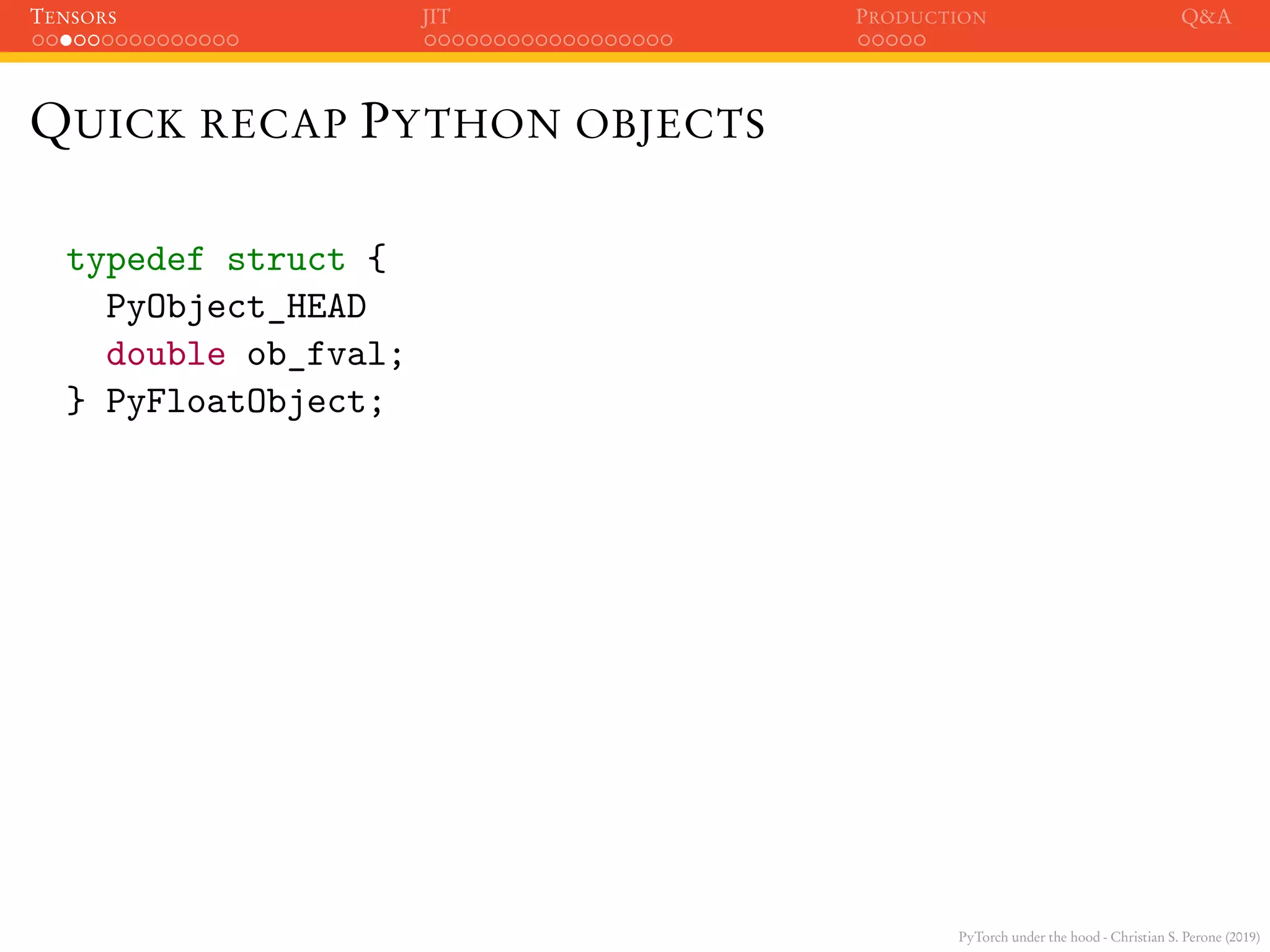
QUICK RECAP PYTHON OBJECTS
typedef struct {
PyObject_HEAD
double ob_fval;
} PyFloatObject;
PyTorch under the hood - Christian S. Perone (2019)
TENSORS JIT PRODUCTION Q&A
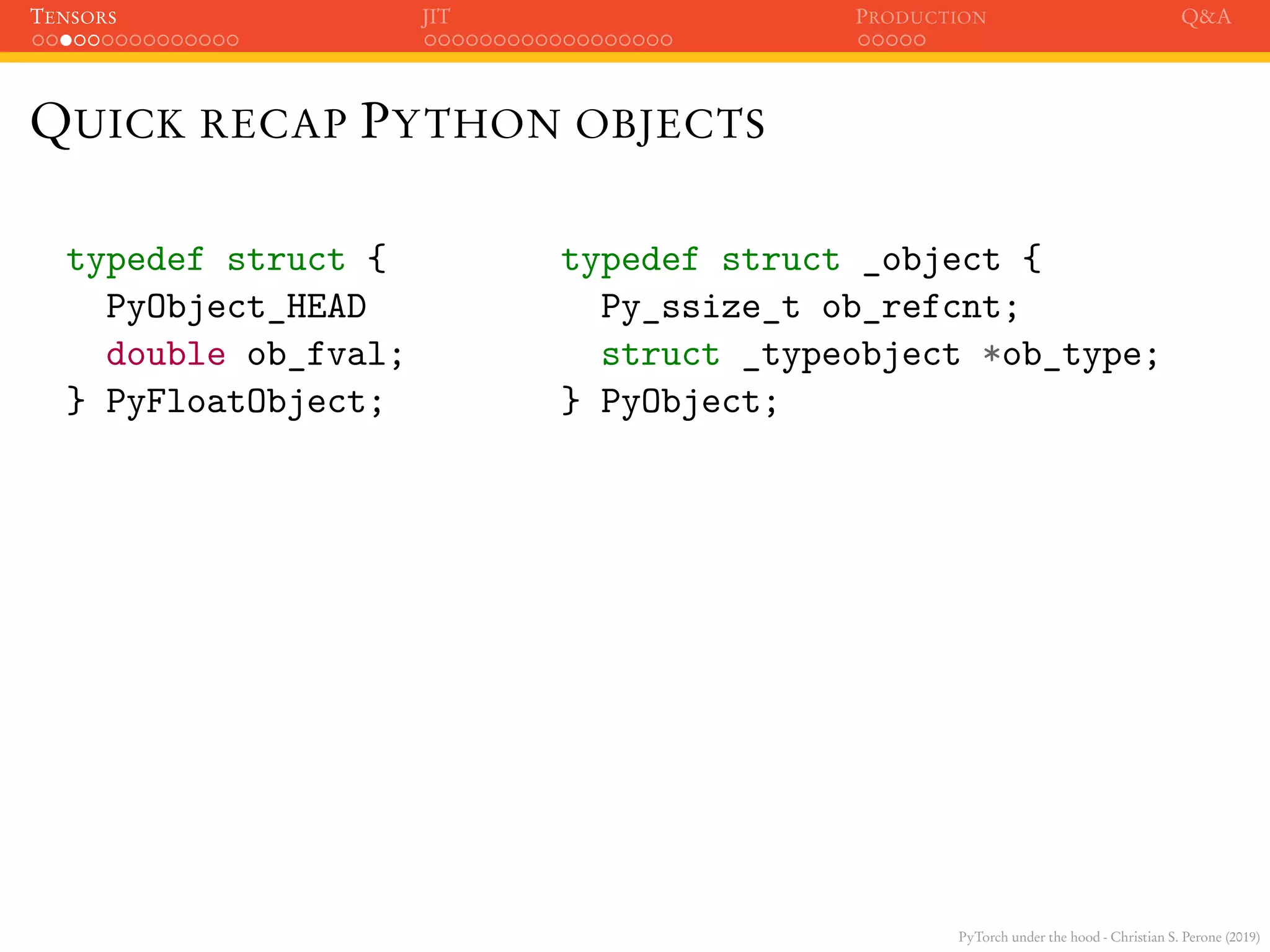
QUICK RECAP PYTHON OBJECTS
typedef struct {
PyObject_HEAD
double ob_fval;
} PyFloatObject;
typedef struct _object {
Py_ssize_t ob_refcnt;
struct _typeobject *ob_type;
} PyObject;
PyTorch under the hood - Christian S. Perone (2019)
TENSORS JIT PRODUCTION Q&A
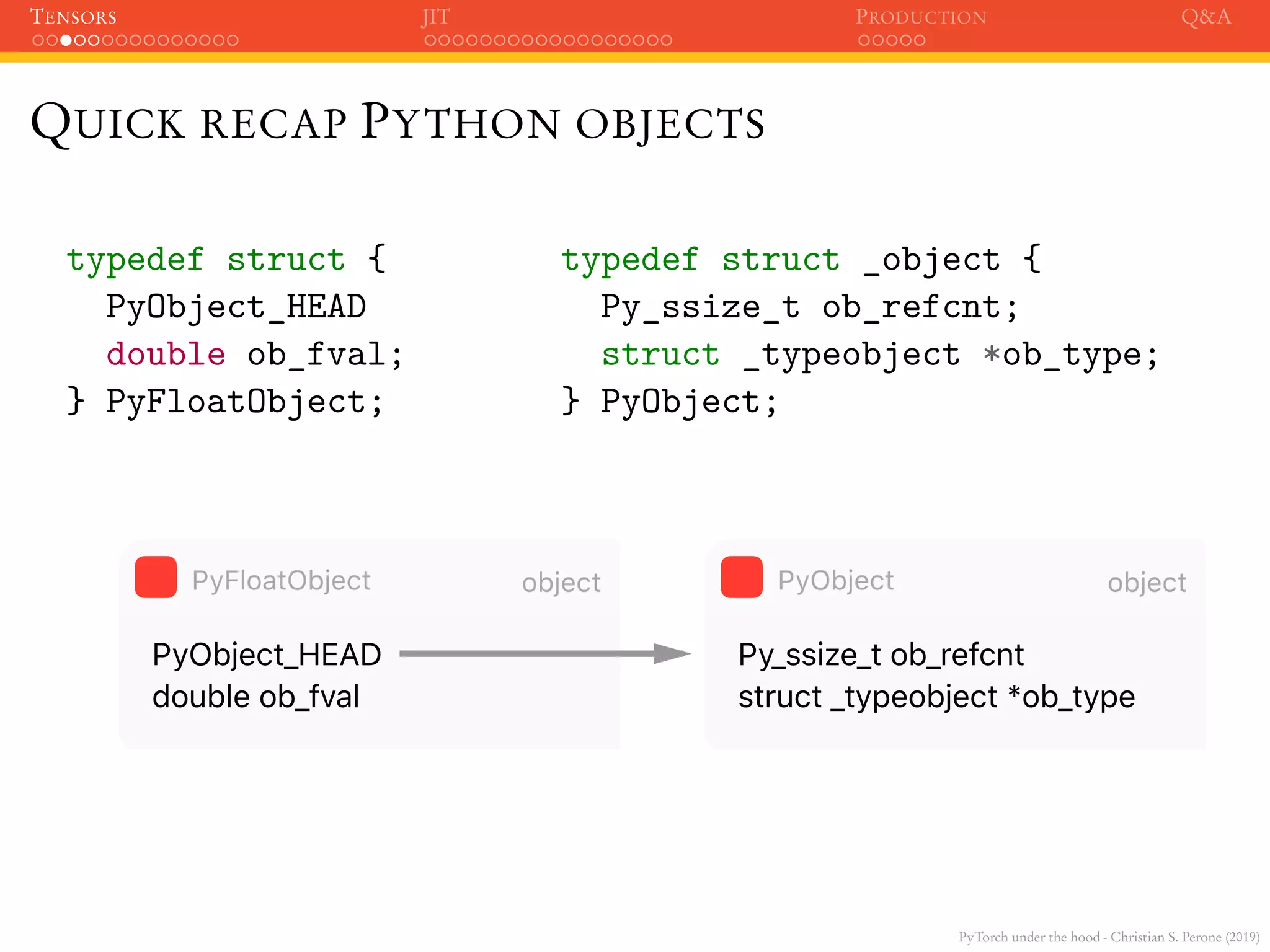
QUICK RECAP PYTHON OBJECTS
typedef struct {
PyObject_HEAD
double ob_fval;
} PyFloatObject;
typedef struct _object {
Py_ssize_t ob_refcnt;
struct _typeobject *ob_type;
} PyObject;
struct _typeobject *ob_type
Py_ssize_t ob_refcnt
objectPyObject
double ob_fval
PyObject_HEAD
objectPyFloatObject
PyTorch under the hood - Christian S. Perone (2019)
TENSORS JIT PRODUCTION Q&A
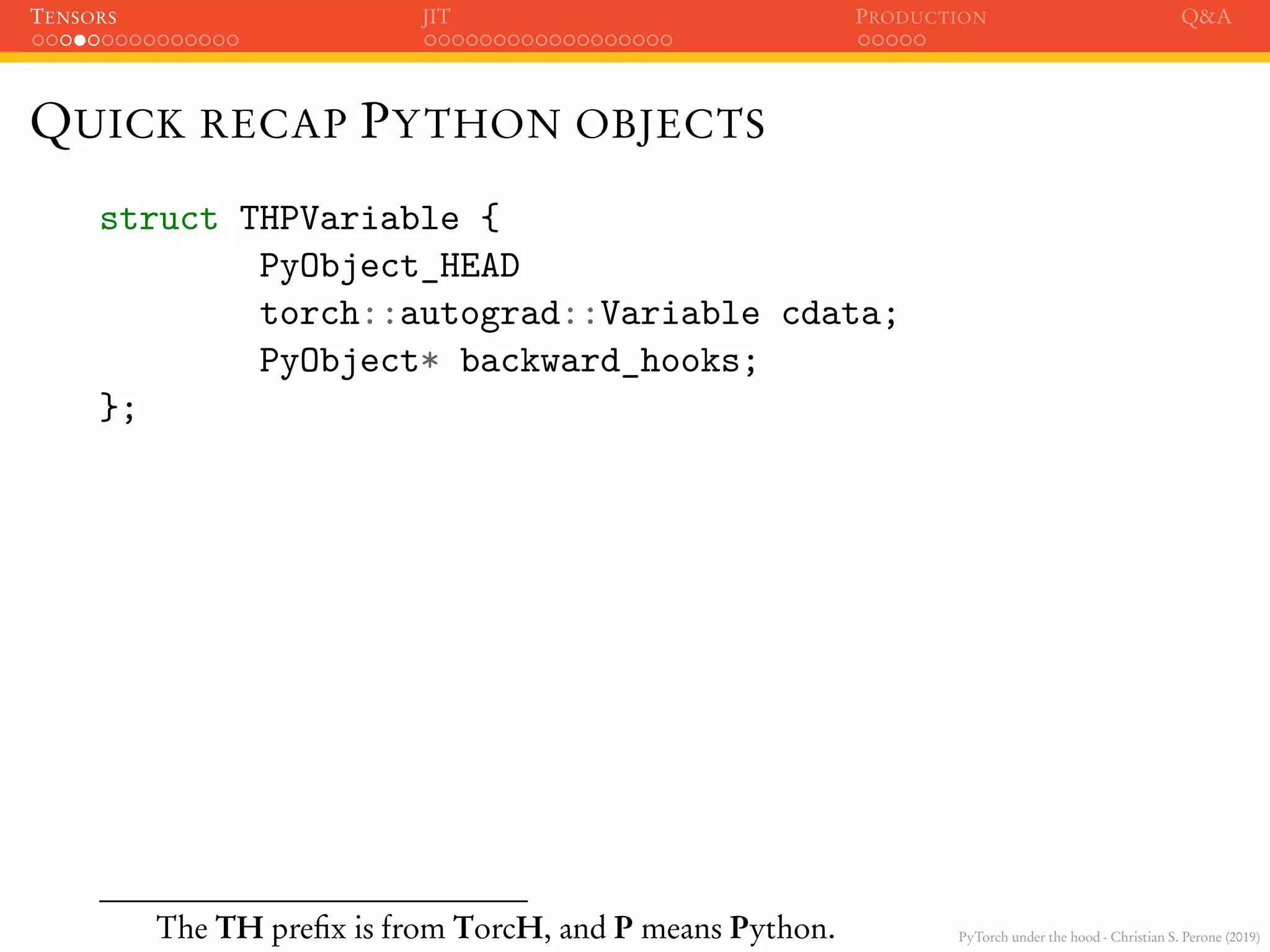
QUICK RECAP PYTHON OBJECTS
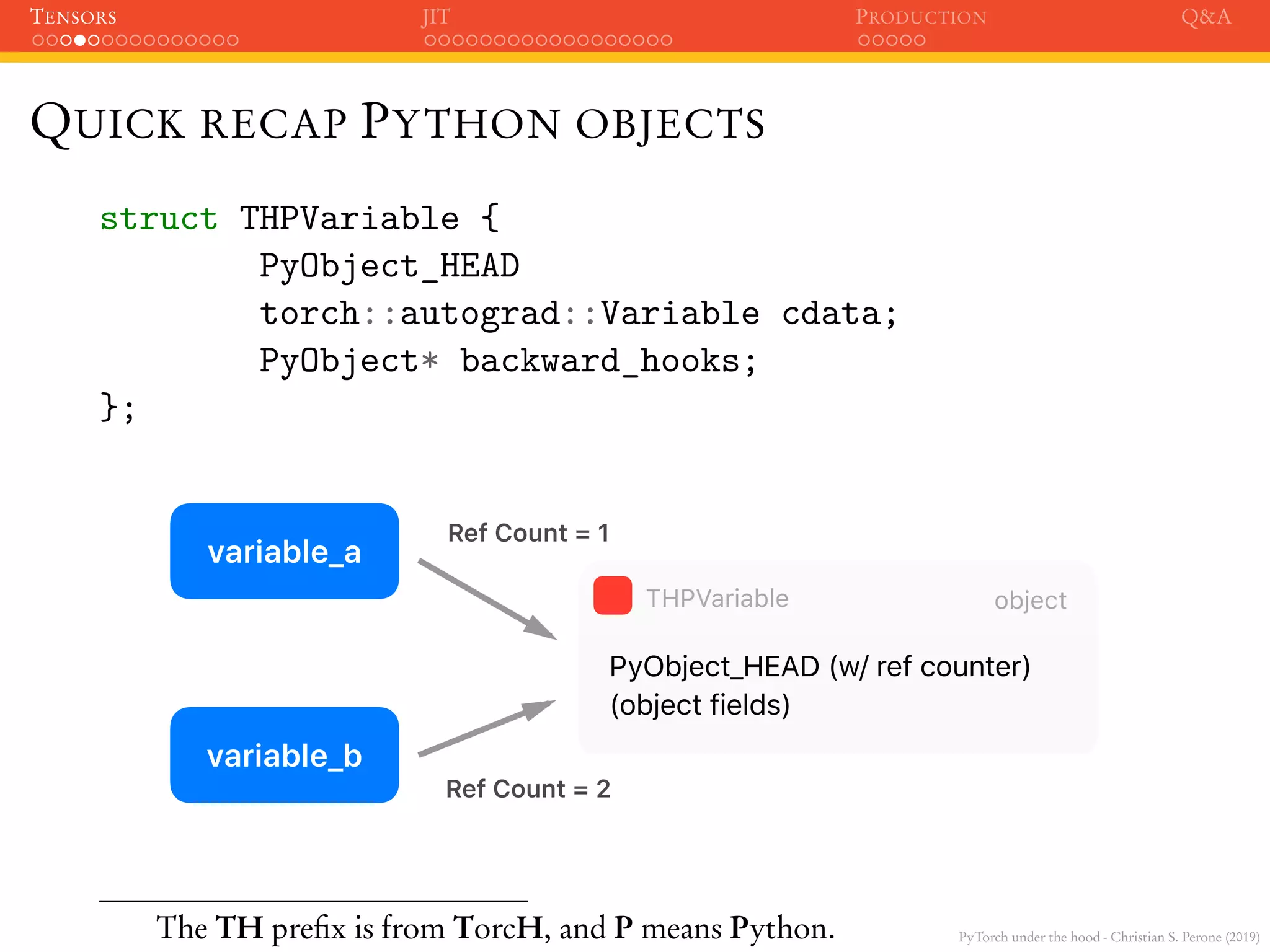
struct THPVariable {
PyObject_HEAD
torch::autograd::Variable cdata;
PyObject* backward_hooks;
};
The TH prefix is from TorcH, and P means Python.
PyTorch under the hood - Christian S. Perone (2019)
TENSORS JIT PRODUCTION Q&A
QUICK RECAP PYTHON OBJECTS
struct THPVariable {
PyObject_HEAD
torch::autograd::Variable cdata;
PyObject* backward_hooks;
};
(object fields)
PyObject_HEAD (w/ ref counter)
objectTHPVariable
variable_a
variable_b
Ref Count = 1
Ref Count = 2
The TH prefix is from TorcH, and P means Python.
PyTorch under the hood - Christian S. Perone (2019)
TENSORS JIT PRODUCTION Q&A
IN PYTHON, EVERYTHING IS AN OBJECT
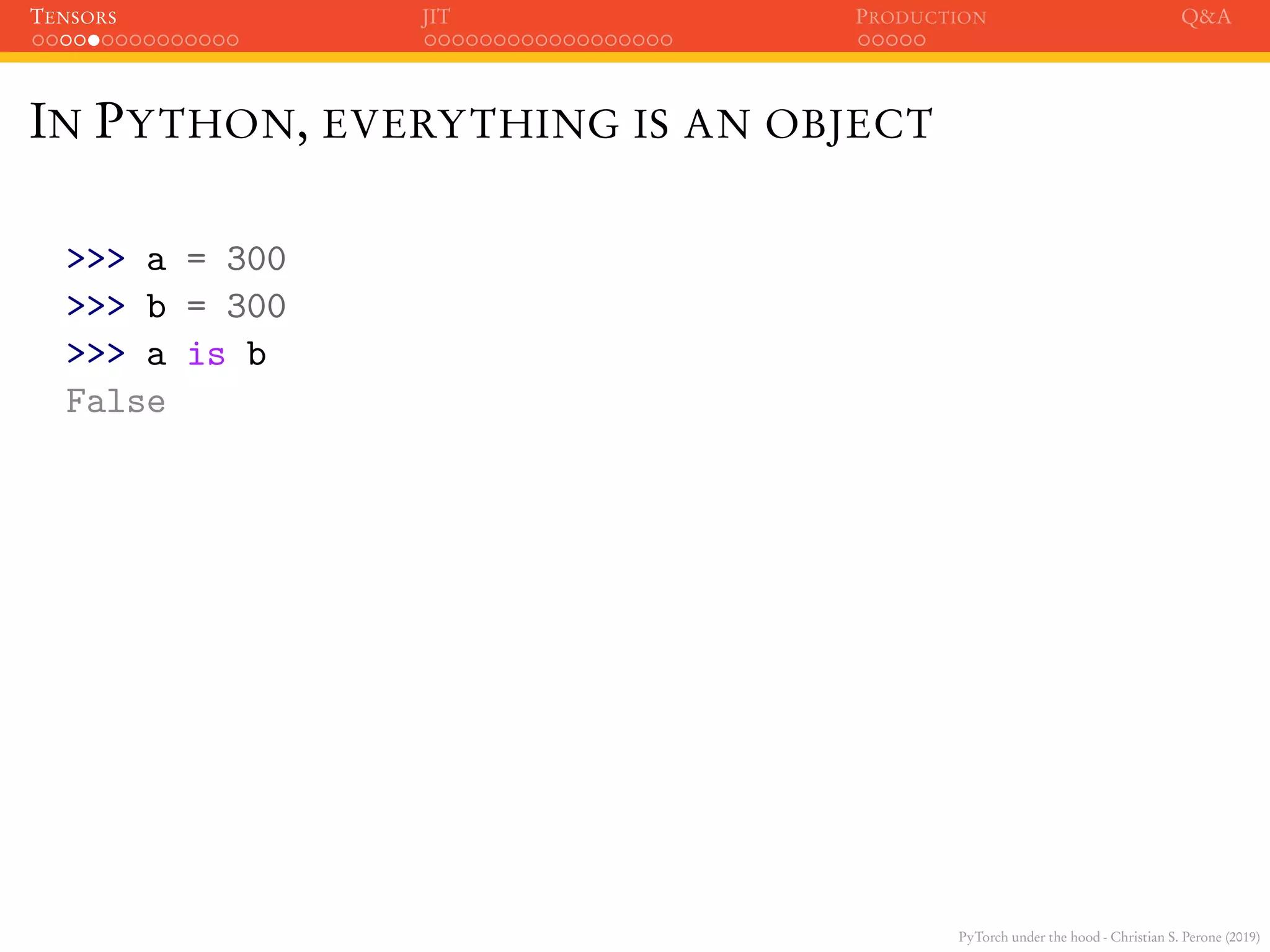
>>> a = 300
>>> b = 300
>>> a is b
False
PyTorch under the hood - Christian S. Perone (2019)
TENSORS JIT PRODUCTION Q&A
IN PYTHON, EVERYTHING IS AN OBJECT
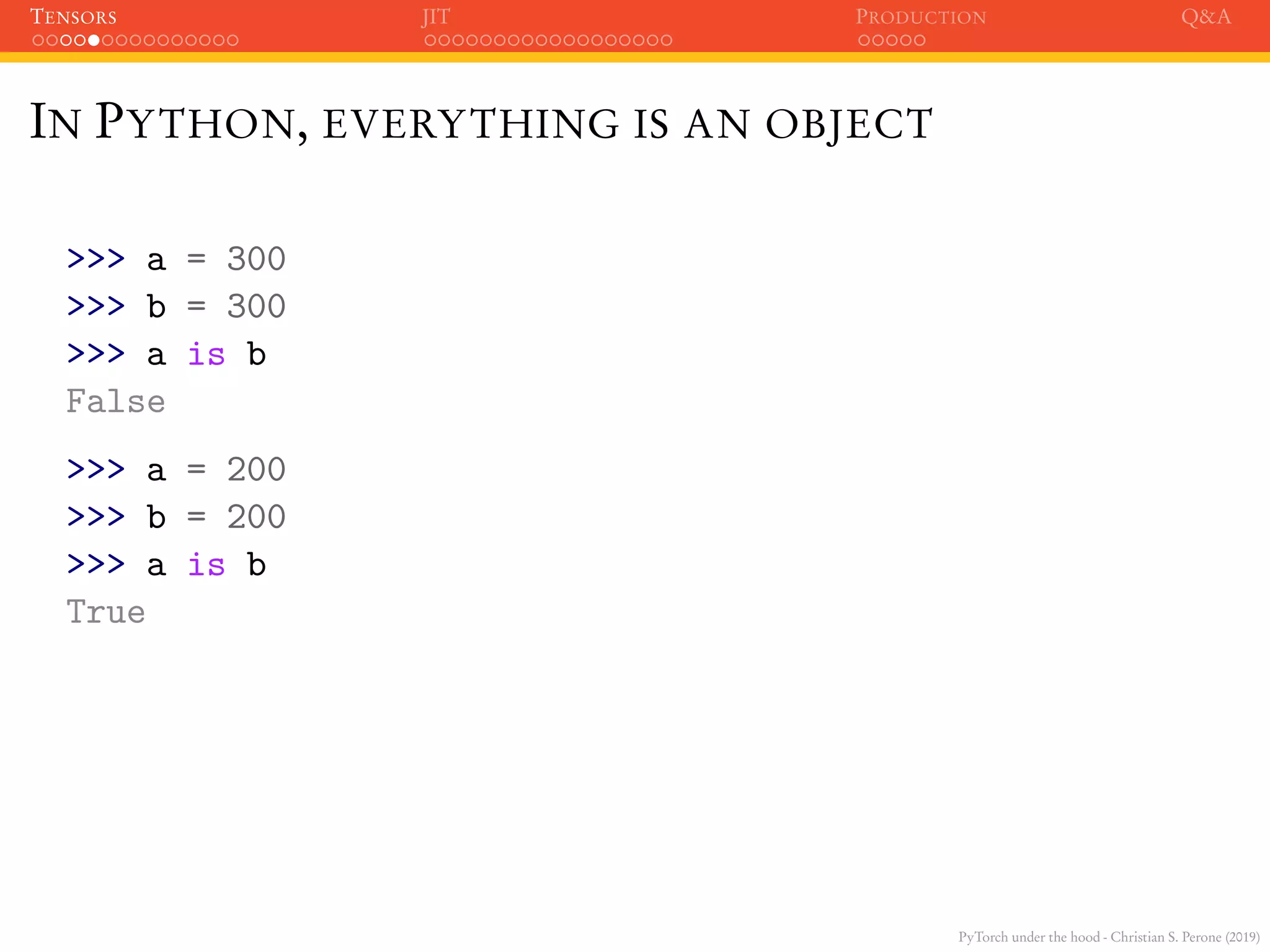
>>> a = 300
>>> b = 300
>>> a is b
False
>>> a = 200
>>> b = 200
>>> a is b
True
PyTorch under the hood - Christian S. Perone (2019)
TENSORS JIT PRODUCTION Q&A
IN PYTHON, EVERYTHING IS AN OBJECT
>>> a = 300
>>> b = 300
>>> a is b
False
>>> a = 200
>>> b = 200
>>> a is b
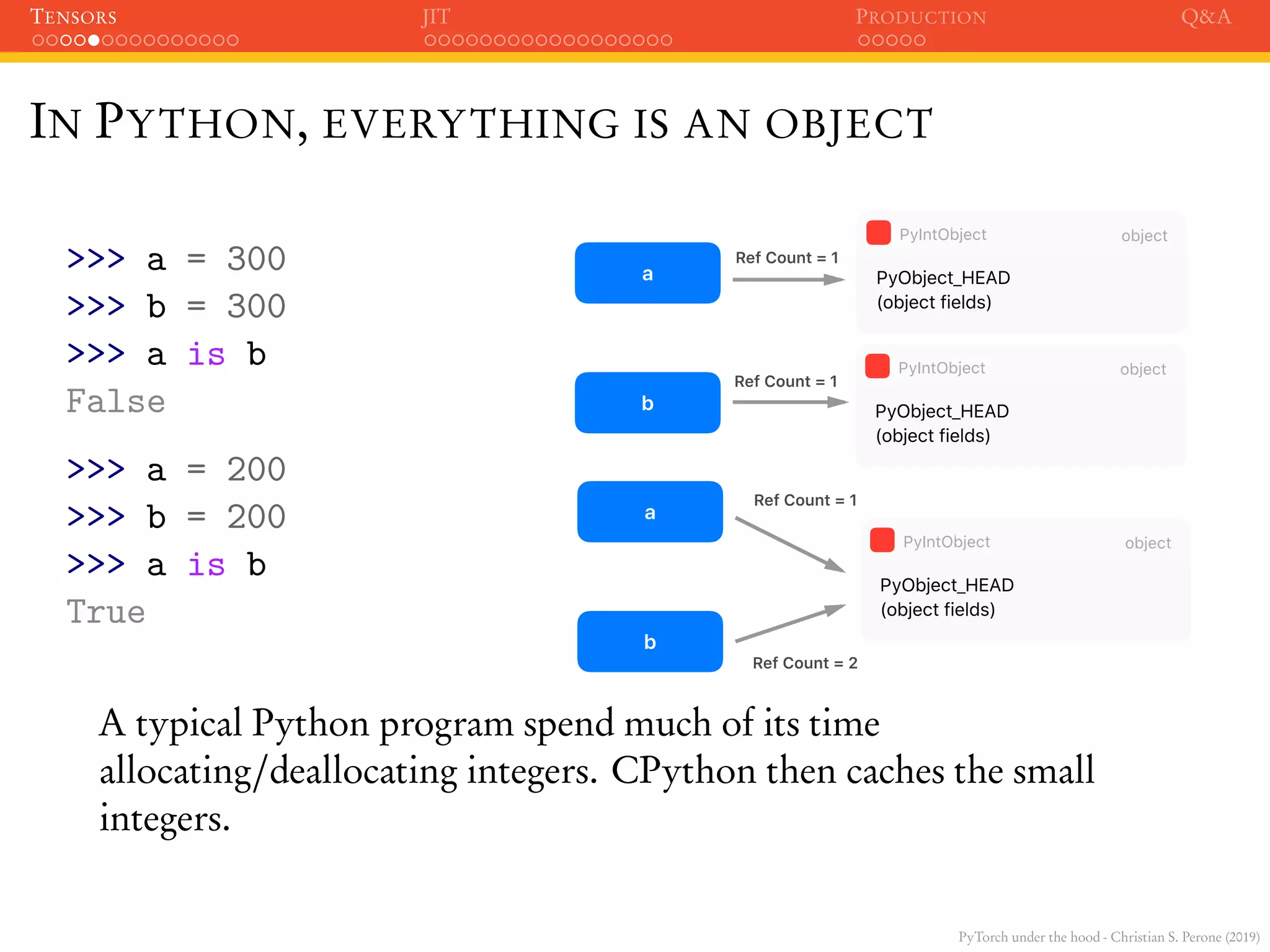
True (object fields)
PyObject_HEAD
objectPyIntObject
a
b
Ref Count = 1
Ref Count = 2
(object fields)
PyObject_HEAD
objectPyIntObject
(object fields)
PyObject_HEAD
objectPyIntObject
a
b
Ref Count = 1
Ref Count = 1
A typical Python program spend much of its time
allocating/deallocating integers. CPython then caches the small
integers.
PyTorch under the hood - Christian S. Perone (2019)
TENSORS JIT PRODUCTION Q&A
ZERO-COPYING TENSORS
It is very common to load tensors in numpy and convert them to
PyTorch, or vice-versa;
>>> np_array = np.ones((2,2))
>>> np_array
array([[1., 1.],
[1., 1.]])
Underline after an operation means an in-place operation.
PyTorch under the hood - Christian S. Perone (2019)
TENSORS JIT PRODUCTION Q&A
ZERO-COPYING TENSORS
It is very common to load tensors in numpy and convert them to
PyTorch, or vice-versa;
>>> np_array = np.ones((2,2))
>>> np_array
array([[1., 1.],
[1., 1.]])
>>> torch_array = torch.tensor(np_array)
>>> torch_array
tensor([[1., 1.],
[1., 1.]], dtype=torch.float64)
Underline after an operation means an in-place operation.
PyTorch under the hood - Christian S. Perone (2019)
TENSORS JIT PRODUCTION Q&A
ZERO-COPYING TENSORS
It is very common to load tensors in numpy and convert them to
PyTorch, or vice-versa;
>>> np_array = np.ones((2,2))
>>> np_array
array([[1., 1.],
[1., 1.]])
>>> torch_array = torch.tensor(np_array)
>>> torch_array
tensor([[1., 1.],
[1., 1.]], dtype=torch.float64)
>>> torch_array.add_(1.0)
Underline after an operation means an in-place operation.
PyTorch under the hood - Christian S. Perone (2019)
TENSORS JIT PRODUCTION Q&A
ZERO-COPYING TENSORS
It is very common to load tensors in numpy and convert them to
PyTorch, or vice-versa;
>>> np_array = np.ones((2,2))
>>> np_array
array([[1., 1.],
[1., 1.]])
>>> torch_array = torch.tensor(np_array)
>>> torch_array
tensor([[1., 1.],
[1., 1.]], dtype=torch.float64)
>>> torch_array.add_(1.0)
>>> np_array
array([[1., 1.], # array is intact, a copy was made
[1., 1.]])
Underline after an operation means an in-place operation.
PyTorch under the hood - Christian S. Perone (2019)
TENSORS JIT PRODUCTION Q&A
ZERO-COPYING TENSORS
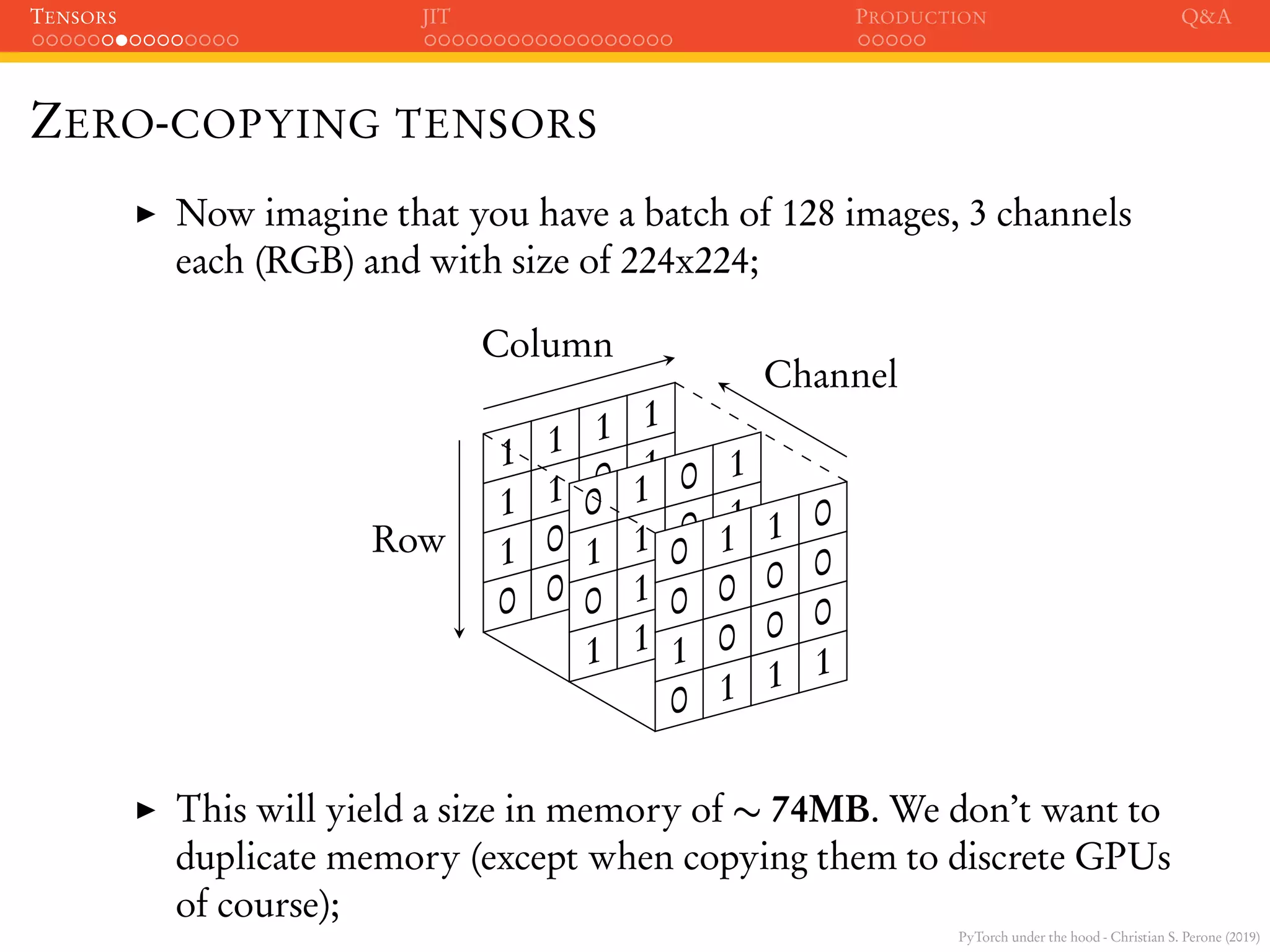
Now imagine that you have a batch of 128 images, 3 channels
each (RGB) and with size of 224x224;
0
1
1
1
0
0
1
1
1
0
0
1
1
1
1
1
1
0
1
0
1
1
1
1
0
1
0
0
0
1
1
1
0
1
0
0
1
0
0
1
1
0
0
1
1
0
0
0
Column
Row
Channel
This will yield a size in memory of ∼ 74MB. We don’t want to
duplicate memory (except when copying them to discrete GPUs
of course);
PyTorch under the hood - Christian S. Perone (2019)
TENSORS JIT PRODUCTION Q&A
ZERO-COPYING TENSORS
Let’s see now a slightly different code using the function
torch.from_numpy() this time:
>>> np_array
array([[1., 1.],
[1., 1.]])
>>> torch_array = torch.from_numpy(np_array)
PyTorch under the hood - Christian S. Perone (2019)
TENSORS JIT PRODUCTION Q&A
ZERO-COPYING TENSORS
Let’s see now a slightly different code using the function
torch.from_numpy() this time:
>>> np_array
array([[1., 1.],
[1., 1.]])
>>> torch_array = torch.from_numpy(np_array)
>>> torch_array.add_(1.0)
PyTorch under the hood - Christian S. Perone (2019)
TENSORS JIT PRODUCTION Q&A
ZERO-COPYING TENSORS
Let’s see now a slightly different code using the function
torch.from_numpy() this time:
>>> np_array
array([[1., 1.],
[1., 1.]])
>>> torch_array = torch.from_numpy(np_array)
>>> torch_array.add_(1.0)
>>> np_array
array([[2., 2.],
[2., 2.]])
PyTorch under the hood - Christian S. Perone (2019)
TENSORS JIT PRODUCTION Q&A
ZERO-COPYING TENSORS
Let’s see now a slightly different code using the function
torch.from_numpy() this time:
>>> np_array
array([[1., 1.],
[1., 1.]])
>>> torch_array = torch.from_numpy(np_array)
>>> torch_array.add_(1.0)
>>> np_array
array([[2., 2.],
[2., 2.]])
The original numpy array was changed, because it used a zero-copy
operation.
PyTorch under the hood - Christian S. Perone (2019)
TENSORS JIT PRODUCTION Q&A
ZERO-COPYING TENSORS
Difference between in-place and standard operations might not be
so clear in some cases:
>>> np_array
array([[1., 1.],
[1., 1.]])
>>> torch_array = torch.from_numpy(np_array)
PyTorch under the hood - Christian S. Perone (2019)
TENSORS JIT PRODUCTION Q&A
ZERO-COPYING TENSORS
Difference between in-place and standard operations might not be
so clear in some cases:
>>> np_array
array([[1., 1.],
[1., 1.]])
>>> torch_array = torch.from_numpy(np_array)
>>> np_array = np_array + 1.0
PyTorch under the hood - Christian S. Perone (2019)
TENSORS JIT PRODUCTION Q&A
ZERO-COPYING TENSORS
Difference between in-place and standard operations might not be
so clear in some cases:
>>> np_array
array([[1., 1.],
[1., 1.]])
>>> torch_array = torch.from_numpy(np_array)
>>> np_array = np_array + 1.0
>>> torch_array
tensor([[1., 1.],
[1., 1.]], dtype=torch.float64)
PyTorch under the hood - Christian S. Perone (2019)
TENSORS JIT PRODUCTION Q&A
ZERO-COPYING TENSORS
Difference between in-place and standard operations might not be
so clear in some cases:
>>> np_array
array([[1., 1.],
[1., 1.]])
>>> torch_array = torch.from_numpy(np_array)
>>> np_array = np_array + 1.0
>>> torch_array
tensor([[1., 1.],
[1., 1.]], dtype=torch.float64)
However, if you use np_array += 1.0 , that is an in-place
operation that will change torch_array memory.
PyTorch under the hood - Christian S. Perone (2019)
TENSORS JIT PRODUCTION Q&A
ZERO-COPYING TENSORS
at::Tensor tensor_from_numpy(PyObject* obj) {
// (...) - omitted for brevity
auto array = (PyArrayObject*)obj;
int ndim = PyArray_NDIM(array);
auto sizes = to_aten_shape(ndim, PyArray_DIMS(array));
auto strides = to_aten_shape(ndim, PyArray_STRIDES(array));
// (...) - omitted for brevity
void* data_ptr = PyArray_DATA(array);
auto& type = CPU(dtype_to_aten(PyArray_TYPE(array)));
Py_INCREF(obj);
return type.tensorFromBlob(data_ptr, sizes, strides,
[obj](void* data) {
AutoGIL gil;
Py_DECREF(obj);
});
}
Pay attention to the reference counting using Py_INCREF() and the
call to tensorFromBlob() function.
PyTorch under the hood - Christian S. Perone (2019)
TENSORS JIT PRODUCTION Q&A
DATA POINTERS
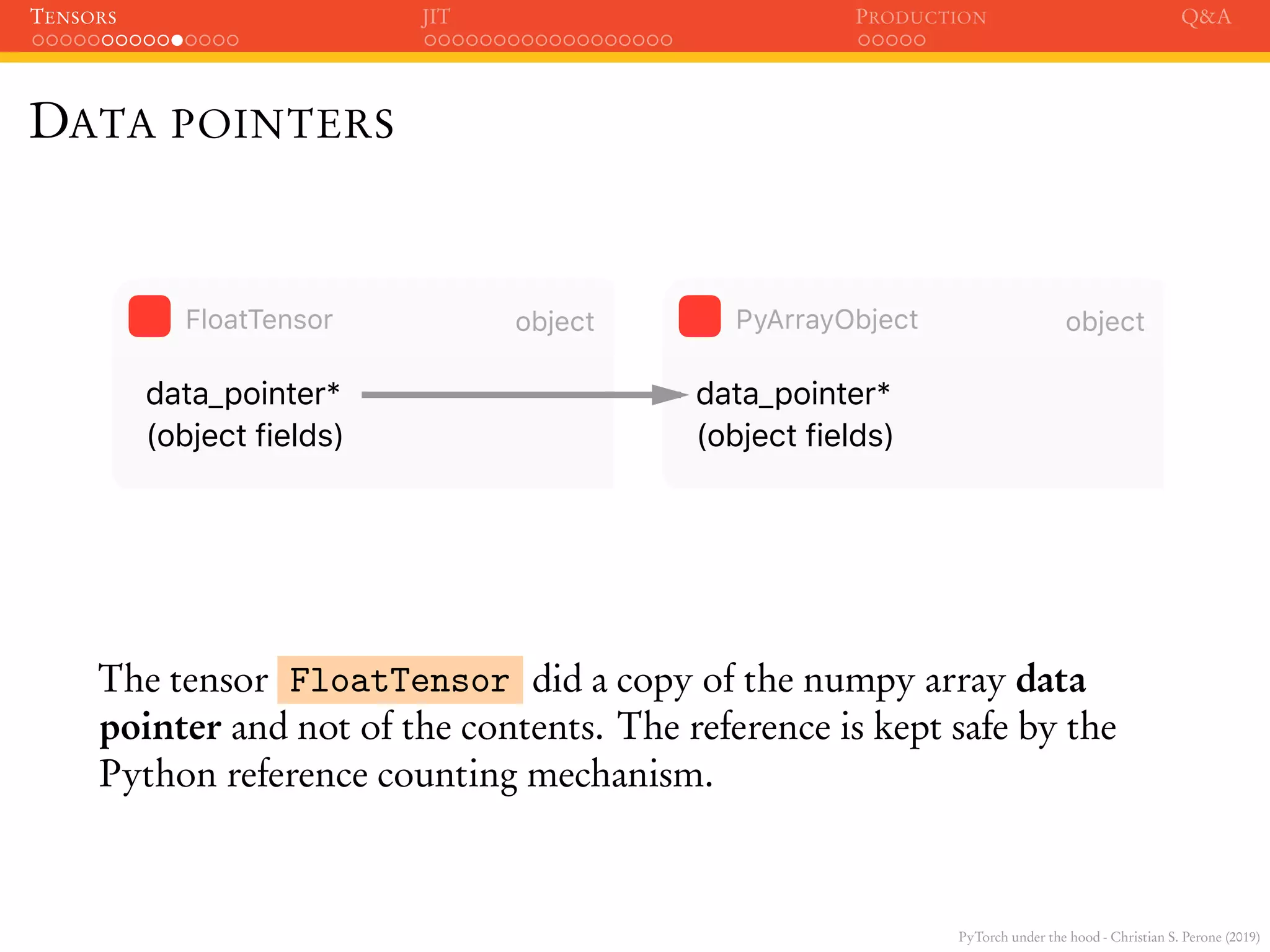
(object fields)
data_pointer*
objectPyArrayObject
(object fields)
data_pointer*
objectFloatTensor
The tensor FloatTensor did a copy of the numpy array data
pointer and not of the contents. The reference is kept safe by the
Python reference counting mechanism.
PyTorch under the hood - Christian S. Perone (2019)
TENSORS JIT PRODUCTION Q&A
TENSOR STORAGE
The abstraction responsible for holding the data isn’t actually the
Tensor , but the Storage .
PyTorch under the hood - Christian S. Perone (2019)
TENSORS JIT PRODUCTION Q&A
TENSOR STORAGE
The abstraction responsible for holding the data isn’t actually the
Tensor , but the Storage .
struct C10_API StorageImpl final : (...) {
// (...)
private:
// (...)
caffe2::TypeMeta data_type_;
DataPtr data_ptr_;
int64_t numel_;
Allocator* allocator_;
}
PyTorch under the hood - Christian S. Perone (2019)
TENSORS JIT PRODUCTION Q&A
TENSOR STORAGE
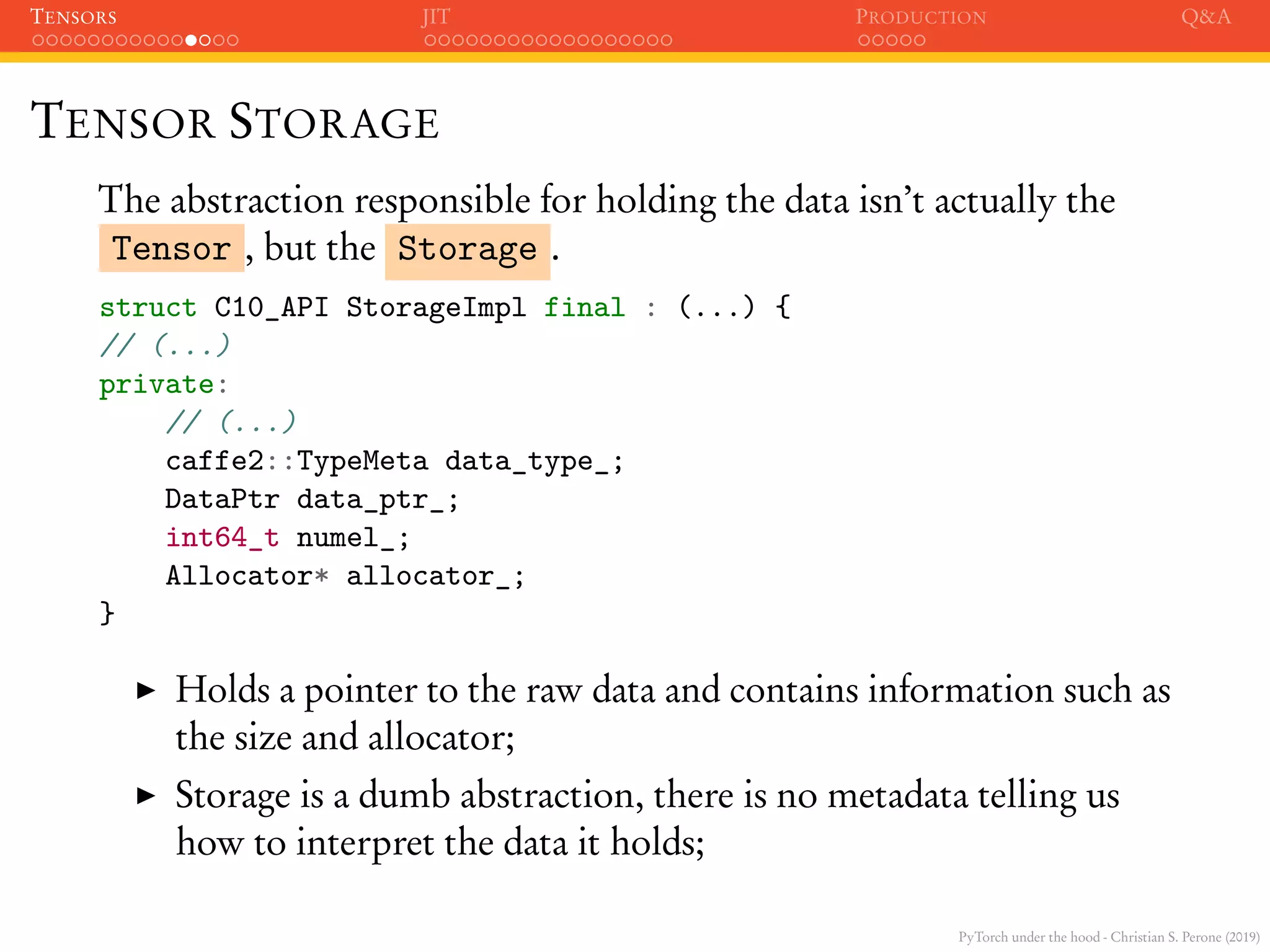
The abstraction responsible for holding the data isn’t actually the
Tensor , but the Storage .
struct C10_API StorageImpl final : (...) {
// (...)
private:
// (...)
caffe2::TypeMeta data_type_;
DataPtr data_ptr_;
int64_t numel_;
Allocator* allocator_;
}
Holds a pointer to the raw data and contains information such as
the size and allocator;
Storage is a dumb abstraction, there is no metadata telling us
how to interpret the data it holds;
PyTorch under the hood - Christian S. Perone (2019)
TENSORS JIT PRODUCTION Q&A
TENSOR STORAGE
The Storage abstraction is very powerful because it decouples
the raw data and how we can interpret it;
PyTorch under the hood - Christian S. Perone (2019)
TENSORS JIT PRODUCTION Q&A
TENSOR STORAGE
The Storage abstraction is very powerful because it decouples
the raw data and how we can interpret it;
We can have multiple tensors sharing the same storage, but
with different interpretations, also called views, but without
duplicating memory:
PyTorch under the hood - Christian S. Perone (2019)
TENSORS JIT PRODUCTION Q&A
TENSOR STORAGE
The Storage abstraction is very powerful because it decouples
the raw data and how we can interpret it;
We can have multiple tensors sharing the same storage, but
with different interpretations, also called views, but without
duplicating memory:
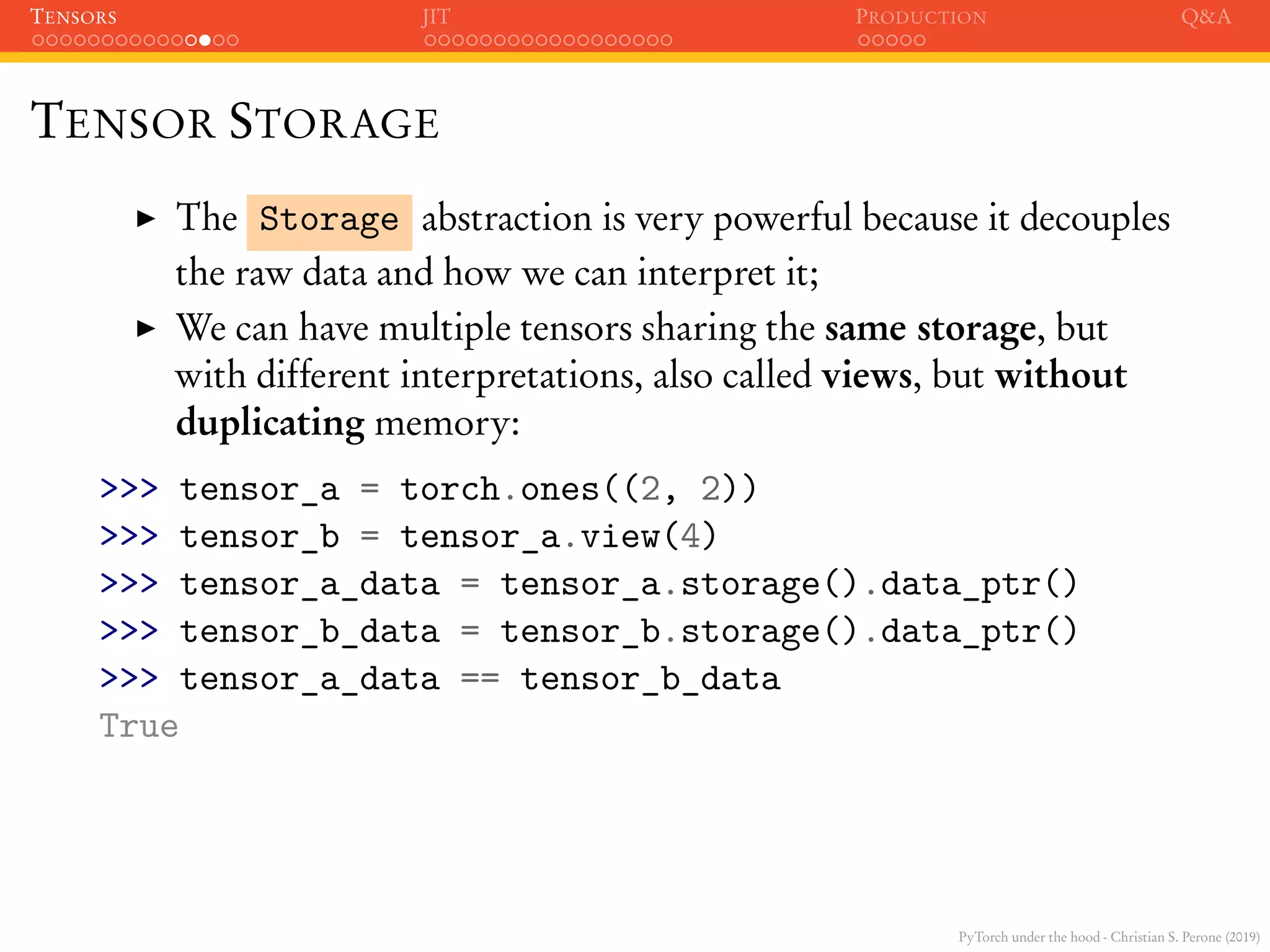
>>> tensor_a = torch.ones((2, 2))
>>> tensor_b = tensor_a.view(4)
>>> tensor_a_data = tensor_a.storage().data_ptr()
>>> tensor_b_data = tensor_b.storage().data_ptr()
>>> tensor_a_data == tensor_b_data
True
PyTorch under the hood - Christian S. Perone (2019)
TENSORS JIT PRODUCTION Q&A
TENSOR STORAGE
The Storage abstraction is very powerful because it decouples
the raw data and how we can interpret it;
We can have multiple tensors sharing the same storage, but
with different interpretations, also called views, but without
duplicating memory:
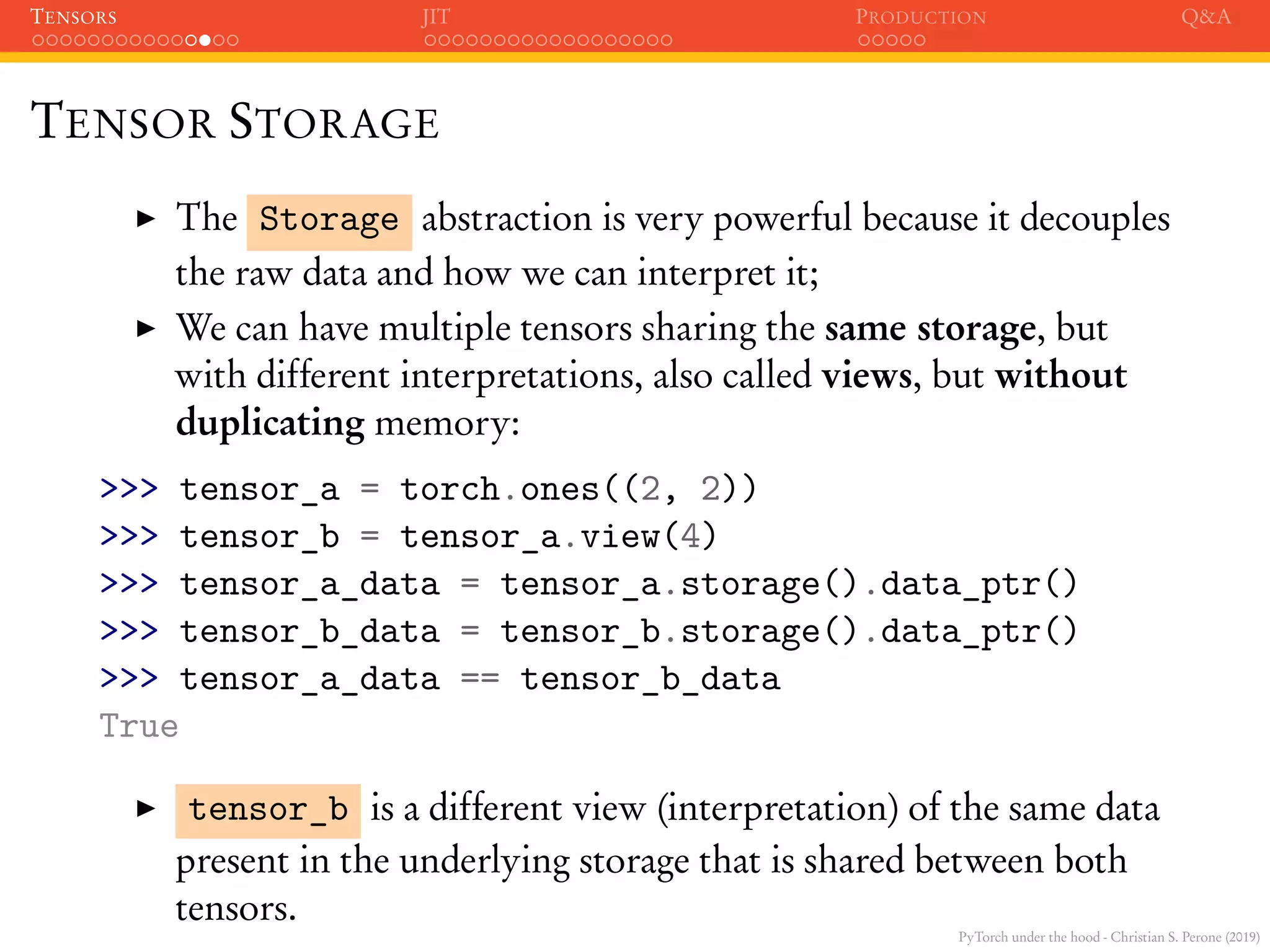
>>> tensor_a = torch.ones((2, 2))
>>> tensor_b = tensor_a.view(4)
>>> tensor_a_data = tensor_a.storage().data_ptr()
>>> tensor_b_data = tensor_b.storage().data_ptr()
>>> tensor_a_data == tensor_b_data
True
tensor_b is a different view (interpretation) of the same data
present in the underlying storage that is shared between both
tensors.
PyTorch under the hood - Christian S. Perone (2019)
TENSORS JIT PRODUCTION Q&A
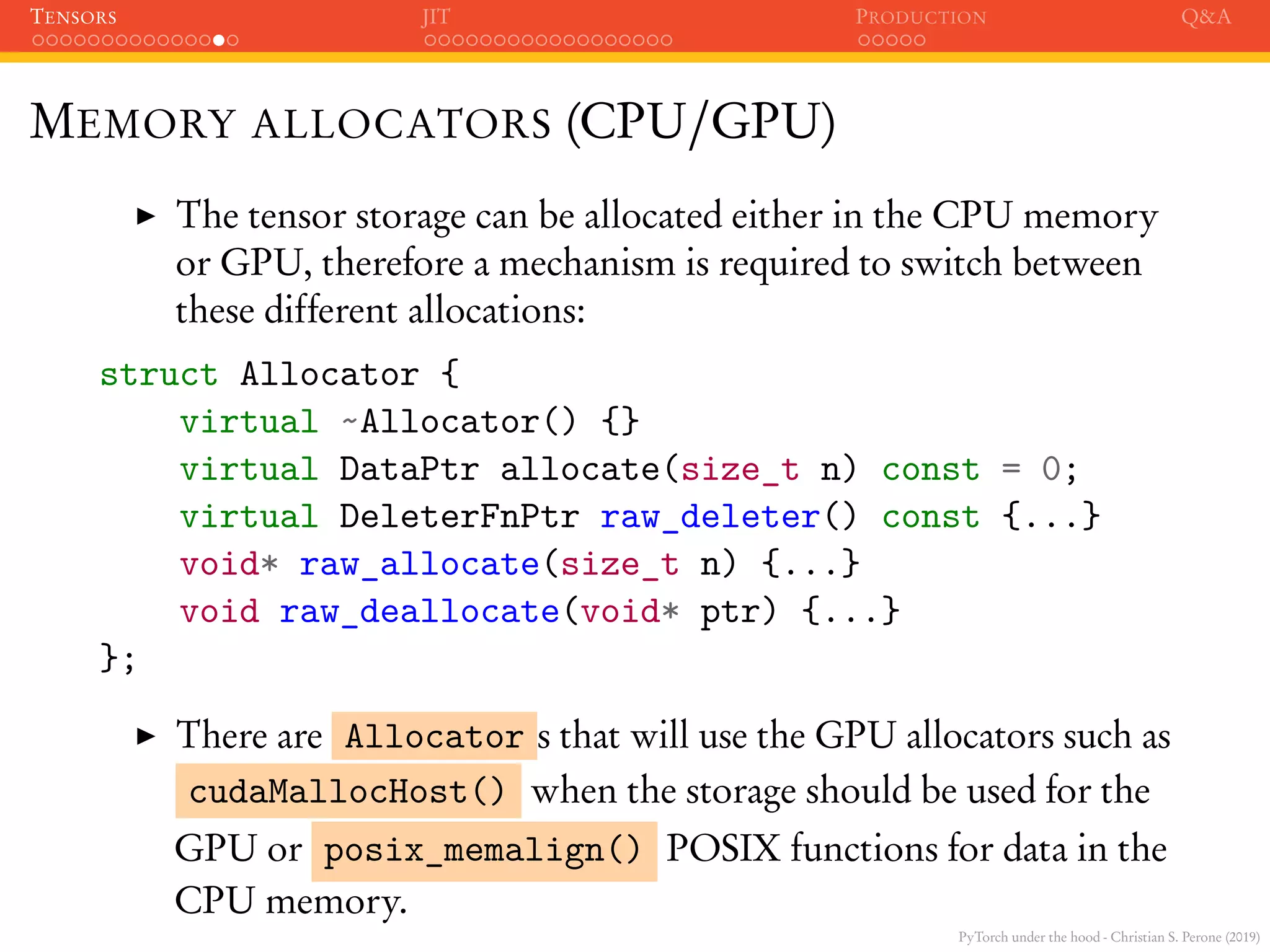
MEMORY ALLOCATORS (CPU/GPU)
The tensor storage can be allocated either in the CPU memory
or GPU, therefore a mechanism is required to switch between
these different allocations:
PyTorch under the hood - Christian S. Perone (2019)
TENSORS JIT PRODUCTION Q&A
MEMORY ALLOCATORS (CPU/GPU)
The tensor storage can be allocated either in the CPU memory
or GPU, therefore a mechanism is required to switch between
these different allocations:
struct Allocator {
virtual ~Allocator() {}
virtual DataPtr allocate(size_t n) const = 0;
virtual DeleterFnPtr raw_deleter() const {...}
void* raw_allocate(size_t n) {...}
void raw_deallocate(void* ptr) {...}
};
There are Allocator s that will use the GPU allocators such as
cudaMallocHost() when the storage should be used for the
GPU or posix_memalign() POSIX functions for data in the
CPU memory.
PyTorch under the hood - Christian S. Perone (2019)
TENSORS JIT PRODUCTION Q&A
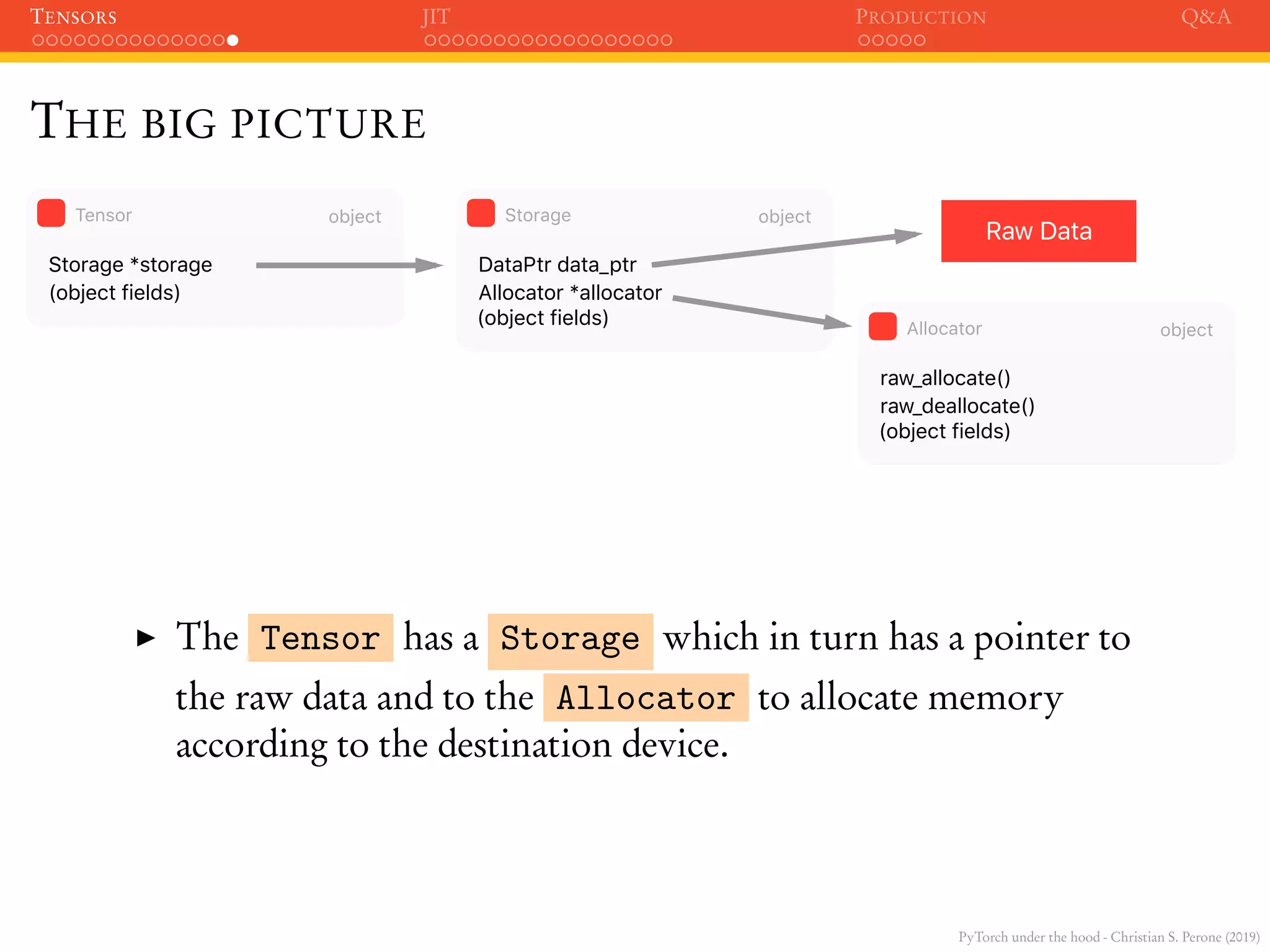
THE BIG PICTURE
(object fields)
Storage *storage
objectTensor
Allocator *allocator
(object fields)
DataPtr data_ptr
objectStorage
raw_deallocate()
(object fields)
raw_allocate()
objectAllocator
Raw Data
The Tensor has a Storage which in turn has a pointer to
the raw data and to the Allocator to allocate memory
according to the destination device.
PyTorch under the hood - Christian S. Perone (2019)
TENSORS JIT PRODUCTION Q&A
Section II
JIT
PyTorch under the hood - Christian S. Perone (2019)
TENSORS JIT PRODUCTION Q&A
JIT - JUST-IN-TIME COMPILER
PyTorch is eager by design, which means that it is easily
hackable to debug, inspect, etc;
PyTorch under the hood - Christian S. Perone (2019)
TENSORS JIT PRODUCTION Q&A
JIT - JUST-IN-TIME COMPILER
PyTorch is eager by design, which means that it is easily
hackable to debug, inspect, etc;
However, this poses problems for optimization and for
decoupling it from Python (the model itself is Python code);
PyTorch under the hood - Christian S. Perone (2019)
TENSORS JIT PRODUCTION Q&A
JIT - JUST-IN-TIME COMPILER
PyTorch is eager by design, which means that it is easily
hackable to debug, inspect, etc;
However, this poses problems for optimization and for
decoupling it from Python (the model itself is Python code);
PyTorch 1.0 introduced torch.jit , which has two main
methods to convert a PyTorch model to a serializable and
optimizable format;
TorchScript was also introduced as a statically-typed subset of
Python;
PyTorch under the hood - Christian S. Perone (2019)
TENSORS JIT PRODUCTION Q&A
JIT - JUST-IN-TIME COMPILER
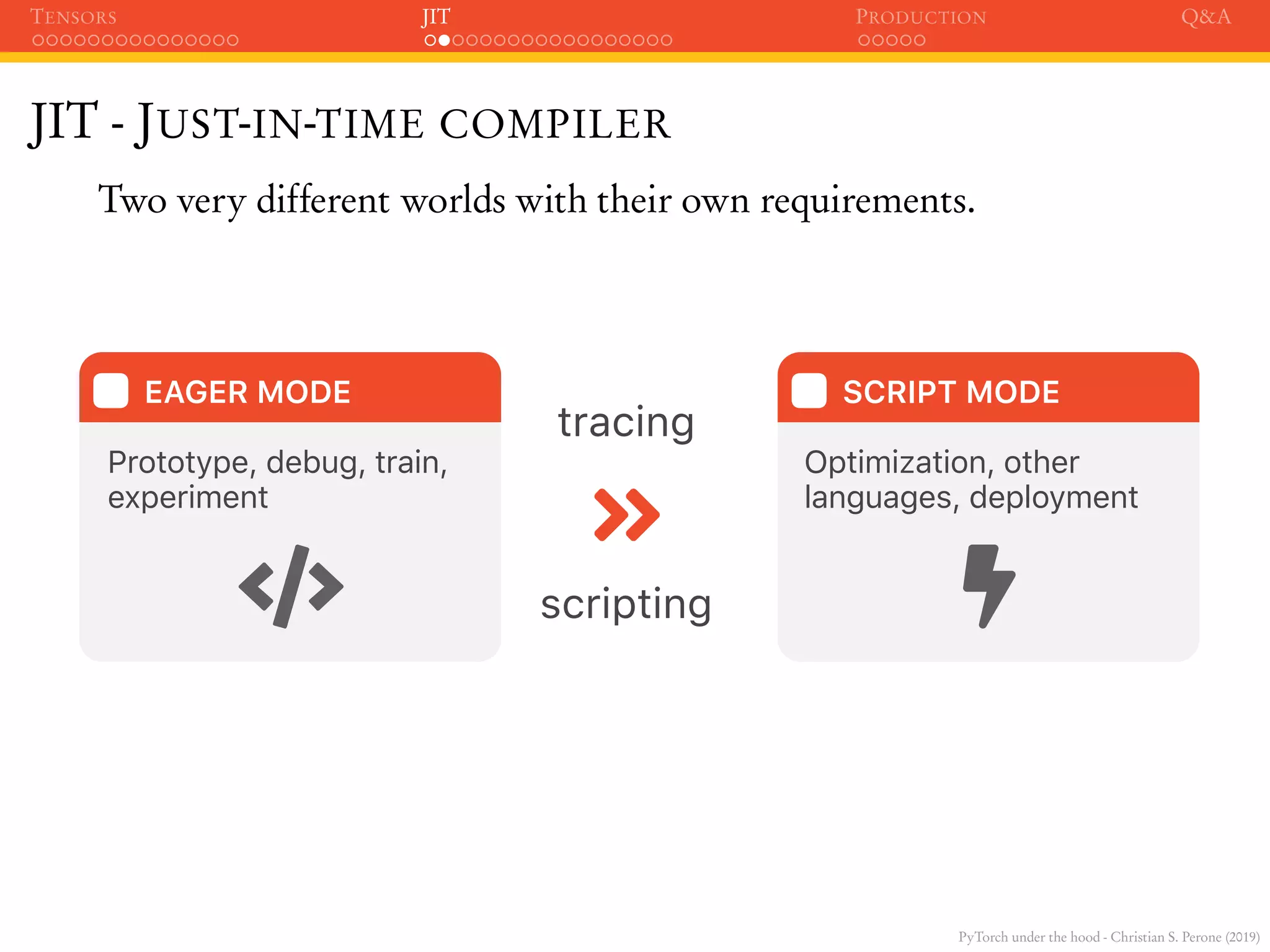
Two very different worlds with their own requirements.
Prototype, debug, train,
experiment
EAGER MODE
Optimization, other
languages, deployment
SCRIPT MODE
tracing
scripting
PyTorch under the hood - Christian S. Perone (2019)
TENSORS JIT PRODUCTION Q&A
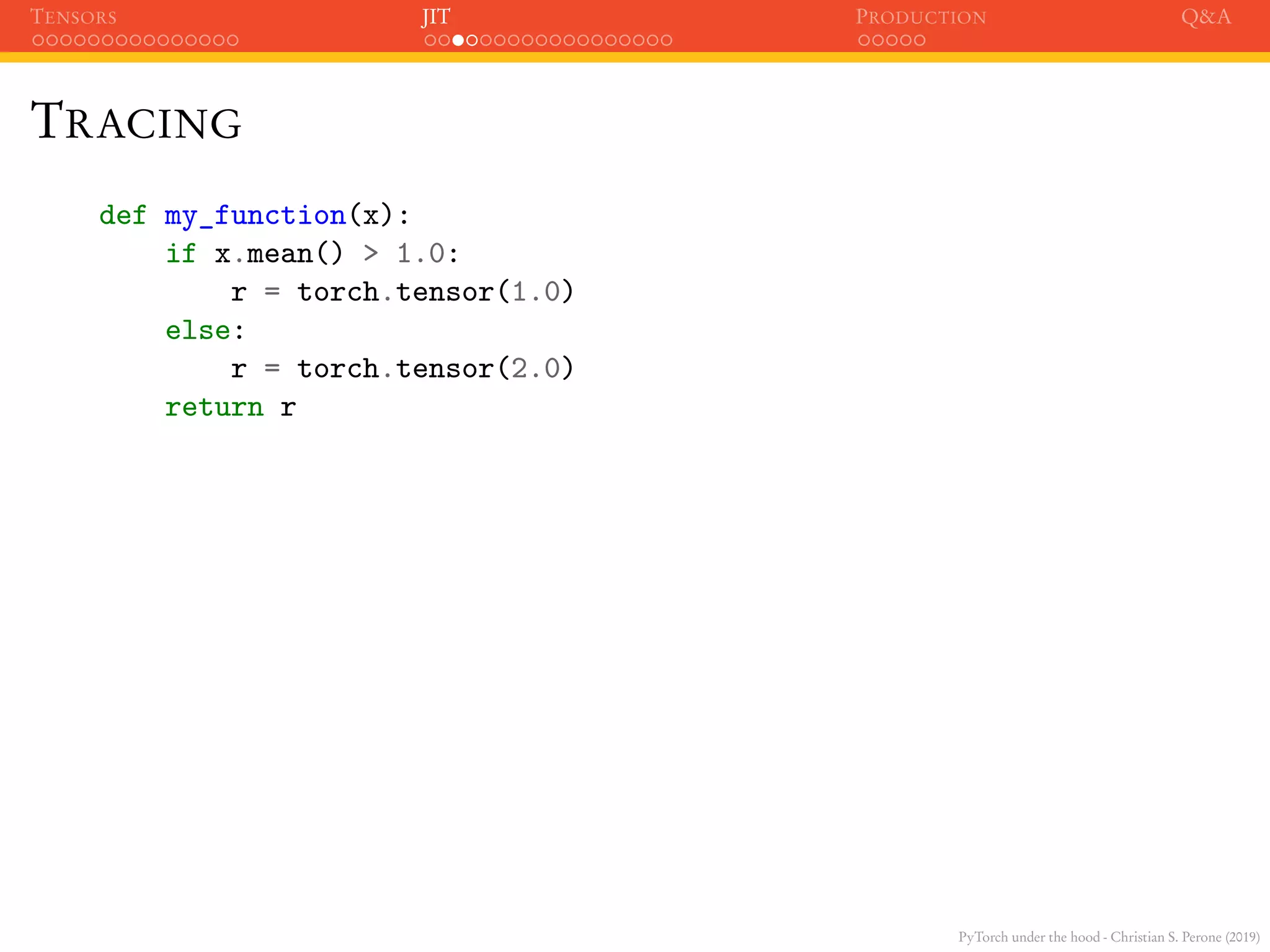
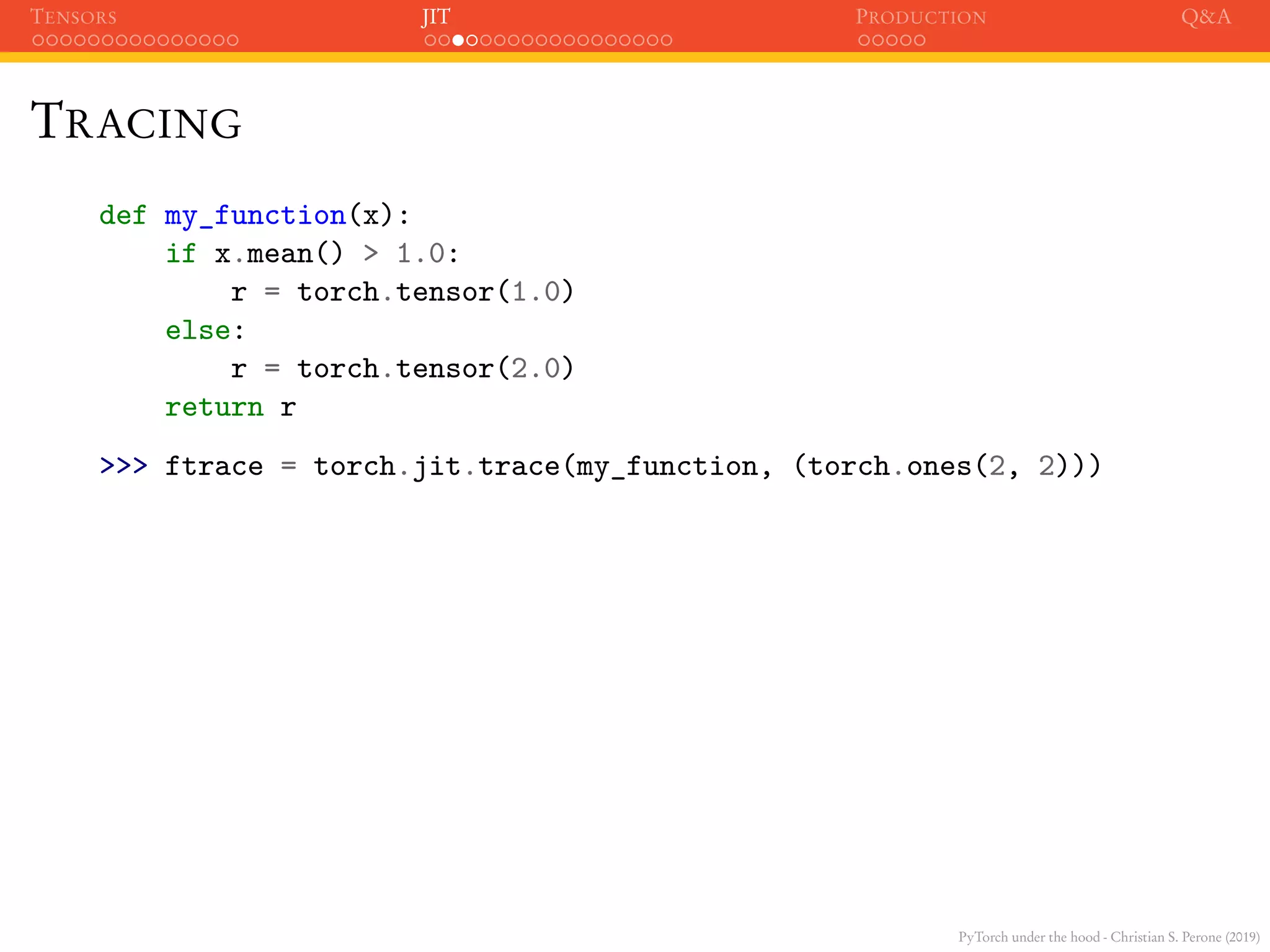
TRACING
def my_function(x):
if x.mean() > 1.0:
r = torch.tensor(1.0)
else:
r = torch.tensor(2.0)
return r
PyTorch under the hood - Christian S. Perone (2019)
TENSORS JIT PRODUCTION Q&A
TRACING
def my_function(x):
if x.mean() > 1.0:
r = torch.tensor(1.0)
else:
r = torch.tensor(2.0)
return r
>>> ftrace = torch.jit.trace(my_function, (torch.ones(2, 2)))
PyTorch under the hood - Christian S. Perone (2019)
TENSORS JIT PRODUCTION Q&A
TRACING
def my_function(x):
if x.mean() > 1.0:
r = torch.tensor(1.0)
else:
r = torch.tensor(2.0)
return r
>>> ftrace = torch.jit.trace(my_function, (torch.ones(2, 2)))
>>> ftrace.graph
graph(%x : Float(2, 2)) {
%4 : Float() = prim::Constant[value={2}]()
%5 : Device = prim::Constant[value="cpu"]()
%6 : int = prim::Constant[value=6]()
%7 : bool = prim::Constant[value=0]()
%8 : bool = prim::Constant[value=0]()
%9 : Float() = aten::to(%4, %5, %6, %7, %8)
%10 : Float() = aten::detach(%9)
return (%10); }
PyTorch under the hood - Christian S. Perone (2019)
TENSORS JIT PRODUCTION Q&A
TRACING
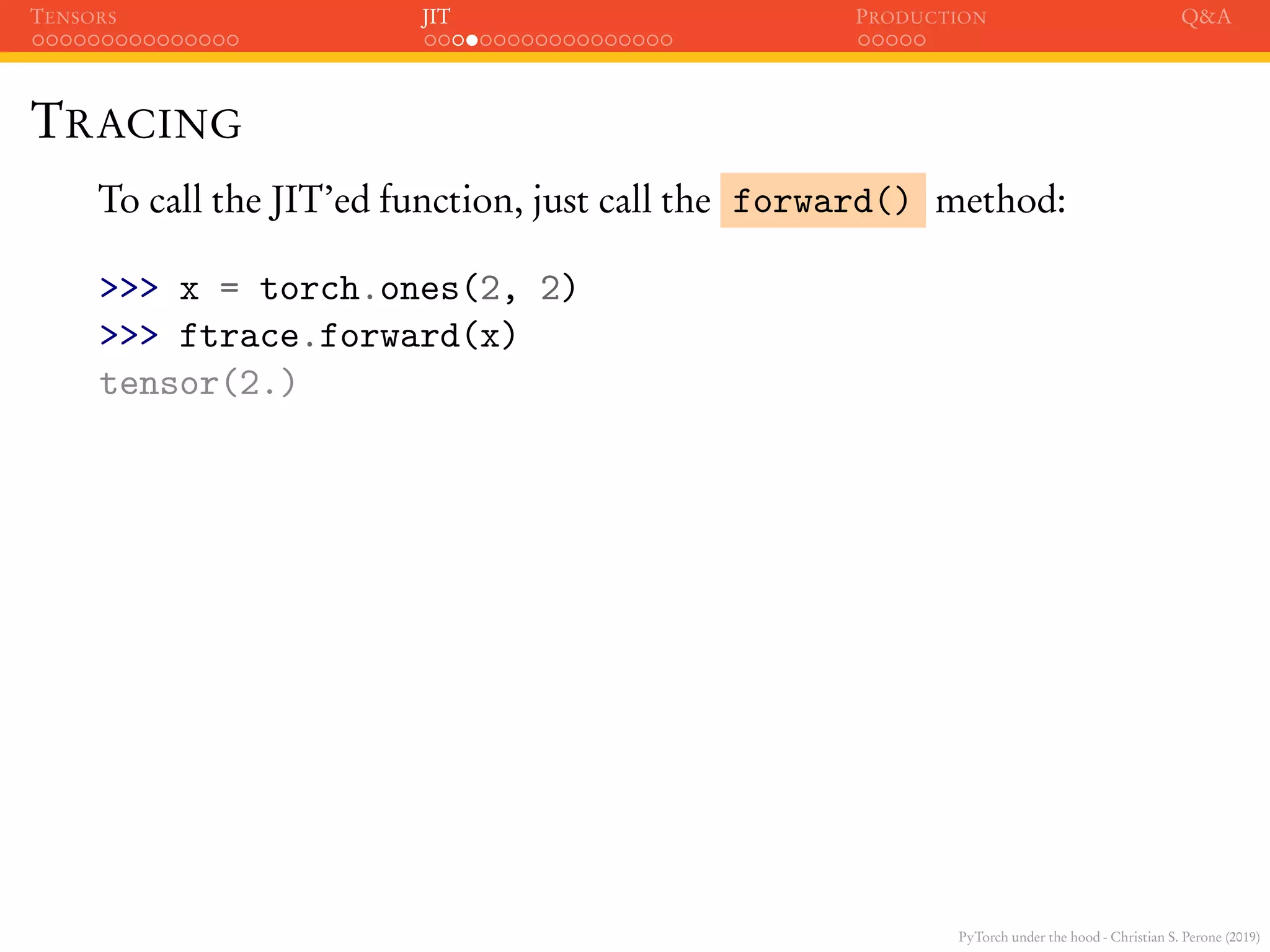
To call the JIT’ed function, just call the forward() method:
>>> x = torch.ones(2, 2)
>>> ftrace.forward(x)
tensor(2.)
PyTorch under the hood - Christian S. Perone (2019)
TENSORS JIT PRODUCTION Q&A
TRACING
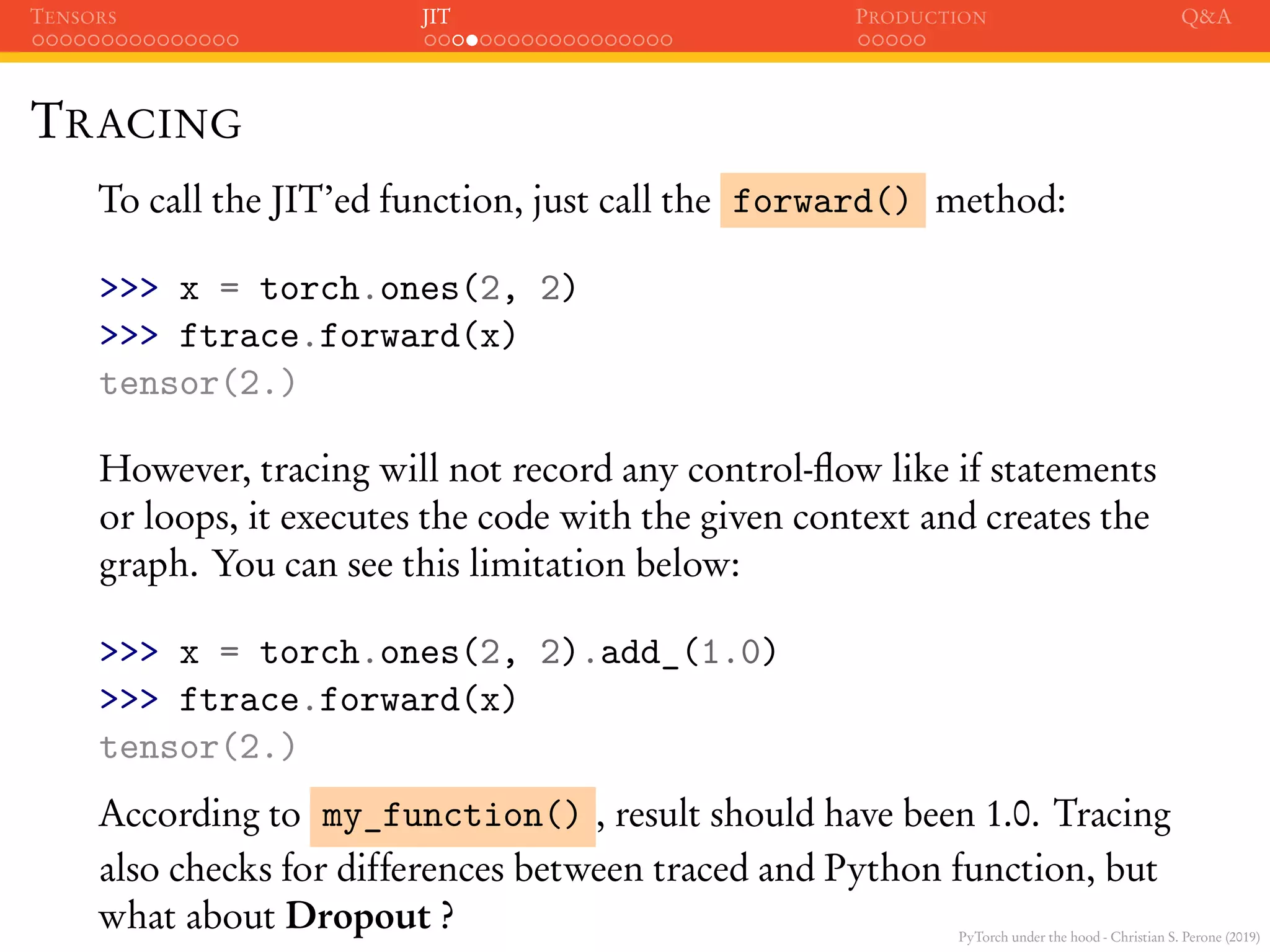
To call the JIT’ed function, just call the forward() method:
>>> x = torch.ones(2, 2)
>>> ftrace.forward(x)
tensor(2.)
However, tracing will not record any control-flow like if statements
or loops, it executes the code with the given context and creates the
graph. You can see this limitation below:
>>> x = torch.ones(2, 2).add_(1.0)
>>> ftrace.forward(x)
tensor(2.)
According to my_function() , result should have been 1.0. Tracing
also checks for differences between traced and Python function, but
what about Dropout ?
PyTorch under the hood - Christian S. Perone (2019)
TENSORS JIT PRODUCTION Q&A
SCRIPTING
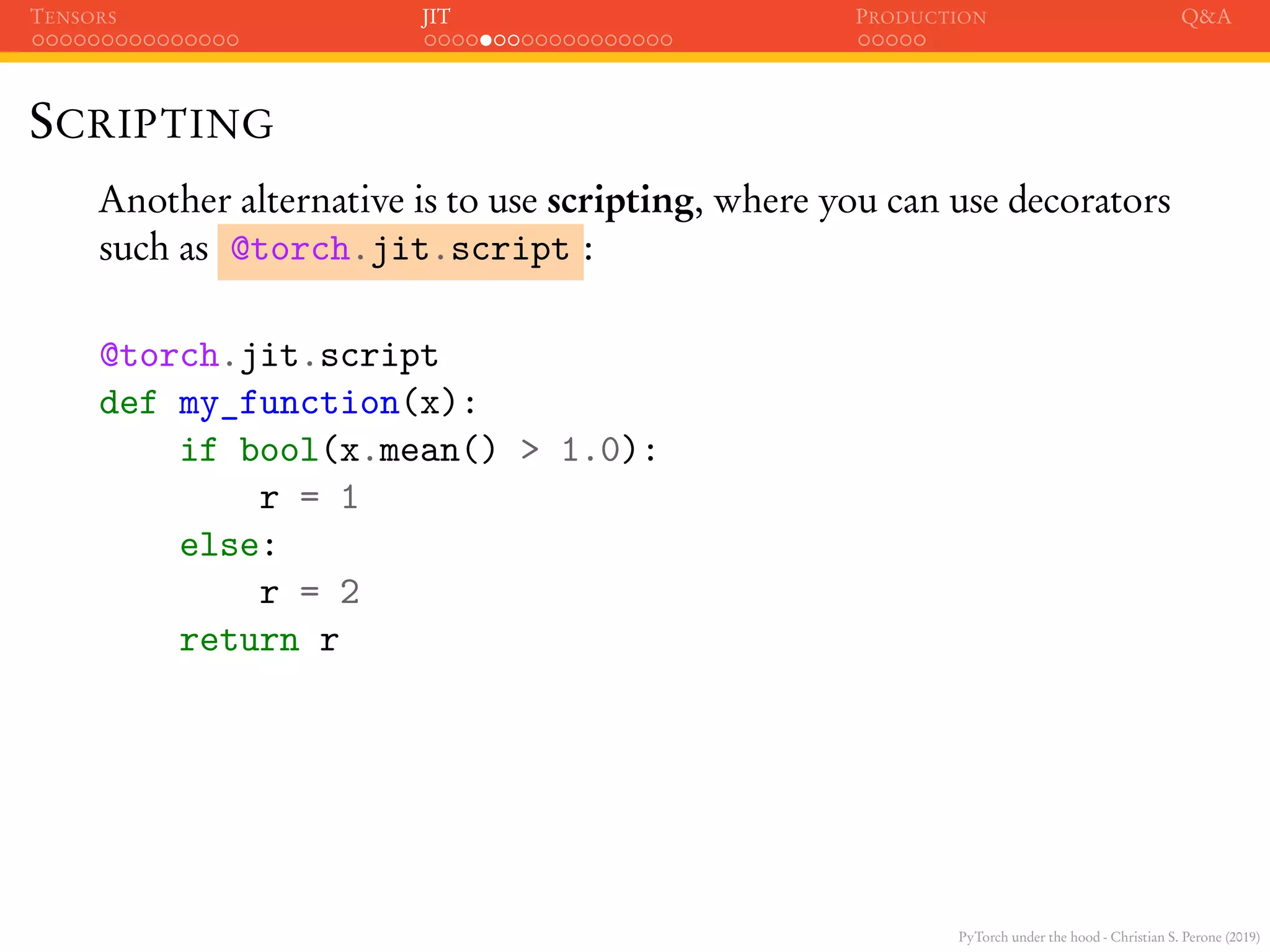
Another alternative is to use scripting, where you can use decorators
such as @torch.jit.script :
@torch.jit.script
def my_function(x):
if bool(x.mean() > 1.0):
r = 1
else:
r = 2
return r
PyTorch under the hood - Christian S. Perone (2019)
TENSORS JIT PRODUCTION Q&A
SCRIPTING
>>> my_function.graph
graph(%x : Tensor) {
%2 : float = prim::Constant[value=1]()
%5 : int = prim::Constant[value=1]()
%6 : int = prim::Constant[value=2]()
%1 : Tensor = aten::mean(%x)
%3 : Tensor = aten::gt(%1, %2)
%4 : bool = prim::Bool(%3)
%r : int = prim::If(%4)
block0() {
-> (%5)
}
block1() {
-> (%6)
}
return (%r);
}
PyTorch under the hood - Christian S. Perone (2019)
TENSORS JIT PRODUCTION Q&A
SCRIPTING
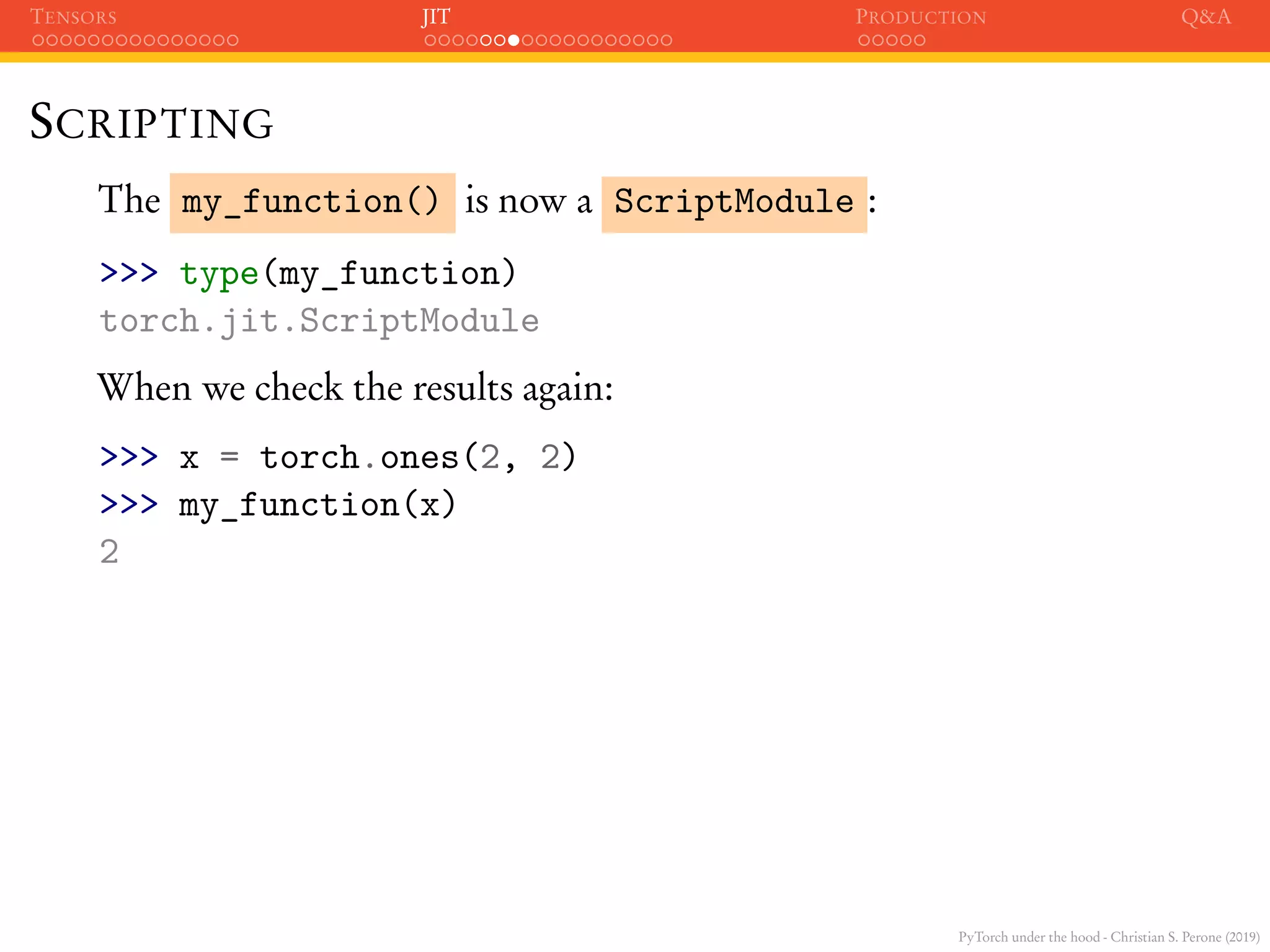
The my_function() is now a ScriptModule :
>>> type(my_function)
torch.jit.ScriptModule
PyTorch under the hood - Christian S. Perone (2019)
TENSORS JIT PRODUCTION Q&A
SCRIPTING
The my_function() is now a ScriptModule :
>>> type(my_function)
torch.jit.ScriptModule
When we check the results again:
>>> x = torch.ones(2, 2)
>>> my_function(x)
2
PyTorch under the hood - Christian S. Perone (2019)
TENSORS JIT PRODUCTION Q&A
SCRIPTING
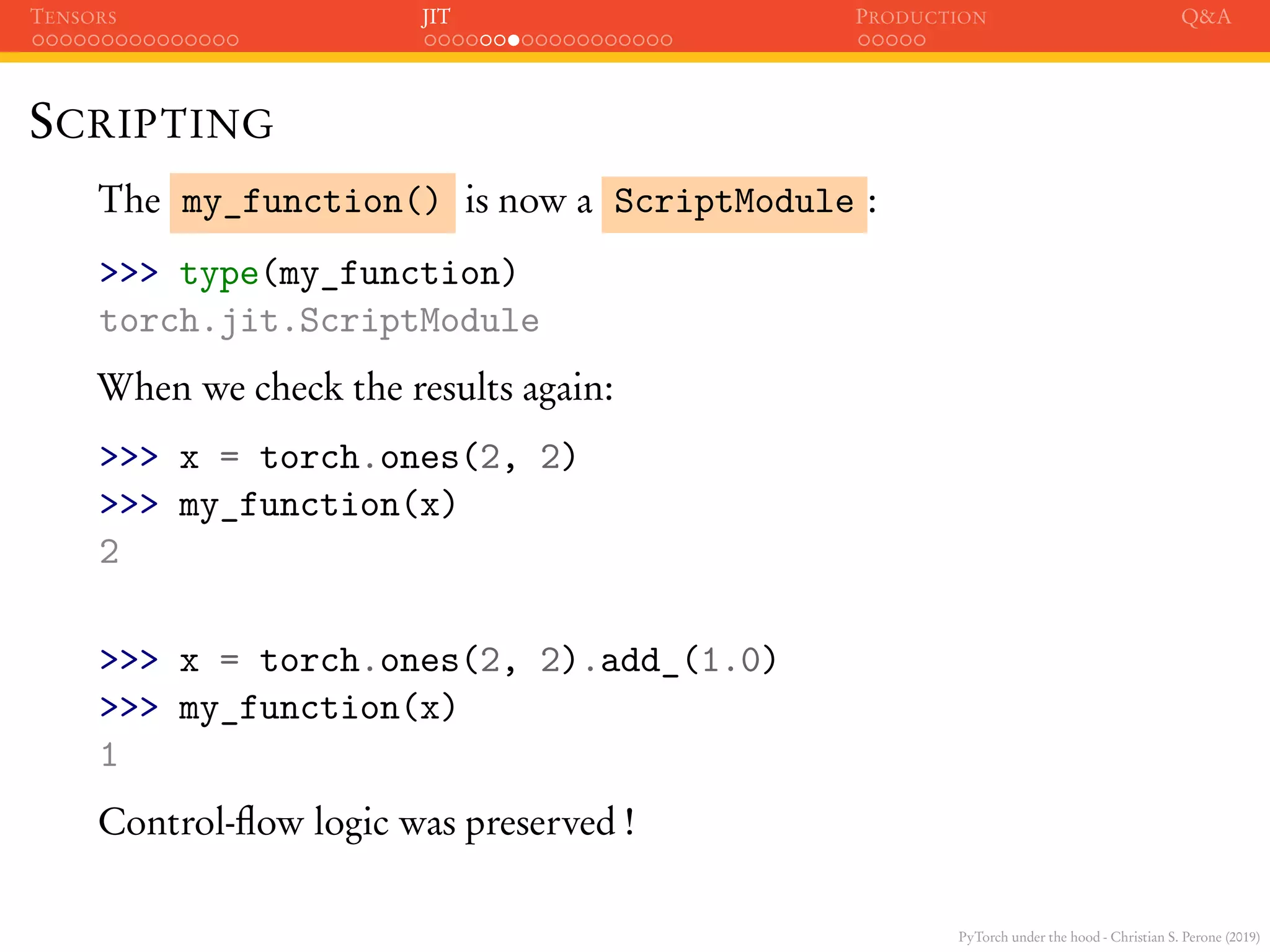
The my_function() is now a ScriptModule :
>>> type(my_function)
torch.jit.ScriptModule
When we check the results again:
>>> x = torch.ones(2, 2)
>>> my_function(x)
2
>>> x = torch.ones(2, 2).add_(1.0)
>>> my_function(x)
1
Control-flow logic was preserved !
PyTorch under the hood - Christian S. Perone (2019)
TENSORS JIT PRODUCTION Q&A
WHY TORCHSCRIPT ?
The concept of having a well-defined Intermediate
Representation (IR) is very powerful, it’s the main concept
behind LLVM platform as well;
PyTorch under the hood - Christian S. Perone (2019)
TENSORS JIT PRODUCTION Q&A
WHY TORCHSCRIPT ?
The concept of having a well-defined Intermediate
Representation (IR) is very powerful, it’s the main concept
behind LLVM platform as well;
This opens the door to:
Decouple the model (computationl graph) from Python runtime;
PyTorch under the hood - Christian S. Perone (2019)
TENSORS JIT PRODUCTION Q&A
WHY TORCHSCRIPT ?
The concept of having a well-defined Intermediate
Representation (IR) is very powerful, it’s the main concept
behind LLVM platform as well;
This opens the door to:
Decouple the model (computationl graph) from Python runtime;
Use it in production with C++ (no GIL) or other languages;
PyTorch under the hood - Christian S. Perone (2019)
TENSORS JIT PRODUCTION Q&A
WHY TORCHSCRIPT ?
The concept of having a well-defined Intermediate
Representation (IR) is very powerful, it’s the main concept
behind LLVM platform as well;
This opens the door to:
Decouple the model (computationl graph) from Python runtime;
Use it in production with C++ (no GIL) or other languages;
Capitalize on optimizations (whole program);
PyTorch under the hood - Christian S. Perone (2019)
TENSORS JIT PRODUCTION Q&A
WHY TORCHSCRIPT ?
The concept of having a well-defined Intermediate
Representation (IR) is very powerful, it’s the main concept
behind LLVM platform as well;
This opens the door to:
Decouple the model (computationl graph) from Python runtime;
Use it in production with C++ (no GIL) or other languages;
Capitalize on optimizations (whole program);
Split the development world of hackable and easy to debug from
the world of putting these models in production and optimize
them.
PyTorch under the hood - Christian S. Perone (2019)
TENSORS JIT PRODUCTION Q&A
BUILDING THE IR
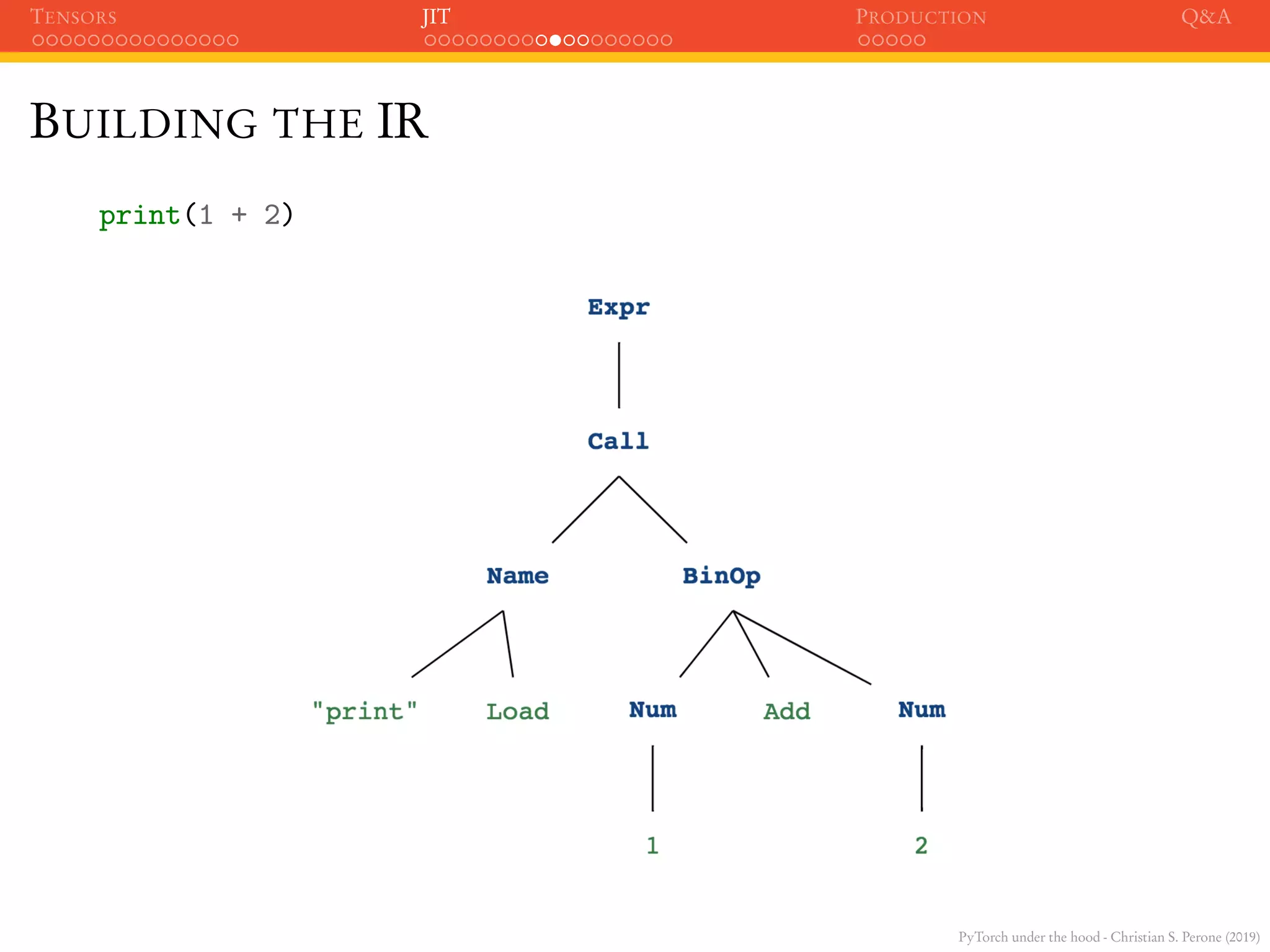
To build the IR, PyTorch takes leverage of the Python Abstract
Syntax Tree (AST) which is a tree representation of the syntactic
structure of the source code.
>>> ast_mod = ast.parse("print(1 + 2)")
>>> astpretty.pprint(ast_mod.body[0], show_offsets=False)
Expr(
value=Call(
func=Name(id='print', ctx=Load()),
args=[
BinOp(
left=Num(n=1),
op=Add(),
right=Num(n=2),
),
],
keywords=[],
),
)
PyTorch under the hood - Christian S. Perone (2019)
TENSORS JIT PRODUCTION Q&A
BUILDING THE IR
print(1 + 2)
PyTorch under the hood - Christian S. Perone (2019)
TENSORS JIT PRODUCTION Q&A
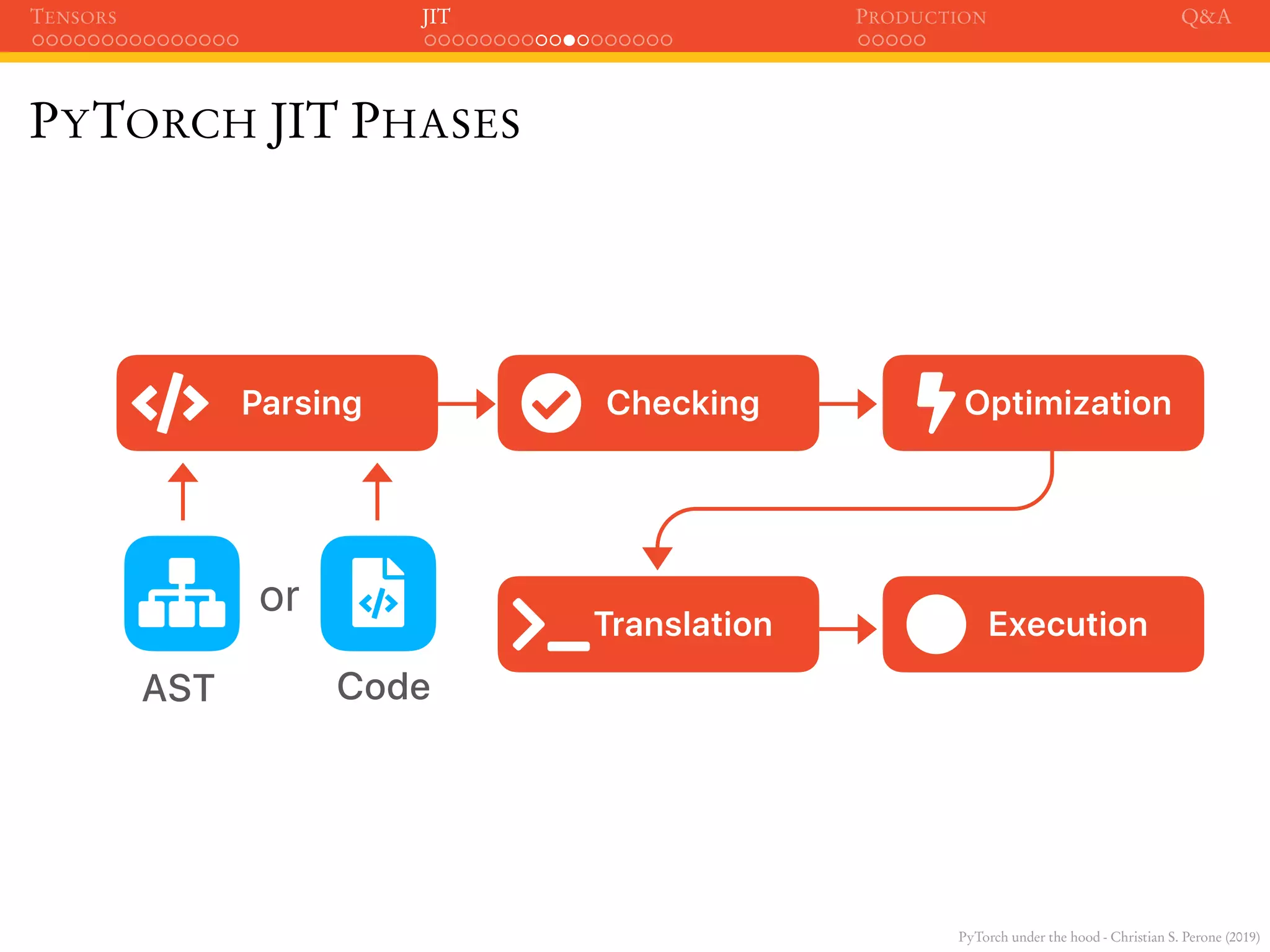
PYTORCH JIT PHASES
Parsing Checking Optimization
Translation Execution○
AST Code
or
PyTorch under the hood - Christian S. Perone (2019)
TENSORS JIT PRODUCTION Q&A
EXECUTING
Just like Python interpreter executes your code, PyTorch has a
interpreter that executes the IR instructions:
bool runImpl(Stack& stack) {
auto& instructions = function->instructions;
size_t last = instructions.size();
while (pc < last) {
auto& inst = instructions[pc];
try {
loadTensorsFromRegisters(inst.inputs, stack);
size_t new_pc = pc + 1 + inst.callback(stack);
for (int i = inst.outputs.size - 1; i >= 0; --i) {
int reg = get(inst.outputs, i);
registers[reg] = pop(stack);
}
pc = new_pc;
// (...) omitted
PyTorch under the hood - Christian S. Perone (2019)
TENSORS JIT PRODUCTION Q&A
OPTIMIZATIONS
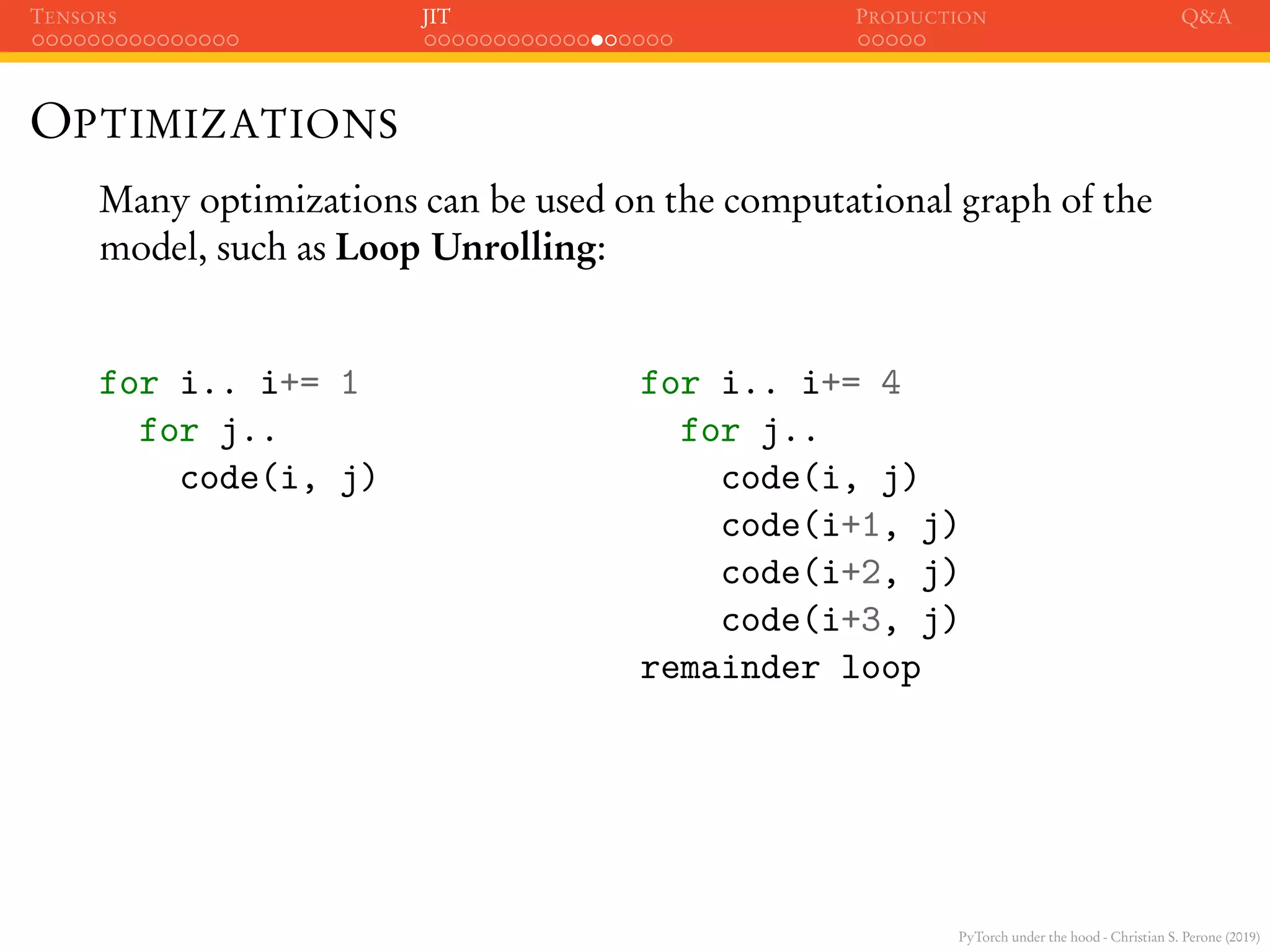
Many optimizations can be used on the computational graph of the
model, such as Loop Unrolling:
for i.. i+= 1 for i.. i+= 4
for j.. for j..
code(i, j) code(i, j)
code(i+1, j)
code(i+2, j)
code(i+3, j)
remainder loop
PyTorch under the hood - Christian S. Perone (2019)
TENSORS JIT PRODUCTION Q&A
OPTIMIZATIONS
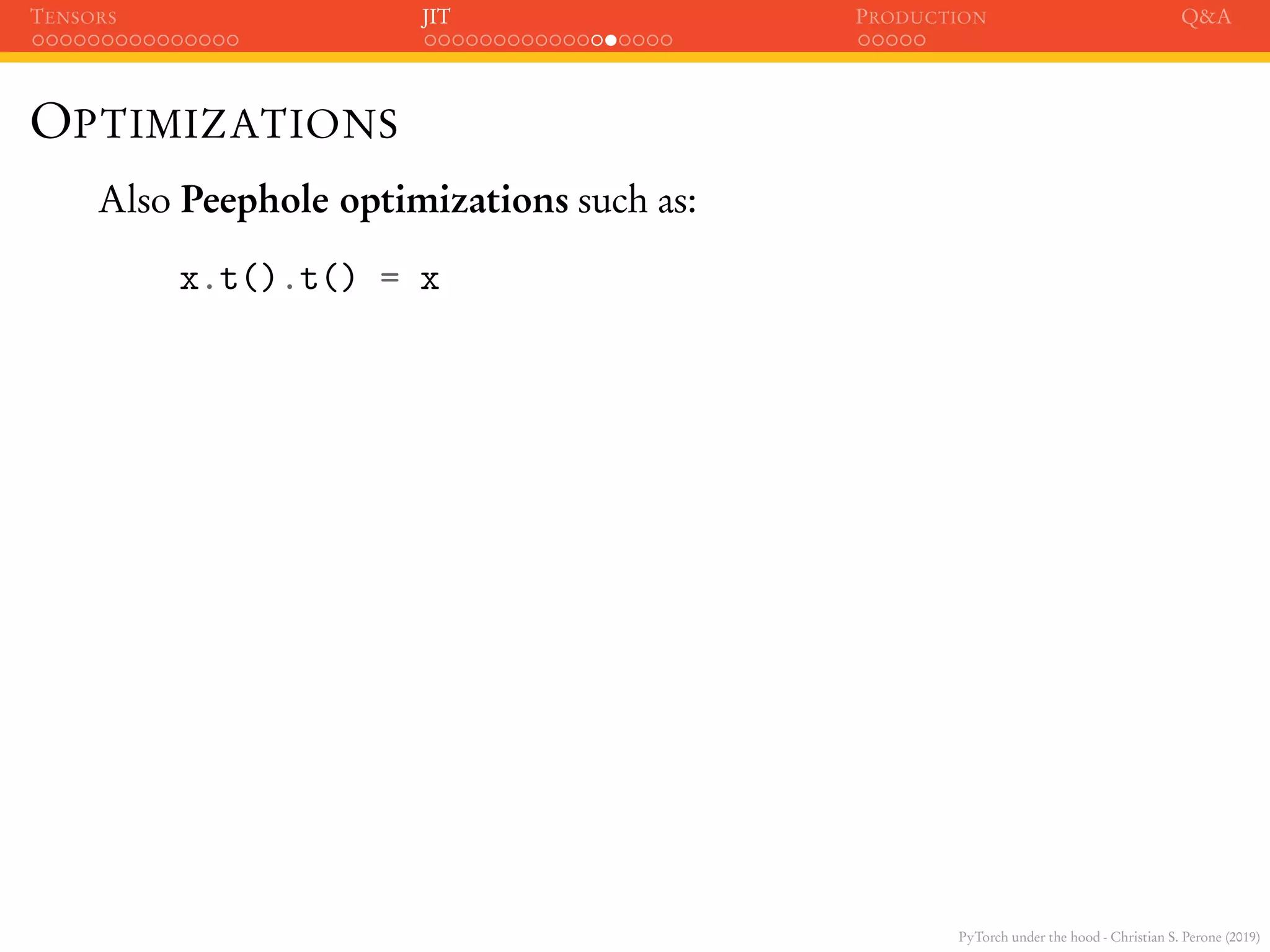
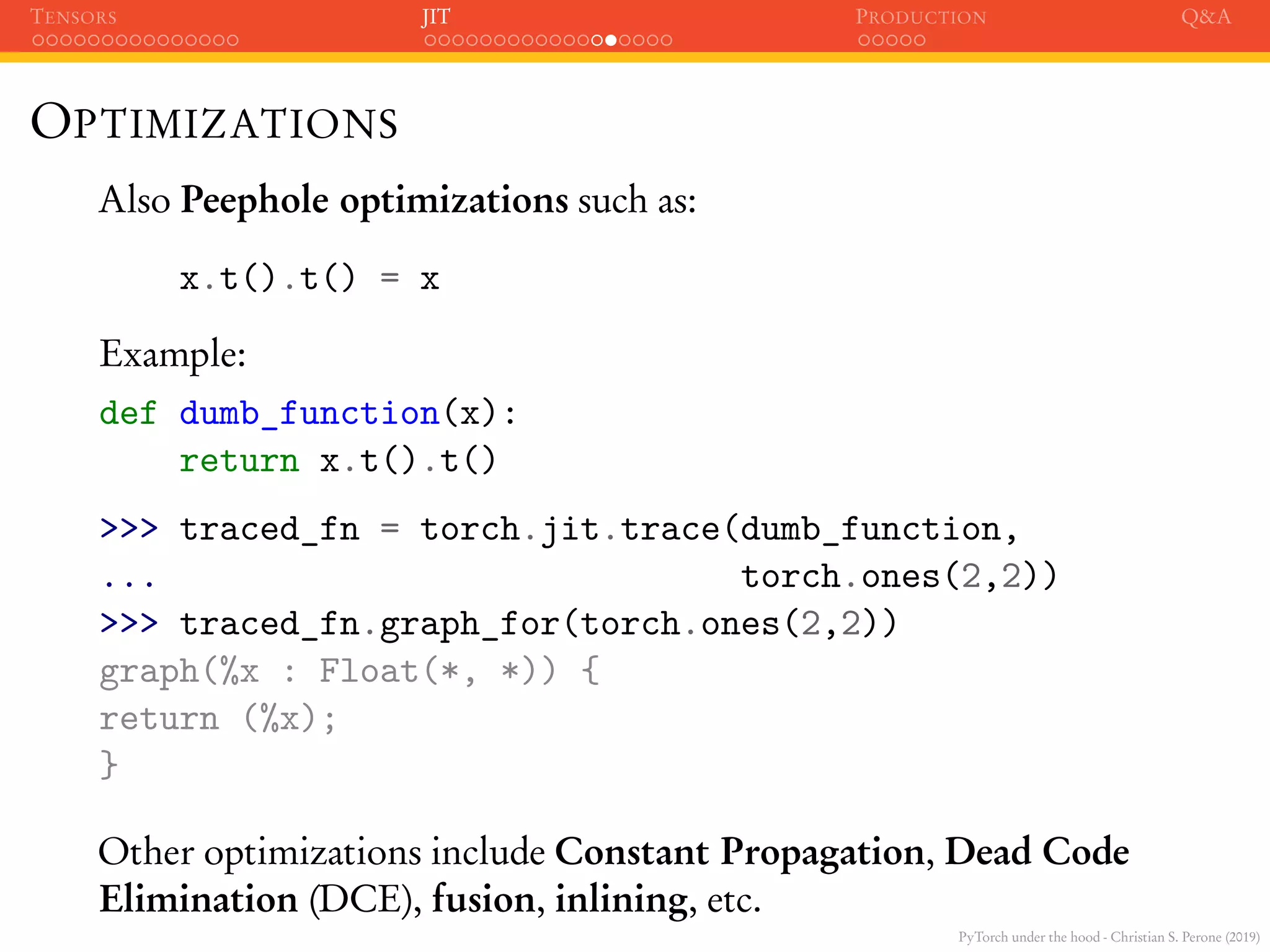
Also Peephole optimizations such as:
x.t().t() = x
PyTorch under the hood - Christian S. Perone (2019)
TENSORS JIT PRODUCTION Q&A
OPTIMIZATIONS
Also Peephole optimizations such as:
x.t().t() = x
Example:
def dumb_function(x):
return x.t().t()
>>> traced_fn = torch.jit.trace(dumb_function,
... torch.ones(2,2))
>>> traced_fn.graph_for(torch.ones(2,2))
graph(%x : Float(*, *)) {
return (%x);
}
PyTorch under the hood - Christian S. Perone (2019)
TENSORS JIT PRODUCTION Q&A
OPTIMIZATIONS
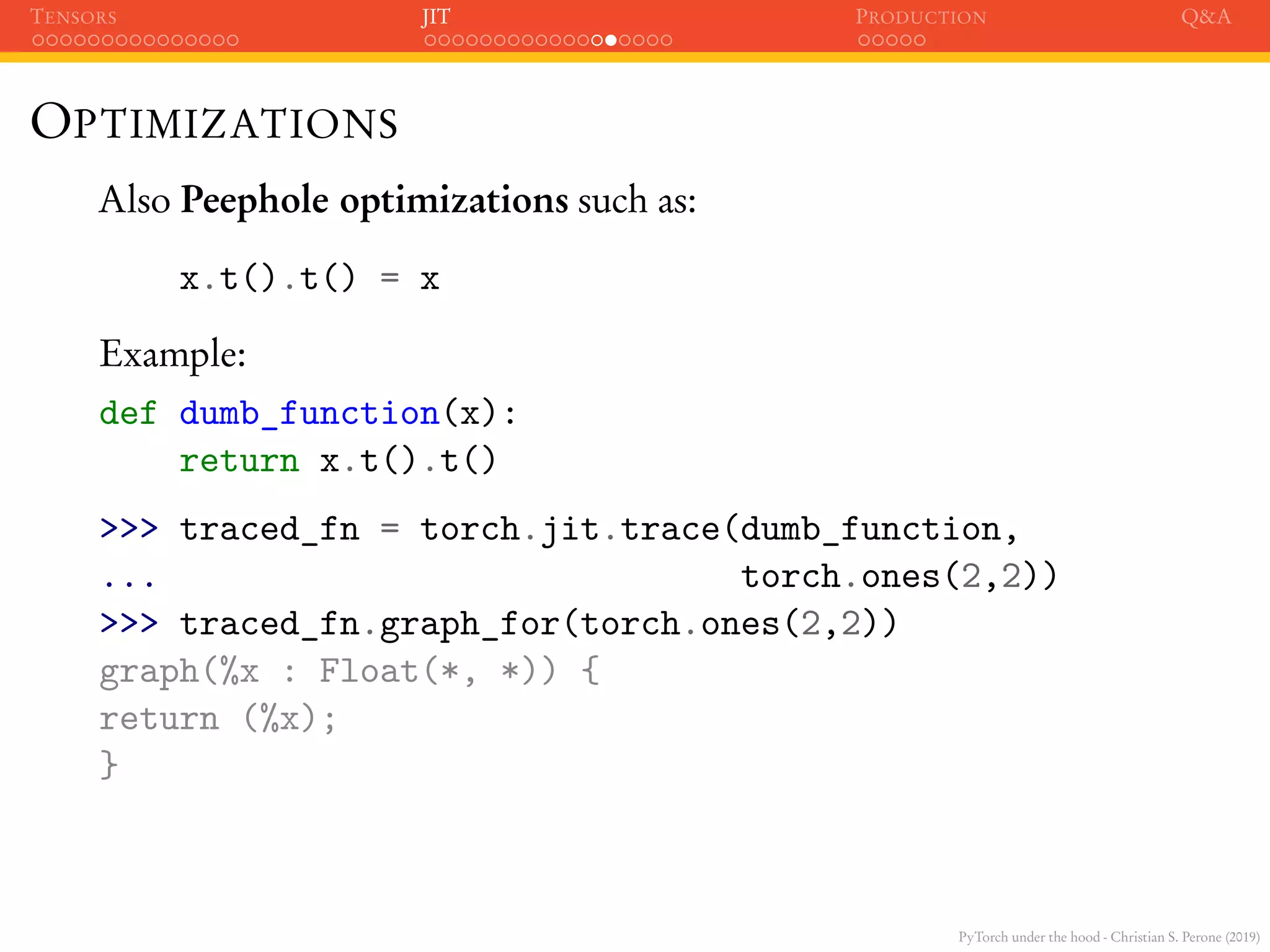
Also Peephole optimizations such as:
x.t().t() = x
Example:
def dumb_function(x):
return x.t().t()
>>> traced_fn = torch.jit.trace(dumb_function,
... torch.ones(2,2))
>>> traced_fn.graph_for(torch.ones(2,2))
graph(%x : Float(*, *)) {
return (%x);
}
Other optimizations include Constant Propagation, Dead Code
Elimination (DCE), fusion, inlining, etc.
PyTorch under the hood - Christian S. Perone (2019)
TENSORS JIT PRODUCTION Q&A
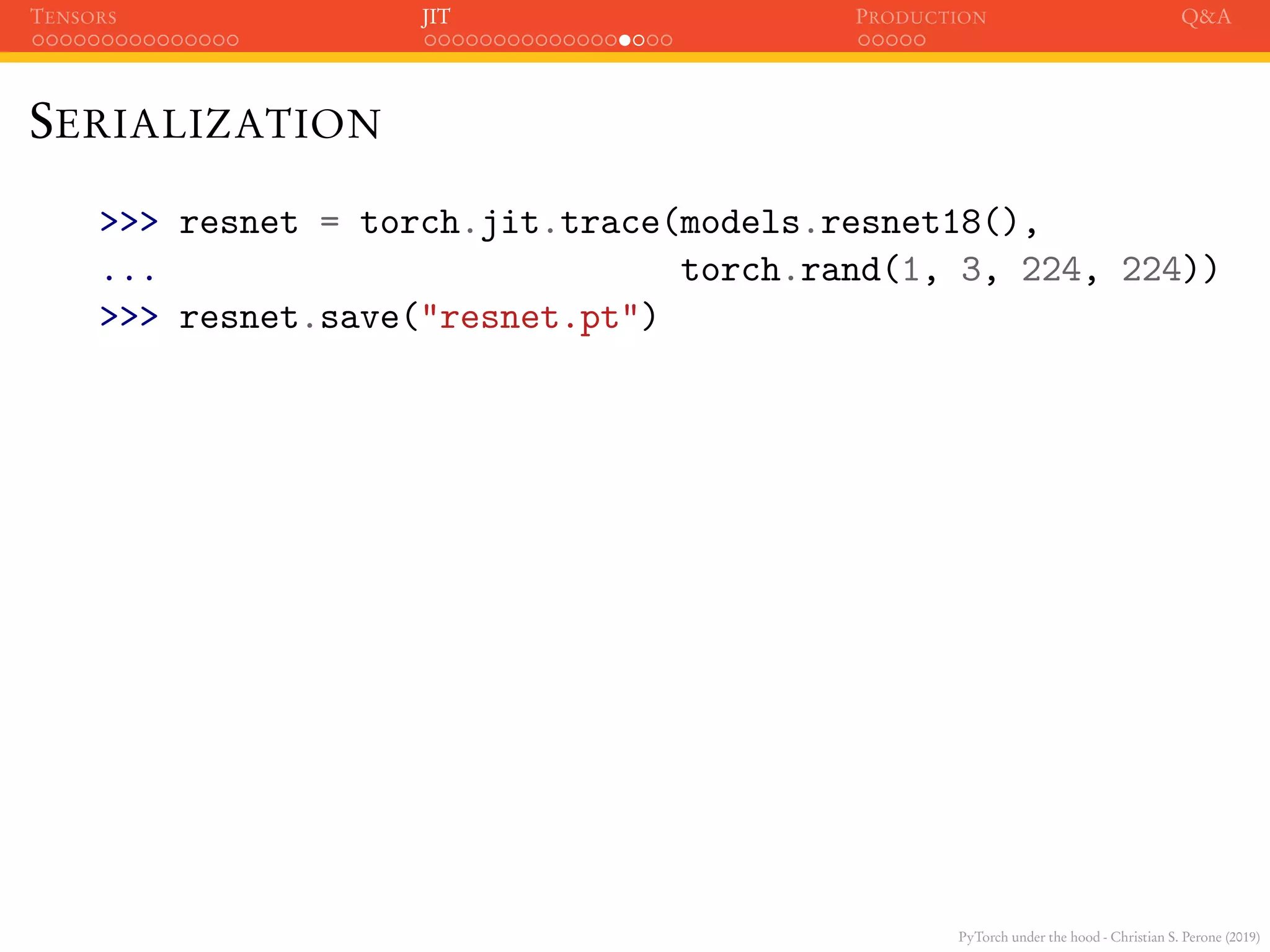
SERIALIZATION
>>> resnet = torch.jit.trace(models.resnet18(),
... torch.rand(1, 3, 224, 224))
>>> resnet.save("resnet.pt")
PyTorch under the hood - Christian S. Perone (2019)
TENSORS JIT PRODUCTION Q&A
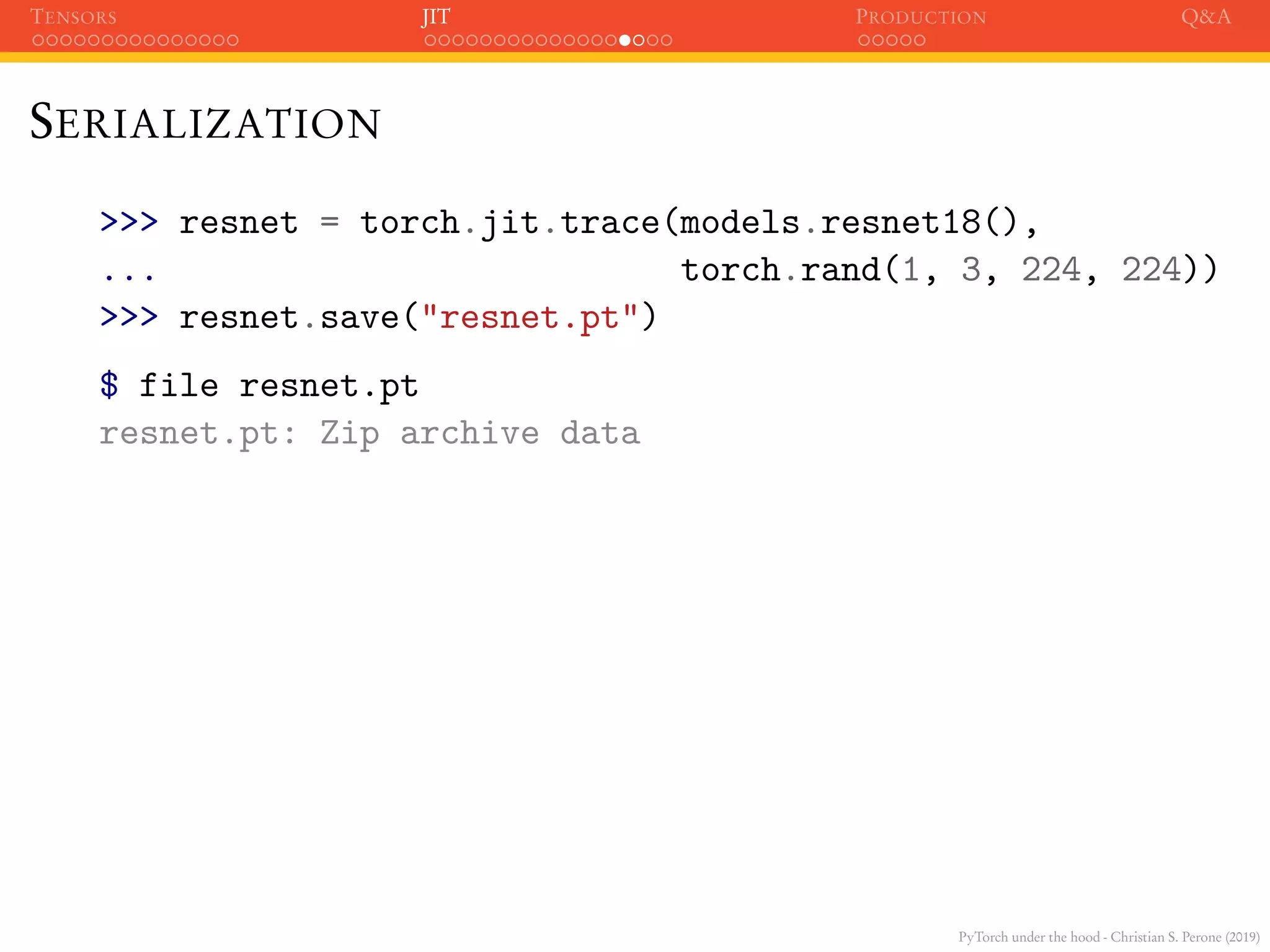
SERIALIZATION
>>> resnet = torch.jit.trace(models.resnet18(),
... torch.rand(1, 3, 224, 224))
>>> resnet.save("resnet.pt")
$ file resnet.pt
resnet.pt: Zip archive data
PyTorch under the hood - Christian S. Perone (2019)
TENSORS JIT PRODUCTION Q&A
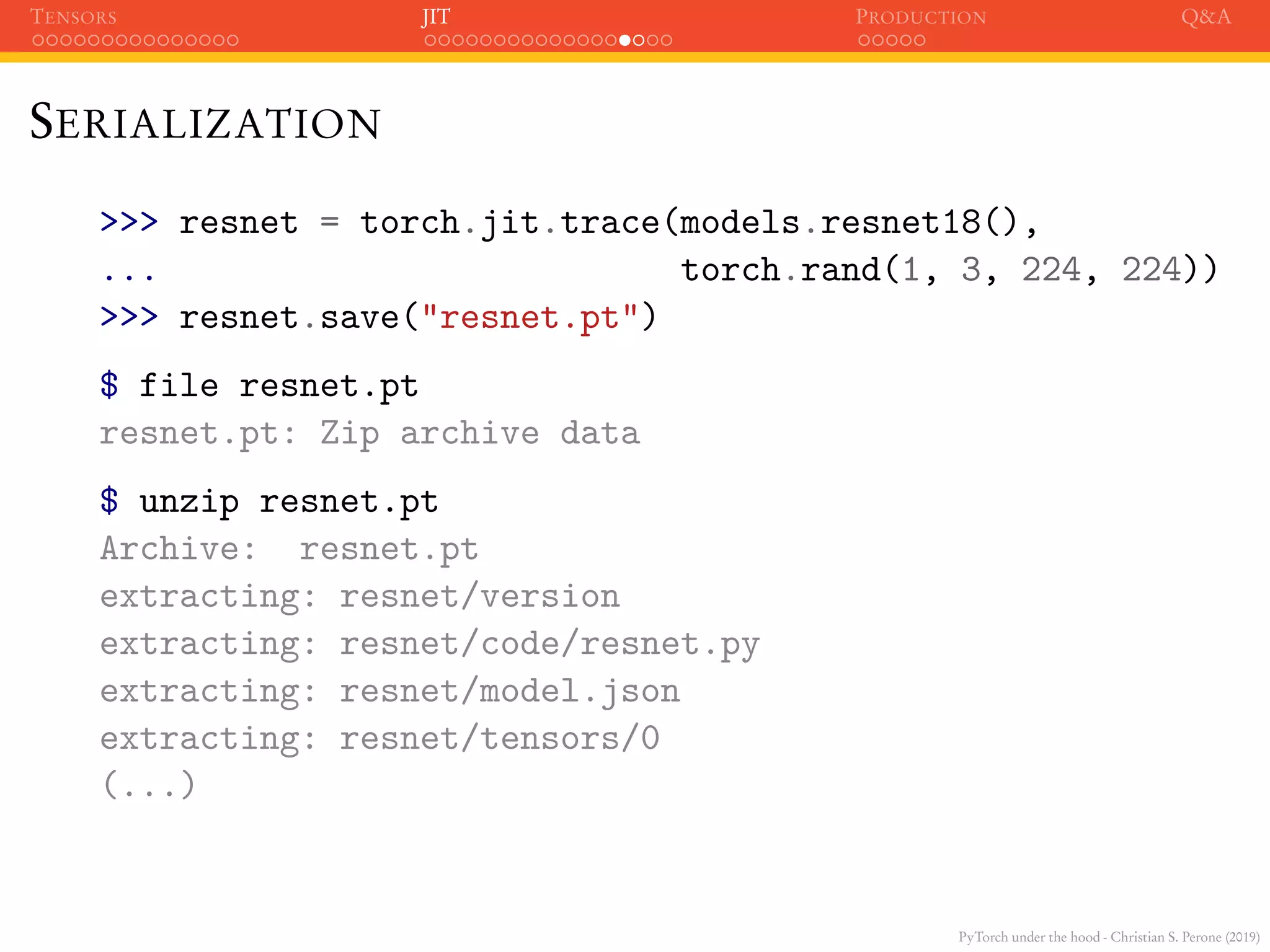
SERIALIZATION
>>> resnet = torch.jit.trace(models.resnet18(),
... torch.rand(1, 3, 224, 224))
>>> resnet.save("resnet.pt")
$ file resnet.pt
resnet.pt: Zip archive data
$ unzip resnet.pt
Archive: resnet.pt
extracting: resnet/version
extracting: resnet/code/resnet.py
extracting: resnet/model.json
extracting: resnet/tensors/0
(...)
PyTorch under the hood - Christian S. Perone (2019)
TENSORS JIT PRODUCTION Q&A
SERIALIZATION
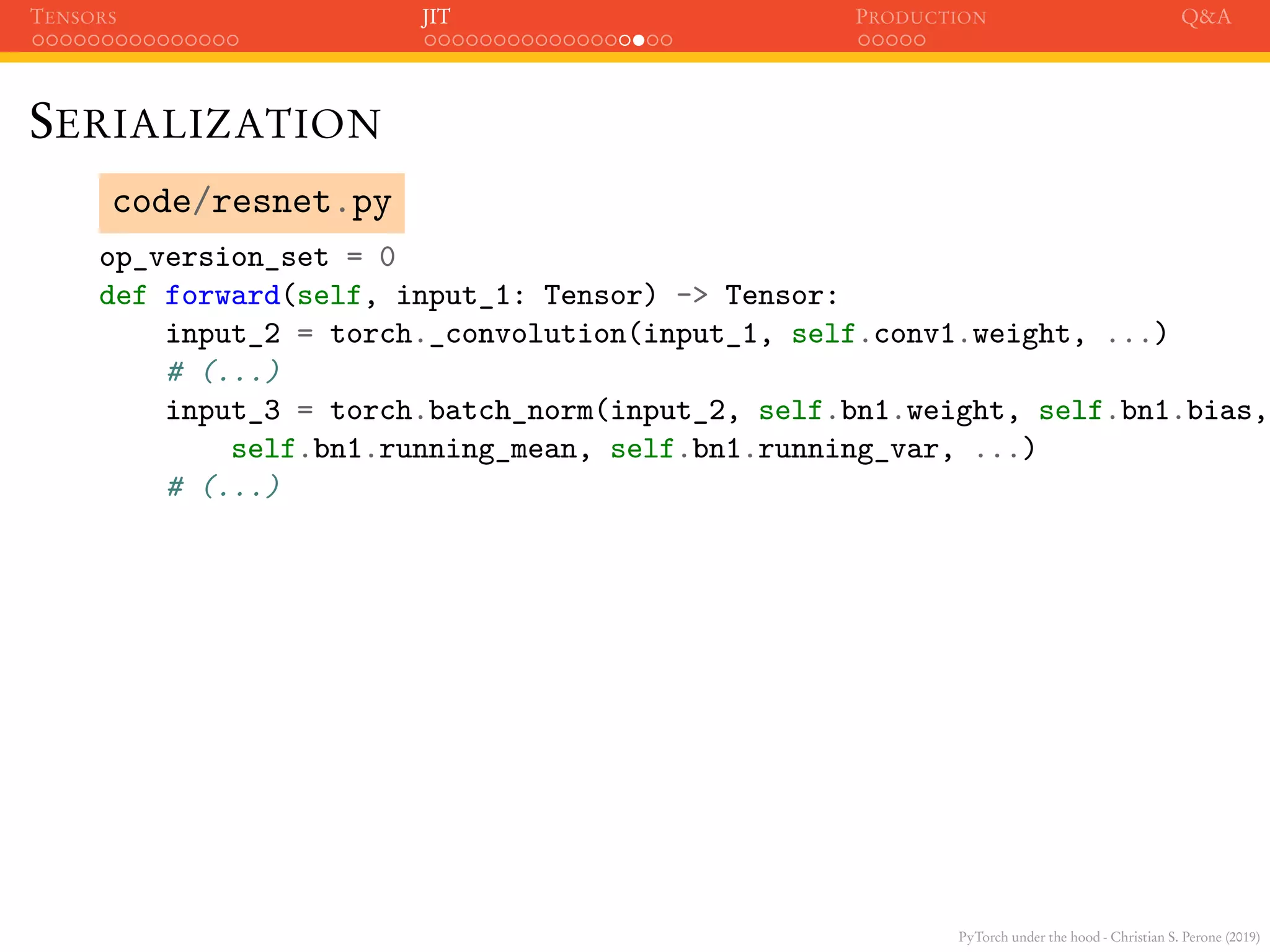
code/resnet.py
op_version_set = 0
def forward(self, input_1: Tensor) -> Tensor:
input_2 = torch._convolution(input_1, self.conv1.weight, ...)
# (...)
input_3 = torch.batch_norm(input_2, self.bn1.weight, self.bn1.bias,
self.bn1.running_mean, self.bn1.running_var, ...)
# (...)
PyTorch under the hood - Christian S. Perone (2019)
TENSORS JIT PRODUCTION Q&A
SERIALIZATION
code/resnet.py
op_version_set = 0
def forward(self, input_1: Tensor) -> Tensor:
input_2 = torch._convolution(input_1, self.conv1.weight, ...)
# (...)
input_3 = torch.batch_norm(input_2, self.bn1.weight, self.bn1.bias,
self.bn1.running_mean, self.bn1.running_var, ...)
# (...)
model.json
{"parameters":
[{ "isBuffer": false,
"tensorId": "1",
"name": "weight" }],
"name": "conv1",
"optimize": true}
PyTorch under the hood - Christian S. Perone (2019)
TENSORS JIT PRODUCTION Q&A
SERIALIZATION
code/resnet.py
op_version_set = 0
def forward(self, input_1: Tensor) -> Tensor:
input_2 = torch._convolution(input_1, self.conv1.weight, ...)
# (...)
input_3 = torch.batch_norm(input_2, self.bn1.weight, self.bn1.bias,
self.bn1.running_mean, self.bn1.running_var, ...)
# (...)
model.json
{"parameters":
[{ "isBuffer": false,
"tensorId": "1",
"name": "weight" }],
"name": "conv1",
"optimize": true}
model.json
[{"isBuffer": true,
"tensorId": "4",
"name": "running_mean"},
{"isBuffer": true,
"tensorId": "5",
"name": "running_var"}],
"name": "bn1",
"optimize": true}
PyTorch under the hood - Christian S. Perone (2019)
TENSORS JIT PRODUCTION Q&A
USING THE MODEL IN C++
PyTorch also has a C++ API that you can use to load/train models in
C++. This is good for production, mobile, embedded devices, etc.
Example of loading a traced model in PyTorch C++ API:
#include <torch/script.h>
int main(int argc, const char* argv[])
{
auto module = torch::jit::load("resnet.pt");
std::vector<torch::jit::IValue> inputs;
inputs.push_back(torch::ones({1, 3, 224, 224}));
at::Tensor output = module->forward(inputs).toTensor();
}
PyTorch under the hood - Christian S. Perone (2019)
TENSORS JIT PRODUCTION Q&A
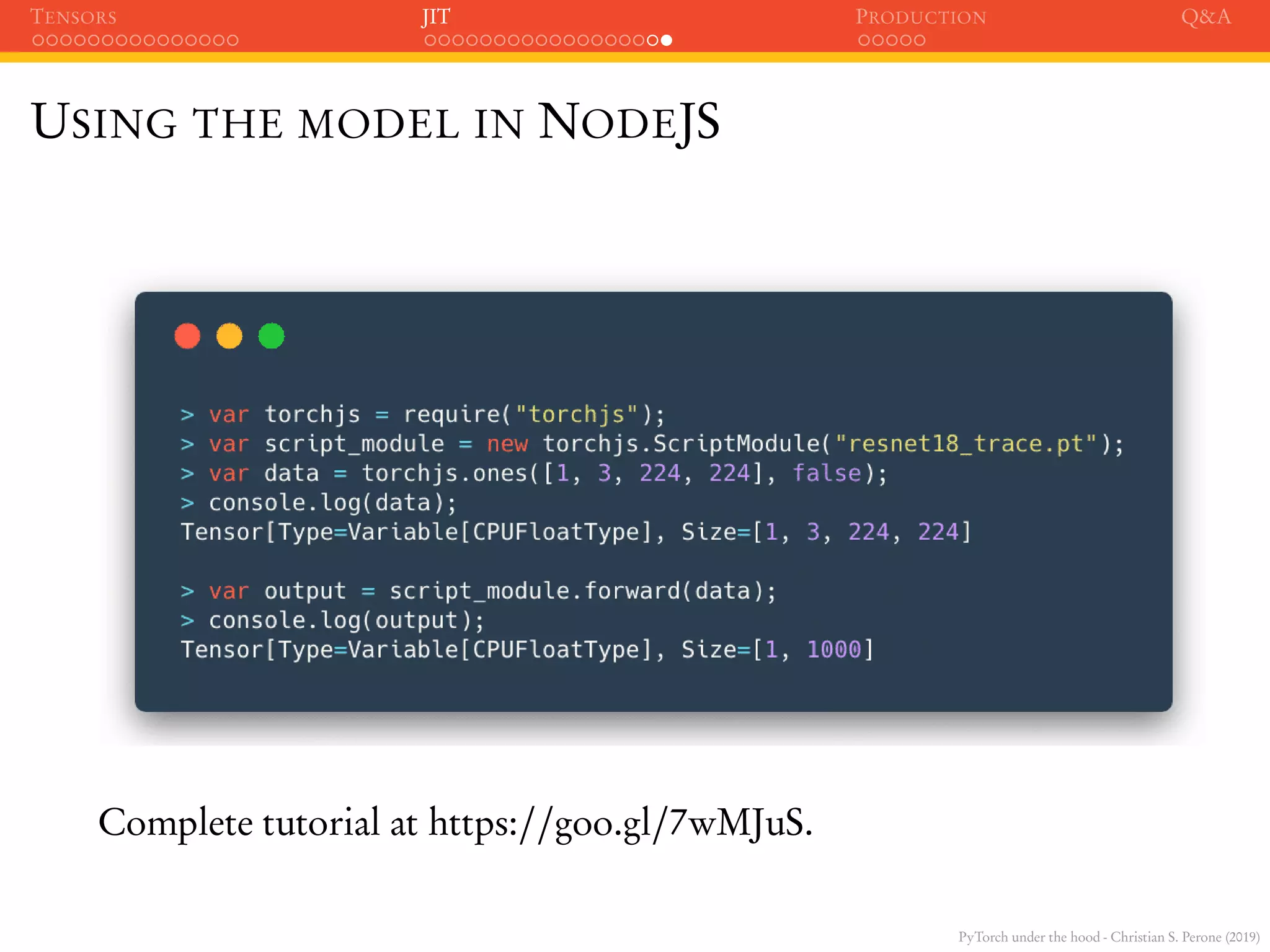
USING THE MODEL IN NODEJS
Complete tutorial at https://goo.gl/7wMJuS.
PyTorch under the hood - Christian S. Perone (2019)
TENSORS JIT PRODUCTION Q&A
Section III
PRODUCTION
PyTorch under the hood - Christian S. Perone (2019)
TENSORS JIT PRODUCTION Q&A
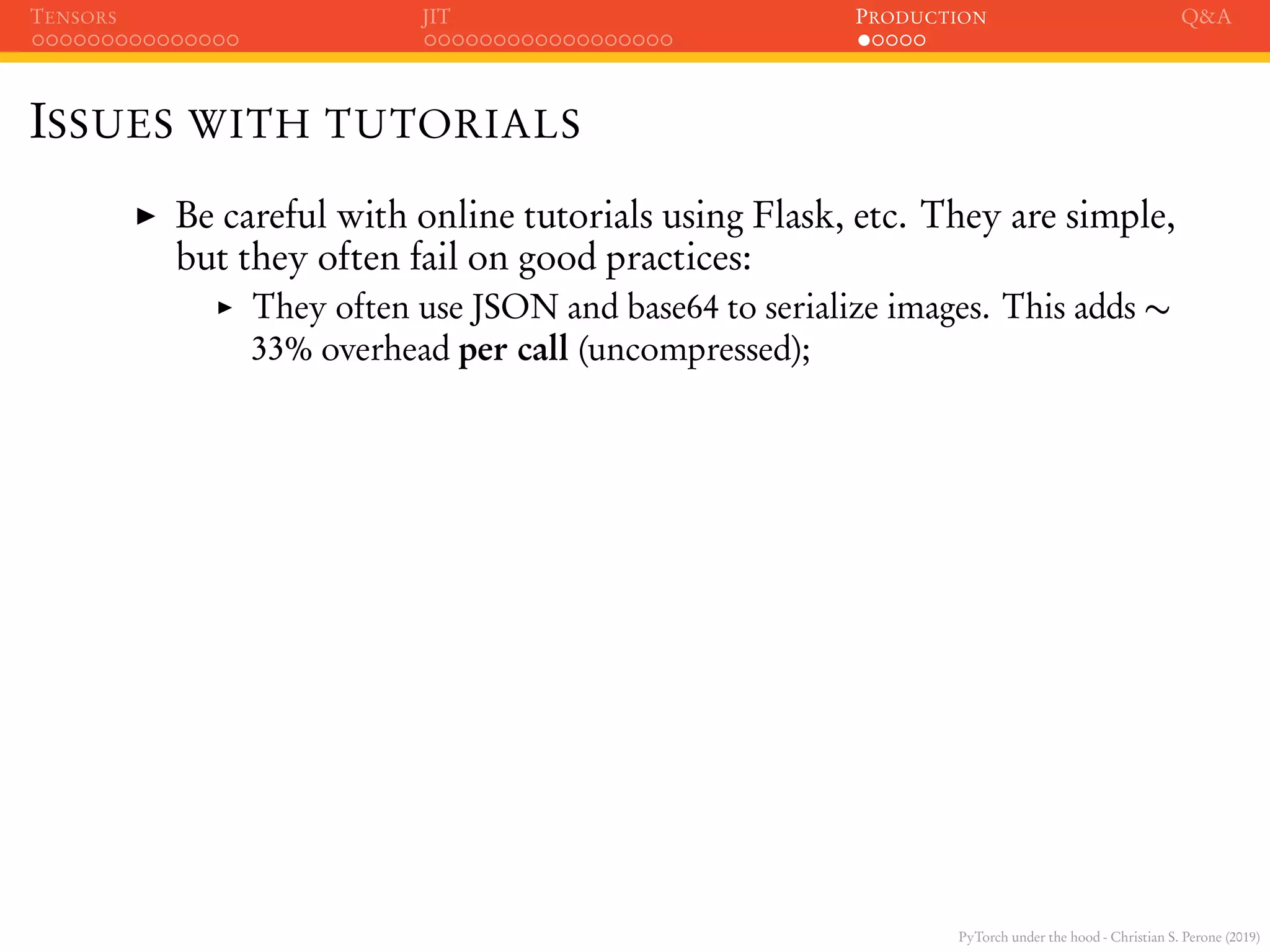
ISSUES WITH TUTORIALS
Be careful with online tutorials using Flask, etc. They are simple,
but they often fail on good practices:
They often use JSON and base64 to serialize images. This adds ∼
33% overhead per call (uncompressed);
PyTorch under the hood - Christian S. Perone (2019)
TENSORS JIT PRODUCTION Q&A
ISSUES WITH TUTORIALS
Be careful with online tutorials using Flask, etc. They are simple,
but they often fail on good practices:
They often use JSON and base64 to serialize images. This adds ∼
33% overhead per call (uncompressed);
They don’t pay attention to zero-copy practices, so they often
transform, reshape, convert to numpy, convert to PyTorch, etc;
PyTorch under the hood - Christian S. Perone (2019)
TENSORS JIT PRODUCTION Q&A
ISSUES WITH TUTORIALS
Be careful with online tutorials using Flask, etc. They are simple,
but they often fail on good practices:
They often use JSON and base64 to serialize images. This adds ∼
33% overhead per call (uncompressed);
They don’t pay attention to zero-copy practices, so they often
transform, reshape, convert to numpy, convert to PyTorch, etc;
They often use HTTP/1;
PyTorch under the hood - Christian S. Perone (2019)
TENSORS JIT PRODUCTION Q&A
ISSUES WITH TUTORIALS
Be careful with online tutorials using Flask, etc. They are simple,
but they often fail on good practices:
They often use JSON and base64 to serialize images. This adds ∼
33% overhead per call (uncompressed);
They don’t pay attention to zero-copy practices, so they often
transform, reshape, convert to numpy, convert to PyTorch, etc;
They often use HTTP/1;
They seldom do batching (important for GPUs);
PyTorch under the hood - Christian S. Perone (2019)
TENSORS JIT PRODUCTION Q&A
ISSUES WITH TUTORIALS
Be careful with online tutorials using Flask, etc. They are simple,
but they often fail on good practices:
They often use JSON and base64 to serialize images. This adds ∼
33% overhead per call (uncompressed);
They don’t pay attention to zero-copy practices, so they often
transform, reshape, convert to numpy, convert to PyTorch, etc;
They often use HTTP/1;
They seldom do batching (important for GPUs);
They never put that "production" code in production.
PyTorch under the hood - Christian S. Perone (2019)
TENSORS JIT PRODUCTION Q&A
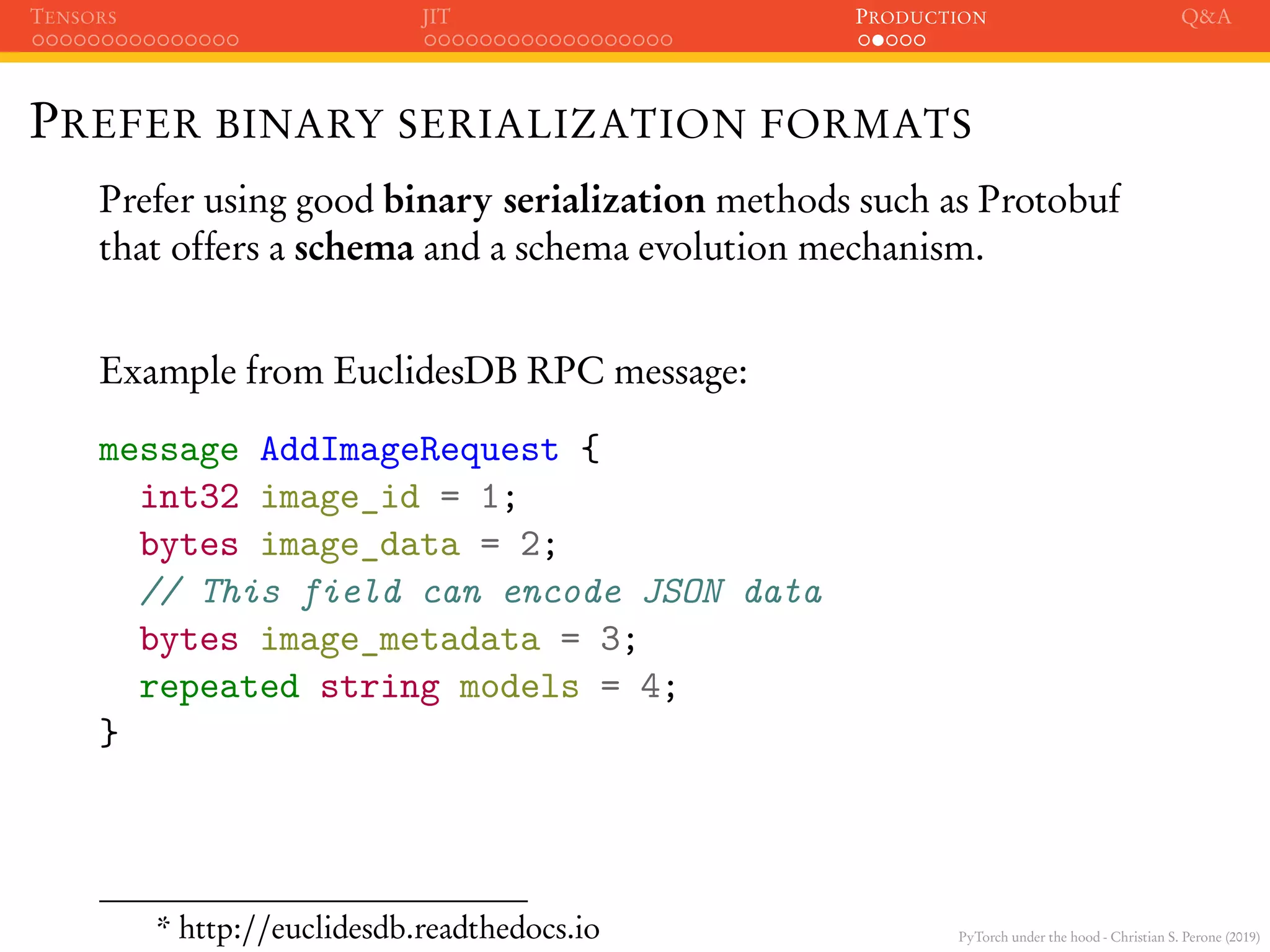
PREFER BINARY SERIALIZATION FORMATS
Prefer using good binary serialization methods such as Protobuf
that offers a schema and a schema evolution mechanism.
Example from EuclidesDB RPC message:
message AddImageRequest {
int32 image_id = 1;
bytes image_data = 2;
// This field can encode JSON data
bytes image_metadata = 3;
repeated string models = 4;
}
* http://euclidesdb.readthedocs.io
PyTorch under the hood - Christian S. Perone (2019)
TENSORS JIT PRODUCTION Q&A
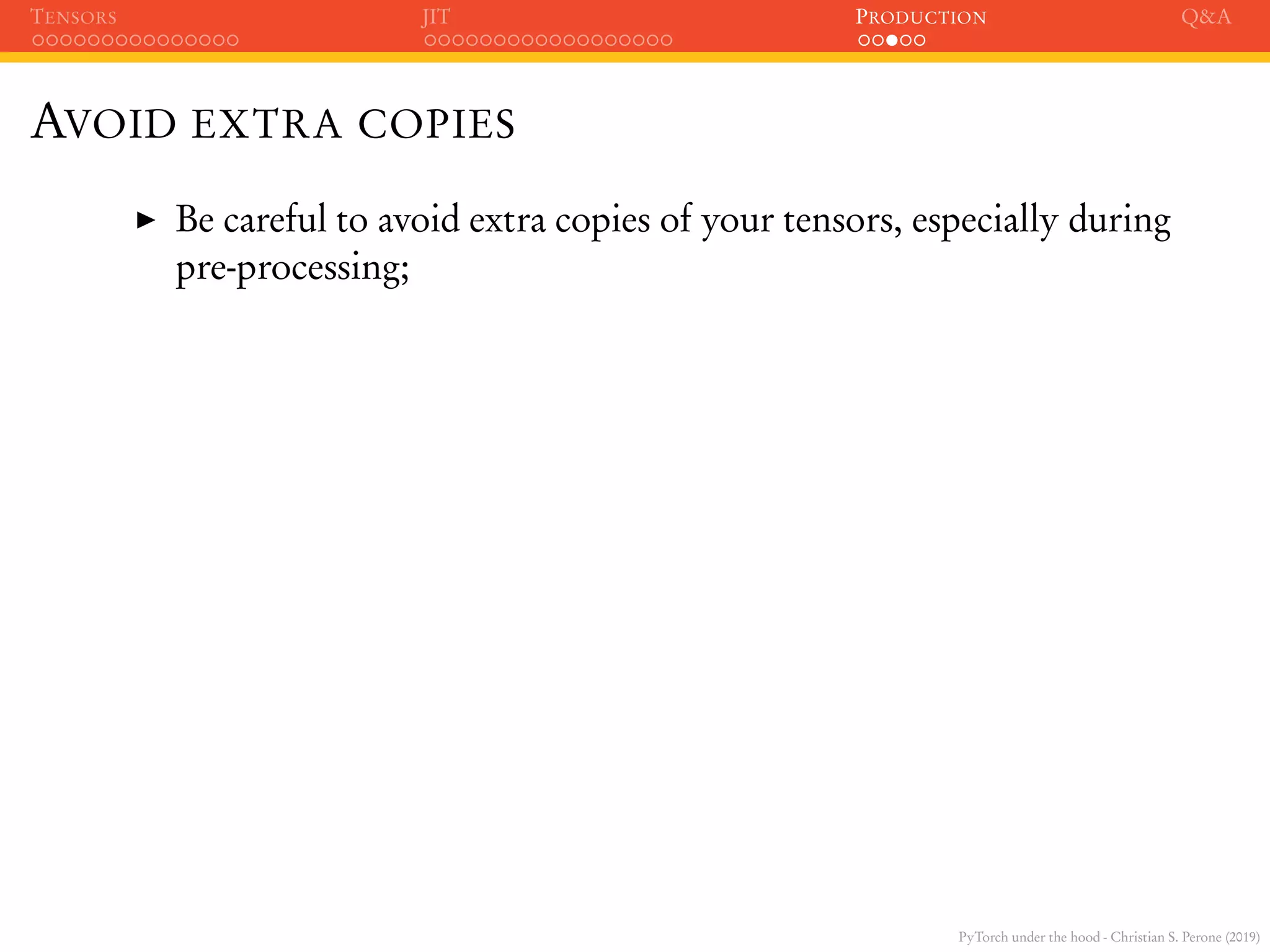
AVOID EXTRA COPIES
Be careful to avoid extra copies of your tensors, especially during
pre-processing;
PyTorch under the hood - Christian S. Perone (2019)
TENSORS JIT PRODUCTION Q&A
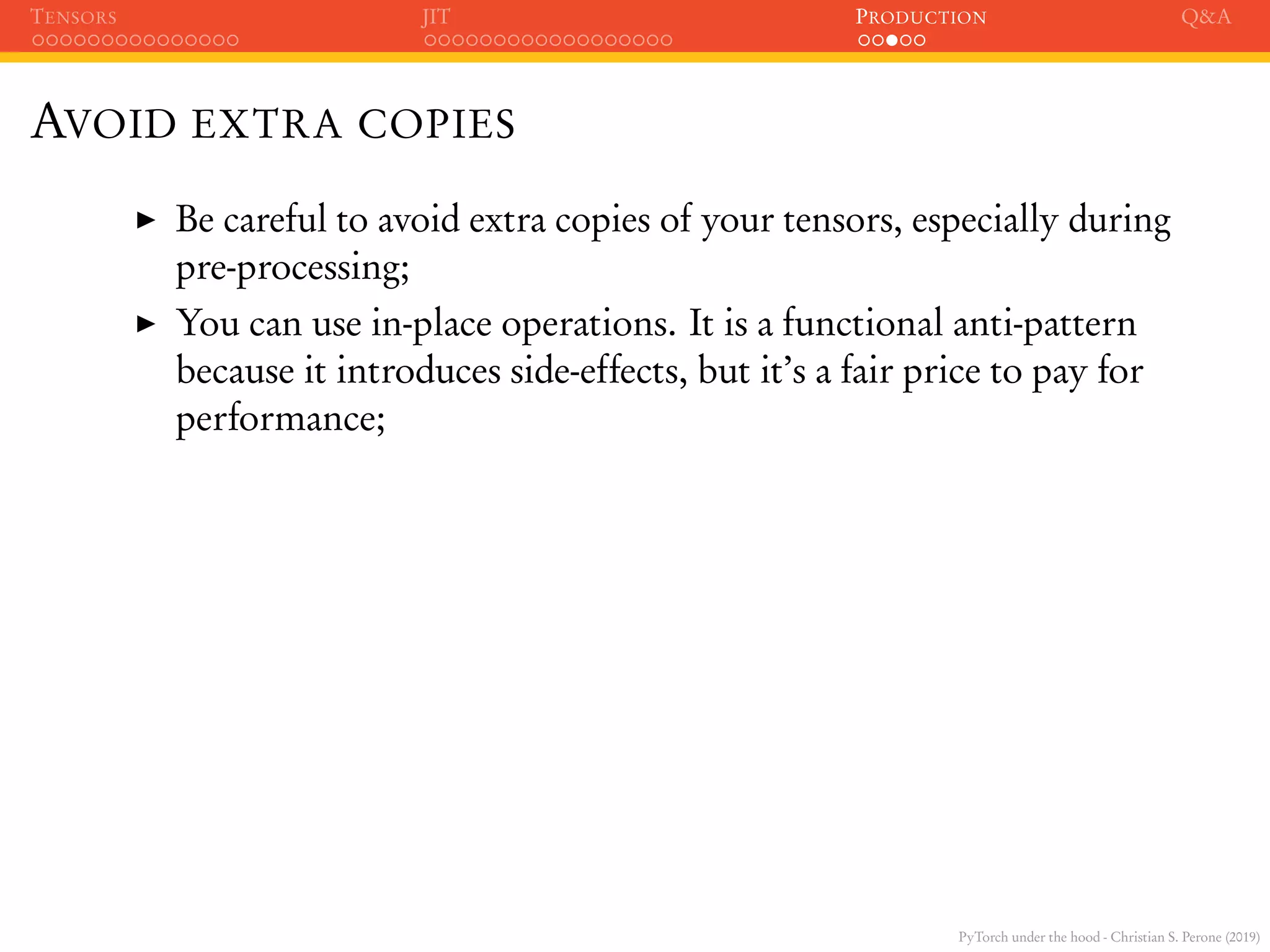
AVOID EXTRA COPIES
Be careful to avoid extra copies of your tensors, especially during
pre-processing;
You can use in-place operations. It is a functional anti-pattern
because it introduces side-effects, but it’s a fair price to pay for
performance;
PyTorch under the hood - Christian S. Perone (2019)
TENSORS JIT PRODUCTION Q&A
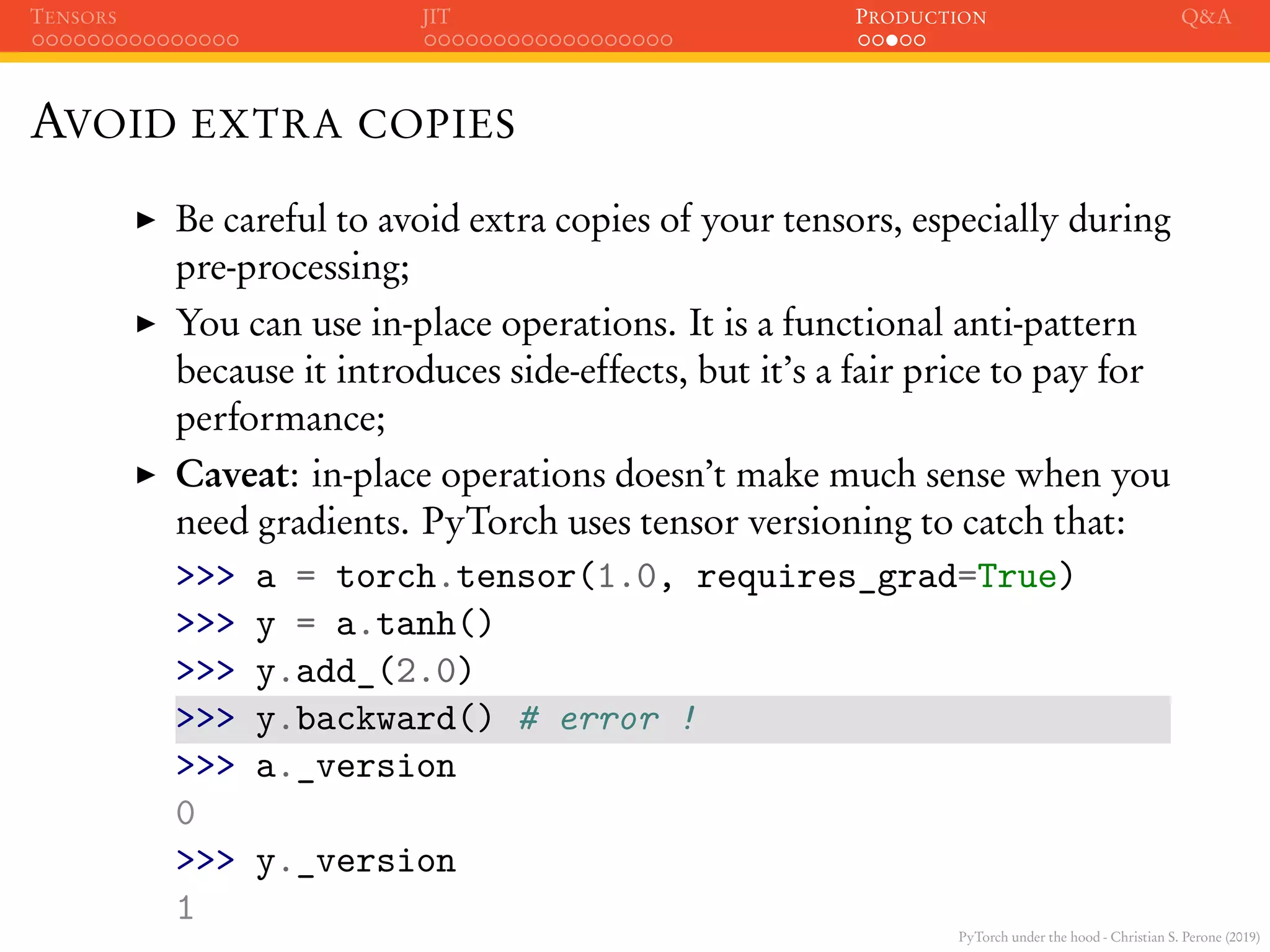
AVOID EXTRA COPIES
Be careful to avoid extra copies of your tensors, especially during
pre-processing;
You can use in-place operations. It is a functional anti-pattern
because it introduces side-effects, but it’s a fair price to pay for
performance;
Caveat: in-place operations doesn’t make much sense when you
need gradients. PyTorch uses tensor versioning to catch that:
>>> a = torch.tensor(1.0, requires_grad=True)
>>> y = a.tanh()
>>> y.add_(2.0)
>>> y.backward() # error !
>>> a._version
0
>>> y._version
1
PyTorch under the hood - Christian S. Perone (2019)
TENSORS JIT PRODUCTION Q&A
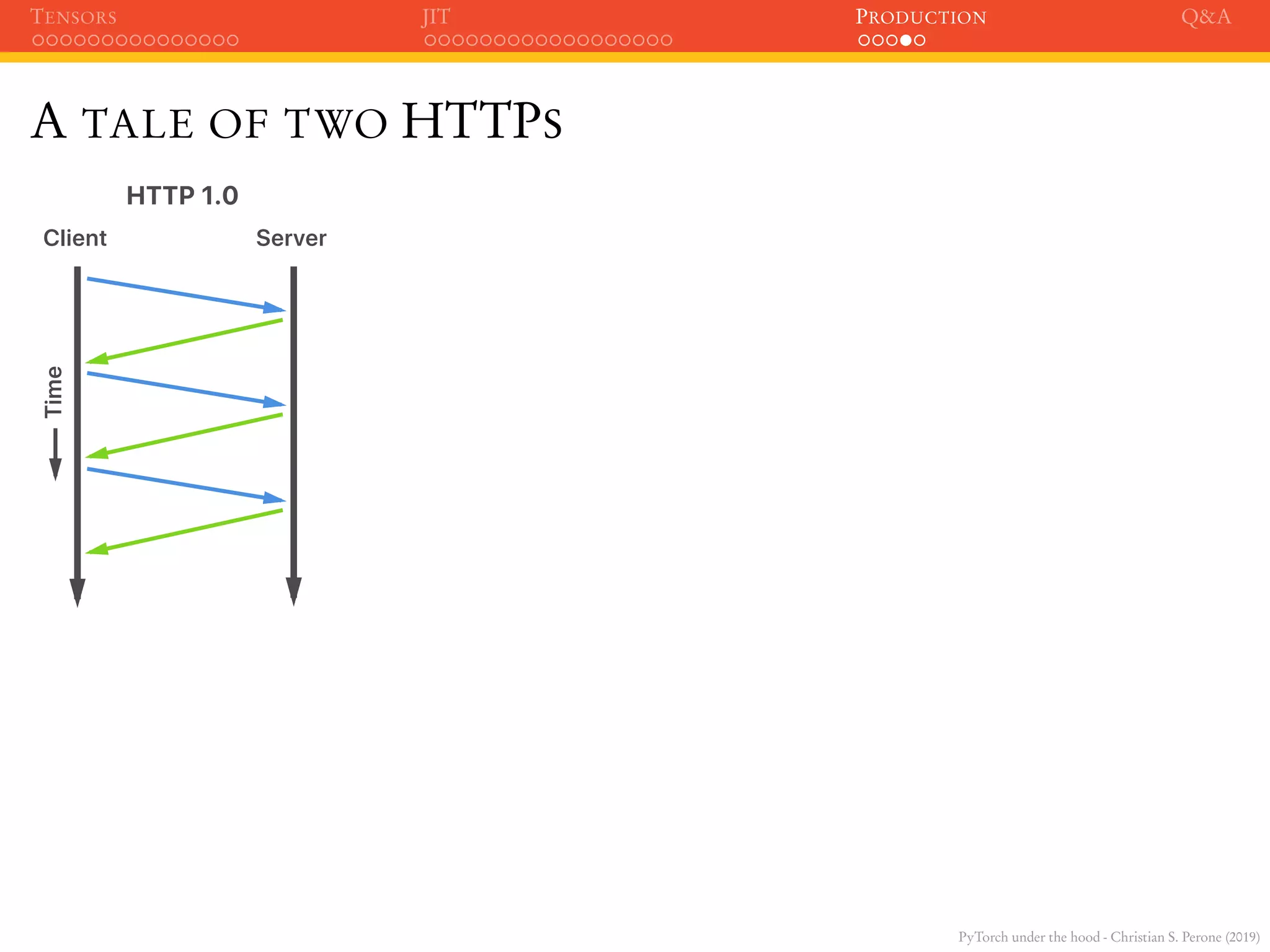
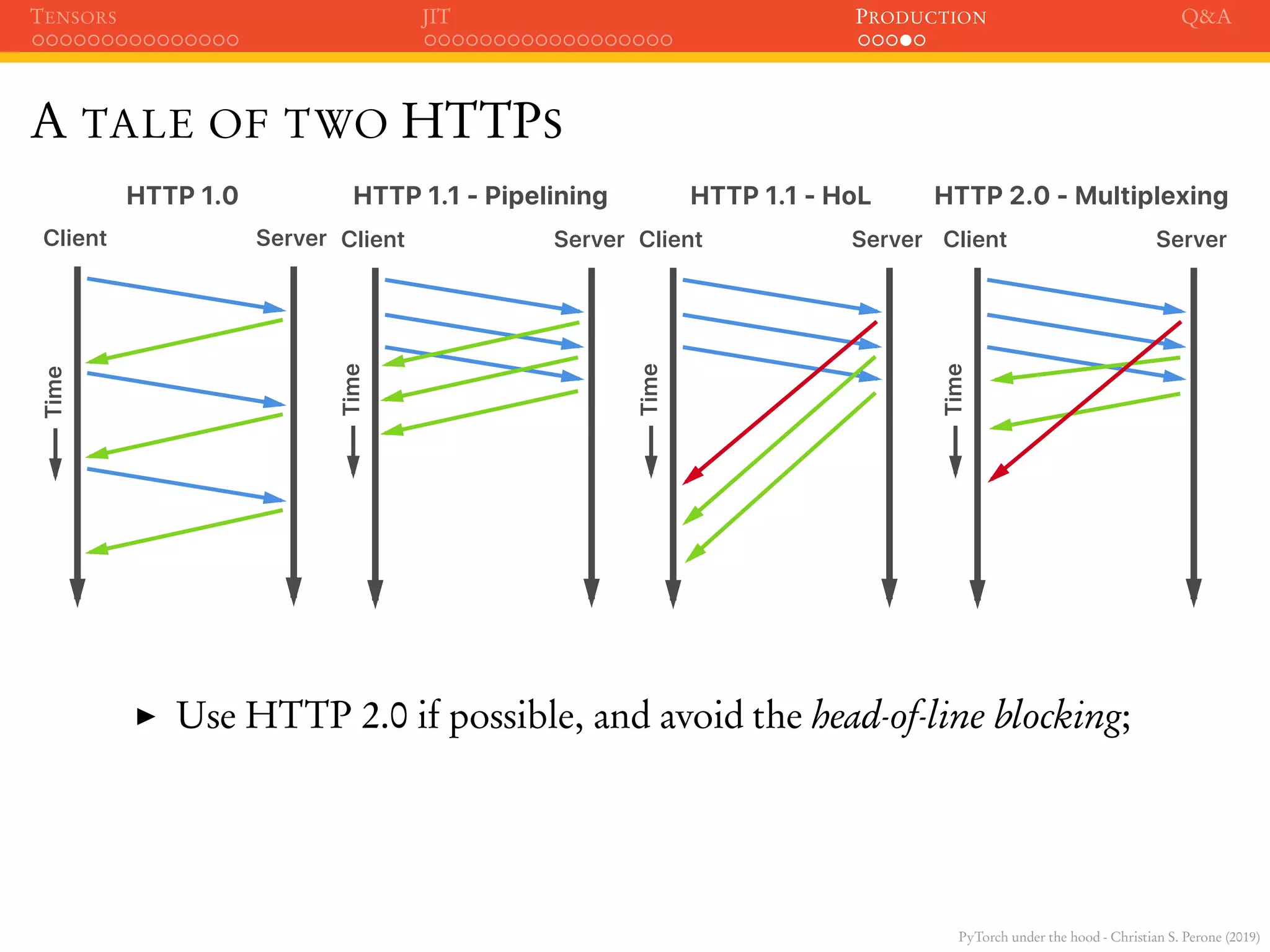
A TALE OF TWO HTTPS
Client Server
Time
HTTP 1.0
PyTorch under the hood - Christian S. Perone (2019)
TENSORS JIT PRODUCTION Q&A
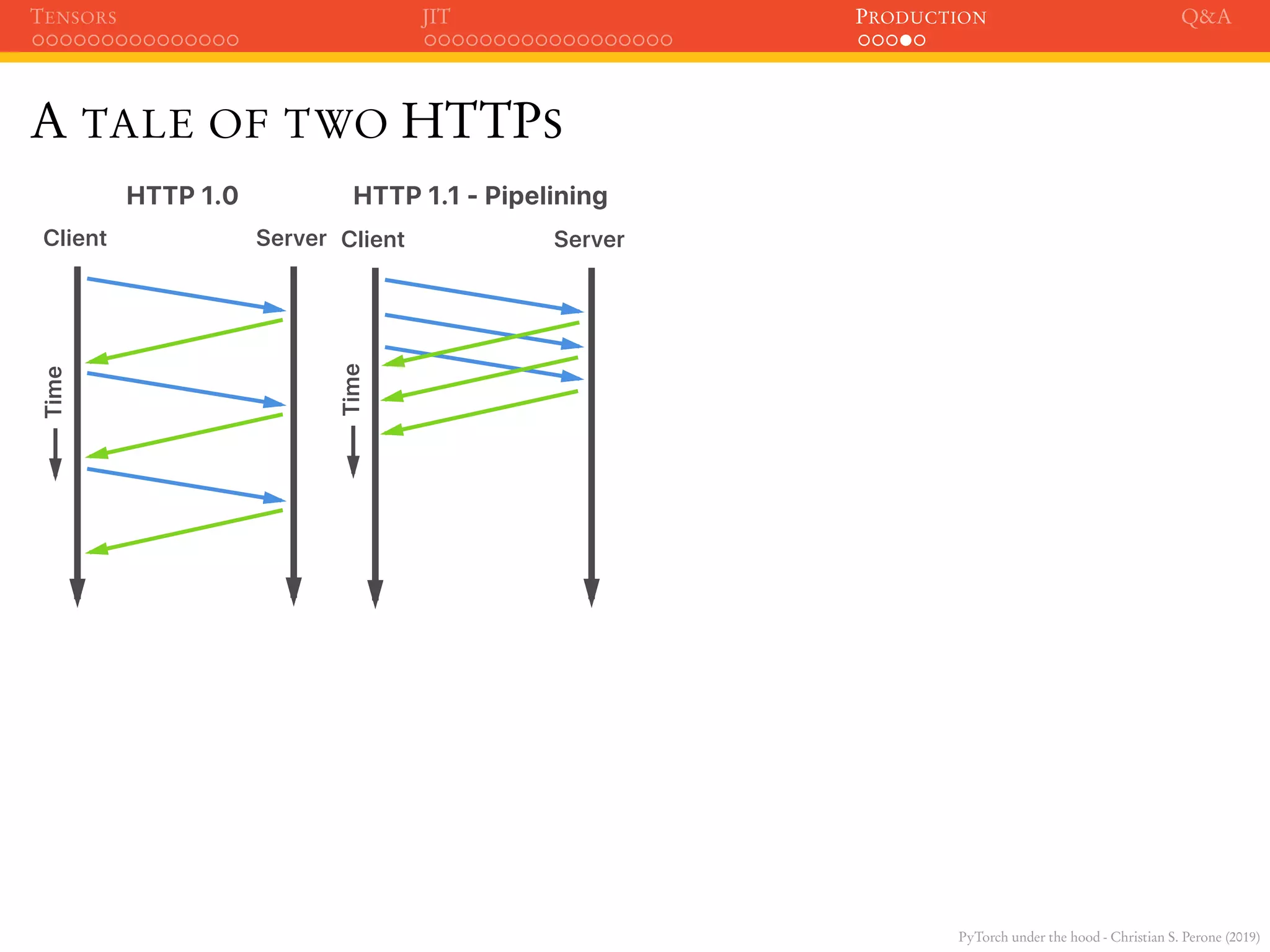
A TALE OF TWO HTTPS
Client Server
Time
HTTP 1.0
Client Server
Time
HTTP 1.1 - Pipelining
PyTorch under the hood - Christian S. Perone (2019)
TENSORS JIT PRODUCTION Q&A
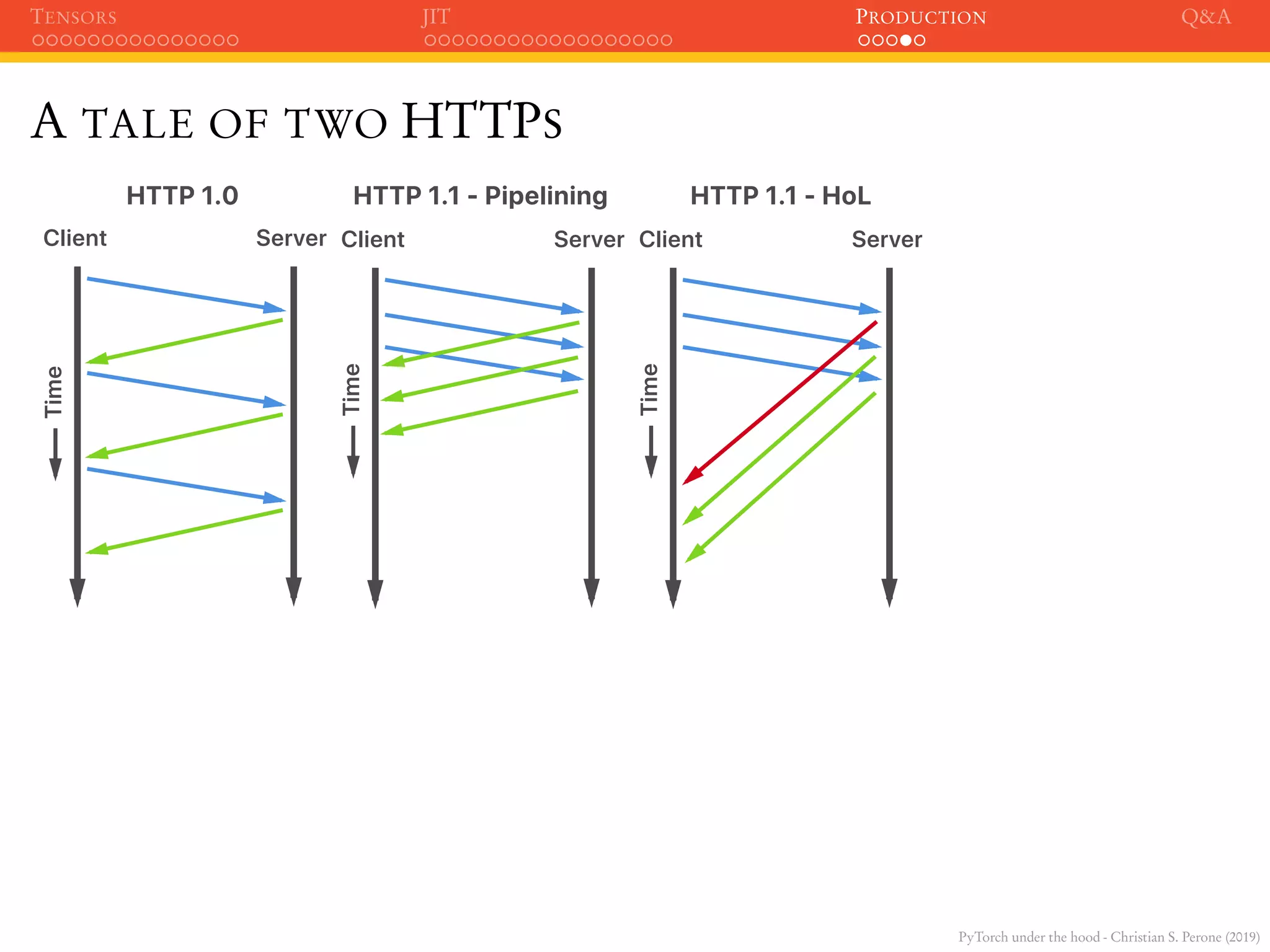
A TALE OF TWO HTTPS
Client Server
Time
HTTP 1.0
Client Server
Time
HTTP 1.1 - Pipelining
Client Server
Time
HTTP 1.1 - HoL
PyTorch under the hood - Christian S. Perone (2019)
TENSORS JIT PRODUCTION Q&A
A TALE OF TWO HTTPS
Client Server
Time
HTTP 1.0
Client Server
Time
HTTP 1.1 - Pipelining
Client Server
Time
HTTP 1.1 - HoL
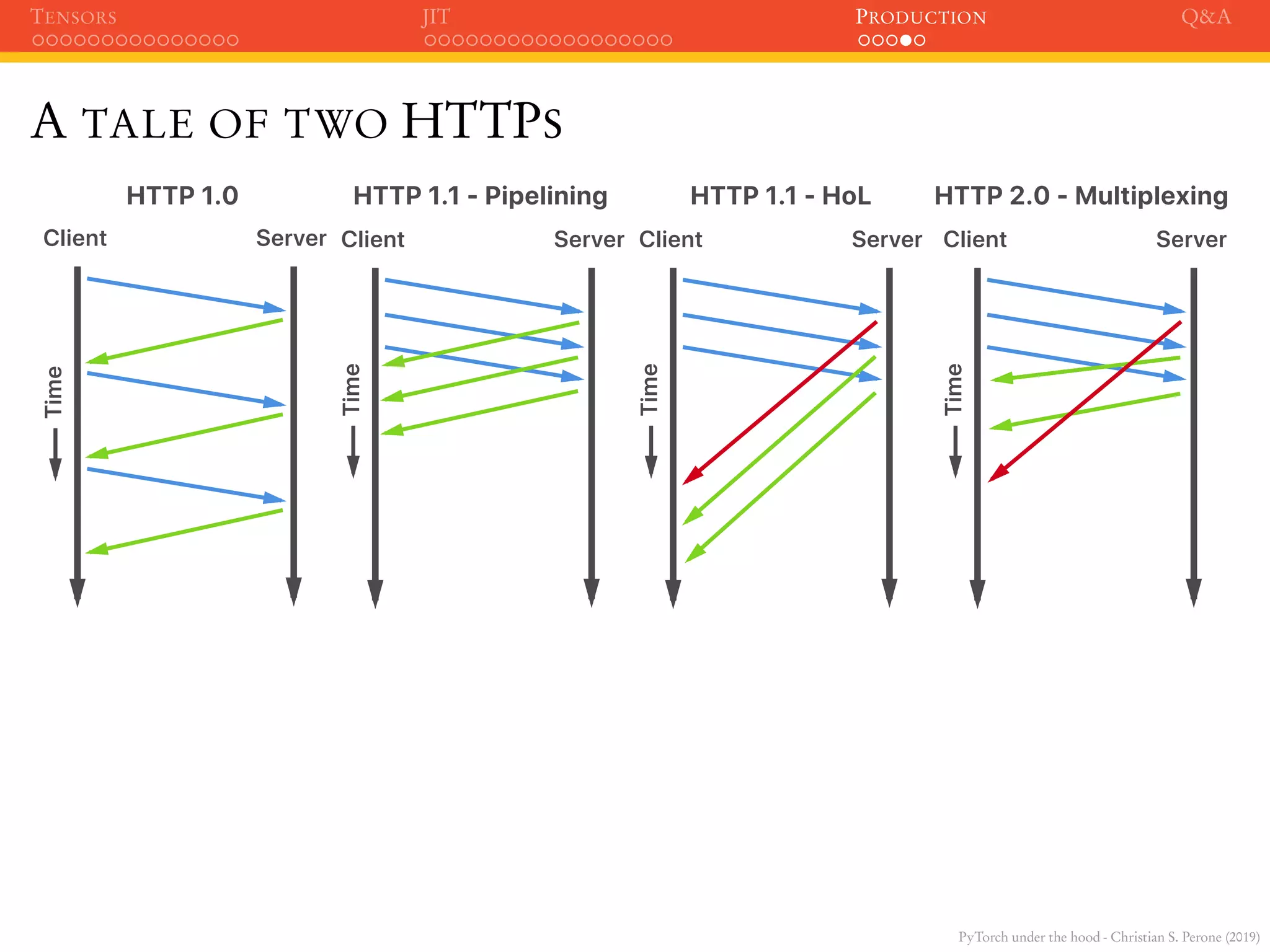
Client Server
Time
HTTP 2.0 - Multiplexing
PyTorch under the hood - Christian S. Perone (2019)
TENSORS JIT PRODUCTION Q&A
A TALE OF TWO HTTPS
Client Server
Time
HTTP 1.0
Client Server
Time
HTTP 1.1 - Pipelining
Client Server
Time
HTTP 1.1 - HoL
Client Server
Time
HTTP 2.0 - Multiplexing
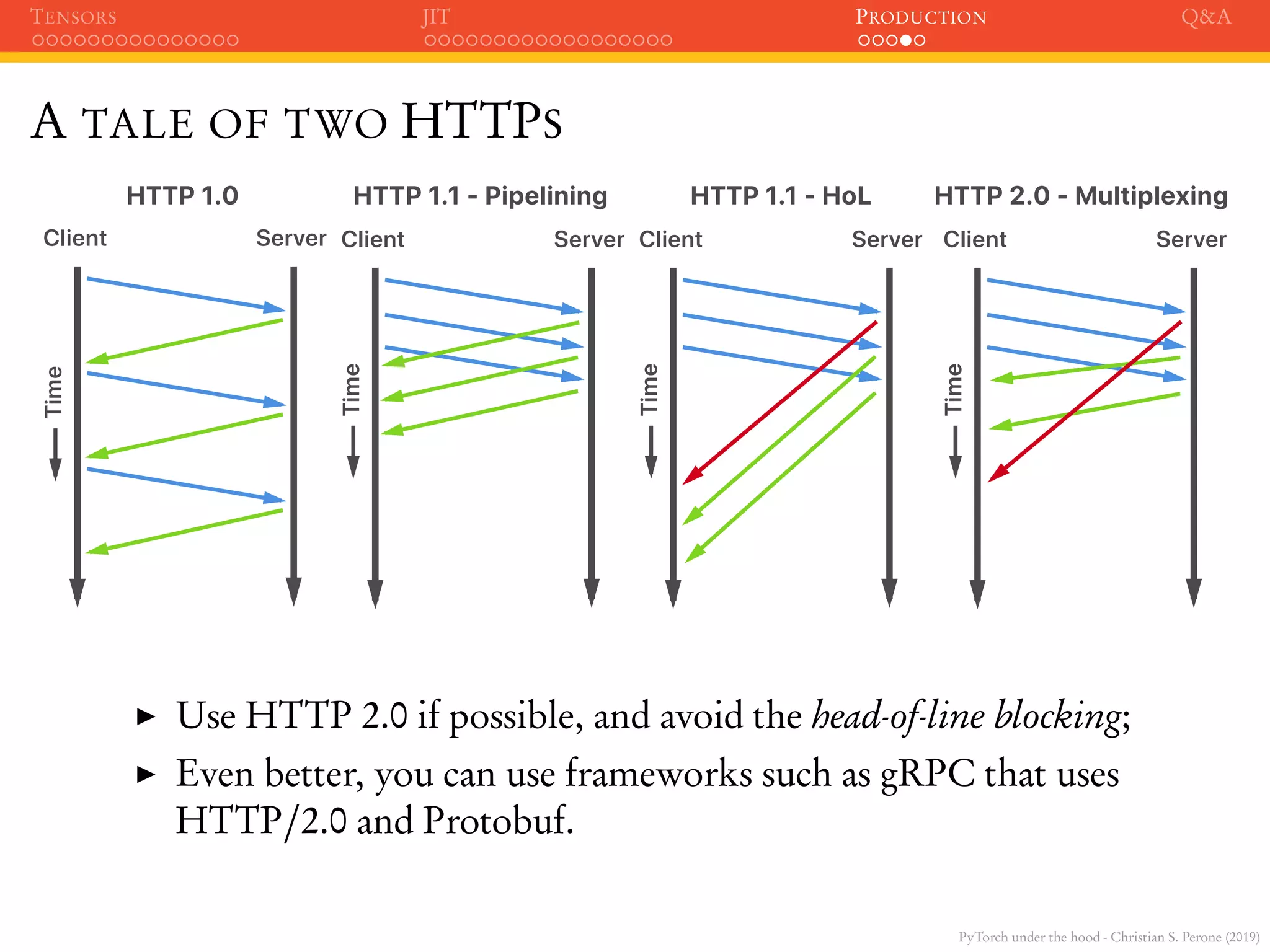
Use HTTP 2.0 if possible, and avoid the head-of-line blocking;
PyTorch under the hood - Christian S. Perone (2019)
TENSORS JIT PRODUCTION Q&A
A TALE OF TWO HTTPS
Client Server
Time
HTTP 1.0
Client Server
Time
HTTP 1.1 - Pipelining
Client Server
Time
HTTP 1.1 - HoL
Client Server
Time
HTTP 2.0 - Multiplexing
Use HTTP 2.0 if possible, and avoid the head-of-line blocking;
Even better, you can use frameworks such as gRPC that uses
HTTP/2.0 and Protobuf.
PyTorch under the hood - Christian S. Perone (2019)
TENSORS JIT PRODUCTION Q&A
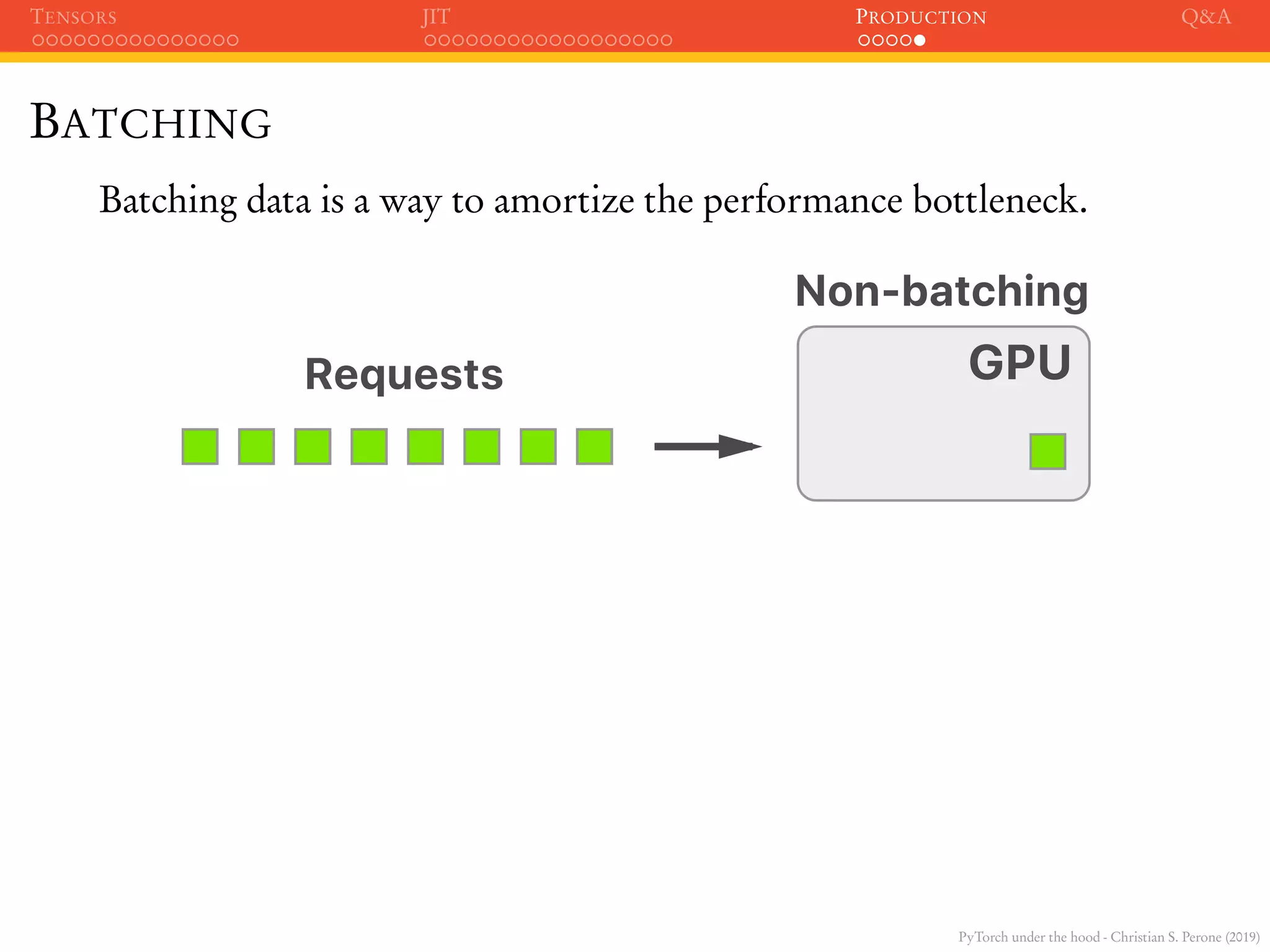
BATCHING
Batching data is a way to amortize the performance bottleneck.
GPU
Non-batching
Requests
PyTorch under the hood - Christian S. Perone (2019)
TENSORS JIT PRODUCTION Q&A
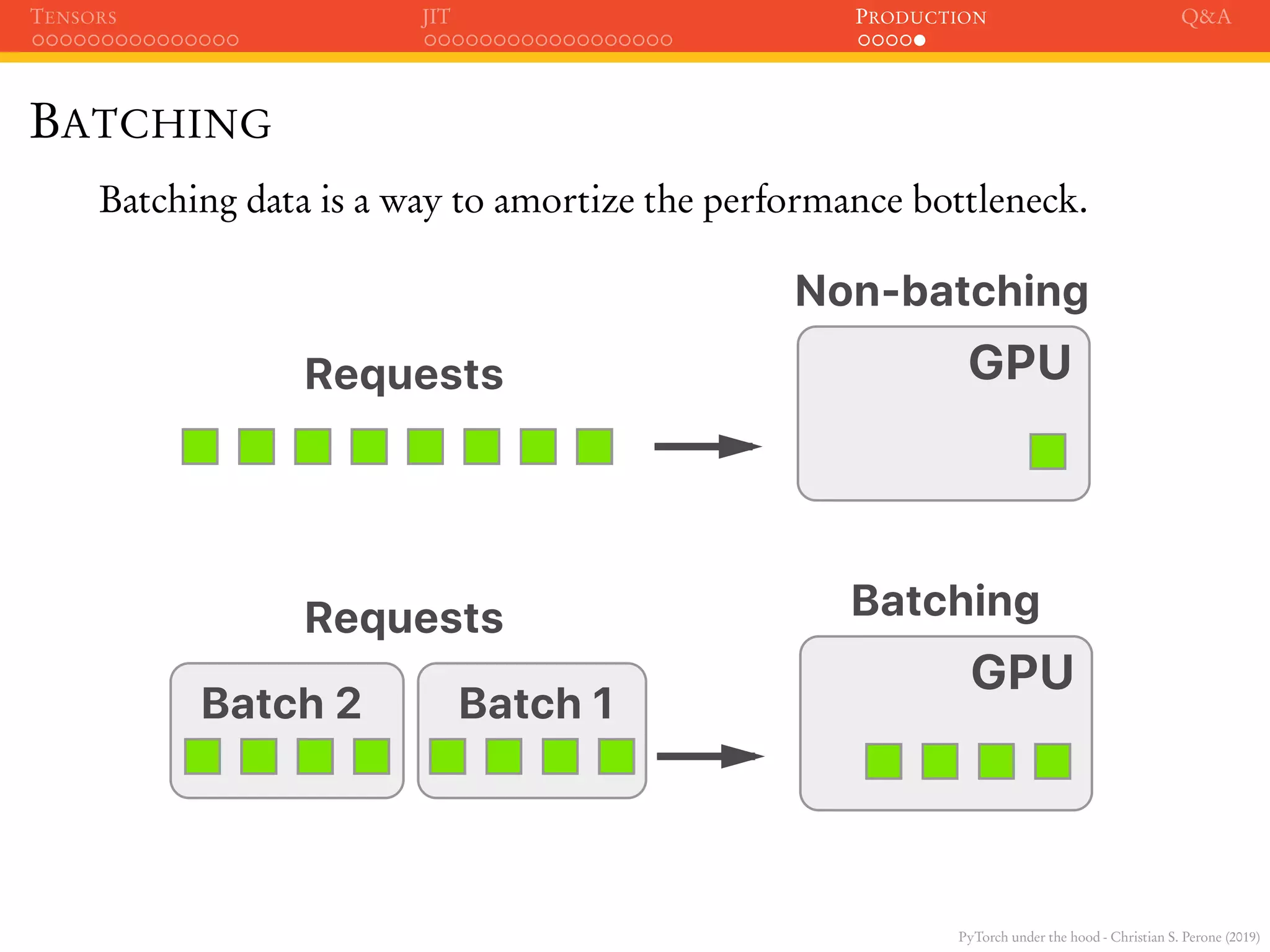
BATCHING
Batching data is a way to amortize the performance bottleneck.
GPU
Non-batching
Requests
GPU
Batch 2 Batch 1
BatchingRequests
PyTorch under the hood - Christian S. Perone (2019)
TENSORS JIT PRODUCTION Q&A
Section IV
Q&A
PyTorch under the hood - Christian S. Perone (2019)
TENSORS JIT PRODUCTION Q&A
Q&A
Thanks !

PyTorch under the hood

  • 1.
    PyTorch under thehood - Christian S. Perone (2019) TENSORS JIT PRODUCTION Q&A PyTorch under the hood A guide to understand PyTorch internals Christian S. Perone (christian.perone@gmail.com) http://blog.christianperone.com PyData Montreal, Feb 2019
  • 2.
    PyTorch under thehood - Christian S. Perone (2019) TENSORS JIT PRODUCTION Q&A Agenda TENSORS Tensors Python objects Zero-copy Tensor storage Memory allocators (CPU/GPU) The big picture JIT Just-in-time compiler Tracing Scripting Why TorchScript ? Building IR and JIT Phases Optimizations Serialization Using models in other languages PRODUCTION Some tips Q&A
  • 3.
    PyTorch under thehood - Christian S. Perone (2019) TENSORS JIT PRODUCTION Q&A WHO AM I Christian S. Perone 14 years working with Machine Learning, Data Science and Software Engineering in industry R&D Blog at blog.christianperone.com Open-source projects at https://github.com/perone Twitter @tarantulae
  • 4.
    PyTorch under thehood - Christian S. Perone (2019) TENSORS JIT PRODUCTION Q&A DISCLAIMER PyTorch is a moving target, Deep Learning ecosystem moves fast and big changes happens every week;
  • 5.
    PyTorch under thehood - Christian S. Perone (2019) TENSORS JIT PRODUCTION Q&A DISCLAIMER PyTorch is a moving target, Deep Learning ecosystem moves fast and big changes happens every week; This is not a talk to teach you the basics of PyTorch or how to train your network, but to teach you how PyTorch components works under the hood in a intuitive way;
  • 6.
    PyTorch under thehood - Christian S. Perone (2019) TENSORS JIT PRODUCTION Q&A DISCLAIMER PyTorch is a moving target, Deep Learning ecosystem moves fast and big changes happens every week; This is not a talk to teach you the basics of PyTorch or how to train your network, but to teach you how PyTorch components works under the hood in a intuitive way; This talk is updated to the PyTorch v.1.0.1 version;
  • 7.
    PyTorch under thehood - Christian S. Perone (2019) TENSORS JIT PRODUCTION Q&A Section I TENSORS
  • 8.
    PyTorch under thehood - Christian S. Perone (2019) TENSORS JIT PRODUCTION Q&A TENSORS Simply put, TENSORS are a generalization of vectors and matrices. In PyTorch, they are a multi-dimensional matrix containing elements of a single data type.
  • 9.
    PyTorch under thehood - Christian S. Perone (2019) TENSORS JIT PRODUCTION Q&A TENSORS Simply put, TENSORS are a generalization of vectors and matrices. In PyTorch, they are a multi-dimensional matrix containing elements of a single data type. >>> import torch >>> t = torch.tensor([[1., -1.], [1., -1.]]) >>> t tensor([[ 1., -1.] [ 1., -1.]])
  • 10.
    PyTorch under thehood - Christian S. Perone (2019) TENSORS JIT PRODUCTION Q&A TENSORS Simply put, TENSORS are a generalization of vectors and matrices. In PyTorch, they are a multi-dimensional matrix containing elements of a single data type. >>> import torch >>> t = torch.tensor([[1., -1.], [1., -1.]]) >>> t tensor([[ 1., -1.] [ 1., -1.]]) >>> t.dtype # They have a type torch.float32
  • 11.
    PyTorch under thehood - Christian S. Perone (2019) TENSORS JIT PRODUCTION Q&A TENSORS Simply put, TENSORS are a generalization of vectors and matrices. In PyTorch, they are a multi-dimensional matrix containing elements of a single data type. >>> import torch >>> t = torch.tensor([[1., -1.], [1., -1.]]) >>> t tensor([[ 1., -1.] [ 1., -1.]]) >>> t.dtype # They have a type torch.float32 >>> t.shape # a shape torch.Size([2, 2])
  • 12.
    PyTorch under thehood - Christian S. Perone (2019) TENSORS JIT PRODUCTION Q&A TENSORS Simply put, TENSORS are a generalization of vectors and matrices. In PyTorch, they are a multi-dimensional matrix containing elements of a single data type. >>> import torch >>> t = torch.tensor([[1., -1.], [1., -1.]]) >>> t tensor([[ 1., -1.] [ 1., -1.]]) >>> t.dtype # They have a type torch.float32 >>> t.shape # a shape torch.Size([2, 2]) >>> t.device # and live in some device device(type='cpu')
  • 13.
    PyTorch under thehood - Christian S. Perone (2019) TENSORS JIT PRODUCTION Q&A TENSORS Although PyTorch has an elegant python first design, all PyTorch heavy work is actually implemented in C++. In Python, the integration of C++ code is (usually) done using what is called an extension;
  • 14.
    PyTorch under thehood - Christian S. Perone (2019) TENSORS JIT PRODUCTION Q&A TENSORS Although PyTorch has an elegant python first design, all PyTorch heavy work is actually implemented in C++. In Python, the integration of C++ code is (usually) done using what is called an extension; PyTorch uses ATen, which is the foundational tensor operation library on which all else is built;
  • 15.
    PyTorch under thehood - Christian S. Perone (2019) TENSORS JIT PRODUCTION Q&A TENSORS Although PyTorch has an elegant python first design, all PyTorch heavy work is actually implemented in C++. In Python, the integration of C++ code is (usually) done using what is called an extension; PyTorch uses ATen, which is the foundational tensor operation library on which all else is built; To do automatic differentiation, PyTorch uses Autograd, which is an augmentation on top of the ATen framework;
  • 16.
    PyTorch under thehood - Christian S. Perone (2019) TENSORS JIT PRODUCTION Q&A TENSORS Although PyTorch has an elegant python first design, all PyTorch heavy work is actually implemented in C++. In Python, the integration of C++ code is (usually) done using what is called an extension; PyTorch uses ATen, which is the foundational tensor operation library on which all else is built; To do automatic differentiation, PyTorch uses Autograd, which is an augmentation on top of the ATen framework; In the Python API, PyTorch previously had separate Variable and a Tensor types, after v.0.4.0 they were merged into Tensor .
  • 17.
    PyTorch under thehood - Christian S. Perone (2019) TENSORS JIT PRODUCTION Q&A QUICK RECAP PYTHON OBJECTS typedef struct { PyObject_HEAD double ob_fval; } PyFloatObject;
  • 18.
    PyTorch under thehood - Christian S. Perone (2019) TENSORS JIT PRODUCTION Q&A QUICK RECAP PYTHON OBJECTS typedef struct { PyObject_HEAD double ob_fval; } PyFloatObject; typedef struct _object { Py_ssize_t ob_refcnt; struct _typeobject *ob_type; } PyObject;
  • 19.
    PyTorch under thehood - Christian S. Perone (2019) TENSORS JIT PRODUCTION Q&A QUICK RECAP PYTHON OBJECTS typedef struct { PyObject_HEAD double ob_fval; } PyFloatObject; typedef struct _object { Py_ssize_t ob_refcnt; struct _typeobject *ob_type; } PyObject; struct _typeobject *ob_type Py_ssize_t ob_refcnt objectPyObject double ob_fval PyObject_HEAD objectPyFloatObject
  • 20.
    PyTorch under thehood - Christian S. Perone (2019) TENSORS JIT PRODUCTION Q&A QUICK RECAP PYTHON OBJECTS struct THPVariable { PyObject_HEAD torch::autograd::Variable cdata; PyObject* backward_hooks; }; The TH prefix is from TorcH, and P means Python.
  • 21.
    PyTorch under thehood - Christian S. Perone (2019) TENSORS JIT PRODUCTION Q&A QUICK RECAP PYTHON OBJECTS struct THPVariable { PyObject_HEAD torch::autograd::Variable cdata; PyObject* backward_hooks; }; (object fields) PyObject_HEAD (w/ ref counter) objectTHPVariable variable_a variable_b Ref Count = 1 Ref Count = 2 The TH prefix is from TorcH, and P means Python.
  • 22.
    PyTorch under thehood - Christian S. Perone (2019) TENSORS JIT PRODUCTION Q&A IN PYTHON, EVERYTHING IS AN OBJECT >>> a = 300 >>> b = 300 >>> a is b False
  • 23.
    PyTorch under thehood - Christian S. Perone (2019) TENSORS JIT PRODUCTION Q&A IN PYTHON, EVERYTHING IS AN OBJECT >>> a = 300 >>> b = 300 >>> a is b False >>> a = 200 >>> b = 200 >>> a is b True
  • 24.
    PyTorch under thehood - Christian S. Perone (2019) TENSORS JIT PRODUCTION Q&A IN PYTHON, EVERYTHING IS AN OBJECT >>> a = 300 >>> b = 300 >>> a is b False >>> a = 200 >>> b = 200 >>> a is b True (object fields) PyObject_HEAD objectPyIntObject a b Ref Count = 1 Ref Count = 2 (object fields) PyObject_HEAD objectPyIntObject (object fields) PyObject_HEAD objectPyIntObject a b Ref Count = 1 Ref Count = 1 A typical Python program spend much of its time allocating/deallocating integers. CPython then caches the small integers.
  • 25.
    PyTorch under thehood - Christian S. Perone (2019) TENSORS JIT PRODUCTION Q&A ZERO-COPYING TENSORS It is very common to load tensors in numpy and convert them to PyTorch, or vice-versa; >>> np_array = np.ones((2,2)) >>> np_array array([[1., 1.], [1., 1.]]) Underline after an operation means an in-place operation.
  • 26.
    PyTorch under thehood - Christian S. Perone (2019) TENSORS JIT PRODUCTION Q&A ZERO-COPYING TENSORS It is very common to load tensors in numpy and convert them to PyTorch, or vice-versa; >>> np_array = np.ones((2,2)) >>> np_array array([[1., 1.], [1., 1.]]) >>> torch_array = torch.tensor(np_array) >>> torch_array tensor([[1., 1.], [1., 1.]], dtype=torch.float64) Underline after an operation means an in-place operation.
  • 27.
    PyTorch under thehood - Christian S. Perone (2019) TENSORS JIT PRODUCTION Q&A ZERO-COPYING TENSORS It is very common to load tensors in numpy and convert them to PyTorch, or vice-versa; >>> np_array = np.ones((2,2)) >>> np_array array([[1., 1.], [1., 1.]]) >>> torch_array = torch.tensor(np_array) >>> torch_array tensor([[1., 1.], [1., 1.]], dtype=torch.float64) >>> torch_array.add_(1.0) Underline after an operation means an in-place operation.
  • 28.
    PyTorch under thehood - Christian S. Perone (2019) TENSORS JIT PRODUCTION Q&A ZERO-COPYING TENSORS It is very common to load tensors in numpy and convert them to PyTorch, or vice-versa; >>> np_array = np.ones((2,2)) >>> np_array array([[1., 1.], [1., 1.]]) >>> torch_array = torch.tensor(np_array) >>> torch_array tensor([[1., 1.], [1., 1.]], dtype=torch.float64) >>> torch_array.add_(1.0) >>> np_array array([[1., 1.], # array is intact, a copy was made [1., 1.]]) Underline after an operation means an in-place operation.
  • 29.
    PyTorch under thehood - Christian S. Perone (2019) TENSORS JIT PRODUCTION Q&A ZERO-COPYING TENSORS Now imagine that you have a batch of 128 images, 3 channels each (RGB) and with size of 224x224; 0 1 1 1 0 0 1 1 1 0 0 1 1 1 1 1 1 0 1 0 1 1 1 1 0 1 0 0 0 1 1 1 0 1 0 0 1 0 0 1 1 0 0 1 1 0 0 0 Column Row Channel This will yield a size in memory of ∼ 74MB. We don’t want to duplicate memory (except when copying them to discrete GPUs of course);
  • 30.
    PyTorch under thehood - Christian S. Perone (2019) TENSORS JIT PRODUCTION Q&A ZERO-COPYING TENSORS Let’s see now a slightly different code using the function torch.from_numpy() this time: >>> np_array array([[1., 1.], [1., 1.]]) >>> torch_array = torch.from_numpy(np_array)
  • 31.
    PyTorch under thehood - Christian S. Perone (2019) TENSORS JIT PRODUCTION Q&A ZERO-COPYING TENSORS Let’s see now a slightly different code using the function torch.from_numpy() this time: >>> np_array array([[1., 1.], [1., 1.]]) >>> torch_array = torch.from_numpy(np_array) >>> torch_array.add_(1.0)
  • 32.
    PyTorch under thehood - Christian S. Perone (2019) TENSORS JIT PRODUCTION Q&A ZERO-COPYING TENSORS Let’s see now a slightly different code using the function torch.from_numpy() this time: >>> np_array array([[1., 1.], [1., 1.]]) >>> torch_array = torch.from_numpy(np_array) >>> torch_array.add_(1.0) >>> np_array array([[2., 2.], [2., 2.]])
  • 33.
    PyTorch under thehood - Christian S. Perone (2019) TENSORS JIT PRODUCTION Q&A ZERO-COPYING TENSORS Let’s see now a slightly different code using the function torch.from_numpy() this time: >>> np_array array([[1., 1.], [1., 1.]]) >>> torch_array = torch.from_numpy(np_array) >>> torch_array.add_(1.0) >>> np_array array([[2., 2.], [2., 2.]]) The original numpy array was changed, because it used a zero-copy operation.
  • 34.
    PyTorch under thehood - Christian S. Perone (2019) TENSORS JIT PRODUCTION Q&A ZERO-COPYING TENSORS Difference between in-place and standard operations might not be so clear in some cases: >>> np_array array([[1., 1.], [1., 1.]]) >>> torch_array = torch.from_numpy(np_array)
  • 35.
    PyTorch under thehood - Christian S. Perone (2019) TENSORS JIT PRODUCTION Q&A ZERO-COPYING TENSORS Difference between in-place and standard operations might not be so clear in some cases: >>> np_array array([[1., 1.], [1., 1.]]) >>> torch_array = torch.from_numpy(np_array) >>> np_array = np_array + 1.0
  • 36.
    PyTorch under thehood - Christian S. Perone (2019) TENSORS JIT PRODUCTION Q&A ZERO-COPYING TENSORS Difference between in-place and standard operations might not be so clear in some cases: >>> np_array array([[1., 1.], [1., 1.]]) >>> torch_array = torch.from_numpy(np_array) >>> np_array = np_array + 1.0 >>> torch_array tensor([[1., 1.], [1., 1.]], dtype=torch.float64)
  • 37.
    PyTorch under thehood - Christian S. Perone (2019) TENSORS JIT PRODUCTION Q&A ZERO-COPYING TENSORS Difference between in-place and standard operations might not be so clear in some cases: >>> np_array array([[1., 1.], [1., 1.]]) >>> torch_array = torch.from_numpy(np_array) >>> np_array = np_array + 1.0 >>> torch_array tensor([[1., 1.], [1., 1.]], dtype=torch.float64) However, if you use np_array += 1.0 , that is an in-place operation that will change torch_array memory.
  • 38.
    PyTorch under thehood - Christian S. Perone (2019) TENSORS JIT PRODUCTION Q&A ZERO-COPYING TENSORS at::Tensor tensor_from_numpy(PyObject* obj) { // (...) - omitted for brevity auto array = (PyArrayObject*)obj; int ndim = PyArray_NDIM(array); auto sizes = to_aten_shape(ndim, PyArray_DIMS(array)); auto strides = to_aten_shape(ndim, PyArray_STRIDES(array)); // (...) - omitted for brevity void* data_ptr = PyArray_DATA(array); auto& type = CPU(dtype_to_aten(PyArray_TYPE(array))); Py_INCREF(obj); return type.tensorFromBlob(data_ptr, sizes, strides, [obj](void* data) { AutoGIL gil; Py_DECREF(obj); }); } Pay attention to the reference counting using Py_INCREF() and the call to tensorFromBlob() function.
  • 39.
    PyTorch under thehood - Christian S. Perone (2019) TENSORS JIT PRODUCTION Q&A DATA POINTERS (object fields) data_pointer* objectPyArrayObject (object fields) data_pointer* objectFloatTensor The tensor FloatTensor did a copy of the numpy array data pointer and not of the contents. The reference is kept safe by the Python reference counting mechanism.
  • 40.
    PyTorch under thehood - Christian S. Perone (2019) TENSORS JIT PRODUCTION Q&A TENSOR STORAGE The abstraction responsible for holding the data isn’t actually the Tensor , but the Storage .
  • 41.
    PyTorch under thehood - Christian S. Perone (2019) TENSORS JIT PRODUCTION Q&A TENSOR STORAGE The abstraction responsible for holding the data isn’t actually the Tensor , but the Storage . struct C10_API StorageImpl final : (...) { // (...) private: // (...) caffe2::TypeMeta data_type_; DataPtr data_ptr_; int64_t numel_; Allocator* allocator_; }
  • 42.
    PyTorch under thehood - Christian S. Perone (2019) TENSORS JIT PRODUCTION Q&A TENSOR STORAGE The abstraction responsible for holding the data isn’t actually the Tensor , but the Storage . struct C10_API StorageImpl final : (...) { // (...) private: // (...) caffe2::TypeMeta data_type_; DataPtr data_ptr_; int64_t numel_; Allocator* allocator_; } Holds a pointer to the raw data and contains information such as the size and allocator; Storage is a dumb abstraction, there is no metadata telling us how to interpret the data it holds;
  • 43.
    PyTorch under thehood - Christian S. Perone (2019) TENSORS JIT PRODUCTION Q&A TENSOR STORAGE The Storage abstraction is very powerful because it decouples the raw data and how we can interpret it;
  • 44.
    PyTorch under thehood - Christian S. Perone (2019) TENSORS JIT PRODUCTION Q&A TENSOR STORAGE The Storage abstraction is very powerful because it decouples the raw data and how we can interpret it; We can have multiple tensors sharing the same storage, but with different interpretations, also called views, but without duplicating memory:
  • 45.
    PyTorch under thehood - Christian S. Perone (2019) TENSORS JIT PRODUCTION Q&A TENSOR STORAGE The Storage abstraction is very powerful because it decouples the raw data and how we can interpret it; We can have multiple tensors sharing the same storage, but with different interpretations, also called views, but without duplicating memory: >>> tensor_a = torch.ones((2, 2)) >>> tensor_b = tensor_a.view(4) >>> tensor_a_data = tensor_a.storage().data_ptr() >>> tensor_b_data = tensor_b.storage().data_ptr() >>> tensor_a_data == tensor_b_data True
  • 46.
    PyTorch under thehood - Christian S. Perone (2019) TENSORS JIT PRODUCTION Q&A TENSOR STORAGE The Storage abstraction is very powerful because it decouples the raw data and how we can interpret it; We can have multiple tensors sharing the same storage, but with different interpretations, also called views, but without duplicating memory: >>> tensor_a = torch.ones((2, 2)) >>> tensor_b = tensor_a.view(4) >>> tensor_a_data = tensor_a.storage().data_ptr() >>> tensor_b_data = tensor_b.storage().data_ptr() >>> tensor_a_data == tensor_b_data True tensor_b is a different view (interpretation) of the same data present in the underlying storage that is shared between both tensors.
  • 47.
    PyTorch under thehood - Christian S. Perone (2019) TENSORS JIT PRODUCTION Q&A MEMORY ALLOCATORS (CPU/GPU) The tensor storage can be allocated either in the CPU memory or GPU, therefore a mechanism is required to switch between these different allocations:
  • 48.
    PyTorch under thehood - Christian S. Perone (2019) TENSORS JIT PRODUCTION Q&A MEMORY ALLOCATORS (CPU/GPU) The tensor storage can be allocated either in the CPU memory or GPU, therefore a mechanism is required to switch between these different allocations: struct Allocator { virtual ~Allocator() {} virtual DataPtr allocate(size_t n) const = 0; virtual DeleterFnPtr raw_deleter() const {...} void* raw_allocate(size_t n) {...} void raw_deallocate(void* ptr) {...} }; There are Allocator s that will use the GPU allocators such as cudaMallocHost() when the storage should be used for the GPU or posix_memalign() POSIX functions for data in the CPU memory.
  • 49.
    PyTorch under thehood - Christian S. Perone (2019) TENSORS JIT PRODUCTION Q&A THE BIG PICTURE (object fields) Storage *storage objectTensor Allocator *allocator (object fields) DataPtr data_ptr objectStorage raw_deallocate() (object fields) raw_allocate() objectAllocator Raw Data The Tensor has a Storage which in turn has a pointer to the raw data and to the Allocator to allocate memory according to the destination device.
  • 50.
    PyTorch under thehood - Christian S. Perone (2019) TENSORS JIT PRODUCTION Q&A Section II JIT
  • 51.
    PyTorch under thehood - Christian S. Perone (2019) TENSORS JIT PRODUCTION Q&A JIT - JUST-IN-TIME COMPILER PyTorch is eager by design, which means that it is easily hackable to debug, inspect, etc;
  • 52.
    PyTorch under thehood - Christian S. Perone (2019) TENSORS JIT PRODUCTION Q&A JIT - JUST-IN-TIME COMPILER PyTorch is eager by design, which means that it is easily hackable to debug, inspect, etc; However, this poses problems for optimization and for decoupling it from Python (the model itself is Python code);
  • 53.
    PyTorch under thehood - Christian S. Perone (2019) TENSORS JIT PRODUCTION Q&A JIT - JUST-IN-TIME COMPILER PyTorch is eager by design, which means that it is easily hackable to debug, inspect, etc; However, this poses problems for optimization and for decoupling it from Python (the model itself is Python code); PyTorch 1.0 introduced torch.jit , which has two main methods to convert a PyTorch model to a serializable and optimizable format; TorchScript was also introduced as a statically-typed subset of Python;
  • 54.
    PyTorch under thehood - Christian S. Perone (2019) TENSORS JIT PRODUCTION Q&A JIT - JUST-IN-TIME COMPILER Two very different worlds with their own requirements. Prototype, debug, train, experiment EAGER MODE Optimization, other languages, deployment SCRIPT MODE tracing scripting
  • 55.
    PyTorch under thehood - Christian S. Perone (2019) TENSORS JIT PRODUCTION Q&A TRACING def my_function(x): if x.mean() > 1.0: r = torch.tensor(1.0) else: r = torch.tensor(2.0) return r
  • 56.
    PyTorch under thehood - Christian S. Perone (2019) TENSORS JIT PRODUCTION Q&A TRACING def my_function(x): if x.mean() > 1.0: r = torch.tensor(1.0) else: r = torch.tensor(2.0) return r >>> ftrace = torch.jit.trace(my_function, (torch.ones(2, 2)))
  • 57.
    PyTorch under thehood - Christian S. Perone (2019) TENSORS JIT PRODUCTION Q&A TRACING def my_function(x): if x.mean() > 1.0: r = torch.tensor(1.0) else: r = torch.tensor(2.0) return r >>> ftrace = torch.jit.trace(my_function, (torch.ones(2, 2))) >>> ftrace.graph graph(%x : Float(2, 2)) { %4 : Float() = prim::Constant[value={2}]() %5 : Device = prim::Constant[value="cpu"]() %6 : int = prim::Constant[value=6]() %7 : bool = prim::Constant[value=0]() %8 : bool = prim::Constant[value=0]() %9 : Float() = aten::to(%4, %5, %6, %7, %8) %10 : Float() = aten::detach(%9) return (%10); }
  • 58.
    PyTorch under thehood - Christian S. Perone (2019) TENSORS JIT PRODUCTION Q&A TRACING To call the JIT’ed function, just call the forward() method: >>> x = torch.ones(2, 2) >>> ftrace.forward(x) tensor(2.)
  • 59.
    PyTorch under thehood - Christian S. Perone (2019) TENSORS JIT PRODUCTION Q&A TRACING To call the JIT’ed function, just call the forward() method: >>> x = torch.ones(2, 2) >>> ftrace.forward(x) tensor(2.) However, tracing will not record any control-flow like if statements or loops, it executes the code with the given context and creates the graph. You can see this limitation below: >>> x = torch.ones(2, 2).add_(1.0) >>> ftrace.forward(x) tensor(2.) According to my_function() , result should have been 1.0. Tracing also checks for differences between traced and Python function, but what about Dropout ?
  • 60.
    PyTorch under thehood - Christian S. Perone (2019) TENSORS JIT PRODUCTION Q&A SCRIPTING Another alternative is to use scripting, where you can use decorators such as @torch.jit.script : @torch.jit.script def my_function(x): if bool(x.mean() > 1.0): r = 1 else: r = 2 return r
  • 61.
    PyTorch under thehood - Christian S. Perone (2019) TENSORS JIT PRODUCTION Q&A SCRIPTING >>> my_function.graph graph(%x : Tensor) { %2 : float = prim::Constant[value=1]() %5 : int = prim::Constant[value=1]() %6 : int = prim::Constant[value=2]() %1 : Tensor = aten::mean(%x) %3 : Tensor = aten::gt(%1, %2) %4 : bool = prim::Bool(%3) %r : int = prim::If(%4) block0() { -> (%5) } block1() { -> (%6) } return (%r); }
  • 62.
    PyTorch under thehood - Christian S. Perone (2019) TENSORS JIT PRODUCTION Q&A SCRIPTING The my_function() is now a ScriptModule : >>> type(my_function) torch.jit.ScriptModule
  • 63.
    PyTorch under thehood - Christian S. Perone (2019) TENSORS JIT PRODUCTION Q&A SCRIPTING The my_function() is now a ScriptModule : >>> type(my_function) torch.jit.ScriptModule When we check the results again: >>> x = torch.ones(2, 2) >>> my_function(x) 2
  • 64.
    PyTorch under thehood - Christian S. Perone (2019) TENSORS JIT PRODUCTION Q&A SCRIPTING The my_function() is now a ScriptModule : >>> type(my_function) torch.jit.ScriptModule When we check the results again: >>> x = torch.ones(2, 2) >>> my_function(x) 2 >>> x = torch.ones(2, 2).add_(1.0) >>> my_function(x) 1 Control-flow logic was preserved !
  • 65.
    PyTorch under thehood - Christian S. Perone (2019) TENSORS JIT PRODUCTION Q&A WHY TORCHSCRIPT ? The concept of having a well-defined Intermediate Representation (IR) is very powerful, it’s the main concept behind LLVM platform as well;
  • 66.
    PyTorch under thehood - Christian S. Perone (2019) TENSORS JIT PRODUCTION Q&A WHY TORCHSCRIPT ? The concept of having a well-defined Intermediate Representation (IR) is very powerful, it’s the main concept behind LLVM platform as well; This opens the door to: Decouple the model (computationl graph) from Python runtime;
  • 67.
    PyTorch under thehood - Christian S. Perone (2019) TENSORS JIT PRODUCTION Q&A WHY TORCHSCRIPT ? The concept of having a well-defined Intermediate Representation (IR) is very powerful, it’s the main concept behind LLVM platform as well; This opens the door to: Decouple the model (computationl graph) from Python runtime; Use it in production with C++ (no GIL) or other languages;
  • 68.
    PyTorch under thehood - Christian S. Perone (2019) TENSORS JIT PRODUCTION Q&A WHY TORCHSCRIPT ? The concept of having a well-defined Intermediate Representation (IR) is very powerful, it’s the main concept behind LLVM platform as well; This opens the door to: Decouple the model (computationl graph) from Python runtime; Use it in production with C++ (no GIL) or other languages; Capitalize on optimizations (whole program);
  • 69.
    PyTorch under thehood - Christian S. Perone (2019) TENSORS JIT PRODUCTION Q&A WHY TORCHSCRIPT ? The concept of having a well-defined Intermediate Representation (IR) is very powerful, it’s the main concept behind LLVM platform as well; This opens the door to: Decouple the model (computationl graph) from Python runtime; Use it in production with C++ (no GIL) or other languages; Capitalize on optimizations (whole program); Split the development world of hackable and easy to debug from the world of putting these models in production and optimize them.
  • 70.
    PyTorch under thehood - Christian S. Perone (2019) TENSORS JIT PRODUCTION Q&A BUILDING THE IR To build the IR, PyTorch takes leverage of the Python Abstract Syntax Tree (AST) which is a tree representation of the syntactic structure of the source code. >>> ast_mod = ast.parse("print(1 + 2)") >>> astpretty.pprint(ast_mod.body[0], show_offsets=False) Expr( value=Call( func=Name(id='print', ctx=Load()), args=[ BinOp( left=Num(n=1), op=Add(), right=Num(n=2), ), ], keywords=[], ), )
  • 71.
    PyTorch under thehood - Christian S. Perone (2019) TENSORS JIT PRODUCTION Q&A BUILDING THE IR print(1 + 2)
  • 72.
    PyTorch under thehood - Christian S. Perone (2019) TENSORS JIT PRODUCTION Q&A PYTORCH JIT PHASES Parsing Checking Optimization Translation Execution○ AST Code or
  • 73.
    PyTorch under thehood - Christian S. Perone (2019) TENSORS JIT PRODUCTION Q&A EXECUTING Just like Python interpreter executes your code, PyTorch has a interpreter that executes the IR instructions: bool runImpl(Stack& stack) { auto& instructions = function->instructions; size_t last = instructions.size(); while (pc < last) { auto& inst = instructions[pc]; try { loadTensorsFromRegisters(inst.inputs, stack); size_t new_pc = pc + 1 + inst.callback(stack); for (int i = inst.outputs.size - 1; i >= 0; --i) { int reg = get(inst.outputs, i); registers[reg] = pop(stack); } pc = new_pc; // (...) omitted
  • 74.
    PyTorch under thehood - Christian S. Perone (2019) TENSORS JIT PRODUCTION Q&A OPTIMIZATIONS Many optimizations can be used on the computational graph of the model, such as Loop Unrolling: for i.. i+= 1 for i.. i+= 4 for j.. for j.. code(i, j) code(i, j) code(i+1, j) code(i+2, j) code(i+3, j) remainder loop
  • 75.
    PyTorch under thehood - Christian S. Perone (2019) TENSORS JIT PRODUCTION Q&A OPTIMIZATIONS Also Peephole optimizations such as: x.t().t() = x
  • 76.
    PyTorch under thehood - Christian S. Perone (2019) TENSORS JIT PRODUCTION Q&A OPTIMIZATIONS Also Peephole optimizations such as: x.t().t() = x Example: def dumb_function(x): return x.t().t() >>> traced_fn = torch.jit.trace(dumb_function, ... torch.ones(2,2)) >>> traced_fn.graph_for(torch.ones(2,2)) graph(%x : Float(*, *)) { return (%x); }
  • 77.
    PyTorch under thehood - Christian S. Perone (2019) TENSORS JIT PRODUCTION Q&A OPTIMIZATIONS Also Peephole optimizations such as: x.t().t() = x Example: def dumb_function(x): return x.t().t() >>> traced_fn = torch.jit.trace(dumb_function, ... torch.ones(2,2)) >>> traced_fn.graph_for(torch.ones(2,2)) graph(%x : Float(*, *)) { return (%x); } Other optimizations include Constant Propagation, Dead Code Elimination (DCE), fusion, inlining, etc.
  • 78.
    PyTorch under thehood - Christian S. Perone (2019) TENSORS JIT PRODUCTION Q&A SERIALIZATION >>> resnet = torch.jit.trace(models.resnet18(), ... torch.rand(1, 3, 224, 224)) >>> resnet.save("resnet.pt")
  • 79.
    PyTorch under thehood - Christian S. Perone (2019) TENSORS JIT PRODUCTION Q&A SERIALIZATION >>> resnet = torch.jit.trace(models.resnet18(), ... torch.rand(1, 3, 224, 224)) >>> resnet.save("resnet.pt") $ file resnet.pt resnet.pt: Zip archive data
  • 80.
    PyTorch under thehood - Christian S. Perone (2019) TENSORS JIT PRODUCTION Q&A SERIALIZATION >>> resnet = torch.jit.trace(models.resnet18(), ... torch.rand(1, 3, 224, 224)) >>> resnet.save("resnet.pt") $ file resnet.pt resnet.pt: Zip archive data $ unzip resnet.pt Archive: resnet.pt extracting: resnet/version extracting: resnet/code/resnet.py extracting: resnet/model.json extracting: resnet/tensors/0 (...)
  • 81.
    PyTorch under thehood - Christian S. Perone (2019) TENSORS JIT PRODUCTION Q&A SERIALIZATION code/resnet.py op_version_set = 0 def forward(self, input_1: Tensor) -> Tensor: input_2 = torch._convolution(input_1, self.conv1.weight, ...) # (...) input_3 = torch.batch_norm(input_2, self.bn1.weight, self.bn1.bias, self.bn1.running_mean, self.bn1.running_var, ...) # (...)
  • 82.
    PyTorch under thehood - Christian S. Perone (2019) TENSORS JIT PRODUCTION Q&A SERIALIZATION code/resnet.py op_version_set = 0 def forward(self, input_1: Tensor) -> Tensor: input_2 = torch._convolution(input_1, self.conv1.weight, ...) # (...) input_3 = torch.batch_norm(input_2, self.bn1.weight, self.bn1.bias, self.bn1.running_mean, self.bn1.running_var, ...) # (...) model.json {"parameters": [{ "isBuffer": false, "tensorId": "1", "name": "weight" }], "name": "conv1", "optimize": true}
  • 83.
    PyTorch under thehood - Christian S. Perone (2019) TENSORS JIT PRODUCTION Q&A SERIALIZATION code/resnet.py op_version_set = 0 def forward(self, input_1: Tensor) -> Tensor: input_2 = torch._convolution(input_1, self.conv1.weight, ...) # (...) input_3 = torch.batch_norm(input_2, self.bn1.weight, self.bn1.bias, self.bn1.running_mean, self.bn1.running_var, ...) # (...) model.json {"parameters": [{ "isBuffer": false, "tensorId": "1", "name": "weight" }], "name": "conv1", "optimize": true} model.json [{"isBuffer": true, "tensorId": "4", "name": "running_mean"}, {"isBuffer": true, "tensorId": "5", "name": "running_var"}], "name": "bn1", "optimize": true}
  • 84.
    PyTorch under thehood - Christian S. Perone (2019) TENSORS JIT PRODUCTION Q&A USING THE MODEL IN C++ PyTorch also has a C++ API that you can use to load/train models in C++. This is good for production, mobile, embedded devices, etc. Example of loading a traced model in PyTorch C++ API: #include <torch/script.h> int main(int argc, const char* argv[]) { auto module = torch::jit::load("resnet.pt"); std::vector<torch::jit::IValue> inputs; inputs.push_back(torch::ones({1, 3, 224, 224})); at::Tensor output = module->forward(inputs).toTensor(); }
  • 85.
    PyTorch under thehood - Christian S. Perone (2019) TENSORS JIT PRODUCTION Q&A USING THE MODEL IN NODEJS Complete tutorial at https://goo.gl/7wMJuS.
  • 86.
    PyTorch under thehood - Christian S. Perone (2019) TENSORS JIT PRODUCTION Q&A Section III PRODUCTION
  • 87.
    PyTorch under thehood - Christian S. Perone (2019) TENSORS JIT PRODUCTION Q&A ISSUES WITH TUTORIALS Be careful with online tutorials using Flask, etc. They are simple, but they often fail on good practices: They often use JSON and base64 to serialize images. This adds ∼ 33% overhead per call (uncompressed);
  • 88.
    PyTorch under thehood - Christian S. Perone (2019) TENSORS JIT PRODUCTION Q&A ISSUES WITH TUTORIALS Be careful with online tutorials using Flask, etc. They are simple, but they often fail on good practices: They often use JSON and base64 to serialize images. This adds ∼ 33% overhead per call (uncompressed); They don’t pay attention to zero-copy practices, so they often transform, reshape, convert to numpy, convert to PyTorch, etc;
  • 89.
    PyTorch under thehood - Christian S. Perone (2019) TENSORS JIT PRODUCTION Q&A ISSUES WITH TUTORIALS Be careful with online tutorials using Flask, etc. They are simple, but they often fail on good practices: They often use JSON and base64 to serialize images. This adds ∼ 33% overhead per call (uncompressed); They don’t pay attention to zero-copy practices, so they often transform, reshape, convert to numpy, convert to PyTorch, etc; They often use HTTP/1;
  • 90.
    PyTorch under thehood - Christian S. Perone (2019) TENSORS JIT PRODUCTION Q&A ISSUES WITH TUTORIALS Be careful with online tutorials using Flask, etc. They are simple, but they often fail on good practices: They often use JSON and base64 to serialize images. This adds ∼ 33% overhead per call (uncompressed); They don’t pay attention to zero-copy practices, so they often transform, reshape, convert to numpy, convert to PyTorch, etc; They often use HTTP/1; They seldom do batching (important for GPUs);
  • 91.
    PyTorch under thehood - Christian S. Perone (2019) TENSORS JIT PRODUCTION Q&A ISSUES WITH TUTORIALS Be careful with online tutorials using Flask, etc. They are simple, but they often fail on good practices: They often use JSON and base64 to serialize images. This adds ∼ 33% overhead per call (uncompressed); They don’t pay attention to zero-copy practices, so they often transform, reshape, convert to numpy, convert to PyTorch, etc; They often use HTTP/1; They seldom do batching (important for GPUs); They never put that "production" code in production.
  • 92.
    PyTorch under thehood - Christian S. Perone (2019) TENSORS JIT PRODUCTION Q&A PREFER BINARY SERIALIZATION FORMATS Prefer using good binary serialization methods such as Protobuf that offers a schema and a schema evolution mechanism. Example from EuclidesDB RPC message: message AddImageRequest { int32 image_id = 1; bytes image_data = 2; // This field can encode JSON data bytes image_metadata = 3; repeated string models = 4; } * http://euclidesdb.readthedocs.io
  • 93.
    PyTorch under thehood - Christian S. Perone (2019) TENSORS JIT PRODUCTION Q&A AVOID EXTRA COPIES Be careful to avoid extra copies of your tensors, especially during pre-processing;
  • 94.
    PyTorch under thehood - Christian S. Perone (2019) TENSORS JIT PRODUCTION Q&A AVOID EXTRA COPIES Be careful to avoid extra copies of your tensors, especially during pre-processing; You can use in-place operations. It is a functional anti-pattern because it introduces side-effects, but it’s a fair price to pay for performance;
  • 95.
    PyTorch under thehood - Christian S. Perone (2019) TENSORS JIT PRODUCTION Q&A AVOID EXTRA COPIES Be careful to avoid extra copies of your tensors, especially during pre-processing; You can use in-place operations. It is a functional anti-pattern because it introduces side-effects, but it’s a fair price to pay for performance; Caveat: in-place operations doesn’t make much sense when you need gradients. PyTorch uses tensor versioning to catch that: >>> a = torch.tensor(1.0, requires_grad=True) >>> y = a.tanh() >>> y.add_(2.0) >>> y.backward() # error ! >>> a._version 0 >>> y._version 1
  • 96.
    PyTorch under thehood - Christian S. Perone (2019) TENSORS JIT PRODUCTION Q&A A TALE OF TWO HTTPS Client Server Time HTTP 1.0
  • 97.
    PyTorch under thehood - Christian S. Perone (2019) TENSORS JIT PRODUCTION Q&A A TALE OF TWO HTTPS Client Server Time HTTP 1.0 Client Server Time HTTP 1.1 - Pipelining
  • 98.
    PyTorch under thehood - Christian S. Perone (2019) TENSORS JIT PRODUCTION Q&A A TALE OF TWO HTTPS Client Server Time HTTP 1.0 Client Server Time HTTP 1.1 - Pipelining Client Server Time HTTP 1.1 - HoL
  • 99.
    PyTorch under thehood - Christian S. Perone (2019) TENSORS JIT PRODUCTION Q&A A TALE OF TWO HTTPS Client Server Time HTTP 1.0 Client Server Time HTTP 1.1 - Pipelining Client Server Time HTTP 1.1 - HoL Client Server Time HTTP 2.0 - Multiplexing
  • 100.
    PyTorch under thehood - Christian S. Perone (2019) TENSORS JIT PRODUCTION Q&A A TALE OF TWO HTTPS Client Server Time HTTP 1.0 Client Server Time HTTP 1.1 - Pipelining Client Server Time HTTP 1.1 - HoL Client Server Time HTTP 2.0 - Multiplexing Use HTTP 2.0 if possible, and avoid the head-of-line blocking;
  • 101.
    PyTorch under thehood - Christian S. Perone (2019) TENSORS JIT PRODUCTION Q&A A TALE OF TWO HTTPS Client Server Time HTTP 1.0 Client Server Time HTTP 1.1 - Pipelining Client Server Time HTTP 1.1 - HoL Client Server Time HTTP 2.0 - Multiplexing Use HTTP 2.0 if possible, and avoid the head-of-line blocking; Even better, you can use frameworks such as gRPC that uses HTTP/2.0 and Protobuf.
  • 102.
    PyTorch under thehood - Christian S. Perone (2019) TENSORS JIT PRODUCTION Q&A BATCHING Batching data is a way to amortize the performance bottleneck. GPU Non-batching Requests
  • 103.
    PyTorch under thehood - Christian S. Perone (2019) TENSORS JIT PRODUCTION Q&A BATCHING Batching data is a way to amortize the performance bottleneck. GPU Non-batching Requests GPU Batch 2 Batch 1 BatchingRequests
  • 104.
    PyTorch under thehood - Christian S. Perone (2019) TENSORS JIT PRODUCTION Q&A Section IV Q&A
  • 105.
    PyTorch under thehood - Christian S. Perone (2019) TENSORS JIT PRODUCTION Q&A Q&A Thanks !